Blockcipher-Based Double-Length Hash Functions for
Pseudorandom Oracles
Yusuke Naito
Mitsubishi Electric Corporation
Abstract. PRO (Pseudorandom Oracle) is an important security of hash functions because it ensures that the hash function inherits all properties of a random oracle up to the PRO bound (e.g., security against length extension attack, collision resistant security, preimage resistant security and so on). In this paper, we propose new blockcipher-based double-length hash functions, which are PROs up to
O(2n) query complexity in the ideal cipher model. Our hash functions use a single blockcipher, which encrypts ann-bit string using a 2n-bit key, and maps an input of arbitrary length to ann-bit output. Since many blockciphers supports a 2n-bit key (e.g. AES supports a 256-bit key), the assumption to use the 2n-bit key length blockcipher is acceptable. To our knowledge, this is the first time double-length hash functions based on a single (practical size) blockcipher with birthday PRO security.
Keywords:Double-length hash function, pseudorandom oracle, ideal cipher model.
1
Introduction
The blockcipher-based design (e.g. [21, 28]) is the most popular method for constructing a cryptographic hash function. A hash function is designed by the following two steps: (1) designing a blockcipher and (2) designing a mode of operation. MD-family [29, 30], SHA-family [25] and SHA-3 candidates follow the design method. Another design method is to utilize a practical blockcipher such as AES. Such hash functions are useful in size restricted devices such as RFID tags and smart cards: when implementing both a hash function and a blockcipher, one has only to implement a blockcipher. However, the output length of practical blockciphers is far too short for a collision resistant hash function, e.g., 128 bits for AES. Thus the design of collision resistant double length hash functions (DLHFs) is an interesting topic. The core of the design of CR-DLHFs is to design a collision resistant double-length compression functions (CR-DLCFs) which maps an input of fixed length (more than 2n-bits) to an output of 2n-bit length when using ann-bit output length blockcipher. Then a hash function combined a domain extension (e.g. strengthened Merkle-Damg˚ard (SMD) [6, 23]), which preserves CR security, with a CR-DLCF yield a CR-DLHF. Many DLCFs, e,g,. [2, 24, 13, 16, 26, 18, 20], have been designed and the security is proven in the ideal cipher (IC) model [9, 13, 19, 11, 26, 17, 31].
The indifferentiability framework was introduced by Maurer et al. [22], which considers the reducibility of one system to another system. Roughly speaking, if a systemF is indifferentiable from another systemG
up to q query complexity, we can useF instead of Gup to q query complexity. So any cryptosystem is at least as secure underF as under Gup to qquery complexity. Recent proposed hash functions, e.g. SHA-3 candidates, considered the security of the indifferentiability from a random oracle (RO) (or Pseudorandom Oracle (PRO)). It ensures that the hash function has no structural design flows in composition and has security against any generic attacks up to the PRO query complexity (e.g., length extension attack, collision attack, preimage attack and so on). So it is important to consider PRO security when a DLHF is designed. Hereafter a blockcipher which encrypts ann-bit string using a k-bit key is denoted by (k,n)-BC. Gong et al. [12] proved that the prefix-free Merkle-Damg˚ard using the PBGV compression function [27] is PRO up toO(2n/2) query complexity as long as the (2n,n)-BC is IC. The PRO security is not enough because the query complexity isO(264) whenn= 128. Chang et al. [4] and Hirose et al. [14] proposed 2n-bit output length DLHFs using a compression functionh:{0,1}d → {0,1}n where d >2n. Their proposals are PROs up toO(2n) query complexity as long ashis a fixed input length RO (FILRO). Since IC where the plain text element is fixed by a constant is FILRO, these hash functions can be modified to blockcipher-based schemes which use a (d,n)-BC. However, practical blockciphers (such as AES) don’t supportd-bit key whered >2n. Many other practical size1blockcipher-based DLHFs were proposed, e.g., [2, 24, 13, 16, 26, 18, 20], while none
1
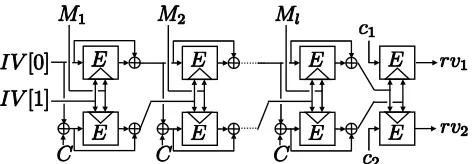
Fig. 1.Our DLHF using Hirose’s compression function
of them achieves PRO security.2 There is no hash function with birthday PRO security, and thus, we rise the following question:
Can we construct a DLHF from a “single practical size blockcipher” with “birthday PRO security”?
In this paper, we propose DLHFs using a single (2n,n)-BC, which are PROs up toO(2n) query complexity in the IC model. Since many blockciphers support 2n-bit key length, e.g., AES supports 256-bit key length, and the existing DLCFs (e.g. Hirose’s compression function [13], Tandem-DM [16], Abreast-DM [16], and generalized DLCF [26]) use a (2n,n)-BC, the assumption to use a (2n,n)-BC is acceptable. To our knowledge, our hash functions are the first time DLHFs based on a practical size blockcipher with birthday PRO security. Whenn= 128 which is supported by AES, our hash functions haveO(2128) security. Since our hash functions use only asingleblockcipher, it is useful on size restricted devices when implementing both a hash function and a blockcipher. (the hybrid encryption schemes use both a blockcipher and a hash function (used in a key derivation function), for example.)
Our DLHF. Our DLHFs, which use Hirose’s compression function [13], Tandem-DM [16] or Abreast-DM [16], iterate the compression function and use a new post-processing function f at the last iteration which calls a (2n, n)-BC twice. Our DLHFs are slightly lesser for speed than existing CR-DLHFs but have higher security (birthday PRO security).
LetBC2n,n= (E, D) be a (2n,n)-BC whereEis an encryption function andDis a decryption function. Let
DLCFBC2n,n be a DLCF: Hirose’s compression function, Tandem-DM, or Abreast-DM. Let SMDDLCFBC2n,n : {0,1}∗ → {0,1}2n be the SMD hash function using the compression function DLCFBC2n,n. Our DLHF is
defined as follows:
FBC2n,n(M) =fBC2n,n(SMDDLCFBC2n,n(M))
where fBC2n,n(x) =E(x, c
1)||E(x, c2) andc1 and c2 are n-bit constant values. Note that the first element of the encryption function is the key element and the second element is the plain text element. The DLHF using Hirose’s compression function is illustrated in Fig. 1 where each line is nbits and IV[0], IV[1], C, c1 and c2 are constant values. Note that in this figure we omit the suffix free padding functionsfpad. So the hash function takes as its input a messageM, sfpad(M) =M1||M2|| · · · ||Ml with each block ofnbits, and
outputs the final value rv1||rv2. We use the DLHF SMDDLCF BC2n,n
to compress an arbitrary length input into an fixed input length value. Since SMD hash functions cannot be used as ROs [5], the post-processing functionfBC2n,n is used to guarantee PRO security.
The use of the constant valuesc1andc2in the post-processing function is inspired by the design technique of EMD proposed by Bellare and Ristenpart [1]. This realizes the fact that the post-processing function behaves like RO. So we can treat our hash function as a NMAC-like hash function. Note that the security of EMD is proven when the compression function is FILRO, while the security of our hash functions is proven when the compression function is the DLCF in the IC model. So additional analyses are needed due to the invertible property of IC and the structures of DLCFs.3We thus prove the PRO security ofFBC2n,n by using
2
Since PRO security is stronger security than CR security. CR security does not guarantee PRO security.
3 One may think that there is an attack based on a decryption (inversion) function of the blockcipher. But our hash
three techniques: the PrA (Preimage Aware) design framework of Dodis et al. [7], PRO for a small function [5], andindifferentiability from a hash function. The first two techniques are existing techniques and the last technique is a new application of the indifferentiability framework [22].
First, we prove that the DLCFs are PrA up toO(2n) query complexity. The PrA design framework offers the hash functions which are PROs up toO(2n) query complexity where FILRO is used as the post-processing function. Second, we convert FILRO into the blockcipher-based post-processing function. We prove that the post-processing function is PRO up toO(2n) query complexity in the IC model (PRO for a small function). Then, we prove that the PRO security of the post-processing function and the first PRO result ensure that the converted hash functions are PROs up toO(2n) query complexity. Note that the hash functions use two blockciphers.4 Finally, we consider the single-blockcipher-based hash functions FBC2n,n. We prove that the
single blockcipher-based hash functions are indifferentiable from the two-blockciphers-based hash functions in the IC model up toO(2n) query complexity (indifferentiability from a hash function). Then we show that the indifferentiable security result and the second PRO result ensure that our hash functions are PROs up toO(2n) query complexity in the IC model.
2
Preliminaris
Notation. For two valuesx, y, x||y is the concatenated value ofxand y. For some valuey, x←y means assigningytox.⊕is bitwise exclusive or.|x|is the bit length ofx. For a set (list)T and an elementW,T ←
W means to insertW intoT andT ←−∪ W meansT ← T ∪{W}. For some 2n-bit valuex,x[0] is the firstnbit value andx[1] is the lastn-bit value.BCd,n= (E, D) be a blockcipher whereE:{0,1}d× {0,1}n→ {0,1}n is an encryption function,D:{0,1}d× {0,1}n→ {0,1}n is a decryption function, the key size isdbits and the cipher text size isnbits. Cd,n = (EI, DI) be a ideal cipher (IC) where EI :{0,1}d× {0,1}n → {0,1}n is an encryption oracle,DI :{0,1}d× {0,1}n→ {0,1}n is a decryption oracle, the key size isdbits and the cipher text size isnbits.Fa,b :{0,1}a → {0,1}b is a random oracle (RO). An arbitrary input length random oracle is denoted by Fb :{0,1}∗ → {0,1}b. For any algorithmA, we writeTime(A) to mean the sum of its description length and the worst-case number of steps.
Merkle-Damg˚ard [6, 23]. Leth:{0,1}2n×{0,1}d→ {0,1}2nbe a compression function using a primitive
P (more strictly hP) and pad : {0,1}∗ → ({0,1}d)∗ be a padding function. The Merkle-Damg˚ard hash function MDhis described as follows whereIV is a 2n-bit initial value.
MDh(M)
z←IV;
Break pad(M) intod-bit blocks,pad(N) =M1|| · · · ||Ml; fori= 1, . . . , ldoz←h(z, Mi);
Ret z;
We denote MDh, when padding pad is a suffix-free padding sfpad, by SMDh, called strengthened Merkle-Damg˚ard. We assume that it is easy to strip padding, namely that there exists an efficiently computable functionunpad: ({0,1}d)∗→ {0,1}∗∪ {⊥}such thatx=unpad(pad(x)) for allx∈ {0,1}∗. Inputs tounpad that are not valid outputs ofpadare mapped to⊥byunpad.
Pseudorandom Oracle [22]. LetHP :{0,1}∗→ {0,1}nbe a hash function that utilizes an ideal primitive
P. We say that HP is PRO if there exists an efficient simulator S that simulates P such that for any distinguisherAoutputting a bit it is the case that
AdvproHP,S(A) =|Pr[A
HP,P
⇒1]−Pr[AFn,SFn ⇒1]|
is small where the probabilities are taken over the coins used the experiments. S can make queries to Fn. TheS’s task is to simulate P such that relations among responses of (HP, P) hold in responses of (F
n, S) as well.
4
Preimage Awareness [7, 8]. The notion of preimage awareness is useful for PRO security proofs of NMAC hash functions. We only explain the definition of preimage awareness. Please see Section 3 of [8] for the spirit of the notion. Let FP be a hash function using an ideal primitive P. The preimage awareness of FP is estimated by the following experiment.
ExppraFP,P,E,A
x←−$ AP,Ex;
z←FP(x);
Ret (x6=V[z]∧Q[z] = 1);
oracle P(m)
c←P(m);
α←−∪ (m, c); Ret c;
oracle Ex(z) Q[z]←1; V[z]← E(z, α); Ret V[z];
Here an adversaryA is provided two oracles PandEx. The oracle Pprovides access to the ideal primitive
P and records a query histryα. The extraction oracleExprovides an interface to an extractorE, which is a deterministic algorithm that useszand the query historyαofP, and returns either⊥or an elementx0such thatFP(x0) =z. Ifx0 can be constructed fromα, it returnsx0 and otherwise returns⊥. In this experiment, the (initially everywhere ⊥) arrayQ and the (initially empty) array V are used. When z is queried to Ex, Q[z]←1 and then the output ofE(z, α) is assigned toV[z]. For the hash functionFP, the adversaryA, and the extractorE, we define the advantage relation
AdvpraFP,P,E = Pr[Exp
pra
FP,P,E,A⇒true]
where the probabilities are over the coins used in running the experiments. When there exists an efficient extractor E such that for any adversaryA the above advantage is small, we say thatFP is preimage aware (PrA).
The pra-advantage can be evaluated from the cr-advantage (collision resistance advantage) and the 1-wpra (1-weak PrA) advantage [8]. The 1-WPrA experiment is described as follows.
Exp1wpraFP,P,E+,A
x←−$ AP,Ex+;
z←FP(x);
Ret (x6∈L∧Q[z] = 1);
oracle P(m)
c←P(m);
α←−∪ (m, c); Ret c;
oracle Ex+(z) Q[z]←1;
L← E+(z, α); Ret L;
The difference between the 1-WPrA experiment and the PrA experiment is the extraction oracle. In the 1-WPrA experiment, a multi-point extractor oracleEx+ is used. Ex+ provides an interface to a multi-point extractor E+, which is a deterministic algorithm that uses z and α, and returns either ⊥ or a set of an element in the domain of FP. The output (set) of E+ is stored in listL. Thus, ifL6={⊥}, for anyx0 ∈L FP(x0) =z. In this experiment, an adversaryA can make only a single query toEx+. For a hash function
FP, an adversaryA, and a multi-point extractorE+, we define the advantage relation
Adv1wpraFP,P,E = Pr[Exp
1wpra
FP,P,E+,A⇒true]
where the probabilities are over the coins used in running the experiments. When there exists an efficient multi-point extractor E+ such that the above advantage is small for any adversary A, we say that FP is 1-WPrA.
The definition of the cr-advantage as follows. LetAbe an adversary that outputs a pair of valuesxand
x0. To hash functionFP using primitiveP and adversaryAwe associate the advantage relation
AdvcrFP,P(A) = Pr[(x, x0)
$
←−AP :FP(x) =FP(x0)∧x6=x0] where the probability is over the coins used byA and primitiveP.
Then the pra-advantage can be evaluated as follows.
Lemma 1 (Lemmas 3.3 and 3.4 of [8]). Let E+ be an arbitrary multi-point extractor. There exists an
extractorE such that for any pra-advarsaryApramakingqe extraction queries andqP primitive queries there
exists 1-wpra adversaryA1wpra and cr-adversary Acr such that
AdvpraFP,P,E(A
pra)≤q
e·Adv1wpraFP,P,E+(A
1wpra) +Advcr
FP,P(Acr).
A1wpra runs in time at most O(qeTime(E+))and makes the same number ofP queries as Apra. Acr asksq
P
NMAC Hash Function. Let g :{0,1}n → {0,1}n be a function and HP :{0,1}∗ → {0,1}n be a hash function using primitiveP such that g is not used inHP. Dodis et al. [8] proved that the PRO security of the NMAC hash functiong◦HP can be reduced into the PrA security ofHP.
Lemma 2 (Theorem 4.1 of [8]).LetP be an ideal primitive,gbe a random oracle andE be any extractor for HP. Then there exists a simulator S = (S
P, Sg) such that for any PRO adversary A making at most
qF, qP, qg queries to its three oracles(OF,OP,Og)where (OF,OP,Og) = (g◦HP, P, g)or (OF,OP,Og) = (Fn, SP, Sg), there exists a PrA adversaryB such that
Advprog◦HP,S(A)≤Adv
pra
HP,P,E(B).
S runs in timeO(qP+qg·Time(E)). Letl be the length of the longest query made byA toOH.B runs in
timeO(Time(A) +qFtH+qP+qg), makes qP+qHqF queries,qg extraction queries, and outputs a preimage
of length at mostl where for any input M toHP the output of HP(M)can be calculated within at mostt H
times andqH queries toP.¨
Dodis et al. proved that the SMD construction preserves the PrA security as follows. Therefore, the PRO security of the NMAChash function using the SMD hash function can be reduced into the PrA security of the compression function.
Lemma 3 (Theorem 4.2 of [8]). Let hP be a compression function using an ideal primitive P. Let E h
be an arbitrary extractor forhP. There exists an extractor EH forSMDh
P
such that for any adversaryAH
making at most qP primitive queries and qe extraction queries and outputting a message at most l blocks
there exists an adversary Ah such that
Advpra SMDhP,P,E
H
(AH)≤Adv
pra
hP,P,Eh(Ah)
EH runs in time at most l(Time(Eh) +Time(unpad)).Ah runs in time at most O(Time(AH) +qel), makes
at mostqH+qP ideal primitive queries, and makes at mostqel extraction queries whereqH is the maximum
number ofP queries to calculateSMDhP.¨
3
Blockcipher-Based Double-Length Hash Functions for PROs
Let BC2n,n = (E, D), BC12n,n = (E1, D1), BC 2
2n,n = (E2, D2), and BC 3
2n,n = (E3, D3) be blockciphers. Let g : {0,1}2n → {0,1}2n be a function. In this section, we propose the following DLHFs using a single blockcipher and prove that our hash functions are PROs up toO(2n) query complexity in the IC model.
FBC2n,n(M) =fBC2n,n(SMDDLCFBC2n,n(M))
wherefBC2n,n(x) =E(x, c
1)||E(x, c2) such thatc1andc2aren-bit different constant values and are different from values which are defined by the compression function (see subsection 3.3). The hash functions use Hirose’s compression function, Tandem-DM, and Abreast-DM as the underlying DLCF, respectively. We prove the PRO security by the three steps. Each step uses the PrA design framework, PRO for a small function and indifferentiability from a hash function, respectively.
– Step 1. We prove that Hirose’s compression function, Tandem-DM, and Abreast-DM are PrA up to
O(2n) query complexity in the IC model. Lemma 2 and Lemma 3 then ensure that the following NMAC hash function is PRO up toO(2n) query complexity as long as the blockcipher is IC andg is FILRO.
Fg,BC
1 2n,n
1 (M) =g(SMD
DLCFBC12n,n
(M))
– Step 2.We prove thatfBC32n,n is PRO up toO(2n) query complexity in the IC model wherec1 andc2
aren-bit different values. Then, we prove that the PRO security ofF1and the PRO security off ensure that the following hash function is PRO up to O(2n) query complexity in the IC model, namely, it can be used as RO up toO(2n) query complexity in the IC model.
FBC
2 2n,n,BC
3 2n,n
2 (M) =f
BC3
2n,n(SMDDLCF
– Step 3.This is the final step. We use the indifferentiability from a hash function: we prove thatFBC2n,n
is indifferentiable from FBC
2
2n,n,BC32n,n
2 up to O(2n) query complexity in the IC model. Then, we prove that the indifferentiable result and the PRO security of F2 ensure that FBC2n,n is PRO up to O(2n) query complexity in the IC model.5
3.1 Step 1
We prove that Hirose’s compression function [13] is PrA up to O(2n) query complexity as long as the blockcipher is an ideal cipher. Similarly, we can prove that Abreast-DM and Tandem-DM [16] are PrA. These proofs are given in Appendix B and Appendix C, respectively.
Definition 1 (Hirose’s Compression Function).LetBC12n,n= (E1, D1)be a blockcipher. LetCFHirose[BC1 2n,n] :
{0,1}2n×{0,1}n → {0,1}2nbe a compression function such that(Gi, Hi) =CFHirose[BC12n,n](Gi−1||Hi−1, Mi)
whereGi, Hi, Gi−1, Hi−1∈ {0,1}n andMi∈ {0,1}n.(Gi, Hi)is calculated as follows:
Gi=Gi−1⊕E1(Hi−1||Mi, Gi−1) (1)
Hi=C⊕Gi−1⊕E1(Hi−1||Mi, Gi−1⊕C,) (2)
We call the procedure 1 “first block” and the procedure 2 “second block”. ¨
Lemma 4 (Hirose’s Compression Function is PrA). LetC1
2n,n= (E1I, D1I)be an ideal cipher. There
exists an extractor E such that for any adversary A making at most qP queries to C2n,n andqe extraction
queries we have
AdvpraCFHirose[C1
2n,n],C21n,n,E
(A)≤ 2q 2 P (2n−2qP)2 +
2qP 2n−2q
P
+ 2qPqe (2n−q
P)2
whereE runs in time at most O(qeqP).¨
Proof. We prove that Hirose’s compression function is 1-WPrA, and then Lemma 1 gives the final bound. We note that Theorem 3 of [11] upperbounds the cr-advantage ofA by 2q2
P/(2n−2qP)2+ 2qP/(2n−2qP), yielding the first two terms.
Intuitively, the 1-WPrA game for the compression function is thatAdeclares a valuezthen an extractor outputs preimages, stored in L, of z which can be constructed from input-output values of A’s queries to
C1
2n,n. Then A outputs a new preimage of z which is not stored in L. Note that A can adaptively query to C1
2n,n. We define the multi-point extractor to utilize the preimage resistant bound, proven in [11], of Hirose’s compression function in Fig. 2. If an input-output triple of the first block is defined, automatically the input of the second block is defined, and vice versa, from the definition of the compression function. For a query (z, α) toE+, when there is an input-output triple (k, x, y) such that x⊕y =z[0], the multi-point extractor E+ checks whether the output of the second block is equal to z[1] or not and if this holds the multi-point extractor stores it in the return listL, and vice versa. Therefore,Amust find a new preimage of
z to win the 1-WPrA experiment. Thus one can straightforwardly adapt the preimage resistant advantage of the compression function (described in Theorem 5 of [11])6 because the proof of Theorem 5 of [11] can be applied to the case that an adversary selects an imagez of the compression function and then finds the
preimage ofz. The advantage is at most 2qP/(2n−qP)2. ut
Lemma 4 ensures the following theorem via Lemma 2 and Lemma 3 whereF1is PRO up toO(2n) query complexity.
5
One may think that since indifferentiability from a hash function considers indifferentiability of two hash functions based on small primitives, the universal composability (UC) [3] may be extended to this setting. However, this is not true because indifferentiability from a hash function follows the indifferentiability framework [22] and the definition of the indifferentiability framework is slightly different from that of the UC framework: indifferentiability considers “reducibility” of one system to another and UC considers “composability” of several systems.
6 Note that while the 1-WPrA bound is equal to the preimage bound, this is not trivial because one needs to construct
algorithmE+(z, α)
LetLbe an empty list;
Parse (k1, x1, y1), . . . ,(ki, xi, yi)←α; //E1(kj, xj) =yj Forj= 1 to ido
Ifz[0] =xj⊕yj then y←E1I(kj, xj⊕C);
Ifz[1] =C⊕xj⊕ythenL←−∪ (xj||k[0], k[1]); Ifz[1] =xj⊕yj then
y←E1I(kj, xj⊕C);
Ifz[0] =C⊕xj⊕ythenL←−∪ ((xj⊕C)||k[0], k[1]); IfLis not an empty list then returnLotherwise return⊥;
Fig. 2.Multi-Point Extractor
Theorem 1. There exists a simulator S1 = (S1g, S1C) where S1C = (S1E, S1D) such that for any
distin-guisherA1making at most(qH, qg, qE, qD)queries to four oracles which are(F1, g, E1, D1)or(F2n, S1g, S1E, S1D),
we have
Advpro Fg,C
1 2n,n
1 ,S1 (A1)≤
2Q2 1 (2n−2Q
1)2
+ 2Q1 2n−2Q
1
+ 2lqgQ1 (2n−Q
1)2
where S1 works in time O(qE+qD+lqgQ1) +lqg×Time(unpad) and S1g makes qg queries to F2n where
Q1 = 2l(qH+ 1) +qE+qD.S1g simulates g, which makes one query to F2n for one S1g query, and S1C,
which makes no query, simulates the ideal cipher.¨
3.2 Step 2
Lemma 5 (fC23n,n is PRO). Let C3
2n,n = (E3I, D3I) be an ideal cipher. Let g = F2n,2n. There exists a
simulator S= (SE,SD)such that for any distinguisherA2 making at mostqf,qE andqD queries to oracles (Of,OE,OD) where(Of,OE,OD) = (fC
3
2n,n, E3I, D3I)or(Of,OE,OD) = (g,SE,SD), we have
Advpro fC32n,n,S
(A2)≤
qf+qE+qD 2n
where S works in time O(Time(A2) +qE+qD) and makes at most queries qE+qD. S simulates the ideal
cipher.¨
Proof. We defineS= (SE,SD) such that it simulatesC23n,n= (E3I, D3I) and the relation among responses of
(fC23n,n, E3I, D3I) holds in responses of (g,SE,SD) as well. Since the relationfC23n,n(k) =E3I(k, c1)||E3I(k, c2)
holds, we defineSso thatSE(k, c1)||SE(k, c2) =g(k). That is,SE(k, c1) =y[0],SE(k, c2) =y[1],SD(k, y[0]) =
c1, andSD(k, y[1]) =c2 wherey=g(k).
simulatorSE(k, x)
01 IfE[k, x]6=⊥, retE[k, x]; 02 IfE[k, c1] =⊥,
03 y∗←g(k);
04 E[k, c1] $
←−y∗[0]; 05 D[k,E[c1, x]]←c1;
06 E[k, c2] $
←−y∗[1]; 07 D[k,E[c2, x]]←c2; 08 Ifx6=c1andx6=c2,
09 E[k, x]←− {$ 0,1}n\T E[k]; 10 D[k,E[k, x]]←x; 11 RetE[k, x];
simulator SD(k, y)
11 IfD[k, y]6=⊥, retD[k, y]; 12 IfE[k, c1] =⊥,
13 y∗←g(k);
14 E[k, c1] $
←−y∗[0]; 15 D[k,E[c1, x]]←c1;
16 E[k, c2] $
←−y∗[1]; 17 D[k,E[c2, x]]←c2; 18 IfD[k, y]6=⊥,
19 D[k, y]←− {$ 0,1}n\{TD[k]}; 20 E[k,D[k, y]]←y;
Shas (initially everywhere⊥) arraysE,Dand (initially empty) tablesTE,TD. Wheny=SE(k, x),yis stored in E[k, x] andx is stored inD[k, y]. For any (k, x) such that E[k, x] 6=⊥, E[k, x] is stored in TE[k], and for any (k, y) such thatD[k, y]6=⊥,D[k, y] is stored inTD[k].
We give the proof via a game-playing argument on the game sequences Game 0, Game 1, Game 2. Game 0 is the fC23n,n scenario and Game 2 is the g scenario. In each game, A2 can make queries to three
oracles (Of,OE,OD). Let Gj be the event that in Game j the distinguisher A2 outputs 1. Therefore,
Pr[AfC
3
2n,n,E3I,D3I ⇒1] = Pr[G0] and Pr[Ag,SE,SD ⇒1] = Pr[G2]. Thus
Advpro fC32n,n,S
(A2) =|Pr[G0]−Pr[G2]| ≤ |Pr[G1]−Pr[G0]|+|Pr[G2]−Pr[G1]|
Game 0:Game 0 is the fC23n,n scenario. So (Of,OE,OD) = (fC
3
2n,n, E3I, D3I).
Game 1: We change the underlying ideal cipher from C3
2n,n to S. So (Of,OE,OD) = (fS,SE,SD) where
fS(k) =S
E(k, c1)||SE(k, c2). Note that only Shas oracle access tog.
We must show that the A2’s view has statistically close distribution in Game 0 and Game 1. Since the difference between the games is the underlying function, we show that the output of the functions is statistically close; this in turn shows that the A2’s view has statistically close distribution in Game 0 and Game 1.
In the following, we use the following lazily-sample method of the ideal cipher.
Encryption OracleEI(k, x) 01 IfE[k, x]6=⊥, retE[k, x]; 02 IfE[k, c1] =⊥,
03 E[k, c1] $
←− {0,1}n; 04 D[k,E[c1, x]]←c1;
05 E[k, c2] $
←− {0,1}n\{E[k, c 1]}; 06 D[k,E[c2, x]]←c2;
07 Ifx6=c1andx6=c2,
08 E[k, x]←− {$ 0,1}n\T E[k]; 09 D[k,E[k, x]]←x; 10 RetE[k, x];
Decryption OracleDI(k, y) 11 IfD[k, y]6=⊥, retD[k, y]; 12 IfE[k, c1] =⊥,
13 E[k, c1] $
←− {0,1}n; 14 D[k,E[c1, x]]←c1;
15 E[k, c2] $
←− {0,1}n\{E[k, c 1]}; 16 D[k,E[c2, x]]←c2;
17 IfD[k, y]6=⊥,
18 D[k, y]←− {$ 0,1}n\{TD[k]}; 19 E[k,D[k, y]]←y;
20 RetD[k, y];
E and D are (initially everywhere ⊥) arrays and TE and TD (initially empty) tables. For any (k, x) such thatE[k, x]6=⊥,E[k, x] is stored inTE[k], and for any (k, y) such thatD[k, y]6=⊥,D[k, y] is stored inTD[k]. On a query which the key element is k, first the output ofEI(k, c1) is determined (Steps 03-04 or Steps 13-14) and second the output ofEI(k, c2) is determined (Steps 05-06 or Steps 15-16). Then the outputs of
EI(k, x) such thatx6=c1andx6=c2 are determined. Since no adversary (distinguisher) learnsEI(k, c1) and
EI(k, c2) until querying the corresponding value, the procedures of Steps 03-06 and 13-16 do not affect the lazily-sample ideal cipher simulation.
We consider the difference of the ideal cipher andS. On a query in which the key element isk, the output of SE(c2, k) is randomly chosen from {0,1}n because g is RO while the output of EI(c2, k) is randomly chosen from{0,1}n\{E[k, c
1]}. Thus the statistical distance between the uniform distribution in{0,1}n and the uniform distribution in{0,1}n\{E[k, c
1]}is 1/2n. Since the number of queries toSis at mostqf+qE+qD times,
|Pr[G1]−Pr[G0]| ≤ qf+qE+qD
2n .
1. In Game 1, for any querykOf(k) is defined byg(k). If this holds, the output distribution ofOfof Game 1 and Game 2 is the same.
2. In Game 2,OE andOD are consistent withOf as well as in Game 1.Of usesOE in Game 1, while does not in Game 2 (note that in both games (OE,OD) = (SE,SD)). Thus, if this holds, the difference does not affect the output distribution ofOE andOD. Namely, the output distribution ofOE andODis the same.
Proof of Point 1. In Game 1, for any query k Of(k) =SE(k, c1)||SE(k, c2). SinceSE(k, c1) = y∗[0] and SE(k, c2) =y∗[1] wherey∗=g(k),Of(k) =SE(k, c1)||SE(k, c2) =g(k).
Proof of Point 2.In Game 1, Of usesOE, namely, if the outputs of SE(k, c1) and SE(k, c2) are defined,
Of(k) = SE(k, c1)||SE(k, c2). So we must show that the same holds in Game 2. Since SE(k, c1) = y∗[0] and SE(k, c2) = y∗[1] where y∗ = g(k), if the outputs of SE(k, c1) and SE(k, c2) are defined, g(k) = SE(k, c1)||SE(k, c2). Namely, in Game 2,OE andODconsistent withOf as in Game 1.
We thus have that Pr[G1] = Pr[G2].
From above discussions, we have that
Advpro
fC32n,n,S(A2)≤
qf+qE+qD
2n .
u t
Using Theorem 1 and Lemma 5, we show that F2 using Hirose’s compression function is PRO up to
O(2n) query complexity in the IC model. Similarly, we can prove the hash functions using Tandem-DM and Abreast-DM.
Theorem 2 (F2 is PRO). There exists a simulator S2 = (S2, S3) where S2 = (S2E, S2D) and S3 = (S3E, S3D)such that for any distinguisherA3making at most(qH, qE2, qD2, qE3, qD3)queries to five oracles
which are(F2, E2, D2, E3, D3) or(F2n, S2E, S2D, S3E, S3D), we have
Advpro FC 2 2n,n,C32n,n
2 ,S2
(A3)≤
2Q2 2 (2n−2Q
2)2
+ 2Q2 2n−2Q
2
+ 2lq3Q2 (2n−Q
2)2
+qH+q3 2n
where S2 works in time O(q2+lq3Q2) +lq3×Time(unpad) and S3 makes q3 queries to F2n where Q2 = 2l(qH+ 1) +qE2+qD2,q2=qE2+qD2 andq3=qE3+qD3.¨
Proof. We use Theorem 1 and Lemma 5. We define the simulatorS2= (S2, S3) byS2 =S1C andS3 =SS1g where (S1g, S1C) are defined in Theorem 1 andS is defined in Lemma 5. Namely,S2E=S1E,S2D=S1D,
S3E =SS1g
E and S3D =S S1g
D where on a query toS3E,SE accepts the query, calculates the output value by usingS1g and returns it, and similarly S3D is defined. In the following, we evaluate the PRO bound of
FC
2 2n,n,C32n,n
2 . We assume thatA2is a distinguisher such that the PRO bound offC 3
is a distinguisher such that the PRO bound ofFg,C
2 2n,n
1 is maximum. For any distinguisherA3,
Advpro FC 2 2n,n,C32n,n
2 ,S2
(A3) =|Pr[A FC
2 2n,n ,C32n,n
2 ,C
2 2n,n,C23n,n
3 ⇒1]−Pr[AF
2n,S2F2n,S3F2n
3 ⇒1]|
=|Pr[AF fC
3 2n,n ,C2
2n,n
1 ,C
2 2n,n,C32n,n
3 ⇒1]−Pr[AF
2n,S2F2n,S3F2n
3 ⇒1]|
≤|Pr[AF fC
3 2n,n ,C2
2n,n
1 ,C
2 2n,n,C
3 2n,n
3 ⇒1]−Pr[A
Fg,C 2 2n,n
1 ,C 2 2n,n,S
g
3 ⇒1]|+
|Pr[AF g,C2
2n,n
1 ,C22n,n,Sg
3 ⇒1]| −Pr[A
F2n,S1FC2n,SS1
F2n g
3 ⇒1]|
≤|Pr[Af
C3 2n,n,C3
2n,n
2 ⇒1]−Pr[A g,Sg
2 ⇒1]|+
|Pr[AF g,C2
2n,n
1 ,C 2 2n,n,g
1 ⇒1]| −Pr[A
F2n,S1FC2n,S1Fg2n
1 ⇒1]|
=Advpro
fC23n,n,S(A2) +Adv
pro
Fg,C 2 2n,n
1 ,S1 (A1).
The second equation holds becauseFf
C3 2n,n,C2
2n,n
1 =F
C2 2n,n,C
3 2n,n
2 . From the third equation to the forth equation,
we changeAF
Oa ,C22n,n
1 ,C
2 2n,n,Ob
3 toAOa
,Ob
1 andAOc ,Od,SOe
3 toAOc ,Od,Oe
2 . The second last equation holds because
A1 andA2 are distinguishers where the PRO bounds are maximum.
Thus, when using the bounds of Theorem 1 and Lemma 5, the PRO bound ofF2can be obtained where
A2 can make at most (qH, qE3, qD3) queries to its three oracles (see Lemma 5) and A1 can make at most (qH, q3, qE2, qD2) queries to its four oracles (see Theorem 1). ut
3.3 Step 3
In the following proof, we consider the hash function using Hirose’s compression function. Using the same proof, we can prove the cases of Tandem-DM and Abreast-DM. So we omit these proofs. When using Hirose’s compression function, we use the constant values c1 and c2 of the post-processing function f such that c1 and c2 are not equal to C⊕IV[0] and IV[0] where IV is the initial value of SMDDLCF
BC2n,n
andC is the constant value used in Hirose’s compression function. If c1 and c2 which are equal to C⊕IV[0] or IV[0] are used, we cannot prove the security of the hash function. In this case, we fail to construct a simulator. When using Tandem-DM,c1 andc2 are such that the values are not equal toIV[0] andIV[1]. When using Abreast-DM,c1 andc2 are such that the values are not equal toIV[0] andIV[1].
First, we define the indifferentiability from a hash function as follows.
Definition 2. Let HP1
1 : {0,1}∗ → {0,1}
2n and HP2
2 : {0,1}∗ → {0,1}
2n be hash functions using ideal
primitivesP1 and P2, respectively.H1P1 is indifferentiable fromH P2
2 if there exists a simulator S such that
for any distinguisher A4 outputting a bit it is the case that
Advindif HP1
1 ,H
P2
2 ,S
(A4)≤ |Pr[A HP1
1 ,P1
4 ⇒1]−Pr[A HP2
2 ,SP2 4 ⇒1]|
is small where the probabilities are taken over the coins used the experiments. ¨
The following lemma is thatF is indifferentiable fromF2up toO(2n) query complexity in the IC model.
Lemma 6. Let C2n,n = (EI, DI) be an ideal cipher. Let C22n,n = (E2I, D2I) and C 3
2n,n = (E3I, D3I) be
different ideal ciphers. There exists a simulator S= (SE,SD)such that for any distinguisher A4 making at
mostqF,qE andqD queries to its oracles(OF,OE,OD)which are(FC2n,n, EI, DI)or(FC 2 2n,n,C23n,n
2 ,SE,SD),
we have
Advindif FC2n,n,FC
2 2n,n,C32n,n
2 ,S
(A4)≤
14×(2(lqF+ 1) +qE+qD) 2n−(2(lq
F + 1) +qE+qD)
where S works in time O(Time(A) + 3(qE+qD))and makes at most ideal cipher queriesqE+qD. l is the
simulatorSE(k, x)
E01 IfE[k, x]6=⊥then retE[k, x]; E02 IfE[k, c1] =⊥,
E03 y←E3I(k, c1);
E04 E[k, c1]←y;D[k, y]←c1;
E05 y←E3I(k, c2);
E06 E[k, c2]←y;D[k, y]←c2;
E07 Ifx6=c1 andx6=c2,
E08 y←E2I(k, x);
E09 E[k, x]←y;D[k, y]←x; E10 RetE[k, x];
simulatorSD(k, y)
D01 IfD[k, y]6=⊥then retD[k, y]; D02 IfE[k, c1] =⊥,
D03 y←E3I(k, c1);
D04 E[k, c1]←y;D[k, y]←c1;
D05 y←E3I(k, c2);
D06 E[k, c2]←y;D[k, y]←c2;
D07 IfD[k, y] =⊥, D08 x←D2I(k, y);
D09 E[k, x]←y;D[k, y]←x; D10 Retx;
Fig. 3.Simulator
Proof. Without loss of generality, we omit the padding function of our hash function which is more general case than including the padding function. In Fig. 3, we define a simulatorS= (SE,SD) such that it simulates the ideal cipherC2n,n= (EI, DI) and the relation among responses of (FC2n,n, EI, DI) holds in responses of
(FC
2 2n,n,C
3 2n,n
2 ,SE,SD) as well, namely,FS(M) =F
C2 2n,n,C
3 2n,n
2 (M). SinceE2I is used in inner calculations and
E3I is used in the post-processing calculations, if for a query (k, x) toSE(k, x) is used in the post-processing calculations, it returns the output ofE3I(k, x), and otherwise it returns the output of E2I(k, x). Since in post-processing calculation the second value xof a E query isc1 or c2, we define S such that SE(k, x) is defined by E3I(k, x), if x = c1 or x = c2, and is defined by E2I(k, x) otherwise.7 E and D are (initially everywhere⊥) arrays.
We give the proof via a game-playing argument on the game sequences Game 0, Game 1, and Game 2. Game 0 is the F scenario and Game 2 is the F2 scenario. In each game,A4 can make queries to three oracles (OF,OE,OD). Let Gj be the event that in Game j the distinguisher A4 outputs 1. Therefore,
Pr[AFC2n,n,EI,DI
4 ⇒1] = Pr[G0] and Pr[A FC
2 2n,n ,C23n,n
2 ,SE,SD
4 ⇒1] = Pr[G2]. Thus
Advindif FC2n,n,FC
2 2n,n,C32n,n
2 ,S
(A4) =|Pr[G0]−Pr[G1]| ≤ |Pr[G1]−Pr[G0]|+|Pr[G2]−Pr[G1]|
Game 0:Game 0 is the F scenario. So (OF,OE,OD) = (FC2n,n, EI, DI).
Game 1: We modify the underlying functions (OE,OD) from (EI, DI) to (SE,SD). So (OF,OE,OD) = (FS,SE,SD) where onlyS has oracle access to (C22n,n,C23n,n).
We must show that the A4’s view has statistically close distribution in Game 0 and Game 1. Since the difference between the games is the underlying function, we show that the output of the functions is statistically close; this in turn shows that the A4’s view has statistically close distribution in Game 0 and Game 1. First we rewriteS in Fig. 4. C3
2n,n is hard-coded in the steps e03-e05, e06-e08, d03-05 and d06-08 whereE2 andD2 are (initially everywhere⊥) arrays to store the output of the ideal cipher andTE2 andTD2 are (initially everywhere empty) tables. Similarly,C3
2n,nis hard-coded in Steps e10-e11 and d10-d11 whereE3 andD3 are (initially everywhere⊥) arrays to store the output of the ideal cipher. For anyk, ifE2[k, x]6=⊥, E2[k, x]∈ TE2[k], and ifD2[k, y]6=⊥,D2[k, y]∈ TD2[k].
In the following, we use the lazily-sample ideal cipher in Fig. 5. E and D are (initially everywhere ⊥) arrays andTE andTD(initially empty) tables. For any (k, x) such thatE[k, x]6=⊥,E[k, x] is stored inTE[k], and for any (k, y) such that D[k, y]6=⊥, D[k, y] is stored inTD[k]. On a query which the key element is k, first the output of EI(k, c1) is determined (steps 03-04 or steps 13-14) and second the output of EI(k, c2) is determined (Steps 05-06 or Steps 15-16). Then the outputs ofEI(k, x) such that x6=c1 andx6=c2 are determined. Since no adversary (distinguisher) learnsEI(k, c1) andEI(k, c2) until querying the corresponding value, the procedures of the steps 03-06 and 13-16 do not affect the lazily-sample ideal cipher simulation.
We compare the simulator with the lazily-sample ideal cipher. In the simulator and the ideal cipher, E[k, c1] and E[k, c2] (and also D[k,E[k, c1]] and D[k,E[k, c2]]) are chosen from the same distribution, while
7
simulatorSE(k, x)
e01 IfE[k, x]6=⊥then retE[k, x]; e02 IfE[k, c1] =⊥,
e03 y1 $
←− {0,1}n;
e04 E3[k, c1]←y1;D3[k, y1]←c1;
e05 E[k, c1]←E3[k, c1];D[k, y1]←c1;
e06 y2 $
←− {0,1}n\{y1};
e07 E3[k, c2] $
←−y2;D3[k, y2]←c2;
e08 E[k, c1]←E3[k, c1];D[k, y2]←c1;
e09 Ifx6=c1 andx6=c2,
e10 y←− {$ 0,1}n\T E2[k];
e11 E2[k, x]←y;D2[k, y]←x; e12 E[k, x]←y;D[k, y]←x; e13 RetE[k, x];
simulatorSD(k, y)
d01 IfD[k, y]6=⊥then retD[k, y]; d02 IfE[k, c1] =⊥,
d03 y1 $
←− {0,1}n;
d04 E3[k, c1]←y1;D3[k, y1]←c1;
d05 E[k, c1]←E3[k, c1];D[k, y1]←c1;
d06 y2 $
←− {0,1}n\{y1};
d07 E3[k, c2] $
←−y2;D3[k, y2]←c2;
d08 E[k, c1]←E3[k, c1];D[k, y2]←c1;
d09 IfD[k, y] =⊥, d10 x←− {$ 0,1}n\T
D2[k];
d11 E2[k, x]←y;D2[k, y]←x; d12 E[k, x]←y;D[k, y]←x; d13 Retx;
Fig. 4.Revised Simulator Encryption OracleEI(k, x)
01 IfE[k, x]6=⊥, retE[k, x]; 02 IfE[k, c1] =⊥,
03 E[k, c1] $
←− {0,1}n; 04 D[k,E[c1, x]]←c1;
05 E[k, c2] $
←− {0,1}n\{E[k, c1]};
06 D[k,E[c2, x]]←c2;
07 Ifx6=c1 andx6=c2,
08 E[k, x]←− {$ 0,1}n\TE[k]; 09 D[k,E[k, x]]←x; 10 RetE[k, x];
Decryption OracleDI(k, y) 11 IfD[k, y]6=⊥, retD[k, y]; 12 IfE[k, c1] =⊥,
13 E[k, c1] $
←− {0,1}n; 14 D[k,E[c1, x]]←c1;
15 E[k, c2] $
←− {0,1}n\{E[k, c1]};
16 D[k,E[c2, x]]←c2;
17 IfD[k, y]6=⊥,
18 D[k, y]←− {$ 0,1}n\{TD[k]}; 19 E[k,D[k, y]]←y;
20 RetD[k, y]; Fig. 5.Lazily-Sample Ideal Cipher
E[k, x] (and D[k,E[k, x]]) where x 6=c1 and x 6=c2 is chosen different distribution. If in the step e10 y is randomly chosen fromTE2[k]∪ {E[k, c1],E[k, c2]} and in the step d10x is randomly chosen from TD2[k]∪
{c1, c2}, then the output distribution of the simulator and the ideal cipher is the same. That is, if any valuey randomly chosen from{0,1}n\T
E2[k] does not collideE[k, c1] andE[k, c2] and any valuexrandomly chosen from{0,1}n\T
D2[k] does not collidec1andc2, then the output distribution between them is the same. Since for anyk, the number of values in TE2[k] andTD2[k] is at most 2lqF+qE+qD, the statistical distance of E[k, x] (andD[k,E[k, x]]) wherex6=c1 and x=6 c2 is at most 2/(2n−(2lqF +qE+qD)). So the statistical distance of the simulator and the ideal cipher is at most (2lqF+qE+qD)×2/(2n−(2lqF+qE+qD)). We thus have that
|Pr[G1]−Pr[G0]| ≤ 2×(2lqF+qE+qD) 2n−(2lq
F+qE+qD)
.
Game 2:We modifyOF fromFS toF
C2 2n,n,C
3 2n,n
2 . So (OF,OE,OD) = (F
C2 2n,n,C
3 2n,n
2 ,SE,SD) and this is the
F2scenario.
We show that unless the following bad events occur, theA4’s view of Game 1 and Game 2 is the same.
– Event B1: On some query (k, x) toSE, the outputy is such thaty⊕xis equal toc1or c2.
– Event B2: On some query (k, x) toSE, the outputy is such thaty⊕x⊕Cis equal toc1or c2.
– Event B3: On some query (k, y) toSD, the output xis equal to c1 or c2 such thatxis defined in the step D08.
To prove this, we use the proof method in [5, 15]. Specifically, we prove the following two points.
1. In Game 1, unless the bad events occur, for any query M the output of OF(M) is equal to that of
FC
2 2n,n,C23n,n
2. In Game 2, unless the bad events occur,OE andODare consistent withOF as in Game 1.OF usesOE in Game 1 while does not in Game 2 (note that in both games (OE,OD) = (SE,SD)). So if this holds, the difference does not affect the output distribution ofOE andOD, namely, the output distribution of
OE andOD in Game 1 and Game 2 is the same.
In the following, for input-output triple (k, x, y) of S we denotex⊕y byw, namely, w=x⊕y. Before proving the above two points, we define chain triples and give a useful lemma.
Definition 3. (k1, x1, y1), . . . ,(ki, xi, yi),(k01, x01, y10), . . . ,(k0i, x0i, y0i),(k, x, y),(k0, x0, y0)stored in the
simula-tor’s tablesE,Dare chain triples if for someM the output ofFS(M)can be obtained from the triples. That is, x1=IV[0], k1[0] =IV[1],kj =kj0 (j= 1, . . . , i),wj=xj+1(j= 1, . . . , i−1),wj⊕C=x0j+1(j= 1, . . . , i−1),
w0j =kj+1[0] (j = 1, . . . , i−1), x=c1, x0 =c2,k =k0, k[0] =wi, k[1] = wi0, M =k1[1]|| · · · ||ki[1], and
y||y0=FS(M).
Lemma 7. For any chain triple(k1, x1, y1), . . . ,(ki, xi, yi),(k01, x01, y10), . . . ,(k0i, x0i, y0i),(k, x, y),(k0, x0, y0),
un-less the bad events occur,FS(M) =FC
2 2n,n,C
3 2n,n
2 (M)where M =k1[1]|| · · · ||ki[1].
Proof. To contrary, assume that there exist chain triples (k1, x1, y1), . . . ,(ki, xi, yi),(k10, x01, y01), . . . ,(k0i, x0i, y0i),
(k, x, y),(k0, x0, y0) such thatFS(M)6=FC
2 2n,n,C
3 2n,n
2 (M) whereM =k1[1]|| · · · ||ki[1]. Then, since the output ofS is defined byE2I orE3I, one of the following events occur.
– Event 1: In the inner calculation ofFS(M), some triple is defined byE3I. That is, some of (k1, x1, y1),
. . . ,(ki, xi, yi),(k01, x01, y10), . . . ,(k0i, xi0, y0i), is defined byE3I.
– Event 2: In the post-processing function calculation of FS(M), some triple is defined byE2I. That is, (k, x, y) or (k0, x0, y0) is defined byE2I.
Consider Event 1. First consider the case that (kj, xj, yj) is defined by E3I. Since x1 = IV[0], j 6= 1. When the output of SE(kj, xj) is defined by E3I, xj = c1 or xj = c2. Which means that wj−1 = c1 or
wj−1=c2. So the bad event 1 occurs. Second consider the case that (kj0, x0j, yj0) is defined byE3I. Similarly, sincex1=IV[0]⊕C,j 6= 1. When the output ofSE(kj, xj) is defined by E3I,xj =c1 or xj =c2. Which means thatw0j−1⊕C=c1 orw0j−1⊕C=c2. So the bad event 2 occurs.
Next consider Event 2. First consider the case that (k, x, y) is defined byE2I. Then the triple is defined inSDbecausex=c1(if the triple is defined inSE, it is defined byE2I due to the condition of the step E07). So the triple is defined in the step D08. The bad event 3 occurs. Finally, consider the case that (k0, x0, y0) is defined by E2I. Then the triple is defined in SD because x=c2. So the triple is defined in the step D08.
The bad event 3 occurs. ut
Proof of Point 1.From the above lemma, unless the bad event occurs, the output ofOF(M) =FS(M) =
FC
2 2n,n,C
3 2n,n
2 (M).
Proof of Point 2. Since in Game 1 for any M the output of OF(M) is calculated by FS(M), we must show that in Game 2 the relation also holds, that is, unless the bad events occur, for any chain triples (k1, x1, y1), . . . ,(ki, xi, yi),(k01, x01, y10), . . . ,(ki0, x0i, y0i),(k, x, y),(k0, x0, y0) the output of FS(M) is equal to
OF(M) (= F
C2 2n,n,C
3 2n,n
2 (M)) where M = k1[1]|| · · · ||ki[1]. From the above lemma, unless the bad event occurs, this holds.
The Bound of |Pr[G2]−Pr[G1]|.The above two points imply that unless the bad events occur, theA4’s view of Game 1 and Game 2 is the same, and so we have that
|Pr[G2]−Pr[G1]| ≤2×max{Pr[B11] + Pr[B21] + Pr[B31],Pr[B12] + Pr[B22] + Pr[B32]}
whereBijis the eventBiin Gamej. Since the number of queries toSin Game 1 is more than that in Game 2,
First, we evaluate the probability Pr[B11]. In Game 1, the number of queries toSis at most 2(lqF+ 1) +
qE+qD. So the output is randomly chosen from at least 2n−(2(lqF + 1) +qE+qD) values. We thus have that
Pr[B11]≤
2×(2(lqF + 1) +qE+qD) 2n−(2(lq
F + 1) +qE+qD)
.
Second, we evaluate the probability Pr[B21]. From the same discussion as Pr[B11],
Pr[B21]≤
2×(2(lqF + 1) +qE+qD) 2n−(2(lq
F + 1) +qE+qD)
.
Finally, we evaluate the probability Pr[B31]. A value in the step D08 is defined byD2I. That is, in this case, the output ofD2Iis equal toc1orc2. Since the number of queries toC22n,nis at most 2(lqF+1)+qE+qD, So the output ofD2I is randomly chosen from at least 2n−(2(lqF+ 1) +qE+qD) values. We thus have that
Pr[B11]≤(2(lqF+ 1) +qE+qD)×
2 2n−(2(lq
F+ 1) +qE+qD)
.
We thus have that
|Pr[G2]−Pr[G1]| ≤2× 6×(2(lqF+ 1) +qE+qD) 2n−(2(lq
F+ 1) +qE+qD)
Consequently, we can obtain the following bound.
Advindif FC2n,n,FC
2 2n,n,C32n,n
2 ,S
(A4)≤
14×(2(lqF+ 1) +qE+qD) 2n−(2(lq
F+ 1) +qE+qD)
.
u t
Using Theorem 2 and Lemma 6, we show thatF is PRO up toO(2n) query complexity in the IC model.
Theorem 3 (F is PRO).There exists a simulatorS = (SE, SD)such that for any distinguisherAmaking
at most(qH, qE, qD)queries to three oracles which are(F, EI, DI)or(F2n, SE, SD), we have
Advpro FC 2 2n,n,C32n,n
2 ,S2
(A)≤ 2Q 2
(2n−2Q)2 + 2Q
2n−2Q+
2l(2q)Q
(2n−Q)2+
qH+ 2q
2n +
14Q
2n−Q.
whereS2 works in timeO(q+ 2lqQ) + 2lq×Time(unpad)and makes2qqueries toF2n whereQ= 2l(qH+ 1) +qE+qD andq=qE+qD.¨
Proof. We use Theorem 2 and Lemma 6. We define a simulator byS =SS2 whereS is defined in Lemma 6 andS2 is defined in Theorem 2. Specifically,SE=SES2,S3 andSD=SDS2,S3. In the following, we evaluate
the PRO bound of FC
2 2n,n,C23n,n
2 . We assume that A4 is a distinguisher such that the indifferentiable bound ofF fromF2 is maximum, andA3 is a distinguisher such that the PRO bound ofF2 is maximum. For any distinguisherA,
AdvindifFC2n,n,S(A) =|Pr[A
FC2n,n,C2n,n⇒1]−Pr[AF2n,SF2n ⇒1]|
≤|Pr[AFC2n,n,C2n,n⇒1]−Pr[AF
C2 2n,n ,C23n,n
2 ,S
C2 2n,n ,C32n,n
⇒1]|
+|Pr[AF
C2 2n,n ,C32n,n
2 ,S
C2 2n,n ,C32n,n
⇒1]−Pr[AF2n,SS
F2n
2 ⇒
1]|
≤|Pr[AFC2n,n,C2n,n
4 ⇒1]−Pr[A FC
2 2n,n ,C23n,n
2 ,S
C2 2n,n ,C32n,n
4 ⇒1]|
+|Pr[AF
C2 2n,n ,C32n,n
2 ,C
2 2n,n,C23n,n
3 ⇒1]−Pr[A
F2n,S2F2n 3 ⇒1]| =Advindif
FC2n,n,FC
2 2n,n,C32n,n
2 ,S
(A4) +Advpro FC 2 2n,n,C32n,n
2 ,S2