Amir Herzberg and Haya Shulman and Amitabh Saxena and Bruno Crispo
AbstractProgram hardeningfor secure execution in remote untrusted environment is an important yet elusive goal of security, with numerous attempts and efforts of the research community to produce secure solutions. Obfuscation is the prevailing practical technique employed to tackle this issue. Unfortunately, no provably secure obfuscation techniques currently exist. Moreover,Barak et. al., showed that not all programs can be obfuscated. Theoretical research exhibits provably secure albeit inefficient constructions, e.g. using tools from encrypted domain.
We present a rigorous approach to software execution in remote environment based on a new white box primitive, the White Box Remote Program Execution (WBRPE), whose security specifications include confidentiality and integrity of both the local and the remote hosts. WBRPEcan be used for many applications, e.g. grid computing, digital rights management, mobile agents.
We then present a construction of a specific program such that if there exists a secureWBRPEfor that program, then there is a secureWBRPEforanyprogram, reducing its security to the underlyingWBRPEprimitive. The security ofWBRPE
construction is established by reduction among two white box primitives and it in-troduces new techniques of programs manipulation.
Amir Herzberg
Bar Ilan, Ramat-Gan, 52900, Israel, e-mail: [email protected]
Haya Shulman (contact author)
Bar Ilan, Ramat-Gan, 52900, Israel, e-mail: [email protected]
Amitabh Saxena
International University in Germany, Bruchsal 76646, Germany, e-mail: [email protected]
Bruno Crispo
University of Trento, Italy, e-mail: [email protected]
1 Introduction
Ensuring secure execution of programs in remote untrusted environment is of high theoretical and practical importance and is required for a wide range of applica-tions, e.g., digital rights management (DRM), grid computing, private information retrieval, mobile agents, network gaming, Voice over IP (VoIP). In remote program execution a program leaves the site of the originator and is transferred to the remote host for execution, defining awhite-box securitymodel. In particular, the originator loses all control over its software, which is completely exposed to the executing en-vironment, and the entity controlling the execution environment obtains full access to the program, and can observe and manipulate the execution, code and data. This is in contrast to traditional cryptography, which assumes a trusted platform, i.e., a
black-box, on which secrets, e.g., secret keys, can be stored. In black-box security all the computations are performed on a trusted platform, and the secret keys never leave its boundaries. More importantly, attackers obtain a black-box access to the cryptographic implementation and can only observe an input/output behaviour, but cannot access the code or data, or observe the execution inside the platform.
In hardware based approach, an additional hardware that constitutes a secure trusted platform, is supplied, e.g., a smartcard or a trusted third party in [1], on which the secret data can be stored and the computations involving it performed. Hardware based approach produces solutions inblack box securitymodel, in which an attacker cannot access and observe the internals of the hardware, e.g. secret keys inside it, and can only control the input/output behaviour of the system.
Although applications that employ hardware benefit from high security promises, there are disadvantages, such as high cost, vulnerability to side channel attacks, unreliability and inflexibility of the hardware. In addition the security completely depends on the trust relationship with the additional hardware, thus making it inap-plicable to many useful scenarios. Furthermore, in practice hardware alone is often not enough, since even hardware based solutions rely on software to accomplish the overall security. Therefore in order to enable a variety of practical applications secure software white-box techniques should be provided.
In addition to practical importance, understanding the level of security that can be attained by employing software only techniques is intriguing on its own, especially due to prevailing belief that it is difficult to provide a reasonable level of security by employing software only approach, let alone a level of security comparable to the one in black box security. In this work, we present a new basic candidate white-box security building block, the White-Box Remote Program Execution (WBRPE)for remote program execution in hostile environment, along with definitions and game-based security specifications. We present a construction game-based onWBRPEscheme, and establish its security by reduction.
is similar in nature to traditional cryptography where few basic, simple building blocks are employed in constructions of cryptographic schemes and primitives.
Security of protocols is established by reduction to the basic building blocks. The motivation is that the cryptanalysis proven standard should be simple and basic, so that it is easy to test its security and the security of the overall construction that uses it. We propose theWBRPEas a candidate white-box security building block, which could be employed to develop and analyse well-defined white-box security constructions. Existing practical primitives are proprietary, and their security relies on vague assumptions.
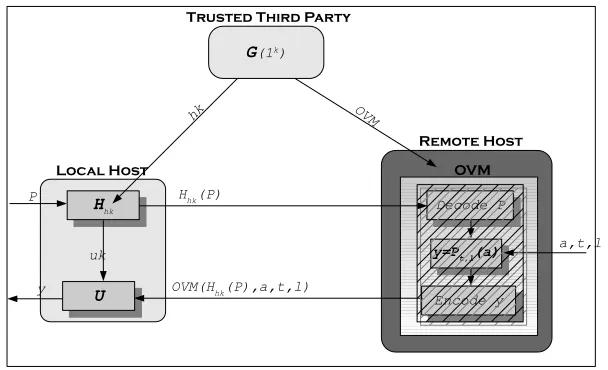
TheWBRPE, in Figure 1, is comprised of two phases, the generation phase, run by offline trusted third party, and the protocol execution phase, between the local and the remote hosts. The trusted party generates the parameters of the scheme, i.e. the keys which are sent to local host, and theOVM, which is transfered to the re-mote host. TheOVMemulates a trusted platform, and executes the input programs supplied by the local host in a secure manner. The local host uses the keys to harden programs which it sends to remote host for execution. TheOVMreceives the hard-ened program, and possibly an input of the remote host. It has the corresponding keys to unharden and execute the program, and then harden the result of the compu-tation. The remote host returns the hardened result to the local host. We require that the local host learns only the result of the computation, while the remote host learns nothing at all.
1.1 Existing Works
Obfuscationis a candidate building block for white box security, which received substantial attention from theoreticians and practitioners. An obfuscatorOis an ef-ficient compiler that transforms a programPinto a hardened programO(P), which pertains the functionality of the original program but is equivalent to black-box ac-cess toP, i.e. should be hard to analyse and to reverse engineer.
Obfuscation is the prevailing practical approach to software hardening, and was also investigated by theoreticians. However in both theory and practice, obfuscation exhibited insufficient results. The impossibility result by [2] states that there does not exist a general obfuscator for any program. Although there are some positive results, e.g. [6], these are restricted and do not suffice for practical applications. In addition, experts in practical obfuscation, e.g. [10], cannot say whether obfuscators can protect even simple programs, e.g. to hide intermediate state of programs. White-Box Cryptography (a special case of obfuscation) aims at protecting se-cret data embedded inside software implementations of cryptographic algorithms, by integrating a secret key in the cryptographic algorithms, thus preventing from attacker, which controls the execution environment, and may be a legitimate user, from extracting the keys for use on a different platform.
More specifically, the white box AES in [9], and the white-box DES in [8]. So far, proposed white box cryptography solutions were subsequently broken [4, 13, 16]. TheWBRPEscheme that we present can be seen as an extension of white-box cryp-tography.
Mobile Code Cryptography It is possible to employ theoretical tools from two party computation protocols, to produce provably secure white-box security schemes. The central approaches used to tackle two party computation scenario are secure function evaluation, computing with encrypted data, and encrypted function. One of the earliest techniques for two party computation, due to [17], is via encrypted circuit construction and evaluation. A solution to mobile code, for computing all polynomial time functions efficiently, based on encrypted circuit evaluation, is pre-sented in [5] using tools from two-party computation. However, their solution only provides for privacy of one of the inputs, but not both. As a result if the input of one participant is a program, it may expose the input of the other participant, e.g. if the program is computing an identity function. In [14] they construct a practical implementation of two party-secure function evaluation, thus showing a practical feasibility of encrypted circuits evaluation approach.
1.2 White Box Remote Program Execution (WBRPE)
In this work, we propose the White Box Remote Program Execution (WBRPE)
scheme, as a candidate white-box security building block.WBRPEcan be employed to facilitate a variety of applications, see Section 1.4.
InRemote Program Execution, programs are sent by alocal host(a.k.a. the orig-inator) for execution on aremote host, and possibly use some data available to the
remote host. The local and the remote hosts may be with conflicting interests, there-fore the security issues need to be dealt with. In particular, these include confiden-tiality and integrity of input programs supplied by the local host and confidenconfiden-tiality of inputs provided by the remote host. TheWBRPEshould satisfy confidentiality and integrity, employing software only techniques without assuming secure hard-ware, i.e. trusted third party or smartcards. The WBRPEscheme is composed of three efficient procedures, generation, hardening and unhardening, see Figure 1:
• The generation procedure produces a hardening key hk, and a program, which we call theobfuscated virtual machine (OVM).
• The hardening keyhkis used by the hardening procedure to harden, e.g. encrypt and/ or authenticate, the input programs.
• The obfuscated virtual machineOVMreceives a hardened input program along with input from the remote host. It decodes the hardened program, e.g. decrypts and/ or validates it, and returns the encoded result, e.g., encrypted and/or authen-ticated, of the program applied to the inputs.
Hhk
a,t,l Hhk(P)
OVM(Hhk(P),a,t,l)
G(1k)
Local Host
Remote Host
OVM Trusted Third Party
P
y uk
hk OVM
Decode P
Encode y y=Pt,l(a)
U
Fig. 1 WBRPEscheme.
1.3 White Box RPE for ALL Programs
The negative result by Baraket al.[2], shows that an obfuscator for all programs does not exist, however this result does not imply that there cannot be alternative hardening schemes which would work for any program. In particular, is there a
WBRPEfor all programs? To address this question we present a specific program, denoted UP (for universal program), with parameterK (key). Given a WBRPE
scheme that works for the family of universal programs{U PK}, we present a
’Uni-versal’ WBRPEscheme that works for any program, i.e. provides the security spec-ifications ofWBRPEforanyinput program.
1.4 Applications of WBRPE
Following are some potential applications ofWBRPE:
• In grid computing a large number of users (nodes) donate their idle CPU cycles to perform computation on behalf of the local host.WBRPEcan ensure that the confidentiality and integrity of the program and input data are not violated. • In P2P systems, e.g., for VoIP systems (such as Skype), the client code contains
secrets (e.g., cryptographic keys and proprietary protocols) that, if leaked to the remote host, would e.g., allow users to make free calls.
• Protection of intellectual property, e.g, music and programs.
• Typically applications based on the setting of online database, e.g. the model of Private Information Retrieval in [7], involve two parties, a server which holds the database and a client who wishes to query the database. The privacy and the integrity of both the local and the remote hosts should be provided.WBRPEcan be applied directly to map the security requirements of applications based on online databases. InWBRPEscheme, the client is the local host and the server is the remote host. The input supplied by the client is a query, and the remote input of the server is a database, and the client wishes to compute the result of its query on the database. The privacy and the integrity of both inputs of the client and the server are preserved, since the server cannot observe the queries submitted by the client, further since the database is queried inside theOVMthe server cannot observe the process of the computation.
2 White-Box RPE Definitions
AWBRPEschemeW is comprised of three efficient algorithms,(G,H,U)for gen-eration, hardening and unhardening, respectively. The generation procedureG gen-erates the obfuscated virtual machineOVMand the hardening keyhk. The hardening procedure applied on some input program, computes the hardened program, e.g. en-cryption and/ or authentication of the original program, and produces two outputs, the hardened program and a one time unhardening key. The remote host passes the hardened program, along with the remote input ato theOVMfor execution. The
OVMhas the required keys, and can therefore extract and evaluate the programPon remote inputa, and returns the (hardened) outputP(a). The local host, upon receipt the hardened output, applies the unhardening procedure with the unhardening key, to obtain the final result of the computation.
Given a Turing machineP∈TM, whereTMis a set of all Turing machines, let
P(a)denote a value of the computation ofPona. We introduce a time parameter, to hide the time that it takes each program to execute, and the length parameter to hide the length of the result. LetPt,l(a) =Pt(a)[1...l]denote anl bit value of thet step computation ofPon inputa. The definition follows.
Definition 1 (WBRPE). A White Box RPE (WBRPE) scheme W for programs family {Pk}k∈N consists of a tupleW =hG,H,Ui of PPT algorithms s.t. for all
(hk,OV M)←R G(1k),a∈ {0,1}∗,P∈TM, OV M ∈PPT,t,l ∈N and (c,uk)←
2.1 Indistinguishability of the Local Inputs Specification
The first security specification we consider is to hide the contents of the input pro-grams from the remote host. To ensure local inputs privacy we employ a variation of the indistinguishability experiment for encryption schemes [12]. We specify the in-distinguishability definition w.r.t. a PPT algorithmA= (A1,A2), denoting byHOthe hardening oracle which the algorithmAobtains access to, during the indistinguisha-bility experiment. The experiment is described in detail in Figure 1, we now give an informal definition. As its first step the experiment generates the keys and the ob-fuscated virtual machine. Next it invokes the adversarial algorithm with anOVMin an input, and provides it with an oracle access to the hardening functionality for its hardening queries. Each application of the hardening procedure generates a hard-ened program and a one time unhardening key. Eventually the adversary outputs two programs of equal size. The experiment tosses a bitband one of the programs is subsequently hardened. During the second phase the adversary keeps an oracle access toHO, obtains the hardened challenge program and has to distinguish. If the adversary guesses correctly, the experiment returns 1, i.e., the adversary won, and otherwise returns 0, the adversary lost.
In the sequel we introduce a flagϕ∈ {PK,SK}, and whenϕ=PKwe refer to an asymmetricWBRPE, whileϕ=SKdenotes a symmetricWBRPE. Whenϕ=PK
the adversary receives the public hardening keyhkin an input and can harden the programs by itself.
Definition 2 (Indistinguishability).LetW = (G,H,U)be aWBRPEscheme and letA= (A1,A2)be a pair of PPT algorithms. Fork∈N,r∈ {0,1}∗we define the
advantage of the adversaryAin theW B-IND-CPAexperiment as follows:
AdvW BW,A-IND-CPA-ϕ(k) =2∗Pr[ExpW BW,A-IND-CPA-ϕ(k) =1]−1
Where the probabilities are taken overG,HandA. The experimentExpW,AW B-IND-CPA-ϕ(k) is defined in Experiment 1. AWBRPEschemeW isW B-IND-CPA-ϕ secure if the advantage functionAdvW BW,A-IND-CPA-ϕ(·)is negligible over all PPT adversarial algo-rithmsA. In private keyWBRPEthere is a secret shared keyhkbetween theOV M
Experiment 1 The indistinguishability ExpW B-IND-CPA-ϕ
W,A (k) and unforgeability
ExpW B-U NF-ϕ
W,A (k) experiments. WhereHO is a hardening oracle that the algorithm Aobtains
access to during the course of the experiments.
ExpW B-IND-CPA-ϕ W,A (k)
hhk,OV Mi ←G(1k) (P0,P1,s)←AHOhk
(·,ϕ)
1 (1k,OV M,hk) b∈ {0,1}k
(cb,ukb)←Hhk(Pb)
b0←AHOhk(·,ϕ)
2 (cb,s)
if((b=b0)∧(|P0|=|P1|)){return 1} return 0
ExpW BW,A-U NF-ϕ(k)
hhk,OV Mi ←G(1k)
(P,s)←AHOhk(·,ϕ)
1 (1
k,OV M)
(c,uk)←Hhk(P)
(ω,t)←AHOhk(·,ϕ)
2 (c,s) y←Uuk(ω)
if(y=⊥){return 0} if(∀a∈ {0,1}∗,y6=P
t,|y|(a)){
return 1 }
return 0 HOhk(P,ϕ)
if(ϕ=PK){return(hk)} return(Hhk(P))
2.2 Unforgeability Specification
In some scenarios, e.g. shopping mobile agent, a remote host may try to change the result of the programs sent by the originator, e.g. such that instead of looking for the best offer the agent purchases the most expensive item. Our goal is to circumvent adversarial attempts to forge the result output by the scheme. This is captured by the unforgeability specification, based on unforgeability experiment which we present below. The unforgeability experiment applies the generation procedure and obtains hardening key hk, andOV M. It then invokes the adversary with oracle access to hardening functionality, and with theOV Mas input. Eventually, the adversary out-puts the forgery, i.e. the hardened result of the computation, denotedω, an input
programP, and the unhardening keyuk. The experiment applies the unhardening procedureUonω,Pandt, and obtains the result of the computationy. Ifyis valid,
then the experiment checks if it is a forgery for anytanda, and if yes, returns 1, i.e. the adversary successfully generated a forgery, otherwise returns 0, the adversary failed.
of a valid resultω such that there does not exist a programP, which could result in
y←Uuk(ω)on any remote inputa, i.e.∀a y6=Pt,|y|(a).
In the symmetricWBRPE, the adversary obtains an oracle access to the harden-ing procedure. If the adversary did not query the hardenharden-ing oracle on the program for which the result was generated, then the adversary wins the experiment. The ex-periment keeps a vectorQ[..], with queried programs and the respective unhardening keys output along with the hardening upon each query. In this type of forgery, the legitimate party never queried the hardening oracle with a program for which the re-sult was generated. Instead, the adversary replaces the authentic hardened program with some other program (replay or a forgery).
Definition 3 (Unforgeability).LetW= (G,H,U)be aWBRPEscheme and letAbe a PPT algorithm. Fork∈N,ϕ∈ {PK,SK}we define the advantage of the adversary
Ain the unforgeability experiment as follows:
AdvW BW,A-U NF-ϕ(k) =Pr[ExpW BW,A-U NF-ϕ(k) =1]
WhereExpW BW,A-U NF-ϕ(k)and the hardening oracle are defined in Experiment 1. A
WBRPEschemeW isW B-U NF-ϕ secure, if the advantageAdvW BW,A-U NF-ϕ(·)is a
negligible function for all PPT adversarial algorithmsA.
3 Universal WBRPE
In this section we show that if there exists aWBRPEscheme that satisfies the se-curity specifications for aspecificfamily of universal programs,U Pthen there ex-ists aUniversal WBRPEscheme that satisfies the security specifications for every program. More specifically, we present the construction of theUniversal WBRPE
scheme given aWBRPEscheme for a specific universal programU Pin Figure 2.
3.1 The Universal Program
U P
LetΠ = (GAE,AE,V D)be a scheme, that performs encryption and authentication, see [3], and decryption and validation of inputs. The universal programU PK (in Figure 2) is a Turing machine, that is created and instantiated with a secret keyK, by the hardening procedureH. When invoked by the obfuscated virtual machine
OV M, the universal programU PK readsa0off the input tape, and parses it to obtain (a,t,l,cP), i.e. the remote input, the number of steps of program’s execution, the length of the output and the encrypted program.U Pdecrypts and validatescPusing the key K. TheU P then runsP on a fort steps and truncates the output y0 tol
Algorithm 2TheUniversal WBRPEschemeW0= (G0,H0,U0), wherecreateOVMandcreateUP are macros, each generating a string that encodes a program (OVM’andU Prespectively).
U0uk0(ω) y←Uuk0(ω)
returny
H0hk(P)
K←GAE(1k)
cP←AEK(P)
U PK←createU P(K)
(cU P,uk)←Hhk(U PK)
c← hcU P,cPi
uk0← huk,K,Pi return(c,uk0)
G0(1k)
(hk,OV M)←G(1k)
OV M0←createOV M(OV M,k)
returnhhk,OV M0i
createOV M0(OVM)
return[read (c,a,t,l)
(cUP,cP)←c
a’←(a,t,l,cP)
t’=p(t)+3
l’=l+|P|+|t|+|K|
returnOVM(cUP,a’,t’,l’)]
createU P(K)
return[read a’
(a,t,l,cP)←a’
P←VDK(cP)
y←Pt,l(a)
return y]
the computation is authentic. The outputy0ofU Pis encoded, i.e. encrypted and/ or authenticated, by theOV M(the encoded value returned by theOV Mis denotedω).
The macrocreateU P, in Figure 2, given a secret keyK, generates and returns the Turing machineU PK, represented as a string. The secret keyK, is instantiated during the generation and is concatenated to the constant parts of the string.
3.2 The Generation Procedure
The generation procedureG0of theUniversal WBRPEschemeW0appliesGof the specificWBRPE W and obtains the the hardening keyhk, and theOV M. It applies thecreateOV M0function on theOV Mof the specificWBRPEscheme to generate the
OV M0of theUniversal WBRPEschemeW0 and returns the tuplehhk,OV M0i. See Figure 2. ThecreateOV M0function generates theOV M0Turing machine encoded in a string. TheOV M0reads(c,a,t,l)of the input tape and generates an input for the
OV MTuring machine. TheOV MdecodescU P and runs the universal program on inputa0, fort0steps and writes anl0bit output on its output tape, wheret0comprised of the number of steps performed byU P, the number of steps the input programP
3.3 The Hardening Procedure
The input to the hardening procedureH0of theUniversal WBRPEschemeW0 is a programPsupplied by the local host. The universal hardening procedure first ap-plies the generation procedure of the authenticated encryption scheme, e.g. in [3], obtains the secret keyKand then encrypts the input programPusingK, which re-sults in cP. Next, it generates the universal program, given the secret keyK, and hardens it usingHto obtain the paircU Panduk, subsequently returning the ordered pairshcU P,cPiandhuk,Ki. Details in Figure 2.
We employ authenticated encryption in order to prevent forgery of the input pro-grams, and to ensure that the input programP of theUniversal WBRPEwas not modified on transit, and replaced with some other input programP0.
3.4 The Unhardening Procedure
The unhardening procedure receives anωand optional[P,t]in an input, and applies the unhardening procedureUof the specificWBRPEschemeW onω. Obtains the
tuple(y,P˜,t˜,K˜). It then checks if theP,tparameters were supplied, if not it simply returnsy, otherwise the validation of the input is also performed.U0verifies that the pair(P,t)supplied by the adversarial algorithm and the pair(P˜,t˜)output from the universal programU PK are identical, and that the secret keyK fromukequals to the secret key ˜Kfrom the output ofU P. This is critical in order to verify that the result of the computation is authentic and not a forgery. If the result is authentic,
U is applied on the universal programU PK,t0 andω, such thatU PK andt0 are generated from the input parameters supplied toU0. These steps are performed in order to validate the resultω, i.e. that it is an authentic computation the universal program after at0steps execution. The universal unhardening procedure returnsyas its output. See the details of the implementation in Algorithm 2.
Theorem 1.Let φ ∈ {W B-IND-CPA-ϕ,(W B-U NF-ϕ &W B-IND-CPA)} and let Π= (GAE,AE,V D)is an IND-CPA secure authenticated encryption scheme. If W= (G,H,U)is aφ secureWBRPEscheme for the universal program U P, then W0=
U niv(W)is aφsecure WBRPE scheme for every program.
We prove the theorem for each value ofφ, in full version of the paper.
References
1. Algesheimer, J., Cachin, C., Camenisch, J., Karjoth, G.: Cryptographic security for mobile code. In: SP ’01: Proceedings of the 2001 IEEE Symposium on Security and Privacy, p. 2. IEEE Computer Society, Washington, DC, USA (2001)
2. Barak, B., Goldreich, O., Impagliazzo, R., Rudich, S., Sahai, A., Vadhan, S., Yang, K.: On the (im)possibility of obfuscating programs. In: CRYPTO ’01: Proceedings of the 21st Annual International Cryptology Conference on Advances in Cryptology. Springer-Verlag, London, UK (2001)
3. Bellare, C., Pointcheval, D., Rogaway, P.: Authenticated Encryption: Relations among notions and analysis of the generic composition paradigm (2000)
4. Billet, Gilbert, Ech-Chatbi: Cryptanalysis of a white box AES implementation. In: SAC: Annual International Workshop on Selected Areas in Cryptography. LNCS (2004)
5. Cachin, C., Camenisch, J., Kilian, J., Muller, J.: One-round secure computation and secure autonomous mobile agents. In: Automata, Languages and Programming, pp. 512–523 (2000). URL citeseer.ist.psu.edu/article/cachin00oneround.html
6. Canetti, R.: Towards Realizing Random Oracles: Hash Functions that Hide All Partial Infor-mation. LECTURE NOTES IN COMPUTER SCIENCE pp. 455–469 (1997)
7. Chor, B., Goldreich, O., Kushilevitz, E., Sudan, M.: Private Information Retrieval. Journal of the ACM45(6), 965–982 (1998)
8. Chow, S., Eisen, P.A., Johnson, H., van Oorschot, P.C.: A white-box DES implementation for DRM applications. In: J. Feigenbaum (ed.) Digital Rights Management Workshop,Lecture Notes in Computer Science, vol. 2696, pp. 1–15. Springer (2002)
9. Chow, S., Eisen, P.A., Johnson, H., van Oorschot, P.C.: White-box cryptography and an AES implementation. In: SAC ’02: Revised Papers from the 9th Annual International Workshop on Selected Areas in Cryptography, pp. 250–270. Springer-Verlag, London, UK (2003) 10. Collberg, C., Thomborson, C.: Watermarking, tamper-proofing, and obfuscation-tools for
soft-ware protection. Softsoft-ware Engineering, IEEE Transactions on28(8), 735–746 (2002) 11. Daemen, J., Rijmen, V.: The Design of Rijndael: AES–the Advanced Encryption Standard.
Springer (2002)
12. Goldreich, O.: Foundations of Cryptography: Volume 2, Basic Applications. Cambridge Uni-versity Press New York, NY, USA (2004)
13. Goubin, L., Masereel, J., Quisquater, M.: Cryptanalysis of white box DES implementations. Proceedings of the 14th Annual Workshop on Selected Areas in Cryptography (2007) 14. Malkhi, D., Nisan, N., Pinkas, B., Sella, Y.: Fairplay: a secure two-party computation system.
In: Proceedings of the 13th USENIX Security Symposium, pp. 287–302 (2004)
15. United States. National Bureau of Standards: Data Encryption Standard,Federal Information Processing Standards publication, vol. 46. U.S. National Bureau of Standards, pub-NBS:adr (1977)
16. Wyseur, B., Michiels, W., Gorissen, P., Preneel, B.: Cryptanalysis of White-Box DES Imple-mentations with Arbitrary External Encodings. Proceedings of the 14th Annual Workshop on Selected Areas in Cryptography (2007)