A remark on the computation of cube roots in
finite fields
⋆Nozomu Nishihara⋆⋆1, Ryuichi Harasawa1, Yutaka Sueyoshi1, and Aichi Kudo1
Faculty of Engineering, Nagasaki University
1-14 Bunkyomachi, Nagasaki-shi, Nagasaki, 852-8521, Japan [email protected]
{harasawa, sueyoshi, kudo}@cis.nagasaki-u.ac.jp
Abstract
We consider the computation of cube roots in finite fields. For the compu-tation of square roots in finite fields, there are two typical methods; the Tonelli-Shanks method [9, 12] and the Cipolla-Lehmer method [4, 6]. The former can be extended easily to the case of r-th roots, which is called the Adleman-Manders-Miller method [1], but it seems to be difficult to extend the latter to more general cases. In this paper, we propose two explicit algorithms for realizing the Cipolla-Lehmer method in the case of cube roots for prime fieldsFp withp≡1 (mod 3). We implement these
methods and compare the results.
Keywords: cube root, finite field, the Tonelli-Shanks method, the Cipolla-Lehmer method
1 Introduction
Solving algebraic equations over finite fields is one of the most popular topics in the computational algebra. The typical equations are in the form
xr=a, given a natural integerr(≥2) and an elementain the base field. For square roots (i.e., r = 2), there exist two well-known methods; the Tonelli-Shanks method [9, 12] and the Cipolla-Lehmer method [4, 6]. The former can be extended easily to the case of r-th roots, which is called the Adleman-Manders-Miller method [1], but it seems to be difficult to extend the latter to more general cases. In this paper, we propose two
⋆
The full version of this paper, named “Root computation in finite fields”, appears in IEICE Trans. Fundamentals, Vol. E96-A, No. 6, pp. 1081 – 1087, 2013, which includes a generalization of the Cipolla-Lehmer method tor-th root cases withr
prime.
⋆⋆
explicit algorithms for realizing the Cipolla-Lehmer method in the case of cube roots for prime fields Fp withp≡1 (mod 3). More precisely, we
describe two methods for constructing irreducible polynomials of degree three satisfying some conditions to apply the Cipolla-Lehmer method. We implement these methods and compare the results.
The remainder of this paper is organized as follows: In Section 2, we describe the Tonelli-Shanks algorithm and the Cipolla-Lehmer algorithm for square roots computation. In Section 3, we consider the cube root versions of the Tonelli-Shanks method and the Cipolla-Lehmer method, and propose two algorithms of constructing irreducible polynomials of degree three which we need in the Cipolla-Lehmer method. In Section 4, we implement these methods, and compare the results. In Section 5, we give a conclusion and future works.
2 The computation of square roots in finite fields
In this section, we introduce two algorithms of computing square roots in finite fields, that is, the Tonelli-Shanks algorithm [9, 12] and the Cipolla-Lehmer algorithm [4, 6].
Letpbe a prime andq a power ofp, and Fq denote a finite field with q elements.
In the case of p = 2, there exists a unique square root for eacha in Fq, which can be computed easily as a
q
2. So we assume that p is odd.
2.1 Tonelli-Shanks algorithm
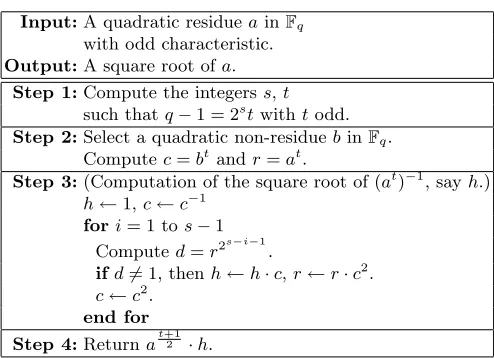
The Tonelli-Shanks algorithm is described in Table 1 ([9, 12], or [7]): Since this algorithm searches a quadratic non-residue (Step 2), it is in a class of randomized algorithms. Its complexity is O(v2(q−1)(logq)3), where v2(q−1) denotes the maximum non-negative integere such that 2e|(q−1). Although the worst time complexity is O((logq)4), some im-provements with complexitiesO((logq)3) have been proposed in the case wherev2(q−1) is small ([2, 8], or [7]).
2.2 Cipolla-Lehmer algorithm
Table 1.The Tonelli-Shanks algorithm
Input:A quadratic residueainFq
with odd characteristic. Output:A square root ofa.
Step 1:Compute the integerss,t
such thatq−1 = 2stwithtodd.
Step 2:Select a quadratic non-residuebinFq.
Computec=btandr=at.
Step 3:(Computation of the square root of (at)−1, sayh.)
h←1,c←c−1
fori= 1 tos−1 Computed=r2s−i−1.
ifd̸= 1, thenh←h·c,r←r·c2.
c←c2. end for
Step 4:Returnat+12 ·h.
Table 2.The Cipolla-Lehmer algorithm
Input:A quadratic residueainFq
with odd characteristic. Output:A square root ofa.
Step 1:Select an elementbsuch that
b2−4ais a quadratic non-residue inFq.
Step 2:Letf(x) be the polynomialx2−bx+a
Step 3:Returnx(q+1)/2 (modf(x)).
3 The computation of cube roots in finite fields
In this section, we consider the computation of cube roots in prime fields Fp with p ≡ 1 (mod 3). We assume p ≡ 1 (mod 32) because efficient
methods are proposed for the other cases [3]. All algorithms which we describe in this section are in a class of randomized algorithms because we need a cubic non-residue inFp. We remark that a non-zero elementa
inFp is a cubic non-residue if and only if a
p−1
3 ̸≡1 (mod p), and in that
3.1 The Tonelli-Shanks based algorithm
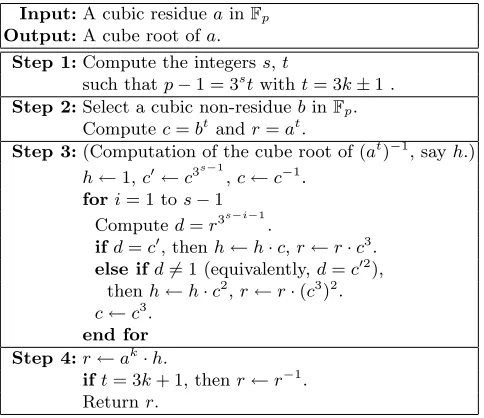
The Tonelli-Shanks method for square roots computation was extended to the general r-th roots computation by Adleman, Manders and Miller [1]. We describe the algorithm for the case of cube roots in Table 3.
Table 3.The cube root computation based on the Tonelli-Shanks algorithm
Input:A cubic residueainFp
Output:A cube root ofa.
Step 1:Compute the integerss,t
such thatp−1 = 3stwitht= 3k±1 . Step 2:Select a cubic non-residuebinFp.
Computec=bt andr=at.
Step 3:(Computation of the cube root of (at)−1, sayh.)
h←1,c′←c3s−1,c←c−1.
fori= 1 tos−1 Computed=r3s−i−1.
ifd=c′, thenh←h·c,r←r·c3. else ifd̸= 1 (equivalently,d=c′2),
thenh←h·c2,r←r·(c3)2.
c←c3. end for Step 4:r←ak·h.
ift= 3k+ 1, thenr←r−1.
Returnr.
As in the case of quadratic roots, the complexity of the algorithm (Table 3) is depend on the value v3(p−1) as well as on the size of logp.
3.2 The Cipolla-Lehmer based algorithm
To extend the Cipolla-Lehmer method to the cube roots computation, we need irreducible polynomials of degree three satisfying some conditions. More precisely, given a cubic residue a in Fp, we have to construct an
irreducible monic polynomial f(x) of degree three with coefficients in Fp
and constant term −a. Once we find such an f(x), we can compute a
cube root ofaasxp2+3p+1 (modf(x)) because we havef(x) = (x−α)(x−
αp)(x−αp2) for a rootα∈F
Letf(x) be a polynomial of degree three with coefficients inFp. Then
we have
f(x): irreducible⇐⇒ f(x) has no factor of degree one. (1)
Since ∏a∈Fp(x−a) =xp−x, we also have
f(x): irreducible⇐⇒ gcd(f(x), xp−x) = 1. (2)
We call the search of irreducible polynomials of degree three based on the fact (2) ”the original method”. In the original method, we choose a random polynomial f(x) in the form x3 +βx−a with β ∈ F
p and see
whether gcd(f(x), xp−x) = 1.
In the remainder of this section, we describe two improvements for finding irreducible polynomials of degree three with constant term −a.
Dickson based method: L. E. Dickson described a necessary and sufficient condition for a cubic polynomial over finite fields of odd char-acteristic to be irreducible, which is as follows:
Theorem 1 ([5]). Let Fq be a finite field of characteristic ̸= 2,3, and f(x) = x3+ax+b a polynomial over Fq of degree three. Then f(x) is irreducible if and only if the following two conditions hold:
{
(i) D(f) is a quadratic residue in Fq, say D(f) = (32µ)2
(ii)α:= 12(−b+µ√−3) is a cubic non-residue inFq(
√ −3),
where D(f) = −(4a3 + 27b2) denotes the discriminant of f(x). We see that the elementα is a root of the quadratic equationx2+bx−3−3a3= 0.
Since p ≡ 1 (mod 3) in our case, we see that (−p3) = (p3) = 1 by the quadratic reciprocity law, where (··) denotes the Legendre symbol. Therefore, we have Fp(
√
−3) =Fp.
Based on Theorem 1, we describe an algorithm which we call ” Pro-posed method 1”, for constructing a polynomial of degree three with con-stant term −a (Table 4).
Linear transformation based method: We propose another method to search irreducible polynomials over Fp of degree three, which is based
on the following fact:
Table 4.Proposed algorithm 1
Input:A cubic residueainFp.
Output:An irreducible monic polynomial with constant term−a.
Step 1:Choose an elementβinFpat random.
f(x)←−x3+βx−a.
D(f)←− −(4β3+ 27a2).
Step 2: ifD(f) is zero or a quadratic non-residue, then go to Step 1.
elseα←− 12(a+ 3−2√−3D(f)) (i.e,α: a root ofx2−ax−3−3β3= 0). Step 3: ifαis a cubic non-residue,
then returnf(x). elsego to Step 1.
We now consider the polynomial in the formf(x) =x3−α overFp.
Ifαis a cubic non-residue, that is, if there exists no elementβ inFp such
that β3=α, thenf(x) is irreducible from the fact (1).
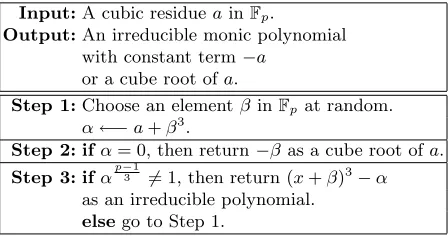
Combining this with the fact (3), we propose an algorithm which we call ”Proposed method 2”, for constructing a polynomial of degree three with constant term−a(Table 5). We remark that, for Steps 1 and 3, the number ofβ’s inFpsuch thata+β3is a cubic non-residue is approximately
2
3p for all sufficiently large p(see Appendix).
Table 5.Proposed algorithm 2
Input:A cubic residueainFp.
Output:An irreducible monic polynomial with constant term−a
or a cube root ofa.
Step 1:Choose an elementβinFpat random.
α←−a+β3.
Step 2: ifα= 0, then return−β as a cube root ofa. Step 3: ifαp−13 ̸= 1, then return (x+β)3−α
4 Experimental results
In this section, we implement the algorithms for computing cube roots based on the proposed methods for various cases, which are listed in Tables 6 – 9. We compute 100 times for each case and list the average time. For the quadratic roots computation in Step 2 of ”Proposed method 1” (Table 4), we use the Tonelli-Shanks method (Table 1). This implies that the running time of ”Proposed method 1” depends on the value
v2(p−1) as well as on the size of logp.
All computations are performed on a 3 GHz Pentium IV with 0.99 Gb RAM. The language is C with Borland C++ compiler 5.5.1 and with no mathematical library.
If the valuev3(p−1) is not so large, the Tonelli-Shanks method is more efficient than the Cipolla-Lehmer method. But, if the value v3(p−1) is large, the Cipolla-Lehmer method is more efficient.
For the Cipolla-Lehmer method, we see that the running time is not depend on the valuev3(p−1) and that the proposed methods 1 and 2 are about twice faster than the original method. We further observe the fol-lowing: (i) In the step of finding an irreducible polynomialf(x) of degree three with a given constant term, the proposed method 2 is more efficient than the proposed method 1. In our implementations, the average number of trials for finding f(x) in the proposed method 1 (resp. the proposed method 2) is about 3 (resp. about 1.5) for a cube root computation. (ii)
For the computation of xp2+3p+1 (mod f(x)), the proposed method 1 is
more efficient than the proposed method 2 because f(x) is a trinomial for the proposed method 1, whilef(x) is a quadrinomial for the proposed method 2.
Table 6.Running time (ms) forFpwith the size ofpbeing 250 bits
the value ofv3(p−1) 2 10 20 30 40 50 60 70 80 90 100
Table 7.Running time (ms) forFpwith the size ofpbeing 500 bits
the value ofv3(p−1) 2 20 40 60 80 100 120 140 160 180 200
Tonelli-Shanks 34.5 32.5 35.6 47.8 76.7 102.5 123.4 167.7 207.3 266.9 314.1 Cipolla Original 132.8 140.2 120.1 121.9 125.6 121.9 121.6 120.9 121.6 130.6 127.2 -Lehmer Proposed 1 65.1 77.5 63.6 75.0 78.1 73.7 78.6 74.1 64.4 77.3 74.4
Proposed 2 65.9 66.4 65.5 63.0 65.0 65.0 64.4 65.3 64.4 66.1 64.1
Table 8.Running time (ms) forFpwith the size ofpbeing 750 bits
the value ofv3(p−1) 2 30 60 90 120 150 180 210 240 270 300
Tonelli-Shanks 68.0 75.2 113.6 175.3 269.1 400.3 528.3 720.2 883.1 1142.3 1371.7 Cipolla Original 387.5 361.4 404.4 337.2 347.2 361.1 344.5 371.2 363.1 364.5 330.8
-Lehmer Proposed 1 191.1 216.4 238.4 183.0 185.3 230.5 185.3 220.6 221.7 226.6 217.6 Proposed 2 186.9 186.1 194.1 190.8 189.4 193.9 187.0 187.7 185.9 190.9 188.1
5 Conclusion and future works
In this paper, we considered the computation of cube roots in finite fields based on the Tonelli-Shanks method and the Cipolla-Lehmer one, and described the computational procedure for realizing the Cipolla-Lehmer method in the case of cube roots. More precisely, we proposed two meth-ods for constructing irreducible polynomials of degree three. We further implemented these methods and compare them.
We leave the detailed analysis of these methods, for example the theme whether there exists a deterministic algorithm for cube roots computation with(out) the Genelized Riemann Hypothesis, and the extension of the Cipolla-Lehmer method to the generalr-th roots computation. These are our future works.
References
1. L. Adleman, K. Manders and G. Miller,On taking roots in finite fields, Proc. 18th IEEE Symposium on Foundations on Computer Science (FOCS), pp. 175 – 177, 1977.
2. A. O. L. Atkin, Probabilistic primality testing, Summary by F. Morain, INRIA Res. Rep. 1779, pp. 159 – 163, 1992.
Table 9.Running time (ms) forFpwith the size ofpbeing 1000 bits
the value ofv3(p−1) 2 40 80 120 160 200 240 280 320 360 400
Tonelli-Shanks 152.7 169.2 354.2 487.0 780.0 1125.0 1570.5 2041.2 2691.2 3315.5 3559.1 Cipolla Original 814.4 919.7 839.7 828.7 774.8 841.2 874.5 811.4 785.0 849.8 847.0
-Lehmer Proposed 1 416.6 505.5 423.7 431.2 499.1 425.1 521.1 410.3 422.1 500.0 430.3 Proposed 2 412.2 420.9 431.2 429.5 417.3 418.4 430.2 421.9 428.9 419.4 433.9
4. M. Cipolla,Un metodo per la risolutione della congruenza di secondo grado, Ren-diconto dell’Accademia Scienze Fisiche e Matematiche, Napoli, Ser. 3, Vol. IX, pp. 154 – 163, 1903.
5. L. E. Dickson, Criteria for the irreducibility of functions in a finite field, Bull. Amer. Math. Soc., Vol.13, No. 1, pp. 1–8, 1906.
6. D. H. Lehmer, Computer technology applied to the theory of numbers, Studies in Number Theory, Englewood Cliffs, NJ: Pretice-Hall, pp. 117 – 151, 1969.
7. A. J. Menezes, P. C. van Oorschot and S. A. Vanstone,Handbook of Applied Cryp-tography, CRC Press, 1997.
8. S. M¨uller,On the computation of square roots in finite fields, Designs, Codes and Cryptography,31, pp. 301 – 312, 2004.
9. D. Shanks, Five number-theoretic algorithms, Proc. 2nd Manitoba Conf. Numer. Math., Manitoba, Canada, pp. 51 – 70, 1972.
10. J. H, Silverman and J. Tate, Rational Points on Elliptic Curves, Undergraduate Texts in Math., vol.106, Springer-Verlag, New York, 1992.
11. H. Stichtenoth, Algebraic Function Fields and Codes, Springer Universitext, Springer-Verlag, Berlin Heidelberg, 1993.
12. A. Tonelli, Bemerkung ¨uber die Aufl¨osung quadratischer Congruenzen, G¨ottinger Nachrichten, pp. 344 – 346, 1891.
Appendix
Unless explicitly stated otherwise, we assume p ≡ 1 (mod 3). In this appendix, for a cubic residue ainFp, we consider the number
N := #{x∈Fp |x3+a is a cubic non-residue}.
Leta=g3 withg∈Fp. Since x3+a=g3{(xg−1)3+ 1}, we consider the
number ofFp-rational pointsC(Fp) on the Fermat curve
C/Fp: x3+ 1 =y3.
Setting x = XZ and y = YZ, we see that C(Fp) contains three points at
is a primitive cube root of unity. For x in Fp, the number of y’s in Fp
satisfying x3+ 1 =y3 is as follows:
0 (x3+ 1: cubic non-residue)
1 (x3+ 1 = 0, i.e. x=−1,−ω, −ω2) 3 (x3+ 1: cubic residue)
So we obtain
N =p− {3 + (#C(Fp)−6)/3}= (p−1)−#C(Fp)/3.
Since the Fermat curve C/Fp has genus one in the case of p̸= 3 [11], we
have
p+ 1−2√p≤#C(Fp)≤p+ 1 + 2√p
from the Hasse-Weil theorem [11]. Therefore, the numberN = (p−1)− #C(Fp)/3 is approximately 23p for all sufficiently large p.
Finally, we describe the explicit estimation on the number of Fp
-rational points on the projective curve defined by X3 +Y3 +Z3 = 0, which comes from Gauss’ Disquisitiones Arithmeticae, Article 358:
Theorem 2 ([10]). We assume p ̸= 3. Let C/Fp be the Fermat curve defined by X3+Y3+Z3 = 0. We have
#C(Fp) =
{
p+ 1 (p̸≡1 (mod 3))
p+ 1 +A (p≡1 (mod 3)),