A New Framework for RFID Privacy
No Author Given No Institute Given
Abstract. Formal RFID security and privacy frameworks are fundamental to the design and analysis of robust RFID systems. In this paper, we develop a new definitional framework for RFID privacy in a rigorous and precise manner. Our framework is based on a zero-knowledge (ZK) formulation [9, 7] and incorporates the notions of adaptive completeness and mutual authentication. We provide meticulous justification of the new framework and contrast it with existing ones in the literature. In particular, we prove that our framework is strictly stronger than the ind-privacy model of [17], which answers an open question posed in [17] for developing stronger RFID privacy models. We also clarify certain confusions and rectify several defects in the existing frameworks. Finally, based on the protocol of [19], we propose an efficient RFID mutual authentication protocol and analyze its security and privacy. The methodology used in our analysis can also be applied to analyze other RFID protocols within the new framework.
1
Introduction
Radio Frequency IDentification (RFID) tags are low-cost electronic devices, from which the stored information can be collected by an RFID reader efficiently (from tens to hundreds of tags per second) at a distance (from several centime-ters to several mecentime-ters) without the line of sight [24]. RFID technology has been widely used in numerous applications, ranging from manufacturing, logistics, transportation, warehouse inventory control, supermarket checkout counters, to many emerging applications [1]. As a key component of future ubiquitous computing environment, however, RFID technology has triggered significant concerns on its security and privacy as a tag’s information can be read or traced by malicious readers from a distance without its owner’s awareness [17, 14, 26, 16, 18, 6, 15].
It is critical to investigate formal RFID security and privacy frameworks that are fundamental to the design and analysis of robust RFID systems [17, 4, 25, 22, 11, 20, 19, 21]. However, due to high system complexity, it turns out to be full of subtleties in developing rigorous and precise RFID system models. By examining the existing RFID system models, in this paper we develop a new definitional framework for RFID security and privacy in a rigorous and precise manner. Our framework is based on a zero-knowledge formulation [9, 7], and incorporates the notions of adaptive completeness and mutual authentication. Compared to existing frameworks, our framework is more practical than those of [11, 19], and is stronger in terms of privacy than those of [17, 4]. Along the way, we also clarify certain confusions and rectify several defects in the existing frameworks.
To show how this new framework can be applied, we design an efficient RFID mutual authentication protocol based on the RFID protocol of [19] and analyze its security and privacy. The methodology used in our analysis is of independent interest and can be applied to analyze other RFID protocols within the new framework.
2
Preliminaries
IfA(·,·, ...)is a randomized algorithm, theny ←A(x1, x2, ...;ρ)means thatyis assigned with the unique output of the algorithmAon inputsx1, x2, ...and coinsρ, whiley←A(x1, x2, ...)is a shorthand for first pickingρat random and then settingy←A(x1, x2, ...;ρ). Lety←AO1,...,On(x1, x2, ...)denote thatyis assigned with the output of the algorithmAwhich takesx1, x2, ...as inputs and has oracle accesses toO1, ..., On. IfSis a set, thens∈RSindicates
thatsis chosen uniformly at random fromS. Ifx1, x2, ...are strings, thenx1||x2|| · · · denotes the concatenation of them. Ifxis a string, then|x|denotes its bit length in binary code. IfSis a set, then|S|denotes its cardinality (i.e. the number of elements ofS). Let Pr[E] denote the probability that an eventEoccurs,N denote the set of all integers,R denote the set of all real numbers.
computationally indistinguishable, if for any probabilistic polynomial-time (PPT) algorithmD, and for sufficiently largeκand anyz∈ {0,1}∗, it holds that|Pr[D(κ, z, X) = 1]−Pr[D(κ, z, Y) = 1]|is negligible inκ.
Next, we review the definition of pseudorandom functions [8]. On a security parameterκ, letm(·)andl(·)be two positive polynomials inκ. We say that
{Fk:{0,1}m(κ)−→ {0,1}l(κ)}k∈R{0,1}κ
is a PRF ensemble if the following two conditions hold:
1. Efficient evaluation: There exists a polynomial-time algorithm that on inputkandx∈ {0,1}m(κ)returnsF
k(x).
2. Pseudorandomness: A PPT oracle machineA(t, ϵ)-breaks the PRF ensemble, if
|Pr[AFκ(κ) = 1]−Pr[AHκ(κ) = 1]| ≥ϵ
whereFκis a random variable uniformly distributed over the multi-set{Fk}k∈R{0,1}κ,Hκis uniformly distributed among all functions mappingm(κ)-bit-long strings tol(κ)-bit-long strings, and the running time ofAis at most t(here each oracle query accounts for one unit operation).
The PRF ensemble is (t, ϵ)-pseudorandom, if for all sufficiently large κthere exists no algorithmA that can (t, ϵ)-break the PRF ensemble. The PRF ensemble is pseudorandom, if for all sufficiently largeκ’s there exists no algorithmAthat can(t, ϵ)-break the PRF ensemble,for anytthat is polynomial inκand anyϵthat is non-negligible inκ.
3
Model of RFID Systems
In this section, we first give a formal description of RFID system setting and adversary. We then define RFID systems to be “complete” in term ofadaptive completeness, and “sound” in terms ofmutual authentication.
3.1 RFID System Setting
Consider an RFID system comprising of a single1legitimate readerRand a set ofℓtagsT ={T
1, ...,Tℓ}, whereℓis a polynomial in a security parameterκ. The reader and the tags are probabilistic polynomial time interactive Turing machines. The RFID system(R,T)is setup by a procedure, denotedSetup(κ, ℓ). Specifically, on(κ, ℓ), this setup procedure generates the public system parameterσR, the reader secret-keykRand initial internal states1R(if needed)
forR. It may also setup an initial databaseDB1forRto store necessary information for identifying and authenticating tags. For eachi,1≤i≤ℓ, this procedure generates the public parameterξTiand the initial secret-keyk1
Tifor a tagTi and sets the tag’s initial internal states1
Ti(typically,s 1
Tiincludes the public parametersσR, ξTi). It may also associate the tagTiwith its unique ID, as well as other necessary information such as tag key and/or tag state information, as a record in the initial databaseDB1ofR. Note thatξTior/ands1T
ican be empty strings.
We usepara= (σR, ξ1,· · ·, ξℓ)to denote the public system parameters. We assume that in the RFID system, the
reader is secure; in other words, the legitimate reader is a “black-box” to an adversary.
A tagTi,1≤i≤ℓ, exchanges messages with the readerRthrough a protocolπ(R,Ti). Without loss of generality, we assume the protocol run ofπis always initiated byRandπconsists of2γ+ 1rounds2 for someγ ≥ 1. Each protocol run ofπis called a session. We assume each tag interacts with the reader sequentially, but multiple tags can interact with the reader “concurrently” (with some anti-collision protocols [27]). To allow and distinguish concurrent sessions (at the side of the readerR), we associate each session of protocolπwith a unique session identifiersid. In practice,sidis typically generated by the reader when it is invoked to send the first-round message. We assume each message from a tag to the reader always bears the corresponding session-identifier.
1
It is straightforward to extend the model to include multiple legitimate readers. Notice that an adversary can use its own readers to interact with tags.
2
Each tag Ti, as well as the reader R, uses fresh and independent random coins (generated on the fly) in each session,in case it is an randomized algorithm. We assume that the random coins used in each session are erased once the session is completed (whether successfully finished or aborted). Also, in each session run, the tag may update its internal state and secret-key, and the reader may update its internal state and database. We assume that the update process of new internal state and secret-key by an uncorrupted tag automatically overwrites (i.e., erases) its old internal state and secret-key.
Given a security parameterκ, we assume that each tagTi takes part in at mosts(sequential) sessions in its life time3withR, and thusRinvolves at mostsℓsessions, wheresis some polynomial inκ. In practice, the valuescan
be a fixed constant (e.g.,s= 228[1]).
More precisely, for thej-th session (ordered by the session initiation time) where1≤j ≤sℓ, the readerRtakes the input from the system parameterspara, its secret-keykR, current internal states
j
R, databaseDB
j, random coins
ρjR, and a partial transcriptT, whereT is either an empty string (which indicates the starting of a new session) or a sequence of messages(sid, c1, α1, c2, α2,· · ·, cu, αu),1≤u≤γ(which indicates the on-going of sessionsid). The
readerRoutputs the next messagecu+1. In the case ofT = (sid, c1, α1, c2, α2,· · ·, cγ, αγ), besides sending back
the last-round messagecγ+1, the readerR also updates its internal state tos
j+1
R , its database toDB
j+1, and stops the session by additionally outputting a bit, denoted byosid
R . This output bit indicates either acceptance (osidR = 1) or
rejection (osid
R = 0) of the current session.
Without loss of generality, we assume that thej-th session run by the readerRcorresponds to thev-th session (of session-identifiersid) run by tagTi, where1 ≤v ≤ sand1 ≤ i ≤ ℓ. In this session,Ti takes the input from the system parameterspara, its current secret-keykvTi, current internal statesvTi, random coinsρvTi, and a partial transcript T = (sid, c1, α1,· · ·, αu−1, cu), where1 ≤ u ≤γ. The tagTioutputs the next message(sid, αu). In the case of
T = (sid, c1, α1,· · ·, cγ, αγ, cγ+1)(i.e.,Ti has received the last-round message of the sessionsid),Ti updates its internal state tosvT+1
i , its secret-key tok
v+1
Ti , and stops the session by additionally outputting a bit, denoted byo
sid
Ti . This output bit indicates either acceptance (osidTi = 1) or rejection (osidTi = 0) of the current session run byTi.
Note that in the above description, it is assumed that the reader and tags update their internal states, database, or keysat the end of each protocol run. In reality, this can be performed at any point of each protocol run. Also, for RFID protocolπwith unidirectional authentication from tag to reader, the tag may not have a session output. In this case, the session outputosid
Ti is set to “0” always.
3.2 Adversary
After an RFID system(R,T)is setup by invokingSetup(κ, ℓ), we model a probabilistic polynomial-time concurrent man-in-the-middle (CMIM) adversaryAagainst(R,T), with adaptive tag corruption. We usemˆ to denote a message sent by adversaryA, andmto denote the actual message sent by readerRor an uncorrupted tag. The adversary is given access to the following oracles:
InitReader():AinvokesRto start a session of protocolπand generate the first-round messagec1which is also used as the session identifiersid. Supposing that the new session is thej-th session run byR, the readerRstoresc1 into its internal statesjR, and returnsc1to the adversary.
SendT(Ti,m): Adversaryˆ A sendsmˆ toTi4. After receiving m,ˆ Ti works as follows: (1) IfTi currently does not run any existing session,Ti initiates a new session with the session-identifiersidset tom, treatsˆ mˆ as the first-round message of the new session, and returns the second-first-round message(sid, α1). (2) IfTi is currently running an incomplete session with session-identifiersid = ˆc, and is waiting for the u-th message fromR, where u ≥ 2,Ti works as follows: If2 ≤u≤γ, it treatsmˆ as theu-th message from the reader and returns the next round message (sid, αu). Ifu=γ+ 1(i.e.,Tiis waiting for the last-round message of the sessionsid),Tireturns its outputosidTi to
the adversary, and (internally) updates its internal state tosvT+1
i , assuming that the sessionsidis thev-th session run byTi, where1≤v≤s.
3It is assumed thatsis large enough so that any tag can never run up tossessions in its life time; otherwise, an adversary may
distinguish two tags, thus violate their privacy, by running one tag more thanstimes while the other less thanstimes [17].
4
SendR(sid,c α): Adversaryˆ Asends(sid,c αˆ)toR. After receiving(sid,c αˆ),Rchecks from its internal state whether it is running a session of session identifiersid=sid, and works as follows: (1) Ifc Ris currently running an incomplete session withsid=sidc and is waiting for theu-th message from a tag, where1≤u≤γ,Racts as follows: Ifu < γ, it treatsαˆ as theu-th message from the tag, and returns the next round messagecu+1toA. Ifu =γ, it returns the last-round messagecγ+1 and the outputosidR toA, and internally updates its internal state tos
j+1
R and the database
toDBj+1, assuming that the sessionsidcorresponds to thej-th session run byR. (2) In all other cases,Rreturns a special symbol⊥(indicating invalid query).
Corrupt(Ti): AdversaryA obtains the secret-key and internal state information (as well as the random coins) currently held byTi. Once a tagTiis corrupted, all its actions are controlled and performed by the adversaryA.
LetO1, O2, O3andO4denote the above oracles, respectively. These oracles fully capture the capability of any PPT CMIM adversary with adaptive tag corruption.5For presentation simplicity, we denote byOthe set of the four oracles
{O1, O2, O3, O4} specified above.An adversary is a (t, n1, n2, n3, n4)-adversary, if it works in timet and makes
oracle queries toOµ without exceedingnµ times, where1 ≤µ ≤4.We treat each oracle call as a unit operation,
and thus for at-time adversary it holds thatΣ4
µ=1nµ ≤t. We denote byAO(R,T, para)a PPT algorithmAthat, on
input of some system public parameterpara, concurrently interacts withRand the tags inT via the four oracles in
O, where(R,T)is setup bySetup(κ, ℓ).
Note that in our formulation, the output bits of protocol participants (which indicate authentication success or failure) arepubliclyaccessible to the adversary. The reason is that, in reality, such outputs can be publicly observed from the behaviors of protocol participants during/after the protocol run or can be learnt by some other side channels.
3.3 Adaptive Completeness and Mutual Authentication
Roughly speaking, adaptive completeness says that, after any attacks (particularly the desynchronizing attacks) made by the adversaryA, the protocol execution between the readerRand any honest uncorrupted tag is still complete (e.g., being able to recover from desynchronization). In other words, after undergoing arbitrary attacks, the uncorrupted parties of the RFID system still can recoverwhenever the attacks stop.
Definition 3.1 (adaptive completeness) For an RFID system(R,T)setup bySetup(κ, ℓ), denote by
(sid, csid1 , αsid1 ,· · ·, αγsid, csidγ+1, osidR , osidT
i )←π(R,Ti)
the running of a session with identifiersidof the protocolπbetweenRand an uncorrupted tagTi∈ T. Suppose that the sessionsidcorresponds to thev-th session at the side ofTiand thej-th session at the side ofR, where1≤v≤s
and1 ≤j ≤sℓ. Consider the case that the two sessions are of the same round messages, and that all the exchanged messages in these two (matching) sessions are all honestly generated byRandTirespectively. Denote byEthe event thatosidR = 0holds (orosidT
i = 0holds if the protocolπis for mutual authentication) orRidentifies a different tag
Ti′ ̸=Tiin itsj-th session.
A PPT CMIM adversary A(t, ϵ, n1, n2, n3, n4)-breaks the adaptive completeness of the RFID system against the uncorruptedTi, if the probability that eventE occurs is at leastϵandAis a(t, n1, n2, n3, n4)-adversary. The probability is taken over the coins used by Setup(κ, ℓ), the coins of A, the coins used byR (up to finishing the j-th session), and the coins used byTi(up to finishing the v-th session). An RFID system(R,T)satisfies adaptive completeness, if for all sufficiently largeκ and for any uncorrupted tagTi, there exists no adversary A that can
(t, ϵ, n1, n2, n3, n4)-break the adaptive completeness againstTi, for any(t, ϵ), wheretis polynomial inκandϵis
non-negligible inκ.
Next, we define mutual authentication of RFID protocols. Roughly speaking, for a protocolπof the RFID system (R,T), authentication from reader to tag (resp., from tag to reader) means that a CMIM adversaryAcannot imperson-ate the readerR(resp., an uncorrupted tagTi∈ T) to an uncorrupted tagTi∈ T (resp., readerR), unlessAhonestly relays messages actually generated and sent byRand the uncorrupted tagTi. Before we define mutual authentication for RFID protocols, we first clarify the notion of matching sessions.
5
Definition 3.2 (matching sessions) Denote by (sid, csid1 , αsid1 ,· · ·, αsidγ , csidγ+1) the transcript of exchanged round
messages (except the session outputs) of asuccessfully completed session sidof the protocol π run by a tag Ti, where1≤i≤ℓ. This session has a matching session at the side of the readerR, ifRever successfully completed a session of the identical session transcript.
Denote by(sid′, csid′
1 , αsid
′
1 ,· · · , αsid
′
γ , csid
′
γ+1)the transcript of exchanged round messages (except the session
out-puts) of asuccessfully completedsessionsid′run byR. This session has a matching session at the side of some tag
Ti, where1≤i≤ℓ, if either of the following conditions holds:
– Tievercompleted, whether successfully finished or aborted, a session of the identical transcriptprefix (sid′, csid1 ′, αsid
′
1 ,· · · , αsid
′
γ );
– Or,Tiis now running a session with partial transcript(sid′, csid1 ′, αsid
′
1 ,· · · , αsid
′
γ )and is waiting for the
last-round message of the sessionsid′.
The matching-session definition, for a successfully completed session run by the readerR, takes into account the following “cutting-last-message” attack: a CMIM adversaryArelays the messages being exchanged by R and an uncorrupted tagTifor a protocol run ofπuntil receiving the last-round messagecsid′
γ+1fromR; after this,Asends an arbitrary messagecˆsid′
γ+1(̸=csid
′
γ+1)toTi(which typically causesTito abort the session), or, just drops the session at the side ofTiwithout sendingTithe last-round message. Such “cutting-last-message” attacks are unpreventable.
Figure 1 shows the authentication experimentExpauth
A [κ, ℓ]. A CMIM adversaryAinteracts withRand tags inT
via the four oracles inO; At the end of the experiment,Aoutputs the transcript,trans, of a session. Denote byE1the event thattranscorresponds to the transcript of a successfully completed session run byRin whichRsuccessfully identifies anuncorruptedtagTi, but this session has no matching session at the side of the uncorrupted tagTi. Denote byE2the event thattranscorresponds to the transcript of a successfully completed session run by someuncorrupted
tagTi∈ T, and this session has no matching session at the side ofR.
ExperimentExpauth
A [κ, ℓ]
1. runSetup(κ, ℓ)to setup the readerRand a set of tagsT; denote byparathe public system parameters;
2.trans← AO(R,T, para).
Fig. 1.Authentication Experiment
Definition 3.3 (authentication) On a security parameterκ, an adversaryA(ϵ, t, n1, n2, n3, n4)-breaks the
authenti-cation of an RFID system(R,T)against the readerR(resp., an uncorrupted tagTi∈ T) if the probability that event
E1(resp.,E2) occurs is at leastϵandAis a(t, n1, n2, n3, n4)-adversary.
The RFID system(R,T)satisfies tag-to-reader authentication (resp., reader-to-tag authentication), if for all suf-ficiently largeκthere exists no adversaryAthat can(ϵ, t, n1, n2, n3, n4)-break the authentication of(R,T)against the readerR(resp., any uncorrupted tagTi ∈ T), for any(t, ϵ), wheretis polynomial inκandϵis non-negligible inκ. An RFID system is of mutual authentication, if it satisfies both tag-to-reader authentication and reader-to-tag authentication.
Adaptive completeness vs. (mutual) authentication.Adaptive completeness essentially says that, after any attacks (particularly the desynchronizing attacks) made by the adversaryA, the protocol execution between the readerRand any honest uncorrupted tag is still complete (e.g., being able to recover from desynchronization). In other words, after undergoing arbitrary attacks, the uncorrupted parties of the RFID system still can recoverwhenever the attacks stop.
We highlight some formulation differences between adaptive completeness and (mutual) authentication. On the one hand, adaptive completeness is formulated w.r.t. the session transcript betweenRand an honest uncorrupted tag
4
Zero-Knowledge Based RFID Privacy
In this section, we present a zero-knowledge based definitional framework for RFID privacy. To make our definition formal, we need to clarify the notion of blind access to tags and the notion of clean tags.
LetAO(R,Tb,I(Tg), aux)be a PPT algorithmAthat, on inputaux∈ {0,1}∗(typically,auxincludes the system parameters or some historical state information ofA), concurrently interacts withRand a set of tagsTb via the four oraclesO={O1, O2, O3, O4}. We say thatAhasblind accessto achallengetagTg̸∈TbifAinteracts withTgvia a special interfaceI. Specifically,Iis a PPT algorithm that runsTginternally, and interacts withAexternally. To send a messagecˆtoTg,Asends toIa specialO2oracle query of the formSendT(challenge,ˆc); after receiving this special O2query,IinvokesTgwithSendT(Tg,ˆc), and returns toAthe output byTg. From the viewpoint ofA, it does not know which tag it is interacting with. It is also required thatAinteracts withTgviaO2queries only.
Next, we define the notion of clean tags. A tagTiis calledclean, if it is not corrupted (i.e., the adversary has not made anyO4query toTi), and is not currently running an incomplete session with the reader (i.e., the last session of the tag has been either finished or aborted). In other words, a clean tag is an uncorrupted tag that is currently at the status of waiting for the first-round message from the reader to start a new session.
Now, we are ready to give a formal definition of zero-knowledge based RFID privacy (zk-privacy, for short). Figure 2 illustrates the real world of the zk-privacy experiment,ExpzkpA [κ,ℓ](ExpzkpA , for simplicity), in which a PPT CMIM adversaryAis comprised of a pair of algorithms(A1,A2)and runs in two stages. In thefirst stage, algorithmA1is concurrently interacting withRand all the tags inT via the four oracles inO, and is required to output a setCofclean
tags at the end of the first stage, whereC ⊆ T consists ofδcleantags, denoted as{Ti1,· · ·,Tiδ}. The algorithmA1 also outputs a state informationst, which will be transmitted to algorithmA2. Between the first stage and the second stage, a challenge tag, denoted asTg, is taken uniformly at random fromC. Note that ifδ = 0, then no challenge tag is selected, andAis reduced toA1in this experiment. In thesecond stage, on inputst,A2concurrently interacts with the readerRand the tags inTb =T − Cvia the four oracles inO, and additionally has blind access toTg. Note thatAcannot corrupt any tag (particularlyTg) inC, andAdoes not have access to tags inC − {Tg}in the second stage. Finally,A2outputs its view, denoted byviewA, at the end of the second stage. Specifically,viewAis defined to include the system public parameterspara, the random coins used byA,ρA, and the (ordered) list of all oracle answers to the queries made byAin the experimentExpzkpA . Note thatviewAdoes not explicitly include the oracle queries made byAandA’s output at the first stage, as all these values are implicitly determined by the system public parameterpara,A’s coins and all oracle answers toA’s queries. The output of experimentExpzkpA is defined to be (g, viewA). Denote by(g, viewA(κ, ℓ))the random variable describing the output of experimentExpzkpA [κ, ℓ].
ExperimentExpzkpA [κ, ℓ]
1. runSetup(κ, ℓ)to setup the readerRand a set of tags
T; denote byparathe public system parameter; 2.{C, st} ← AO1(R,T, para), whereC={Ti1,Ti2,· · ·,
Tiδ} ⊆ T is a set ofcleantags,0≤δ≤ℓ; 3.g∈R{1,· · · , δ}, setTg=Tig andTb =T − C; 4.viewA← AO2(R,Tb,I(Tg), st);
5. output(g, viewA).
Fig. 2.zk-privacy experiment: real world
Figure 3 illustrates the simulated world of zk-privacy experiment,ExpzkpS [κ,ℓ](ExpzkpS , for simplicity), in which a PPT simulatorS is comprised of a pair of algorithms(S1,S2)and runs in two stages. In thefirst stage, algorithm
S1concurrently interacts withRand all the tags inT via the four oracles inO, and outputs a set, denotedC, ofclean tags, where|C|=δand0 ≤δ≤ℓ. It also outputs a state informationst, which will be transmitted to algorithmS2. Between the two stages, a valueg is taken uniformly at random from{1,· · · ,|C|}(which is unknown toS). In the
ExperimentExpzkpS [κ, ℓ]
1. runSetup(κ, ℓ)to setup the readerRand a set of tags
T; denote byparathe public system parameter; 2.{C, st} ← S1O(R,T, para), whereC={Ti1, Ti2,· · ·,
Tiδ} ⊆ T is a set ofcleantags,0≤δ≤ℓ; 3.g∈R{1,· · · , δ}, and setTb =T − C;
4.sview← S2O(R,Tb, st), wheresviewparticularly includes all oracle answers to queries made byS; 5. output(g, sview).
Fig. 3.zk-privacy experiment: simulated world
simulated view, denotedsview, at the end of the second stage. We require that all oracle answers to the queries made byS(in both the first stage and the second stage) in the experimentExpzkpS are included insview. The output of the experimentExpzkpS is defined to be(g, sview). Denote by(g, sview(κ, ℓ))the random variable describing the output of the experimentExpzkpS [κ,ℓ].
Informally, an RFID protocolπsatisfies zk-privacy, if what can be derived by interacting with the challenge tagTg in the second-stage ofAcan actually be derived byAitselfwithout interacting withTg. In this sense, the interaction betweenA2andTgleaks “zero knowledge” toA. For this reason, our RFID privacy notion is named zk-privacy. Definition 4.1 (zk-privacy) An RFID protocolπsatisfies computational (resp., statistical) zk-privacy, if for any PPT CMIM adversaryAthere exists a polynomial-time simulatorS such that for all sufficiently largeκand anyℓwhich is polynomials in κ (i.e., ℓ = poly(κ), where poly(·) is some positive polynomial), the following ensembles are computationally (resp., statistically) indistinguishable:
– {g, viewA(κ, ℓ)}κ∈N,ℓ∈poly(κ) – {g, sview(κ, ℓ)}κ∈N,ℓ∈poly(κ)
That is, for any polynomial-time (resp., any power unlimited) algorithmD, it holds that|P r[D(κ, ℓ, g, viewA(κ, ℓ)) = 1]−P r[D(κ, ℓ, g, sview(κ, ℓ)) = 1]|=ε, whereεis negligible ink. The probability is taken over the random coins used bySetup(κ, ℓ), the random coins used byA,S, the readerRand all (uncorrupted) tags, the choice ofg, and the coins used by the distinguisher algorithmD.
We now extend our definition to forward and backward zk-privacy. Denote by(kfT g, s
f
Tg)(resp.,(k 1
Tg, s 1
Tg)) the final (resp., initial) secret-key and internal state of Tg at the end of (resp., beginning) of the experimentExpzkpA . An RFID protocol πis offorward(resp.,backward)zk-privacy, if for any PPT CMIM adversaryAthere exists a polynomial-time simulatorS such that for all sufficiently largeκand anyℓ = poly(κ), the following distributions are indistinguishable:{kTf
g, s
f
Tg(resp., k 1
Tg, s 1
Tg), g, viewA(κ, ℓ)}and{k
f
Tg, s
f
Tg(resp., k 1
Tg, s 1
Tg), g, sview(κ, ℓ)}. For forward/backward zk-privacy, it is required that the challenge tagTg should remaincleanat the end of experiment ExpzkpA . Note that the adversary is allowed to corrupt the challenge tag after the end ofExpzkpA .
4.1 Discussions
Why allowA1to output anarbitrary setCof tags, and limitA2to blind access to a challenge tag chosen randomly
fromC?The definition of zk-privacy implies that the adversaryAcannot distinguish any challenge tagTgfrom any set
Why limitA1to output of cleantags?IfA1is allowed to output “unclean tags”,A2can trivially violate the zk-privacy. Consider thatA1selects two tags that are waiting for different round message (e.g., one tag is clean and the other is not), thenA2can trivially distinguish them by forwarding toTgdifferent round messages.
Why allowS to have access to oracles inO? Suppose thatS simulates a tag from scratch andA(run byS as a subroutine) requests to corrupt the tag in the middle of the simulation. Without oracle access, it is difficult or even impossible forSto continue its simulation and keep it consistent with its previous simulation for the same tag.
Why limitsviewto include all oracle answers to queries made byS?This is to restrictSnot to access the oracles in
Omore thanAdoes. The indistinguishability between the simulated viewsviewand the real viewviewAof adversary
Ain zk-privacy implies that for any(t, n1, n2, n3, n4)-adversaryA, with overwhelming probability,S cannot query O1, O2, O3, O4more thann1, n2, n3, n4times, respectively.
Why requireTgto remain clean at the end ofExpzkpA for forward/backward privacy?In general, forward/backward privacy cannot be achieved if the adversary is allowed to corrupt the challenge tag before the end of its sessions in ExpzkpA (i.e., the tag is not clean at the moment of corruption); otherwise, the adversary is able to derive certain protocol messages from the tag’s internal state, secret-key, random coins, and the partial session transcript.
More on backward privacy.In general, backward privacy means that even ifAlearns the internal state and secret-key of a tag for thev-th session, it still cannot distinguish the run of(v+ 1)-th session run by this tag from a simulated session run. Without loss of generality, we assume that the internal state and secret-key known toAare the initial ones (i.e.,k1
Tg ands 1
Tg). For most RFID protocols in practice, the internal state and the secret-key of any tag at any timet can be determined by the tag’s initial state, initial secret-key, and the session transcript related to the tag up to timet. In such a case, the indistinguishability between the simulated viewsviewofSand the real viewviewAofArelies upon the random coins used byTgin experimentExpzkpA . These random coins are not disclosed toAsince the random coins used by an uncorrupted tag in any session are erased once the session is completed, and the challenge tagTgis required to be clean at the end ofExpzkpA .
Why disallowA2 to corrupt tags inC in zk-privacy formulation?For any tagTi ∈ C corrupted by A2, it can distinguish whetherTiis the challenge tagTgor not, which can nullify any polynomial-time successful simulation by the simulatorSunlessScan also corrupt the corresponding tags inC. However, allowing the simulatorSto corrupt (or just get access to) tags inC weakens simulatability (e.g., in case tags have correlated states) and can even make simulatability meaningless (e.g., in caseScorrupts the challenge tagTg), as such a simulator may be too powerful. Recall thatA2and the simulator should, in particular, not know which tag inCis the challenging tag. For conceptual simplicity, we disallowA2to have access to tags inCother than blind access to the challenge tagTg. As we shall see, the zk-privacy is still very poweful. We remind thatA2still can corrupt any tags inTˆ =T − C.
On some special cases in zk-privacy experiments.One special case is that in the experimentExpzkpA ,A1outputs
C=T. In this case, the simulatorS2does not have oracle access to any tag. The zk-privacy is analogue to auxiliary-input zero-knowledge [7], where the view ofA1/S1corresponds to the auxiliary input. Another special case is thatA1 outputs only a single tag inC, and all other tags can be corrupted byA1andA2. In this case, the forward/backward zk-privacy implies that both adversaryAand simulatorShave access to certain secret information of all tags.
5
Comparison with Existing Frameworks
In this section, we compare our RFID security and privacy framework with typical existing frameworks. We argue that our framework is more reasonable in practice than some frameworks, and it is stronger in terms of privacy than at least one of the existing frameworks. We also clarify some subtleties and confusions in the existing frameworks. The detailed comparisons, alone with subtlety clarifications, also further justify the zk-privacy formulation.
5.1 Comparison with Model in [17]
The RFID privacy model proposed in [17] describes the indistinguishability between any two tags by an adversary, which is referred to as “ind-privacy.” It was mentioned in [17] that an important area for future research is to study stronger RFID privacy notions. We shall prove that zk-privacy is strictly stronger than a revised version of ind-privacy after some subtleties are clarified.
Figure 4 illustrates the ind-privacy experimentExpindA [κ, ℓ, n1, n2, n3, n4](ExpindA , for simplicity) in terms of the notion defined in this paper. InExpindA , an adversaryAis comprised of a pair of algorithms(A1,A2)and runs in two stages. Throughout the experiment, the adversaryAis allowed to launchO1, O2, O3 andO4 oracle queries without exceedingn1, n2, n3 andn4 overall calls, respectively. The experiment proceeds as follows. At first, the experiment runsSetup(κ, ℓ)to setup an RFID system(R,T). Then, in thelearning stage, algorithmA1outputs a piece of state informationstand a pair of uncorrupted tags{Ti0,Ti1}to which it has not madeCorruptqueries. Next, the experiment selects a random bitgand sets the challenge tag to beTig. Finally, in theguess stage, algorithmA2is asked to guess the random bitgby outputting a bitb′. During the second stage,A2can interact withRand the tags inTb=T −{Ti0,Ti1}, and gets blind access to (but cannot corrupt) the challenge tagTig via the interfaceI. (In [17], it is stated thatA2is still allowed to access the challenge tagTig but cannot corruptTig, without formally formulating the interface entityI as within our framework.)
ExperimentExpindA [κ, ℓ, n1, n2, n3, n4] 1. runSetup(κ, ℓ)to setup the readerRand a
set of tagsT; denote byparathe system public parameters;
2.{Ti0,Ti1, st} ← AO1(R,T, para); //learning stage
3. setTb =T − {Ti0,Ti1}; 4.g∈R{0,1};
5.b′ ← AO2(R,Tb,I(Tig), st); //guess stage
6. the experiment outputs 1 ifb′=g, 0 otherwise.
Fig. 4.Ind-Privacy Experiment
Definition 5.1 (ind-privacy) The advantage ofA, denoted AdvindA (κ, ℓ, n1, n2, n3, n4), in the experiment Expind
A [κ, ℓ, n1, n2, n3, n4]is defined to be :
|Pr[ExpindA [κ, ℓ, n1, n2, n3, n4] = 1]− 1 2|.
An adversaryA(ϵ, t, n1, n2, n3, n4)-breaks the ind-privacy of the RFID system(R,T)if the advantage ofAin
the experimentExpindA , i.e., AdvindA (k, ℓ, n1, n2, n3, n4), is at leastϵand the running time ofAis at mostt.
An RFID system(R,T)is said to be of ind-privacy, if there exists no adversary who can(ϵ, t, n1, n2, n3, n4)-break
the RFID system for some non-negligibleϵand some polynomialst, n1, n2, n3, n4(all of them are inκ).
zk-privacy vs. ind-privacy for single-tag systems.We note that any RFID protocol, even if it just reveals the tag’s secret-key, trivially satisfies ind-privacy for special RFID systems consisting only one tag (e.g., for a unique item of high value). The reason is that in this special scenario, the view ofAis independent of the random bitg (as the challenge tagTigis always the unique tag regardless of the choice ofg), and thusPr[b′ =g]is just
1
2for any adversary. In comparison, in this special scenario the zk-privacy is essentially degenerated to the traditional zero-knowledge definition, which still provides very reasonable privacy guarantee.
Theorem 1 zk-privacy is stronger than ind-privacy.
Proof. First, we show that zk-privacy implies ind-privacy, which holds unconditionally. In other words, if an RFID system(R,T)does not satisfy ind-privacy, then it also does not satisfy zk-privacy. To prove this, we show that if there exists a PPT adversaryA= (A1,A2)which can(ϵ, t, n1, n2, n3, n4)-break the ind-privacy of the RFID system (R,T), then we can construct another PPT adversaryA′such that no PPT simulator exists forA′.
In the experimentExpzkpA′ , letA′runAand do whateverAdoes. In particular,A′ andAare of the same
param-eters(t, n1, n2, n3, n4). SinceArun byA′ always outputs apairof clean tags at the end of its first stage,Exp
zkp
A′
outputs(g, viewA′), whereg ∈ {0,1}is a random bit, andviewA′ implicitly determines the output ofA(i.e., the
guessed bitb′). That is, the guessed bitb′ can be computed out fromviewA′ in polynomial-time. As we assumeA
(ϵ, t, n1, n2, n3, n4)-breaks ind-privacy, it holds thatPr[b′ =g]is at least 12+ϵfor the output ofExp
zkp
A′ . However,
the simulated viewsviewin the output of the experimentExpzkpS is independent ofg(recall that the random value g is unknown to the simulatorS). Therefore, for the guessed bitb′ implied bysview(which can be computed out fromsviewin polynomial-time), it always holds thatP r[b′ =g] = 12. This shows that for the aboveA′and for any polynomial-time simulator, there exists a polynomial-time distinguisher that can distinguish the output ofExpzkpA and that ofExpzkpS with non-negligible probability at leastϵ.
Next, we present several protocol examples (based on one-time secure signatures or CPA-secure public-key en-cryption) that satisfy ind-privacy but dissatisfy zk-privacy.
Consider a special RFID system that consists of only one tagT1 (and a readerR). The secret-key ofT1 is the signature ofT1’s ID, denotedsID, signed byR under the public-key ofR. Consider an RFID protocolπin which T1 just reveals its secret-key sID toR. As discussed above, any RFID protocol trivially satisfies ind-privacy for
RFID systems consisting of only one tag, and thus the protocolπis of ind-privacy. But, πclearly does not satisfy zk-privacy. Specifically, considering an adversaryA = (A1,A2)whereA1simply outputsC = {T1} and thenA2 invokesTg=T1to get the signaturesID, no PPT simulator can outputsIDby the security of the underlying signature
scheme. Note that one-time secure signature is sufficient to show this protocol example not satisfying zk-privacy, and one-time secure signatures can be based on any one-way function [23].
Given any ind-private two-round RFID protocol π = (c, a)for an RFID system(R,T), whereT consists of polynomially many tags,cis the first-round message from the reader andais the response from a tag, we transform πinto a new protocolπ′as follows: In the protocolπ′, besides their respective secret-keys all tags inT also share a unique pair of public-keyP Kand secret-keySKfor a CPA-secure public-key encryption scheme. For a protocol run ofπ′ between the readerRand a tagTi,Rsendsc′ =EP K(c)in the first-round, andTidecryptsc′to getcand then
sends backa′ =c||a. The protocolπ′ could appear in the scenario of tag group authentication, where the ability of sending backccan demonstrate the membership of the group identified by the public-keyP K. Furthermore, in the scenario of anonymizer-enabled RFID systems [10], the decryption operation can be performed by the anonymizer. As in the new protocolπ′all tags share the same public-keyP K, the ind-privacy ofπ′ is inherited from that ofπ. Specifically, the session transcripts ofπ′can be computed in polynomial-time from the session transcripts ofπand the public-keyP K. However,π′does not satisfy zk-privacy. Specifically, consider an adversaryA= (A1,A2), whereA1 simply outputs the set of clean tagsC=T (in particular,Anever corrupts tags) and thenA2blindly interacts with the challenge tagTgfor only one session. By the CPA-security of the underlying public-key encryption scheme, no PPT simulator can handle theSendT(challenge,ˆc)queries made byA2, as such ability implies the ability of ciphertext decryption. Note that CPA security is sufficient here, as the adversaryAinvolves only one session with the challenge
tagTg.
5.2 Comparison with Model in [25, 22]
In the framework of [25, 22], the adversary is categorized into the following classes: (1) Weak adversary, which cannot corrupt any tags; (2) Forward adversary, which can corrupt tags under the limitation that once the adversary corrupts a tag, it can do nothing subsequently except for corrupting more tags; (3) Destructive adversary, which can do anything after a tag corruption, but under the limitation that the adversary cannot reuse a tag after corrupting it. Specifically, once a tag is corrupted it will be virtually destroyed. In particular, a destructive adversary cannot observe or interact with a corrupted tag nor can the adversary impersonate a corrupted tag to the reader; (4) Strong adversary, which has no limitations on corrupting tags, and can do anything at its wish. For each category of adversary defined above, it is also defined anarrowvariant, where a narrow adversary cannot access the outputs of the players for any protocol run. Suppose that C is one of the adversary categories. Informally, an RFID protocol is called C-private if for any adversaryA ∈ C, there exists a simulatorS such that Acannot distinguish its interactions with the actual RFID system or with the simulator (the reader is referred to [25, 22] for formal definitions).
The major differences between our framework and that of [25, 22] are summarized below.
In [25, 22], the simulator is not required to handle tag corruption queries by the adversary. In other words, the simulator works only for those adversaries which do not make tag corruption queries. It is not clear how such a simulator acts upon tag corruption queries made by an adversary. Suppose thatSsimulates a tag from scratch andA (typically run bySas a subroutine) requests to corrupt the tag in the middle of simulation (possibly in the middle of a session run). Without access to tag corruption queries, it is difficult or even impossible forSto continue its simulation for the tag and keep it consistent with its previous simulation for the same tag.
The adversary considered in our framework essentially corresponds to strong adversary in [25, 22], with the dif-ference in that the adversary cannot corrupt any tag in set C before the end of zk-privacy experimentExpzkpA . In comparison, the model in [25, 22] poses no restriction on tag corruption (though it is not clear how the simulator handles such adversaries), which implies that an adversary can corrupt any tag at any time (possibly in the middle of session). However, in such a case, forward/backward privacy may not be achievable if the challenge tag is corrupted in the middle of a session; this is the reason why we require that the challenge tagTgmust remaincleanat the moment of corruption. Indeed, there are some confusions in [25, 22].
The matching session concept defined in [25, 22] is restricted to identical session transcript, without clarifying some subtleties such as the “last-round-message attacks” for defining authentication from tag to reader.
The notion of adaptive completeness is not defined in [25, 22]. The completeness notion in [25, 22] is defined for honest protocol execution only, with no adversarial desynchronizing attacks being taken into account.
The privacy notions proposed in [25, 22] and that proposed in [17] are incomparablein general(though for certain concrete adversarial strategies, the privacy notions of [25, 22] may imply the ind-privacy), while the privacy notion proposed in this work is strictly stronger than that of [17].
5.3 Comparison with Models in [11, 19]
The RFID privacy notion given in [11, 19] is formulated based on the unpredictability of protocol output. We refer to this privacy notion as “unp-privacy.” The unp-privacy is formulated with respect to RFID protocols with a 3-round canonical form, denoted asπ= (c, r, f), wherec, r, fstand for the first, second, and third round message, respectively. Note that our framework, as well as models in [17, 25, 22]), are not confined to this protocol structure.
Another point is that the adversaries considered in the definition of unp-privacy [11, 19] is not allowed to access protocol outputs. Therefore, such adversaries arenarrowones as defined in [25, 22]. Informally, the unp-privacy exper-iment works as follows. Given a first-round messagec(which could be generated by the adversaryA), the experiment selects a valuerwhich could be either the actual second-round message generated by an uncorrupted tag in response tocor just a random value in a certain domain; then the experiment presents the valuertoA. The unp-privacy means thatAcannot determine in which case the valueris. Note that ifAhas access to protocol outputs, it can simply dis-tinguish between the two cases ofr. WhatAneeds to do is to forwardrto the readerRas the second round message. Ifris generated by an uncorrupted tag (and the valuec was generated by the reader in a matching session),Rwill always output “accept.” On the other hand, ifris just a random value, with overwhelming probabilityRwill reject the message due to authentication soundness from tag to reader.
In summary, we argue that zk-privacy is more reasonable than unp-privacy in practice. It allows for more general protocol structure, more powerful adversary, and non-pseudorandom protocol messages.
5.4 Comparison with Model in [3]
In the model of [3], a tag can have multiple different pseudonyms in different sessions. Then, roughly speaking, an RFID scheme is private, if for any pair(ti, tj), no probabilistic polynomial-time algorithm can tell whether ti, tj
correspond to the same tag or not, whereti, tjare two pseudonyms used in two sessions in chronological order. That
is, any polynomial-time adversaryAis not able to make the link between several authentications of a same tag [3]. The scheme is calledpast(resp.,future) private, ifAcannot link(ti, tj)even iftj (resp.,ti) is corrupted. The reader
is referred to [3] for details.
We note that, in the framework of [3], upon corruption of a tag, only the secret-key of this tag is revealed to the adversary. In comparison, within our framework, upon corruption of a tag both its secret-key and internal state andrandom coins are revealed to the adversary. We note the security analysis of the RFID protocols proposed in [3], based upon public-key cryptosystems, critically relies upon this assumption on tag corruption (i.e., no random coins are revealed upon tag corruption). Specifically, in the analysis of [3], the “dummy” adversary (corresponding to the simulator within our framework) simulates messages sent by the challenge tag (which are just ciphertexts of a public-key encryption scheme). But, suppose the challenge tag is corrupted just after the dummy adversary sent the simulated ciphertexts, and the adversary learns both the secret-key andrandom coinsof the challenge tag, then the dummy adversary (i.e., the simulator) cannot give a consistent simulation further (i.e., unable to make the simulated ciphertext to be consistent with the private-key and random coins of the corrupted tag).
In the framework of [3], no internal state update mechanism is given. This implies that symmetric encryptions or MACs alone are almost useless for achieving past or future privacy (without appropriate internal state update mechanisms). Indeed, all the authentication protocols proposed in [3] are based upon public-key cryptosystems.
In the framework of [3], only authentication from tag to reader is formulated, while mutual (both tag-to-reader and reader-to-tag) authentication is formulated within our framework.
6
An RFID Protocol within Our Framework
LetFk:{0,1}2κ → {0,1}2κbe a pre-specified keyed PRF andFk0 (resp.,Fk1) theκ-bit prefix (resp., suffix) of the
output of Fk, whereκis the system security parameter. In practice, the PRF can be implemented based on some
lightweight stream or block ciphers [13, 2, 12]. When a tagTiwith identityIDregisters to the readerR, it is assigned a secret-keyk ∈R {0,1}κ, a counterctr of lengthl
ctr with initial value 1.R pre-computes an initial indexI =
F0
k(1||pad1)for the tag, wherepad1 ∈ {0,1}2κ−lctr is a fixed padding, and stores the tuple(I, k, ctr, ID)into its
database.
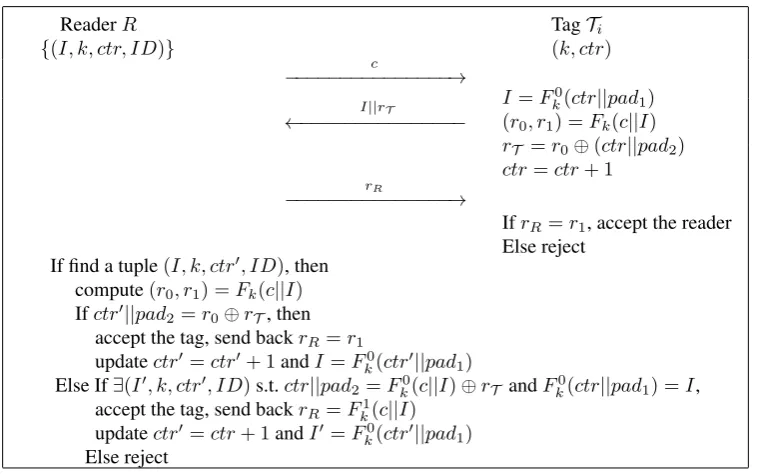
At the start of a new protocol session, Rsends a challenge stringc ∈R {0,1}κ toTi, which also serves as the session identifier. To simplify the presentation, the session identifier and the corresponding verification of the identifier by protocol players are implicitly implied and will not be explicitly mentioned in the following.
Upon receiving c fromR,Ti computes I = Fk0(ctr||pad1),(r0, r1) = Fk(c||I) (where r0 = Fk0(c||I)and
r1=Fk0(c||I)), andrT =r0⊕(ctr||pad2).Tisends(I, rT)toRand then updates its counterctr=ctr+ 1, where pad2∈ {0,1}κ−lctris another predetermined padding string.
– IfRfinds such a tuple, say(I, k, ctr′, ID), it computes(r0, r1) = Fk(c||I), and checks whetherctr′||pad2 =
r0⊕rT: If yes,RacceptsTiby outputting “1”, sendsrR=r1to the tag, updates the tuple(I, k, ctr′, ID)with
ctr′ = ctr′+ 1 andI = F0
k(ctr′||pad1); If not,R searches for the next tuple includingI(to avoid potential collision of indexI, i.e., two different tuples are of the same indexI).
– If no tuple is found to have an indexI (which indicates counter desynchronization betweenRandTi), for each tuple (I′, k, ctr′, ID)in its database,R computes(r0, r1) = Fk(c||I)andctr||pad2 = r0⊕rT, and checks whetherI=F0
k(ctr||pad1): If yes (which indicatesctris the correct counter value atTi),RacceptsTi, outputs “1”, sends back rR = r1as the third message, and updates the tuple(I′, k, ctr′, ID)withctr′ =ctr+ 1and I′=F0
k(ctr′||pad1). In the case thatRfails with all the tuples in its database, it rejects the tag and outputs “0”.
Upon receivingrR,Tichecks whetherrR=r1: If yes,Tiaccepts the reader and outputs “1”; otherwise it rejects
the reader and outputs “0”. This RFID protocol is also depicted in Figure 5.
ReaderR
{(I, k, ctr, ID)}
TagTi (k, ctr)
c
−−−−−−−−−−−−−−−→ I||rT
←−−−−−−−−−−−−−−−
rR
−−−−−−−−−−−−−−−→
I=F0
k(ctr||pad1) (r0, r1) =Fk(c||I)
rT =r0⊕(ctr||pad2) ctr=ctr+ 1
IfrR=r1, accept the reader Else reject
If find a tuple(I, k, ctr′, ID), then compute(r0, r1) =Fk(c||I)
Ifctr′||pad2=r0⊕rT, then accept the tag, send backrR=r1 updatectr′=ctr′+ 1andI=F0
k(ctr′||pad1)
Else If∃(I′, k, ctr′, ID)s.t.ctr||pad2=Fk0(c||I)⊕rT andF
0
k(ctr||pad1) =I, accept the tag, send backrR=Fk1(c||I)
updatectr′=ctr+ 1andI′=F0
k(ctr′||pad1)
Else reject
Fig. 5.RFID Protocol with Mutual Authentication and ZK-Privacy
In comparison with the protocol proposed in [19], the above protocol adds mutual authentication (and is logically more precise), and we can formally prove that it is of adaptive completeness, mutual authentication, and zk-privacy within the new framework. Analysis of completeness and authentication was not conducted in [19], and as we shall see, the zk-privacy analysis of the new protocol is much more complicated than the unp-privacy analysis in [19]. We suggest that the methodology used in our analysis is of independent interest, which can be applied to analyze other RFID protocols (particularly those based on PRFs) within our new framework.
Theorem 2 AssumingFkis a pseudorandom function, the protocol specified above satisfies adaptive completeness,
mutual authentication and zk-privacy.
Below we provide a high level analysis of the zk-privacy property. The complete detailed proof of the theorem is given in Appendix A.
The core of the simulation by the simulatorS = (S1,S2), who runs the underlying adversaryA= (A1,A2)as a subroutine, lies in the actions ofS2in dealing with the following queries made byA2to the readerRand the challenge tagTg.S1just mimicsA1by using the PRFFk.
2. On oracle querySendT(challenge,ˆc), where the challenge tagTg(simulated byS2) currently does not run any session,S2opens a session forTg withˆcas the first-round message (that also serves as the session-identifier of this new session); Then,S2randomly selectsI, rT ∈R {0,1}κ, and sends backI||rT toA2as the second-round message.
3. On oracle querySendR(ˆc,Iˆ||rˆT),S2works as follows:
Case-3.1. IfIˆ||rˆT was sent byTg(simulated byS2) in a session of session-identifierc,ˆ S2simulates the responses of the readerRas follows:
Case-3.1.1 If R is running an incomplete session of session-identifiercˆ(i.e., ˆc was sent by R upon an InitReader query and R is waiting for the second-round message), S2 just returns a random string rR∈R{0,1}κtoA2, and outputs “1” indicating “accept”.
Case-3.1.2. Otherwise,S2simply returns a special symbol “⊥” indicating invalid query.
Case-3.2. In all other cases,S2makes the same oracle querySendR(ˆc,Iˆ||rˆT)to the readerR, and relays back the answer fromRtoA2.
4. On oracle querySendT(challenge,rˆR), where the challenge tagTg(simulated byS2) currently runs a session of partial session-transcript(ˆc, I||rT)and is waiting for the third-round message,S2works as follows:
Case-4.1. If there exists a matching session of the same session transcript(ˆc, I||rT,rˆR)at the side ofR(where
ˆ
rRmay be simulated byS2as in the above Case-3.1),S2outputs “1” indicating “accept”. Case-4.2. Otherwise,S2simply outputs “0” indicating “reject”.
5. Output ofS2: Finally, wheneverA2stops,S2also stops and outputs the simulated viewsviewas specified in the zk-privacy definition, which particularly consists of all oracle answers (including ones provided by the real oracles inOandones simulated byS2) to queries made byA.
It is easy to see thatSworks in polynomial-time. We investigate the differences between the simulated viewsview output bySand the real viewviewAofA:
Difference-1: In Case-4.1 (resp., Case-4.2)S2 always outputs “accept” (resp., “reject”), while the actual challenge tagTgmay output “reject” in Case-4.1 (resp., “accept” in Case-4.2) in the experimentExpzkpA .
Difference-2: On oracle querySendT(challenge,cˆ)or in Case-3.1 upon the oracle querySendR(ˆc,Iˆ||rˆT),S2 al-ways returns truly random strings, while the actual players (i.e.,TgandR) provide pseudorandom strings in the experimentExpzkpA by invoking the PRFFkwherekis the secret-key ofTg.
Intuitively, Difference-1 can occur only with negligible probability, by the properties of adaptive completeness and mutual authentication. The subsequent analysis argues that the properties of adaptive completeness and mutual authentication indeed hold under the simulation ofSinExpzkpS .
Intuitively, Difference-2 should not constitute distinguishable gap betweensviewandviewA, due to the pseudo-randomness ofFk. However, the technical difficulty and subtlety here is that: the difference between
pseudorandom-ness and real randompseudorandom-ness only occurs in the second stages of bothExpzkpA andExpzkpS (i.e.,A2andS2), while bothS1 andA1are w.r.t. the PRFFk. In other words, to distinguish the PRFFkfrom a truly random one in the second stage,
the distinguisher has already accessedFk for polynomially many times in the first stage. In general, the definition of
PRF says nothing on the pseudorandomness in the second stage. To overcome this technical difficulty, we build a list of hybrid experiments.
In the first hybrid experiment, a polynomial-time algorithmSˆrunsA as a subroutine and has oracle access to the PRFFk or a truly random functionH.Sˆfirst randomly guesses the challenge tagTg (by takingg uniformly at
random from{1,· · ·, ℓ}), and then setups the RFID system(R,T)except for the challenge-tagTg. Note thatSˆcan perfectly handle all oracle queries made byAto the readerRand all tags inT − {Tg}. For oracle queries directed toTg,SˆmimicsTg with the aid of its oracle, i.e, the PRFFk or a truly random functionH. Denote by the view of Aunder the run of Sˆ with oracle access toFk (resp.,H) asview
ˆ
SFk
A (resp., viewSˆ
H
A ). By the pseudorandomness
ofFk, we have thatview
ˆ
SFk
A andviewSˆ
H
A are indistinguishable. Next, supposeSˆsuccessfully guesses the challenge
tagTg (that occurs with probability 1ℓ),viewSˆFk
In the second hybrid experiment, we consider another polynomial-time algorithmS′ that mimicsS, with oracleˆ access toFk orH, but with the following modifications: in the second stage of this hybrid experiment,S′essentially
mimics the original zk-privacy simulatorS. Denote by the view ofAunder the run ofS′with oracle access toFk(resp.,
H) asviewS′Fk
A (resp.,viewS ′H
A ). By the pseudorandomness ofFk,viewS
′Fk
A andviewS ′H
A are indistinguishable. We
can show thatviewS′H
A andview
ˆ
SH
A are also indistinguishable, and thatviewS ′Fk
A andsvieware also indistinguishable
(conditioned onS′successfully guesses the challenge tagTg), which particularly implies that the properties of adaptive completeness and mutual authentication hold also insview. This establishes the indistinguishability betweensview andviewA.
7
Future Work
One of our future research directions is to analyze existing RFID protocols and design new protocols within the new framework presented in this paper.
Since our framework is formulated w.r.t. the basic scenario of an RFID system consisting of a single uncompro-mised reader and multiple tags, where tags identify themselves to the reader individually and independently. A future research direction is to extend our RFID privacy framework to more sophisticated and practical scenarios which allow compromising of readers, tag group authentication, anonymizer-enabled RFID systems, and tag ownership transfer. Acknowledgment: We are indebted to Andrew C. Yao for many contributions to this work, though he finally declined the coauthorship. Yunlei Zhao thanks Shaoying Cai for helpful discussions on RFID security and privacy.
References
1. C. Berbain, O. Billet, J. Etrog and H. Gilbert. An Efficient Forward Private RFID Protocol. InConference on Computer and Communications Security – CCS’09.
2. C. de Canniere and B. Preneel. Trivium. In M. Robshaw and O. Billet, editors, New Stream Cipher Designs: The eSTREAM Finalists, volume 4986 of LNCS, pages 244-266. Springer-Verlag, 2008.
3. S. Canard1, I. Coisel, J. Etrog, and M. Girault. Privacy-Preserving RFID Systems: Models and Constructions, Cryptology ePrint Archive, Report No. 2010/405.
4. I. Damg˚ard and M. Ostergaard. RFID Security: Tradeoffs between Security and Efficiency. InTopics in Cryptology–CT-RSA 2008, volume 4964 ofLecture Notes in Computer Science, pages 318–332, 2008.
5. R. H. Deng, Y. Li, A. C. Yao, M. Yung and Y. Zhao. A New Framework for RFID Privacy. Cryptology ePrint Archive, Report No. 2010/059.
6. S. Garfinkel, A. Juels, and R. Pappu. RFID Privacy: An Overview of Problems and Proposed Solutions. IEEE Security and Privacy, 3(3):34–43, 2005.
7. O. Goldreich.The Foundations of Cryptography, volume I, Basic Tools. Cambridge University Press, 2001. 8. O. Goldreich, S. Goldwasser, and S. Micali. How to construct random functions.J. ACM, 33(4):792–807, 1986.
9. S. Goldwasser, S. Micali and C. Rackoff. The Knowledge Complexity of Interactive Proof-Systems InACM Symposium on Theory of Computing, pages 291-304, 1985.
10. P. Golle, M. Jakobsson, A. Juels, and P. Syverson. Universal reencryption for mixnets. InTopics in Cryptology–CT-RSA 2004, LNCS 2964, pages 163-178.
11. J. Ha, S. Moon, J. Zhou, and J. Ha. A new formal proof model for RFID location privacy. InEuropean Symposium on Research in Computer Security (ESORICS) 2008, volume 5283 ofLecture Notes in Computer Science.
12. M. Hell, T. Johansson, and W. Meier. The Grain Family of Stream Ciphers. In M. Robshaw and O. Billet, editors, New Stream Cipher Designs: The eSTREAM Finalists, volume 4986 of LNCS, pages 179-190. Springer-Verlag, 2008.
13. International Standard ISO/IEC 9798 Information technology−Security techniques−Entity authentication−Part 5: Mecha-nisms using Zero-Knowledge Techniques.
14. Nicholas J. Hopper and Manuel Blum. Secure human identification protocols. InASIACRYPT, pages 52–66, 2001.
15. A. Juels. RFID Security and Privacy: A Research Survey.IEEE Journal on Selected Areas in Communications, 24(2):381–394, 2006.
16. A. Juels, R. L. Rivest, and M. Szydlo. The blocker tag: Selective blocking of RFID tags for consumer privacy. In8th ACM Conference on Computer and Communications Security – ACM CCS, pages 103–111. ACM Press, 2003.