Abstract— Providing security services for multicast, such as traffic integrity, authentication, and confidentiality requires securely distributing a group key to group receivers. In literature, this problem is called multicast key distribution (MKD). A famous MKD protocol — OFT (One-way Function Tree) has been found vulnerable to collusion attacks. Solutions to prevent these attacks have been proposed, but at the cost of a higher communication overhead than the original protocol. In this paper, we prove falsity of a recently-proposed necessary and sufficient condition for a collusion attack on the OFT protocol to exist by a counterexample and give a new necessary and sufficient condition for nonexistence of any type of collusion attack on it. We instantiate the general notion of OFT to obtain a particular type of cryptographic construction named homomorphic one-way function tree (HOFT). We propose two structure-preserving graph operations on HOFTs, tree product and tree blinding. One elegant quality possessed by HOFTs is that handling (adding, removing, or changing) leaf nodes in a HOFT can be achieved by using tree product without compromising its structure. We provide algorithms for handling leaf nodes in a HOFT. Employing HOFTs and related algorithms, we put forward a collusion-resistant MKD protocol without losing any communication efficiency compared to the original OFT protocol. We also prove the security of our MKD protocol in a symbolic security model.
Index Terms— Multicast key distribution, One-way function tree, Homomorphism, Collusion
I. INTRODUCTION
Many emerging group-oriented applications, for instance, IPTV, DVB (Digital Video Broadcast),
videoconferences, interactive group games, collaborative applications, and so on all require a
one-to-many or many-to-many group communication mechanism. One of the most efficient
approaches to ensure confidentiality of group communications is employing a symmetric-key
encryption scheme. But before the sender encrypts and transmits the data over a group
communication channel to a group of privileged users, a shared key called group key must be
Manuscript received August 31, 2010; revised December 20, 2010; accepted April 08, 2011. This work was supported in part by the National Natural Science Foundation of China under Grant No. 60973134 and the Natural Science Foundation of Guangdong Province under Grants No. 10351806001000000.
Copyright (c) 2010 IEEE. Personal use of this material is permitted. However, permission to use this material for any other purposes must be obtained from the IEEE by sending a request to [email protected].
Collusion-Resistant Multicast Key Distribution
Based on Homomorphic One-Way Function
established among them. Group key establishment can be subdivided into group key distribution
(GKD) and group key exchange (or group key agreement). Two parallel lines of research,
commonly referred to as broadcast encryption (BE) [1] and multicast key distribution (MKD) (or
multicast encryption), have been established to study the GKD problem. This paper only focuses
on MKD protocols. In contrast with stateless receivers in BE protocols, each receiver in MKD
protocols is stateful, which means that they are allowed to maintain a personal state and make
use of previously learned keys for decrypting current transmissions. Generally speaking, for
large dynamic groups, MKD protocols are often more efficient and scalable than BE protocols.
Rather than tackling the general GKD problem as BE protocols, most MKD protocols aim to
solve a more specific problem in the multicast encryption setting, called immediate group
rekeying. To prevent a new member from decoding messages exchanged before it joins a group,
a new group key must be distributed to the group when a new member joins. This security
requirement is called group backward secrecy [2]. On the other hand, to prevent a departing
member from continuing access to the group’s communication (if it keeps receiving the
messages), the key should be changed as soon as a member leaves. This security requirement is
called group forward secrecy [2]. To provide both group backward secrecy and group forward
secrecy, the group key must be updated upon every membership change and distributed to
legitimate members. This process is referred to as immediate group rekeying in literature.
Respectively, the rekeying process due to a joining membership change (resp. a departing
membership change) is referred to as join rekeying (resp. leave rekeying). For large dynamic
groups with frequent changes in membership, it is a big challenge to design a scalable MKD
Among all generic MKD protocols in which rekey messages are built using traditional
cryptographic primitives (symmetric-key encryption and pseudorandom generators), a class of
protocol called tree-based protocol [3],[4],[5] is the most efficient one to date in terms of
communication overhead. They have a communication complexity of O(log2n) for a group size
of n. A recent result by Micciancio et al. [6] has also confirmed that log2n is the optimal lower
bound on the communication complexity of generic MKD protocols. The first tree-based MKD
protocol is the Logical Key Hierarchy (LKH) [3],[4]. The OFT protocol [7],[5] halves the
communication overhead of LKH in case of leaving rekeying by deriving its key tree in a
bottom-up manner. However, Horng [8] showed that OFT is vulnerable to a particular kind of
collusion attack. Soon after, Ku and Chen [9] found new types of collusion attacks, and they
proposed an improved protocol to prevent any collusion attack. But leaving rekeying using their
approach requires a communication complexity of O((log2n)2+log2n). Recently, Xu et al. [10]
showed that all the known attacks on OFT can be subsumed by a generic collusion attack. They
also derived a necessary and sufficient condition for such an attack to exist and further proposed
a protocol to prevent collusion attacks while minimizing the average broadcast size of rekeying
message. However their protocol requires a storage linear to the size of the key tree (O(2n-1))
and still has a much bigger broadcast size than the original OFT protocol.
In this paper, we prove falsity of Xu et al.’s necessary and sufficient condition for existence of
a collusion attack on the OFT protocol by a counterexample and give a new necessary and
sufficient condition. We introduce a new cryptographic construction named homomorphic
one-way function trees (HOFT) by respectively substituting a homomorphic trapdoor function and a
blinding — for HOFTs and prove that both are structure-preserving. Then, we provide
algorithms for adding/removing/changing leaf nodes in a HOFT without compromising its
structure (i.e., functional dependency between node secrets) by performing a tree product of the
HOFT and a corresponding incremental tree. Utilizing HOFTs and related algorithms, we put
forward a collusion-resistant MKD protocol without losing any communication efficiency
compared to the original OFT protocol. In contrast, two existing solutions [9], [10] to improve
the OFT protocol have to trade off communication efficiency for collusion resistance. We also
prove the security of our protocol in a symbolic security model.
The remainder of this paper is organized as follows. Section II reviews related research results.
In section III, we prove the falsity of Xu et al.’s necessary and sufficient condition for a collusion
attack on OFT to exist by a counterexample. We give a new necessary and sufficient condition
for nonexistence of an arbitrary type of collusion attack. In sections IV, we introduce a new
cryptographic construction – Homomorphic OFT and related algorithms. Section V presents a
collusion-resistant MKD protocol based on HOFTs and related algorithms. Section VI proves the
security of our MKD protocol in a symbolic security model. Section VII gives a comparison
between our protocol and other related protocols. Section VIII concludes this paper and gives
some topics for future research.
II. RELATED RESEARCH
A. Tree-based MKD protocols
The Logical Key Hierarchy (LKH) protocol was independently proposed by Wong et al. [3]
and Wallner et al. [4]. In the LKH protocol, each internal node in the key tree represents a key
root node represents the group key. A key associated with the internal node is shared by all
members associated with its descendant leaf nodes. Every member is assigned to the keys along
the path from its leaf to the root. When a member leaves the group, all the keys that the member
knows should be changed. The key server generates new keys to replace those keys and sends
the newly-generated keys encrypted with keys that the departing member does not have access to.
If n represents the current number of members in a group and we consider a full and balanced
binary tree, leave rekeying using LKH requires at least 2log2n key encryptions and transmission
by the key server. When a member joins, the key server creates a leaf node for it, and changes all
the keys from this leaf node to the root. In addition to sending the newly-generated keys
encrypted with the new member’s leaf node key, the key server sends each new internal node
key encrypted under the key it is replacing, to the other members. Join rekeying using LKH
requires encryptions and transmission of 2log2n keys by key server.
The OFT protocol was proposed by Sherman, Balenson and McGrew [5],[7]. Each internal
node i of a key tree is associated with a node secret xi, a blinded node secret yi and a node key Ki.
Let x2i and x2i+1 denote the left child and right child of xi, respectively. The node secret of the root
node is the group key. There exist two different pseudorandom functions f and g. The function f
is used to compute a corresponding blinded node secret from a node secret, i.e., yi = f(xi); The
function g is used to compute a corresponding node key from a node secret, i.e., Ki = g(xi). A
node key rather than a node secret is used as a key encryption key (KEK) in a rekeying message.
Unlike in the LKH protocol, the key server does not send each member those node secrets along
the path from its associated leaf node to the root. Instead, it supplies each member with the
secrets in its path to the root according to a functional relationship as below. A one-way function
key tree is computed in a bottom-up manner using the pseudorandom functions f and a bitwise
exclusive-or operation denoted by ‘’. Specifically, each internal node secret xi is computed by
exclusive-oring y2i with y2i+1, i.e., xi = y2i y2i+1. When a new member joins/leaves the group, all
the node secrets in its path to the root must change (and therefore the corresponding blinded node
secrets along this path also change). The key server sends the joining member the blinded node
secrets it is entitled to, after encrypting them with this member’s leaf node key. In addition, the
key server encrypts each of those changed blinded node secrets under the corresponding sibling’s
node key, and sends them to old group members in the case of join rekeying or remaining
members in the case of leave rekeying. Consider a full and balanced OFT with n members (after
the join/leave). The key server needs to encrypt and send 2log2n blinded node secrets when a
member joins. It needs to encrypt and send log2n blinded node secrets when a member leaves.
B. Collusion attacks on the OFT protocol
The functional dependency relationship among the node secrets in a one-way function tree
allows leave rekeying using OFT to save half of communication cost as compared to that using
LKH. However, the same relationship also renders it vulnerable to collusion attacks.
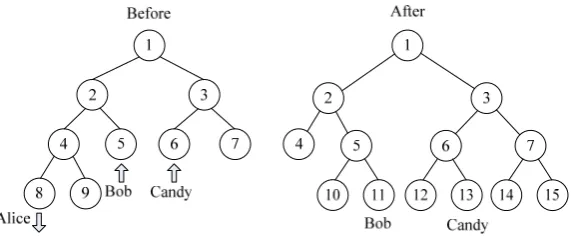
The first collusion attack on the OFT protocol attributes to Horng [8]. Referring to Figure 1,
suppose that Alice, associated with node 8, leaves at time tA, and later Candy joins the group at
time tC and is associated with node 13 (ignore Bob’s joining for the time being). We use xi t t[ , ]A C to
denote the node secret associated with node i in the time interval between tA and tC. Suppose that
there are no changes in group membership between time tA and tC. Since after the eviction of
Alice, x3 is not changed until Candy joins, Alice holds its blinded versiony3[ , ]t tA C . Since x2 is
changed when Alice leaves, and then remains unchanged at least until Candy joins, Candy
receives its blinded versiony2[ , ]t tA C at the time of joining. Collectively knowing y2[ , ]t tA C andy3[ , ]t tA C ,
Alice and Candy can collude to obtain the group key in the time interval [tA, tC] by
computingx1 [ , ]t tA C y2[ , ]t tA C y3[ , ]t tA C . Therefore, the OFT protocol fails to provide not only group
forward secrecy against Alice but also group backward secrecy against Candy. Horng thus
proposed two necessary conditions for a collusion attack to exist: (1) the two colluding nodes
must be evicted and join at different subtree of the root; (2) no key update happens between time
tA and tC. Later, Ku and Chen [9] showed that neither of these two conditions is necessary by
proposing two new kinds of collusion attacks. Referring to Figure 1 again, the first kind of
collusion attack can be described as follows. Suppose that Alice leaves at time tA, and later Bob
joins the group at time tB and is associated with node 11. Also suppose that there are no changes
in group membership between time tA and tB. For the same reason as above, Alice and Bob can
collude to computex2[ , ]t tA B . Since x3 remains unchanged during the time interval [tA, tB], Alice and
Bob both hold its blinded version y3[ , ]t tA B . Therefore, both can further compute the group
key 1[ , ]
A B
t t
x by 1 [ , ] ( 2[ , ]) 3[ , ]
A B A B A B
t t t t t t
at time tA, later Bob joins the group at time tB, and Candy joins the group last at time tC. We also
assume that there are no changes in group membership not only between time tA and tB, but also
between time tB and tC. After the eviction of Alice, x3 is not changed until Candy joins the group.
Therefore, Alice holds its blinded version y3[ , ]t tA C even after her eviction. Since x2 is changed when
Bob joins the group, and then remains unchanged at least until Candy joins the group, Candy
receives its blinded version y2[ , ]t tB C at the time of joining. Collectively knowing y3[ , ]t tA C andy2[ , ]t tB C ,
Alice and Candy can collude to compute the group keyx1[ , ]t tB C (note that [ , ] [ , ]t tB C t tA C ). This attack refutes Horng’s necessary condition (2).
C. Improvements on the OFT protocol
When a new member joins, it will be supplied with the blinded node secrets that were once
used to compute the past group key. On the other hand, when a member leaves, it brings out the
blinded node secrets that may be used to compute the future group key. It is thus possible for a
pair of evicted member and joining member to combine their knowledge together to compute a
valid group key between the time of eviction and that of joining. Therefore, it becomes
reasonable to devise a solution to prevent collusion attacks either by preventing a departing
member from bringing out any blinded node secrets that contain any information about the future
group key or by supplying joining member with blinded node secrets that contain no information
about the past group key. Each of the following two improvements on the OFT protocol is just
aiming at one aspect to achieve collusion-resistance.
Ku and Chen improve the OFT protocol by changing all the keys known by a departing
member. That is to say, when a member leaves, not only all the node secrets in its path to the
must be changed. The additional updates of node secrets increase the broadcast size by (log2n)2
keys. The key server needs to encrypt and send (log2n)2+log2n+1 keys in total.
Xu et al. [10] observed that collusion between an evicted member and a joining member is not
always possible and its success depends on a temporal relationship between them. It is not
necessary to always change additional blinded node secrets as above unless a collusion attack is
indeed possible. They proposed a stateful approach in which the key server tracks all evicted
members and records all the knowledge held by them. Every time a new member joins, the key
server checks against that knowledge to decide whether this joining member could have a
successful collusion with any previous evicted member. For that purpose, their protocol has a
storage requirement linear to the size of the key tree. The key server will not change additional
blinded node secrets as Ku and Chen’s protocol until a successful collusion is detected.
Therefore it has a communication overhead lower than Ku and Chen’s protocol, but still bigger
than the original OFT protocol.
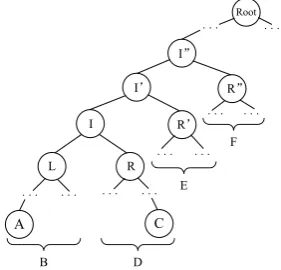
In their paper [10], Xu et al. put forward three propositions to support the correctness and
security of their protocol. They first consider a generic collusion attack on the OFT protocol
(depicted in Figure 2, and notice that this figure actually combines two different key trees
respectively at tA and tC). Before introducing their propositions, let us get familiar with some
notations to be used. Suppose that A leaves at time tA and C joins at a later time tC. Let B, D, E,
and F respectively denote the subtrees rooted at nodes L, R, R’, and R”. Let tDMIN, tEMIN, and tFMIN
denote the time of the first group key update after tA that happens in D, E, and F, respectively.
Let tBMAX, tEMAX, and tFMAX denote the time of the last group key update before tC that happens in
Xu’s proposition 1: For the OFT protocol, referring to Figure 2, the only node secrets that
can be computed by A and C when colluding are:
- xI in the time interval [tBMAX, tDMIN],
- xI’in [tBMAX, tDMIN]∩([tA, tEMIN]∪[tEMAX, tC]),
- xI”in [tBMAX, tDMIN]∩([tA, tEMIN]∪[tEMAX, tC]) ∩([tA, tFMIN]∪[tFMAX, tC]) ,
and so on, up to the root.
In fact, it is easy to verify that all kinds of collusion attacks presented in Section II-B are
subsumed by this generic attack.
Xu’s proposition 2: A pair of colluding members A and C cannot compute any node secret
which they are not supposed to know by the OFT protocol, if one of the following conditions
holds
- A is removed after C joins.
- A and C both join.
- A and C are both removed.
Root
R” I”
F R’ I’
E R I
D L
A C
B
This proposition confirms that the above generic collusion attack is the only pattern of
two-party collusion attack. The same authors also give the following sufficient and necessary
condition for a collusion attack to exist.
Xu’s proposition 3: For the OFT protocol, an arbitrary collection of removed members and
joining members can collude to compute some node secret not already known, if and only if the
same node secret can be computed by a pair of members in the collection.
Unfortunately, in their proof of this proposition, the authors claim that to compute a node
secret not already known, the set of colluding members must already know both child blinded
node secrets of it. This claim is wrong, since the colluding members may not know those child
blinded node secrets at first, but can collude to compute them.
III. A NEW NECESSARY AND SUFFICIENT CONDITION
In this section, we first present an interesting counterexample that refutes the necessity of Xu’s
proposition 3, and then propose a new necessary and sufficient condition for the nonexistence of
an arbitrary type of collusion attack on the OFT protocol. At last, we reveal that for OFT-based
protocols, security against collusion attacks follows from security against collusion between an
A. A counterexample
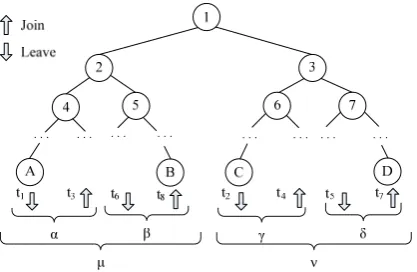
We consider a collusion scenario depicted in Figure 3 (notice that this figure actually
combines multiple key trees respectively at different time ti (i =1, , 7)). Suppose that Alice (A)
and Colin (C) leave the group at time t1 and t2, respectively, and Dean (D) and Bob (B) join the
group at time t7 and t8, respectively. It is assumed that the chronological order of t1, t2, , and t8
corresponds with the numerical order of their subscripts. Let α, β, γ, δ, μ, and ν denote the
subtrees rooted at node 4, 5, 6, 7, 2, and 3, respectively. In addition to the above changes in
group membership, there are changes at time t3, t4, t5, and t6, which happened in α, γ, δ, and β,
respectively. Let X MAX
t denote the time of the last group key update before X joins the group that
happens in α. Let Y
MIN
t denote the time of the first group key update after Y leaves the group that
happens in β. Recall that xv denotes the node secret associated with node v and yv denotes the
blinded version of it. Moreover, xv [t1, t2] denotes the value of node secret xv in the time interval [t1,
t2].
According to Xu’s proposition 1, Alice and Bob can collude to compute x2 in the time interval
[ B MAX
t ,tAMIN], i.e.,x2[ , ]t t3 6 ; Colin and Dean can collude to compute x3 in the time interval [ D
MAX
t ,tCMIN],
i.e., x3[ , ]t t4 5 . Thus, collectively knowing x2[ , ]t t3 6 andx3[ , ]t t4 5 , Alice, Bob, Colin and Dean can collude
to compute
4 5
1[ , ]t t
x . However, we shall show that each pair of evicted member and joining member
cannot collude to computex1[ , ]t t4 5 .
According to Xu’s proposition 1, all the node secrets that can be computed by Alice and Bob
when colluding are:
- x2 in the time interval [tBMAX,tAMIN], i.e.,x2[ , ]t t3 6 ,
- x1 in the time interval [tBMAX,tAMIN]∩([t1,tAMIN]∪[tBMAX,t8]), but evaluation of this formula results
in [t3, t6] ∩([t1,t2]∪[t7,t8])= φ.
Thus, Alice and Bob cannot collude to computex1[ , ]t t4 5 . By the same argument, we can prove
that for the rest of eviction-joining scenarios, i.e., the collusion between Colin and Dean, that
between Alice and Dean, or that between Colin and Bob, x1[ , ]t t4 5 cannot be computed either. This
counterexample thus falsifies the necessity of Xu’s proposition 3.
B. A new necessary and sufficient condition
For OFT-based protocols, the functional dependency between node secrets follows an important
result concerning collusion attacks as follows.
Theorem 1:For a One-way Function Tree Xwith n legitimate members, an arbitrary collection
of k (2≤k≤n) parties cannot collude to compute any node secret not already known (including
the group key), if and only if an arbitrary pair of parties cannot collude to compute any node
secret not already known.
Proof: For an arbitrary node secret xi in a key tree X, we use x2i and x2i+1 to denote its left child
true for any arbitrary k<m (m<n), we prove it is true for k=m by contradiction. Suppose that there
exists a key tree X0 and a group of m parties (denoted by S) who can collude to compute a node
secret xi[a,b] not already known, we divide S into an arbitrary sub-group S’ of size m-1 and a
remaining party mi. According to the inductive hypothesis, an arbitrary collection of parties in S’
cannot collude to compute any node secret not already known (including xi[a,b]). On the other
hand, xi[a,b] is unknown to mi itself since xi[a,b] is unknown to the group S (including mi). In this
case, the only possible way for parties in S to produce a new node secret xi[a,b] on the one-way
function tree X0 is that some party mi’ in S’ already knows x2i[c,d] ([a,b][c,d]) (or x2i+1[e,f]
([a,b][e,f])) and mi already knows x2i+1[e,f] ([a,b][e,f]) (or x2i[c,d] ([a,b][c,d])) such that they
can collude to compute xi[a,b]= f(x2i[c,d]) f(x2i+1[e,f]). But that is a contradiction to the initial
assumption that an arbitrary pair of parties cannot collude to compute any node secret not
already known.
According to Theorem 1, preventing an arbitrary collusion attack on an OFT-based protocol
(Notice that here we mean preventing any collection of parties from colluding to compute any
not-already-known node secret on an OFT tree) is reduced to preventing collusion between an
arbitrary pair of parties. Furthermore, Xu’s proposition 2 confirms that the latter can be reduced
to preventing collusion between an arbitrary pair of evicted member and later-joining member.
Thus, if one is interested in analyzing the security of an OFT-based protocol against collusion
attacks, it suffices to prove it secure against collusion between an arbitrary pair of evicted
member and later-joining member only; immunity to an arbitrary collusion attack follows from
this automatically! Thus, we have the following theorem.
Theorem 2: An OFT-based protocol is secure against collusion attacks if it is secure against
As we discussed in Section II-C, both Ku and Chen’s improvement on OFT protocol and Xu’s
are meant to prevent collusion between an arbitrary pair of evicted member and later-joining
member. It is easy to prove that both are secure against this type of collusion attack using Xu’s
proposition 1.
IV. HOMOMORPHIC ONE-WAY FUNCTION TREES
A. Definition
Before we give the definition of a homomorphic one-way function tree, let’s review some
basic mathematical concepts. A group G with its operation “” is denoted by (G, ). Given two
groups (G, ) and (H, ·), a group homomorphism from (G, ) to (H, ·) is a function f : G →H
such that for all u and v in G, it holds that f(uv) = f(u)·f(v). One can easily deduce that a group
homomorphism f maps the identity element eG of G to the identity element eH of H, and maps
inverses to inverses in the sense of f(u-1) = f(u)-1. According to this definition, the Rabin function
[11] and the RSA function [12] are both homomorphic.
Since all nodes in an OFT are homogeneous (i.e., cryptographic keys), we choose to use
self-homomorphism that maps an Abelian group G to G. If every node secret in an OFT X is an
element of an Abelian group G, we say X is defined over G.
Definition 1 Homomorphic OFT — A homomorphic OFT (HOFT) over an Abelian group(G,
) is a binary key tree that is computed using a self-homomorphic OWF f and the multiplicative
operation “” in a bottom-up manner as follows. For an arbitrary node secret xi in a HOFT X,
suppose that its left child and right child are denoted by x2i and x2i+1 respectively, and we have xi
B. Two structure-preserving operations on HOFTs
A binary operation (resp. unary operation) is said to be structure-preserving if the operation
takes two HOFTs (resp. one HOFT) as inputs (resp. input) and outputs a HOFT. For convenience,
we shall interchangeably use the same notation “xi” or “yi” to denote either a node itself or its
associated node secret in Section IV.
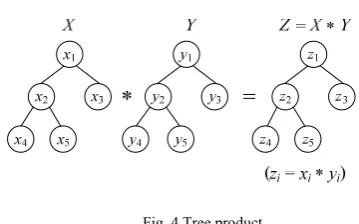
Definition 2 Tree product — Given two arbitrary HOFTs X and Y, both defined over an
Abelian group (G, ), if X and Y are isomorphic, a tree product of X and Y, denoted by XY, is
computed by multiplying their corresponding node secrets (see Figure 4).
Note that although we use the same notation “” for both group operation and tree product, its
meaning is context-evident.
Theorem 3: Given two arbitrary isomorphic HOFTs X and Y, both defined over an Abelian
group (G, ), the result of a tree product X Y is also a HOFT.
Proof: Let X and Y are two arbitrary HOFTs defined over an Abelian (G, ), and Z = XY. We
prove Z is also a HOFT. For an arbitrary node secret ziZ,we have
zi = xiyi (Definition 2)
= (f(x2i) f(x2i+1)) (f(y2i) f(y2i+1)) (Definition 1)
= (f(x2i) f(y2i)) (f(x2i+1) f(y2i+1)) (“” is commutative and associative)
= f(z2i) f(z2i+1) (Definition 2).
Thus, Z is a HOFT according to Definition 1.
It follows that tree product is structure-preserving.
Definition 3 Tree blinding —For an arbitrary HOFT X defined over an Abelian group (G, )
in conjunction with a homomorphic one-way function (HOWF) f, a tree blinding operation based
on f maps X to another key tree Y, denoted by Y = f(X). Y is computed by applying f to every node
of X (see Figure 5). We call Y a blinded tree of X.
Theorem 4: For an arbitrary HOFT X over (G, ), the blinded tree of X, i.e., f(X) is also a
HOFT.
Proof: Let X is an arbitrary HOFT and Y = f(X). We prove Y is also a HOFT. For an arbitrary
node secret yiY, we have
yi = f(xi)
= f(f(x2i) f(x2i+1)) (X is a HOFT)
= f(y2i y2i+1) (Y = f(X))
= f(y2i)f(y2i+1) (f is homomorphic)
Thus, Y is a HOFT according to Definition 1.
x1
x3
x5
x2
x4
y1
y3
y5
y2
y4
X Y=f(X)
(yi= f(xi))
f
It follows that tree blinding is also a structure-preserving operation. Due to one-wayness of f,
tree blinding operation helps conceal information about each node secrets of a key tree without
compromising its structure.
C. Algorithms for handling leaf nodes in HOFTs
In tree-based MKD protocols, adding or removing members involves adding or removing
corresponding leaf nodes in a key tree. In this section, we provide algorithms for handling
(adding, removing, or changing) leaf nodes in a HOFT X without compromising its structureby
performing a tree product of X and an incremental tree (or incremental chain). First of all, we
introduce a concept called Combined Ancestor Tree that was proposed by Sherman and McGrew
[5]. For a set of leaf nodes, the subtree consisting of all ancestors of those leaf nodes is called a
Combined Ancestor Tree (CAT). Especially, an ancestor chain is an instance of a CAT that has
one single leaf node. In below, we only discuss the general (complicate) case —
adding/removing/changing multiple leaf nodes in a HOFT. Algorithms for
adding/removing/changing a single leaf node can be easily derived from those given here.
1) Algorithm 1— adding multiple leaf nodes
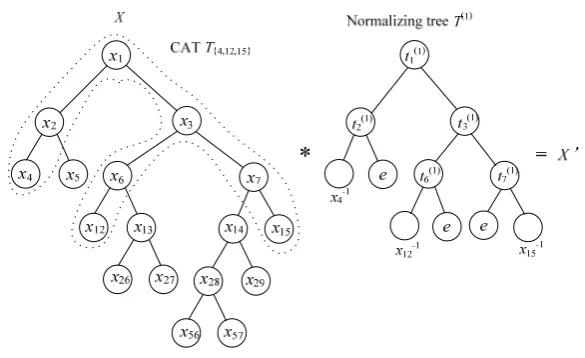
Referring to Figure 6, we want to add leaf nodes x9, x25, and x31 to X. To maintain the balance
of a key tree, we prefer to choose those shallowest nodes as the growing points (i.e., the place
where a new node will be added), for example, x4, x12, and x15 in this case. We use T{4,12,15}to
denote the CAT induced by x4, x12, and x15. Adding multiple leaf nodes to a HOFT without
compromising its structure takes two steps. The first step called normalization (depicted in
Figure 6) is in fact to perform a tree product of X and a normalizing tree T(1). The purpose is to
turn the value of each leaf node secret of the CAT T{4,12,15} into the identity element of G. The
normalizing tree T(1) is constructed from T{4,12,15} by first changing the value of each leaf node
secret of T{4,12,15} into its corresponding inverse in G, and then computing all the other internal
node secrets in a bottom-up manner as described in Definition 1.
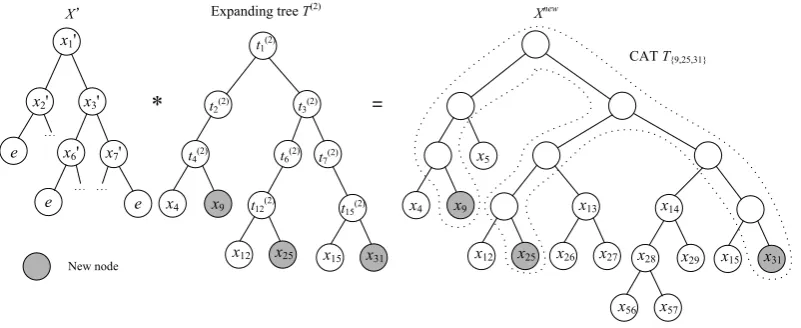
The second step called expansion (illustrated in Figure 7) is to perform a tree product of the
output of the first step, i.e., X’ and an expanding tree T(2). New leaf nodes are actually added onto
X in this step. The expanding tree T(2) is also constructed from T
{4,12,15} by first creating two new
child nodes for each leaf node xi of T{4,12,15} such that the node secret formerly associated with xi
is now associated with the left child of x, and a new node secret is associated with the right child
Xnew
x5
x13 x14
x26 x27 x28 x29
x56 x57
x4 x9
x12 x25 x15 x31
Expanding tree T(2)
x4 x9
x12 x25 x15 x31
e e
e
=
X’ x1'
x2' x3'
x6' x7'
t1(2)
t2(2) t3(2)
t4(2) t6(2) t7(2)
t12(2) t15(2)
New node
CAT T{9,25,31}
of xi, and then computing all the other internal node secrets in a bottom-up manner. The output of
expansion is the final result — an updated key tree Xnew.
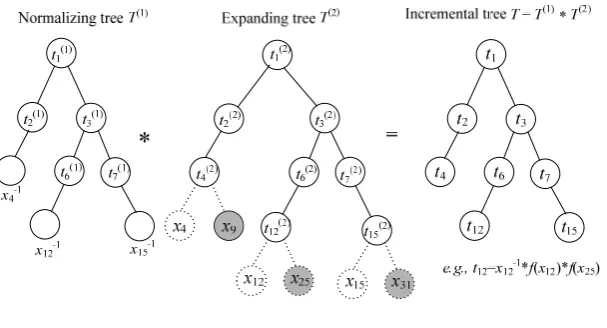
To simplify the two-step process, we introduce a concept called incremental tree. From X to
Xnew, the corresponding incremental tree T depicted in Figure 8 is obtained by performing a tree
product of the normalizing tree T(1) and its counterpart in the expanding tree T(2). Notice that in
Figure 8, we use a dotted circle (shaded or not shaded) to denote node that does not directly
involve in a tree product computation, but whose position should be remembered. Now, Xnew can
be obtained from X by first directly performing a tree product of X and T, then creating two new
child nodes for each node whose place is formerly a growing point, such that the node secret
formerly associated with a growing point is now associated with one child, and a new node
secret is associated with the other child.
2) Algorithm 2 — removing multiple leaf nodes
As illustrated in Figure 9, to remove x9, x11 and x13 from a key tree X without compromising its
structure, the first step is similar to the normalization step for adding multiple leaf nodes.
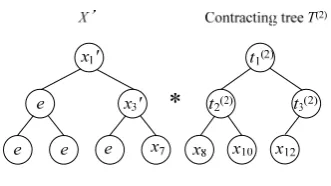
The second step called contraction as illustrated in Figure 10, is to perform a tree product of the
output of the first step, i.e., X’ and a contracting tree T(2). The contracting tree T(2) is constructed
from CAT T{4,5,6} by first replacing each leaf node of T{4,5,6} with its child in X not to be removed,
and then computing all the other internal node secrets in a bottom-up manner.
Similar to the incremental tree for multiple additions (Figure 8), the incremental tree T for these
multiple removals can also be obtained by performing a tree product of the normalizing tree T(1)
and the contracting tree T(2). Now, the updated new key tree Xnew can be obtained from X by first
deleting each leaf node in need of removing and its corresponding sibling (even if it is a subtree),
then performing a tree product of the resulting tree and T.
Fig. 9 Normalization for multiple removals
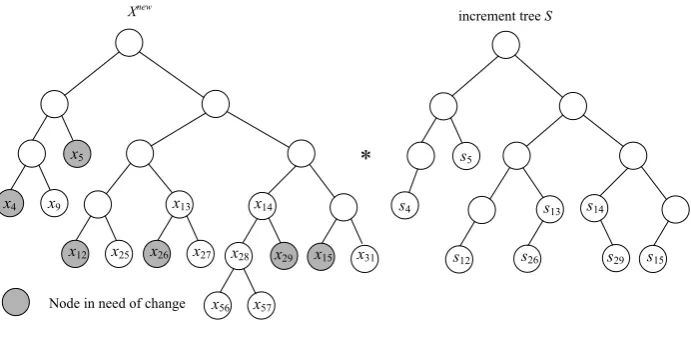
3) Algorithm 3 — changing the value of multiple leaf nodes
As illustrated in Figure 11, to change the value of leaf nodes x4, x5, x12, x26, x29, and x15 in Xnew
into a new value without affecting other leaf nodes and compromising the structure of Xnew, we
randomly select seeds s4, s5, s12, s26, s29, and s15. Then we compute an increment tree S in the
bottom-up manner and perform a tree product of Xnew and S. Of course, the value of all the
internal nodes in the path from the changed leaf node to the root node is also changed. Obviously,
to trigger changing the value of the root node of a HOFT T without compromising T’s structure,
we can choose to change a shallowest leaf node in T using the above algorithm. An efficient way
to change all leaf nodes of a HOFT without compromising it structure is using the tree blinding
operation.
V. A COLLUSION-RESISTANT MKD PROTOCOL BASED ON HOFTS
Employing the three algorithms provided in Section IV, we are able to put forward a
collusion-resistant MKD protocol (we call it the HOFT protocol). When members join or leave,
all the node secrets on the corresponding CAT should be changed. The key server uses
algorithms provided in Section IV to construct an incremental tree (or chain), and update the key
Xnew
x5
x13 x14
x26 x27 x28 x29
x56 x57
x4 x9
x12 x25 x15 x31
increment tree S
s5
s13 s14
s26 s29
s4
s12 s15
Node in need of change
tree by performing a tree product of it and the incremental tree. After that, the key server needs
to communicate all the changes in the key tree to group members by broadcasting the
incremental tree (or chain) such that legitimate members can update their rekeyed node secrets
and rekeyed blinded node secrets by multiplying those secrets by their corresponding
incremental secrets. The essential task of a MKD protocol based on HOFTs is to strictly control
access to the incremental tree (or chain) to ensure group forward secrecy and group backward
secrecy.
Bursty behaviour (a number of membership changes happen simultaneously), periodic group
rekeying or batch group rekeying all require a bulk operation that can process multiple
membership changes simultaneously. The broadcast size and computational effort of multiple
additions and removals can be substantially reduced by using a bulk operation that removes and
adds multiple members simultaneously rather than repeatedly applying individual adding or
removing operations. This reduction results from the fact that a set of individual operations may
repeatedly change node secrets along common segments of the key tree. Although we only
present the protocol for adding/removing multiple members, group rekeying protocol for
adding/removing a single member can be easily derived from those given here.
In the following passages, for any leaf node of a key tree, we shall interchangeably refer to it
and its associated member for simplicity. Similar to OFT, we also use a pseudorandom OWF g to
compute each node key Kv from its corresponding node secret xv, i.e, Kv = g(xv).
A. Removing multiple members in a bulk operation
Taking the scenario depicted in Figure 9 as an example, to remove members x9, x11 and x13 from
CAT T{4,5,6} (resp. x4, x5, x6) with a rekeyed sibling of an evictee (resp. x8’, x10’, x12’). Then the
key server sends the blinded version of each incremental secret ti encrypted under the node key
associate with the sibling of xinew (if exists) in the updated key tree Xnew, for example,
{f(t2)}_K3new, {f(t3)}_K2new, {f(t4)}_K5new(recall that Kinew = g(xinew)). In addition, the key server
sends the sibling of each evictee a new node secret encrypted under its old value, i.e., {x8’}_K8,
{x10’}_K10, {x12’}_K12 (recall that Ki = g(xi)).
After every legitimate member receives the rekeying message, it extracts all blinded
incremental secrets it is entitled to, and computes all incremental secrets it is entitled to in the
incremental tree T in a bottom-up manner, and then updates its own rekeyed node secrets/
blinded node secrets by multiplying their old values by their corresponding incremental secrets.
Consider a full and balanced HOFT with n members. When l members leave, we can compute
the broadcast overhead by the size of the induced incremental tree. We denote the size of the
incremental tree induced by l leaving (joining or changing) members by S(l). According to [5],
S(l) satisfies 2l 1 log2
n l/
S l
2l 1 l log2
n l/
. To remove l members, the key serverneeds to encrypt and send S(l)+l-1 secrets. In addition, the key server needs to perform 2S(l)
modular multiplication computations and S(l)-1 OWF computations.
B. Adding multiple members in a bulk operation
At first, we give the following concept.
Definition 4 Dangling subtree—For a tree X and a subtree T of X, let v be a vertex in T. If v
has a child not in T then every subtree rooted at a child of v not in T is called a dangling subtree
For example, referring to the right part of Figure 7, all the dangling subtrees of T{9, 25, 31} in
Xneware subtrees respectively rooted at x
4, x5, x12, x13, x14, and x15 (Notice that some subtree may
contain only one node). For a full binary tree with n leaves, the number of dangling subtrees of
an arbitrary subtree with l leaves are at most llog2(n/l) (this claim immediately follows from
Claim 1 of [13]).
Taking the scenario depicted in Figure 6 as an example, to add members x9, x25, and x31 to a
HOFT X, the key server needs to perform the following two steps:
(1) Add x9, x25, and x31 onto X
The key server uses the same algorithm 1 provided in Section IV on X to compute the
corresponding incremental tree T (refer to Fig. 8, and here we call it the first incremental tree)
and update the key tree X. Let Xnew denote the updated key tree obtained after the first step (Fig.
7).
(2) Change all the blinded node secrets before supplying them to each joining member
As mentioned in Section II-C, to prevent the possible collusion between a pair of evicted
member and joining member, one of solutions is changing all the blinded node secrets before
supplying them to each joining member. Referring to the HOFT Xnew in Figure 7, all the
corresponding node secrets in need of change are accordingly the root nodes of all the dangling
subtrees of CAT T{9,25,31}, i.e., x4, x5, x12, x13, x14, and x15. As stated in algorithm 3 in Section VI,
to trigger changing the root node of each dangling subtree, we can choose to change a shallowest
leaf node of it. Therefore, to change the root nodes of all the dangling subtrees of CAT T{9,25,31},
the leaf nodes in need of change accordingly are x4, x5, x12, x26, x29, and x15. Now we use
the second incremental tree) and update the tree Xnew. Let XFin denote the final updated key tree
obtained after the second step.
To distribute the first incremental tree T to old members, the key server sends every leaf node
secret of T encrypted under the old group key K1 [recall that K1 =g(x1)], i.e., {t4, t12, t15}_K1. To
distribute the second incremental tree S to old members, the key server sends every leaf node
secret of S encrypted under the old group key K1, , i.e., {s4, s5, s12, s26, s29, s15}_K1. After
decrypting these two messages, every old member can reconstruct these two incremental trees T
and S. Therefore, they can accordingly update their own rekeyed node secrets and rekeyed
blinded node secrets. In addition, the key server also needs to supply every joining member with
blinded node secrets it is entitled to, i.e., {f(x4Fin), f(x5Fin), f(x3Fin)}_K9, {f(x12Fin), f(x13Fin),
f(x2Fin)}_K25, {f(x15Fin), f(x14Fin), f(x6Fin) , f(x2Fin)}_K31 (recall that the final updated key tree is
denoted by XFin).
Consider a full and balanced OFT with n members (after l members join). When l members
join the group, the key server needs to encrypt and send (l+llog2(n/l)+llog2n) (Keys). Recall
that S(l) denotes the size of the incremental tree induced by l leaving (joining, or changing)
members. Also recall that the number of leaf nodes of the second incremental tree equals to the
number of dangling trees of the CAT, i.e., llog2(n/l) at most. Therefore, the size of the first
increment tree and the second incremental tree are respectively S(l) and S(llog2(n/l)). In addition,
the key server needs to perform l+S(l)+S(llog2(n/l)) OWF computations and 2(S(l)+
VI. SECURITY PROOF
In [14], Panjwani develops a symbolic security model for studying GKD protocols. In this
model, all keys and messages generated by a GKD protocol are treated as abstract data types and
cryptographic primitives as abstract functions over such data types. Security notions for GKD
protocols are defined in such a model. Panjwani also proves the security of the LKH protocol [3]
and subset cover protocols [13] using a straightforward inductive argument. We prove the
security of the HOFT protocol under this model as well. Since a rigorous treatment will occupy a
full-length paper, we prove it in a less rigorous (i.e., heuristic) manner. In the following
discussion, we will use some notations given by [14]. Consider a multicast group of n users,
labelled 1, 2, , n. Each user i shares a long-lived key Ki with the key server. At any time t,
users in a specific set S(t) {1,2, , n }, referred to as legitimate members at that time, are
authorized to receive information sent over the multicast channel. The key used to encrypt all the
information sent to S(t) is called the group key, denoted by K(t). The HOFT corresponding to S(t) is
denote by Tr(t). Let [n] denote the set {1, , n} and let 2[n] denote the power set of [n].
Obviously, the group dynamics up to time t can be represented by a sequence of sets
( )t ( (0), (1), , ( )t ) (2 )[ ]n t
S S S S . A sequence S( )t (2 )[ ]n tis called simple, if for all t1, S(t-1) changes
into S(t) through a single change in membership. According to [14],we only need to consider
simple sequence as arbitrary group membership updates can be simulated using simple
sequences only.
We present the following security definitions adapted from the related security definitions
Definition 5: A n-user OFT-based protocol (including the HOFT protocol) is called correct,
if for all t≥0, for all simple sequenceS( )t (2 )[ ]n t, iS(t), i always knows the node secrets on the
path from its associated leaf node to the root (and therefore the corresponding blinded keys along
this path) in Tr(t), and the blinded node secrets that are siblings to this path, and no other node
secrets nor blinded secrets in Tr(t).
Definition 6: An n-user GKD protocol is called secure against single user attack, if for all
t0, for all simple sequenceS( )t (2 )[ ]n t, iS(t), i can never recover (compute) any node secret in Tr(t) (including K(t)) from Ki and the entire rekeying messages throughout the lifetime of the
group.
Definition 7: An n-user GKD protocol is called secure against collusion attacks, if for all
t0, for all simple sequenceS( )t (2 )[ ]n t, an arbitrary set of users Col={i|iS(t)}, Col can never
recover any node secret in Tr(t) (including K(t)) from {Ki| iCol} and the entire rekeying
messages throughout the lifetime of the group.
It is easy to derive that security against collusion attacks implies group forward secrecy and
group backward secrecy for a GKD protocol.
Theorem 5:The HOFT protocol is correctand secure against single user attack.
Proof: We prove this claim using induction over t. For t=0, since S(0)= φ, the claim is trivially
true. Now we argue that if the claim is true for some t-1≥0, then it is true for t as well. For any
simple sequenceS( )t (S(0),S(1), ,S( 1)t ,S( )t )
, we only need to consider the following cases:
Case 1 (iS(t-1)
∧iS(t), and S(t-1) changes into S(t) due to a member’s leaving): According to the
HOFT protocol, i can only recover all those incremental secrets corresponding to its rekeyed
node secrets in Tr(t-1) from the rekeying messages. From inductive hypothesis, i holds all the node
secrets and blinded node secrets in Tr(t-1) as required by Definition 5. Therefore, it still holds and
only holds all the node secrets and blinded node secrets in Tr(t) as required by Definition 5.
Case 2 (iS(t-1)∧iS(t), and S(t-1) changes into S(t) due to a member’s joining): According to the
HOFT protocol, even though i can recover all the incremental secrets in the first incremental
chain (notice that S( )t is simple) and the second incremental tree at time t from the rekeying
messages, it can only update those rekeyed node secrets and blinded node secrets it holds in Tr(t
-1). From inductive hypothesis, i holds all the secret materials in Tr(t-1) as required by Definition 5.
Therefore, it still holds and only holds all the secret materials in Tr(t) as required by Definition 5.
Case 3 (iS(t-1)
∧iS(t)): That is to say, i joins the group at time t. According to the HOFT
protocol, every newly joining member i can recover just the same secret materials as required by
Definition 5 from the rekeying messages.
Case 4 (iS(t-1)∧iS(t)): That is to say, i is evicted at time t. From the inductive hypothesis, all
secrets that i knows are the node secrets on its path to the root and the blinded node secrets that
are siblings to this path in Tr(t-1). However, according to the HOFT protocol, all the node secrets
on i’s path to the root in Tr(t-1) are changed at time t. Even though some blinded node secrets in
Tr(t-1) that i brings out may not change at time t, each incremental secret in the incremental chain
at time t is encrypted not by any blinded node secret, but by a node secret that is one of the
siblings to i’s path to the root in Tr(t-1), and thus unknown to i. Therefore the whole incremental
chain at time t is inaccessible to i, i can never compute any node secret on Tr(t).
every incremental secret is encrypted by a node secret in Tr(t-1) (in the case of both leave
rekeying and join rekeying). Therefore, the whole incremental chain in the case of leave rekeying
at time t (resp. the first incremental chain and the second incremental tree in the case of join
rekeying at time t) is inaccessible to i, and thus i can never compute any node secret on Tr(t).
In fact, the OFT protocol can also be proved to be correct and secure against single user attack
in the same way. In their proof of Xu’s proposition 1 and Xu’s proposition 2, Xu et al. implicitly
assume that the OFT protocol is correct and secure against single user attack.
Theorem 6:An arbitrary pair of colluding members A and C cannot compute any node secret
which they are not supposed to know by a HOFT protocol that is correct and secure against
single user attack.
Proof: As in the proof of Xu’s proposition 2, we use Figure 2 to analyse all possible node keys
that can be computed by a pair of colluding members. In the following three cases: (1) A is
evicted after C joins; (2) C joins after A joins; (3) C is evicted after A is evicted, our proof is just
the same as Xu’s proposition 2 and thus omitted. We only consider the remaining cases as below.
(4) A and C are both evicted at the same time. Referring to Figure 2, according to the HOFT
protocol, all the node secrets on their paths to the root are changed after A and C are evicted.
Furthermore, their knowledge about the siblings (such as node R’ and R’’) to the intersection of
their paths is same. Therefore, they cannot compute any node secret besides what they already
know.
(5) A and C join at the same time. This case is similar to case (4). Thus the proof is omitted.
(6) C joins after A is evicted. Referring to Figure 2, suppose that A is evicted at time tA and later
C joins the group at time tC. According to the HOFT protocol, all the blinded node secrets of
according to Xu’s proposition 1, we have [tBMAX, tDMIN]= φ. Thus, A and C cannot compute any
node secret besides what they already know.
Theorem 7: The HOFT protocol is secure against collusion attacks.
Proof: We prove this claim by contradiction. According to Definition 7, suppose that there
exist a t00 and a simple sequence S( )t0 (2 )[ ]n t0such that a set of users ( )0
0 { }
t
Col i i S can recover
a node secret xi in Tr( )t0 using their long-lived keys and the entire rekeying messages. Because
the HOFT protocol is secure against single user attack (according to Theorem 5), for each
0
( ) 0
t
i Col i S , i can never recover any node secret in Tr( )t0 . Therefore, users in Col0 must
collude to compute the node secret xi. According to Theorem 1, there exists a pair of users (who
may not belong to Col0) who can collude to compute a node secret not already known. This
VII. COMPARISON WITH OTHER PROTOCOLS
We summarize related discussions in Section II and Section V to present a comparison
between our protocol and related protocols, covering the following measures: collusion attack,
TABLE 1COMPARISON WITH RELATED PROTOCOLS (1)ADDING A MEMBER
LKH OFT Ku&Chen Xu HOFT
Collusion attack no yes no no no
Broad. size(bits) 2log2n*K (2log2n+1)*K (2log2n+1)*K
(2log2n+1)*K or ((log2n)2+2log2n+1)*K
(when detecting collusion)
(2log2n+1)*K
Server comp. 2log2n*CE
(2log2n+1)*CE+
(log2n+1)*Ch
(2log2n+1)*CE+
(log2n+1)*Ch
(2log2n+1)*CE+(log2n+1)*Ch
or ((log2n)2+2log2n+1)*CE+
((log2n)2+log2n+1)*Ch(when detecting collusion)
(2log2n+1)*CE+(1+log2n+S(log2n))*Cf+ (2S(log2n)+1)*CM (at most)
Max. old mem.
comp. log2n*CD 2CD+log2n*Ch 2CD+log2n*Ch
2CD+log2n*Ch
or (log2n+1)*CD+0.5*(log2n)2*Ch (when detecting collusion)
(1+log2n)*CD+(log2n+S(log2n))*Cf+ 2log2n*CM(at most)
(2)REMOVING A MEMBER
LKH OFT Ku&Chen Xu HOFT
Collusion attack no yes no no no
Broad. size(bits) 2log2n*K (log2n+1)*K ((log2n)2+log2n+1)*K (log2n+1)*K (log2n+1)*K
Server comp. 2log2n*CE (log2n+1)*CE+log2n*Ch ((log2n)
2
+log2n+1)*CE+
((log2n)2+log2n)*Ch
(log2n+1)*CE+log2n*Ch (log2n+1)*CE+(log2n-1)*Cf+
(log2n+2)*CM
Max. mem. comp. log2n*CD CD+log2n*Ch log2n*CD+0.5*(log2n)2*Ch CD+log2n*Ch CD+log2n*Cf+(log2n+1)*CM
(3)ADDING l MEMBERS
Collusion attack no yes no
Broad. size(bits) (2S(l)-l)*K (S(l)+l*log2n)*K (l+l*log2(n/l)+l*log2n)*K (at most)
Server comp. (2S(l)-l)*CE S(l)*CE+(2S(l)-l)*Ch
(l+l*log2(n/l)+l*log2n)*CE+(l+S(l)+S(l*log2(n/l)))*Cf+
2(S(l)+S(l*log2(n/l))+l)*CM (at most)
Max. old mem.
comp. log2n*CD (l+1)*CD+log2n*Ch
(l+l*log2(n/l))*CD+(S(l)+S(l*log2(n/l)))*Cf+
2log2n*CM(at most)
LKH OFT HOFT
(4)REMOVING l MEMBERS
Collusion attack no yes no
Broad.
size(bits) (2S(l)-l)*K (S(l)+l-1)*K (S(l)+l)*K
Server comp. (2S(l)-l)*CE (S(l)+l-1)*CE+2S(l)*Ch (S(l)+l)*CE+(S(l)-1)*Cf+2S(l)*CM (at most)
Max. mem.
comp. log2n*CD l*CD+log2n*Ch l*CD+log2n*Cf+(2log2n+1)*CM(at most)
broadcast size (in bits), key server’s computational overhead and maximum (old) member
computational cost. The two solutions to improve the OFT protocol respectively proposed by Ku
et al. and Xu et al. are referred to as Ku&Chen protocol and Xu protocol. Since both protocols
did not give the specific algorithms for processing multiple membership changes, we omit them
from relevant comparison. Cost analysis for batch group rekeying using LKH is based on
protocol proposed by Li et al. [15]. In Table 1, n is the number of members in the group and S(l)
is the size of the CAT induced by l leaving (joining or changing) members (Recall that
2 2
2l 1 log n l/ S l 2l 1 l log n l/ ). K is the size of a cryptographic key or (blinded) node secret in bits. CE, CD, Ch, Cf, and CM respectively denote the computational cost of one
evaluation of the encryption function E, one evaluation of the decryption function D, one
evaluation of hash function, one evaluation of trapdoor OWF f, and one modular multiplication
respectively.
In case of leave rekeying, the OFT protocol and the HOFT protocol nearly half the
communicational overhead of the LKH protocol. Another advantage of the OFT protocol over
LKH lies in member’s computational overhead. Surprisingly, this merit possessed by OFT has
been noticed neither by its inventors nor by existing literatures. Unfortunately the OFT protocol
is subject to collusion attack. Ku & Chen protocol improves the OFT protocol to prevent
collusion attack by changing all the node secrets and blinded node secrets known by an evictee
on every member eviction, which require a broadcast of quadratic size. Xu protocol only
performs additional blinded node secret update when detecting a possible collusion between an
evictee and a joining member, thus it has lower communication overhead than Ku & Chen
original OFT protocol. Moreover, when adding l multiple members in a bulk operation, the
worst-case communication cost of HOFT protocol is less than that of the original OFT protocol
by (l-1)K bits. However, due to using a trapdoor OWF (e.g., Rabin function) and modular
multiplication instead of a much faster hash function (e.g., SHA1) and exclusive-or operation as
in the original OFT protocol, HOFT has higher computational overhead than the original one,
especially in conducting join rekeying. However, according to Canetti et al. [16], among all
measures used to evaluate a MKD protocol, communication complexity is probably the most
important one, as it is the biggest bottleneck in current applications. Therefore, it is worth trading
off moderate computational cost for achieving collusion resistance and at the same time, not
losing the communication efficiency compared to the original OFT protocol.
VIII. CONCLUSION AND FUTURE RESEARCH
In this paper, we instantiate the general notion of One-way Function Tree to obtain a new
cryptographic construction named HOFT. Employing HOFTs and related algorithms, we propose
a collusion-resistant MKD protocol without losing the communication efficiency compared to
the OFT protocol. Finding other meaningful application of HOFT is a worthwhile topic. In our
protocol, a HOFT is constructed in a bottom-up manner. We can construct a top-down
homomorphic one-way function tree. But its meaningful application should receive further study
either. To instantiate the general concept of the famous Merkle authentication tree [17] to obtain
a homomorphic authentication tree, we must find a self-homomorphic OWF with respect to a
non-commutative operation at first. We leave as an open problem the existence of homomorphic