A Situational Analytic Method for User Behavior Pattern in
Multimedia Social Networks
Mr. Ahmed bin Khalid & Mr. Mir Mustafa Ali
1Dept. of IT, Deccan College of Engineering and Technology, Hyderabad.
2Assistant Professor, Dept. of IT, Deccan College of Engineering and Technology, Hyderabad
Abstract: The past decade has witnessed
the emergence and progress of multimedia social networks (MSNs), which have explosively and tremendously increased to penetrate every corner of our lives, leisure and work. Moreover, mobile Internet and mobile terminals enable users to access to MSNs at anytime, anywhere, on behalf of any identity, including role and group.
Therefore, the interaction behaviors
between users and MSNs are becoming more comprehensive and complicated. This paper primarily extended and enriched the situation analytics framework for the specific social domain, named as SocialSitu, and further proposed a novel algorithm for users’ intention serialization analysis based on classic Generalized Sequential Pattern (GSP). We leveraged the huge volume of user behaviors records to explore the frequent sequence mode that is necessary to predict user intention. Our experiment selected two general kinds of intentions: playing and sharing of multimedia, which are the most common in MSNs, based on the intention serialization algorithm. By using the user’s behaviors analysis on intentions, we found that the optimal behavior patterns of each user, and a user’s behavior patterns are different due to his/her identity variations in a large volume of session’s data.
1.
Introduction
The rapid development of Multimedia Social Networks (MSNs) causes the tremendous growth of users and digital contents. It’s also convenient for users to access digital contents in MSNs with a large-scale video dataset [1]. Meanwhile, the interaction between user and user, user and system increases. Therefore, providing users with timely and rapidly personalized services considering the complex interaction [2] is now a challenge in the study of multimedia social networks. Generally speaking, multimedia computing can be decomposed into three different stages, from data centric multimedia compression, content-centric multimedia communication and content analysis, to user-centric social media analysis till today, including user trust modeling [3, 4], propagation paths mining [5, 6] and digital right sharing [7], and digital forensics[8-10]. However, understanding and predicting what multimedia content users’ real needs in different situations and contexts have not been well studied [11].
2.
Literature Survey:
Dimensional Situation Analytics: from
We propose a dimensional situation analytics towards a new view on the DIKW hierarchy. By incorporating functional Map Reduce computing paradigm, we present in this paper a novel (MR)2 paradigm, which refers to two consecutive Map Reduce that cut across the boundaries between Data, Information, Knowledge and Wisdom. We argue that our (MR)2 paradigm promotes comprehensive decision making and therefore, offers new insights in knowledge transformation from data to wisdom.
Recommendation of multimedia objects for social network Applications
We present the main points related to recommender systems using multimedia data, especially for social networks applications. We also describe, as an example, a framework developed at the University of Naples “Federico II”. It provides customized recommendations by originally combining intrinsic features of multimedia objects (low-level and semantic similarity), past behavior of individual users and overall behavior of the entire community of users, and eventually considering users’ preferences and social interests.
Context-aware location prediction
In this chapter, we present a context-aware location prediction algorithm that utilizes various types of context information to predict future location of vehicles. We use five contextual features related to either the object environment or its current movement
data: current location; object velocity; day of the week; weather conditions; and traffic congestion in the area. Our algorithm incorporates these context features into its trajectory-clustering phase as well as in its location prediction phase. We evaluate the proposed algorithm using two real-world GPS trajectory datasets. The experimental results demonstrate that the context-aware approach can significantly improve the accuracy of location predictions.
Partial Copy Detection in Videos: A Benchmark and an Evaluation of Popular Methods
In this paper, we introduce a large-scale video copy database (VCDB) with over 100,000 videos, and more than 9,000 copy pairs found by manual annotation. A state-of-the-art system of video copy detection is evaluated on VCDB to show the limitations of existing techniques. We also evaluate deep learning features learned by two neural networks: one is independently trained on a different dataset and the other is tailored to deal with the copy detection task. Our evaluation suggests that all the existing techniques, including the deep learning features, are far from satisfactory in detecting complex real copies.
Towards robust and reliable multimedia analysis through semantic integration of services
annotation platform, which returns reliable results for diverse multimedia analysis problems. This allows for better metadata generation, and improves the efficient retrieval of multimedia resources.
3. System Analysis:
Existing System:
In social media networks, the user has different roles in different groups. The different identifications that the user has may cause the user’s intention to change. The change of intention reflects the change in user’s behavior. The Situ theory does not fully meet the analysis of the intention of users with different identities in the social media environment.
Shen et al put forward an algorithm which considers the surrounding environment and social network relationship. This algorithm could make use of user’s recognized situation, preference, and social network relationship to acquire user’s nearest neighbors through the calculation of the user's comprehensive situation similarity, and predict the potential situation user preference to make a recommendation.
Zhang et al presented an improved N-gram prediction model to predict the possible future web access request of the user through the server log data.
Bar-David et al stated that existing technology made an attempt to predict the
location of moving user according to historical trajectory of moving objects.
Lee et al designed a recommendation mechanism to predict user’s intention and activate appropriate service; an event-condition behavior model and a rule induction algorithm was used to find out behavior patterns of smart phone users, and then, made use of their behavior pattern to predict and recommend the appropriate service for the users.
Disadvantages:
In Bar-David et al method the dynamic nature of the moving behavior may lead to errors in prediction.
Users’ data are high noise and discrete in MSNs, especially mobile social networks, and these. Data cannot be used for analysis and mining in time.
Chang’s situation analytics theory [16, 19] is oriented toward the field of software engineering, not completely appropriate for the emerging application scenario of multimedia social networks.
Proposed System:
In order to better understand users’ intention in MSNs, we greatly need to explore users’ online social behavior Patterns.
social media ecosystem, through newly and comprehensively considering user’s changeable identity and the other is to propose a novel algorithm for users’ behavior pattern analysis and mining
This paper primarily extended and enriched the situation analytics framework for the specific social domain, named as SocialSitu, and further proposed a novel algorithm for users’ intention serialization analysis.
Advantages:
This paper extends and enriches the Situ theory, and builds a SocialSitu framework for the social media networks
.
We design and achieve the intention serialization algorithm in multimedia social networks. The user’s frequent intention sequence mode is obtained through the intention serialization algorithm.
Modules:
Admin Module:
The current sequence of a user is compared with intention sequences of the user in the database to predict the current intention of the user to make a rapid and timely response to the user’s request and provide a personalized service, The ending point of each Intention(i) sequence is used as the result.
User Module:
The user has at least one goal in MSNs, and this corresponds to at least one intention sequence. The user’s intention sequence with a specific goal is saved to the database.
Intention Sequence Generation:
SocialSitu(t) sequence of user from starting point to target achievement, namely
I={SocialSitu(1),SocialSitu(2), ...,
SocialSitu(n)} ,n N,SocialSitu(1) refers to the starting point; SocialSitu(n) refers to the ending point when the target is achieved. Here, SocialSitu(t) sequence is directly correlated to the target achievement. Through the intention sequence, the user achieves the target,
corresponds to the user’s intention, namely i N,i 1 .
4. System Design:
4.1 System Architecture
Image 4.2 Activity Diagram
5. Output Results:
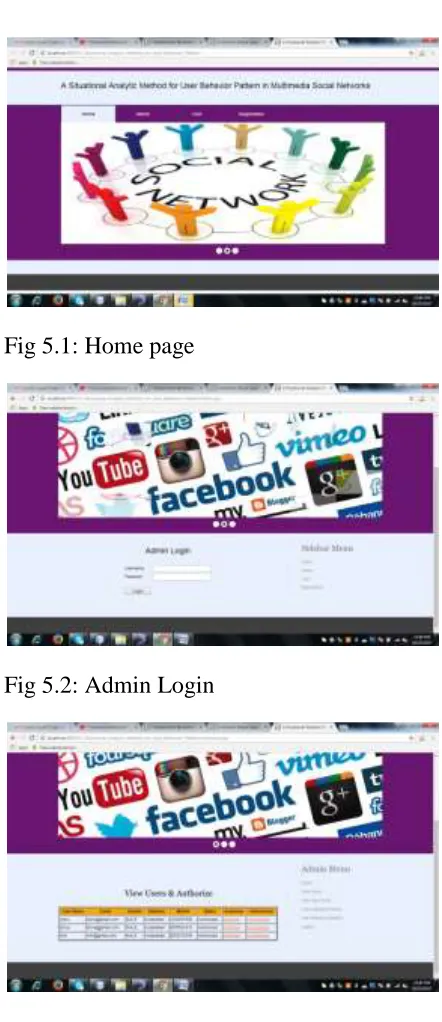
Fig 5.1: Home page
Fig 5.2: Admin Login
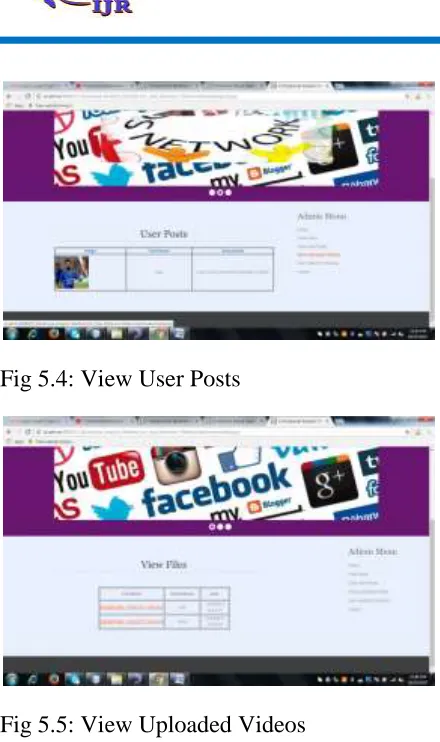
Fig 5.4: View User Posts
Fig 5.5: View Uploaded Videos
Fig 5.6: View User Intention
6. Conclusion
The existing MSNs environment increasingly requires situation awareness. Users’ environment and behavior are dynamic, and an individual’s intention is
also to change. In order to adapt to the dynamic changes of user identities in the social domain, this paper extends and enriches the Situ theory, and builds a SocialSitu framework for the social media networks. We design and achieve the intention serialization algorithm in multimedia social networks. The user’s frequent intention sequence mode is obtained through the intention serialization algorithm. When the user’s identify changes, we conclude his behavior pattern with different ID, and prove that different SocialSitu(t) sequences are acquired in the same MinSupport with the same intention when his role and group change. In the future works, the existing intention sequence patterns of the user could be adopted to predict the user’s more and deeper intentions.
Also the user’s intentions depend not only on his personal behaviour; rather it is also influenced by the behaviour and intentions of the people he is interacting with on MSNs. So while checking for the intention sequence in intention sequence database, we will first give considerations to users intention sequences, followed by intention sequences of users he/she has been interacting with, then go for all the other MSN users. This will allow faster and more reliable sequence of intentions that could be used for predication and various purposes. Besides, we will employ the SocialSituand the proposed algorithm to improve multimedia recommendation system and some killer applications in MSNs.
References
[1] Y. G. Jiang and J. J. Wang, “Partial Copy Detection in Videos:A Benchmark and an Evaluation of Popular Methods,” IEEETrans. Big Data, vol. 2, no. 1, pp.
32-42, Jan/Mar
2016,doi:10.1109/TBDATA.2016.2530714.
[2] B. De Meester, R. Verborgh, P. Pauwels, W. De Neve, E.Mannens, and R. Van de Walle, “Towards robust and reliablemultimedia analysis through semantic integration of services,”Multimedia Tools Appl., vol. 75, no. 22, pp. 14019-14038, Nov.2016.
[3] Z. Zhang and K. Wang, “A Trust Model for Multimedia SocialNetworks,” Soc. Netw.Anal. Min., vol. 3, no. 4, pp. 969-979, Dec.2013.
[4] Z. Zhang and B. B. Gupta, “Social Media Trustworthiness andSecurity: Overview and New Direction,” Future GenerationComputer Systems, submitted for publication.
[5] W. Feng, Z. Zhang, J. Wang, and L. Han, “A NovelAuthorization Delegation for Multimedia Social Networks byusing Proxy Re-encryption,” Multimedia Tools Appl., vol. 75, no.21, pp. 13995-14014, Nov. 2016.
[6] Z. Zhang and K. Wang, “A Formal Analytic Approach toCredible Potential Path and Mining Algorithms forMultimedia
Social Networks,” Comput J., vol. 58, no.4, pp. 668-678, Sep. 2015.
[7] Z. Zhang, Z. Wang, and D. Niu, “A Novel Approach to RightsSharing-Enabling Digital Rights Management for MobileMultimedia,” Multimedia Tools Appl., vol. 74, no. 16, pp. 6255-6271, Aug. 2015.
[8] A. Azfar, K.-K. R. Choo, and L. Liu, “Forensic Taxonomy ofAndroid Social Apps,” J. Forensic Sci., preprint, Nov. 2016, doi:10.1111/1556-4029.13267.
[9] D. Quick and K.-K. R. Choo, “Big forensic data management inheterogeneous distributed systems: quick analysis ofmultimedia forensic data,” Softw. Pract.Exper., preprint, 2016,doi: 10.1002/spe.2429.
[10] N. H. AbRahman, W. B. Glisson, Y. Yang, and K.-K. R. Choo,“Forensic-by-design framework for cyber-physical cloudsystems,” IEEE Cloud Comput., vol. 3, no. 1, pp. 50-59, Feb 2016.
[11] P. Cui, W. Zhu, T. S. Chua, and R. Jain, “Social-SensedMultimedia Computing,” IEEE Multimedia, vol. 23, no. 1, pp.92-96, Jan/Mar 2016.
[13] K. Srinivasan, P. Agrawal, R. Arya, N. Akhtar, D. Pengoria,and T. A. Gonsalves, “Context-aware, QoE-driven adaptationof multimedia services,” 5th International Conference on MobileWireless Middleware, Operating Systems, and Applications, pp.236-249, Nov. 2012, doi: 10.1007/978-3-642-36660-4_17.
[14] C. Tekin and M. Van Der Schaar, “Contextual online learningfor multimedia content aggregation,” IEEE Trans. Multimedia,vol. 17, no. 4, pp. 549-561, Apr. 2015, doi:10.1109/TMM.2015.2403234.