Volume 2006, Article ID 48012, Pages1–10 DOI 10.1155/ASP/2006/48012
Design of Experiments for Performance
Evaluation and Parameter Tuning
of a Road Image Processing Chain
Yves Lucas,1Antonio Domingues,2Driss Driouchi,3and Sylvie Treuillet4
1Laboratoire Vision et Robotique, IUT Mesures Physiques, Universit´e d’Orl´eans, 63 avenue de Lattre, 18020 Bourges cedex, France 2Laboratoire Vision et Robotique, ENSIB 10 Bd Lahitolle, 18000 Bourges, France
3Laboratoire de Statistiques Th´eoriques et Appliqu´ees, Universit´e Pierre & Marie Curie, 175 rue du Chevaleret, 75013 Paris, France 4Laboratoire Vision et Robotique, Polytech Orl´eans 12, rue de Blois BP 6744 45067 Orleans, France
Received 1 March 2005; Revised 20 November 2005; Accepted 28 November 2005
Tuning a complete image processing chain (IPC) is not a straightforward task. The first problem to overcome is the evaluation of the whole process. Until now researchers have focused on the evaluation of single algorithms based on a small number of test images and ad hoc tuning independent of input data. In this paper, we explain how the design of experiments applied on a large image database enables statistical modeling for IPC significant parameter identification. The second problem is then considered: how can we find the relevant tuning and continuously adapt image processing to input data? After the tuning of the IPC on a typical subset of the image database using numerical optimization, we develop an adaptive IPC based on a neural network working on input image descriptors. By testing this approach on an IPC dedicated-to-road obstacle detection, we demonstrate that this experimental methodology and software architecture can ensure continuous efficiency. The reason is simple: the IPC is globally optimized, from a large number of real images and with adaptive processing of input data.
Copyright © 2006 Hindawi Publishing Corporation. All rights reserved.
1. ADAPTIVE PROCESSING IN VISION SYSTEMS
Designing an image processing application involves a se-quence of low- and medium-level operators (filtering, edge detection and linking, corner detection, region growing, etc.) in order to extract relevant data for decision purposes (pat-tern recognition, classification, inspection, etc.). At each step of the processing, tuning parameters have a significant influ-ence on the algorithm behavior and the ultimate quality of results. Thanks to the emergence of extremely powerful and low cost processors, artificial vision systems now exist for de-manding applications such as video surveillance or car driv-ing where the scene contents are uncontrolled, versatile, and rapidly changing. The automatic tuning of the IPC has to be solved, as the quality of low-level vision processes needs to be continuously preserved to guarantee high-level task robust-ness.
The first problem to be tackled in order to design adap-tive vision systems is the evaluation of image processing tasks. Within the last few years, researchers have proposed
rather empirical solutions [1–7]. When confirmed a ground
truth is available, it is possible to compare directly this ref-erence to the results obtained by using a specific metric.
Sometimes no ground truth exists or data are uncertain and either application experts are needed for qualitative visual as-sessment or empirical numerical criteria are searched for. All
these methods consider only one operator at a time [8–11].
However the separate tuning of each operator rarely leads to an optimal setting of the complete IPC. Moreover, image op-erators are generally tested on a too small number of test im-ages, sometimes even on artificial noised imim-ages, to
evalu-ate algorithm efficiency. This cannot replace a large real
im-age base, for IPC testing. So, how can we evaluate on a great number of images a sequence of image processing operators involving numerous parameters?
A second problem remains unsolved: how to find the rel-evant tuning and hence how to adapt image processing to maintain a constant quality of results? As real time process-ing is executed by electronic circuits, this hardware must in-corporate programmable facilities so that operator parame-ters can be modified in real time. Artificial retinas as well as intelligent video cameras already enable the tuning of some acquisition parameters. Concerning the processing parame-ters, the amount of computing necessary to distinguish the
effect on the results of modifying several parameters seems at
parameters. It should be noted that the choice of operators here still appeals to the experimenter but an other research
work also examines the possibility of its automation [12,13].
In this paper, we show how to overcome these problems using an experimental approach combining statistical mod-eling, numerical optimization, and learning. We illustrate this approach in the case of an IPC dedicated to line extrac-tion for road obstacle detecextrac-tion.
2. METHODOLOGY OVERVIEW
To evaluate a full image processing chain, including a series of low- and medium-level operators with tunable parameters, instead of focusing on single algorithms, we need to adopt a global optimization approach. The first step is the evalu-ation of the IPC performance, depending on the significant tuning parameters to be identified and on their interactions. The second step is the parameter tuning itself which should enable adaptive image processing. It implies relating input image content to the optimal tuning parameter for each par-ticular image. These two steps are described in the following paragraphs.
2.1. Performance evaluation
Building a specific and exhaustive database for the target ap-plication is the preliminary and delicate step to achieve rel-evant tuning of the IPC. Indeed, this database covering all situations is required during modeling, optimization, and control learning tasks. From a statistical point of view, se-lected images should reflect the frequency of any image con-tent during the IPC operation and express all its versatility.
A typical subset of this database is then processed by the
IPC. Output evaluation is here necessary in off-line mode, for
IPC understanding and adjustment. This type of evaluation has been extensively researched even if the studies involve a single algorithm at each time. It remains a critical step, as each IPC is specific and requires its own evaluation criteria. The evaluation can be supported by a ground truth or can be unsupervised when empirical criteria are used instead.
Testing all the tuning parameters on the whole image database would lead to a combinatorial explosion; and more-over a physical model of that IPC could still not be deduced. As it is necessary to model the influence of the IPC pa-rameters, we decided to build instead a statistical model.
Modeling the parameter influence is carried out through
the design of experiments [14]. This is a common tool in
en-gineering practice but has been only recently introduced for
machine vision applications [15,16]. It consists in
model-ing the effects of simultaneous changes of IPC parameters
with a minimum number of trials. In the simplest case, only two modes are allowed for each parameter: a low one and a high one, which means that the parameter bounds need to be carefully set. During the experiments, the IPC is considered
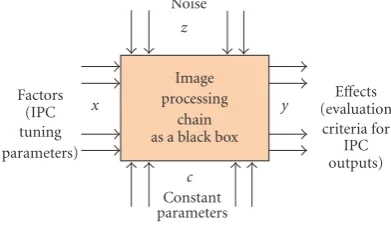
as a black box whose factors (Xituning parameters) influence
the effects (Yivalues of the criteria for output image
evalua-tion) (Figure 1).
Image processing
chain as a black box Factors
(IPC tuning parameters)
x y
z
c
Effects (evaluation
criteria for IPC outputs) Constant
parameters Noise
Figure1: System modeling.
Note that tuning only one parameter at a time can not lead to an optimal setting as some parameters may be inter-dependent. Hence, the goal is to identify which of the pa-rameters are really significant and their strong interactions
with respect to the effects. Generally a polynomial model is
adopted, whose coefficientsai j are estimated by least square
methods:
y=a0+a1x1+· · ·+akxk+a12x1x2+· · ·+ak−1kxk−1xk.
(1)
The interpretation of the experiments by variance analysis confirms whether the model obtained is really meaningful or not. The amount of computing remains very high as the same trials must be repeated on a large number of test im-ages to obtain statistical evidence. Hence, no optimal tun-ing is obtained for a given image, only an average tuntun-ing for the IPC itself. The parameters influencing significantly the quality of results are identified, and the strong interactions among them are also detected, so that only the latter are con-sidered for further IPC programing tasks.
2.2. Parameter tuning
For each particular test image of the database, the optimal tuning of the IPC parameters still needs to be sought. This is typically an optimization process which still involves the output evaluation. The average tuning obtained previously provides valid initial conditions to the search process and the high and low modes of the significant parameters bound the exploration domain.
To obtain the optimal parameter tuning for the IPC, we look for methods not based on the local gradient computing as it is not available here. The simplex method enables to ex-plore the experimental domain and to reach maxima using a
simple cost function to guide the search direction [17].
Ex-perimentally, a figure ofn+ 1 points of ann-dimension space
is moved and warped through geometric transformations in the parameter space, until a stop condition on the cost func-tion is verified.
Large image database
Image processing chain (IPC)
Output Descriptors New tuning Tested parameters Measures Input
evaluation
Control module
Output evaluation
Modeling module Learning
Figure2: Architecture of an adaptive IPC.
that could be correlated to the optimal tuning parameters of these images. Such descriptors will be calculated also on new incoming images, and we should expect that images with similar descriptors will be processed correctly by the IPC dur-ing inline mode, usdur-ing similar tundur-ing parameters. So, to con-stitute a learning base, we compute the descriptors of the test images with known optimal tuning parameters.
The selection of relevant descriptors is not an obvious task and implies experimentation. The idea is that such de-scriptors should extract data which is significant for the tun-ing parameters of the considered IPC. Input evaluation has been investigated much less than output evaluation. Achiev-ing an adaptive and automatic IPC tunAchiev-ing implies extractAchiev-ing relevant descriptors from input images, that is to say, they are closely related with IPC optimal tuning for each image. Im-age descriptors also enable the initial dimension of the tuning
problem (image size inn2pixels) to be lowered, as each image
pixel contributes to the tuning. Experimentally, a parameter
vector lowers this dimension to the gray-level number (≈n),
using a histogram computed over the image.
The last step is the control module programing. This module will compute in real time adapted tuning parame-ters for new incoming images, using the descriptors of these images.
A neural network is a convenient tool for estimating the complex relation between the input image descriptors and the corresponding values of the tuning parameters. As men-tioned previously, the set of test images with optimal tun-ing parameters constitutes the learntun-ing base of this network. Then, if the selected descriptors are relevant for the tuning purpose, the neural network should converge. The other part of the image database is reserved for the test of the neural network. The performance of the tuning will be steadily mea-sured by comparing not the tuning parameters, but the IPC output directly. In particular, we will compare the neural net-work performance to simplex reference and also to the best trials of the design of experiments.
Finally, after the preceding steps devoted to statistical modeling, numerical optimization, and learning, the IPC is toggled into an operational mode, and the image processing tuning parameters are continuously adapted to the charac-teristics of new input images. To summarize our approach for IPC tuning, the architecture of an adaptive IPC can be
the following (Figure 2).
In the following, we illustrate our approach for IPC tun-ing on a road image processtun-ing chain. This application will also help us to introduce practical details of the methodol-ogy. Naturally, input and output image evaluations will be specific to the application, but the methodology is generic.
3. APPLICATION TO A ROAD IMAGE
PROCESSING CHAIN
3.1. IPC overview
This application is part of the French PREDIT program and has been integrated in the SPINE project (intelligent passive security) intended to configure an intelligent airbag system in precrash situations. An on-board multisensor system (EEV high speed camera + SICK scanning laser range finder) inte-grated in a PEUGEOT 406 experimental car classifies poten-tial front obstacles and estimates their collision course in less
than 100 ms [18–20]. To respect this drastic real-time
con-straint, a low and medium image processing has been imple-mented in the hardware with the support of the MBDA
com-pany. It consists of two ASIC circuits [21] embedded with
a DSP into an electronic board interfaced with the vehicle CAN bus. As the first tests performed by the industrial car part supplier FAURECIA demonstrated that a static tuning is
ineffective against road image variability, an automatic and
adaptive tuning based on the approach presented here has
been successfully adopted [22]. Eight reconfigurable
param-eters can be modified at any time: Canny-Deriche filter
co-efficient (X1), image amplification coefficient (X2), edge low
and high threshold values (X3,X4), the number of
elemen-tary automata for contour closing (X5), polygonal
approxi-mation threshold (X6), little segment elimination threshold
(X7), and the approximation threshold for horizontal and
vertical lines (X8) (Figure 3).
3.2. Output evaluation
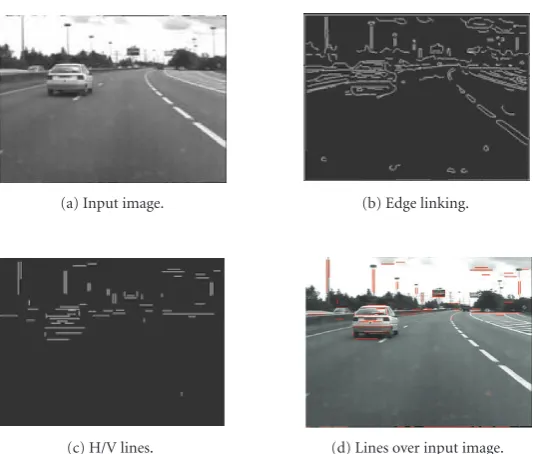
The IPC should extract from the image horizontal and
ver-tical lines (Figure 4), which, after perceptual grouping,
Line/col convolution Gradient computing edge thresholding
OREC ASIC
Edge extraction thinning
linking OPNI ASIC
DSP
Horizontal & vertical lines Video
input
Edge points
X1 X2 X5 X6
X3 X4 X7 X8
Figure3: Tunable parameters of the road image processing chain.
(a) Input image. (b) Edge linking.
(c) H/V lines. (d) Lines over input image.
Figure4: H/V line extraction.
called covering rate, which can be computed for different
pa-rameter tunings (Figure 5).
The covering rater is defined as follows: for each
hor-izontal or vertical S segment, we introduce a
rectangular-shapedMSmask centered on this segment and whose width
is proportional to the length of that segment. The shape ratio of the mask is a constant, experimentally tuned on road
im-ages, to obtain significant variations ofrfor different tunings
without saturation effects (ROI entirely covered by masks).
For each image pixel (i,j) inW(nx- andny-dimensions),
we define a function f(i,j) by
f(i,j)=1 if∃S∈W|(i,j)∈MS,
f(i,j)=0 otherwise. (2)
The covering rate (0≤r ≤1) is then simply given by
r= 1
nxny nx
i=1 ny
j=1
f(i,j). (3)
The higher covering rate is desirable as it indicates that the ROI contains many large and well-distributed segments, which are robust entities for car detection.
This criterion is dependent on the image content: if only
a few segments exist,r cannot reach high scores even after
optimal tuning, sor is considered as acceptable when most
of the obstacle edges have been well extracted. An intuitive graphical interpretation exists for the covering rate: it is sim-ply the part of the ROI which is covered by the superimposi-tion of the masks associated to the set of segments detected by the IPC; it will be expressed in this paper as a percentage.
3.3. Statistical modeling
Three experiment designs have been implemented inside the
modeling module:a2k−p factorial fractional design with 16
trials [23] to select the really significant parameters, a
Rech-schaffner design [24] with 37 trials, and finally a quadratic
design with 27 trials, by adding an intermediate zero mode to detect nonlinearity. By using two modes for the tuning
of each parameter (Table 1), 28different IPC outputs can be
compared from any given input image.
A preliminary task consists in specifying for each factor an interval which bounds the experimental domain. Dur-ing each experimental trial, every factor is set to its low or
(a) Trial no 1. (b) Trial no 7.
(c) Trial no 1: covering rate 31.50%.
(d) Trial no 7: covering rate 78.34%.
Figure5: IPC output evaluation.
Table1: Modes for all the design of experiments.
Factor Parameter Modes
X1 Canny-Deriche filter 0.5 1
X2 Image amplification 33 63
X3 Edge low threshold 5 15
X4 Edge high threshold 15 30
X5 Contour closing 26 30
X6 Polygonal approximation 5 6
X7 Little chains threshold 5 10
X8 Slope threshold 1 3
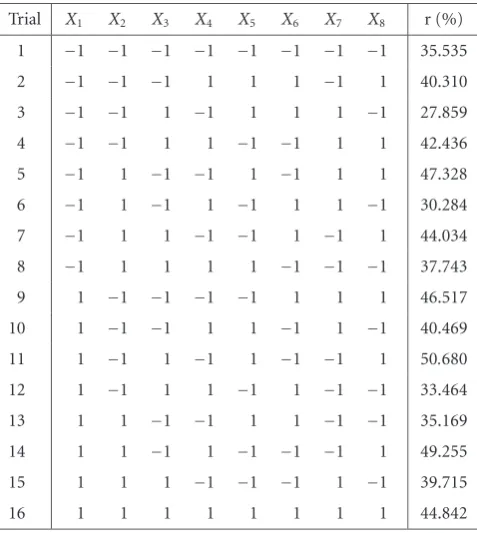
experiment matrix. Therefore, each experiment design of ex-periments is well defined by its experiment matrix whose line number refers to the number of trials and column number refers to the number of tested parameters. We present below the experiment matrix and the covering rate for the set of
trials of the first design of experiments (Table 2).
These designs have been tested on 180 input images se-lected from a video sequence of over 30 000 city and mo-torway frames. A statistical model has been deduced and
validated by measuring R-Square and Mallow C(p)
indi-cator (Table 3). HighR-Square and lowC(p) indicate that
the number of significant parameters is three (X1,X6,X8). A
fourth parameter is not relevant as it does not appreciably
improve theR-Square andC(p) values; hence experimental
data will not fit better to the model with an additional pa-rameter. The first design of experiments only models the sig-nificant parameters without interactions:
Y=51.1965 + 8.65X1−4.08X6+ 4.31X8. (4)
Table2: Experiment matrix-fractional factorial 28−3 design:
aver-aged outputs.
Trial X1 X2 X3 X4 X5 X6 X7 X8 r (%)
1 −1 −1 −1 −1 −1 −1 −1 −1 35.535
2 −1 −1 −1 1 1 1 −1 1 40.310
3 −1 −1 1 −1 1 1 1 −1 27.859
4 −1 −1 1 1 −1 −1 1 1 42.436
5 −1 1 −1 −1 1 −1 1 1 47.328
6 −1 1 −1 1 −1 1 1 −1 30.284
7 −1 1 1 −1 −1 1 −1 1 44.034
8 −1 1 1 1 1 −1 −1 −1 37.743
9 1 −1 −1 −1 −1 1 1 1 46.517
10 1 −1 −1 1 1 −1 1 −1 40.469
11 1 −1 1 −1 1 −1 −1 1 50.680
12 1 −1 1 1 −1 1 −1 −1 33.464
13 1 1 −1 −1 1 1 −1 −1 35.169
14 1 1 −1 1 −1 −1 −1 1 49.255
15 1 1 1 −1 −1 −1 1 −1 39.715
16 1 1 1 1 1 1 1 1 44.842
High module values of the coefficients denote significant
pa-rameters as theY is strongly affected when such parameter
Table3: Significance of the model.
Coef R-Square C(p) Factors
1 0.673 49.01 X8
2 0.827 22.29 X1,X8
3 0.938 3.48 X1,X6,X8
4 0.950 3.36 X1,X2,X6,X8
5 0.956 4.25 X1,X2,X4,X6,X8
6 0.960 5.47 X1,X3,X4,X6,X7,X8
7 0.961 7.18 X1,X2,X3,X4,X6,X7,X8
8 0.962 9.00 All
(brighter). The coefficients are slightly modified but the signs
of the coefficients and the significant parameters remain the
same.
We obtain for the left shift:
Y =35.65 + 6.31X1−3.14X6+ 4.8X8 (5)
and for the right shift:
Y=50.14 + 8.86X1−5.01X6+ 5.50X8. (6)
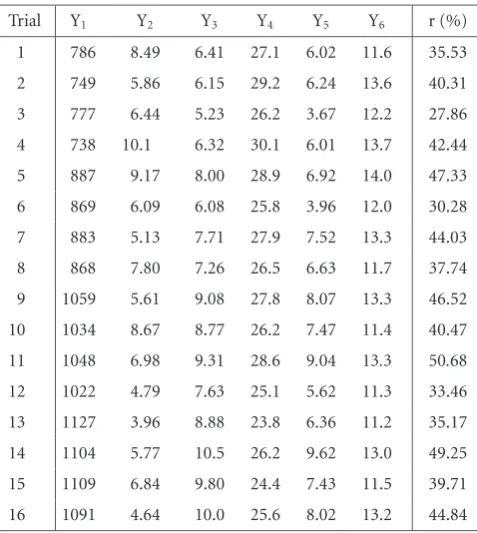
InTable 4, we added the internal IPC quality indicators on
the 28−3 design results: Y
1 stands for the number of edge
points at OREC ASIC output, Y2 is the average length of
linked edge points at OPNI ASIC output, and Y3 andY4
(resp.,Y5andY6) are the number and average length of
hor-izontal (vertical) lines detected at DSP output, respectively. It is clear that a separate tuning of the IPC components does not give optimal results for the whole IPC. Hence, the evalu-ation criteria for the IPC performance should only be com-puted at the output.
The second design of experiments (Table 5) displays
an-other polynomial model that extracts the same three signifi-cant parameters. As the number of trials is larger, it is possi-ble this time to take the strongest parameter interactions into
account (Table 6). There is an interaction between two
pa-rameters if the tuning of one of the papa-rameters works diff
er-ently depending on the tuning of the second one. High
mod-ule values for the coefficients ofXiXjproducts denote strong
interaction. Other products are eliminated in the polynomial expression:
Y =40.2 + 2.06X1+ 0.74X2−2.47X6
+ 5.30X8−0.92X1X2+ 0.95X6X8.
(7)
Finally, in the third design of experiments (Table 7), only the
three significant factors are tuned but a third mode is added
to take nonlinear effects into account.
The covering rates obtained for the different trials
pro-vide an average tuning for the IPC parameters. This static tuning cannot be optimal for each given input image but it enables initializing the Nelder & Mead optimization al-gorithm based on the simplex method. This alal-gorithm then computes all the parameter optimal values corresponding to each tested input image.
Table4: Comparison of internal and output evaluation criteria.
Trial Y1 Y2 Y3 Y4 Y5 Y6 r (%)
1 786 8.49 6.41 27.1 6.02 11.6 35.53
2 749 5.86 6.15 29.2 6.24 13.6 40.31
3 777 6.44 5.23 26.2 3.67 12.2 27.86
4 738 10.1 6.32 30.1 6.01 13.7 42.44
5 887 9.17 8.00 28.9 6.92 14.0 47.33
6 869 6.09 6.08 25.8 3.96 12.0 30.28
7 883 5.13 7.71 27.9 7.52 13.3 44.03
8 868 7.80 7.26 26.5 6.63 11.7 37.74
9 1059 5.61 9.08 27.8 8.07 13.3 46.52
10 1034 8.67 8.77 26.2 7.47 11.4 40.47
11 1048 6.98 9.31 28.6 9.04 13.3 50.68
12 1022 4.79 7.63 25.1 5.62 11.3 33.46
13 1127 3.96 8.88 23.8 6.36 11.2 35.17
14 1104 5.77 10.5 26.2 9.62 13.0 49.25
15 1109 6.84 9.80 24.4 7.43 11.5 39.71
16 1091 4.64 10.0 25.6 8.02 13.2 44.84
3.4. Input evaluation
Before starting the learning of the control module, input de-scriptors should be computed to characterize input images.
The homogeneity histogram [25] of the input image has been
selected to take in account regions with uniform shade (e.g., vehicle paintings) as well as homogeneous texture (e.g., road
surface) (Figure 6).
The homogeneity measure combines two local criteria:
the local contrastσi jin ad×d(d=5) window centered on
the current pixel (i,j), and a gradient measureei jin another
t×t(t=3) window:
σi j= 1
d2
p=i+(d−1)/2
p=i−(d−1)/2
q=j+(d−1)/2
q=j−(d−1)/2
gpq−μi j 2
, (8)
whereμi jis the average of the gray levels computed inside the
same window by
μi j= 1
d2
p=i+(d−1)/2
p=i−(d−1)/2
q=j+(d−1)/2
q=j−(d−1)/2
gpq. (9)
The measure of intensity variationsei jaround a pixel (i,j) is
computed by Sobel operator:
ei j=
G2
x+G2y, (10)
whereGxandGyare the components of the gradient at pixel
(i,j) inxandydirections, respectively.
These measures are normalized usingVi j =σi j/maxσi j
Table5: Experiment matrix-Rechschaffner design: averaged
out-puts.
Trial X1 X2 X3 X4 X5 X6 X7 X8 r (%)
1 −1 −1 −1 −1 −1 −1 −1 −1 35.47
2 −1 1 1 1 1 1 1 1 43.50
3 1 −1 1 1 1 1 1 1 45.13
4 1 1 −1 1 1 1 1 1 45.68
5 1 1 1 −1 1 1 1 1 45.01
6 1 1 1 1 −1 1 1 1 44.99
7 1 1 1 1 1 −1 1 1 47.73
8 1 1 1 1 1 1 −1 1 46.53
9 1 1 1 1 1 1 1 −1 33.46
10 1 1 −1 −1 −1 −1 −1 −1 40.99
11 1 −1 1 −1 −1 −1 −1 −1 41.12
12 1 −1 −1 1 −1 −1 −1 −1 40.98
13 1 −1 −1 −1 1 −1 −1 −1 41.69
14 1 −1 −1 −1 −1 1 −1 −1 34.56
15 1 −1 −1 −1 −1 −1 1 −1 40.87
16 1 −1 −1 −1 −1 −1 −1 1 51.06
17 −1 1 1 −1 −1 −1 −1 −1 38.03
18 −1 1 −1 1 −1 −1 −1 −1 37.75
19 −1 1 −1 −1 1 −1 −1 −1 38.19
20 −1 1 −1 −1 −1 1 −1 −1 30.98
21 −1 1 −1 −1 −1 −1 1 −1 37.82
22 −1 1 −1 −1 −1 −1 −1 1 47.78
23 −1 −1 1 1 −1 −1 −1 −1 33.89
24 −1 −1 1 −1 1 −1 −1 −1 35.12
25 −1 −1 1 −1 −1 1 −1 −1 27.49
26 −1 −1 1 −1 −1 −1 1 −1 34.85
27 −1 −1 1 −1 −1 −1 −1 1 43.81
28 −1 −1 −1 1 1 −1 −1 −1 34.42
29 −1 −1 −1 1 −1 1 −1 −1 27.36
30 −1 −1 −1 1 −1 −1 1 −1 34.27
31 −1 −1 −1 1 −1 −1 −1 1 43.29
32 −1 −1 −1 −1 1 1 −1 −1 28.19
33 −1 −1 −1 −1 1 −1 1 −1 35.38
34 −1 −1 −1 −1 1 −1 −1 1 44.66
35 −1 −1 −1 −1 −1 1 1 −1 27.89
36 −1 −1 −1 −1 −1 1 −1 1 41.10
37 −1 −1 −1 −1 −1 −1 1 1 44.26
Table6: Factor influence and interactions: Rechschaffner design.
X1 2.06 — — — — — — —
X2 −0.92 0.74 — — — — — —
X3 −0.05 0.08 −0.23 — — — — —
X4 0.07 0.16 0.03 −0.21 — — — —
X5 −0.04 −0.01 0.06 0.03 0.08 — — —
X6 0.04 0.05 0.01 0.13 0.06 −2.47 — —
X7 −0.21 −0.07 0.03 0.03 0.03 0.02 −0.34 —
X8 −0.04 0.05 −0.11 −0.09 −0.03 0.95 −0.03 5.30
X1 X2 X3 X4 X5 X6 X7 X8
Table7: Experiment matrix-Quadratic design: averaged outputs.
Trial X1 X6 X8 r (%)
1 −1 −1 −1 41.22
2 0 −1 −1 44.74
3 +1 −1 −1 45.26
4 −1 0 −1 34.22
5 0 0 −1 38.00
6 +1 0 −1 39.26
7 −1 +1 −1 34.16
8 0 +1 −1 37.90
9 +1 +1 −1 39.10
10 −1 −1 0 47.97
11 0 −1 0 50.96
12 +1 −1 0 51.67
13 −1 0 0 43.23
14 0 0 0 45.56
15 +1 0 0 47.45
16 −1 +1 0 43.10
17 0 +1 0 45.58
18 +1 +1 0 47.33
19 −1 −1 +1 50.40
20 0 −1 +1 53.90
21 +1 −1 +1 55.02
22 −1 0 +1 46.85
23 0 0 +1 51.00
24 +1 0 +1 52.93
25 −1 +1 +1 46.87
26 0 +1 +1 51.13
(a) Input image.
(b) Local contrast image (Vi j).
(c) Gradient image (Ei j).
(d) Homogeneity image (Hi j). Figure6: Homogeneity measure.
expressed by
Hi j=1−Ei j·Vi j. (11)
Each pixel (i,j) with aHi j measure verifyingHi j > 0.95 is
taken into account in the histogram computed on the 256 gray levels of the input image.
3.5. IPC control
We have used a simple multilayer perceptron as a control module. It is composed of 256 input neurons (homogene-ity histogram levels over the 256 gray levels), 48 hidden neu-rons (maximum speed convergence during the learning), and output neurons corresponding to the tuning parameters of
Table8: Neural network programing.
Neural network Parameter MAE (%) Covering rate Absolute error Learning
NN3 1.4 % 8.06
NN8 0.8 % 3.55
Test
NN3 23.7 9.53
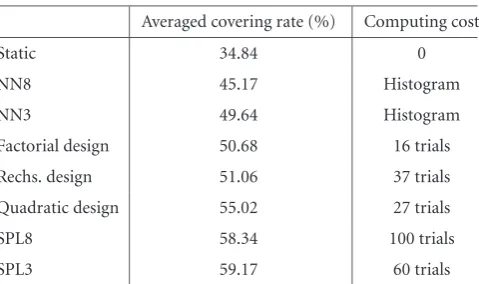
NN8 28.6 13.17
Table9: Comparison of several tuning methods.
Averaged covering rate (%) Computing cost
Static 34.84 0
NN8 45.17 Histogram
NN3 49.64 Histogram
Factorial design 50.68 16 trials
Rechs. design 51.06 37 trials
Quadratic design 55.02 27 trials
SPL8 58.34 100 trials
SPL3 59.17 60 trials
the IPC. One version of the neural network computes only the significant parameters (NN3) and the other version com-putes all tuning parameters (NN8).
During the learning step carried out on 75% of the input images, the decrease of the mean absolute error (MAE) is ob-served between optimal parameters and those computed by
the network (convergence over 400 iterations) (Table 8). It is
essential to control on the remaining 25% test images that the tuning parameters computed by the network not only are close enough to the optimal values, but also produce re-ally good results at the IPC output; that is to say, line groups are well detected. We can note that the neural network only based on significant tuning parameters (NN3) is the most ro-bust during the test step although errors are larger during the learning step.
In (Table 9), we compare the output image quality (cov-ering rates) averaged on the set of test images, depending on the tuning process adopted. Eight modes have been tested: a static one (without adaptive tuning, that is to say, an aver-age tuning resulting from the design of experiments), three modes based on the best trial of the design of experiments presented previously, two modes for the neural networks us-ing only significant parameters (NN3) or all tunus-ing param-eters (NN8) and two modes for the optimal tuning of sig-nificant parameters (SPL3), or all parameters (SPL8) using simplex algorithm.
the simplex method are naturally optimal but the price for that is the prohibitive time required for the parameter space exploration.
Finally, the neural networks provide high values, espe-cially the 3 output network, with a negligible computing cost
(≈computation of the input image descriptors). We have
in-tentionally mentioned in this table the results obtained for an eight-parameter tuning: we can easily verify that the tuning of the 5 parameters considered little significant by the design of experiments is useless.
4. CONCLUSION
These promising results obtained in the context of an im-age processing chain (IPC) dedicated to road obstacle de-tection highlight the interest of the experimental approach for the adaptive tuning of an IPC. The main reasons for
this efficiency are simple: unlike previous work, the IPC is
globally optimized, from a great number of real test images and by adapting image processing to each input image. We are currently testing this approach on other applications in which the image typology, image processing operators, and data evaluation criteria for inputs as well as outputs are also specific. This should enable us to unify and generalize this methodology for better IPC performance.
ACKNOWLEDGMENT
This research program has been supported by the French PREDIT Program and by Europe FSE grant.
REFERENCES
[1] R. M. Haralick, “Performance characterization protocol in computer vision,” inProceedings of the ARPA Image Under-standing Workshop, vol. I, pp. 667–673, Monterey, Calif, USA, November 1994.
[2] P. Courtney, N. Thacker, and A. Clark, “Algorithmic model-ing for performance evaluation,” inProceedings of the ECCV Workshop on Performance Characteristics of Vision Algorithms, p. 13, Cambridge, UK, April 1996.
[3] W. Forstner, “10 pros and cons against performance charac-terization of vision algorithms,” inProceedings of the ECCV Workshop on Performance Characteristics of Vision Algorithms, Cambridge, UK, April 1996.
[4] K. W. Bowyer and P. J. Phillips,Empirical Evaluation Tech-niques in Computer Vision, Wiley-IEEE Computer Society Press, Los Alamitos, Calif, USA, 1998.
[5] P. Meer, B. Matei, and K. Cho, “Input guided performance evaluation,” in Theoretical Foundations of Computer Vision (TFCV ’98), pp. 115–124, Dagstuhl, Germany, March 1998. [6] I. T. Phillips and A. K. Chhabra, “Empirical performance
eval-uation of graphics recognition systems,”IEEE Transactions on Pattern Analysis and Machine Intelligence, vol. 21, no. 9, pp. 849–870, 1999.
[7] J. Blanc-Talon and V. Ropert, “Evaluation des chaˆınes de traitement d’images,” Revue Scientifique et Technique de la D´efense, no. 46, pp. 29–38, 2000.
[8] S. Philipp-Foliguet,Evaluation de la segmentation, ETIS, Cer-gy-Pontoise, France, 2001.
[9] N. Sebe, Q. Tian, E. Loupias, M. S. Lew, and T. S. Huang, “Evaluation of salient point techniques,” inProceedings of In-ternational Conference on Image and Video Retrieval (CIVR ’02), vol. 2383, pp. 367–377, London, UK, July 2002. [10] P. L. Rosin and E. Ioannidis, “Evaluation of global image
thresholding for change detection,”Pattern Recognition Letters, vol. 24, no. 14, pp. 2345–2356, 2003.
[11] Y. Yitzhaky and E. Peli, “A method for objective edge detec-tion evaluadetec-tion and detector parameter selecdetec-tion,”IEEE Trans-actions on Pattern Analysis and Machine Intelligence, vol. 25, no. 8, pp. 1027–1033, 2003.
[12] V. Ropert, “Proposition d’une architecture de contr ˆole pour un syst`eme de vision,” Th`ese de l’Universit´e Ren´e Descartes (Paris 6), Paris, France, D´ecembre 2001.
[13] I. Levner and V. Bulitko, “Machine learning for adaptive im-age interpretation,” inProceedings of the 16th Innovative Appli-cations of Artificial Intelligence Conference (IAAI ’04), pp. 870– 876, San Jose, Calif, USA, July 2004.
[14] P. Schimmerling, J.-C. Sisson, and A. Za¨ıdi,Pratique des Plans d’Exp´eriences, Lavoisier Tec & Doc, Paris, France, 1998. [15] S. Treuillet, “Analyse de l’influence des param`etres d’une
chaˆıne de traitements d’images par un plan d’exp´eriences,” in 19e colloque GRETSI sur le traitement du signal et des images (GRETSI ’03), Paris, France, September 2003.
[16] S. Treuillet, D. Driouchi, and P. Ribereau, “Ajustement des param`etres d’une chaˆıne de traitement d’images par un plan d’exp´eriences fractionnaire 2k−p,”Traitement du Signal,
vol. 21, no. 2, pp. 141–155, 2004.
[17] M. H. Wright, “The nelder-mead simplex method: recent the-ory and practice,” inProceedings of the 16th International Sym-posium on Mathematical Programming (ISMP ’97), Lausanne, Switzerland, August 1997.
[18] A. Domingues, Y. Lucas, D. Baudrier, and P. March´e, “D´etection et suivi d’objets en temps r´eel par un syst`eme embarqu´e multi capteurs,” inProceedings of the 18th Sympo-sium GRETSI on Signal and Image Processing (GRETSI ’01), Toulouse, France, Septembre 2001.
[19] A. Domingues, “Syst`eme embarqu´e multicapteurs pour la d´etection d’obstacles routiers—D´eveloppement du prototype et r´eglage automatique de la chaˆıne de traitement d’images,” Th`ese de l’Universit´e d’Orl´eans, Orl´eans, France, Juillet 2004. [20] Y. Lucas, A. Domingues, M. Boubal, and P. March´e, “Syst`eme
de vision embarqu´e pour la d´etection d’obstacles routiers,” Techniques de l’Ing´enieur—Recherche & Innovation, p. 9, 2005, IN-24.
[21] P. Lamaty, “Op´erateurs de niveau interm´ediaire pour le traite-ment temps r´eel des images,” Th`ese de Doctorat, Th`ese de l’Universit´e de Cergy-Pontoise, Cergy-Pontoise, France, 2000. [22] Y. Lucas, A. Domingues, D. Driouchi, and P. March´e, “Model-ing, evaluation and control of a road image processing chain,” inProceedings of the 14th Scandinavian Conference on Image Analysis (SCIA ’05), vol. 3540, pp. 1076–1085, Joensuu, Fin-land, June 2005.
[23] A. Fries and W. G. Hunter, “Minimum aberration 2k−p
de-signs,”Technometrics, vol. 22, no. 4, pp. 601–608, 1980. [24] R. L. Rechtschaffner, “Saturated fractions of 2n and 3n
facto-rial designs,”Technometrics, vol. 9, pp. 569–575, 1967. [25] H.-D. Cheng and Y. Sun, “A hierarchical approach to color
Yves Lucasreceived the Master’s degree in discrete mathematics from Lyon 1 Univer-sity, France, in 1988 and the DEA in com-puter science and automatic control from the Applied Sciences National Institute of Lyon, France, in 1989. He focused on the field of CAD-based vision system program-ing and obtained the Ph.D. degree from INSA Lyon, France, in 1993. Then, he joined the Orleans University, France, where he is
currently in charge of the Vision Group at the Vision and Robotics laboratory, which is centered on 3D object reconstruction and color image segmentation. His research interests include vision system learning and tuning, as well as pattern recognition and image anal-ysis for medical, industrial, and robotic applications.
Antonio Dominguesreceived the Master’s degree in electronic systems for vision and robotics, from Clermont-Ferrand Univer-sity, France, in 1999. He joined the Vision and Robotics laboratory, Bourges, France, in 2001 and worked in relation with MBDA company on the SPINE project, centered on an embedded road obstacle detection sys-tem for intelligent airbag control based on a vision system. He received in 2004 the Ph.D.
degree from Orleans University, France, in the field of industrial technology and currently works in a software engineering company in Paris, France.
Driss Driouchireceived the Master’s degree both in pure mathematics and in mathe-matical engineering at Paul Sabatier Univer-sity, Toulouse, France, in 1998 and 1999. He obtained in 2000 the DEA in the field of statistics at Pierre and Marie Curie Paris 6 University, France, where he worked in the team of Professor Paul Deheuvels and re-ceived the Ph.D. degree in statistics in 2004. He is currently an Assistant Professor at
Mohamed I University, Nador, Morocco. His research interests are in the field of theoretical and practical problems about the design of experiments.
Sylvie Treuilletreceived the Dipl. Ing. de-gree in electronic engineering, from the University of Clermont-Ferrand, France, in 1988. She started working as a Research En-gineer in a private company and developed an imagery system for chromosomes classi-fication. In 1990, she received a fellowship for a study about multisensory data fusion for obstacle detection and tracking on mo-torways and obtained the Ph.D. degree in