Volume 2011, Article ID 184635,15pages doi:10.1155/2011/184635
Research Article
Fixed-Point MAP Decoding of Channel Codes
Massimo Rovini, Giuseppe Gentile, and Luca Fanucci
Department of Information Engineering, University of Pisa, Via G. Caruso 16, 56122 Pisa, Italy
Correspondence should be addressed to Giuseppe Gentile,[email protected]
Received 21 June 2010; Revised 28 November 2010; Accepted 8 February 2011
Academic Editor: Olivier Sentieys
Copyright © 2011 Massimo Rovini et al. This is an open access article distributed under the Creative Commons Attribution License, which permits unrestricted use, distribution, and reproduction in any medium, provided the original work is properly cited.
This paper describes the fixed-point model of the maximum a posteriori (MAP) decoding algorithm of turbo and low-density parity-check (LDPC) codes, the most advanced channel codes adopted by modern communication systems for forward error correction (FEC). Fixed-point models of the decoding algorithms are developed in a unified framework based on the use of the Bahl-Cocke-Jelinek-Raviv (BCJR) algorithm. This approach aims at bridging the gap toward the design of a universal, multistandard decoder of channel codes, capable of supporting the two classes of codes and having reduced requirements in terms of silicon area and power consumption and so suitable to mobile applications. The developed models allow the identification of key parameters such as dynamic range and number of bits, whose impact on the error correction performance of the algorithm is of pivotal importance for the definition of the architectural tradeoffs between complexity and performance. This is done by taking the turbo and LDPC codes of two recent communication standards such as WiMAX and 3GPP-LTE as a reference benchmark for a mobile scenario and by analyzing their performance over additive white Gaussian noise (AWGN) channel for different values of the fixed-point parameters.
1. Introduction
Modern communication systems rely upon block channel codes to improve the reliability of the communication link, as a key facet to enhance the quality of service (QoS) to the final user. To achieve this target, a block of source data is encoded into a codeword that adds some redundancy to the transmission of source (information) bits in the form of parity bits. Then, at the receiver side, the parity bits are exploited by the decoder to perform forward error correction (FEC), meaning the partial or complete correc-tion of the errors added by the transmission over a noisy channel.
Two main categories of channel codes have gained the momentum of the scientific and industrial community, low-density parity-check codes [1], and serial or parallel concatenation of convolutional codes, SCCC, and PCCC
[2]. Although LDPC codes were first designed by Gallager
in the early 1960s, they were soon abandoned because of the inadequacy of the microelectronics technology, incapable of facing the complexity of the decoding algorithm. It was
only in the early 1990s that channel codes became popular, when Berrou et al., sustained by an already mature very large scale of integration (VLSI) technology, revealed the
turbo decoding of PCCCs [3], soon extended to SCCCs
[2,4]. This started a new age in digital communications and paved the road to many research activities and achievements in the field of information theory. Continuous advances in the VLSI technology have reinforced the success of turbo and LDPC codes and deep submicron CMOS processes (down to 65–45 nm and beyond) allow the implementation of decoders sustaining very high clock frequency, and so reaching very high processing rate or throughput. This issue is particularly felt given the iterative nature of the decoding algorithm, running for a certain number of consecutive iterations.
At the present, several communication standards specify the use of either turbo or LDPC codes or both, for FEC.
These cover different applications and services, including
access networks such as wireless local access networks
(W-LANs) (IEEE802.11n) [5] and wireless metropolitan access
[6], high-speed cellular networks starting from UMTS-2000 [7] and 3GPP [8] to the long-term evolution 3GPP-LTE [9], satellite broadcasting for fixed [10,11] and hand-held
ter-minals [12], and up to very high rate data links on optic
fiber [13]. Overall, a considerable variety of code
param-eters is specified, such as different code rates and block
lengths, along with very different requirements in terms of decoding throughput (from 2 Mb/s in UMTS to 100 Mb/s in 3GPP-LTE and even 10 Gb/s in 10GBASE-T). Hence, the design of a channel code decoder in general and in particular of a multistandard decoder is a challenging task in view of the flexibility demanded to its architecture and because of the practical restrictions on chip area and power consumption.
The definition of a fixed-point VLSI architecture of the decoding algorithm, that is, flexible, uses the smallest num-ber of bits, and still yields very good error correction perfor-mances, is an effective means to attain an effective implemen-tation of the related decoder, featuring both low complexity and low power consumption. On the other hand, floating-or fixed-point (16- floating-or 32-bit) digital signal processing (DSP) units are inadequate to this aim and beside the known limitations in power consumption, they only meet the throughput requirements of the slowest standards and only with high degrees of parallelism (and so with increased power consumption).
For this reason, this paper develops an accurate fixed-point model of a decoder for turbo and LDPC codes, treated within a unified framework exploiting the inherent analogies between the two classes of codes and the related decoding algorithms.
Several works have already dealt with the same objective of fixed-point models of MAP decoding [14–16], and useful indications are provided for practical implementations of turbo [17–19] and LDPC decoders [20–22]. However, while very elegant bounds to the maximum growth of the internal signals of a turbo decoder are provided in [14,15], the model described in this paper allows the full exploration of the
complexity/performance tradeoffs. Furthermore, this model
is extended to the decoding of LDPC codes, and so provides useful hints toward the design of a multistandard, multicode decoding platform.
This paper is organized like this. After this introduction, Section 2 recalls the definition of turbo and LDPC codes, andSection 3reviews the fundamentals of the MAP decod-ing algorithm, godecod-ing through the BCJR decoddecod-ing of con-volutional codes, the turbo decoding principle and the so-called horizontal layered decoding (HLD) of LDPC codes.
Then, Section 4 describes the fixed-point models of the
two decoding algorithms, and the dynamic range and quantization of the internal operations are discussed in detail. The performance of the fixed-point algorithms are
then studied in Section 5, where frame error rate (FER)
curves are shown for two turbo codes, the 3GPP-LTE binary code with block size 1504 and rate 1/3 and the WiMAX duo-binary code with size 480 and rate 1/2, and for one LDPC code, the WiMAX code with size 1056 and rate 2/3 (class B). Finally, conclusions are drawn inSection 6.
uk
RSC
ck,0
ck,1 Π
RSC
vk
ck,2 + +
+ +
+ +
+ +
Figure1: 3GPP-LTE turbo encoder.
2. Channel Codes
2.1. Turbo Codes. Focusing on the class of parallel
concate-nated convolutional code (PCCC) codes,Figure 1shows the
encoder of the 3GPP-LTE turbo code. This is composed of two stacked recursive systematic convolutional (RSC) encoders, where the upper and lower units are fed by a direct and an interleaved version of the information bits, respectively. Interleaving among the bits of the information
word is performed in the block labeledΠinFigure 1. Each
RSC encoder is a particular linear feedback shift register
(LFSR) whose output bits ci, i = 0, 1, also called parity
bits, are a function of the status S of the register, of the forward/backward connections (calledtaps), and of the input bituentering the encoder.
The performance of the turbo code closely depends on the parameters of the constituent RSCs such as the number of states, denoted asν, and connection of the feed-back and
feed-forwardtaps. The number of statesνis linked to the
number of memory elements in the RSC, also referred to as theconstraintlengthL(L =4 in the example ofFigure 1), through the relationshipν=2L−1.
The encoding process of the RSC can be effectively
represented by resorting to the so-called trellis graph,
reported in Figure 2 for the 3GPP-LTE encoder. This is a
diagram showing the evolution in time of the LFSR state and describing the transitions (also referred to asedges) between pairs of consecutive states: as shown inFigure 2, every edge is labeled with the pair of transmitted information symbols that caused the transition and the parity bits output by the encoder. So the RSC encoding process of a given information word can be followed as a specific path on the trellis.
Aiming at enhanced error correction capabilities,M-ary
turbo codes have become widely used in recent communica-tion standards after their introduccommunica-tion in the early 2000s [23].
In this case, each information symbol can assumeM > 2
values (M = 2 corresponds to a binary code) that can be
expressed onmbits, so thatM=2m. Standards such as
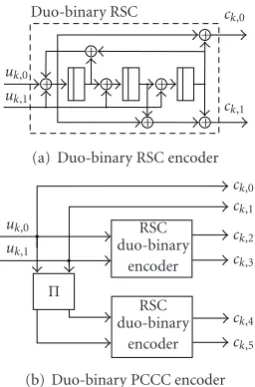
DVB-RCS and WiMAX define duo-binary turbo codes (m = 2,
M =4), and an example of a duo-binary encoder is shown
0/00
0/00
0/00
1/11 1/11 0/00
0/10
1/01 1/01
1/01
0/10
0/10 0/10
1/11
1/11
1/01 s0
s1
s2
s3
s4
s5
s6
s7
s0
s1
s2
s3
s4
s5
s6
s7
s0
s1
s2
s3
s4
s5
s6
s7
k−1 k k+ 1
t
Figure2: Example of an 8-state trellis diagram.
Duo-binary RSC
uk,0 uk,1
ck,0
ck,1 + + + + +
+ +
(a) Duo-binary RSC encoder
RSC duo-binary
encoder RSC duo-binary
encoder
uk,0 uk,1
ck,0 ck,1 ck,2 ck,3
ck,4 ck,5 Π
(b) Duo-binary PCCC encoder Figure3: The WiMAX turbo encoder.
2.2. LDPC Codes. LDPC codes are linear block codes defined
by a sparse matrixH known as parity-check matrix, andx
is a valid codeword if belongs to the null space orkernelof
H, that is,HxT =0. The parity-check matrix has a number
of columnsNequal to the bits in the transmitted codeword
and a number of rows M equal to the number of
parity-check constraints, whereP=N−Mis the number of parity
bits added by the LDPC encoder. Each row of the matrix describes a parity-check constraint, with the convention that the element hi,j set to “1” means that the jth bit of the codeword participates into theith parity-check constraint.
LDPC codes can be also described by means of a bi-partite graph known as Tanner graph [24] which is arranged in variable nodes (VNs), represented with circles, and check nodes (CNs), represented with squares. Each VN represents
C0
C1
CP−1 . . .
b0
b2
b3
bN−1 . . .
Figure4: Example of a Tanner graph.
a bit of the transmitted codeword and corresponds to a
col-umn ofH, while a CN represents a parity-check constraint,
that is, a row ofH. A connection between variable and check nodes, referred to asedge, corresponds to a “1” of the parity-check matrix and graphically links a parity-parity-check constraint to a bit in the codeword. The number of edges connected
to a VN (CN) is known as variable node degree,dv (check
node degree,dc). An example of a Tanner graph is shown in Figure 4.
As far as the design of the parity-check matrix is con-cerned, it heavily affects both the error correction perfor-mance and the complexity of the LDPC decoder. Hence, joint code-decoder design techniques are usually applied [25]. Following this route, a particular class of
architecture-aware- (AA-LDPC) codes [26] is currently being adopted
by all modern communication standards specifying LDPC codes. The underlying idea is the arrangement of 1s in the parity-check matrix according to patterns that ease the parallelization of the decoding operations. Therefore, the parity-check matrix is partitioned in smaller squared matrices that can be either permutations or cyclic shifts of the unit matrix called circulants [27]. Figure 5 shows the prototype matrix of the WiMAX LDPC code 2/3a with length 2304: it is partitioned inZ×Zmatrices withZ=96, where a null entry corresponds to the all 0 matrix, while a nonnull entry specifies the rotation (left-shift) applied to the unit matrix.
3. Maximum A Posteriori Decoding of
Channels Codes
The BCJR algorithm [28] provides the common framework
to the decoding of turbo and LDPC codes as it is applied to the decoding of the two component RSC codes of a turbo code as well as to the parity-check update of an LDPC code.
3.1. The BCJR Decoding Algorithm. Figure 6summarizes the
notation used in the BCJR decoding algorithm of anM-ary
convolutional code (M=2m). In particular,
(i)e is the oriented edge connecting the starting state SS(e) to the ending stateSE(e),SS(e)
e
0 1 3 4 5 6 7 8 9 10 11 13 14 15 17 18 19 20 21 22 23 0
1
2
3
4
5
6
7 0 0 0 0 0 0 0 0 0 0 0 0 0 0
3 3 1
2 2
0
34 7 3 0
36
1
10
1 18 2 0
12 2 15 40 3 15 2 13
19 24 3 6 17 8 39
20 6 10 29 14 38 0
10 20 36 21 45
35 25 37 21 5 0 4 20
6 6 4 14 30 3 36 14 1 1
1 1
1 1
1 1 3
1
8 9
1 28
0
28
12 16
H=
=96×96 identity matrix rotated byr =96×96 zero matrix
r
. ..
Figure5: Prototype matrix of WiMAX 2/3a LDPC code with length 2304 (Z=96). Different block sizes are obtained withZranging from 24 to 96 in steps of 4 and rotations derived from the code with length 2304 after simple modulo or scaling operations (refer to [6] for further details).
Ss
Se
e u(e)/c(e)
Figure6: BCJR notation on the trellis.
(ii)u(e) is the information symbol related to edge e, drawn from the alphabetU= {0, 1,. . .,M−1}, with M=2m;
(iii)c(e) is the coded symbol associated to edgee, and
ci(e) is theith bit inc(e), withi=0, 1,. . .,n−1.
So, againstminformation bits encoded in the symbolu,
n ≥ mcoded bits are generated, and the ratior = m/nis
referred to as the rate of the code.
Being a particular form of MAP decoding, the BCJR algo-rithm aims at the maximization of thea posterioriprobability of the transmitted bit, given the observation of the received codeword in noise. For an efficient implementation, the algo-rithm is formulated in terms of reliability messages having
the form of log-likelihood ratios (LLRs). Given the M-ary
random variablexwith values inX= {x0,x1,. . .,xM−1}, its
LLR is defined as
LLR(x=xi) ˙=log
P(x=xi)
P(x=x0), (1)
whereP(·) denotes the probability mass function and i =
1, 2,. . .,M−1. In (1),x0is used as the reference symbol for
normalization, so that onlyM−1 LLRs are associated to an
M-ary random variable.
Borrowing a notation from [4], the BCJR algorithm
involves the following quantities:
(i)λchk,iis the channel a priori information for the coded bit ci at time k, with i = 0, 1,. . .,n−1 and k = 0, 1,. . .,N−1; being the input of the algorithm,λchk,i is also referred to as input LLR;
(ii)γk(c(e)) (or simply γk(e)) is the cumulative metric associated to the coded symbolc(e) on the edgeeat timek;γk(c(e)) is also referred to asbranchmetric;
(iii)λI
k(u(e)) (or simplyλIk(e)) is the a priori information
associated to the information symbol u(e) on the
edgeeat timek;
(iv)λOk(u(e)) (or simplyλOk(e)) is the a posterioriextrinsic information associated to the to information symbol u(e) on the edgeeat timek;
(v)ΛAPPk (u(e)) (or simply ΛAPPk (e)) is the a posteriri probability (APP) associated to the information symbolu(e) on the edgeeat timek.
The BCJR algorithm first computes the branch-metric
γk(e) as
γk(e)= n−1
i=0
ci(e)·λchk,i (2)
Along with the a prioriextrinsicinformation λIk(e), the branch-metricγk(e) drives the forward and backward
recur-sionsαandβ, computed in the log-domain according to
αk+1(Si)= max∗ e:SE(e)=Si
αk(SS(e)) +γk(e) +λIk(e)
,
βk(Si)= max∗ e:SS(e)=Si
βk+1(SE(e)) +γk(e) +λIk(e)
, (3)
where the max∗(a,b) operator is defined as
max∗(a,b) ˙=logea+eb
=max(a,b) + log1 +e−|a−b|. (4)
However, the max∗ can be approximated with a simpler
max operation for a lower complexity implementation; in this case the decoding algorithm is referred to as max-log-MAP [4].
The forward (backward) recursionα(β) in (3) is evalu-ated over the set of the edgesewith ending (starting) state
Si at time k + 1 (k) and is initialized with α0 = αinit
(βN = βinit), atk = 0 (k = N). Indeed, the initialization
value depends on the selected termination strategy, and it is [1/ν,. . ., 1/ν] for codes not terminated and is [1, 0,. . ., 0] for 0-tail terminated codes, while for tail biting or circular codes it is used to propagate the value reached by either the forward or backward recursion at the previous iteration.
The state-metric recursions in (3) are in the form of
logarithm of probabilities, and to increase the numerical robustness of the algorithm [14,15], they are normalized with respect to the value taken by a reference state, typically the “zero” stateS0, as in a regular LLR. This corresponds to
the following subtractions:
αk(Si)=αk(Si)−αk(S0),
βk(Si)=βk(Si)−βk(S0)
(5)
withi=0, 1,. . .,ν−1.
Once the state-metric recursions are available, the a pos-teriori estimation of the information symboluis derived as
λOk(ui)= max∗ e:u(e)=ui
αk(SS(e)) +γk(e) +βk+1(SE(e))
− max∗ e:u(e)=u0
αk(SS(e)) +γk(e) +βk+1(SE(e))
. (6)
Being not directly connected to the input a priori mes-sageλIk(e), the APP outputλOk(ui) is said to beextrinsic.
3.2. The Turbo Decoding Principle. The turbo decoding algo-rithm is achieved as the direct application of the BCJR algorithm to both of its constituent RSC codes, according
to the block diagram of Figure 7. The two BCJR decoders
are the soft-in soft-out (SISO) units labeled SISO 1 and SISO 2, and the algorithm evolves as the iterative exchange ofextrinsicmessages that are the a posteriori outputs of the SISO engines.
The algorithm is fed with the channel a priori estimations λchk,i, in the form of LLR and computed according to (1) for
λchk,i
λch Π(k,i) SISO 1
SISO 2
λI(c)
λI(u)
λO(u) λ ext,1 k
Π
Π
Π−1
λext,1Π(k)
λext,2Π(k) λext,2k
+
λAPPk
λI(u)
λI(c)
λO(u)
Figure7: Decoding of PCCC codes: the turbo principle.
binary variables (M=2). The output of SISO 1, calledλext,1
in Figure 7, is scrambled according to the interleaving law
Π before being passed to SISO 2 as a priori information.
The latter also receives a scrambled version of the channel a priori estimationsλch
k,iand outputs the a posteriori reliability messages λext,2. After inverse scrambling, these go back to
SISO 1 as refined a priori estimations about the transmitted symbols.
As shown inFigure 7, the output of the turbo decoder,
that is, the a posteriori estimation of the transmitted symbol,
is given by the sum of the twoextrinsicmessages output by
the SISO units. In formula,
ΛAPPk (ui)=λext,1k (ui) +λext,2k (ui) (7)
withui∈U= {u0,u1,. . .,uM−1}andk=0, 1,. . .,K−1.
3.3. MAP Decoding of LDPC Codes. The MAP decoding algo-rithm of LDPC codes is commonly referred to as belief propagation (BP) or more generally message passing (MP)
algorithm [29]. BP has been proved to be optimal if the
graph of the code does not contain cycles, that is, consecutive nodes connected in a closed chain, but it can still be used and considered as a reference for practical codes with cycles. In this case the sequence of the elaborations, referred to as schedule, considerably affects the performance both in terms of convergence speed and error correction rate.
The most straightforward schedule is the two-phase or
flooding schedule (FS) [30], which proceeds through two
consecutive phases, where all parity-check nodes first and all variable nodes then are updated in sequence.
A more powerful schedule is the so-calledshuffledor lay-eredschedule [26,30–32]. Compared to FS, shuffled sched-ules almost double the decoding convergence speed, both for codes with cycles and cycle-free [33]; this is achieved
by looking at the code as the connection of smallersuper
-codes [26] or layers [31], exchanging reliability messages. Specifically,a posteriori messages are made available to the next layers immediately after computation and not at next iteration like in FS. Layers can either be sets of consecutive
CNs or VNs, and, accordingly, CN-centric (or horizontal)
0/0 0/0 0/0 0/0 0/0
0/0 0/0 0/0
1/1 1/1 1/1 1/1
1/1 1/1 1/1
1/1
Even parity
Odd parity
S0 S0 S0 S0 S0 S0
S1 S1 S1 S1
Figure 8: Two-state trellis representation of a parity-check con-straint withdc=5.
3.3.1. Horizontal Layered Decoding. The HLD algorithm up-dates the parity-check constraints sequentially around the parity-check matrix. The key feature of HLD is the
contin-uous update, during decoding, of a cumulative metric yn
associated to every VN in the code,n=0, 1,. . .,N−1, and called soft output (SO).
The update of CNm, withm=0, 1,. . .,M−1, is based on the availability of variable-to-check (vtoc) messagesμn,m
directed from VNnto CNmand computed as
μm(q,)n=yn(q)−n(q,m), (8)
where(nq,m) is the check-to-variable (ctov) propagated by CN mtoward VNnat previous iteration,n∈Nmdenotes the set of VNs connected to CNm, andq=0, 1,. . .,Nit,max−1 is the
iteration index.
Refined ctov messagesn(q,m+1) are produced as a result of the check-node update, and, based on these, the set of SOs
involved in CN m, that is, yn with n ∈ Nm, is updated
according to
yn(q+1)=μm(q,)n+m(q,+1)n =y(nq)−(nq,m) +(mq,+1)n . (9)
Thanks to the mechanism described in (8) and (9),
check-node operations always rely on up-to-date SOs, which
explains the increased convergence speed of HLD-shuffled
schedule.
The HLD algorithm is initialized at iterationq=0 with
yn(0)=λchn, (0)m,n=0,
(10)
whereλch
n is the LLR of the a priori channel estimation of the received bits in noise,m=0, 1,. . .,M−1 andn∈Nm.
3.3.2. Check-Node Update. As far as the check-node update is concerned, it is shown in [26] that a parity-check constraint can be viewed as a 2-state convolutional code, where one state is associated toevenparity (S0) and the other tooddparity
(S1). The block size of the equivalent code is then equal to
the CN degreedc, and an example of its trellis representation is given inFigure 8.
This analogy allows the BCJR algorithm to be also em-ployed for parity-check updates of LDPC codes, and the re-sulting decoding algorithm is known as turbo decoding
message passing (TDMP) [26]. The algorithm is fed with
vtoc messages as a priori information and produces ctov messages as a posteriori outputs, with nobranchmetric from
the channel. So, in the update of CN m, the state-metric
recursions are simplified into
αk+1=max∗
αk,μ
(q)
m,n
−max∗αk+μ
(q)
m,n, 0
,
βk=max∗
βk+1,μ (q)
m,n
−max∗βk+1+μ (q)
m,n, 0
, (11)
wherek=1, 2,. . .,dc(m)−1 is the recursion step, withdc(m) being the degree of CNm, andn=Nm(k) is the index of the VN involved at stepk. The recursions in (11) are initialized withα0=1 andβdc=1.
Then, the computation of a posteriori extrinsic informa-tion in (6) can be reworked in the form
(mq,+1)n =max∗αk,βk+1
−max∗αk+βk+1, 0
(12)
withk=0, 1,. . .,dc(m)−1 andn=Nm(k).
4. Fixed-Point Models
Given a positional numeric system in baseδ, the fixed-point representationXof a real (i.e., floating-point) signalx∈Ê
is expressed as
X=
NI−1
n=0
anδn+ NF
n=1
bnδ−n, (13)
whereNI (NF) is the number of integer (fractional) digits an(bn), drawn from the setD = {0, 1,. . .,δ−1}. Overall, Nx=NI+NFdigits are used to representx.
The multiplication of (13) by the factorδNF, also referred
to asscalingfactor, is practical to get rid of the decimal point
and is effective for the implementation of fixed-point DSP
or VLSI systems. Focusing on binary systems withδ =2,X
becomes an integer number in the form
X=
Nx−1
n=0
xn2n, (14)
where xn, n = 0, 1,. . .,Nx − 1 are the binary digits of the integer representation of x, with xn = bNF−n for n =
0, 1,. . .,NF−1 andxn=an−NFforn=NF,NF+ 1,. . .,NF+
NI−1.
4.1. Conversion Law. Given a signalxdefined in the domain
of reals, that is, x ∈ Ê, its fixed-point counterpart X on
Nx bits is now derived. As only a limited number of bits
is available, the domain ofx needs to be constrained to an
interval ofÊ, say [−A,A]. So a preventive saturation of the
X
2Nx−1−1
2 1
x
−2Nx−1+ 1 −2
−1
Δx
A
2Δx Δx
−A −2Δx−Δx
Figure 9: Staircase conversion function from floating- to fixed-point signals.
The operation of fixed-point conversion can be done ac-cording to the following transformation:
X=min 2Nx−1−1,
x Δx
+ 0.5
, x≥0,
X=max −2Nx−1+ 1,
x
Δx −
0.5
, x <0,
(15)
whereΔx=2A/(2N−1) is the quantization step, that is, the
maximum difference between two different floating-point
values that are mapped onto the same fixed-point symbol X. The value of Δx is a measure of the resolution of the representation, that is, is the weight of the least significant bit (LSB)x0ofX.
Note that (15) not only performs the quantization of the input signal, but it also limits its domain to the interval [−A,A], as shown inFigure 9, as values greater (less) thanA (−A) are saturated to the biggest positive (smallest negative) level 2Nx−1−1 (−2Nx−1−1).
In (15), only 2Nx−1 fixed-point levels are used (the
cod-omain of the transformation function is symmetrical with respect to the level 0); this choice prevents the algorithm from drifting toward negative levels, which otherwise would be systematically advantaged as also noted in [15].
So the pair (A,Nx) fully defines the quantization of the floating-point signalx, providing the dynamic range and the weight of the LSBΔxused for its representation.
This approach is similar to that described in [15] for the quantization of input LLRs and is more flexible than that generally adopted in the literature [14,17–22], where the fixed-point format is specified by the pair (NI:NF), disregarding the dynamic range of the underlying real signal. In other words, the dynamic range of the real signal is often
put in the form A = 2NI−1 and is limited to a power of
two. On the contrary, our approach comes through this restriction, and it is applied to every internal fixed-point elaboration.
4.2. Fixed-Point Turbo Decoding. The complete scheme of
the fixed-point SISO decoder is shown in Figure 10. The
algorithms described in Section 3.1 are reformulated in
fixed-point domain to involve operations among integers. Following a cascade approach, all the involved operations are converted into their fixed-point counterpart one after the other.
4.2.1. Channel A Priori Information. Channel LLRs are quantized according to (15) using the thresholdAλchandNλch
bits.
4.2.2. Branch Metric. The computation ofγk(e) as in (2) in-volves the summation ofnchannel a priori reliabilitiesλchk,i, i=0, 1,. . .,n−1. So, in the worst case, where they all sum coherently, it holds γk(e) = n·Aλch, and the fixed-point
counterpartΓofγneeds to be represented with
Aγ=n·Aλch,
Nγ=Nλch+
log2n.
(16)
4.2.3. max∗Operator. The operationz=max∗(x,y) implies
the computation of the max of two signalsxand y, and the
addition of a correction term in the range ]0, log 2]; hence,
the dynamic range of thezis upper bounded by
Az =max
Ax,Ay
+ log 2. (17)
In order to let the comparison be possible, the fixed-point
counterparts ofx and y,X and Y, respectively, must have
the same resolution, that is,Δx=Δy=Δ; holding this, the number of bits to representzcan be derived from definition ofΔas
2Nz =2Az
Δ + 1=
2A
Δ +
2 log 2
Δ + 1
=2N−1+2 log 2
Δ + 1=2
N 1 +log 2
A
,
(18)
whereA=˙max(Ax,Ay) andN=˙ max(Nx,Ny). Then, assum-ing thatA >log 2, as it is generally the case, expression (18) gives
Nz=
log2 2N 1 +log 2 A
=N+ 1. (19)
However, (18) and (19) strictly hold when x = Ax =
y =Ay =A, when the contribution of the correction term is maximum; beside this very unlikely case, the additional bit required in (19) is not really exploited, and the use of Az=max(Ax,Ay) is generally enough, so that the result can
be saturated onNz = N bits. This approximation yields a
very little loss of information and so has negligible impact on
the algorithm performance. Therefore, the fixed-point max∗
operation becomes
Z=max∗(X,Y)=min{max(X,Y) + LUT(D),L}, (20)
where L = 2N−1−1 is the saturation threshold. In (20),
the correction term is quantized using the same resolution
Δ and is stored in a look-up table (LUT) addressed with
λch Nλ
λ-MEM
Nλ
Branch metric
Γ
Nγ
α/β-MEM
Mα
Mα
Amem LSL
Tα
LSR
Tα
Extr-APP unit
α/βstate-metric recursion unit
Nλ ++ + M
max∗
max∗
M
+ + M+ 1
M
Nα
A
Nα
M=ceil (log 2{Aγ+Aα+Aλ/2Sλ})
+ + + NΛ−1
max∗
max∗
NΛ−1
NΛ−1 +
+ NΛ
Λ
LSR
TΛ
MΛ Λ-MEM
MΛ Λmem LSL
Tλ
MΛ+TΛ
Figure10: Fixed-point model of the SISO engine in a turbo decoder.
4.2.4. A Posteriori Extrinsic Information. Since a posteriori extrinsic reliabilities and forward/backward recursions are mutually dependent through the iterative turbo principle, their fixed-point representation can be studied under the assumption that the state-metric recursions are represented onNα=Nβ=Nγ+kbits, withkany integer. From (6), the
dynamic range ofλOis upper bounded by
AλO =
Aα+Aγ+Aβ
−−Aα−Aγ−Aβ
=2·2Aα+Aγ
=2Aγ·
1 + 2k+1,
(21)
where it has been exploited thatAα=2kAγandAα=Aβ. The full precision representation ofλO can be obtained usingNλO = log
2(2AλO/ΔλO+ 1)bits, which gives
NλO=1 +Nγ+
log21 + 2k+1
=1 +Nγ+
max∗2(0,k+ 1)
,
(22)
where the function max∗2 is the two-base max∗ operator
defined as max∗2(a,b) ˙=max(a,b) + log2(1 + 2−|a−b|). The
following cases can be distinguished:
(a)k≥0: it is easy to prove that max∗2(0,k+1) =k+2,
so thatNλO =Nγ+k+ 3=Nα+ 3;
(b)k < 0: now it is max∗2(0,k+ 1) = 1 andNλO =
Nγ+ 2=Nα+ 2−k.
In both casesNλOis a known function ofNαandNγ, that
is, ofNαandk.
4.2.5. State-Metric Recursions. Because of its recursive com-putation, the magnitude of forward/backward recursions would steadily grow proceeding along the trellis unless it is controlled by means of saturation. Under the same hypothesis ofSection 4.2.4, that is,Nα=Nγ+k, the growth
of state metrics after one update step of (3) and (5) is upper bounded by
2Aα+Aγ+AλI
=2Aα 2 + 2−k+ AλI
Aα
, (23)
where the a priori informationλI is indeed the a posteriori output of the companion decoder, so thatAλI =AλO.
Substi-tuting (21) in (23), the latter becomes
2Aα
1 + 2−k+ 2k−1·21−k=25 + 2−k+ 21−kA α, (24)
meaning that the dynamic range ofαwould increase by the
factor 2(5 + 3·2−k) after every recursion step. This would result in the addition of 1 + log2(5 + 3·2−k)bits. Again, two cases can be distinguished:
(a)k≥0: the term (5+3·2−k) falls in the range from 5 to 8, resulting in the addition of 4 bits at each recursion step;
(b)k <0: the term log2(5 + 3·2−k)evaluates to 2−k, and overall 3−kmore bits are added at every step. So the saturation of 4 or 3−kbits, respectively, prevents the uncontrolled growth of state metrics, hence represented with (Aα,Nα). In [14, 15], bounds are provided for the dynamic range of state-metric recursions, used to dimension the internal precision of the SISO engine. On the contrary, in the described approach the resolution of state-metric recursion is a free input of the model and is controlled by means of saturation. As also noted in [14], the precision of state-metric recursions is inherently linked to that ofbranch
metrics and extrinsic messages, and if they are different,
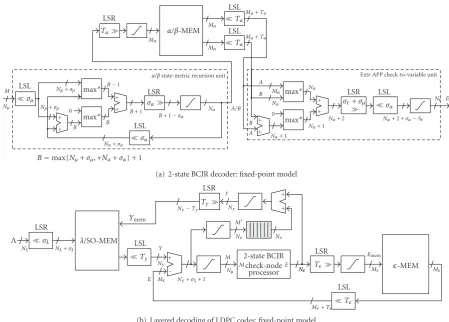
4.3. Fixed-Point LDPC Decoding. The fixed-point model of a decoder of LDPC codes is derived following a similar cascaded approach, and its scheme is reported inFigure 11.
The model allows the analysis of the independent effect
on performance of the representation of three different
signals, input a priori LLR, ctov messages, and state-metric recursions within check-node updates.
4.3.1. Computation of Variable to Check Messages. The
com-putation of variable to check messages μ according to (8)
involves SOs and ctov messages.
Let input LLRs be quantized with (Aλ,Nλ) and ctov
messages with (A,N), and let Δλ and Δ denote the
respective resolutions. Then, let the ratio ρ = Δλ/Δ be
constrained to be a power of two. This assumption reduces the number of independent variables in the model (only three out of the four variablesAλ,Nλ,A, andNare actually
independent), but it is also the only viable solution for a practical implementation of the algorithm.
Ifρ >1, that is, when a finer resolution is used on ctov messages, channel a priori LLRs need to be left shifted by σλ = log2(ρ) bits to be brought on the same resolution of
ctov messages, which in turn are not shifted (σ=0); in the
other case, no shift is needed on input LLRs (σ =0), while
ctov messages should be left shifted byσ= −log2(ρ) bits.
As channel a priori LLRs are used to initialize SOs, the
two signals have the same resolution, that is, Δy = Δλ.
Therefore, the same relationship between the resolution of ctov messages and input LLRs holds between ctov messages and SOs. In view of this, SOs are initialized with a scaled
version of input LLRs (see the input right-shift by σλ in
Figure 11(b)) so that data stored or retrieved from theλ/SO memory use the same resolution of ctov messages. This
allows the direct subtractionY −E to compute fixed-point
vtoc messages.
Once available, vtoc messages are saturated in two diff er-ent ways, onNμbits on the input of the CN update unit and onNνbits for the SO update in (9).
4.3.2. Update of Soft Outputs. The sum in (9) is performed
between updated ctov messages E and vtoc messages M
saturated onNν, and its output is saturated toNybits. As the SO is always equal to the sum ofdvctov messages entering a given VN, the following relationship holds:
Ny=N+
log2dv,max
, (25)
wheredv,maxis the maximum VN degree in the code.
How-ever, lower-complexity solutions can be investigated, where SOs are saturated on fewer bits than in (25).
4.3.3. State-Metric Recursions. Expression (11) combines vtoc messages with recursion metrics, and, similarly to the
computation of vtoc messages, different resolutions of the
two signals can be considered. Again, the ratioρ = Δ/Δα is constrained to be a power of two. As before,ρis used to
align the fixed-point representation M and A of μand α,
respectively, so thatMis shifted byσμ=log2(ρ) ifρ >1 and
byσμ =0 otherwise; dually,Ais shifted byσα= −log2(ρ) if
ρ <1 and byσα=0 otherwise. So the fixed-point sumα+μ in (11) becomes
A·2σα+M·2σμ (26)
as also shown inFigure 11(a).
The remainder of the algorithm can be quantized in a very similar way to that followed for turbo decoders, with
some simplifications. As also shown in Figure 11(a), if we
define B=˙max{Nα+ σα,Nμ + σμ}, the new value of A is represented onB+ 1 bits, and, after right shift byσα bits, it is saturated to the desired number of bitsNα.
4.3.4. APP Check to Variable Messages. With reference to Figure 11(a), check to variable messages are computed with the recursion metrics taken from memory, where they are represented onMαbits. So the full-precision representation of (12) can be represented onMα+2 bits. Then, countershifts are performed (left shift byσαand right-shift byσ) in order
to go back to the resolution of ctov messages, and the final saturation restores the representation onNbits.
4.4. Memory Size Reduction. Practical implementations of turbo and LDPC codes decoders are based on the extensive
use of memory as a means to exchangeextrinsic messages
(turbo decoders), to accumulate the output estimation (LDPC decoders), and to store intermediate results (state-metric recursions in turbo and LDPC decoders, ctov mes-sages in LDPC decoders). It follows that the overall decoder complexity is heavily dominated by memory, and techniques such as truncation of the least significant bits (LSBs) or saturation of the most significant bits (MSBs) are very effective to limit the size of data stored in memory. However, the use of saturation is preferable, as it reduces not only the size of memory but also that of the data paths accessing the memory unit. On the contrary, data truncated before storage in memory need to be left shifted after retrieval from memory to restore the original resolution (or weight of the
LSBΔ) and data paths do not benefit of any reduction in
size.
With reference to signal x, the notationTx and Sx will denote in the remainder of this paper the number of LSBs truncated or MSBs saturated before storage in memory, respectively.
Regarding the fixed-point turbo decoder, truncation and saturation are performed on the state-metric recursions
stored in theα/β-MEM memory (TαandSαbits, resp.) and
on the a posteriori extrinsic information stored in the Λ
-MEM memory (TΛandSΛbits, resp.), as shown inFigure 10.
In the LDPC decoder, truncation is operated on ctov
messages (T bits), on SOs (Ty bits), and on state-metric
LSR
Tα α/β-MEM
LSL
Tα LSL
Tα
LSL
σμ
max∗
max∗
max∗
max∗ LSR
σα
LSL
σα
LSR
σ+σμ
LSL
σα M
Nμ
Mα
Mα
Mα
Mα+Tα
Mα+Tα
Nμ+σμ B−1
B B
B+ 1 +
+
+ +
B+ 1−σα
Nα A/B α/βstate-metric recursion unit
Nα+σα
Nμ+σμ
0
A
B
A B
+ +
+ + Mα
Nα
0
Nα
Nα+ 1 Nα+ 1
Nα+ 2 Nα+ 2 +σα−S
N E
Extr-APP check-to-variable unit
B=max{Nμ+σμ, +Nα+σα}+ 1
(a) 2-state BCJR decoder: fixed-point model
LSR
σλ LSL
Tγ
LSR
Tγ
λ/SO-MEM Λ
Ymem
2-state BCJR check-node
processor
LSR
T
LSL
T Nλ Nλ+σλ Y
Ny
M
E Ny+σλ+ 1
Ny−Ty
y
Ny
M
Nυ Nυ
M
Nμ
M E
N
N
Emem
M M
M+T
+ −
+ +
-MEM
(b) Layered decoding of LDPC codes: fixed-point model Figure11: The fixed-point model of LDPC codes decoding.
Table1: Reference codes for the simulation scenario.
Standard Code Size (m) Length (K) Rate (R) IterationsNit
3GPP-LTE Turbo 1 1504 1/3 10
WiMAX Turbo 2 480 1/2 10
WiMAX LDPC 1 1056 2/3b 15
5. Simulation Results
The error correction performance and implementation loss
(IL) of the fixed-point models developed inSection 4have
been assessed by means of simulation. A full communica-tion system complete of encoder, modulator, transmission over AWGN channel, demodulator, and decoder has been described in C++, and the two parametric fixed-point models have been implemented as user-configurable C++ classes and methods.
Three different codes have been considered as a
bench-mark for the developed models, two turbo codes (a 3GPP-LTE binary code and a WiMAX duo-binary code) and one LDPC code (a WiMAX code), and their parameters are
summarized inTable 1. Their fixed-point performance has
been measured in the form of FER curves versus the signal to noise ratio (SNR)Eb/N0.
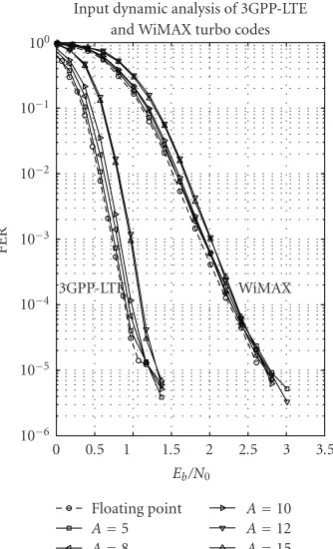
5.1. Turbo Codes Performance. The first critical design issue is the identification of an optimal value for the input
dynamic rangeAλch.Figure 12shows the FER performance
for different values ofAλch. As a design constraint for a
low-complexity implementation, the input LLRsλchwere coded
onNλch = 5 bits while the forward/backward metrics were
represented on a large number of bits (Nα=16) so that the IL is only due to the quantization of the inputsλch.
Focusing on the 3GPP-LTE code (left-most bundle of curves inFigure 12), the smaller the value ofAch
λ , the smaller the IL; the case Ach
λ = 10 corresponds to an impairment
below 0.1 dB with respect to the floating point reference model, while further increasing the dynamic range yields to very coarse resolutionΔλch, which results in considerable
losses, especially at lowEb/N0.
Conversely, the WiMAX code (right-most curves of Figure 12) seems to be less sensitive to variations of Aλch,
the maximum impairment being about 0.15 dB forAλch ≥
12. This can be explained with the increased robustness to channel noise offered by duo-binary codes, paid at the cost of a bigger computational effort in the decoding algorithm.
AlthoughFigure 12seems to allow the use ofAλch = 5,
this value corresponds to a very rough quantization of the channel LLRs, where several floating point samples are saturated to the levels±Aλch. Then, the coarser quantization
3.5 3 2.5 2 1.5 1 0.5 0
Eb/N0 10−6
10−5 10−4 10−3 10−2 10−1 100
FER
Floating point
A=5
A=8
A=10
A=12
A=15 Input dynamic analysis of 3GPP-LTE
and WiMAX turbo codes
3GPP-LTE WiMAX
Figure12: Dynamic range analysis forNλch=5 bits.
impairments due to the quantization noise, which can result in flattening the FER curve (error floor). In view of this, the valueAλch=10 is cautiously selected for the next analysis.
Note that this kind of analysis was not feasible with the quantization scheme generally adopted in the literature, or at least with a very coarser step, beingAλch constrained to
powers of two.
Figure 13shows the FER performance for different values
of the fixed-point parameters defined in Section 4.2 and
described with the triplet (Nλch,Nα,NΛ).
Focusing on the 3GPP-LTE code, it turns out that no impairment is observed by saturating three bits on the
extrinsic reliabilities (SΛ = 3) when Nα = 7, while the
saturation of only 1 bit of the recursion metrics (Sα = 1,
Nα = 6) results in an IL of about 0.18 dB at high Eb/N0.
Not surprisingly, the truncation of either recursion metrics (Tα=1) or extrinsic reliabilities (TΛ=1) slightly spoils the
FER performance at lowEb/N0, where the LSBs bear the most
of the information, while the loss becomes almost negligible
at high Eb/N0. Finally, aiming at a very low-complexity
solution, recursions and extrinsic metrics can be represented onNα=NΛ=6 with an IL of 0.3 dB at highEb/N0.
As far as the WiMAX code is concerned, the robustness of duo-binary codes is once again confirmed by a negligible IL for all the simulated configurations. Indeed, only a slight deviation at highEb/N0is shown when 1 bit of the recursion
metrics is saturated (Sα=1).
Table 2 summarizes the fixed-point parameters of two optimal configurations, one (config. A) for better perform-ances and the other (config. B) for lower complexity. The
3 2.5 2 1.5 1 0.5 0
Eb/N0 10−6
10−5 10−4 10−3 10−2 10−1 100
FER
Floating reference (5, 7, 10) (5, 7, 7)SΛ=3 (5, 7, 6)SΛ=3Sα=1 (5, 7, 7)SΛ=3Tα=1 (5, 6, 6)SΛ=3 (5, 7, 7)SΛ=3TΛ=1
Fixed-point performance of 3GPP-LTE and WiMAX turbo codes
3GPP-LTE WiMAX
Figure13: Analysis of the performance of the fixed-point turbo-decoding algorithm.
Table2: Optimal fixed-point parameters of the turbo decoder.
Signal Config. A Config. B
A priori channel LLR (10, 5) (10, 5) Branchmetric (RCSr=1/2) (20, 6) (20, 6) State-metric recursions (40, 7) (20, 6)
Bits saturated onα/β(Sα) 2 2
A posterioriextrinsicmessages (40, 7) (20, 6) Bits saturated on extr. msg. (SΛ) 3 3
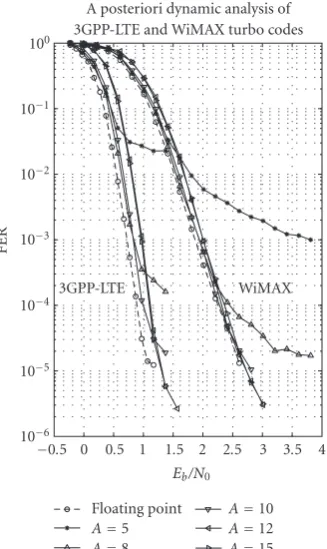
latter has been further investigated to analyze the joint effect of the input dynamic range and coarse quantization of the algorithm on the overall error correction performance. Figure 14 shows that the FER curves flatten for Aλch = 5
and Aλch = 8. This is a common issue to both binary
and duo-binary codes and is due to the combination of the distortion introduced by the very strong saturation on channel a priori inputs with the quantization noise generated in the remainder of the algorithm. The value
Aλch = 10 yields the minimum convergence loss, but also
shows clear signs of a floor at very high Eb/N0. On the
other hand, the use ofAλch = 12 and 15 prevents any floor
4 3.5 3 2.5 2 1.5 1 0.5 0
−0.5
Eb/N0 10−6
10−5 10−4 10−3 10−2 10−1 100
FER
Floating point
A=5
A=8
A=10
A=12
A=15 A posteriori dynamic analysis of 3GPP-LTE and WiMAX turbo codes
3GPP-LTE WiMAX
Figure14: End-to-end fixed-point performance for different values ofAλch.
5.2. LDPC Codes Performance. The WiMAX LDPC code with
rate 2/3 (class B) and N = 1056 features a maximum VN
degreedv,max=6 and a maximum CN degreedc,max=11.
The effect of the quantization of the input LLRs is
analyzed inFigure 15, where the FER is plotted against the dynamic rangeAλchfor three different values ofNλch, 4, 5, and
6 bits. The three curves are simulated atEb/N0 = 3.25 dB,
along with the floating point reference (solid line). The value
Aλch = 10 represents the best solution with 4 and 5 bits,
while the use ofAλch = 12 is preferable forNλch = 6 bits.
However, aiming at a low-complexity implementation, the scheme (10, 5) is retained for the next analysis.
An analysis similar to that of Figure 15 is repeated in
Figure 16for the quantization of the state-metric recursions within the CN processor; in this case, full FER curves are plotted as a function ofEb/N0, and, to get rid of the losses
due to the quantization of ctov and SO messages, a very fine quantization is used for both signals, based on many bits and very large dynamic ranges. In particular, the scheme (160, 12) is used for ctov messages, while 3 more bits (dv,max=6) were
allowed for SOs andNy =15. Similarly,Nμ =15 was also
used for vtoc messages, and, overall, the remainder of the algorithm was run in quasi-floating-point domain.
The curves in Figure 16 can be parted in three groups
with different resolutions of the state-metric recursions: the
first group contains the curves with (Aα,Nα) = (10, 6),
(20, 7), and (40, 8) (referred to as lsb-0.5 and shown in
dashed lines), the second group is for the curves (10, 5) and (20, 6) (referred to aslsb-1, solid lines), and the third group
15 14 13 12 11 10 9 8 7 6 5
Channel LLR dynamic range (Allr) 10−6
10−5 10−4 10−3
FER
Floating point
Nllr=4
Nllr=5 Nllr=6 WiMAX LDPC code (N=1056,r=2/3b)
Figure15: WiMAX LDPC code: effects of the quantization on input LLRs.
contains the curves (20, 5), (40, 6), and (80, 7) (referred to aslsb-2, dotted lines). It is shown that forlsb-0.5, at least 7 or even 8 bits are required to get rid of any flattening issue; forlsb-1,Nα=6 already provides good performances, while lsb-2 needs at least 7 bits to get close to the floating point reference. As a result, the scheme (20, 6) can be retained for a low-complexity solution. These results agree with those reported in [17,18] about fixed-point turbo decoding.
The quantization of ctov, SO, and vtoc messages is
studied inFigure 17, where messages are on 5 bits (dashed
lines) or 6 bits (dotted lines). Regarding the representation of SO, sincedv,max=6, 3 more bits are required in principle
(Ny =N+ 3), but smaller values ofNyare also simulated. Similarly, starting from the caseNν=Ny, lower-complexity solutions withNν< Nyare also investigated.
When ctov messages are represented on 5 bits and SOs on 8, the use ofA=20 results in a considerable IL, greater
than 0.3 dB, due to the very coarse quantization; on the other hand, the IL is greatly reduced withA =10, but the curves
flatten at high SNR, due to the limit imposed to the dynamic range of ctov messages. Further reducing the number of bits of SO or vtoc only worsens this situation.
Figure 17shows that better performance is achieved with
N = 6 andA = 20, in line with the observations in [20,
21]. In this case, the curve with SO and vtoc on 8 bits stays very close to the floating point reference curve, the IL being smaller than 0.05 dB, while the saturation of only 1 bit either on vtoc (curve (20, 6)[8, 7]) or on SO (curve (20, 6)[7-7]) is enough to spoil performance.
As a result of the above analysis, the value of the fixed-point parameters yielding the best error correction perfor-mance is summarized inTable 3. Starting from this reference configuration,Figure 18shows the effects of the reductions
ofα/βmetrics, SO, and ctov before storage in memory. The
3.6 3.1
2.6 2.1
1.6
Eb/N0(dB) 10−6
10−5 10−4 10−3 10−2 10−1 100
FER
Floating point (10, 6) (20, 7) (40, 8) (10, 5)
(20, 6) (20, 5) (40, 6) (80, 7) WiMAX LDPC 1056r=2/3b:
λ=(10, 5),=(160, 12)
Figure16: WiMAX LDPC code: effects of the quantization on the state-metric recursions within the CN processor.
Table3: Optimal fixed-point parameters of the LDPC decoder.
Signal Dynamic range (A) No. of bits (N)
A priori channel LLR 10 5
Vtoc for CN update 20 6
Vtoc for SO update 80 8
State-metric recursions 20 6
Ctovextrinsicmessages 20 6
SO (so) metrics 80 8
can be truncated on state-metric recursions with negligible losses (Tα=1), the IL is more relevant when 1 bit is saturated
(Sα = 1, i.e., Mα = 5). A similar result holds for ctov
messages, where the caseT=1 is tolerated with minimum
losses, whileS=1 is not. Regarding SOs, truncation of only
one bit (Ty=1) utterly corrupts the decoding performance.
6. Summary and Conclusion
This paper has described the fixed-point model of a decoder for turbo and LDPC codes, derived in a unified framework based on the use of the BCJR decoding algorithm.
Comparing the results of Tables 2and 3, the following
conclusions hold:
(i) a priori channel reliability can be represented with (10, 5) with negligible losses for both codes;
3.6 3.1
2.6 2.1
1.6
Eb/N0(dB) 10−6
10−5 10−4 10−3 10−2 10−1 100
FER
Floating point
=(20, 5), [8, 8]
=(20, 5), [7, 7]
=(10, 5), [8, 8]
=(10, 5), [7, 7]
=(10, 5), [6, 6]
=(20, 6), [8, 8]
=(20, 6), [8, 7]
=(20, 6), [7, 7] WiMAX LDPC 1056r=2/3b:
λ=(10, 5),α=(20, 6)
Figure17: WiMAX LDPC code: effects of the quantization of check to variable, soft-output, and variable to check messages.
(ii) state-metric recursions need the representation (20, 6) or (40, 7) for turbo codes, while (20, 6) is enough for LDPC codes. This can be explained with the smaller number of edges (2) in the trellis of an LDPC code compared with a turbo code (2 in binary, 4 in
duo-binary codes) and with the absence ofbranch
metrics in LDPC decoding;
(iii) a posterioriextrinsic messages of SISO decoders are on 6 or 7 bits, while soft outputs of LPDC codes need 8 bits. Considering that the turbo decoder APP output is the sum of two extrinsic messages (see (7)), the results are in agreement;
(iv) check to variable messages of LDPC decoding need the quantization (20, 6), and no counterpart exists in turbo decoders.
These results are in line with those contained in [15,16, 18,19,34] for turbo decoders or in [20–22] for decoders of
LDPC codes. Compared with [14], state-metric recursions
need significantly fewer bits than in the bound given, which evaluates to 9 bits for the considered codes. Also, the single-SISO architecture in [14] needs 7 bits forextrinsicmessages, in agreement with our results.
The fixed-point quantization law described in this paper, based on the dynamic range (A) of the underlying (floating) signal and number of bits (or, equivalently, the resolution
Δ), has allowed the analysis of their independent effects
3.6 3.1
2.6 2.1
1.6
Eb/N0(dB) 10−6
10−5 10−4 10−3 10−2 10−1 100
FER
Floating point
α: [0, 0],: [0, 0],y: [0, 0]
α: [1, 0],: [0, 0],y: [0, 0]
α: [0, 1],: [0, 0],y: [0, 0]
α: [0, 0],: [1, 0],y: [0, 0]
α: [0, 0],: [0, 1],y: [0, 0]
α: [0, 0],: [0, 0],y: [1, 0] WiMAX LDPC 1056r=2/3b:Nλ=5,
N=6,Ny=8,Nμ=8,Nα=6
Figure18: WiMAX LDPC code: effects of saturation and trunca-tion before memorizatrunca-tion.
adopted in the literature (see [14, 16, 18, 19, 34]), the dynamic range of the floating signal and the number of bits of its representation have been left independent, and the dynamic ranges not constrained to a power of two. This solution, also adopted in [15], has been extensively exploited in the proposed models, not only for the quantization of input signals but also for every internal fixed-point opera-tion.
Also, the model described in this paper has overcome the limitation common to similar works in the field and related
to the use of the same resolution Δ for every fixed-point
elaboration, such computation of a priori channel messages, state-metric recursions, and ctov messages in an LDPC decoder. Furthermore, the model has allowed the exploration of memory reduction techniques based on truncation and saturation, and simulations have shown that 1 bit can be truncated on state-metric recursions before memorization in both turbo and LDPC decoders.
A final remark relates to the optimal choice of the fixed-point parameters, which does not have absolute validity, rather it depends on the operating point of the decoder and so on the desired error-correction rate; systems or applications operating above, next to, or below the error floor of the FER curve need indeed different values of the fixed-point parameters. To this extent, our results extend down to the beginning of the error-floor, above FER 10−6.
References
[1] R. Gallager,Low-density parity-check codes, Ph.D. dissertation, Massachusetts Institutes of Technology, 1960.
[2] S. Benedetto, D. Divsalar, G. Montorsi, and F. Pollara, “Serial concatenation of interleaved codes: performance analysis, design and iterative decoding,”IEEE Transactions on Informa-tion Theory, vol. 44, no. 3, pp. 909–926, 1998.
[3] C. Berrou, A. Glavieux, and P. Thitimajshima, “Near shannon limit error-correcting coding and decoding: turbo codes,” in Proceedings of the IEEE International Conference on Communi-cations, vol. 2, pp. 1064–1070, May 1993.
[4] S. Benedetto, G. Montorsi, D. Divsalar, and F. Pollara, “Soft-input softoutput modules for the construction and distributed iterative decoding of code networks,”European Transactions on Telecommunications, vol. 9, no. 2, pp. 155–172, 1998. [5] “Local and metropolitan area networks–specific
require-ments—part 11: wireless LAN medium access control (MAC) and physical layer (PHY) specifications amendment 5: enhancements for higher throughput,” IEEE 802.11nTM-2009,
October 2009.
[6] “IEEE standard for local and metropolitan area networks— part 16: Air interface for broadband wireless access systems,” IEEE Computer Society, IEEE Std 802.16TM-2009, May 2009.
[7] “Universal Mobile Telecommunication system,” European Telecommunications Standards Institute, ETSI UMTSTM
-2000, June 2000.
[8] “3rd Generation Partnership Project—Technical Specification Group Radio Access Network- High Speed Downlink Packet Access (HSDPA)-Overall description,” 3rd Gener. Partnership Project, September 2009.
[9] “Evolved Universal Terrestrial Radio Access (E-UTRA),” 3rd Gener. Partnership Project 2, June 2009.
[10] “Satellite digital video broadcasting of second generation (DVB-S2),” ETSI Standard EN302307, February 2005. [11] “Digital Video Broadcasting (DVB); interaction channel for
satellite distribution Systems,” European Telecommunications Standards Institute, DVB-RCSTM-2002, November 2002.
[12] “Framing structure, channel coding and modulation for satellite services to handheld devices (SH) below 3 GHz,” Digital Video Broadcasting group, DVB-SHTM-2007, July
2007.
[13] “Physical Layer and Management Parameters for 10 Gb/s Op-eration, Type 10GBASE-T,” 802.3 Working Group, September 2006.
[14] G. Montorsi and S. Benedetto, “Design of fixed-point iterative decoders for concatenated codes with interleavers,” IEEE Journal on Selected Areas in Communications, vol. 19, no. 5, pp. 871–882, 2001.
[15] E. Boutillon, C. Douillard, and G. Montorsi, “Iterative decod-ing of concatenated convolutional codes: implementation issues,”Proceedings of the IEEE, vol. 95, no. 6, pp. 1201–1227, 2007.
[16] E. Boutillon, W. J. Gross, and P. G. Gulak, “VLSI architectures for the MAP algorithm,”IEEE Transactions on Communica-tions, vol. 51, no. 2, pp. 175–185, 2003.
[17] T. K. Blankenship and B. Classon, “Fixed-point performance of low-complexity turbo decoding algorithms,” inProceedings of the 53rd IEEE Vehicular Technology Conference (VTC ’01), vol. 2, pp. 1483–1487, May 2001.
[19] A. Morales-Cort´es, R. Parra-Michel, L. F. Gonzalez-Perez, and C. T. Gabriela, “Finite precision analysis of the 3GPP standard turbo decoder for fixed-point implementation in FPGA devices,” inProceedings of the International Conference on Reconfigurable Computing and FPGAs (ReConFig ’08), pp. 43–48, December 2008.
[20] T. Zhang, Z. Wang, and K. Parhi, “On finite precision imple-mentation of low density parity check codes decoder,” in Proceedings of the IEEE International Symposium on Circuits and systems (ISCAS ’01), vol. 4, pp. 202–205, May 2001. [21] Z. Zhang, L. Dolecek, M. Wainwright, V. Anantharam, and
B. Nikoli´c, “Quantization effects in low-density parity-check decoders,” inProceedings of the IEEE International Conference on Communications (ICC ’07), pp. 6231–6237, June 2007. [22] R. Zarubica, R. Hinton, S. G. Wilson, and E. K. Hall, “Efficient
quantization schemes for LDPC decoders,” inProceedings of the IEEE Military Communications Conference (MILCOM ’08), pp. 1–5, November 2008.
[23] C. Berrou, M. Jezquel, C. Douillard, and S. Keroudan, “The advantages of non-binary turbo codes,” inProceedings of the IEEE Information Theory Workshop, pp. 61–62, September 2001.
[24] R. M. Tanner, “A recursive approach to low complexity codes,” IEEE Transactions on Information Theory, vol. 27, no. 5, pp. 533–547, 1981.
[25] E. Boutillon, J. Castura, and F. Kschischang, “Decoder-first code design,” inProceedings of the International Symposium on Turbo Codes and Related Topics, pp. 459–462, September 2000. [26] M. M. Mansour and N. R. Shanbhag, “High-throughput LDPC decoders,” IEEE Transactions on Very Large Scale Integration (VLSI) Systems, vol. 11, no. 6, pp. 976–996, 2003. [27] H. Zhong and T. Zhang, “Block-LDPC: a practical LDPC
coding system design approach,”IEEE Transactions on Circuits and Systems I, vol. 52, no. 4, pp. 766–775, 2005.
[28] L. R. Bahl, J. Cocke, F. Jelinek, and J. Raviv, “Optimal decoding of linear codes for minimizing symbol error rate,” IEEE Transactions on Information Theory, vol. 20, no. 2, pp. 284– 287, 1974.
[29] T. J. Richardson and R. L. Urbanke, “Efficient encoding of low-density parity-check codes,”IEEE Transactions on Information Theory, vol. 47, no. 2, pp. 638–656, 2001.
[30] F. Guilloud, E. Boutillon, J. Tousch, and J.-L. Danger, “Generic description and synthesis of LDPC decoders,”IEEE Transac-tions on CommunicaTransac-tions, vol. 55, no. 11, pp. 2084–2091, 2006. [31] D. E. Hocevar, “A reduced complexity decoder architecture via layered decoding of LDPC codes,” in Proceedings of the IEEE Workshop on Signal Processing Systems Design and Implementation (SISP ’04), pp. 107–112, October 2004. [32] E. Sharon, S. Litsyn, and J. Goldberger, “An efficient
message-passing schedule for LDPC decoding,” in Proceedings of the 23rd IEEE Convention of Electrical and Electronics Engineers in Israel, pp. 223–226, September 2004.
[33] H. Kfir and I. Kanter, “Parallel versus sequential updating for belief propagation decoding,”Physica A, vol. 330, no. 1-2, pp. 259–270, 2003.