Dependency Tree-based Sentiment Classification using CRFs with Hidden
Variables
Tetsuji Nakagawa∗, Kentaro Inui∗† and Sadao Kurohashi∗‡ ∗National Institute of Information and Communications Technology
†Tohoku University ‡Kyoto University
[email protected], [email protected], [email protected]
Abstract
In this paper, we present a dependency tree-based method for sentiment classification of Japanese and English subjective sentences us-ing conditional random fields with hidden variables. Subjective sentences often con-tain words which reverse the sentiment po-larities of other words. Therefore, interac-tions between words need to be considered in sentiment classification, which is difficult to be handled with simple bag-of-words ap-proaches, and the syntactic dependency struc-tures of subjective sentences are exploited in our method. In the method, the sentiment po-larity of each dependency subtree in a sen-tence, which is not observable in training data, is represented by a hidden variable. The po-larity of the whole sentence is calculated in consideration of interactions between the hid-den variables. Sum-product belief propaga-tion is used for inference. Experimental re-sults of sentiment classification for Japanese and English subjective sentences showed that the method performs better than other meth-ods based on bag-of-features.
1 Introduction
Sentiment classification is a useful technique for an-alyzing subjective information in a large number of texts, and many studies have been conducted (Pang and Lee, 2008). A typical approach for sentiment classification is to use supervised machine learning algorithms with bag-of-words as features (Pang et al., 2002), which is widely used in topic-based text classification. In the approach, a subjective tence is represented as a set of words in the sen-tence, ignoring word order and head-modifier rela-tion between words. However, sentiment classifi-cation is different from traditional topic-based text classification. Topic-based text classification is gen-erally a linearly separable problem ((Chakrabarti,
2002), p.168). For example, when a document con-tains some domain-specific words, the document will probably belong to the domain. However, in sentiment classification, sentiment polarities can be reversed. For example, let us consider the sentence “The medicine kills cancer cells.” While the phrase
cancer cellshas negative polarity, the wordkills re-verses the polarity, and the whole sentence has pos-itive polarity. Thus, in sentiment classification, a sentence which contains positive (or negative) ity words does not necessarily have the same polar-ity as a whole, and we need to consider interactions between words instead of handling words indepen-dently.
Recently, several methods have been proposed to cope with the problem (Zaenen, 2004; Ikeda et al., 2008). However, these methods are based on flat bag-of-features representation, and do not consider syntactic structures which seem essential to infer the polarity of a whole sentence. Other methods have been proposed which utilize composition of sentences (Moilanen and Pulman, 2007; Choi and Cardie, 2008; Jia et al., 2009), but these methods use rules to handle polarity reversal, and whether po-larity reversal occurs or not cannot be learned from labeled data. Statistical machine learning can learn useful information from training data and generally robust for noisy data, and using it instead of rigid rules seems useful. Wilson et al. (2005) proposed a method for sentiment classification which utilizes head-modifier relation and machine learning. How-ever, the method is based on bag-of-features and po-larity reversal occurred by content words is not han-dled. One issue of the approach to use sentence composition and machine learning is that only the whole sentence is labeled with its polarity in gen-eral corpora for sentiment classification, and each component of the sentence is not labeled, though such information is necessary for supervised
Whole Dependency Tree
Polarities of Dependency Subtrees
It cancer and heart disease. prevents
cancer and heart disease. prevents
cancer and heart disease.
+
[image:2.612.318.540.58.107.2]− −
Figure 1: Polarities of Dependency Subtrees chine learning to infer the sentence polarity from its components.
In this paper, we propose a dependency tree-based method for Japanese and English sentiment classifi-cation using conditional random fields (CRFs) with hidden variables. In the method, the sentiment po-larity of each dependency subtree, which is not ob-servable in training data, is represented by a hidden variable. The polarity of the whole sentence is cal-culated in consideration of interactions between the hidden variables.
The rest of this paper is organized as follows: Sec-tion 2 describes a dependency tree-based method for sentiment classification using CRFs with hid-den variables, and Section 3 shows experimental re-sults on Japanese and English corpora. Section 4 discusses related work, and Section 5 gives conclu-sions.
2 Dependency Tree-based Sentiment Classification using CRFs with Hidden Variables
In this study, we handle a task to classify the polar-ities (positive or negative) of given subjective sen-tences. In the rest of this section, we describe a prob-abilistic model for sentiment classification based on dependency trees, methods for inference and param-eter estimation, and features we use.
2.1 A Probabilistic Model based on Dependency Trees
Let us consider the subjective sentence “It prevents cancer and heart disease.” In the sentence, cancer
andheart disease have themselves negative
polari-It prevents cancer and heart disease. s0
+
<root> s1
0
s2
+
s3
−
s4
−
Figure 2: Probabilistic Model based on Dependency Tree
s
0s
1s
2s
3s
4g
1g
2g
3g
4g
5 [image:2.612.72.296.63.221.2]g
6g
7g
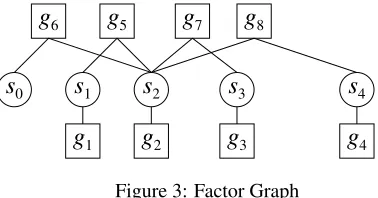
8Figure 3: Factor Graph
ties. However, the polarities are reversed by modi-fying the wordprevents, and the dependency subtree “prevents cancer and heart disease” has positive po-larity. As a result, the whole dependency tree “It prevents cancer and heart disease.” has positive po-larity (Figure 1). In such a way, we can consider the sentiment polarity for each dependency subtree of a subjective sentence. Note that we use phrases as a basic unit instead of words in this study, because phrases are useful as a meaningful unit for sentiment classification1. In this paper, adependency subtree
means the subtree of a dependency tree whose root node is one of the phrases in the sentence.
We use a probabilistic model as shown in Fig-ure 2. We consider that each phrase in the subjective sentence has a random variable (indicated by a cir-cle in Figure 2). The random variable represents the polarity of the dependency subtree whose root node is the corresponding phrase. Two random variables are dependent (indicated by an edge in Figure 2) if their corresponding phrases have head-modifier re-lation in the dependency tree. The node denoted as
<root>in Figure 2 indicates a virtual phrase which represents the root node of the sentence, and we re-gard that the random variable of the root node is the polarity of the whole sentence. In usual annotated corpora for sentiment classification, only each sen-tence is labeled with its polarity, and each phrase (dependency subtree) is not labeled, so all the ran-dom variables except the one for the root node are
[image:2.612.323.512.143.242.2]hidden variables that cannot be observed in labeled data (indicated by gray circles in Figure 2). With such a probabilistic model, it is possible to utilize properties such that phrases which contain positive (or negative) words tend to have positive (negative) polarities, and two phrases with head-modifier rela-tion tend to have opposite polarities if the head con-tains a word which reverses sentiment polarity.
Next, we define the probabilistic model as shown in Figure 2 in detail. Let n denote the number of phrases in a subjective sentence,wi thei-th phrase,
andhi the head index of thei-th phrase. Letsi
de-note the random variable which represents the po-larity of the dependency subtree whose root is the
i-th phrase (si ∈ {+1,−1}), and let p denote the
polarity of the whole sentence (p ∈ {+1,−1}). We regard the0-th phrase as a virtual phrase which rep-resents the root of the sentence.w,h,srespectively denote the sequence ofwi,hi,si.
w=w1· · ·wn, h=h1· · ·hn, s=s0· · ·sn,
p=s0.
For the example sentence in Figure 1, w1 =It,
w2 =prevents, w3 =cancer, w4 =and heart dis-ease.,h1 = 2,h2 = 0,h3 = 2,h4 = 2. We define
the joint probability distribution of the sentiment po-larities of dependency subtreess, given a subjective sentence w and its dependency tree h, using log-linear models:
PΛ(s|w,h)= 1
ZΛ(w,h) exp
{ K ∑
k=1
λkFk(w,h,s)
}
,
(1)
ZΛ(w,h)=
∑
s exp
{ K ∑
k=1
λkFk(w,h,s)
}
, (2)
Fk(w,h,s)= n
∑
i=1
fk(i,w,h,s), (3)
where Λ = {λ1,· · ·, λK} is the set of parameters
of the model. fk(i,w,h,s) is the feature function of the i-th phrase, and is classified to node feature
which considers only the corresponding node, or
edge feature which considers both the correspond-ing node and its head, as follows:
fk(i,w,h,s)=
{
fn
k(wi, si) (k∈Kn),
fke(wi, si, whi, shi) (k∈K
e),
(4)
whereKnandKerespectively represent the sets of indices of node features and edge features.
2.2 Classification of Sentiment Polarity
Let us consider how to infer the sentiment polarity
p ∈ {+1,−1}, given a subjective sentence wand its dependency treeh. The polarity of the root node (s0) is regarded as the polarity of the whole sentence,
andpcan be calculated as follows:
p=argmax
p0
PΛ(p0|w,h), (5)
PΛ(p|w,h)=
∑
s:s0=p
PΛ(s|w,h). (6)
That is, the polarity of the subjective sentence is ob-tained as the marginal probability of the root node polarity, by summing the probabilities for all the possible configurations of hidden variables. How-ever, enumerating all the possible configurations of hidden variables is computationally hard, and we use sum-product belief propagation (MacKay, 2003) for the calculation.
Belief propagation enables us to efficiently calcu-late marginal probabilities. In this study, the graph-ical model to be solved has a tree structure (identi-cal to the syntactic dependency tree) which has no loops, and an exact solution can be obtained us-ing belief propagation. Dependencies among ran-dom variables in Figure 2 are represented by a factor graph in Figure 3. The factor graph consists of vari-able nodes si indicated by circles, and factor
(fea-ture) nodes gi indicated by squares. In the
exam-ple in Figure 3, gi(1 ≤ i ≤ 4) correspond to the node features in Equation (4), and gi(5 ≤ i ≤ 8)
correspond to the edge features. In belief propa-gation, marginal distribution is calculated by pass-ing messages (beliefs) among the variables and fac-tors connected by edges in the factor graph (Refer to (MacKay, 2003) for detailed description of belief propagation).
2.3 Parameter Estimation
and calculate the parametersΛˆ which maximize the value:
LΛ=
L
∑
l=1
logPΛ(pl|wl,hl)− 1 2σ2
K
∑
k=1
λ2k, (7)
ˆ
Λ=argmax
Λ
LΛ, (8)
whereσis a parameter of Gaussian priors and is set to1.0in later experiments. The partial derivatives of
LΛare as follows:
∂LΛ
∂λk =
L
∑
l=1
[ ∑
s
PΛ(s|wl,hl, pl)Fk(wl,hl,s)
−∑
s
PΛ(s|wl,hl)Fk(wl,hl,s)
]
− 1
σ2λk.
(9)
The model parameters can be calculated with the L-BFGS quasi-Newton method (Liu and Nocedal, 1989) using the objective function and its partial derivatives. While the partial derivatives contain summation over all the possible configurations of hidden variables, it can be calculated efficiently us-ing belief propagation as explained in Section 2.2. This parameter estimation method is same to one used for Latent-Dynamic Conditional Random Field (Morency et al., 2007). Note that the objective func-tionLΛis not convex, and there is no guarantee for
global optimality. The estimated model parameters depend on the initial values of the parameters, and the setting of the initial values of model parameters will be explained in Section 2.4.
[image:4.612.325.526.57.271.2]2.4 Features
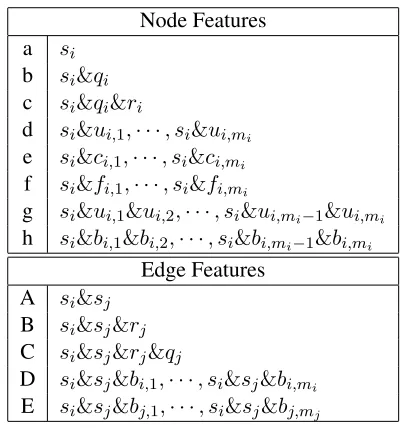
Table 1 shows the features used in this study. Fea-tures (a)–(h) in Table 1 are used as the node fea-tures (Equation (4)) for the i-th phrase, and fea-tures (A)–(E) are used as the edge feafea-tures for the
i-th andj-th phrases (j=hi). In Table 1,si denotes
the hidden variable which represents the polarity of the dependency subtree whose root node is the i -th phrase, qi denotes the prior polarity of the i-th
phrase (explained later), ri denotes the polarity
re-versal of the i-th phrase (explained later), mi
de-notes the number of words in thei-th phrase, ui,k,
bi,k,ci,k, fi,k respectively denote the surface form,
base form, coarse-grained part-of-speech (POS) tag,
Node Features a si
b si&qi
c si&qi&ri
d si&ui,1,· · ·, si&ui,mi
e si&ci,1,· · ·, si&ci,mi
f si&fi,1,· · ·, si&fi,mi
g si&ui,1&ui,2,· · ·, si&ui,mi−1&ui,mi
h si&bi,1&bi,2,· · ·, si&bi,mi−1&bi,mi
Edge Features A si&sj
B si&sj&rj
C si&sj&rj&qj
D si&sj&bi,1,· · ·, si&sj&bi,mi
E si&sj&bj,1,· · ·, si&sj&bj,mj
Table 1: Features Used in This Study
fine-grained POS tag of the k-th word in the i-th phrase.
We used the morphological analysis system JU-MAN and the dependency parser KNP2 for pro-cessing Japanese data, and the POS tagger MX-POST (Ratnaparkhi, 1996) and the dependency parser MaltParser3 for English data. KNP outputs phrase-based dependency trees, but MaltParser out-puts word-based dependency trees, and we con-verted the word-based ones to phrase-based ones us-ing simple heuristic rules explained in Appendix A. The prior polarity of a phraseqi ∈ {+1,0,−1}is
the innate sentiment polarity of a word contained in the phrase, which can be obtained from sentiment polarity dictionaries. We used sentiment polarity dictionaries made by Kobayashi et al. (2007) and Hi-gashiyama et al. (2008)4 for Japanese experiments (The resulting dictionary contains 6,974 positive ex-pressions and 8,428 negative exex-pressions), and a dic-tionary made by Wilson et al. (2005)5 for English experiments (The dictionary contains 2,289 positive expressions and 4,143 negative expressions). When a phrase contains the words registered in the dictio-naries, its prior polarity is set to the registered po-larity, otherwise the prior polarity is set to0. When a phrase contains multiple words in the dictionaries, the registered polarity of the last (nearest to the end
2
http://nlp.kuee.kyoto-u.ac.jp/nl-resource/ 3http://maltparser.org/
4
http://cl.naist.jp/˜inui/research/EM/sentiment-lexicon.html 5
of the sentence) word is used.
The polarity reversal of a phraseri ∈ {0,1}
rep-resents whether it reverses the polarities of other phrases (1) of not (0). We prepared polarity revers-ing word dictionaries, and the polarity reversal of a phrase is set to 1 if the phrase contains a word in the dictionaries, otherwise set to 0. We con-structed polarity reversing word dictionaries which contain such words as decreaseandvanishthat re-verse sentiment polarity. A Japanese polarity revers-ing word dictionary was constructed from an auto-matically constructed corpus, and the construction procedure is described in Appendix B (The dictio-nary contains 219 polarity reversing words). An English polarity reversing word dictionary was con-structed from the General Inquirer dictionary6in the same way as Choi and Cardie (2008), by collecting words which belong to either NOTLW or DECREAS categories (The dictionary contains 121 polarity re-versing words).
Choi and Cardie (2008) categorized polarity re-versing words into two categories: function-word negators such asnotand content-word negators such aseliminate. The polarity reversal of a phraseri
ex-plained above handles only the content-word nega-tors, and function-word negators are handled in an-other way, since the scope of a function-word nega-tor is generally limited to the phrase containing it in Japanese, and the number of function-word negators is small. The prior polarityqiand the polarity
rever-salriof a phrase are changed to the followingq0iand
ri0, if the phrase contains a function-word negator (in Japanese) or if the phrase is modified by a function-word negator (in English):
qi0=−qi, (10)
ri0=1−ri. (11)
In this paper, unless otherwise noted, the word po-larity reversalis used to indicate polarity reversing caused by content-word negators, and function-word negators are assumed to be applied toqiandriin the
above way beforehand.
As described in Section 2.3, there is no guaran-tee of global optimality for estimated parameters, since the objective function is not convex. In our
6
http://www.wjh.harvard.edu/ inquirer/
preliminary experiments, L-BFGS often did not con-verge and classification accuracy was unstable when the initial values of parameters were randomly set. Therefore, in later experiments, we set the initial values in the following way. For the feature (A) in Table 1 in whichsi andsj are equal, we set the
ini-tial parameterλiof the feature to a random number
in[0.9,1.1], otherwise we set to a random number in
[−0.1,0.1]7. By setting such initial values, the initial model parameters have a property that two phrases with head-modifier relation tend to have the same polarity, which is intuitively reasonable.
3 Experiments
We conducted experiments of sentiment classifica-tion on four Japanese corpora and four English cor-pora.
3.1 Data
We used four corpora for experiments of Japanese sentiment classification: the Automatically Con-structed Polarity-tagged corpus (ACP) (Kaji and Kitsuregawa, 2006), the Kyoto University and NTT Blog corpus (KNB)8, the NTCIR Japanese opinion
corpus (NTC-J) (Seki et al., 2007; Seki et al., 2008), the 50 Topics Evaluative Information corpus (50 Topics) (Nakagawa et al., 2008). The ACP corpus is an automatically constructed corpus from HTML documents on the Web using lexico-syntactic pat-terns and layout structures. The size of the corpus is large (it consists of 650,951 instances), and we used1/100of the whole corpus. The KNB corpus consists of Japanese blogs, and is manually anno-tated. The NTC-J corpus consists of Japanese news-paper articles. There are two NTCIR Japanese opin-ion corpora available, the NTCIR-6 corpus and the NTCIR-7 corpus; and we combined the two cor-pora. The 50 Topics corpus is collected from various pages on the Web, and is manually annotated.
We used four corpora for experiments of English sentiment classification: the Customer Review data
7The values of most learned parameters distributed between -1.0 and 1.0 in our preliminary experiments. Therefore, we de-cided to give values around the upper bound (1.0) and the mean (0.0) to the features in order to incorporate minimal prior knowl-edge into the model.
8
(CR)9, the MPQA Opinion corpus (MPQA)10, the Movie Review Data (MR) 11, and the NTCIR En-glish opinion corpus (NTC-E) (Seki et al., 2007; Seki et al., 2008). The CR corpus consists of re-view articles about products such as digital cameras and cellular phones. There are two customer review datasets, the 5 products dataset and the 9 products dataset, and we combined the two datasets. In the MPQA corpus, sentiment polarities are attached not to sentences but expressions (sub-sentences), and we regarded the expressions as sentences and classified the polarities. There are two NTCIR English cor-pora available, the 6 corpus and the NTCIR-7 corpus, and we combined the two corpora.
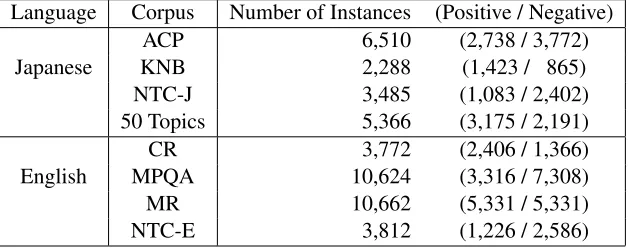
The statistical information of the corpora we used is shown in Table 2. We randomly split each corpus into 10 portions, and conducted 10-fold cross valida-tion. Accuracy of sentiment classification was cal-culated as the number of correctly predicted labels (polarities) divided by the number of test examples.
3.2 Compared Methods
We compared our method to 6 baseline methods, and this section describes them. In the following,
p0 ∈ {+1,−1}denotes the major polarity in
train-ing data,Hidenotes the set consisting of all the
an-cestor nodes of the i-th phrase in the dependency tree, and sgn(x)is defined as below:
sgn(x)=
+1 (x >0),
0 (x= 0), −1 (x <0).
Voting without Polarity Reversal The polarity of a subjective sentence is decided by voting of each phrase’s prior polarity. In the case of a tie, the major polarity in the training data is adopted.
p=sgn ( n
∑
i=1
qi+ 0.5p0
)
. (12)
Voting with Polarity Reversal Same to Voting without Polarity Reversal, except that the po-larities of phrases which have odd numbers of
9
http://www.cs.uic.edu/ liub/FBS/sentiment-analysis.html 10
http://www.cs.pitt.edu/mpqa/
11 http://www.cs.cornell.edu/People/pabo/movie-review-data/
reversal phrases in their ancestors are reversed before voting.
p=sgn ( n
∑
i=1
qi
∏
j∈Hi
(−1)rj+ 0.5p
0
)
.(13)
Rule The polarity of a subjective sentence is deter-ministically decided basing on rules, by con-sidering the sentiment polarities of dependency subtrees. The polarity of the dependency sub-tree whose root is thei-th phrase is decided by voting the prior polarity of thei-th phrase and the polarities of the dependency subtrees whose root nodes are the modifiers of thei-th phrase. The polarities of the modifiers are reversed if their head phrase has a reversal word. The cision rule is applied from leaf nodes in the de-pendency tree, and the polarity of the root node is decided at the last.
si=sgn
(
qi+
∑
j:hj=i
sj(−1)ri
)
, (14)
p=sgn(s0+ 0.5p0). (15)
Bag-of-Features with No Dictionaries The polar-ity of a subjective sentence is classified us-ing Support Vector Machines. Surface forms, base forms, coarse-grained POS tags and fine-grained POS tags of word unigrams and bi-grams in the subjective sentence are used as features12. The second order polynomial ker-nel is used and the cost parameterC is set to
1.0. No prior polarity information (dictionary) is used.
Bag-of-Features without Polarity Reversal Same to Bag-of-Features with No Dictionaries, ex-cept that the voting result of prior polarities (one of positive, negative or tie) is also used as a feature.
Bag-of-Features with Polarity Reversal Same to
Bag-of-Features without Polarity Reversal, ex-cept that the polarities of phrases which have
12
Language Corpus Number of Instances (Positive / Negative)
ACP 6,510 (2,738 / 3,772)
Japanese KNB 2,288 (1,423 / 865)
NTC-J 3,485 (1,083 / 2,402)
50 Topics 5,366 (3,175 / 2,191)
CR 3,772 (2,406 / 1,366)
English MPQA 10,624 (3,316 / 7,308)
MR 10,662 (5,331 / 5,331)
[image:7.612.150.465.61.185.2]NTC-E 3,812 (1,226 / 2,586)
Table 2: Statistical Information of Corpora
Method Japanese English
ACP KNB NTC-J 50 Topics CR MPQA MR NTC-E
Voting-w/o Rev. 0.686 0.764 0.665 0.727 0.714 0.804 0.629 0.730 Voting-w/ Rev. 0.732 0.792 0.714 0.765 0.742 0.817 0.631 0.740
Rule 0.734 0.792 0.742 0.764 0.743 0.818 0.629 0.750
BoF-no Dic. 0.798 0.758 0.754 0.761 0.793 0.818 0.757 0.768 BoF-w/o Rev. 0.812 0.823 0.794 0.805 0.802 0.840 0.761 0.793 BoF-w/ Rev. 0.822 0.830 0.804 0.819 0.814 0.841 0.764 0.797 Tree-CRF 0.846* 0.847* 0.826* 0.841* 0.814 0.861* 0.773* 0.804
(* indicates statistical significance atp <0.05)
Table 3: Accuracy of Sentiment Classification
odd numbers of reversal phrases in their ances-tors are reversed before voting.
Tree-CRF The proposed method based on depen-dency trees using CRFs, described in Section 2.
3.3 Experimental Results
The experimental results are shown in Table 3. The proposed method Tree-CRF obtained the best ac-curacies for all the four Japanese corpora and the four English corpora, and the differences against the second best methods were statistically signifi-cant (p < 0.05) with the paired t-test for the six of the eight corpora. Tree-CRF performed better for the Japanese corpora than for the English cor-pora. For both the Voting methods and the Bag-of-Features methods, the methods with polarity rever-sal performed better than those without it13.
Both BoF-w/ Rev. and Tree-CRF use supervised machine learning and the same dictionaries (the
13
The Japanese polarity reversing word dictionary was con-structed from the ACP corpus as described in Appendix B, and it is not reasonable to compare the methods with and without polarity reversal on the ACP corpus. However, the tendency can be seen on the other 7 corpora.
prior polarity dictionaries and the polarity revers-ing word dictionaries), but the latter performed bet-ter than the former. Our error analysis showed that BoF-w/ Rev. was not robust for erroneous words in the prior polarity dictionaries. BoF-w/ Rev. uses the voting result of the prior polarities as a feature, and the feature is sensitive to the errors in the dictionary, while Tree-CRF uses several information as well as the prior polarities to decide the polarities of depen-dency subtrees, and was robust to the dictionary er-rors. We investigated the trained model parameters of Tree-CRF, and found that the features (E) in Ta-ble 1, in which the head and the modifier have op-posite polarities and the head word is such as pro-tectandwithdraw, have large positive weights. Al-though these words were not included in the polar-ity reversing word dictionary, the property that these words reverse polarities of other words seems to be learned with the model.
4 Related Work
pro-posed for handling reversal of polarities. In this pa-per, our method was not directly compared with the other methods, since it is difficult to completely im-plement them or conduct experiments with exactly the same settings.
Choi and Cardie (2008) proposed a method to classify the sentiment polarity of a sentence bas-ing on compositional semantics. In their method, the polarity of the whole sentence is determined from the prior polarities of the composing words by pre-defined rules, and the method differs from ours which uses the probabilistic model to handle interac-tions between hidden variables. Syntactic structures were used in the studies of Moilanen and Pulman (2007) and, Jia et al. (2009), but their methods are based on rules and supervised learning was not used to handle polarity reversal. As discussed in Sec-tion 1, Wilson et al. (2005) studied a bag-of-features based statistical sentiment classification method in-corporating head-modifier relation.
Ikeda et al. (2008) proposed a machine learning approach to handle sentiment polarity reversal. For each word with prior polarity, whether the polarity is reversed or not is learned with a statistical learning algorithm using its surrounding words as features. The method can handle only words with prior polar-ities, and does not use syntactic dependency struc-tures.
Conditional random fields with hidden variables have been studied so far for other tasks. Latent-Dynamic Conditional Random Fields (LDCRF) (Morency et al., 2007; Sun et al., 2008) are prob-abilistic models with hidden variables for sequen-tial labeling, and belief propagation is used for in-ference. Out method is similar to the models, but there are several differences. In our method, only one variable which represents the polarity of the whole sentence is observable, and dependency re-lation among random variables is not a linear chain but a tree structure which is identical to the syntactic dependency.
5 Conclusion
In this paper, we presented a dependency tree-based method for sentiment classification using condi-tional random fields with hidden variables. In this method, the polarity of each dependency subtree
of a subjective sentence is represented by a hid-den variable. The values of the hidhid-den variables are calculated in consideration of interactions be-tween variables whose nodes have head-modifier re-lation in the dependency tree. The value of the hidden variable of the root node is identified with the polarity of the whole sentence. Experimental results showed that the proposed method performs better for Japanese and English data than the base-line methods which represents subjective sentences as bag-of-features.
Appendix
A Rules for Converting Word Sequence to Phrase Sequence
Letv1,· · ·, vN denote an English word sequence,yi
the part-of-speech of thei-th word, andzi the head
index of thei-th word. The word sequence was con-verted to a phrase sequence as follows, by applying rules which combine two adjacent words:
LT ≡ {“,(,-LRB-,-LSB-,-LCB-,CC} RT≡ {”,),,,--,.,:,POS,-RRB-,-RSB-,-RCB-}
P P≡ {IN,RP,TO,DT,PDT,PRP,WDT,WP,WP$,WRB} N N≡ {CD,FW,NN,NNP,NNPS,NNS,SYM,JJ} do
fori:=1toN−1
ifxiandxi+1are not yet combined∧ (xi∈LT ∨
xi+1∈RT∨
((yi=yi+1∨yi=i+ 1∨yi+1=i)∧ (xi∈P P∨
(xi∈N N∧xi+1∈N N))))then Combine the wordsviandvi+1
untilNo rules are applied
B Construction of Japanese Polarity Reversing Word Dictionary
References
Alina Andreevskaia and Sabine Bergler. 2008. When Specialists and Generalists Work Together: Overcom-ing Domain Dependence in Sentiment TaggOvercom-ing. In
Proceedings of the 46th Annual Meeting of the Asso-ciation for Computational Linguistics: Human Lan-guage Technologies, pages 290–298.
Soumen Chakrabarti. 2002. Mining the Web: Dis-covering Knowledge from Hypertext Data. Morgan-Kauffman.
Yejin Choi and Claire Cardie. 2008. Learning with Compositional Semantics as Structural Inference for Subsentential Sentiment Analysis. In Proceedings of the 2008 Conference on Empirical Methods in Natural Language Processing, pages 793–801.
Masahiko Higashiyama, Kentaro Inui, and Yuji Mat-sumoto. 2008. Acquiring Noun Polarity Knowledge Using Selectional Preferences. InProceedings of the 14th Annual Meeting of the Association for Natural Language Processing, pages 584–587. (in Japanese). Daisuke Ikeda, Hiroya Takamura, Lev-Arie Ratinov, and
Manabu Okumura. 2008. Learning to Shift the Po-larity of Words for Sentiment Classification. In Pro-ceedings of the 3rd International Joint Conference on Natural Language Processing, pages 296–303. Lifeng Jia, Clement Yu, and Weiyi Meng. 2009. The
Ef-fect of Negation on Sentiment Analysis and Retrieval Effectiveness. In Proceeding of the 18th ACM Con-ference on Information and Knowledge Management, pages 1827–1830.
Nobuhiro Kaji and Masaru Kitsuregawa. 2006. Auto-matic Construction of Polarity-Tagged Corpus from HTML Documents. In Proceedings of the COL-ING/ACL 2006 Main Conference Poster Sessions, pages 452–459.
Nozomi Kobayashi, Kentaro Inui, and Yuji Matsumoto. 2007. Opinion Mining from Web Documents: Extrac-tion and StructurizaExtrac-tion. Journal of the Japanese So-ciety for Artificial Intelligence, 22(2):227–238. Dong C. Liu and Jorge Nocedal. 1989. On the limited
memory BFGS method for large scale optimization.
Mathematical Programming, 45(3):503–528.
David J. C. MacKay. 2003. Information Theory, Infer-ence, and Learning Algorithms. Cambridge Univer-sity Press.
Karo Moilanen and Stephen Pulman. 2007. Sentiment Composition. InProceedings of the Recent Advances in Natural Language Processing International Confer-ence, pages 378–382.
Louis-Philippe Morency, Ariadna Quattoni, and Trevor Darrell. 2007. Latent-Dynamic Discriminative Mod-els for Continuous Gesture Recognition. In Proceed-ings of the 2007 IEEE Conference on Computer Vision and Pattern Recognition, pages 1–8.
Tetsuji Nakagawa, Takuya Kawada, Kentaro Inui, and Sadao Kurohashi. 2008. Extracting Subjective and Objective Evaluative Expressions from the Web. In
Proceedings of the 2nd International Symposium on Universal Communication.
Bo Pang and Lillian Lee. 2008. Opinion Mining and Sentiment Analysis. Foundations and Trends in Infor-mation Retrieval, 2(1-2):1–135.
Bo Pang, Lillian Lee, and Shivakumar Vaithyanathan. 2002. Thumbs up? Sentiment Classification using Machine Learning Techniques. InProceedings of the 2002 Conference on Empirical Methods in Natural Language Processing, pages 79–86.
Adwait Ratnaparkhi. 1996. A Maximum Entropy Model for Part-of-Speech Tagging. In Proceedings of the 1996 Conference on Empirical Methods in Natural Language Processing Conference, pages 133–142. Yohei Seki, David Kirk Evans, Lun-Wei Ku, Hsin-His
Chen, Noriko Kando, and Chin-Yew Lin. 2007. Overview of Opinion Analysis Pilot Task at NTCIR-6. InProceedings of the 6th NTCIR Workshop, pages 265–278.
Yohei Seki, David Kirk Evans, Lun-Wei Ku, Le Sun, Hsin-Hsi Chen, and Noriko Kando. 2008. Overview of Multilingual Opinion Analysis Task at NTCIR-7. In
Proceedings of the 7th NTCIR Workshop.
Xu Sun, Louis-Philippe Morency, Daisuke Okanohara, and Jun’ichi Tsujii. 2008. Modeling Latent-Dynamic in Shallow Parsing: A Latent Conditional Model with Improved Inference. In Proceedings of the 22nd In-ternational Conference on Computational Linguistics, pages 841–848.
Theresa Wilson, Janyce Wiebe, and Paul Hoffmann. 2005. Recognizing Contextual Polarity in Phrase-Level Sentiment Analysis. InProceedings of the 2005 Joint Conference on Human Language Technology and Empirical Methods in Natural Language Processing, pages 347–354.