Exploring Semi-Supervised Coreference Resolution of Medical Concepts
using Semantic and Temporal Features
Preethi Raghavan∗, Eric Fosler-Lussier∗, and Albert M. Lai†
∗Department of Computer Science and Engineering
†Department of Biomedical Informatics
The Ohio State University, Columbus, Ohio, USA
{raghavap, fosler}@cse.ohio-state.edu, [email protected]
Abstract
We investigate the task of medical concept coreference resolution in clinical text using two semi-supervised methods, co-training and multi-view learning with posterior regulariza-tion. By extracting semantic and temporal features of medical concepts found in clinical text, we create conditionally independent data views; co-training MaxEnt classifiers on this data works almost as well as supervised learn-ing for the task of pairwise coreference resolu-tion of medical concepts. We also train Max-Ent models with expectation constraints, using posterior regularization, and find that poste-rior regularization performs comparably to or slightly better than co-training. We describe the process of semantic and temporal feature extraction and demonstrate our methods on a corpus of case reports from the New England Journal of Medicine and a corpus of patient narratives obtained from The Ohio State Uni-versity Wexner Medical Center.
1 Introduction
The clinical community creates and uses a variety of semi-structured and unstructured electronic tex-tual documents that include medical reports such as admission notes, progress notes, pathology re-ports, radiology reports and hospital discharge sum-maries. The documents, collectively termed clini-cal narratives, account for various medical condi-tions, procedures, diagnoses and assessments in a patient’s medical history. Researchers have inves-tigated ways in which clinical text can be automati-cally processed for enabling access to relevant
infor-mation for physicians and health researchers (Embi and Payne, 2009). One application is to support pa-tient recruitment into clinical trials (research studies that try to answer scientific questions to find bet-ter ways to prevent, diagnose, or treat a disease) by matching patient characteristics against eligibil-ity criteria (Raghavan and Lai, 2010). While there has been significant efforts to move to structured data collection, clinical narratives remain a critical data source for these tasks.
Extracting structured information from unstruc-tured clinical text using natural language processing (NLP) is complicated by the distinct clinical report-ing sub-language characterized by incomplete sen-tences and domain specific abbreviations (Friedman et al., 2002). The large number of clinical narra-tives generated per patient, over the years, along with redundant information within and across narra-tives, further adds to the complexity of using infor-mation structured using NLP. There is a tendency to copy and edit parts of an old clinical narrative when-ever a new one is created, thus leading to redundant information in clinical narratives of a patient. Fur-thermore, since different types of clinical narratives are created for different purposes, certain narratives may summarize information from various other, at times older, clinical narratives. All of this makes the task of automatically processing unstructured clin-ical narratives significantly difficult. However, the ability to resolve medical concept coreferences helps deal with redundant information within and across clinical narratives and thus produce a unique list of medical concepts in the patient’s clinical history.
We investigate the task of resolving references to
the same medical concept in the clinical narratives of a patient using supervised and semi-supervised methods. Our main contributions are as follows: 1. Since manual coreference annotation of patient narratives is a slow and expensive process and pub-licly available datasets are difficult to acquire, we study the application of semi-supervised methods, co-training and using expectation constraints with posterior regularization, to medical concept coref-erence resolution (MCCR).
2. We work with the hypothesis that if two medical concepts have the same meaning and have occurred at the same time, there is a very high probability that they corefer. Based on this hypothesis, we explain extraction of semantic and temporal feature sets that are effectively used for MCCR.
3. We propose a method to associate medical con-cepts with time durations centered around admission and discharge dates of the patient using CRFs. 4. With the help of corpora created from the New England Journal of Medicine (NEJM) and actual pa-tient narratives obtained from the medical center, we demonstrate that the semi-supervised methods per-form comparably with supervised learning for pair-wise MCCR using a MaxEnt classifier.
2 Related Work
Free-text reports form a significant portion of the information content in a patient’s medical record. There is great need for tools that can structure the information in clinical text for use in various stud-ies studstud-ies such as clinical trials, quality assess-ment of healthcare delivery in institutions, and pub-lic health research. Researchers have been investi-gating ways in which clinical free-text can be struc-tured to transform the information content in a clin-ical narrative into a representation suitable for com-putational analysis (Ananiadou et al., 2004). Medi-cal NLP systems like Mayo’s cTakes (Savova et al., 2010), IBM’s MedKAT,1 and MedLEE (Chiang et
al., 2010), have components specifically trained or designed for the clinical domain, to support tasks such as named entity recognition. Previous at-tempts at learning temporal relations between med-ical events in clinmed-ical text include work by Jung et
1
https://cabig-kc.nci.nih.gov/Vocab/KC/
index.php/OHNLP
al. (2011) and Zhou et al. (2006). Gaizauskas et al. (2006) learn the temporal relationsbefore, after, is includedbetween events from a corpus of clinical text much like the event-event relation tlink learn-ing in Timebank (Pustejovsky et al., 2003). A com-prehensive survey of temporal reasoning in medi-cal data is provided by Zhou and Hripcsak (2007). Chapman et al. (2011) discuss barriers to NLP de-velopment in the clinical domain.
Coreference resolution is a well-studied prob-lem in computational linguistics (Ng, 2010; Raghu-nathan et al., 2010). Supervised machine learn-ing algorithms have been previously used for noun phrase coreference resolution with fairly good re-sults (Soon et al., 2001; Raghunathan et al., 2010). Recently, the i2b2 challenge2 on coreference reso-lution examined coreference resoreso-lution in clinical data. The problem addressed in our paper is simi-lar to the task described in the i2b2 challenge.3 Be-sides the i2b2 challenge, there has not been signifi-cant work in MCCR. This may be due to various pri-vacy concerns and the efforts required to anonymize and annotate massive amounts of patient narratives. Zheng et al. (2011) review heuristic-based, super-vised and unsupersuper-vised methods for coreference res-olution in the context of the clinical domain. He (2007) studied coreference resolution in discharge summaries, treating coreference resolution as a bi-nary classification problem and investigated critical features for coreference resolution for entities that fall into five medical semantic categories commonly appearing in discharge summaries. However, we fo-cus on feature extraction to determine the similarity between medical concepts, both in terms of meaning and time of occurrence, for resolving coreferences within and across all types of clinical narratives.
A disadvantage of supervised machine learning approaches is the need for an unknown amount of annotated training data for optimal performance. Researchers then began to experiment with weakly supervised machine learning algorithms such as co-training (Blum and Mitchell, 1998). Muller et al. (2002) investigate the practical applicability of co-training for the task of building a classifier for coref-erence resolution and observed that the results were
2
https://www.i2b2.org/NLP/Coreference/
3
https://www.i2b2.org/NLP/Coreference/assets/
mostly negative for their dataset.
Ganchev et al. (2010) propose a posterior regular-ization framework for weakly supervised learning to derive a multi-view learning algorithm. Multi-view methods typically begin by assuming that each view alone can yield a good predictor. Under this as-sumption, we can regularize the models from each view by constraining the amount by which we per-mit them to disagree on unlabeled instances. In the proposed approach, they train a model for each view, and use constraints that the models should agree on the label distribution.
We investigate the applicability of these two weakly supervised methods to the task of MCCR using se-mantic and temporal views. Savova et al. (2011) dis-cuss the creation of a corpus for coreference resolu-tion in the clinical narrative. We annotate a corpus of clinical narratives to tag medical concepts, temporal relations, and coreference information. We use this corpus as a gold standard to evaluate the proposed approach to resolving coreferences between medical concepts in clinical text.
To summarize, we study the problem of intra and cross-narrative coreference resolution on longitudi-nal patient data using relatedness between medical concepts in terms of semantics and time. Further, we importantly demonstrate that this task gives us reasonable results even when modeled as a semi-supervised problem. Creating annotated clinical cor-pora is tedious, time consuming, and costly, as it requires experts with medical domain knowledge. Thus, the ability to train semi-supervised models with limited labeled data for MCCR would be of tremendous value.
3 Problem Description
Coreference resolution in clinical text refers to the problem of identifying all medical concepts that re-fer to the same medical concept. Medical con-cepts are medical entities, events or states associ-ated with the patient’s medical condition and health-care. These include medical conditions, drugs ad-ministered, diseases, procedures and lab tests as well as normal health situations like pregnancy affecting the patient’s health. The task of MCCR is similar to noun phrase coreference resolution. However, med-ical concepts are not restricted to noun phrases. For
instance, the actionscauterizeandcauterizationare both considered medical concepts.
To make the task of identifying medical concepts from clinical text more deterministic, any contigu-ous group of words that have a direct or close match in the Unified Medical Language System (UMLS) Metathesaurus4 is considered a medical concept. The UMLS includes a large Metathesaurus of con-cepts and terms from many biomedical vocabular-ies and a lexicon which contains syntactic, morpho-logical, and orthographic information for biomedi-cal and common words in the English language.
Problem Formulation. Consider a corpus of clini-cal narratives, where multiple cliniclini-cal narratives are associated with each patient. IfPi,i∈ {1,2, ..., n}
where n is the number of patients in corpus, then for eachPi, we have a set of associated clinical
nar-ratives. Each clinical narrative in turn has a set of medical concepts. Thus, eachPihas a set of
associ-ated medical concepts,M ={M1, M2, M3, ..}that
occur within each clinical narrative as well as across clinical narratives for thatPi. We study the problem
of MCCR of all medical concepts inM for eachPi.
4 Semantic and Temporal Features
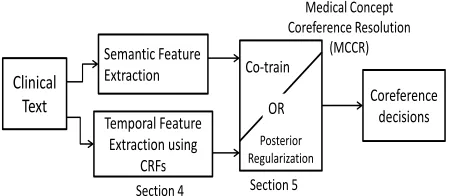
We extract features based on semantic and tempo-ral relatedness for each pair of medical concepts. Semantic relatedness measures closeness between medical concepts in terms of their meaning. This is quantified by measuring distance between medical events in the UMLS Metathesaurus graph structure (Xiang et al., 2011). Temporal relatedness measures the closeness between medical concepts in terms of when they occurred. This is achieved by first, learn-ing to assign every medical concept to a time-bin, and then using the time-bin as a feature for learn-ing to resolve coreferences. Extractlearn-ing semantic and temporal features helps identify conditionally inde-pendent views of the data for co-training classifiers. As previously noted by Nigam and Ghani (2000), it is hard to identify conditionally independent views for real-data problems. However, we believe there are no natural dependencies between the semantic and temporal feature sets. While semantic features help identify synonymous medical concepts, that alone may not guarantee coreference. Medical
Clinical Text
Semantic Feature Extraction
Temporal Feature Extraction using
CRFs
Co-train
Posterior Regularization
Coreference decisions
Section 4 Section 5
Medical Concept Coreference Resolution
(MCCR)
[image:4.612.68.294.66.164.2]OR
Figure 1: MCCR pipeline: Extract semantic and tempo-ral features from clinical text to train MaxEnt classifiers for medical concept coreference resolution using 1) Co-training or 2) Posterior Regularization
cepts that are similar in meaning, but dissimilar in terms of their time of occurrence, most probably do not corefer. Similarly, medical concepts that occur during the same time duration but are dissimilar in terms of meaning, most probably do not corefer.
Semantic Relatedness. We leverage the UMLS
to derive a semantic relatedness score between med-ical concepts. The UMLS codifies concepts found in various medical vocabularies (e.g., ICD5 and SNOMED-CT6) and includes relationships between various concepts. The medical concepts and their relationships are modeled in a graph structure. We use the k-Neighborhood decentralization method (kDLS) (Xiang et al., 2011) to index and transi-tively traverse associated relations between concept unique identifiers (CUIs) in the UMLS graph. The UMLS uses semantic relations to mark the avail-able links between two concepts. Around 2,404,937 CUIs and 15,333,246 links between them are seen in the full UMLS graph structure. The kDLS method is shown to outperform both breadth-first and depth-first search in terms of speed and various other measures in finding important information, such as reachability, distance, and a summary of paths, be-tween two concepts in the UMLS graph structure. The relation between two conceptsMj (denoted by
x) andMk(denoted byy) is measured as follows.
R(x, y) =X p∈D(x,y)
1
γlength(p)−1 + X
q∈D(y,x) 1
γlength(q)−1
where D(x, y) is the set of paths fromx to y and D(y, x)is the set of paths from y to x obtained
us-5http://www.cdc.gov/nchs/icd.htm
6http://www.ihtsdo.org/snomed-ct/
ing the kDLS method, excluding paths with length equal to 1. In order to make the measurement be-tween a medical concepts unbiased against the avail-able links in the UMLS that directly connect them, the paths with length being 1 between them are not counted. Each path’s contribution to the relation scoreR(x, y)is determined by its length andγ.γis varied between 1 to 50; ifγis set to 1, then all paths contribute equally to R irrespective of their lengths. When γ increases, more weight will be placed on the short paths as opposed to the long paths. Xiang et al. (2011) observe several fold enrichment values whenγ is varied between 5 and 15.
Besides traversing the UMLS graph structure us-ing the kDLS method to obtain a similarity score between medical concepts, we also measure similar-ity between medical concepts by taking into account the surrounding context. We do so by measuring the KL-divergence between the sentences to which the medical concepts belong. In order to avoid the possibility of an empty set when calculating the in-tersection of the probability distributions, we use a smoothing method that makes the probability distri-butions sum to 1 (Brigitte, 2003).
Another important semantic feature is the type of relation between the medical concepts. This feature is calculated by first computing the stemmed word overlap between the medical concepts and deriving features based on exact and partial matches between the word stems of the medical concepts. If there is no exact or partial match between the concepts, we query the UMLS to check if the stem of one of the medical concepts occurs in the UMLS definition or atoms of the other medical event. An atom is the smallest unit of naming within the UMLS. A med-ical concept in UMLS represents a single meaning and contains all atoms in the UMLS that express that meaning in any way, whether formal or casual, ver-bose or abbreviated. All of the atoms within a con-cept are synonymous.
Besides the described features, we also include the UMLS semantic category of each medical con-cept and the WordNet7similarity score between sen-tences containing the medical concept.
Temporal Relatedness. Clinical text is
fre-quently characterized by temporal expressions
occurring with medical concepts (Zhou and Hripc-sak, 2007). For instance,two days ago, fever started
4 days before rash, July 10th, 2010etc. The abil-ity to associate medical concepts with temporal ex-pressions helps order medical concepts and deter-mine potential temporal overlap between them. This in turn could be a powerful discriminatory feature in MCCR. Consider the medical conceptchest pain
that occurs multiple times in a clinical narrative. If these mentions of chest pain have occurred at the same time, there is a possibility that they all refer to the same instance of the medical conceptchest pain. Instead of relying on implicit temporal references that may or may be evident from the clinical nar-rative, we focus on temporal expressions that are found in most clinical narratives. We do so by lever-aging structural properties of clinical narratives such as section information and explicit temporal infor-mation such as admission and discharge dates, to learn to assign medical concepts to time periods we refer to as time-bins.
We now proceed to explain the process of assign-ing medical concepts to time-bins usassign-ing CRFs. Clin-ical narratives are usually formatted with a struc-tured header with information that includes the pa-tient admission and discharge date. Clinical narra-tives are also typically divided into sections. Sec-tions represent a logical, and at times, temporal grouping of information in the narrative. Sections such as “history of present illness,” “physical ex-amination,” “review of systems,” “impression,” and “assessment plan” tend to occur in a certain order within each clinical narrative. Thus, section tran-sitions may indicate a temporal pattern for medical concepts across those sections. For example, “past medical history” (before admission), followed by “findings on admission” (on admission), followed by “physical examination” (after admission). Sec-tions of certain types may also exhibit certain tem-poral patterns. A “history of present illness” sec-tion may start with diseases and diagnoses 30 years ago and then proceed to talk about them in the con-text of a medical condition that happened few years ago and finally describe the patient’s condition on admission. Given the temporal patterns within sec-tions and at section transisec-tions, it works well to treat the list of medical concepts from each clinical nar-rative as a sequence (considering them in narnar-rative
order) and learning to label them with a correspond-ing time-bin. We define the followcorrespond-ing sequence of time-bins centered around admission and discharge,
{way before admission, before admission, on admis-sion, after admisadmis-sion, after discharge}.
We model the problem of assigning medical con-cepts to time-bins as a sequence labeling task using a CRF where we predict labels from the set{way be-fore admission, bebe-fore admission, on admission, af-ter admission, afaf-ter discharge}as a sequenceY pre-dicted from the detected medical conceptsX. CRFs use two types of features in classification, state fea-tures and transition feafea-tures. State features con-sider relating the labely (time-bin) of a single ver-tex (medical concept) to features corresponding to a medical conceptx, and are given by,
S(x, y, i) =P
jλjsj(y, x, i)
Transition features consider the mutual depen-dence of labelsyi−1andyi(dependence between the
time-bins of the current and previous medical event in the sequence) and are given by,
T(x, y, i) =P
kµktk(yi−1, yi, x, i)
Above, sj is a state feature function, and λj is its
associated weight andtkis a transition function, and
µk is its associated weight. In contrast to the state
function, the transition function takes as input the current label as well as the previous label, in addition to the data.
Example state features include indicator features based on verbs patterns in the same sentence as that of the medical concept, last verb before the medical concept, and type of clinical narrative. We also in-clude position of medical event in the narrative as well as within each section, the temporal expres-sions and dates co-occurring with the medical con-cept as features and the difference between these dates and the admission date on each clinical nar-rative. Example transition features include section transitions based on the sections under which the medical concept occurs, UMLS relatedness score between the previous and current medical concept, difference in verb patterns between the previous and current medical concept, difference in dates (if any) between the dates co-occurring with the previous and current medical concept.
al-gorithm to automatically identify sections and asso-ciate medical concepts with them.
1. Extract lines that are all upper-case, and longer than a word, from all narratives in corpus. They mostly correspond to section titles.
2. Derive the stem of each word in the title using a Porter stemming algorithm8 and sort stemmed titles by frequency. If two or more words in the title overlap, they are considered the same. This gives us a candidate set of section titles.
3. When parsing a clinical narrative, and encoun-tering a stemmed ngram matching a section ti-tle from the frequent list, all subsequent sen-tences are associated with that section until a new section title is encountered. If an exact match is not found, we allow partially match-ing ngrams to be considered as section titles.
Along with the time-bin that are learned using the process described above, dates and temporal expres-sions extracted from the annotations in our corpus are also used as temporal features. The list of fea-tures extracted for the task of MCCR include the following:
1. Verb pattern in the sentence in which the med-ical concept occurs.
2. Last verb before the medical concept in the same sentence.
3. Type of clinical narrative.
4. Section under which the medical concept is mentioned.
5. Position of the medical concept.
6. Dates that fall in the same sentence as the med-ical concept.
7. Difference between admission date and the date in the same sentence as the clinical narrative. 8. The learned time-bin of each medical concept.
We also derive features based on the overlap-ping in time-bins for the medical concept pair and the nature of time-bin (past, present, fu-ture).
9. Difference in verb patterns in the sentences of the medical concept pair.
10. Difference in dates between the medical con-cept pair.
8http://tartarus.org/martin/PorterStemmer/
11. UMLS relatedness score between the medical concept pair and all the UMLS related and other features described previously in the se-mantic relatedness section.
When applying CRFs to the problem of assigning medical concepts to time-bins, an observation se-quence is medical concepts in the order in which they appear in a clinical narrative, and the state se-quence is the corresponding label sese-quence of time bins. Thus, given a sequence of concepts in narrative order {M1, M2, M3, ..}, we learn a corresponding
label sequence of time-bins{way before admission, before admission, on admission, after admission, af-ter discharge}. The learned label sequence is now used as part of the temporal feature set in co-training and posterior regularization for MCCR.
5 Weakly Supervised Learning
5.1 Co-training
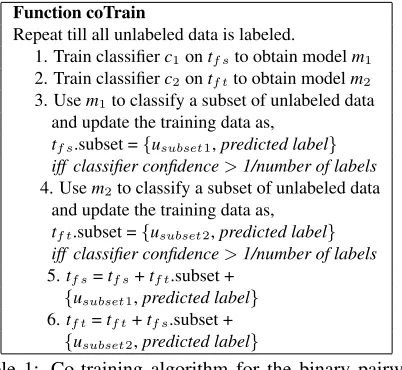
We co-train two MaxEnt classifiers, one each on the semantic featuresfs and temporal featuresftof the data, to classify pairs of medical concepts as core-fer orno-corefer in a semi-supervised fashion. We use the co-training algorithm proposed by Blum and Mitchell (1998).
The assumption here is that each feature set contains sufficient information to train a model for classifica-tion of medical concepts. Consider the concept pair,
Function coTrain
Repeat till all unlabeled data is labeled.
1. Train classifierc1ontf sto obtain modelm1
2. Train classifierc2ontf tto obtain modelm2
3. Usem1to classify a subset of unlabeled data
and update the training data as, tf s.subset ={usubset1,predicted label}
iff classifier confidence>1/number of labels 4. Usem2to classify a subset of unlabeled data
and update the training data as, tf t.subset ={usubset2,predicted label}
iff classifier confidence>1/number of labels 5.tf s=tf s+tf t.subset +
{usubset1,predicted label}
6.tf t=tf t+tf s.subset +
[image:7.612.86.287.54.239.2]{usubset2,predicted label}
Table 1: Co-training algorithm for the binary pairwise classification task of MCCR (Blum and Mitchell, 1998). c= classifier,u= unlabeled data.
usubset1,usubset2= subsets of unlabeled data.
usubset1andusubset2are mutually exclusive.
F={fs, ft}is the features space divided into condition-ally independent semantic and temporal feature sets. tf s ={fs,l}training data consisting of semantic features of a medical concept pair along with class label.
tf t ={ft,l}training data consisting of temporal features of a medical concept pair along with class label.
into the labeled pool. An unlabeled sample is la-beled in a particular iteration, ifclassifier confidence
> 1/number of labels. In the next iteration, ran-domly pick a subset of unlabeled samples and label all samples in this subset. This could include sam-ples that have already been labeled in previous iter-ations. A label is assigned in a subsequent iteration if: the sample was previously labeled OR if classi-fier confidence>threshold. The parameters in this algorithm are the number of iterations, the pool size of examples selected from the unlabeled set in each iteration and the number of labeled examples added at each iteration to the labeled data pool. Similar to Blum and Mitchell (1998), we update the pool size by2p+ 2nin each iteration, wherepis the number of medical pairs that corefer andnis the number of medical concept pairs that do not corefer.
5.2 MaxEnt with Posterior Regularization
The next semi-supervised learning method applied to MCCR is MaxEnt with posterior regularization using expectation constraints (Ganchev et al., 2010). This method incorporates prior knowledge directly on the output variables during learning. The prior
knowledge is expressed as inequalities on the ex-pected value under the posterior distribution of user-defined constraint features. Thus, posterior regular-ization incorporates side-information into unsuper-vised estimation in the form of constraints on the model’s posteriors. It is similar to the EM algorithm during learning, but it solves a problem similar to Maximum Entropy inside the E-Step to enforce the constraints.
Posterior regularization is used to derive a multi-view learning algorithm while specifying constraints that the models should agree on the label distri-bution. We train MaxEnt models based on two views of the data, semantic and temporal. This method starts by considering the setting of complete agreement where there is a common desired out-put for the two models and each of the two views is sufficiently rich to predict labels accurately. The search is restricted to model pairs p1, p2 that
sat-isfyp1(y|x) ≈ p2(y|x), wherep1 andp2 each
de-fine a distribution over labels. The product dis-tributionp1(y1)p2(y2) is considered and constraint
features are defined such that the proposal distri-bution q(y1, y2) will have the same marginal for
y1 andy2. There is one constraint feature defined
for each label y given by, φy(y1, y2) = δ(y1 =
y)δ(y2 = y), where δ(.)is the 0-1 indicator
func-tion. The constraint set Q = q:Eq[φ] = 0 re-quires that the marginals over the two output vari-ables are identical q(y1) = q(y2). An agreement
between two models is defined asagree(p1, p2) =
argmin KL(q(y1, y2)||p1(y1)p2(y2))|Eq [φ] = 0.
Class(time-bin) Precision Recall after discharge 96.05 62.53 before admission 94.02 92.44 on admission 33.25 75.16 way before admission 50.42 66.72 after admission 93.62 99.14
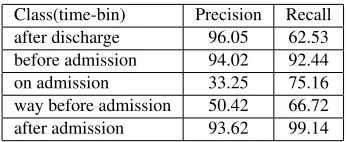
Table 2: Sequence tagging of medical concepts with time-bins using CRFs.
6 Experimental Setup
6.1 Corpus Annotation
Annotation of clinical text is a time consuming and costly process. Many annotation efforts have used physicians to annotate the data. Instead, we use an-notators that are students or recently graduated stu-dents from diverse clinical backgrounds with vary-ing levels of clinical experience. In spite of this di-versity, the annotation agreement across our team of annotators is high; all annotators agreed on 89.5% of the events and our overall inter-annotator Cohen’s kappa statistic (Conger, 1980) for medical events was 0.865. The annotators mark medical concepts, coereference chains and temporal expressions in the clinical narratives and the NEJM case reports. They also map each medical concept to a UMLS CUI.
6.2 Feature Extraction
The first step involves extraction of semantic and temporal features for the annotated medical con-cepts, as described in Section 4 from both corpora. The semantic relatedness scores are computed us-ing the kDLS (Xiang et al., 2011) method to calcu-late the relationship between concepts in the UMLS with value of γ set to 7. The type of relation be-tween medical concepts is derived by matching word stems in each medical concept using the Lucene9
implementation of the Porter stemming algorithm. We query the latest release (UMLS 2011AB) of the UMLS Metathesaurus for finding a match between medical concept and the UMLS definition or UMLS atoms. The WordNet similarity score is computed using Java API for WordNet Searching (JAWS).10
Explicit temporal expressions annotated in the corpora are included in our temporal feature set. Medical concepts in the NEJM are mostly de-scribed temporally relative to the patient’s
admis-9http://lucene.apache.org/
10
http://lyle.smu.edu/˜tspell/jaws/
Class NEJM Clinical Narratives Precision Recall Precision Recall coref 79.24 94.53 74.81 88.33 no-coref 86.71 90.62 83.92 94.86
Table 3: Supervised learning for MCCR.
sion. Temporal expressions like “2 years before ad-mission” and “3 weeks before adad-mission” are com-mon. Hence, we use a heuristic-based algorithm to associate medical concepts with explicit tempo-ral expressions in the NEJM corpus. The algo-rithm parses case reports and identifies the tempo-ral expressions anchored to admission. All medi-cal concepts following such a temporal expression are anchored to it until a new temporal expression is encountered. Over 88% of the medical concept-temporal expression associations done with the al-gorithm above is accurate when compared against the NEJM gold standard.
As described in Section 4, we apply sequence tag-ging using a CRF to assign medical concepts in clin-ical narratives to time-bins. We use the implementa-tion of CRF in Mallet,11trained by Limited-Memory BFGS for our experiments. We use the Stanford POS tagger12to identify verbs and derive verb pat-terns. The dataset for the task of assigning medi-cal concepts to time-bins consisted of 1613 medimedi-cal concepts. We used a 60-40 train-test split to train a CRF using a sequence of medical concepts and ob-served an overall accuracy of 92%. The precision and recall values for each time-bin class is indicated in Table 2. The percentage of medical concepts that fall under “way before admission” and “on admis-sion” are less than 5%, affecting the learning accu-racy of those classes. When modeled as a multi-class multi-classification task using MaxEnt, we achieve around 86% accuracy.
7 MCCR Results and Discussion
We perform the following experiments for pairwise MCCR: 1) Supervised learning with a MaxEnt clas-sifier, using the combined semantic and temporal feature set, 2) Co-training two MaxEnt models, 3) Training MaxEnt models with using posterior regu-larization.
11
http://mallet.cs.umass.edu/
12
http://nlp.stanford.edu/software/tagger.
[image:8.612.326.527.54.101.2]Class NEJM Clinical Narratives
Co-train Precision Recall Precision Recall
coref 70.32 82.54 69.26 87.31
no-coref 82.54 84.85 71.15 89.44 PR Precision Recall Precision Recall
coref 76.63 90.41 74.81 84.25
[image:9.612.83.290.53.136.2]no-coref 80.35 89.21 78.93 87.46
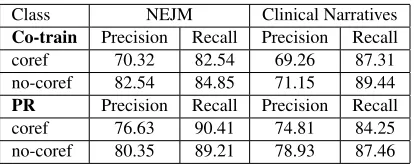
Table 4: Co-training and posterior regularization (PR) for MCCR using semantic and temporal feature sets.
We use the MaxEnt classifier available in Mallet for 1) and 2) and the the Mallet implementation of MaxEnt models with posterior regularization for 3). The NEJM corpus has 722 medical concepts, 12576 candidate pairs of medical concepts includ-ing 137 pairs that corefer. We include all 12576 pairs in our experiments. The clinical narrative cor-pus has 1613 medical concepts. The candidate pairs and coreference chains for each patient is as follows. Patient 1 has 241001 candidate pairs, 29 corefer-ence chains. Patient 2 has 149604 candidate pairs, 9 coreference chains. Patient 3 has 6,446,521 can-didate pairs, 20 coreference chains. From all the candidate pairs in the clinical narrative corpus, 1025 pairs corefer. We randomly sample the no-coref in-stances to restrict the corpus size to 1 million candi-date pairs of medical concepts.
The results for all 3 experiments for both corpora is shown in Tables 3, 4. We also train-test a super-vised MaxEnt classifier on a 60-40 split of the en-tire corpus. This gives us a precision of 74.81% and 88.33% recall (coref) for the binary classification task of pairwise MCCR in the clinical narratives cor-pus. In the both the semi-supervised experiments, we use an initial labeled pool size of 30 where 12 medical concept pairs that corefer (p) and 18 that do not corefer (n). The growth size is each iteration of co-training is2p+ 2n. At each iteration, confidently labeled examples are added to the training set from the previous iteration. The co-training algorithm is run until all unlabeled instances become labeled. The parameters in the posterior regularization im-plementation include the regularization penalty for each step and the number of iterations. We use the default values (maxIterations=100, pGaussianPrior-Variance=0.1, qGaussianPriorVariance=1000) sug-gested on the Mallet toolkit page (Bellare et al., 2009). Co-training two MaxEnt models based on independent semantic and temporal views of the
data results in 69.26% precision and 87.31% recall (coref), whereas training MaxEnt models with ex-pectation constraints gives us 74.81% precision and 84.25% recall (coref), on the corpus of clinical nar-ratives.
Posterior regularization does better than co-training and the performance of both the semi-supervised methods is comparable to if not as good as the super-vised classifier trained on a 60-40 split of the corpus. Thus, our results indicate that the use of semantic and temporal features is effective for MCCR in clin-ical text. It is clear from the co-training and poste-rior regularization results that treating MCCR as a semi-supervised problem works.
8 Conclusions
We investigated the task of MCCR in clinical text us-ing supervised and semi-supervised learnus-ing meth-ods. We create annotated corpora of clinical text with case reports from the NEJM and narratives ob-tained from The Ohio State University Wexner Med-ical Center. We work with the hypothesis that de-termining semantic and temporal similarity between medical concepts helps resolve coreferences. In order to test this hypothesis, we describe the pro-cess of semantic and temporal feature extraction from clinical text. We demonstrate the effective-ness of the extracted features in a supervised binary classification task for MCCR with MaxEnt classi-fiers (using the combined feature set) as well as us-ing semi-supervised methods of co-trainus-ing MaxEnt classifiers and training MaxEnt models using pos-terior regularization (using two independent views of the data - semantic view and temporal view). Thus, we show that MCRR can be performed using semi-supervised learning with semantic and tempo-ral views of the data.
Acknowledgments
References
Sophia Ananiadou, Carol Freidman, and Jun´ıchi Tsu-jii. 2004. Introduction: named entity recognition in biomedicine. J. of Biomedical Informatics, pages 393– 395.
Kedar Bellare, Gregory Druck, and Andrew McCallum. 2009. Alternating projections for learning with expec-tation constraints. InProceedings of the Twenty-Fifth Conference on Uncertainty in Artificial Intelligence, UAI ’09, pages 43–50.
Avrim Blum and Tom M. Mitchell. 1998. Combin-ing labeled and unlabeled data with co-trainCombin-ing. In COLT’98, pages 92–100.
Bigi Brigitte. 2003. Using Kullback-Leibler distance for text categorization. InProceedings of the 25th Euro-pean conference on IR research, ECIR’03, pages 305– 319.
Wendy W Chapman, Prakash M Nadkarni, Lynette Hirschman, Guergana K Savova Leonard W D’Avolio, and Ozlem Uzuner. 2011. Overcoming barriers to NLP for clinical text: the role of shared tasks and the need for additional creative solutions. InJAMIA. Jung-Hsien Chiang, Jou-Wei Lin, and Chen-Wei Yang.
2010. Automated evaluation of electronic discharge notes to assess quality of care for cardiovascular dis-eases using Medical Language Extraction and Encod-ing System (MedLEE). JAMIA, pages 245–252. A.J. Conger. 1980. Integration and generalization of
kappas for multiple raters. In Psychological Bulletin Vol 88(2), pages 322–328.
Peter J Embi and Philip Payne. 2009. Clinical research informatics: challenges, opportunities and definition for an emerging domain. Journal of the American Medical Informatics Association, 16(3):316–327. Carol Friedman, Pauline Kra, and Andrey Rzhetsky.
2002. Two biomedical sublanguages: a description based on the theories of Zellig Harris. Journal of Biomedical Informatics, 35(4):222–235.
Rob Gaizauskas, Henk Harkema, Mark Hepple, and An-drea Setzer. 2006. Task-oriented extraction of tem-poral information: The case of clinical narratives. In Proceedings of the Thirteenth International Sym-posium on Temporal Representation and Reasoning, TIME ’06, pages 188–195.
Kuzman Ganchev, Joo Graa, Jennifer Gillenwater, and Ben Taskar. 2010. Posterior regularization for struc-tured latent variable models. Journal of Machine Learning Research, pages 2001–2049.
Tian Ye He. 2007. Coreference Resolution on Entities and Events for Hospital Discharge Summaries. EECS, Cambridge, MA, MIT. M.Eng.
Hyuckchul Jung, James Allen, Nate Blaylock, Will de Beaumont, Lucian Galescu, and Mary Swift. 2011.
Building timelines from narrative clinical records: ini-tial results based-on deep natural language under-standing. InProceedings of BioNLP 2011 Workshop, BioNLP ’11, pages 146–154.
Christoph Muller, Stefan Rapp, and Michael Strube. 2002. Applying co-training to reference resolution. In ACL, pages 352–359.
Vincent Ng. 2010. Supervised noun phrase coreference research: The first fifteen years. InProceedings of the ACL, pages 1396–1411.
Kamal Nigam and Rayid Ghani. 2000. Analyzing the effectiveness and applicability of co-training. In CIKM’00, pages 86–93.
James Pustejovsky, Jos M. Castao, Robert Ingria, Roser Sauri, Robert J. Gaizauskas, Andrea Setzer, Graham Katz, and Dragomir R. Radev. 2003. Timeml: Robust specification of event and temporal expressions in text. In New Directions in Question Answering’03, pages 28–34.
Preethi Raghavan and Albert M. Lai. 2010. Leveraging natural language processing of clinical narratives for phenotype modeling. InPIKM’10, pages 57–66. Karthik Raghunathan, Heeyoung Lee, Sudarshan
Ran-garajan, Nathanael Chambers, Mihai Surdeanu, Dan Jurafsky, and Christopher Manning. 2010. A multi-pass sieve for coreference resolution. InProceedings of the 2010 Conference on Empirical Methods in Nat-ural Language Processing, EMNLP ’10, pages 492– 501, Stroudsburg, PA, USA. Association for Compu-tational Linguistics.
Guergana K. Savova, James J. Masanz, Philip V. Ogren, Jiaping Zheng, Sunghwan Sohn, Karin Kip-per Schuler, and Christopher G. Chute. 2010. Mayo clinical text analysis and knowledge extraction sys-tem (cTAKES): architecture, component evaluation and applications. JAMIA, pages 507–513.
Guergana K. Savova, Wendy Webber Chapman, Jiaping Zheng, and Rebecca S. Crowley. 2011. Anaphoric relations in the clinical narrative: corpus creation. JAMIA, 18(4):459–465.
Wee Meng Soon, Hwee Tou Ng, and Chung Yong Lim. 2001. A machine learning approach to coreference resolution of noun phrases. Computational Linguis-tics, pages 521–544.
Yang Xiang, Kewei Lu, Stephen L James, Tara B Bor-lawsky, Kun Huang, and Philip R O Payne. 2011. k-neighborhood decentralization: A comprehensive so-lution to index the UMLS for scale knowledge discov-ery. InJournal of Biomedical Informatics.
Li Zhou and George Hripcsak. 2007. Temporal rea-soning with medical data - a review with emphasis on medical natural language processing. Journal of Biomedical Informatics, pages 183–202.