Voice Morphing using 3D Waveform Interpolation
Surfaces and Lossless Tube Area Functions
Yizhar Lavner
Department of Computer Science, Tel-Hai Academic College, Upper Galilee 12210, Israel Email:yizhar [email protected]
Signal and Image Processing Lab (SIPL), Department of Electrical Engineering, Technion – Israel Institute of Technology, Haifa 32000, Israel
Gidon Porat
Signal and Image Processing Lab (SIPL), Department of Electrical Engineering, Technion – Israel Institute of Technology, Haifa 32000, Israel
Email:[email protected]
Received 31 December 2003; Revised 2 February 2005; Recommended for Publication by Mark Kahrs
Voice morphing is the process of producing intermediate or hybrid voices between the utterances of two speakers. It can also be defined as the process of gradually transforming the voice of one speaker to that of another. The ability to change the speaker’s individual characteristics and to produce high-quality voices can be used in many applications. Examples include multimedia and video entertainment, as well as enrichment of speech databases in text-to-speech systems. In this study we present a new technique which enables production of a given number of intermediate voices or of utterances which gradually change from one voice to another. This technique is based on two components: (1) creation of a 3D prototype waveform interpolation (PWI) surface from the LPC residual signal, to produce an intermediate excitation signal; (2) a representation of the vocal tract by a lossless tube area function, and an interpolation of the parameters of the two speakers. The resulting synthesized signal sounds like a natural voice lying between the two original voices.
Keywords and phrases:voice morphing, prototype waveform interpolation, lossless tube area function, speech synthesis.
1. INTRODUCTION
Voice morphing is the process of producing intermediate or hybrid voices between the utterances of two speakers. It can also be defined as the process of smoothly changing speech
identity between two speakers [1], or gradually transforming
the voice of a given speaker to that of another [2,3]. The abil-ity to change the speaker’s individual characteristics and pro-duce high-quality voices can be used in many applications. For example, in multimedia and video entertainment, voice morphing is similar to its visual counterpart: while seeing a face gradually changing from one person’s to another’s, we can simultaneously hear the voice progressively changing, as well. Another potential application is forensic voice
identifi-cation: creating a voice bank of different pitches, rates, and
timbres to assist in recognition of a suspect’s voice. In a
simi-lar manner, producing a databank of different voices which
are intermediates between several given speech recordings can enhance the possibility of synthesizing a given utterance more naturally. When prerecorded speech data is taken from
different speakers, a natural-sounding new message, created
by concatenation of speech segments taken from these
speak-ers, may be achieved using speech morphing [1]. Speech and
audio morphing can also be a valuable tool for voice and speaker perception research, for example, in an attempt to
control the emotional content of speech [2]. Within a
text-to-speech (TTS) synthesis framework, voice morphing also
offers the opportunity to generate a variety of voices from a
database containing only a small number of speakers. This is potentially advantageous since the voice creation process for a TTS system is quite time consuming, and it can also con-siderably reduce the memory requirements for storing TTS voices.
Several studies have explored the subject of speech or
voice morphing to date. Slaney et al. [3] used a
represen-tation of separate time-aligned spectrograms for pitch and spectral envelope, using MFCC, and modified the spectro-grams separately to achieve an audio morph. Short vowels were used to demonstrate the resulting morphs. Morphing between a woman’s vowel and a short note of an oboe was also used. A similar approach used smooth spectrographic
representations to interpolate between utterances with diff
er-ent emotional conter-ents [2]. In another study, real-time
mor-phing was applied to a singing voice, using an interpolation of a source voice with a target voice, based on a sinusoidal
model [4]. The same method of sinusoidal analysis was
re-ported in [5]. In the digital music industry, the Morpheus
synthesizer by E-mu [6] introduced a 14-pole dynamically
variable filter which could model different resonant
charac-teristics, perform spectral morphing-like effects between
dif-ferent musical samples, and interpolate between them in real time.
In this study we present a new technique which enables the production of a desired number of intermediate voices between the original voices of two speakers, or the produc-tion of one voice signal that changes gradually in time from one speaker to another. The latter means that, at the begin-ning of the utterance, the voice characteristics are those of one speaker, and the voice is perceived as belonging to that speaker. The voice is gradually modified towards the charac-teristics of another speaker, so that, by the end of the utter-ance, it is perceived as belonging to the second speaker. This technique is based on two components. One is the creation of a 3D prototype waveform interpolation (PWI) surface from the residual error signal which is obtained by LPC analysis to produce a new intermediate excitation signal. The second component is a representation of the vocal tract by a loss-less tube area function, and interpolation of the parameters of the two speakers.
The morphing algorithm consists of two main stages: analysis and synthesis. In the analysis stage, the residual error signal is estimated, along with the vocal tract parameters. The residual signal is then used to create a PWI surface for each speech utterance. In the synthesis stage, a new residual error signal is recovered from a PWI surface interpolated from the two original surfaces. The area functions of the two speakers are also interpolated, producing a hybrid area function, from which a new vocal-tract filter is computed. The residual sig-nal is then transferred through this filter to yield a morphed speech signal. Thus, we use an excitation signal the dynam-ics of which are comprised of both excitation waves and pitch period contours, along with a vocal tract with an interpolated structure.
This study resembles other studies on voice conversion or voice transformations [7,8,9,10,11,12,13,14], but it is
sig-nificantly different. Voice conversion modifies the utterances
of one speaker so that his/her voice will sound like another (target) voice, by matching the source voice to the
statisti-cal properties of the target voice. In these studies, different
methods are used to represent the relationships between the source and the target speakers, and most of the studies are
concentrated on the spectral envelope data of short segments of speech. The spectral envelopes are characterized by one of
several possible representations, such as HNM (8), Cepstrum
or log-area ratio [8], LSF [9,11], LPC [12], and formant
fre-quencies [13]. For example, in [7] a Gaussian mixture model
(GMM) is used, where the conversion is performed in the context of the harmonic + noise model (HNM), using a con-tinuous probabilistic model of the source envelopes.
Conver-sion using GMM is also utilized in [12], with joint density
estimation for the spectral conversion using LPC analysis, while the pitch of the source has been modified to match the average pitch of the target. The residual LPC in each pitch period in the latter study was left intact. In other studies, the conversion is performed using codebook mapping with
vec-tor quantization [9,13], or with artificial neural networks
[14].
The aim of speech morphing, as it is proposed and used
in [1, 2,3], and as it has been carried out in the current
study, is to produce intermediate voices between two given utterances that will be perceived as lying between the two original voices. In the other morphing type, gradual mor-phing, the morphed sound should be perceived as one
ob-ject that smoothly changes into another sound [3]. The
mor-phing algorithm presented here is shown to produce high-quality morphing sounds that are perceived as highly natural and smooth.
The paper is organized as follows. InSection 2.1, the PWI
technique is introduced, and inSection 2.2, the idea of using
it for speech morphing is presented. The basic morphing
al-gorithm is described inSection 2.3. A detailed computation
of the characteristic waveforms function, with the construc-tion of corresponding PWI surface, and the interpolaconstruc-tion
be-tween two such surfaces are all presented in Section 2.3.1.
The procedure for extracting a new intermediate residual er-ror signal is presented inSection 2.3.2. Subsequently, the cal-culation of the new vocal tract model and the synthesis of
the morphed speech are described. InSection 2.4, subjective
tests for evaluating the naturalness and the intelligibility of the morphing voices are presented. Finally, we discuss the advantages and disadvantages of the algorithm in contrast to previous studies.
2. PROCEDURE AND RESULTS
In this section, a method for decomposing the speech sig-nals of two speakers and recombining the components is presented. The components are the excitation signal, rep-resented by the residual error signal from an LPC analysis, and the vocal tract parameters, represented by the area coef-ficients of a lossless tube model. The method is designed so that the resulting speech will be characterized perceptually as an interpolated version of the voices of the two speakers.
2.1. Prototype waveform interpolation
pitch cycle has a close similarity to its neighbors. The slow change in the shape and duration of the pitch cycle suggests that extracting the cycles’ waveform at regular time intervals
should be sufficient in order to reconstruct the signal from
the sampled cycles by interpolation. The interpolation pro-cedure is carried out by constructing a 3D surface from the speech or the residual error waveforms. The coding proce-dure can be applied for both the speech signal and its resid-ual error function, derived from the LPC analysis. A detailed description of this coding technique for bit-rate reduction
can be found in [16]. The representation of a speech signal’s
residual error function in the form of 3D surfaces has been found useful for voiced speech morphing. The creation of such a surface is described below.
2.2. PWI-based speech morphing
Prototype waveform interpolation is based on the observa-tion that during voiced segments of speech, the pitch cycles resemble each other, and their general shape usually evolves slowly in time (see [16,17,18]). The essential characteris-tics of the speech signal can, thus, be described by the pitch-cycle waveform. By extracting pitch pitch-cycles at regular time in-stants, and interpolating between them, an interpolation sur-face can be created. The speech can then be reconstructed from this surface if the pitch contour and the phase function (seeSection 2.3.1) are known.
The algorithm presented here is based on the
source-filter model of speech production [19,20]. According to this
model, voiced speech is the output of a time-varying vocal-tract filter, excited by a time-varying glottal pulse signal. In order to separate the vocal-tract filter from the source
sig-nal, we used the LPC analysis [21], by which the speech is
decomposed into two components: the LPC coefficients
con-taining the information of the vocal tract characteristics, and the residual error signal, analogous to the derivative of the glottal pulse signal. In the proposed morphing technique, we used the PWI to create a 3D surface from the residual error signal which would represent the source characteristics for each speaker. Interpolation between the surfaces of the two speakers allows us to create an intermediate excitation signal. In addition to the fact that the information of the vocal tract (seeSection 2.3.3) is manipulated separately from the infor-mation of the residual error signal, it is also more advanta-geous to create a PWI surface from the residual signal than to obtain one from the speech itself. In this domain, it is rel-atively easy to ensure that the periodic extension procedure (see below) does not result in artifacts in the characteristic
waveform shape [16]. This is due to the fact that the
resid-ual signal contains mainly excitation pulses, with low-power regions in between, and thus, allows a smooth reconstruc-tion of the residual signal from the PWI surface with minimal phase discontinuities.
In the proposed algorithm, the surfaces of the residual
er-ror signals, computed for each voiced phoneme of two diff
er-ent speakers, are interpolated to create an intermediate sur-face. Together with an intermediate pitch contour and an in-terpolated vocal-tract filter, a new voiced phoneme is pro-duced.
2.3. The basic algorithm
The morphing algorithm consists of two main stages— analysis and synthesis. As most of the speaker’s individuality
is contained in the voiced portion of speech [22], and
be-cause, in preliminary experiments, it was found that mor-phing the unvoiced sections yielded low-quality utterances, the algorithm is applied on the voiced segments only. The unvoiced segments were left intact, and concatenated with the interpolated voiced segments. Concatenation of voiced and unvoiced segments was performed by overlapping and adding two adjacent frames, about 20 milliseconds each, one from the voiced phoneme, and the other from the unvoiced one. The two frames are overlapped after each of them is multiplied by a half-left or half-right Hanning or linear win-dows, to yield a new frame that gradually changes from the voiced segment to the unvoiced segment or vice-versa. Since this operation may shorten the utterance, time-scale com-pensation is carried out for each vocal segment by extending the PWI surface as necessary.
The unvoiced segments are taken according to the mor-phing factor (α): from the first speaker where 0 ≤α <0.5,
and from the second one where 0.5 ≤ α < 1.0. The basic
block diagram of the algorithm is shown inFigure 1.
In the analysis stage, the voiced segments of both speech signals are marked and each section in one of the voices is associated with the corresponding section in the other. The segmentation and mapping of the speech segments are done semiautomatically. First, a simple algorithm for voiced/unvoiced segmentation is applied, which is based on 3 parameters: the short-time energy, the normalized maxi-mal peak of the autocorrelation function in the range of 3–16 milliseconds (the possible expected pitch period duration),
and the short-time zero-crossing rate (Figure 2). The output
of the automatic voiced/unvoiced segmentation is a series of voiced segments for each of the two voices. However, due to the imperfection of the segmentation algorithm, and the dis-similarity of the characteristics of the two voices, and as ac-curate mapping between the corresponding voiced sections of the two voices is crucial for the success of the algorithm, a manual correction mode has been added to refine the pre-liminary segmentation. The manual mode allows for making adjustments to the edges of the segments, splitting segments, joining segments, and adding new segments or deleting ones. For the demarcation of phoneme boundaries, the user can
be assisted by the graph of the 2-norm of the difference
be-tween the MFCCs of adjacent frames (10 milliseconds each, seeFigure 2).
It was found that, by applying manual segmentation as a refinement of the automatic segmentation, it is possible to reach accurate mapping with only small adjustments.
A pitch detection algorithm is applied to both speakers’ utterances. The pitch detection algorithm is based on a
com-bination of the cepstral method [23] for coarse-pitch period
detection, and the cross-correlation method [24] for refining
the results. Pitch marks are obtained, and after preemphasis,
linear prediction coefficients are calculated for each voiced
Phonemes boundaries demarcation Phonemes
boundaries demarcation
Pitch detector
LPC analysis
LPC analysis
Pitch detector
PWI
creation Interpolator
PWI creation
Excitation signal reconstruction
Interpolated LPC model
New interpolated voice
Speaker B Speaker A
Synthesizer
Figure1: A basic diagram of the algorithm.
frame, or pitch synchronously) to create the vocal-tract filter and the residual error function for each segment. The pro-totype waveform surfaces are then created from the resid-ual error functions (seeSection 2.3.1). In the synthesis stage, a new residual error signal is recovered from a PWI sur-face interpolated from the two original ones (as described in Section 2.3.2). The two speakers’ area functions are also interpolated, producing an intermediate area function, from
which a new vocal-tract filter is computed (seeSection 2.3.3).
The new residual signal is then used to excite the interpo-lated vocal-tract filter to yield an intermediate speech signal. The final morphed speech signal is created by concatenating the new vocal phonemes, in order, along with the unvoiced phonemes and silent periods of the source or of the target.
2.3.1. Computation of the characteristic waveform surface
The characteristic waveform surface, which represents the residual error signal derived from the voiced sections [16], is a two-dimensional signal that represents a one-dimensional signal, and is constructed as follows: letu(t,φ) be the
char-acteristic waveform, wheretdenotes the time axis, andφis a
phase variable whose values are in the range [0, 2π]. The
pro-totype waveforms are displayed along the phase axis, where each prototype is a short segment from the residual signal with a length of one pitch period. Each prototype is
consid-ered as a periodic function, with a period of 2π. The time
axis of the surface displays the waveform evolution. A
one-dimensional signal can be recovered fromu(t,φ) by using a
specificφ(t), so that
r(t)=ut,φ(t), (1)
whereφ(t) is calculated using the signal pitch period
func-tion or pitch contour,p(t) by
φ(t)=φt0
+
t
t0
2π
p(t)dt. (2)
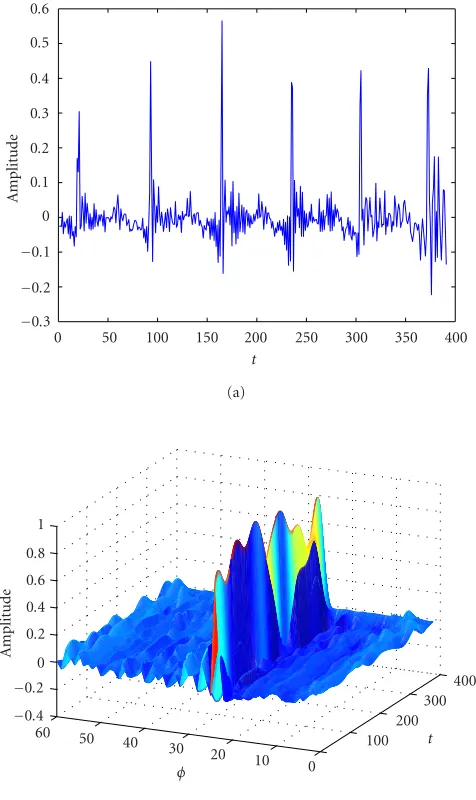
A typical prediction error signal and its surface are shown in
Figure 3.
In the proposed solution, the surface for each phoneme is created separately. The construction of such a surface is
detailed in using the following procedure (Figure 4).
(1) Pitch detection is applied in order to obtain an instan-taneous pitch value,p(t), which will track the pitch cy-cle change through time. At any given point in time, the pitch cycle is determined by a linear interpolation of the pitch marks obtained by the pitch detector. (2) A rectangular window with duration of one pitch
pe-riod multiplies the residual error function around a
sampling time ti, with a step update of 2.5
millisec-onds, to create a prototype waveform. In order to smooth the surface along the time axis, a low-order Savitzky-Golay filter is applied to the error function.
0 50 100 150 200 250 300 350 400
−0.3
−0.2
−0.1 0 0.1 0.2 0.3 0.4 0.5 0.6
A
m
plitude
t
(a)
60 50
40 30
20 10 0
100 200
300 400
−0.4
−0.2 0 0.2 0.4 0.6 0.8 1
A
m
plitude
φ
t
(b)
Figure3: Creating the characteristic waveform surface. (a) A typ-ical residual error signal, derived from the speech signal using lin-ear prediction analysis. (b) The surface is constructed by plotting the prototype waveform along theφ-axis at intervals of 2.5 millisec-onds, after alignment and interpolation of the prototypes.
(3) For the reconstruction of the signal from the surface, it is extremely important to maintain similar and min-imum energy values at both ends of the prototype waveform (which actually represent the same point
due to the 2πperiodicity along the phase axis).
There-fore a shift of±∆samples (∆maxwas set to be 1
mil-lisecond) is allowed for the location of the window’s center in the construction of the PWI surface.
(4) Because the pitch cycle varies in time, each prototype
waveform will be of different length. Therefore all
pro-totypes must be aligned alongφ=[0−2π] and must
The error waveform surface Interpolate
along time axis Normalize
between 0−2π
Align with previous waveform Prototype
waveform sampler
LPF Short-time
pitch function calculation
Error signal calculation Pitch detection
marks
LPC parameters
Figure4: A schematic description of the PWI surface construction.
(5) Once a prototype waveform is sampled according to step (3) above, a cyclical shift along theφ-axis is per-formed to obtain maximum cross-correlation with the former prototype waveform, thus creating a relatively smooth waveform surface when moving across the time axis.
(6) In order to create a surface that reflects the error’s pitch cycle evolution over time, an interpolation along the time axis is performed.
2.3.2. Construction of the intermediate residual error signal
Letus(t,φ),ut(t,φ) : {t : [0−Ts,Tt];φ : [0−2π]}be the PWI of the source and target speakers, respectively. As de-scribed earlier, the new intermediate waveform surface will
be an interpolation of the two surfaces (Figure 5). Therefore,
unew(t,φ)=α·us(β·t,φ) + (1−α)·ut−aligned(γ·t,φ),
unew(t,φ) :
t: [0−Tnew]; φ: [0−2π]
,
(3)
whereβ=Tnew/Ts,γ=Tnew/Tt, andα1is the relative part of
us(t,φ).
1The factor may be invariant; if so, the voice produced will be an inter-mediate between the two speakers, or it may vary in time (fromα=1 at
t=0 toα=0 att=T), yielding a gradual change from one voice to the other.
−0.2
−0.1 0 0.1 0.2 0.3 0.4 0.5 0.6
60 50 40
30 20
10 0
+
0 100
200 300 400
A
m
plitude
φ
t
−0.4
−0.3
−0.2
−0.1 0 0.1 0.2 0.3 0.4
60 50
40 30
20 10
0 0 100
200
300 400
A
m
plitude
φ
t
−0.2
−0.1 0 0.1 0.2 0.3 0.4 0.5
60 50
40 30
20 10
0 0 100
200
300 400
A
m
plitude
φ
t
−0.2 0 0.2
0 0
50 100
150 200
φ
t
A
m
plitude
2π
Figure6: The new PWI surface is constructed by interpolation of two PWI surfaces of the residual error signals of two speakers. The new reconstructed residual can be recovered by moving on the sur-face along the phase axis according to the phaseφ(t) determined by the new pitch contour. (The tracking is represented by the black line along the surface.)
In order to maximize the cross-correlation between the two surfaces, the target speaker’s surface is shifted along the φ-axis, and is referred to asut−aligned(t,φ), where
ut−aligned(t,φ)=ut
t,φ+φn, (4)
φn=arg max
φe
2π φ=0
Tnew
t=0 us(t,φ)·ut
t,φ+φedtdφ us·ut
t,φ+φe
, (5)
u =
2π
φ=0
Tnew
t=0 u(t,φ)·u(t,φ)dtdφ, (6)
where φe is the correction needed for the surfaces to be
aligned.
The last step (after creating unew(t,φ)) is reconstruct-ing the new residual error signal from the waveform
sur-face. The reconstruction is performed by definingenew(t)=
unew(t,φnew(t)), for allt=[0 :Tnew], whereφnew(t) is created by the following equation:
φnew(t)=
t
t0
2π pnew(t)dt
. (7)
pnew(t) is calculated as an average of the source’s and target’s short-time pitch contour functions, as shown in the follow-ing equation:
pnew(t)=α·ps(β·t) + (1−α)·pt(γ·t),
β=Tnew
Ts ,
γ=Tnew
Tt ,
(8)
where the factorsβandγare scaling factors for the new time
axis [0,Tnew], andα, as in (3), is a weighting factor between
the pitch of the source and the pitch of the target.Figure 6
shows the derivation of a new residual error signal using the
track on the PWI surface determined byφnew(t).
2.3.3. New vocal tract model calculation and synthesis It is well known that the linear prediction parameters (i.e.,
the coefficients of the predictor polynomial A(z)) are highly
sensitive to quantization [19]. Therefore their quantization
or interpolation may result in an unstable filter and may pro-duce an undesirable signal. However, certain invertible
non-linear transformations of the predictor coefficients result in
equivalent sets of parameters that tolerate quantization or in-terpolation better. An example of such a set of parameters
is the PARCOR coefficients (ki), which are related to the
ar-eas of lossless tube sections modeling the vocal tract [20], as given by the following equation:
Ai+1=
1−ki 1 +ki
·Ai. (9)
The value of the first area function parameter (A1) is
arbi-trarily set to be 2. A new set of LPC parameters that defines a new vocal tract is computed using an interpolation of the two area vectors (source and target). This choice of the area pa-rameters seems to be more reasonable, since intermediate
vo-cal tract models should reflect intermediate dimensions [25].
Let the source and target vocal tracts be modeled byN
loss-less tube sections with areasAsi,Ati:{i: [1−N]}, respectively. The new signal’s vocal tract will be represented by
Anew
i =α·Asi+ (1−α)·Ati ∀i: [1, 2,. . .,N]. (10) After calculating the new areas, the prediction filter is computed and the new vocal phoneme is synthesized
accord-ing to the followaccord-ing scheme (Figure 7):
(1) compute new PARCOR parameters from the new areas by reversing (9);
(2) compute the coefficients of the new LPC model from
the new PARCOR parameters;
(3) filter the new excitation signal through the new vocal-tract filter to obtain the new vocal phoneme.
When temporal voice morphing is applied, informal
subjec-tive listening tests performed on different sets of morphing
parameters have revealed that in order to have a “linear” per-ceptual change between the voices of the source and the tar-get, the coefficient α(t) (the relative part ofus(t,φ)) must
vary nonlinearly in time (like the one inFigure 8). When the
coefficient changed linearly with time, the listeners perceived
an abrupt change from one identity to the other. Using the nonlinear option, that is, gradually changing the identity of one speaker to that of another, a smooth modification of the “source” properties to those of the “target” properties was achieved. In another subjective listening test (see below) per-formed on morphing from a woman’s voice to a man’s voice, and vice versa, both uttering the same sentence, the mor-phed sound was perceived as changing smoothly and natu-rally from one speaker to the other. The quality of the mor-phed voices was found to depend upon the specific speakers,
the differences between their voices, and the content of the
New phoneme Synthesize
new speech signal Calculate new LPC parameters Calculate new
tube areas Modification parameter (α) Source and target
pitch functions
Source and target error surface Creat new
error surface
Recover new excitation
Source and target LPC parameters
Modification parameter (α)
Calculate
φnew(t) Evaluate
Pnew(t)
Figure7: A block diagram of the procedure for synthesizing the new phoneme.
0 0.1 0.2 0.3 0.4 0.5 0.6 0.7 0.8 0.9 1
0 0.1 0.2 0.3 0.4 0.5 0.6 0.7 0.8 0.9 1
A
ctual
mor
p
hing
co
e
ffi
cient
Desired morphing coefficient
Figure8: An example of a nonlinear morphing function, obtained empirically, and used to achieve a linear perceptual change between the first speaker and the second speaker, when time-varying mor-phing was performed.
2.4. Evaluation of the algorithm
Evaluation of the algorithm was carried out using three sub-jective listening tests. The naturalness, intelligibility, identity change, and smoothness of the morphing algorithm were examined in these psychoacoustic tests. In all tests, six lis-teners participated (three males and three females, all with-out hearing impairments, and inexperienced in speech mor-phing). The sentences for the tests were taken from TIMIT database, and from BGU Hebrew database. The speech stim-uli were played using high-quality loudspeakers. In all tests,
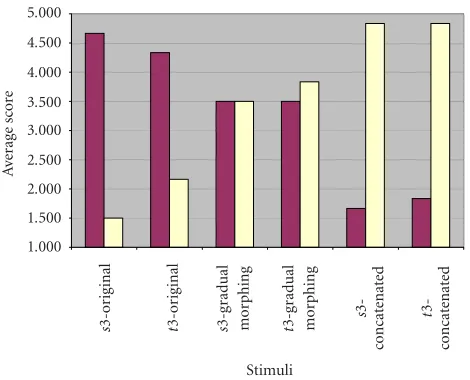
the stimuli were played in random order. The listeners were free to play each stimulus more than once, without any limi-tation. In the first test, the listeners had to decide if there was a change in the identity of the speaker for each of the three sentences, on a 1–5 scale, where 1 meant that one identity was perceived along the utterance and 5 meant that there was more than one speaker. The listeners had to rate the smooth-ness of the utterance, as well, on a similar 1–5 scale, where 5 meant smooth utterance and 1 meant abrupt change or changes in the utterance. Three types of stimuli were used: the original speech, morphed speech (in which the identity changed gradually from one speaker to another during the sentence), and concatenated speech of two speakers, at a fixed
point [1]. The aim of this test was to evaluate if the
iden-tity change was perceived, and to assess the effect of the algo-rithm on the smoothness of the gradual morphed utterances. The results of this experiment for one of the sentences (“We
were different shades, and it did not make a bit of difference
among us,” taken from [9]) are depicted inFigure 9. As
ex-pected, it is readily seen that the original utterance was per-ceived as a smooth speech without identity change, while the abrupt change in identity in the concatenated utterance was perceived and rated accordingly, that is, as more than one identity and with an abrupt change. The change of identity was perceived in the morphed signal, as well (average score
3.5, std.=0.96), since the sentence was long enough to
s
3-or
ig
inal
t
3-or
ig
inal
s
3-g
radual
mor
p
hing
t
3-g
radual
mor
p
hing
s
3-co
ncat
enat
ed
t
3-co
ncat
enat
ed
1.000 1.500 2.000 2.500 3.000 3.500 4.000 4.500 5.000
Av
er
ag
e
sc
o
re
Stimuli
Figure9: Evaluation of smoothness and identity change in an ut-terance in which a gradual morphing is produced (smoothness— left column, identity change—right column).
two utterances yielded similar results. In the second test, the listeners had to evaluate the naturalness and intelligibility of a given sentence on a 1–5 scale. The listeners attended to 3 stimuli: two original sentences, one uttered by a male speaker, and the other by a female speaker, and a morphed
sentence with a morphing factor of 0.5, which is a hybrid
sig-nal between the two origisig-nals. The results are summarized in
Figure 10. It is clear from this figure that the morphed sig-nal was perceived as highly natural and clear by most of the listeners (naturalness average score: 4.3, std. =0.74, intelli-gibility average score: 4.17, std.=0.69). In the third exper-iment, the listeners had to rate the identity change and the naturalness of two sentences on a 1–5 scale. Each sentence
was repeated as a cyclostationary morph (see [3]) 16 times
with various morphing factors, from 0 to 1. The average
nat-uralness was 3.25, and the identity change was rated with an
average of 3.3. Naturalness in this case was not perfect
(al-though it is quite high), and can be explained by the fact that the voice timbers in this test were distant, and the hybrid voice that was produced could be perceived as uncommon. In summary, the results of the tests show that the morphed signals are perceived in most cases as highly natural, highly intelligible, with a relatively smooth change from one speech voice to another.
3. CONCLUSIONS
In this study, a new speech morphing algorithm is presented. The aim is to produce natural sounding hybrid voices be-tween two speakers, uttering the same content. The algo-rithm is based on representing the residual error signal as a PWI surface, and the vocal tract as a lossless tube area func-tion. The PWI surface incorporates the characteristics of the excitation signal, and enables reproduction of a residual sig-nal with a given pitch contour and time duration, which in-cludes the dynamics of both speakers’ excitations. It is known
1.000 1.500 2.000 2.500 3.000 3.500 4.000 4.500 5.000
Av
er
ag
e
sc
o
re
Man Woman Morphing 0.5
Stimuli
Figure 10: Results of subjective evaluation for naturalness (left bars) and intelligibility (right bars) for 3 stimuli: a man (left) and a woman (middle) voices, and a morphing between the two voices (right).
[16] that PWI surfaces can be exploited efficiently for speech
coding, and therefore, they allow for higher compression of the speech database. The area function was used in an at-tempt to reflect an intermediate configuration of the vocal
tract between the two speakers [25]. The utterances produced
by the algorithm were shown to be of high quality and to con-sist of intermediate features of the two speakers.
There are at least two modes in which the morphing algo-rithm can be used. In the first mode the morphing parameter is invariant, meaning, for example, taking a factor of 0.5, and receiving a morphed signal with characteristics which are be-tween the two voices for the whole duration of the articu-lation. In the second mode, we start from the first (source)
speaker (morphing factor=0), and the morphing factor is
changed gradually along the duration of the sentence, so its value is 1 at the end of the sentence. The same morphing factor was used for both the excitation and the vocal tract parameters.
In this time-varying version of the algorithm, that is, when morphing gradually from one voice to another over time, smooth morphing was achieved, producing a highly natural transition between the source and the target speakers. This was assessed by subjective evaluation tests, as previously described.
The algorithm described here is more capable of pro-ducing longer and more smooth and natural sounding
ut-terances than previous studies [1,3]. One of the advantages
the residual signal regardless of the pitch information, since the pitch data is normalized within the PWI surface. There-fore, the morphed pitch contour is extracted independently, and can be manipulated separately. In addition, the current
approach enables morphing between utterances with diff
er-ent pitches, between male and female voices, or between
voices of different and perceptually distant timbres.
Kawa-hara and his colleagues [26,27] implemented a morphing
system based on interpolation between time-frequency rep-resentations of the source and the target signals. It appears
that the STRAIGHT-based morphing system (see [2,26])
was able to produce intermediate voices of higher clarity than our algorithm, but the need to assign multiple anchor points for each short segment, using visual inspection and phono-logical knowledge, is a noticeable disadvantage of that
sys-tem, which can make it difficult to use for morphing between
long utterances.
Further research is needed to improve the quality of the
morphed signals, which are natural sounding (see http://
spl.telhai.ac.il/speech/), but are somewhat degraded com-pared to the originals.
ACKNOWLEDGMENTS
We would like to thank Professor David Malah, the Head of SIPL, for proposing to apply PWI to voice morphing, and for his valuable discussions and comments. We also thank Dima Ruinskiy for his valuable assistance, for programming part of the morphing system, and for preparing the semiau-tomatic segmentation, and Yefim Yakir for preparing part of the figures, and for technical support. The authors thank the reviewers for their helpful comments. This study was partly supported by Guastella Fellowship of the Sacta-Rashi Foun-dation, and the JAFI project.
REFERENCES
[1] M. Abe, “Speech morphing by gradually changing spectrum parameter and fundamental frequency,” Tech. Rep. SP96-40, The Institute of Electronics, Information and Communica-tion Engineers (IEICE), July 1996.
[2] H. Kawahara and H. Matsui, “Auditory morphing based on an elastic perceptual distance metric in an interference-free time-frequency representation,” inProc. IEEE International Conference on Acoustics, Speech, and Signal Processing (ICASSP ’03), vol. 1, pp. 256–259, Hong Kong, China, 2003.
[3] M. Slaney, M. Covell, and B. Lassiter, “Automatic audio mor-phing,” inProc. IEEE International Conference on Acoustics, Speech, and Signal Processing (ICASSP ’96), vol. 2, pp. 1001– 1004, Atlanta, GA, USA, May 1996.
[4] P. Cano, A. Loscos, J. Bonada, M. de Boer, and X. Serra, “Voice morphing system for impersonating in karaoke applications,” inProc. International Computer Music Conference (ICMA ’00), pp. 109–112, Berlin, Germany, August 2000.
[5] E. Tellman, L. Haken, and B. Holloway, “Timbre morphing of sounds with unequal numbers of features,” Journal of the Audio Engineering Society (AES), vol. 43, no. 9, pp. 678–689, 1995.
[6] D. Rossum, “The “armadillo” coefficient encoding scheme for digital audio filters,” inproc. IEEE Workshop on Applications of Signal Processing to Audio and Acoustics (WASPAA ’91), pp. 129–130, New Paltz, NY, USA, October 1991.
[7] Y. Stylianou, O. Capp´e, and E. Moulines, “Continuous prob-abilistic transform for voice conversion,” IEEE Trans. Speech Audio Processing, vol. 6, no. 2, pp. 131–142, 1998.
[8] N. Iwahashi and Y. Sagisaka, “Speech spectrum conversion based on speaker interpolation and multi-functional repre-sentation with weighting by radial basis function networks,” Speech Communication, vol. 16, no. 2, pp. 139–151, 1995. [9] L. M. Arslan, “Speaker Transformation Algorithm using
Seg-mental Codebooks (STASC),”Speech Communication, vol. 28, no. 3, pp. 211–226, 1999.
[10] A. Kain and M. Macon, “Spectral voice conversion for text-to-speech synthesis,” inProc. IEEE International Conference on Acoustics, Speech and Signal Processing (ICASSP ’98), vol. 1, pp. 285–288, Seattle, WA, USA, May 1998.
[11] A. Kain and M. Macon, “Personalizing a speech synthesizer by voice adaptation,” inProc. 3rd ESCA/COCOSDA Interna-tional Speech Synthesis Workshop, pp. 225–230, Jenolan, Caves, Australia, November 1998.
[12] A. Kain and M. Macon, “Design and evaluation of a voice con-version algorithm based on spectral envelope mapping and residual prediction,” inProc. IEEE International Conference on Acoustics, Speech, and Signal Processing (ICASSP ’01), vol. 2, Salt Lake City, Utah, USA, May 2001.
[13] M. Abe, S. Nakamura, K. Shikano, and H. Kuwabara, “Voice conversion through vector quantization,” inProc. IEEE In-ternational Conference on Acoustics, Speech, and Signal Pro-cessing (ICASSP ’88), pp. 655–658, New York, NY, USA, April 1988.
[14] M. Narendranath, H. A. Murthy, S. Rajendran, and B. Yegna-narayana, “Transformation of formants for voice conversion using artificial neural networks,”Speech Communication, vol. 16, no. 2, pp. 206–216, 1995.
[15] O. Lev (Fellah) and D. Malah, “Low bit-rate speech coder based on a long-term model,” inProc. 22nd IEEE Convention of Electrical and Electronics Engineers in Israel, Tel-Aviv, Israel, December 2002.
[16] W. B. Kleijn and J. Haagen, “Waveform interpolationfor cod-ing and synthesis,” in Speech Coding and Synthesis, W. B. Kleijn and K. K. Paliwal, Eds., chapter 5, pp. 175–207, Else-vier Science B. V., Amsterdam, the Netherlands, 1995. [17] W. B. Kleijn, “Encoding speech using prototype waveforms,”
IEEE Trans. Speech Audio Processing, vol. 1, no. 4, pp. 386–399, 1993.
[18] W. B. Kleijn and J. Haagen, “Transformation and decompo-sition of the speech signal for coding,”IEEE Signal Processing Lett., vol. 1, no. 9, pp. 136–138, 1994.
[19] J. R. Deller, J. G. Proakis, and J. H. L. Hansen, Discrete Time Processing of Speech Signals, chapter 7, Macmillan Publishing, New York, NY, USA, 1993.
[20] L. R. Rabiner and R. W. Schafer, Digital processing of speech signals, chapter 8, Signal Processing Series. Prentice-Hall Pub-lishing, Englewood Cliffs, London, 1978.
[21] J. Makhoul, “Linear prediction: A tutorial review,”Proc. IEEE, vol. 63, no. 4, pp. 561–580, 1975.
[22] H. Kuwabara and Y. Sagisaka, “Acoustic characteristics of speaker individuality: Control and conversion,”Speech Com-munication, vol. 16, no. 2, pp. 165–173, 1995.
[23] A. M. Noll, “Cepstrum pitch determination,” Journal of the Acoustical Society of America, vol. 41, no. 2, pp. 293–309, 1967. [24] Y. Medan, E. Yair, and D. Chazan, “Super resolution pitch determination of speech signals,”IEEE Trans. Acoust., Speech, Signal Processing, vol. 39, no. 1, pp. 40–48, 1991.
[26] H. Kawahara, I. Masuda-Katsuse, and A. de Cheveign´e, “Re-structuring speech representations using a pitch-adaptive time-frequency smoothing and an instantaneous-frequency-based F0 extraction: Possible role of a repetitive structure in sounds,” Speech Communication, vol. 27, no. 3-4, pp. 187– 207, 1999.
[27] H. Kawahara, H. Katayose, A. de Cheveign´e, and R. D. Pat-terson, “Fixed point analysis of frequency to instantaneous frequency mapping for accurate estimation of f0 and period-icity,” inProc. European Union Activities in Human Language Technologies (EUROSPEECH ’99), vol. 6, pp. 2781–2784, Bu-dapest, Hungary, September 1999.
Yizhar Lavnerreceived a Ph.D. degree from
the Technion – Israel Institute of Technol-ogy in 1997. He joined the Department of computer science, Tel-Hai Academic Col-lege, Upper Galilee, Israel, in 1997, where he is a Senior Lecturer. He is teaching in SIPL (Signal and Image Processing Lab), Elec-trical Engineering Faculty, the Technion, Haifa, Israel), since 1998. His research in-terests include speech and audio signal pro-cessing and genomic signal propro-cessing.
Gidon Poratreceived his B.S. degree (cum
laude) in electrical engineering from the Technion – Israel Institute of Technology in January 2003. As a part of his grad-uation requirements, Porat has researched voice morphing in the Electrical Engineer-ing Faculty’s Signal and Image ProcessEngineer-ing Lab in the Technion. Porat was a recipient of a Best Student’s Paper Award at the IEEE 22nd Convention of Electrical &