Volume 2006, Article ID 93920, Pages1–14 DOI 10.1155/ASP/2006/93920
Using Intermicrophone Correlation to Detect Speech in
Spatially Separated Noise
Ashish Koul1and Julie E. Greenberg2
1Broadband Video Compression Group, Broadcom Corporation, Andover, MA 01810, USA
2Massachusetts Institute of Technology, 77 Massachusetts Avenue, Room E25-518, Cambridge, MA 02139-4307, USA
Received 29 April 2004; Revised 20 April 2005; Accepted 25 April 2005
This paper describes a system for determining intervals of “high” and “low” signal-to-noise ratios when the desired signal and interfering noise arise from distinct spatial regions. The correlation coefficient between two microphone signals serves as the decision variable in a hypothesis test. The system has three parameters: center frequency and bandwidth of the bandpass filter that prefilters the microphone signals, and threshold for the decision variable. Conditional probability density functions of the intermicrophone correlation coefficient are derived for a simple signal scenario. This theoretical analysis provides insight into optimal selection of system parameters. Results of simulations using white Gaussian noise sources are in close agreement with the theoretical results. Results of more realistic simulations using speech sources follow the same general trends and illustrate the performance achievable in practical situations. The system is suitable for use with two microphones in mild-to-moderate reverberation as a component of noise-reduction algorithms that require detecting intervals when a desired signal is weak or absent.
Copyright © 2006 A. Koul and J. E. Greenberg. This is an open access article distributed under the Creative Commons Attribution License, which permits unrestricted use, distribution, and reproduction in any medium, provided the original work is properly cited.
1. INTRODUCTION
Conventional hearing aids do not selectively attenuate back-ground noise, and their inability to do so is a common com-plaint of hearing-aid users [1–4]. Researchers have proposed a variety of speech-enhancement and noise-reduction algo-rithms to address this problem. Many of these algoalgo-rithms require identification of intervals when the desired speech signal is weak or absent, so that particular noise characteris-tics can be estimated accurately [5–7]. Systems that perform this function are referred to by a number of terms, includ-ing voice activity detectors, speech detectors, pause detec-tors, and double-talk detectors. Speech pause detectors are not limited to use in hearing-aid algorithms. They are used in a number of applications including speech recognition [8,9], mobile telecommunications [10,11], echo cancellation [12], and speech coding [13].
In some cases, noise-reduction algorithms are initially developed and evaluated using information about the timing of speech pauses derived from the clean signal, which is pos-sible in computer simulations but not in a practical device. Marzinzik and Kollmeier [11] point out that speech pause detectors “are a very sensitive and often limiting part of sys-tems for the reduction of additive noise in speech.”
Many of the previously proposed methods for speech pause detection are intended for use with single-microphone noise-reduction algorithms, where it is assumed that the de-sired signal is speech and the noise is not speech. In these ap-plications, the distinction between signal and noise depends on the presence or absence of signal characteristics particu-lar to speech, such as pitch [14,15] or formant frequencies [16]. Other approaches rely on assumptions about the rela-tive energy in frames of speech and noise [8,17]. A summary of single-microphone pause detectors is found in [11].
Other methods of speech pause detection are possible when more than one microphone signal are available. Using signals from multiple microphones, information about the signal-to-noise ratio (SNR) can be discerned by comparing the signals received at different microphones. The distinction between desired signal and unwanted noise is based on the direction of arrival of the sound sources, so these approaches also operate correctly when the noise is a competing talker with characteristics similar to those of the desired speech sig-nal.
algorithm used as a front end for a speech recognition sys-tem [18]; a joint syssys-tem for noise-reduction and speech cod-ing [19]; a voice activity detector based on the coherence be-tween two microphones to improve the performance of noise reduction algorithms for mobile telecommunications [20]. This third system requires a substantial distance between mi-crophones, as it is only effective when the noise signal is rel-atively incoherent between the two microphones. A related body of work is the use of single- and double-talk detectors to control the update of adaptive filters in echo cancellers. Although there is only one microphone in this application, a second signal is obtained from the loudspeaker. A compre-hensive summary of these approaches is found in [12].
In developing adaptive algorithms for microphone-array hearing aids and cochlear implants, researchers have found that it is necessary to limit the update of the adaptive filter weights to intervals when the desired signal is weak or ab-sent. Several methods have been proposed to detect such in-tervals based on the correlation between microphones and the ratio of intermediate signal powers [7,21,22]. Green-berg and Zurek [7] propose a simple method using the in-termicrophone correlation coefficient to detect intervals of low SNR that substantially improves noise-reduction perfor-mance of an adaptive microphone-array hearing aid. This method is applicable whenever two microphone signals are available and the signal and noise are distinguished by spa-tial, not temporal or spectral, characteristics. Despite its demonstrated effectiveness, this method was developed in an ad hoc manner. The purpose of this work is to per-form a rigorous analysis of the intermicrophone correlation coefficient of multiple sound sources in anechoic and rever-berant environments, to formalize the selection of parame-ter settings when using the inparame-termicrophone correlation co-efficient to estimate the range of SNR, and to evaluate the performance that can be obtained when optimal settings are used.
2. PROPOSED SYSTEM
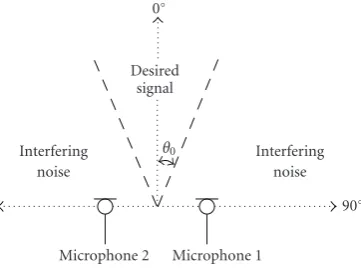
Figure 1 shows the signal scenario used in this work. All sources and microphones are assumed to lie in the same plane, with the microphones in free space. Sources with an-gles of incidence between−θ0 andθ0 are considered to be
desired signals, while sources arriving from θ0 to 90◦ and −θ0 to −90◦ are interfering noise. Sound can arrive from
any angle in a 360◦ range, but due to the symmetry inher-ent in a two-microphone broadside array, sources arriving at incident angles in the range 180◦ ±θ0 will also be treated
as desired signals. Moreover, due to the symmetry in the definition of desired signal and noise, we restrict the fol-lowing analysis to the range 0–90◦without loss of general-ity.
Figure 2shows the previously proposed system that uses the correlation coefficient between the two microphone sig-nals to distinguish between intervals of high and low SNRs [7]. The microphone signals are digitized and then passed through bandpass filters with center frequency f0and
band-widthB. The bandpass filtered signals x1[n] and x2[n] are
0◦
Desired signal
θ0 Interfering
noise
Interfering noise
90◦ Microphone 2 Microphone 1
Figure1: Signal scenario indicating the ranges of incident angles for the desired signal and interfering noise sources.
divided intoN-point long segments. For each pair of seg-ments, the corresponding intermicrophone correlation coef-ficientris computed as
r= N
n=1x1[n]x2[n]
N
n=1x12[n] N
n=1x22[n]
. (1)
Finally,ris compared to a fixed thresholdr0to determine the
predicted SNR range for each segment.
Because the desired signal arrives at array broadside from angles near straight-ahead, it will be highly correlated in the two microphone signals and will contribute positive values to r, provided that the source is located inside the critical distance in a reverberant environment. The interfering noise arrives from off-axis directions and should contribute nega-tive values tor. This effect is enhanced by the bandpass fil-ter which limits the frequency range so that signals arriv-ing from the range of noise angles will be out of phase and produce minimum correlation values. Thus, the purpose of the bandpass filter is to enhance the ability of the intermi-crophone correlation measure to distinguish between desired signal and interfering noise.
This approach is attractive for applications such as digital hearing aids, where computing resources are limited. If nec-essary, the correlation coefficient can be estimated efficiently using the sign of the bandpass filtered signals [7].
The proposed system has three independent parameters: the center frequency (f0) of the bandpass filter, the
band-width (B) of the bandpass filter, and the threshold (r0).
An-other important parameter of the proposed system is the in-termicrophone spacing (d). The intermicrophone spacing is not treated as a free parameter, rather it is incorporated into the analysis by normalizing two of the independent parame-ters (center frequency and bandwidth) as discussed in detail inSection 4.1.
Microphone 1
A/D y1[n] Bandpassfilter f0, B
x1[n] Finite-time
cross-correlation Microphone 2
A/D y2[n] Bandpassfilter f0, B
x2[n] r
Yes
High SNR
> r0?
Low SNR No
Figure2: Block diagram of the system to estimate the intermicrophone correlation coefficient for determining range of SNR.
tests for the intermicrophone correlation. In Section 4, the analysis ofSection 3is used to examine the effects of the three parameters. InSection 4.1, theoretical results from the ane-choic scenario are used to identify candidates for the optimal value of the center frequencyf0. InSection 4.2, theoretical
re-sults from the reverberant scenario are used to optimize the thresholdr0. For practical reasons described inSection 4.1,
the bandwidth parameterBcannot be optimized based on the theoretical analysis; instead, it is determined from the simulations performed inSection 5.
3. ANALYSIS 3.1. Preliminaries
3.1.1. Assumptions
The following assumptions are made to allow a tractable analysis.
(i) There is one desired signal source and one interfering noise source in the environment.
(ii) The desired signal arrives at the microphone array from an incident angle in the range 0◦ toθ0, and the
interfering noise arrives from an incident angle in the rangeθ0to 90◦. For both the desired signal and the
in-terfering noise, the probability of the source arriving at any incident angle is uniformly distributed over the corresponding range of angles.
(iii) Sound sources are continuous, zero-mean, white Gaussian noise processes. Desired signal and interfer-ing noise sources have variances σ2
s and σi2, respec-tively. The signal-to-noise ratio is defined as SNR=
10 log10(W), whereW=σ2
s/σi2.
(iv) Reverberation can be modelled as a spherically diffuse sound field. This is an admittedly simplified model of reverberation which is only applicable for relatively small rooms [23]. Reverberant energy is characterized by the direct-to-reverberant ratio DRR=10 log10(β), whereβis the ratio of energy in the direct wave to en-ergy in the reverberant sound. The value ofβis equal for both signal and noise sources, implying that both sources are roughly the same distance from the micro-phones.
(v) The filters applied to the incoming signals areideal
bandpass filters with center frequency f0 and
band-widthB.
3.1.2. Signal model
While the system shown inFigure 2processes the digitized signals, for the analysis, we consider the signals x1(t) and
x2(t), continuous-time reconstructions of the bandpass
fil-tered signalsx1[n] andx2[n]. For a two-microphone array in
free space, these two signals can be modelled as
x1(t)=s(t) +i(t),
x2(t)=s
t−τs
+it−τi
, (2)
wheres(t) is the desired signal after bandpass filtering,i(t) is the interfering noise after bandpass filtering, and τs and
τi represent the time delays between microphones for the desired signal and interfering noise, respectively. Assuming plane wave propagation,τsandτican be expressed as
τs=d
csin
θs
, τi=d
csin
θi
, (3)
wheredis the distance separating the microphones,cis the speed of sound, andθsandθiare the incident angles of the respective sources.
The theoretical correlation coefficientρof the two signals is
ρ= E
x1(t)x2(t)
Ex2 1(t)
Ex2 2(t)
, (4)
whereE{·}denotes expected value. Under ideal conditions of stationary signals and infinite data,ρwould be the deci-sion variable used in the system ofFigure 2. However, in this application, we use the intermicrophone correlation coeffi -cientr, defined in (1) to estimateρfrom discrete samples of the two signals over a finite time period.
3.1.3. FisherZ-transformation
Consider the case of two random variablesa andb drawn from a bivariate Gaussian distribution. We wish to obtain an estimaterof the theoretical correlation coefficientρusingN
sample pairs drawn from the joint distribution of aandb. In general, the probability distribution of the estimatorr is difficult to work with directly, because its shape depends on the value ofρ.
The FisherZ-transformation is defined as
z=tanh−1(r)=1 2ln
1 +r
This yields the new random variablezwhich has an approx-imately Gaussian distribution with mean z=(1/2) ln((1 +
ρ)/(1−ρ)) and varianceσ2
z =1/(N−3) [24]. This derived variablezhas a simple distribution whose shape does not de-pend on the unknown value ofρ.
Due to the assumption that the signal and noise sources are Gaussian random processes, the microphone signals are jointly Gaussian random processes. Even after bandpass fil-tering, the input variablesx1(t) andx2(t) defined in (2) are
jointly Gaussian, and the Fisher Z-transformation may be applied.
3.2. Intermicrophone correlation for one source in an anechoic environment
We begin by deriving the probability density function (pdf) ofrfor a single source with incident angleθ. After A/D con-version and bandpass filtering, the signalsx1[n] andx2[n] are
rectangular bands of noise. The true intermicrophone corre-lation is [25]
ρθ=cos (kdsinθ) sin
(πBd/c) sinθ
(πBd/c) sinθ , (6)
wherekis the wavenumber,
k=2π f0
c . (7)
Using the FisherZ-transformation, the conditional pdf ofz, given a source at incident angleθ, is
fz|θ(z|θ)= 1
σz
√
2πexp
−
z−z(θ)2 2σ2
z
(8)
with
z(θ)=1
2ln
1 +ρθ 1−ρθ
,
σ2
z =
1
N−3.
(9)
Using the assumption thatθis uniformly distributed over a specific range of angles, the joint pdf forzandθis
fz,θ(z,θ)= 1
θ2−θ1fz|θ
(z|θ), (10)
whereθ2=θ0andθ1=0 for a signal source andθ2=90◦and
θ1=θ0for a noise source. To obtain the marginal density of
z, the joint density in (10) is integrated over the appropriate range ofθ, that is,
fz(z)=
1
θ2−θ1 σz √ 2π θ2 θ1 exp −
z−z(θ)2 2σ2
z
dθ.
(11)
With this expression for the pdf ofz, we can use the defini-tion of the FisherZ-transformation to derive the pdf of the intermicrophone correlation coefficientr. Sincer=tanh(z)
is a monotonic transformation of the random variablez, the pdf ofrcan be obtained using [26]
fr(r)= fz(z)dz
dr. (12)
Substitutingdz/dr=1/(1−r2) and the definition ofz
pro-duces the pdf ofrfor a single source:
fr(r)=
1
1−r2θ 2−θ1
σz √ 2π × θ2 θ1 exp −
tanh−1(r)−z(θ)2 2σ2
z
dθ.
(13)
3.3. Intermicrophone correlation for two independent sources in an anechoic environment
Next, we consider the intermicrophone correlation coeffi -cient for one signal source and one noise source in an ane-choic environment, denoted byra. Substituting discrete-time versions of (2) into (1) yields
ra=
n
s[n] +i[n]sn−τs
+in−τi
n
s[n] +i[n]2nsn−τs
+in−τi
2.
(14)
The corresponding expression for the desired signal compo-nent alone is
rs=
n
s[n]sn−τs
ns2[n]
ns2
n−τs
, (15)
and for the noise component alone is
ri=
n
i[n]in−τi
ni2[n]
ni2
n−τi
. (16)
We now make the following assumptions.
(1) Thes×icross terms in (14) are negligible when com-pared with thes×sandi×iterms to which they add. (2) The effect of time delay on the energy can be ignored
such that
n
s2[n]≈
n
s2n−τ
s
,
n
i2[n]≈
n
i2n−τ
i
. (17)
(3) The SNR defined in Section 3.1.1 can be estimated from the sample data as
W =
ns2[n]
ni2[n].
(18)
Using the first two assumptions, (14) becomes
ra=
ns[n]s
n−τs
+ni[n]in−τi
ns2[n] +
ni2[n] .
Substituting (15) and (16), dividing all terms by ni2[n],
and then substituting (18), we obtain
ra=Wrs+ri
W+ 1 =
W W+ 1rs+
1
W+ 1ri. (20) Equation (20) expresses the intermicrophone correlation as a linear combination of the correlations for signal and noise separately. The pdfs of bothrsandrican be obtained from (13).
For a known SNR, the pdf forra, a linear combination of
rsandri, is obtained by
fra|W(ra|W)=
W+ 1
W frs
W+ 1
W rs
∗(W+ 1)fri
(W+ 1)ri
,
(21)
where∗denotes convolution [26]. Equation (21) is the pdf of the intermicrophone correlation estimate for anechoic en-vironmentsraconditioned on a particular value of SNR.
3.4. Reverberation
Until now, we have only considered the direct wave of the sound sources. We now consider the addition of reverber-ation. As described in Section 3.1.1, the reverberant sound component is modelled as a spherically diffuse sound field that is statistically independent of the direct signal and noise components. In addition, it has energy that is characterized by the direct-to-reverberant ratioβ.
Analogous to (15) and (16), we define the intermicro-phone correlation for the direct componentsragiven by (20) and for the reverberationrr. Applying arguments similar to those used in the previous section produces an expression for the intermicrophone correlation in the case of reverberation:
r =βra+rr
β+ 1 =
β β+ 1ra+
1
β+ 1rr. (22) Once again, the total correlation is a linear combination of its components, and for a known direct-to-reverberant ratio, the pdf forr, a linear combination ofraandrr, is obtained by convolution [26]:
fr|β,W(r|β,W)=
β+ 1
β fra|W
β+ 1
β ra|W
∗(β+ 1)frr
(β+ 1)rr
.
(23)
Equation (23) is the pdf of the intermicrophone correlation estimaterconditioned on particular values of DRR and SNR. It requires convolution of the direct component pdf, given by (21), and the reverberant component pdf, derived below.
Under the existing assumptions, the pdf for the reverber-ant component is based on the intermicrophone correlation coefficient for bandlimited Gaussian white noise processes, approximated by [27]
ρr=
sin(πBd/c)
πBd/c
sin(kd)
kd . (24)
In the following, (24) is used as the true intermicrophone correlation for reverberant soundρr.
The intermicrophone correlation for reverberant sound based on sample datarr is an estimate ofρr. Applying the FisherZ-transformation,
z=tanh−1rr
= 1
2ln
1 +rr 1−rr .
(25)
The random variablezhas an approximately Gaussian dis-tribution,
fz(z)= 1
σz
√
2πexp−
[z−z]2
2σ2
z
(26)
with
z=1
2ln
1 +ρr 1−ρr ,
σz2= 1
N−3.
(27)
Applying (12) to (26) produces the pdf of intermicrophone correlation for the reverberant component,
frr(r)=
1
1−r2σ
z
√
2π
×exp
−
tanh−1rr
−z2
2σ2
z
.
(28)
This pdf for the reverberant sound field is combined with the pdf for the direct sounds given by (21) according to (23) to obtain the pdf for the total intermicrophone correlation for signal and noise with reverberation.
3.5. Hypothesis testing
The goal of the system shown inFigure 2is to distinguish be-tween two situations: “low” SNR and “high” SNR, denoted by H0 andH1, respectively. Although the preceding
analy-sis was performed under the assumption that the sources were white Gaussian noise processes, the system is intended to work with speech sources, detecting intervals of high and low SNRs which occur due to the natural fluctuations in speech. We defineH0to be 10 log(W)< 0 dB andH1 to be
10 log(W)> 0 dB. The choice of 0 dB as the cutoffpoint is motivated by the application of designing robust adaptive al-gorithms for microphone-array hearing aids, an application where the degrading effects of strong target signals typically occur when the SNR exceeds 0 dB [7].
The preceding analysis treated the SNR,W, as a known constant, but for the purpose of formulating a hypothesis test, it is now regarded as a random variable. Thus, it be-comes necessary to know an approximate probability distri-bution for W. We assume that the SNR is uniformly dis-tributed between −20 dB and +20 dB, so the variableU =
10 log(W) is uniformly distributed between−20 and 20. Un-der this assumption, the two hypothesesH0andH1both have
pdf for each value ofr, that is, we conclude thatH1 is true
when fr|H1,β(r |H1,β)> fr|H0,β(r |H0,β) and we conclude
thatH0is true when fr|H0,β(r|H0,β)> fr|H1,β(r |H1,β).
To derive the conditional pdf ofr under either hypothe-ses, the pdf given by substituting (21) and (28) into (23) is integrated over the appropriate range:
fr|H0,β
r|H0,β
= 0
−20fr|W,β(r|W,β)dU,
fr|H1,β
r|H1,β
= 20
0 fr|W,β(r|W,β)dU.
(29)
Evaluating these expressions requires substitutingW=10U/10.
Performance is measured by computing the probability of correct detections, that is, sayingH1whenH1is true,
PD=
1
r0fr|H1,β
r|H1,β
dr, (30)
and false alarms, that is, sayingH1whenH0is true,
PF=
1
r0 fr|H0,β
r|H0,β
dr, (31)
wherer0is the threshold defined inSection 2. We also define
the probability of missed detections
PM=1−PD, (32) and the overall probability of error
PE=1 2PF+
1
2PM, (33)
again assuming thatH0 andH1have equal prior
probabili-ties.
4. ANALYTIC RESULTS
All calculations were performed in Matlab(R) on a PC with
a Pentium III processor. Probability density functions were computed from (21), (23), and (28) using the Matlab(R)
functionquad. Throughout this analysis, the boundary be-tween desired signals and interfering noise is set toθ0=15◦.
4.1. Effects of frequency and bandwidth
As described inSection 2, the three parameters to be selected are the center frequency (f0) of the bandpass filter, the
band-width (B) of the bandpass filter, and the threshold (r0).
With-out loss of generality, we use two alternate variables in place of the center frequency and bandwidth, specifically kd in place of center frequency and fractional bandwidth in place of absolute bandwidth. Using (7), the quantitykdis related to center frequency according to
kd=2π f0d
c . (34)
This alternate variablekdpermits quantifying the center fre-quency parameter in a way that simultaneously incorporates
both center frequency and intermicrophone distance, and we will refer to it asrelative center frequency. The fractional bandwidthBis defined as
B= B
f0.
(35)
Using (34) and (35) with (6) reveals that for a source arriving from angleθ, the true intermicrophone correlation can be expressed exclusively in terms of these two parameters, that is,
ρθ=
cos (kdsin θ) sin(kdB/2) sinθ
(kdB/2) sinθ . (36)
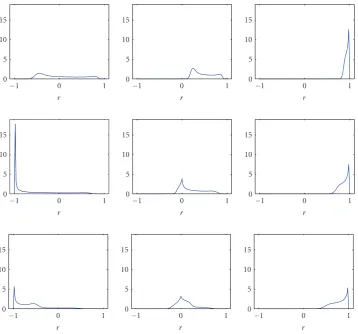
We begin to determine the optimal value of the relative center frequencykd by examining the pdfs of the intermi-crophone correlation in an anechoic environment.Figure 3 shows pdfs ofra, computed by evaluating (21) for three val-ues of SNR and three valval-ues ofkdwith fractional bandwidth
B =0.22. As expected, when the microphone inputs con-sist of signal alone (right column ofFigure 3),rais concen-trated near +1; when the inputs consist of noise alone (left column ofFigure 3),ra takes on substantially lower values. When the microphone inputs consist of signal and noise with SNR=0 dB (center column ofFigure 3),ratakes on interme-diate values distributed according to the convolution of the two extreme cases of signal alone and noise alone. Other val-ues of SNR produce pdfs that vary along a continuum be-tween the cases shown in each row ofFigure 3.
UsingFigure 3to consider the effect ofkd reveals that for any choice of the relative center frequency, for the signal alone, the pdf is heavily concentrated nearra=1, although lower values ofkdproduce more tightly concentrated pdfs. For the noise alone, the pattern is less evident. Forkd=π, the pdf is heavily concentrated nearra=−1. This is expected since noise sources originating from 90◦ are exactly out of phase when kd=π, and therefore have a true correlation of−1. When the value of kddeviates from this ideal situ-ation, the noise-alone pdfs are not necessarily concentrated nearra=−1.
Because the ultimate goal is to user as a decision vari-able in a hypothesis test, the system will perform better when the pdfs are such that they occupy different regions of thex -axis under the two extreme conditions, with minimal over-lap of the pdfs between the cases of signal alone and noise alone. Therefore, at first glance, it might appear that select-ing the relative center frequency of kd =π is the optimal choice for this parameter. However, careful examination of Figure 3reveals that the noise-alone pdf forkd=πspans a very large range, with a tail in the positiveradirection reach-ing values close tor=+1. Since overlap of the signal-alone and noise-alone pdfs will adversely affect the performance of the hypothesis test, this long tail is an undesirable feature. Examining the noise-alone pdf forkd=4π/3, which is less concentrated about ra = −1 but has less overlap with the corresponding signal-alone pdf, indicates that this parame-ter setting should not be eliminated as a candidate.
15 10 5 0
−1 0 1 r
15 10 5 0
−1 0 1 r
15 10 5 0
−1 0 1 r
15 10 5 0
−1 0 1 r
15 10 5 0
−1 0 1 r
15 10 5 0
−1 0 1 r
15 10 5 0
−1 0 1 r
15 10 5 0
−1 0 1 r
15 10 5 0
−1 0 1 r
Figure3: Probability density functions of the estimated intermicrophone correlation coefficient for two sources in an anechoic environment,
fra|W(ra|W), computed from (21), for three SNRs (−∞, 0, and +∞dB) and for three values of relative center frequency (kd=2π/3,π, 4π/3), with fractional bandwidthB=0.22 andθ0=15◦. The first row representskd=2/3π, the second row representskd=π, and the third row
representskd=4/3π. The first column represents noise alone, the second column represents SNR=0 dB, and the third column represents signal alone.
of the signal-alone pdf about +1 and the moment of the noise-alone pdf about −1 will quantify how concentrated each pdf is about the desired extreme value, while penaliz-ing long tails deviatpenaliz-ing from that value. Low values of the moment are desirable, indicating more concentrated pdfs.
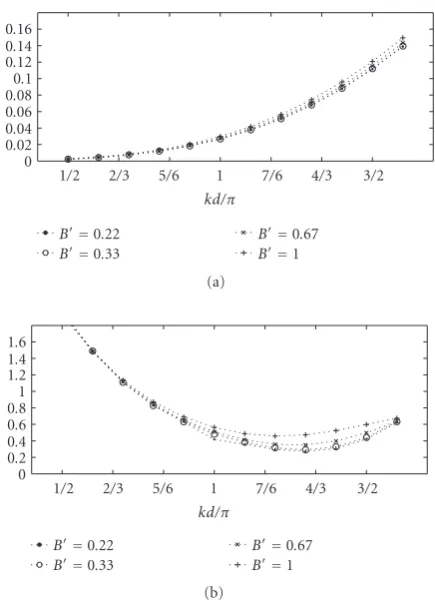
Figure 4shows the second moments of the signal- and noise-alone pdfs as a function ofkdfor several values of frac-tional bandwidth. The lines inFigure 4(a)are monotonic, in-dicating that reducingkdalways causes the signal-alone pdf to be more concentrated about +1.Figure 4(b)shows that the moment of the noise-alone pdf has a local minimum for
kd≈1.3π, with a slight variation due to bandwidth. The mo-ments of the noise-alone pdf are an order of magnitude larger than those of the signal-alone pdfs, so in terms of optimizing the overall performance, relatively greater weight should be given to the noise-alone pdfs.
Based on Figure 4, the rest of this work considers two choices of relative center frequencykd=πandkd=(4/3)π. The value ofkd=(4/3)πis chosen because it is near the mini-mum of the noise-alone pdf for the lower values of fractional bandwidth. The valuekd=πis selected since for this value,
the moment for the noise-alone pdf is still within the rela-tively broad region about its minimum, while being consid-erable lower for the signal-alone pdf.
Figure 4 also shows that for the idealized scenario of white Gaussian noise sources, increasing the bandwidth pa-rameterBslightly increases the moments. This will have a small but detrimental effect on the performance. However, in a practical system, where the desired signal is speech, a rel-atively wide bandwidth is required to capture enough energy from the speech signal to minimize adverse affects due to rel-ative energy fluctuations in different frequency regions. The current theoretical analysis is necessarily based on idealized signals, while the final system will operate on speech sources. Therefore, the selection of the bandwidth parameter will be evaluated via simulations inSection 5.
4.2. Effects of reverberation and threshold selection
Figure 5shows the pdfs of the intermicrophone correlation
0.16 0.14 0.12 0.1 0.08 0.06 0.04 0.02 0
1/2 2/3 5/6 1 7/6 4/3 3/2 kd/π
B=0.22 B=0.33
B=0.67 B=1 (a)
1.6 1.4 1.2 1 0.8 0.6 0.4 0.2 0
1/2 2/3 5/6 1 7/6 4/3 3/2 kd/π
B=0.22 B=0.33
B=0.67 B=1 (b)
Figure4: Second moments of pdfs as a function of relative center frequencykd, withθ0=15◦. The multiple curves are for different
values of fractional bandwidthB. (a) Moment of signal-alone pdf about +1. (b) Moment of noise-alone pdf about−1.
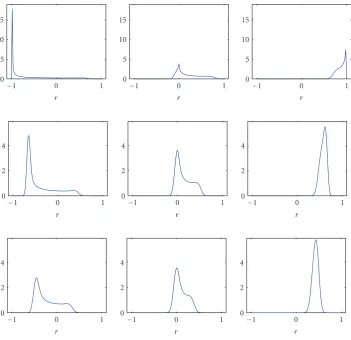
system is dependent on the directional information con-tained in the direct wave of the signals, it is not expected to perform well in strong reverberation. Accordingly, we restrict the level of reverberation toβ≥1, corresponding to DRRs greater than 0 dB. Comparing the top row ofFigure 5 (ane-choic) to the middle and bottom rows reveals that the effect of reverberation is to shift the center-of-mass of the pdfs away from the extreme values of±1 and towards more moderate values of r. This increases the overlap between the signal-alone and noise-signal-alone pdfs, thereby increasing the probabil-ity of error of the hypothesis test.
In the previous section, candidate values ofkdwere de-termined based on the pdfs for the anechoic case. Figure 5 illustrates that the signal-alone and noise-alone pdfs are af-fected equally by the simple model of reverberation used in this work, indicating that the analysis of the effect ofkdin the anechoic case also applies to reverberation.
The next step is to determine the optimal range for the thresholdr0. Because the effect of reverberation is to bring
the signal-alone and noise-alone pdfs closer together, we must include reverberation as we consider the threshold se-lection. Furthermore, until now we have based our analy-sis on the conceptually simple signal- and noise-alone pdfs shown in the right and left columns of Figures3and5. How-ever, in this application, we are not attempting to distinguish
between signal-alone from noialone cases; we wish to se-lect a threshold that will minimize the probability of error when classifying combinations of signal and noise at vari-ous SNRs. Therefore, to select the threshold, we consider the signal scenario described in conjunction with the hypothesis tests inSection 3.5.
Figure 6shows the conditional pdfs for the hypothesis test as given by (29) for three levels of reverberation. Given equal prior probabilities for the two hypotheses, the opti-mum choice of the thresholdr0is the value at which the pdfs
corresponding toH0 andH1 intersect. However, as seen in
Figure 6, the value ofrat which this intersection occurs is not constant; it varies with the level of reverberation. A practical system must use one threshold to operate robustly across all levels of reverberation. The threshold cannot be selected to account for the level of reverberation, which is an unknown environmental variable.
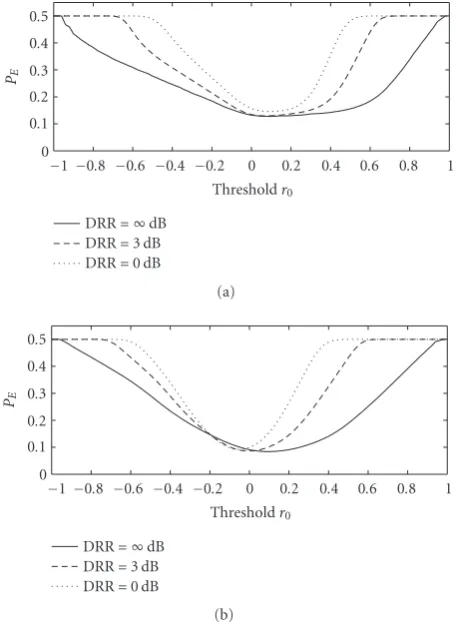
Figure 7shows the probability of error given by (33) as a function of the thresholdr0for two values ofkd. Forkd=
π, any choice of threshold in the range 0–0.2 minimizes the probability of error, regardless of the level of reverberation. Forkd =(4/3)π, the minimum probability of error varies somewhat with threshold, but using r0 =0 provides
near-optimal performance for all levels of reverberation.
5. SIMULATIONS
This section presents the results of computer simulations of the SNR-detection system shown inFigure 2. These sim-ulations were performed in Matlab(R). The sound sources
were sampled at 10 kHz. The bandpass filters were 81-point FIR filters designed using the Parks-McClellan method. The filtered signals were broken into frames of 100 samples (10 ms), which is appropriate for tracking power fluctuations in speech. For each frame, the sample correlation coefficient is computed according to (1). This value is compared to the threshold. If it exceeds the threshold, then the system declares
H1(high SNR), otherwise it declaresH0(low SNR).
15 10 5 0
−1 0 1 r
15 10 5 0
−1 0 1 r
15 10 5 0
−1 0 1 r
4 2 0
−1 0 1 r
4 2 0
−1 0 1 r
4 2 0
−1 0 1 r
4 2 0
−1 0 1 r
4 2 0
−1 0 1 r
4 2 0
−1 0 1 r
Figure5: Probability density functions of the estimated intermicrophone correlation coefficient for two sources in varying levels of rever-berationfr|β,W(r|β,W) computed from (23), for three SNRs (−∞, 0, and +∞dB) and three levels of reverberation (DRR=0, 3, and +∞dB represents by the three rows), with relative center frequency ofkd=π, fractional bandwidthB=0.22, andθ0=15◦. The first column
represents noise alone, the second column representsSNR=0 dB, and the third column represents signal alone.
radius was 1.62 m and the absorption coefficient was again 0.6.
The desired signal source angle varied between 0◦ and 12◦ and the interfering noise source angle varied between 18◦ and 90◦, both in 4◦ increments. For each of the result-ing 76 combinations of signal and noise source angles, the system generated predictions of high and low SNRs for each 10-millisecond frame. These results were then compared to the true SNRs for each frame to determine the detection and false alarm rates.
5.1. Simulations with white Gaussian noise
Simulations were performed using desired signal and inter-fering noise sources consisting of 28000-sample long seg-ments of white Gaussian noise. The variance of the interfer-ing noise source was constant at a value of one. The desired signal source consisted of a series of 2000-sample intervals each with a constant variance; the variance increased in steps of 3 dB between intervals such that the SNR ranged from
−19.5 dB to 19.5 dB. This input is structured so that the SNR
is less than 0 dB for the first 14000 samples, and the SNR is greater than 0 dB for the last 14000 samples. Thus, the first half of the signal was used to determine the false alarm rate
PF, and the second half was used to determine the detection ratePD. The values ofPDandPFwere averaged over all com-binations of source angles for desired signals and interfering noise.
All of the simulations with white noise used an intermi-crophone spacing ofd=14 cm together with two sets of sys-tem parameters. In the first set,kd=π andr0=0.1. With
d=14 cm, this results in a center frequency of f0=1238 Hz.
In the second parameter set, kd =(4/3)π andr0 =0,
re-sulting in a value of f0=1650 Hz. For both parameter sets,
the fractional bandwidthBvaried between 0.1 and 1.5, cor-responding to actual bandwidths of 124 Hz to 1856 Hz for the first parameter set and 165 Hz to 2475 Hz for the second set.
4 3 2 1 0
−1 −0.8 −0.6 −0.4 −0.2 0 0.2 0.4 0.6 0.8 1 r
H1 H0
(a) 4
3 2 1 0
−1 −0.8 −0.6 −0.4 −0.2 0 0.2 0.4 0.6 0.8 1 r
H1 H0
(b) 4
3 2 1 0
−1 −0.8 −0.6 −0.4 −0.2 0 0.2 0.4 0.6 0.8 1 r
H1 H0
(c)
Figure 6: Conditional probability density functions of the esti-mated intermicrophone correlation coefficient for the two hypothe-ses fr|H0,β(r|H0,β) andfr|H1,β(r|H1,β), computed as in (29) with
relative center frequency ofkd=π, fractional bandwidthB=0.22, andθ0=15◦for three levels of reverberation (a) DRR=+∞, (b)
DRR=3 dB, (c) DRR=0 dB.
of detection, false alarm, and error as predicted by the anal-ysis in Section 4. The agreement between the analytic and simulation results is quite good, especially for the anechoic condition. Minor but systematic deviations are apparent in the false alarm and error rates for the reverberant condi-tions, which is not surprising considering the oversimpli-fied model of reverberation as a spherically diffuse sound field that was used in the analysis, but not in the simula-tions.
Overall, the best performance is obtained with low-to-moderate values of the fractional bandwidth. As predicted by Figure 4, large values of the fractional bandwidth increase the overlap between the pdfs, thereby increasing the error rate. However, the noise simulation results indicate that perfor-mance is relatively constant for a relatively wide range of frac-tional bandwidths. While both values ofkdperform compa-rably, there is a slight benefit in usingkd=(4/3)π.
0.5 0.4 0.3 0.2 0.1 0
PE
−1−0.8 −0.6 −0.4 −0.2 0 0.2 0.4 0.6 0.8 1 Thresholdr0
DRR=∞dB DRR=3 dB DRR=0 dB
(a) 0.5
0.4 0.3 0.2 0.1 0
PE
−1−0.8 −0.6 −0.4 −0.2 0 0.2 0.4 0.6 0.8 1 Thresholdr0
DRR=∞dB DRR=3 dB DRR=0 dB
(b)
Figure7: Probability of errorPEas a function of thresholdr0 for
two values of relative center frequency (kd=(a)π, (b) 4π/3) and three levels of reverberation (DRR=0, 3, and +∞dB), with frac-tional bandwidthB=0.22 andθ
0=15◦.
5.2. Simulations with speech
More realistic simulations were performed using speech as the desired signal and babble as the noise signal. The speech source was 7-second long, formed by concatenating two sen-tences [31] spoken by a single male talker. The noise source consisted of 12-talker SPIN babble [32] trimmed to the same length as the speech material and normalized to have the same total power. The “true” SNR was calculated for each 10-millisecond frame by taking the ratio of the total power in the speech segment to the total power in the babble seg-ment. The “true” SNRs were compared to the system outputs to determine the detection and false alarm rates, which were averaged over all combinations of signal and noise angles.
The speech simulations investigated three intermicro-phone spacingsd=7, 14, and 28 cm, all withkd=(4/3)πand
r0=0.1This resulted in center frequencies of f0=3300, 1650,
and 825 Hz ford=7, 14, and 28 cm, respectively. The frac-tional bandwidth varied between 0.1 and 1.5. Ford=7 cm,
1 0.8 0.6 0.4 0.2 0
0 0.5 1 1.5
B
1 0.8 0.6 0.4 0.2 0
0 0.5 1 1.5
B
1 0.8 0.6 0.4 0.2 0
0 0.5 1 1.5
B
1 0.8 0.6 0.4 0.2 0
0 0.5 1 1.5
B
1 0.8 0.6 0.4 0.2 0
0 0.5 1 1.5
B
1 0.8 0.6 0.4 0.2 0
0 0.5 1 1.5
B
Figure8: System performance as a function of fractional bandwidthBfor three levels of reverberation (DRR=0, 3, and +∞dB) and two values of relative center frequency (kd=π, 4π/3). The plots show detection rates (circle), false alarm rates (diamond), and error rates (square) from the simulations with white noise along with the theoretical probabilities of detection (dot), false alarm (x), and error (+) predicted by the analysis inSection 4. The first row represents DRR=∞, the second row represents DRR=3 dB, and the third row represents DRR=0 dB. The first column representskd=πand the second column representskd=4/3π.
the larger fractional bandwidths (B=1.0 and 1.5) were not simulated because they corresponded to frequency ranges that exceeded the signals’ 5 kHz bandwidth.
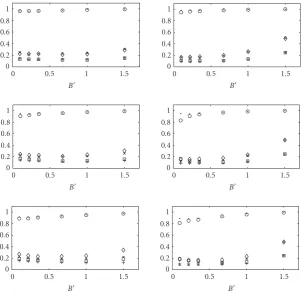
Figure 9shows the results of these simulations, display-ing the detection, error, and false alarm rates as a function of fractional bandwidth for three values ofdand three levels of reverberation. Comparing the columns inFigure 9 con-firms that the overall performance is relatively unaffected by microphone spacing when comparing systems based on the normalized parameterskdandB. The exception is the smaller microphone spacing (d=7 cm), where small frac-tional bandwidths produce relatively more detections and false alarms, leading to comparable overall error rates.
Comparing the middle column ofFigure 9to the right-hand column ofFigure 8reveals that for the same parameter settings, the use of speech signals leads to substantial reduc-tions in system performance, as evidenced by higher error and false alarm rates and lower detection rates. The discrep-ancies between Figures8and9are explained by the obser-vation that in the case of the speech signals, the SNRs are not uniformly distributed in the range−20 dB to 20 dB, as was assumed in the analysis. This assumption was true for the noise simulation. In the case of speech, values of the short-time SNR tend to be concentrated at less extreme val-ues, where the system does not perform as well. In fact, the
majority of errors made by the system occur when the SNR is close to 0 dB, and therefore in transition between the two hypotheses. This is illustrated inFigure 10, which shows the true short-term SNRs for a 3-second speech segment and the values of intermicrophone correlation computed according to (1), along with the locations of misses and false alarms.
Another major difference between Figures8and9is the more pronounced effect of bandwidth on speech when com-pared with noise sources. For the noise signals, the energy was uniformly distributed across the bandwidth, but this is not the case for speech signals. As discussed in Section 4, selection of the bandwidth represents a tradeoff between the theoretical considerations, which dictate smaller band-widths, and practical considerations, which require that the system captures sufficient energy from the nonstationary speech signal to minimize adverse affects of the relative energy fluctuations in different frequency regions. The simu-lation results inFigure 9suggest that for speech signals, frac-tional bandwidths in the range 0.67 to 1.0 yield the best per-formance.
6. SUMMARY AND CONCLUSIONS
1 0.8 0.6 0.4 0.2 0
0 0.5 1 1.5 B
1 0.8 0.6 0.4 0.2 0
0 0.5 1 1.5 B
1 0.8 0.6 0.4 0.2 0
0 0.5 1 1.5 B
1 0.8 0.6 0.4 0.2 0
0 0.5 1 1.5 B
1 0.8 0.6 0.4 0.2 0
0 0.5 1 1.5 B
1 0.8 0.6 0.4 0.2 0
0 0.5 1 1.5 B
1 0.8 0.6 0.4 0.2 0
0 0.5 1 1.5 B
1 0.8 0.6 0.4 0.2 0
0 0.5 1 1.5 B
1 0.8 0.6 0.4 0.2 0
0 0.5 1 1.5 B
Figure9: System performance as a function of fractional bandwidthBfor three levels of reverberation (DRR=0, 3, and +∞dB) and three intermicrophone spacings (d=7, 14, 28 cm), with relative center frequency (kd=4π/3). The plots show detection rates (circle), false alarm rates (diamond), and error rates (square) from the simulations with speech. The first row represents DRR= ∞, the second row represents DRR=3 dB, and the third represents DRR=0 dB. The first column representsd=7 cm, the second column representsd=14 cm, and the third column representsd=28 cm.
noise arise from distinct spatial regions. It uses the correla-tion coefficient between two microphone signals as the de-cision variable in a hypothesis test. The system has three parameters: the center frequency of the bandpass filter, the bandwidth of the bandpass filter, and the threshold for the decision variable. We performed a theoretical analysis based on a signal scenario that includes two spatially separated sound sources and a simple model of reverberation. By deriv-ing conditional probability density functions of the intermi-crophone correlation coefficient under both hypotheses, we gained insight into optimal selection of the system param-eters. Results of simulations using white Gaussian noise for the sound sources were in close agreement with the theoret-ical results. More realistic simulations using speech sources followed the same general trends and illustrated the per-formance that can be obtained in practical situations with the parameters determined by the analysis, specifically,kd=
(4/3)π,B=0.67−1.0, andr0=0.
The contributions of this work are twofold. First, it pro-vides an example of how speech detection systems can be analyzed and optimized. Rigorous comparison of the many speech detection systems proposed in the literature is often
hampered by the differing conditions under which they are evaluated. If theoretical analyses similar to the one per-formed here were available, they would greatly facilitate the comparison of different speech detection systems. Second, for the particular speech detection system considered here, the analysis provides simple and widely applicable guidelines for the selection of parameters.
20 10 0 −10 −20 −30
SNR
(dB)
0 0.5 1 1.5 2 2.5 3
Time (s) Missed detections
False alarms
(a) 1
0.5 0 −0.5 −1
r
0 0.5 1 1.5 2 2.5 3
Time (s) (b)
Figure10: Simulation results for a desired speech source at 8◦and interfering babble at 86◦azimuth, combined to produce a long-term SNR of 0 dB. The sources were in an anechoic environment with 14 cm microphone spacing. (a) Short-time SNR as a function of time for a 3-second segment of speech. (b) Estimated intermi-crophone correlation coefficientrfor the same speech and babble segment as in (a), computed forkd=4/3πandB=0.22. Using a threshold ofr0=0, the symbols in (a) indicate frames, where there
were missed detections (“+”) and false alarms (“x”).
the proposed system for use in speech-enhancement and noise-reduction algorithms that require identification of in-tervals when the desired signal is weak or absent.
ACKNOWLEDGMENTS
The authors are grateful to Pat Zurek, who suggested the use of the FisherZ-transformation and outlined portions of the derivation presented inSection 3, and to three anonymous reviewers, who provided valuable feedback on an earlier ver-sion of this paper. This work was supported by the National Institute of Deafness and Other Communicative Disorders under Grant 1-R01-DC00117.
REFERENCES
[1] R. Plomp, “Auditory handicap of hearing impairment and the limited benefit of hearing aids,”Journal of the Acoustical Society of America, vol. 63, no. 2, pp. 533–549, 1978.
[2] T. C. Smedley and R. L. Schow, “Frustrations with hearing aid use: candid reports from the elderly,”The Hearing Journal, vol. 43, no. 6, pp. 21–27, 1990.
[3] S. Kochkin, “MarkeTrak V: consumer satisfaction revisited,”
The Hearing Journal, vol. 53, no. 1, pp. 38–55, 2000.
[4] S. Kochkin, “MarkeTrak V: ‘why my hearing aids are in the drawer’: the consumers’ perspective,” The Hearing Journal, vol. 53, no. 2, pp. 34–42, 2000.
[5] D. Van Compernolle, “Hearing aids using binaural processing principles,”Acta Oto-Laryngologica: Supplement, vol. 469, pp. 76–84, 1990.
[6] M. Kompis and N. Dillier, “Noise reduction for hearing aids: Combining directional microphones with an adaptive beam-former,”Journal of the Acoustical Society of America, vol. 96, no. 3, pp. 1910–1913, 1994.
[7] J. E. Greenberg and P. M. Zurek, “Evaluation of an adaptive beamforming method for hearing aids,”Journal of the Acousti-cal Society of America, vol. 91, no. 3, pp. 1662–1676, 1992. [8] D. Van Compernolle, W. Ma, F. Xie, and M. Van Diest, “Speech
recognition in noisy environments with the aid of microphone arrays,”Speech Communication, vol. 9, no. 5-6, pp. 433–442, 1990.
[9] H. Kobatake, K. Tawa, and A. Ishida, “Speech/nonspeech discrimination for speech recognition system under real life noise environments,” inProc IEEE International Conference on Acoustics, Speech, and Signal Processing (ICASSP ’89), vol. 1, pp. 365–368, Glasgow, Scotland, UK, May 1989.
[10] D. K. Freeman, G. Cosier, C. B. Southcott, and I. Boyd, “The voice activity detector for the Pan-European digital cellular mobile telephone service,” inProceedings of IEEE International Conference on Acoustics, Speech, and Signal Processing (ICASSP ’89), vol. 1, pp. 369–372, Glasgow, Scotland, UK, May 1989. [11] M. Marzinzik and B. Kollmeier, “Speech pause detection for
noise spectrum estimation by tracking power envelope dy-namics,”IEEE Transactions on Speech and Audio Processing, vol. 10, no. 2, pp. 109–118, 2002.
[12] C. Breining, P. Dreiscitel, E. Hansler, et al., “Acoustic echo control. An application of very-high-order adaptive filters,”
IEEE Signal Processing Magazine, vol. 16, no. 4, pp. 42–69, 1999.
[13] J. Stegmann and G. Schroder, “Robust voice-activity detection based on the wavelet transform,” inProceedings of IEEE Work-shop on Speech Coding For Telecommunications Proceeding, pp. 99–100, Pocono Manor, Pa, USA, September 1997.
[14] R. Tucker, “Voice activity detection using a periodicity mea-sure,”IEE Proceedings. I: Communications, Speech, and Vision, vol. 139, no. 4, pp. 377–380, 1992.
[15] J. Pencak and D. Nelson, “The NP speech activity detection algorithm,” inProceedings of IEEE International Conference on Acoustics, Speech, and Signal Processing (ICASSP ’95), vol. 1, pp. 381–384, Detroit, Mich, USA, May 1995.
[16] J. D. Hoyt and H. Wechsler, “Detection of human speech in structured noise,” inProceedings of IEEE International Confer-ence on Acoustics, Speech, and Signal Processing (ICASSP ’94), vol. 2, pp. 237–240, Adelaide, Australia, April 1994.
[17] J. T. Sims, “A speech-to-noise ratio measurement algorithm,”
Journal of the Acoustical Society of America, vol. 78, no. 5, pp. 1671–1674, 1985.
[18] M. Akagi and T. Kago, “Noise reduction using a small-scale microphone array in multi noise source environment,” in Pro-ceedings of IEEE International Conference on Acoustics, Speech, and Signal Processing (ICASSP ’02), vol. 1, pp. 909–912, Or-lando, Fla, USA, May 2002.
[20] R. Le Bouquin-Jeann`es and G. Faucon, “Study of a voice ac-tivity detector and its influence on a noise reduction system,”
Speech Communication, vol. 16, no. 3, pp. 245–254, 1995. [21] M. Kompis, N. Dillier, J. Francois, J. Tinembart, and R.
Hausler, “New target-signal-detection schemes for multi-microphone noise-reduction systems for hearing aids,” in Pro-ceedings of 19th Annual International Conference of the IEEE Engineering in Medicine and Biology Society (EMBS ’97), vol. 5, pp. 1990–1993, Chicago, Ill, USA, October–November 1997. [22] R. J. M. van Hoesel and G. M. Clark, “Evaluation of a
portable two-microphone adaptive beamforming speech pro-cessor with cochlear implant patients,”Journal of the Acoustical Society of America, vol. 97, no. 4, pp. 2498–2503, 1995. [23] P. Janecek, “A model for the sound energy distribution in work
spaces based on the combination of direct and diffuse sound fields,”Acustica, vol. 74, pp. 149–156, 1991.
[24] M. G. Bulmer,Principles of Statistics, Dover, New York, NY, USA, 1979.
[25] W. M. Hartmann, Signals, Sound, and Sensation, Springer, New York, NY, USA, 1998.
[26] H. P. Hsu,Probability, Random Variables, and Random Pro-cesses, McGraw-Hill, New York, NY, USA, 1997.
[27] H. N´elisse and J. Nicolas, “Characterization of a diffuse field in a reverberant room,”Journal of the Acoustical Society of Amer-ica, vol. 101, no. 6, pp. 3517–3524, 1997.
[28] H. L. Van Trees,Detection, Estimation, and Modulation Theory, Part I, John Wiley & Sons, New York, NY, USA, 1968. [29] J. B. Allen and D. A. Berkley, “Image method for efficiently
simulating small-room acoustics,”Journal of the Acoustical So-ciety of America, vol. 65, no. 4, pp. 943–950, 1979.
[30] P. M. Peterson, “Simulating the response of multiple micro-phones to a single acoustic source in a reverberant room,”
Journal of the Acoustical Society of America, vol. 80, no. 5, pp. 1527–1529, 1986.
[31] IEEE, “IEEE recommended practice for speech quality mea-surements,” Tech. Rep. IEEE 297, Institute of Electrical and Electronics Engineers, Washington, DC, USA, 1969.
[32] D. N. Kalikow, K. N. Stevens, and L. L. Elliot, “Development of a test of speech intelligibility in noise using sentence materials with controlled word predictability,”Journal of the Acoustical Society of America, vol. 61, no. 5, pp. 1337–1351, 1977.
Ashish Koulreceived the B.S. and M.Eng. degrees in electrical engineering and com-puter science from the Massachusetts Insti-tute of Technology in 2001 and 2003, re-spectively. While at MIT, he served as a Re-search Assistant in the Sensory Communi-cations Group within the Research Labora-tory of Electronics, where he was involved in applications of digital signal processing in hearing-aid design. Currently, he is
em-ployed as an Engineer working on research and development in the Broadband Video Compression Group at the Broadcom Corpora-tion in Andover, Mass.
Julie E. Greenberg is a Principal Research Scientist in the Research Laboratory of Elec-tronics at the Massachusetts Institute of Technology (MIT). She also serves as the Director of Education and Academic Affairs for the Harvard-MIT Division of Health Sciences and Technology (HST). She re-ceived a B.S.E. degree in computer engi-neering from the University of Michigan, Ann Arbor (1985), an S.M. in electrical