
Volume 2007, Article ID 38373,15pages doi:10.1155/2007/38373
Research Article
Distributed Bayesian Multiple-Target Tracking in Crowded
Environments Using Multiple Collaborative Cameras
Wei Qu,1Dan Schonfeld,1and Magdi Mohamed2
1Multimedia Communications Laboratory, Department of Electrical and Computer Engineering, University of Illinois at Chicago, IL 60607-7053, USA
2Visual Communication and Display Technologies Lab, Physical Realization Research COE, Motorola Labs, Schaumburg, IL 60196, USA
Received 28 September 2005; Revised 13 March 2006; Accepted 15 March 2006
Recommended by Justus Piater
Multiple-target tracking has received tremendous attention due to its wide practical applicability in video processing and analysis applications. Most existing techniques, however, suffer from the well-known“multitarget occlusion”problem and/or immense computational cost due to its use of high-dimensional joint-state representations. In this paper, we present a distributed Bayesian framework using multiple collaborative cameras for robust and efficient multiple-target tracking in crowded environments with significant and persistent occlusion. When the targets are in close proximity or present multitarget occlusions in a particular camera view, camera collaboration between different views is activated in order to handle the multitarget occlusion problem in an innovative way. Specifically, we propose to model the camera collaboration likelihood density by using epipolar geometry with sequential Monte Carlo implementation. Experimental results have been demonstrated for both synthetic and real-world video data.
Copyright © 2007 Hindawi Publishing Corporation. All rights reserved.
1. INTRODUCTION AND RELATED WORK
Visual multiple-target tracking (MTT) has received tremen-dous attention in the video processing community due to its numerous potential applications in important tasks such as video surveillance, human activity analysis, traffic monitor-ing, and so forth. MTT for targets whose appearance is dis-tinctive is much easier since it can be solved reasonably well by using multiple independent single-target trackers. In this situation, when tracking a specific target, all the other targets can be viewed as background due to their distinct appear-ance. However, MTT for targets whose appearance is similar or identical such as pedestrians in crowded scenes is a much more difficult task. In addition to all of the challenging prob-lems inherent in single-target tracking, MTT must deal with multitarget occlusion, namely, the tracker must separate the targets and assign them correct labels.
Most early efforts for MTT use monocular video. A widely accepted approach that addresses many problems in this difficult task is based on a joint state-space representa-tion and infers the joint data associarepresenta-tion [1,2]. MacCormick and Blake [3] used a binary variable to identify foreground objects and proposed a probabilistic exclusion principle to
proposed decentralized solutions for multitarget tracking. Yu and Wu [12] and Wu et al. [13] used multiple collaborative trackers for MTT modeled by a Markov random network. This approach demonstrates the efficiency of the decentral-ized method. However, it relies on the objects’ joint prior and does not deal with the“false labeling”problem. The de-centralized approach was carried further by Qu et al. [14] who proposed an interactively distributed multiobject track-ing (IDMOT) framework ustrack-ing a magnetic-inertia potential model.
Monocular video has intrinsic limitations for MTT, espe-cially in solving the multitarget occlusion problem, due to the camera’s limited field of view and loss of the targets’ depth information by camera projection. These limitations have recently inspired researchers to exploit multiocular videos, where expanded coverage of the environment is provided and occluded targets in one camera view may not be oc-cluded in others. However, using multiple cameras raises many additional challenges. The most critical difficulties pre-sented by multicamera tracking are to establish a consistent-label correspondence of the same target among the different views and to integrate the information from different camera views for tracking that is robust to significant and persistent occlusion. Many existing approaches address the label cor-respondence problem by using different techniques such as feature matching [15,16], camera calibration and/or 3D en-vironment model [17–19], and motion-trajectory alignment [20]. Khan and Shah [21] proposed to solve the consistent-labeling problem by finding the limits of the field of view of each camera as visible in the other cameras. Methods for es-tablishing temporal instead of spatial label correspondences between nonoverlapping fields of view are discussed in [22– 24]. Most examples of MTT presented in the literature are limited to a small number of targets and do not attempt to solve the multitarget occlusion problem which occurs fre-quently in crowded scenes. Integration of information from multiple cameras to solve the multitarget occlusion problem has been approached by several researchers. Static and ac-tive cameras are used together in [25]. Chang and Gong [26] used Bayesian networks to combine multiple modalities for matching subjects. Iwase and Saito [27] integrated the track-ing data of soccer players from multiple cameras by ustrack-ing homography and a virtual ground image. Mittal and Davis [28] proposed to detect and track multiple objects by match-ing regions along epipolar lines in camera pairs. A particle filter-based approach is presented by Gatica-Perez et al. [29] for tracking multiple interacting people in meeting rooms. Nummiaro et al. [30] proposed a color-based object tracking approach with a particle filter implementation in multicam-era environments. Recently, Du and Piater [31] presented a very efficient algorithm using sequential belief propagation to integrate multiview information for a single object in or-der to solve the problem of occlusion with clutter. Several researchers addressed the problem of 3D tracking of multi-ple objects using multimulti-ple camera views [32,33]. Dockstader and Tekalp [34] used a Bayesian belief network in a cen-tral processor to fuse independent observations from mul-tiple cameras for 3D position tracking. A different central
process is used to integrate data for football player tracking in [35].
In this paper, we present a distributed Bayesian frame-work for multiple-target tracking using multiple collabora-tive cameras. We refer to this approach as Bayesian multiple-camera tracking (BMCT). Its objective is to provide a supe-rior solution to the multitarget occlusion problem by exploit-ing the cooperation of multiocular videos. The distributed Bayesian framework avoids the computational complexity inherent in centralized methods that rely on joint-state rep-resentation and joint data association. Moreover, we present a paradigm for a multiple-camera collaboration model us-ing epipolar geometry to estimate thecamera collaboration
functionefficiently without recovering the targets’ 3D
coor-dinates.
The paper is organized as follows:Section 2presents the proposed BMCT framework. Its implementation using the density estimation models of sequential Monte Carlo is dis-cussed inSection 3. In Section 4, we provide experimental results for synthetic and real-world video sequences. Finally, inSection 5, we present a brief summary.
2. DISTRIBUTED BAYESIAN MULTIPLE-TARGET TRACKING USING MULTIPLE
COLLABORATIVE CAMERAS
We use multiple trackers, one tracker per target in each cam-era view for MTT in multiocular videos. Although we illus-trate our framework by using only two cameras for simplic-ity, the method can be easily generalized to cases using more cameras. The state of a target in camera A is denoted byxtA,i, wherei=1,. . .,Mis the index of targets, andtis the time index. We denote the image observation of xAt,ibyzAt,i, the set of all states up to timetbyx0:A,ti, wherex0A,iis the
initial-ization prior, and the set of all observations up to timetby
z1:A,ti. Similarly, we can denote the corresponding notions for targets in camera B. For instance, the“counterpart”ofxAt,iis xtB,i. We further use zAt,Jt to denote the neighboring obser-vations of ztA,i, which“interact” with ztA,i at time t, where Jt = {jl1,jl2,. . .}. We define a target to have “interaction” when it touches or even occludes with other targets in a cam-era view. The elementsjl1,jl2,. . .∈ {1,. . .,M},jl1,jl2,. . .=i, are the indexes of targets whose observations interact with
ztA,i. When there is no interaction ofzAt,i with other obser-vations at time t, Jt = ∅. Since the interaction structure among observations is changing,Jmay vary in time. In ad-dition,zA,J1:t
1:t represents the collection of neighboring obser-vation sets up to timet.
2.1. Dynamic graphical modeling and conditional
independence properties
Thegraphical model[36] is an intuitive and convenient tool
xAt−,11
ztA−,11 xAt−,21
zAt−,21 xA ,3 t−1
zAt−,31
xtA,1
zAt,1 xAt,2
ztA,2
xAt,3
zAt,3 Camera A
xBt−,11
xBt−,21
zBt−,11 zBt−,21 xBt−,31
zBt−,31
xBt,1
zBt,1 xBt,2
zBt,2
xBt,3
zBt,3 Camera B
Figure1: The dynamic graphical model for multiple-target tracking using multiple collaborative cameras. The directed curve link shows the “camera collaboration” between the counterpart states in different cameras.
nodes representing the targets’ states; the observable layer has square nodes representing the observations associated with the hidden states. The directed link between consecu-tive states of the same target in each camera represents the state dynamics. The directed link from a target’s state to its observation characterizes the local observation likelihood. The undirected link in each camera between neighboring observation nodes represents the“interaction.”As it is men-tioned, we activate the interaction only when the targets’ ob-servations are in close proximity or occlusion. This can be approximately determined by the spatial relation between the targets’ trackers since the exact locations of observations are unknown. The directed curve link between the counterpart states of the same target in two cameras represents the
“cam-era collaboration.”This collaboration is activated between any
possible collection of cameras only for targets which need help to improve their tracking robustness. For instance, when the targets are close to occlusion or possibly completely oc-cluded by other targets in a camera view. The direction of the link shows “which target resorts to which other targets for help.” This“need-driven”-based scheme avoids perform-ing camera collaboration at all times and for all targets; thus, a tremendous amount of computation is saved. For example, inFigure 1, all targets in camera B at timetdo not need to ac-tivate the camera collaboration because their observations do not interact with the other targets’ observations at all. In this case, each target can be robustly tracked using independent trackers. On the other hand, targets 1 and 2 in camera A at timetactivate camera collaboration since their observations interact and may undergo multitarget occlusion. Therefore, external information from other cameras may be helpful to make the tracking of these two targets more stable.
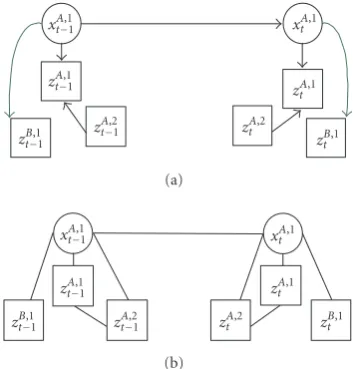
A graphical model likeFigure 1 is suitable for central-ized analysis using joint-state representations. However, in order to minimize the computational cost, we choose a completely distributed process where multiple collaborative trackers, one tracker per target in each camera, are used for MTT simultaneously. Consequently, we further decompose the graphical model for every target in each camera by per-forming four steps: (1) each submodel aims at one target in one camera; (2) for analysis of the observations of a spe-cific camera, only neighboring observations which have di-rect links to the analyzed target’s observation are kept. All the nodes of both nonneighboring observations and other targets’ states are removed; (3) each undirected“interaction”
link is decomposed into two different directed links for the different targets. The direction of the link is from the other target’s observation to the analyzed target’s observation; (4) since the“camera collaboration”link from a target’s state in the analyzed camera view to its counterpart state in another view and the link from this counterpart state to its associ-ated observation have the same direction, this causality can be simplified by a direct link from the grandparent node to its grandson as illustrated inFigure 2[36].Figure 3(a) illus-trates the decomposition result of target 1 in camera A. Al-though we neglect some indirectly related nodes and links and thus simplify the distributed graphical model when an-alyzing a certain target, the neglected information is not lost but has been taken into account in the other targets’ models. Therefore, when all the trackers are implemented simultane-ously, the decomposed subgraphs together capture the origi-nal graphical model.
xAt,1 xB ,1 t
zBt,1
xtA,1 xBt,1
ztB,1
Figure2: Equivalent simplification of camera collaboration link. The link causality from grandparent to parent then to grandson node is replaced by a direct link from grandparent to grandson node.
xAt−,11
zAt−,11
zBt−,11
zAt−,21
xAt,1
zAt,1
zAt,2
zBt,1
(a) xAt−,11
zAt−,11
zBt−,11 zAt−,21
xtA,1
zAt,1
zAt,2 zBt,1
(b)
Figure3: (a) Decomposition result for the target 1 in view A from Figure 1; (b) the moral graph of the graphical model in (a) for Markov property analysis.
properties [36, pages 69–70] for every decomposed graph on its correspondingmoral graphsas illustrated inFigure 3(b). Then, by applying theseparation theorem[36, page 67], the followingMarkovproperties can be easily substantiated:
(i) p(xAt,i,ztA,Jt,zBt,i | x0:A,ti−1,z1:A,ti−1,zA ,J1:t−1
1:t−1 ,zB1:,ti−1) = p(xtA,i, zA,Jt
t ,zBt,i|x0:A,ti−1),
(ii) p(zA,Jt
t ,ztB,i|xtA,i,xA0:,ti−1)=p(ztA,Jt,ztB,i|xAt,i),
(iii) p(zAt,i|xA0:,ti,z1:At,i−1,zA1:,tJ1:t,z1:B,ti)=p(ztA,i|xtA,i,zAt,Jt,zBt,i), (iv) p(zBt,i|xtA,i,ztA,i)=p(ztB,i|xAt,i),
(v) p(zA,Jt
t ,ztB,i | xtA,i,zAt,i) = p(ztA,Jt | xAt,i,ztA,i)p(zBt,i | xAt,i,zAt,i).
These properties have been used in the appendix to facilitate the derivation.
2.2. Distributed Bayesian tracking for each tracker
In this section, we present a Bayesian conditional den-sity propagation framework for each decomposed graphi-cal model as illustrated inFigure 3. The objective is to pro-vide a generic statistical framework to model the interaction among cameras for multicamera tracking. Since we use mul-tiple collaborative trackers, one tracker per target in each
camera view, for multicamera multitarget tracking, we will dynamically estimate the posterior based on observations from both the target and its neighbors in the current cam-era view as well as the target in other camcam-era views, that is,
p(xA0:,ti |z1:A,ti,zA1:,tJ1:t,z1:B,ti) for each tracker and for each camera view. By applying Bayes’s rule and theMarkovproperties de-rived in the previous section, a recursive conditional density updating rule can be obtained:
pxA0:,ti|zA1:,ti,z1:A,tJ1:t,zB1:,ti
=ktp
ztA,i|xtA,i
pxAt,i|xA0:,ti−1
pzA,Jt
t |xAt,i,zAt,i
×pztB,i|xAt,i
px0:A,ti−1|zA1:,ti−1,zA1:,tJ1:−1t−1,zB1:,ti−1
, (1) where
kt= 1
pztA,i,ztA,Jt,ztB,i|z1:A,ti−1,z1:A,tJ1:−t1−1,zB1:,ti−1
. (2)
The derivation of (1) and (2) is presented in the appendix. Notice that the normalization constantkt does not depend on the statesxA0:,ti. In (1),p(ztA,i|xAt,i) is the local observation likelihood for targetiin the analyzed camera viewA,p(xtA,i| x0:A,ti−1) represents the state dynamics, which are similar to
tra-ditional Bayesian tracking methods.p(zA,Jt
t |xAt,i,zAt,i) is the
“target interaction function”within each camera which can be
estimated by using the“magnetic repulsion model”presented in [14]. A novel likelihood densityp(zBt,i|xtA,i) is introduced to characterize the collaboration between the same target’s counterparts in different camera views. We call it a“camera collaboration function.”
When not activating the camera collaboration for a tar-get and regarding its projections in different views as inde-pendent, the proposed BMCT framework can be identical to the IDMOT approach [14], where p(ztB,i | xtA,i) is uni-formly distributed. When deactivating the interaction among the targets’ observations, our formulation will further sim-plify to traditional Bayesian tracking [37,38], wherep(zA,Jt
t | xtA,i,zAt,i) is also uniformly distributed.
3. SEQUENTIAL MONTE CARLO IMPLEMENTATION
Since the posterior of each target is generally non-Gaussian, we describe in this section a nonparametric implementa-tion of the derived Bayesian formulaimplementa-tion using the sequen-tial Monte Carlo algorithm [38–40], in which a particle set is employed to represent the posterior
px0:A,ti|z1:A,ti,zA1:,tJ1:t,z1:B,ti
∼x0:At,i,n,wAt,i,n
Np
n=1, (3)
where{xA0:,ti,n, n = 1,. . .,Np}are the samples,{wtA,i,n, n = 1,. . .,Np}are the associated weights, andNpis the number of samples.
corresponding weights are given by
wit,n∝wit,−n1p
ztA,i|xtA,i,n
pzA,Jt
t |xAt,i,n,zAt,i
pzBt,i|xAt,i,n
.
(4)
It has been widely accepted that better importance density functions can make particles more efficient [39, 40]. We choose a relatively simple functionp(xtA,i|xtA−,i1) as in [37] to
highlight the efficiency of using camera collaboration. Other importance densities such as reported in [41–44] can be used to provide better performance.
Modeling the densities in (4) is not trivial and usually has great influence on the performance of practical implementa-tions. In the following subsections, we first discuss the target model, then present the proposedcamera collaboration
likeli-hood model, and further summarize other models for density
estimation.
3.1. Target representation
A proper model plays an important role in estimating the densities. Different target models, such as the 2D ellipse model [45], 3D object model [34], snake or dynamic contour model [37], and so forth, are reported in the literature. In this paper, we use a five-dimensional parametric ellipse model which is quite simple, saves a lot of computational costs, and is sufficient to represent the tracking results for MTT. For example, the statextA,iis given by (cxtA,i,cyAt,i,atA,i,btA,i,ρAt,i), wherei=1,. . .,Mis the index of targets,tis the time index, (cx,cy) is the center of the ellipse,ais the major axis,bis the minor axis, andρis the orientation in radians.
3.2. Camera collaboration likelihood model
The proposed Bayesian conditional density propagation framework has no specific requirements of the cameras (e.g., fixed or moving, calibrated or not) and the collaboration model (e.g., 3D/2D) as long as the model can provide a good estimation of the density p(zBt,i | xAt,i). Epipolar geometry [46] has been used to model the relation across multiple camera views in different ways. In [28], an epipolar line is used to facilitate color-based region matching and 3D coor-dinate projection. In [26], match scores are calculated using epipolar geometry for segmented blobs in different views. Nummiaro et al. used an epipolar line to specify the dis-tribution of samples in [30]. Although they are very useful in different applications as reported in the prior literature, these models are not suitable for our framework. Since gen-erally hundreds or even thousands of particles are needed in sequential Monte Carlo implementation for multiple-target tracking in crowded scenes, the computation required to perform feature matching for each particle is not feasi-ble. Moreover, using the epipolar line to facilitate impor-tance sampling is problematic and is not suitable for track-ing in crowded environments [30]. Such a camera collabo-ration model may introduce additional errors as discussed and shown in Section 4.2. On the other hand, we present a paradigm of camera collaboration likelihood model using
Objectj
Objecti
Camera A Camera B
ztB,i
zBt,j
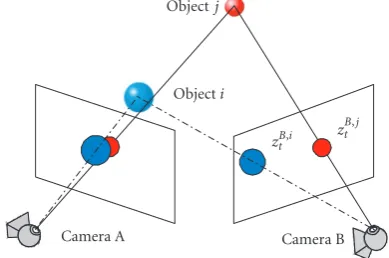
Figure4: The model setting in 3D space for camera collaboration likelihood estimation.
sequential Monte Carlo implementation which does not re-quire feature matching and recovery of the target’s 3D coor-dinates, but only assumes that the cameras’ epipolar geome-try is known.
Figure 4illustrates the model setting in 3D space. Two targetsiandjare projected onto two camera views. In view A, the projections of targetsiandjare very close (occluding) while in view B, they are not. In such situations, we only ac-tivate the camera collaboration for trackers of targetsiandj
in view A but not in view B. We have considered two meth-ods to calculate the likelihood p(ztB,i | xAt,i) without recov-ering the target’s 3D coordinates: (1) mappingxtA,i to view B and then calculating the likelihood there; (2) mapping the observationzBt,i to camera view A and calculating the den-sity there. The first way looks more impressive but is actu-ally infeasible. Since usuactu-ally hundreds or thousands of par-ticles have to be used for MTT in crowded scenes, mapping each particle into another view and computing the likelihood requires an enormous computational effort. We have there-fore decided to to choose the second approach. The obser-vationszBt,i andzB
,j
t are initially found by tracking in view B. Then they are mapped to view A, producing(zBt,i) and (zBt,j), where(·) is a function ofzBt,i orzB
,j
t characteriz-ing the epipolar geometry transformation. After that, the col-laboration likelihood can be calculated based on(ztB,i) and (zBt,j). Sometimes, a more complicated case occurs, for ex-ample, targetiis occluding with others in both cameras. In this situation, the above scheme is initialized by randomly se-lecting one view, say, view B, and using IDMOT to find the observations. These initial estimates may be not very accu-rate; therefore, in this case, we iterate several times (usually twice is enough) between different views to get more stable estimates.
dtA,i,1 xtA,i,1 xtA,i,2
· · ·
dAt,i,2
xAt,i,n dAt,i,n
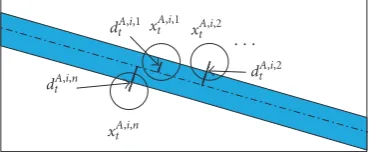
Figure5: Calculating the camera collaboration weights for targeti in view A. Circles instead of ellipses are used to represent the parti-cles for simplicity.
wide-baseline cameras usually make the target’s features vary significantly in different views. Moreover, the occluded tar-get’s features are interrupted or even completely lost. Sec-ondly, the crowded scene means that there may be several similar candidate targets along this band. It usually happens that the optimal match may be a completely wrong location, and thus falsely guides the tracker away. Our experiments show that using the band(ztB,i) itself cannot only avoid the above errors but also provides useful spatial information for target location. Furthermore, the local image observation has already been considered in the local likelihoodp(zAt,i |xtA,i) which provides information for estimating both the target’s location and size.
Figure 5shows the procedure used to calculate the col-laboration weight for each particle based on(zBt,i). The par-ticles{xtA,i,1,xtA,i,2,. . .,xtA,i,n}are represented by the circles in-stead of ellipse models for simplicity. Given the Euclidean distancedAt,i,n= xtA,i,n−(ztB,i)between the particlexAt,i,n and the band (zBt,i), the collaboration weight for particle xtA,i,ncan be computed as
φAt,i,n= 1
√
2πΣφ exp
−
dAt,i,n
2
2Σ2
φ
, (5)
whereΣ2φis the variance which can be chosen as the band-width. InFigure 5, we simplifydAt,i,nby using apoint-line
dis-tancebetween the center of the particle and the middle line of
the band. Furthermore, the camera collaboration likelihood can be approximated as follows:
pzBt,i|xAt,i
≈
Np
n=1
φAt,i,n Np
n=1φA,i,n
t
δxAt,i−xAt,i,n
. (6)
3.3. Interaction and local observation
likelihood models
We have proposed a“magnetic repulsion model”to estimate the interaction likelihood in [14]. It can be used here simi-larly:
pzA,Jt
t |xAt,i,ztA,i
≈
Np
n=1
ϕAt,i,n Np
n=1ϕA,i,n t
δxAt,i−xAt,i,n
, (7)
whereϕAt,i,nis the interaction weight of particlexAt,i,n. It can be iteratively calculated by
ϕAt,i,n=1− 1
αexp
−
ltA,i,n
2
Σ2
ϕ
, (8)
whereαandΣϕ are constants.ltA,i,n is the distance between the current particle’s observation and the neighboring obser-vation.
Different cues have been proposed to estimate the lo-cal observation likelihood [37,47,48]. We fuse the target’s color histogram [47] with a PCA-based model [48] together, namely, p(zAt,i | xAt,i) = pc×pp, where pc and pp are the likelihood estimates obtained from the color histogram and PCA models, respectively.
3.4. Implementation issues
3.4.1. New target initialization
For simplicity, we manually initialize all the targets in the ex-periments. Many automatic initialization algorithms such as reported in [6,21] are available and can be used instead.
3.4.2. Triangle transition algorithm for each target
To minimize computational cost, we do not want to activate the camera collaboration when targets are far away from each other since a single-target tracker can achieve reasonable per-formance. Moreover, some targets cannot utilize the camera collaboration even when they are occluding with others if these targets have no projections in other views. Therefore, a tracker activates the camera collaboration and thus imple-ments the proposed BMCT only when its associated target
“needs” and“could” do so. In other situations, the tracker
will degrade to implement IDMOT or a traditional Bayesian tracker such as multiple independent regular particle filters (MIPFs) [37,38].
Figure 6shows the triangle algorithm transition scheme. We usecounterpart epipolar consistence loop checkingto check if the projections of the same target in different views are on each other’s epipolar line (band).
Every target in each camera view is in one of the following three situations.
(i) Having good counterpart. The target and its
counter-part in other views satisfy the epipolar consistence loop checking. Only such targets are used to activate the camera collaboration.
(ii) Having bad counterpart. The target and its counterpart
do not satisfy the epipolar consistence loop checking which means that at least one of their trackers made a mistake. Such targets will not activate the camera col-laboration to avoid additional error.
(iii) Having no counterpart. Occurs when the target has no projection in other views at all.
The targets“having bad counterpart”or“having no
BMCT for targets having good counterpart and close
enough to other targets
Counterpart epipolar consistence loop
checking fails Reinitialization targets status changes
IDMOT only for targets
(1) having no counterpart and close enough to other targets; or (2) having bad counterpart and close
enough to other targets
MIPF for isolated targets
Isolat ed
Inter actwi
thoth ers
Iso lated Close
to others
Figure6: Triangle transition algorithm; BMCT: the proposed distributed Bayesian multiple collaborative cameras multiple-target tracking approach; IDMOT: interactively distributed multiple-object tracking [14]; MIPF: multiple independent regular particle filters [38].
The only chance for these trackers to be upgraded back to BMCT is after reinitializtion, where the status may change to
“having good counterpart.”
Within a camera view, if the analyzed tracker is isolated from other targets, it will only implement MIPF to reduce the computational costs. When it becomes closer or interacts with other trackers, it will activate either BMCT or IDMOT according to the associated target’s status. This triangle tran-sition algorithm guarantees that the proposed BMCT using multiocular videos can work better and is never inferior to monocular video implementations of IDMOT or MIPF.
3.4.3. Target tracker killing
The tracker has the capability to decide that the associated target disappeared and should be killed in two cases: (1) the target moves out of the image; or (2) the tracker loses the target and tracks clutter. In both situations, the epipolar con-sistence loop checking fails and the local observation weights of the tracker’s particles become very small since there is no target information any more. On the other hand, in the case where the tracker misses its associated target and follows a false target, we do not kill the tracker and leave it for further comparison.
3.4.4. Pseudocode
Algorithm 1 illustrates the pseudocode of the proposed BMCT using sequential Monte Carlo implementation for targetiin camera A at timet.
4. EXPERIMENTAL RESULTS
To demonstrate the effectiveness and efficiency of the pro-posed approach, we performed experiments on both syn-thetic and real video data with different conditions. We have used 60 particles per tracker in all the simulations for our ap-proach. Different colors and numbers are used to label the targets. To compare the proposed BMCT against the state of the art, we also implemented multiple independent par-ticle filters (MIPF) [37], interactively distributed multiple-object tracking (IDMOT) [14], and color-based multicamera
// Regular Bayesian tracking such as MIPF. Draw particlesxA,i,n
t ∼q(xAt,i|x0:A,ti−,n1,z1:At,i,z1:A,tJ1:t,zB1:,ti). Local observation weighting:wtA,i,n=p(ztA,i|xAt,i,n). Normalize (wAt,i,n).
Temporary estimateztA,i∼xAt,i= nN=p1wtA,i,nxtA,i,n. // Camera collaboration qualification checking. IF (epipolar consistence loop checking is OK) // BMCT. (i) IF (zAt,iis close to others) // Activate camera collaboration.
(1) Collaboration weighting:φAt,i,n=p(ztB,i|xAt,i,n). (2) IF (zAt,iis touching others) // Activate target interaction.
(a) FORk=1∼K// Interaction iteration: Interaction weighting:ϕAt,i,n,k// (8).
· · ·
(b) ReweightingwA,i,n
t =wtA,i,n×ϕAt,i,n,K. (3) ReweightingwtA,i,n=wtA,i,n×φtA,i,n. ELSE // IDMOT only.
(ii) IF (zAt,iis touching others).
(1) FORk=1∼K// Interaction iteration: Interaction weighting:ϕAt,i,n,k// (8).
· · ·
(2) ReweightingwAt,i,n=wtA,i,n×ϕAt,i,n,K. Normalize (wAt,i,n).
EstimatextA,i= Np
n=1wtA,i,nxAt,i,n. Resample{xtA,i,n,wtA,i,n}.
Algorithm1: Sequential Monte Carlo implementation of BMCT algorithm.
tracking (CMCT) [30]. For all real-world videos, the funda-mental matrix of epipolar geometry is estimated by using the algorithm proposed by Hartley and Zisserman [46, pages 79– 308].
4.1. Synthetic videos
CAM1#075 CAM2#075 CAM1#286 CAM2#286 1
32
2 54 0
1 5 2
4
0
50 4
3
2 1 1 5
(a)
CAM1#075 CAM2#075 CAM1#286 CAM2#286
1 3 2
5 4
0
1 5
2 4
0
5
0 2
1 4 3 4 3 5 2
1 0
(b)
CAM1#075 CAM2#075 CAM1#286 CAM2#286
1 3 2
5 4
0
1 2
5 4
3 0
5
2
0 1 4 3
4 3 2 5
1 0
(c)
Figure7: Tracking results of the synthetic videos: (a) multiple independent particle filters [37]; (b) interactively distributed multiple-object tracking [14]; (c) the proposed BMCT.
the target’s projections in the different views is neglected for simplicity since only the epipolar geometry information and not the target’s features are used to estimate the cam-era collaboration likelihood. The change in the target’s size is also neglected since the most important concern of track-ing is the target’s location. Various multitarget occlusions are frequently encountered when the targets are projected onto each view. A two-view sequence, where each view has 400 frames with a resolution of 320×240 pixels, is used to demonstrate the ability of the proposed BMCT for solv-ing multitarget occlusions. For simplicity, only the color his-togram model [47] is used to estimate the local observation likelihood.
Figure 7illustrates the tracking results of (a) MIPF, (b) IDMOT, and (c) BMCT. MIPF suffers from severe multi-target occlusions. Many trackers (circles) are “hijacked” by targets with strong local observation, and thus lose their associated targets after occlusion. Equipped with magnetic repulsion and inertia models to handle target interaction, IDMOT has improved the performance by separating the occluding targets and labeling them correctly for many tar-gets. The white link between the centers of the occluding
targets shows the interaction. However, due to the intrinsic limitations of monocular video and the relatively simple in-ertia model, this approach has two failure cases. In camera 1, when targets 0 and 2 move along the same direction and persist in a severe occlusion, due to the absence of distinct in-ertia directions, the blind magnetic repulsion separates them with random directions. Coincidentally, a “strong” clutter nearby attracts one tracker away. In camera 2, when targets 2 and 5 move along the same line and occlude, their labels are falsely exchanged due to their similar inertia. By using biocular videos simultaneously and exploiting camera col-laboration, BMCT rectifies these problems and tracks all of the targets robustly. The epipolar line through the center of a particular target is mapped from its counterpart in another view and reveals when the camera collaboration is activated. The color of the epipolar line is an indicator of the counter-part’s label.
4.2. Indoor videos
CAM1#068 CAM2#068 CAM1#361 CAM2#361 1
0 0 1 1 0 10
Figure8: Tracking results of the proposed BMCT on the indoor gray videosHall.
has 776 frames with a resolution of 640×480 pixels and a frame rate of 29.97 frames per second (fps). Two people loi-ter around generating frequent occlusions. Due to the gray-ness of the images, many color-based tracking approaches are not suitable. We use this video to demonstrate the ro-bustness of our BMCT algorithm for tracking without color information. Background subtraction [49] is used to de-crease the clutter and enhance the performance. An intensity histogram, instead of color histogram, is combined with a PCA-based model [48] to calculate the local observation like-lihood. Benefiting from not using color or other feature-based matching but only exploiting the spatial information provided by epipolar geometry, our camera collaboration likelihood model still works well for gray-image sequence. As expected, BMCT produced very robust results in each cam-era view as shown for sample frames inFigure 8.
TheUnionStationvideos are captured at Chicago Union
Station using two widely separated digital cameras at diff er-ent heights above the ground. The videos have a resolution of 320×240 pixels and a frame rate of 25 fps. Each view se-quence consists of 697 frames. The crowded scene has var-ious persistent and significant multitarget occlusions when pedestrians pass by each other.Figure 9shows the tracking results of (a) IDMOT, (b) CMCT, and (c) BMCT. We used the ellipses’ bottom points to find the epipolar lines. Although IDMOT was able to resolve many multitarget occlusions by handling the targets within each camera view, IDMOT still made mistakes during severe multitarget occlusions because of the intrinsic limitations of monocular videos. For exam-ple, in view B, tracker 2 falsely attaches to a wrong person when the right person is completely occluded by target 6 for a long time. CMCT [30] is a multicamera target tracking ap-proach which also uses epipolar geometry and a particle fil-ter implementation. The original CMCT needs to prestore the target’s multiple color histograms for different views. For practical tracking, however, especially in crowded environ-ments, this prior knowledge is usually not available. There-fore, in our implementation, we simplified this approach by using the initial color histograms of each target from mul-tiple cameras. Then, these histograms are updated using the adaptive model proposed by Nummiaro et al. in [47]. The original CMCT is also based on the best front-view selec-tion scheme and only outputs one estimate each time for a target. For a better comparison, we keep all the estimates from the different cameras.Figure 9(b)shows the tracking
results using the CMCT algorithm. As indicated in [30], us-ing an epipolar line to direct the sample distribution and (re)initialize the targets is problematic. When there are sev-eral candidate targets in the vicinity of the epipolar lines, the trackers may attach to wrong targets, and thus lose the cor-rect target. It can be seen fromFigure 9(b)that CMCT did not produce satisfactory results, especially when multitar-get occlusion occurs. Compared with the above approaches, BMCT shows very robust results separating targets apart and assigning them with correct labels even after persistent and severe multitarget occlusions as a result of using both tar-get interaction within each view and camera collaboration between different views. The only failure case of BMCT oc-curs in camera 2, where target 6 is occluded by target 2. Since there is no counterpart of target 6 appearing in camera 1, the camera collaboration is not activated and only IDMOT instead of BMCT is implemented. By using more cameras, such failure cases could be avoided. The quantitative perfor-mance and speed comparisons of all these methods will be discussed later.
TheLivingRoomsequences are captured with a resolution
of 320×240 pixels and a frame rate of 15 fps. We use them to demonstrate the performance of BMCT for three collab-orative cameras. Each sequence has 616 frames and contains four people moving around with many severe multiple-target occlusions.Figure 10illustrates the tracking results. By mod-eling both the camera collaboration and target interaction within each camera simultaneously, BMCT solves the multi-target occlusion problem and achieves a very robust perfor-mance.
4.3. Outdoor videos
The test videos Campus have two much longer sequences, each of which has 1626 frames. The resolution is 320×240 and the frame rate is 25 fps. They are captured by two cam-eras set outdoors on campus. Three pedestrians walk around with various multitarget occlusions. The proposed BMCT achieves stable tracking results on these videos as can be seen in the sample frames inFigure 11.
4.4. Quantitative analysis and comparisons
4.4.1. Computational cost analysis
CAM1#063 CAM2#063 CAM1#130 CAM2#130 5
2 1 4 5 2 0 1 4
3 4 1 5 4
6 2 1
(a)
CAM1#063 CAM2#063 CAM1#130 CAM2#130
5
2 0 1 4 62 0 1 4
3 2 4 5 2 5
(b)
CAM1#063 CAM2#063 CAM1#130 CAM2#130
5
2 0 134 62 0
14
3 2 4 1 5 3
2 4 5 1
(c)
Figure9: Tracking results of the videosUnionStation: (a) interactively distributed multiple-object tracking (IDMOT) [14]; (b) color-based multicamera tracking approach (CMCT) [30]; (c) the proposed BMCT.
likelihood p(zAt,i | xtA,i); (2) target interaction likelihood p(zA,Jt
t | xtA,i,zAt,i) within each camera; and (3) camera col-laboration likelihoodp(zBt,i| xAt,i). The weighting complex-ity of these likelihoods are the main factors which impact the entire system’s computational cost. InTable 1, we com-pare the average computation time of the different likeli-hood weightings in processing one frame of the synthetic se-quences using BMCT. As we can see, compared with the most time-consuming component which is the local observation likelihood weighting of traditional particle filters, the com-putational cost required for camera collaboration is negligi-ble. This is because of two reasons: firstly, a tracker activates the camera collaboration only when it encounters potential multitarget occlusions; and secondly, our epipolar geometry-based camera collaboration likelihood model avoids feature matching and is very efficient.
The computational complexity of the centralized ap-proaches used for multitarget tracking in [9,29,33] increases exponentially in terms of the number of targets and cam-eras since the centralized methods rely on joint-state repre-sentations. The computational complexity of the proposed distributed framework, on the other hand, increases linearly
with the number of targets and cameras. InTable 2, we com-pare the complexity of these two modes in terms of the num-ber of targets by running the proposed BMCT and a joint-state representation-based MCMC particle filter (MCMC-PF) [9]. The data is obtained by varying the number of tar-gets on the synthetic videos. It can be seen that under the condition of achieving reasonable robust tracking perfor-mance, both the required number of particles and the speed of the proposed BMCT vary linearly.
4.4.2. Quantitative performance comparisons
CAM3#042 CAM2#042
CAM1#042 3
2 0 1 2
3
1 0
2
3 1
0
(a)
CAM3#128 CAM2#128
CAM1#128 3
2 1
2
3 1
0 0
3 1 2
(b)
Figure10: Tracking results of the proposed BMCT on the trinocular videosLivingRoom.
CAM1#133 CAM2#133 CAM1#210 CAM2#210
2 0 1 0 2 1 2 1 0 1 0
2
Figure11: Tracking results of the proposed BMCT on the outdoor videosCampus.
label, we compare the tracking performance quantitatively by defining thefalse position rateFRpand thefalse label rateFRl as follows:
FRp=
the number of position failures the total number of targets in all cameras, FRl=
the number of label failures the total number of targets in all cameras,
(9)
where aposition failureis defined as the absence of a tracker associated with one of the tracking targets in a camera and
alabel failureis defined as a tracker associated with a wrong
target.Table 3presents the statistical performance using dif-ferent tracking algorithms on theUnionStationvideos. It can be observed that BMCT outperforms the other approaches with much lower false position and label rates.
Table1: Average computational time comparison of different like-lihood weightings.
Local observation Target interaction Camera collaboration likelihood likelihood likelihood
0.057 s 0.0057 s 0.003 s
4.4.3. Speed comparisons
Speed comparisons of the different tracking approaches are presented inTable 3. We implemented all of the algorithms independently in C++ without code optimization on a 3.2
Table2: Complexity analysis in terms of the number of targets.
Total targets number 4 5 6
Total MCMC-PF 500 1100 2800
particles BMCT 400 500 600
Speed MCMC-PF 8.5∼9 2.1∼3 0.3∼0.5 (fps) BMCT 13.8∼15 11∼12 9∼10.5
Table3: Quantitative performance and speed comparisons.
Method MIPF IDMOT CMCT BMCT
FR†p 36.8% 11.6% 24.6% 2.3%
FR†l 40.1% 15.3% 26.5% 1.6%
Particles per tracker 60 60 100 60 Speed (fps) 11∼13.5 10.5∼12 4∼5.3 9∼10
†FR
pis the false position rate andFRlis the false label rate.
performance; yet it will also increase the running time. De-termination of the optimal number of particles to achieve a proper tradeoffbetween stability and speed of particle fil-ters is still an open problem. In our simulations, we compare the tracking results visually and select the minimal number of particles which does not degrade the performance signif-icantly. It can be observed that the proposed BMCT outper-forms the CMCT in speed and achieves very close efficiency compared with MIPF and IDMOT.
5. CONCLUSION
In this paper, we have proposed a Bayesian framework to solve the multitarget occlusion problem for multiple-target tracking using multiple collaborative cameras. Compared with the common practice of using a joint-state represen-tation whose compurepresen-tational complexity increases exponen-tially with the number of targets and cameras, our approach solves the multicamera multitarget tracking problem in a dis-tributed way whose complexity grows linearly with the num-ber of targets and cameras. Moreover, the proposed approach presents a very convenient framework for tracker initializa-tion of new targets and tracker eliminainitializa-tion of vanished tar-gets. The distributed framework also makes it very suitable for efficient parallelization in complex computer networking application. The proposed approach does not recover the tar-gets’ 3D locations. Instead, it generates multiple estimates, one per camera, for each target in the 2D image plane. For many practical tracking applications such as video surveil-lance, this is sufficient since the 3D target location is usu-ally not necessary and 3D modeling will require a very ex-pensive computational effort for precise camera calibration and nontrivial feature matching. The merits of our BMCT algorithm compared with 3D tracking approaches are that it is fast, easy to implement, and can achieve robust track-ing results in crowded environments. In addition, with the necessary camera calibration information, the 2D estimates can also be projected back to recover the target’s 3D location
in the world coordinate system. Furthermore, we have pre-sented an efficient camera collaboration model using epipo-lar geometry with sequential Monte Carlo implementation. It avoids the need for recovery of the targets’ 3D coordinates and does not require feature matching, which is difficult to perform in widely separated cameras. The preliminary exper-imental results have demonstrated the superior performance of the proposed algorithm in both efficiency and robustness for multiple-target tracking in different conditions.
Several problems remain unresolved and will be the sub-ject of future research. (1) The local likelihood model and the camera collaboration model are critical for practical im-plementation. Although very effective, the current versions of these models are based only on image (e.g., color, appear-ance) and geometry information. We plan to integrate multi-ple cues such as audio and other sensor information into our framework. (2) The simulation results provided are based on fixed camera locations. However, the proposed BMCT framework is not limited to fixed cameras. We plan to incor-porate promising camera calibration methods or panoramic background modeling techniques to extend the application to moving cameras. (3) Three-dimensional tracking is essen-tial in many applications such as stereo tracking and virtual reality applications. We plan to extend our framework for 3D tracking from multiple camera views.
APPENDIX
DERIVATION OF THE DENSITY UPDATING RULE
We will now derive the recursive density update rule (1) in Section 2.2 using the Markov properties presented in Section 2.1:
pxA0:,ti|zA1:,ti,z1:A,tJ1:t,zB1:,ti
= p
ztA,i|xA0:t,i,z1:A,ti−1,z1:A,tJ1:t,zB1:,ti
pxA0:,ti|zA1:,ti−1,z1:A,tJ1:t,zB1:,ti
pztA,i|z1:A,ti−1,zA1:,tJ1:t,z1:B,ti
= p
zAt,i|xAt,i,zAt,Jt,ztB,i
px0:A,ti|z1:A,ti−1,zA1:,tJ1:t,z1:B,ti
pztA,i|zA1:,ti−1,zA1:,tJ1:t,zB1:,ti
.
(A.1)
In (A.1), we use Markov property (iii) presented in Section 2.1, that is,p(zAt,i | x0:A,ti,z1:A,ti−1,zA
,J1:t
1:t ,z1:B,ti) = p(zAt,i | xtA,i,zAt,Jt,zBt,i). We further derive the densities p(zAt,i | xtA,i,zAt,Jt,zBt,i) and p(x0:At,i | z1:A,ti−1,z1:A,tJ1:t,z1:B,ti), respectively, as follows.
Forp(zAt,i|xAt,i,zAt,Jt,zBt,i), we have
pzAt,i|xAt,i,ztA,Jt,zBt,i
=pzAt,i|xAt,i
pzA,Jt
t ,ztB,i|xtA,i,ztA,i
pzA,Jt
t ,ztB,i|xAt,i
.
Forp(x0:At,i|zA1:,ti−1,z1:A,tJ1:t,zB1:,ti), we have pxA0:,ti|zA1:,ti−1,z1:A,tJ1:t,zB1:,ti
= p
xtA,i,zAt,Jt,ztB,i|xA0:,ti−1,zA1:,ti−1,z1:A,tJ1:−t1−1,zB1:,ti−1
pzA,Jt
t ,zBt,i|z1:At,i−1,z1:A,tJ1:−t1−1,z1:B,ti−1
×px0:A,ti−1|z1:A,ti−1,z1:A,tJ1:−1t−1,z1:B,ti−1
= p
xAt,i,zAt,Jt,zBt,i|x0:A,ti−1
pzA,Jt
t ,zBt,i|z1:At,i−1,z1:A,tJ1:−t1−1,zB1:,ti−1
×px0:A,ti−1|z1:A,ti−1,z1:A,tJ1:−1t−1,z1:B,ti−1
= p
zA,Jt
t ,ztB,i|xtA,i,x0:A,ti−1
pzA,Jt
t ,zBt,i|z1:At,i−1,z1:A,tJ1:−t1−1,zB1:,ti−1
(A.3)
×pxtA,ixA0:,ti−1
pxA0:,ti−1|zA1:,ti−1,z1:A,tJ1:−1t−1,zB1:,ti−1
= p
zA,Jt
t ,zBt,i|xtA,i
pzA,Jt
t ,zBt,i|z1:A,ti−1,zA ,J1:t−1
1:t−1 ,zB ,i
1:t−1
×pxtA,i|x0:A,ti−1
px0:A,ti−1|z1:A,ti−1,zA ,J1:t−1
1:t−1 ,z1:B,ti−1
.
(A.4) In (A.3),Markovproperty (i) is used. In (A.4), property (ii) is applied.
By substituting (A.2) and (A.4) back into (A.1) and rear-ranging terms, we have
pxA0:,ti|z1:A,ti,zA1:,tJ1:t,z1:B,ti
=pztA,i|xtA,i
pxAt,i|x0:A,ti−1
pzA,Jt
t ,zBt,i|xtA,i,zAt,i
× p
x0:A,ti−1|z1:At,i−1,z1:A,tJ1:−t1−1,z1:B,ti−1
pzAt,i,ztA,Jt,ztB,i|z1:A,ti−1,z1:A,tJ1:−t1−1,zB1:,ti−1
=pxAt,i|xA0:,ti−1
pzA,Jt
t |xtA,i,zAt,i
pzBt,i|xtA,i,zAt,i
×p
zAt,i|xtA,i
pxA0:,ti−1|zA1:,ti−1,z1:A,tJ1:−1t−1,zB1:,ti−1
pzAt,i,zAt,Jt,ztB,i|zA1:,ti−1,zA ,J1:t−1
1:t−1 ,zB1:,ti−1
(A.5)
=pztA,i|xtA,i
pxAt,i|x0:A,ti−1
pzA,Jt
t |xAt,i,zAt,i
×p
zBt,i|xAt,i
px0:A,ti−1|z1:A,ti−1,zA1:,tJ1:−1t−1,zB1:,ti−1
pztA,i,zAt,Jt,ztB,i|z1:A,ti−1,zA ,J1:t−1
1:t−1 ,zB ,i
1:t−1
.
(A.6) In (A.5),Markovproperty (v) is used. In (A.6), property (iv) is applied.
ACKNOWLEDGMENTS
We would like to thank the anonymous reviewers for con-structive comments and suggestions. We wish to express our
gratitude to Lu Wang from the University of Southern Cali-fornia for his help with estimating the epipolar geometry of the real-world videos. We would also like to thank Yuanyuan Jia for her help.
REFERENCES
[1] Y. Bar-Shalom and A. G. Jaffer,Tracking and Data Association, Academic Press, San Diego, Calif, USA, 1998.
[2] C. Hue, J.-P. L. Cadre, and P. P´erez, “Sequential Monte Carlo methods for multiple target tracking and data fusion,”IEEE Transactions on Signal Processing, vol. 50, no. 2, pp. 309–325, 2002.
[3] J. MacCormick and A. Blake, “A probabilistic exclusion prin-ciple for tracking multiple objects,”International Journal of Computer Vision, vol. 39, no. 1, pp. 57–71, 2000.
[4] N. Gordon, “A hybrid bootstrap filter for target tracking in clutter,”IEEE Transactions on Aerospace and Electronic Systems, vol. 33, no. 1, pp. 353–358, 1997.
[5] M. Isard and J. MacCormick, “BraMBLe: a Bayesian multiple-blob tracker,” inProceedings of 8th IEEE International Confer-ence on Computer Vision (ICCV ’01), vol. 2, pp. 34–41, Van-couver, BC, Canada, July 2001.
[6] T. Zhao and R. Nevatia, “Tracking multiple humans in crowded environment,” inProceedings of the IEEE Computer Society Conference on Computer Vision and Pattern Recognition (CVPR ’04), vol. 2, pp. 406–413, Washington, DC, USA, June-July 2004.
[7] T. Zhao and R. Nevatia, “Tracking multiple humans in com-plex situations,”IEEE Transactions on Pattern Analysis and Ma-chine Intelligence, vol. 26, no. 9, pp. 1208–1221, 2004. [8] H. Tao, H. Sawhney, and R. Kumar, “A sampling algorithm
for detection and tracking multiple objects,” in Proceedings of IEEE International Conference on Computer Vision (ICCV ’99) Workshop on Vision Algorithm, Corfu, Greece, September 1999.
[9] Z. Khan, T. Balch, and F. Dellaert, “An MCMC-based particle filter for tracking multiple interacting targets,” inProceedings of 8th European Conference on Computer Vision (ECCV ’04), vol. 4, pp. 279–290, Prague, Czech Republic, May 2004. [10] K. Smith, D. Gatica-Perez, and J.-M. Odobez, “Using particles
to track varying numbers of interacting people,” inProceedings of the IEEE Computer Society Conference on Computer Vision and Pattern Recognition (CVPR ’05), vol. 1, pp. 962–969, San Diego, Calif, USA, June 2005.
[11] S. J. McKenna, S. Jabri, Z. Duric, A. Rosenfeld, and H. Wech-sler, “Tracking groups of people,”Computer Vision and Image Understanding, vol. 80, no. 1, pp. 42–56, 2000.
[12] T. Yu and Y. Wu, “Collaborative tracking of multiple targets,” in Proceedings of the IEEE Computer Society Conference on Computer Vision and Pattern Recognition (CVPR ’04), vol. 1, pp. 834–841, Washington, DC, USA, June-July 2004. [13] Y. Wu, G. Hua, and T. Yu, “Tracking articulated body by
dy-namic Markov network,” inProceedings of 9th IEEE Interna-tional Conference on Computer Vision (ICCV ’03), vol. 2, pp. 1094–1101, Nice, France, October 2003.
[14] W. Qu, D. Schonfeld, and M. Mohamed, “Real-time inter-actively distributed multi-object tracking using a magnetic-inertia potential model,” inProceedings of 10th IEEE Interna-tional Conference on Computer Vision (ICCV ’05), vol. 1, pp. 535–540, Beijing, China, October 2005.
IEEE Transactions on Pattern Analysis and Machine Intelligence, vol. 21, no. 11, pp. 1241–1247, 1999.
[16] A. Utsumi and J. Ohya, “Multiple-camera-based human track-ing ustrack-ing non-synchronous observations,” in Proceedings of 4th Asian Conference on Computer Vision (ACCV ’00), pp. 1034–1039, Taipei, Taiwan, January 2000.
[17] P. H. Kelly, A. Katkere, D. Y. Kuramura, S. Moezzi, S. Chatter-jee, and R. Jain, “An architecture for multiple perspective in-teractive video,” inProceedings of 3rd ACM International Con-ference on Multimedia (ACM Multimedia ’95), pp. 201–212, San Francisco, Calif, USA, November 1995.
[18] J. Black and T. Ellis, “Multiple camera image tracking,” in Pro-ceedings of 2nd IEEE International Workshop on Performance Evaluation of Tracking and Surveillance (PETS ’01), Kauai, Hawaii, USA, December 2001.
[19] C. Stauffer and K. Tieu, “Automated multi-camera planar tracking correspondence modeling,” in Proceedings of IEEE Computer Society Conference on Computer Vision and Pattern Recognition (CVPR ’03), vol. 1, pp. 259–266, Madison, Wis, USA, June 2003.
[20] L. Lee, R. Romano, and G. Stein, “Monitoring activities from multiple video streams: establishing a common coordinate frame,”IEEE Transactions on Pattern Analysis and Machine In-telligence, vol. 22, no. 8, pp. 758–767, 2000.
[21] S. Khan and M. Shah, “Consistent labeling of tracked ob-jects in multiple cameras with overlapping fields of view,” IEEE Transactions on Pattern Analysis and Machine Intelligence, vol. 25, no. 10, pp. 1355–1360, 2003.
[22] V. Kettnaker and R. Zabih, “Bayesian multi-camera surveil-lance,” inProceedings of IEEE Computer Society Conference on Computer Vision and Pattern Recognition (CVPR ’99), vol. 2, pp. 253–259, Fort Collins, Colo, USA, June 1999.
[23] O. Javed, Z. Rasheed, K. Shafique, and M. Shah, “Tracking across multiple cameras with disjoint views,” inProceedings of the 9th IEEE International Conference on Computer Vision (ICCV ’03), vol. 2, pp. 952–957, Nice, France, October 2003. [24] A. Rahimi, B. Dunagan, and T. Darrell, “Simultaneous
cali-bration and tracking with a network of non-overlapping sen-sors,” inProceedings of the IEEE Computer Society Conference on Computer Vision and Pattern Recognition (CVPR ’04), vol. 1, pp. 187–194, Washington, DC, USA, June-July 2004. [25] C. Micheloni, G. L. Foresti, and L. Snidaro, “A network of
co-operative cameras for visual surveillance,”IEE Proceedings, Vi-sion, Image & Signal Processing, vol. 152, no. 2, pp. 205–212, 2005.
[26] T.-H. Chang and S. Gong, “Tracking multiple people with a multi-camera system,” inProceedings of IEEE Workshop on Multi-Object Tracking, pp. 19–26, Vancouver, BC, Canada, July 2001.
[27] S. Iwase and H. Saito, “Parallel tracking of all soccer play-ers by integrating detected positions in multiple view images,” inProceedings of the 17th International Conference on Pattern Recognition (ICPR’04), vol. 4, pp. 751–754, Cambridge, UK, August 2004.
[28] A. Mittal and L. Davis, “Unified multi-camera detection and tracking using region-matching,” inProceedings of IEEE Work-shop on Multi-Object Tracking, pp. 3–10, Vancouver, BC, Canada, July 2001.
[29] D. Gatica-Perez, J.-M. Odobez, S. Ba, K. Smith, and G. Lath-oud, “Tracking people in meetings with particles,” in Proceed-ings of International Workshop on Image Analysis for Multime-dia Interactive Services (WIAMIS ’05), Montreux, Switzerland, April 2005.
[30] K. Nummiaro, E. B. Koller-Meier, T. Svoboda, D. Roth, and L.
V. Gool, “Color-based object tracking in multi-camera envi-ronments,” inProceedings of 25th DAGM Symposium on Pat-tern Recognition, pp. 591–599, Magdeburg, Germany, Septem-ber 2003.
[31] W. Du and J. Piater, “Multi-view tracking using sequential be-lief propagation,” inProceedings of Asian Conference on Com-puter Vision (ACCV ’06), Hyderabad, India, January 2006. [32] H. Tsutsui, J. Miura, and Y. Shirai, “Optical flow-based person
tracking by multiple cameras,” inProceedings of International Conference on Multisensor Fusion and Integration for Intelligent Systems (MFI ’01), pp. 91–96, Baden-Baden, Germany, August 2001.
[33] T. Zhao, M. Aggarwal, R. Kumar, and H. Sawhney, “Real-time wide area multi-camera stereo tracking,” in Proceed-ings of IEEE Computer Society Conference on Computer Vision and Pattern Recognition (CVPR ’05), vol. 1, pp. 976–983, San Diego, Calif, USA, June 2005.
[34] S. L. Dockstader and A. M. Tekalp, “Multiple camera tracking of interacting and occluded human motion,”Proceedings of the IEEE, vol. 89, no. 10, pp. 1441–1455, 2001.
[35] M. Xu, J. Orwell, L. Lowey, and D. Thirde, “Architecture and algorithms for tracking football players with multiple cameras,”IEE Proceedings, Vision, Image & Signal Processing, vol. 152, no. 2, pp. 232–241, 2005.
[36] J. Whittaker,Graphical Models in Applied Mathematical Multi-variate Statistics, John Wiley & Sons, Chichester, UK, 1990. [37] M. Isard and A. Blake, “CONDENSATION—conditional
den-sity propagation for visual tracking,”International Journal of Computer Vision, vol. 29, no. 1, pp. 5–28, 1998.
[38] M. S. Arulampalam, S. Maskell, N. Gordon, and T. Clapp, “A tutorial on particle filters for online nonlinear/non-Gaussian Bayesian tracking,” IEEE Transactions on Signal Processing, vol. 50, no. 2, pp. 174–188, 2002.
[39] N. Bergman, “Recursive Bayesian estimation: navigation and tracking applications,” Ph.D. dissertation, Link¨oping Univer-sity, Link¨oping, Sweden, 1999.
[40] A. Doucet, “On sequential simulation-based methods for Bayesian filtering,” Tech. Rep. CUED/F-INFENG/TR 310, Cambridge University, Department of Engineering, Cam-bridge, UK, 1998.
[41] W. Qu and D. Schonfeld, “Detection-based particle filtering for real-time multiple-head tracking applications,” inImage and Video Communications and Processing 2005, vol. 5685 of Proceedings of SPIE, pp. 411–418, San Jose, Calif, USA, January 2005.
[42] K. Okuma, A. Taleghani, N. de Freitas, J. J. Little, and D. G. Lowe, “A boosted particle filter: multitarget detection and tracking,” inProceedings of 8th European Conference on Com-puter Vision (ECCV ’04), vol. 1, pp. 28–39, Prague, Czech Re-public, May 2004.
[43] Y. Rui and Y. Chen, “Better proposal distributions: object tracking using unscented particle filter,” inProceedings of the IEEE Computer Society Conference on Computer Vision and Pattern Recognition (CVPR ’01), vol. 2, pp. 786–793, Kauai, Hawaii, USA, December 2001.
[44] N. Bouaynaya, W. Qu, and D. Schonfeld, “An online motion-based particle filter for head tracking applications,” in Proceed-ings of IEEE International Conference on Acoustics, Speech, and Signal Processing (ICASSP ’05), Philadelphia, Pa, USA, March 2005.
[46] R. Hartley and A. Zisserman,Multiple View Geometry in Com-puter Vision, Cambridge University Press, Cambridge, UK, 2004.
[47] K. Nummiaro, E. B. Koller-Meier, and L. J. Van Gool, “Object tracking with an adaptive color-based particle filter,” in Pro-ceedings of the 24th DAGM Symposium on Pattern Recognition, pp. 353–360, Zurich, Switzerland, September 2002.
[48] B. Moghaddam and A. Pentland, “Probabilistic visual learning for object representation,”IEEE Transactions on Pattern Anal-ysis and Machine Intelligence, vol. 19, no. 7, pp. 696–710, 1997. [49] O. Tuzel, F. Porikli, and P. Meer, “A Bayesian approach to back-ground modeling,” inProceedings of IEEE Computer Society Conference on Computer Vision and Pattern Recognition (MVIV ’05), vol. 3, pp. 58–58, San Diego, Calif, USA, June 2005. [50] J. Black, T. Ellis, and P. Rosin, “A novel method for video
track-ing performance evaluation,” inProceedings of Joint IEEE In-ternational Workshop on Visual Surveillance and Performance Evaluation of Tracking and Surveillance, Nice, France, October 2003.
[51] http://vspets.visualsurveillance.org/.
Wei Quwas born in 1977. He received the B.E. degree in automatic control from Bei-jing Institute of Technology, BeiBei-jing, China, in 2000. From 2000 to 2002, he was a Re-search Assistant in Institute of Automa-tion, Chinese Academy of Sciences, Beijing, China. In 2002, he became a Ph.D. Stu-dent in Electrical and Computer Engineer-ing Department, University of Illinois at Chicago, where he received the M.S. degree
in electrical and computer engineering in 2005. He is currently a Ph.D. candidate in Multimedia Communications Laboratory, Elec-trical and Computer Engineering Department, University of Illi-nois at Chicago. From 2004 to 2005, he was a Research Assis-tant with Visual Communications and Display Technologies Lab, Motorola Labs, Schaumburg, Ill. In the summer of 2005, he was a Research Intern with Mitsubishi Electric Research Laboratories (MERL), Cambridge, Mass. He has authored over 20 technical pa-pers in various journals and conferences. He is a student member of the Institute of Electrical and Electronics Engineers (IEEE), In-ternational Neural Network Society (INNS), and InIn-ternational So-ciety of Optical Engineering (SPIE). His current research interests are video tracking, retrieval, multimedia processing, pattern recog-nition, computer vision, and machine learning.
Dan Schonfeld was born in Westchester, Pennsylvania, on June 11, 1964. He received the B.S. degree in electrical engineering and computer science from the University of California at Berkeley, and the M.S. and Ph.D. degrees in electrical and computer engineering from the Johns Hopkins Uni-versity, in 1986, 1988, and 1990, respec-tively. In 1990, he joined the University of Illinois at Chicago, where he is currently an
Associate Professor in the Department of Electrical and Computer Engineering. He has authored over 100 technical papers in various journals and conferences. He was a co-author of a paper that won the Best Student Paper Award in Visual Communication and Image Processing 2006. He was also a co-author of a paper that was a final-ist in the Best Student Paper Award in Image and Video Communi-cation and Processing 2005. He has served as an Associate Editor of
the IEEE Transactions on Image Processing on Nonlinear Filtering as well as an Associate Editor of the IEEE Transactions on Signal Processing on Multidimensional Signal Processing and Multimedia Signal Processing. His current research interests are in signal, im-age, and video processing; video communications; video retrieval; video networks; image analysis and computer vision; pattern recog-nition; and genomic signal processing.
Magdi Mohamedreceived the B.Sc. (electri-cal engineering) degree from the University of Khartoum, Sudan, and the M.S. (com-puter science) and Ph.D. (electrical and computer engineering) degrees from the University of Missouri-Columbia, in 1983, 1990, and 1995, respectively. During 1985– 1988, he worked as a Teaching Assistant at the Computer Center, University of Khar-toum. He also worked as a Computer
![Figure 7: Tracking results of the synthetic videos: (a) multiple independent particle filters [37]; (b) interactively distributed multiple-objecttracking [14]; (c) the proposed BMCT.](https://thumb-us.123doks.com/thumbv2/123dok_us/1142298.1143305/8.600.70.536.70.427/tracking-synthetic-multiple-independent-interactively-distributed-objecttracking-proposed.webp)