R E S E A R C H
Open Access
Procedure for the steady-state verification of
modulation-based noise reduction systems in
hearing instruments
Jesko G Lamm
*, Anna K Berg, Christian M Künzler, Bernhard Kuenzle and Christian G Glück
Abstract
Hearing instrument verification involves measuring the performance of modulation-based noise reduction systems. The article proposes a systematic procedure for their verification. The procedure has the potential for application in the verification of other signal processing systems, because it is independent of the hearing instrument domain. Its key concept, the separation of abstract and concrete design of test signals, has been adopted from the embedded systems domain. Specifically for modulation-based noise reduction systems in hearing instruments, the article shows a complete implementation of the verification procedure, proposing improvements of existing measurement techniques. To fully cover the verification procedure, a new measurement approach based on maximum length sequences and DFT processing is introduced, revisiting concepts of system identification that came up in the 1970s. These can easily be used with the computational resources of today’s microcomputers. Sample measurements with existing hearing instruments demonstrate the verification procedure with different measurement techniques.
1 Introduction
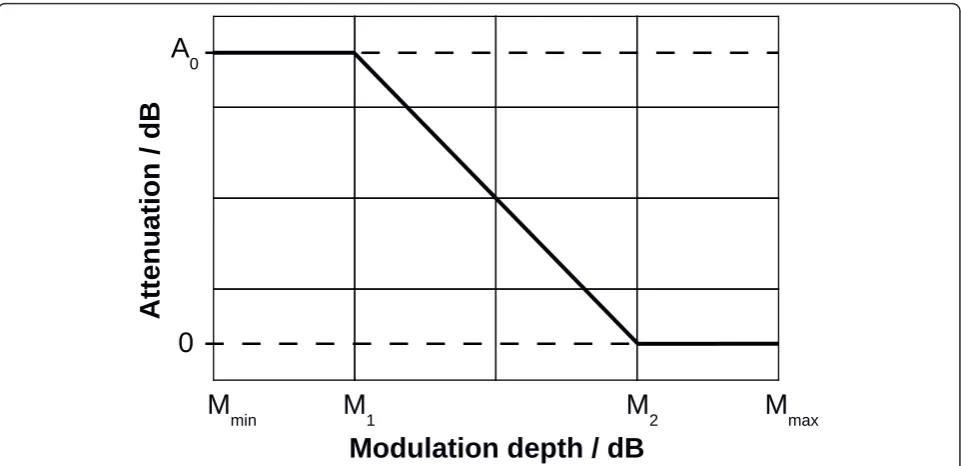
A hearing instrument should assist its user by amplifying sound with a certain gain, but can also cause discomfort in noisy environments. Therefore, its noise reduction subsystem should reduce the hearing instrument’s gain while noise is present - usually dependent on frequency in different subbands. To preserve speech understanding, the noise reduction should avoid gain reduction in those subbands that contain speech. Based on the observation that speech has a characteristic modulation spectrum [1], a modulation-based noise reduction should detect speech by its modulation [2], which is the fluctuation of a sub-band signal’s envelope over time. As a consequence, modulation-based noise reduction will reduce gain more strongly in a subband carrying unmodulated sound than in a subband with modulated sound [3], as it has been illustrated in Figure 1.
This article describes the verification of a noise reduc-tion subsystem within the fully integrated hearing instrument. By verification we mean the confirmation of
compliance with the specified requirements, here, by measurement. This means that the scope of this article is limited to the measurement of system responses rather than a clinical verification of the noise reduction functionality under test.
Measuring system responses with test signals is a typi-cal problem of system identification and has been solved with measurement techniques based on test signals that meet some typical requirements regarding their power spectrum and their amplitude distribution. Particularly, the minimization of peaks has been of interest with regard to the fact that practical systems have a limited dynamic range. However, the synthesis of test signals that allow enforcing a signal feature like modulation has only recently been proposed [4,5].
This article puts the synthesis techniques of prior work into the context of systematic verification, focusing the so-called coverage of the system’s input parameters. We show how to systematically design sets of test sig-nals that drive the system under test into a number of different states, allowing to confirm a complete verifica-tion of the subsystem of interest.
A process for achieving the systematic verification is needed. While processes targeted at test coverage have * Correspondence: [email protected]
Bernafon AG, Morgenstrasse 131, 3018 Bern, Switzerland JGL: EURASIP Member
been described for the verification of purely software-oriented systems (e.g., [6]) or simple signal processing systems like e.g., control units in automotive technology ([7,8]), there has not yet been such work for systems that should provide intense digital signal processing, like e.g., noise reduction subsystems in hearing instruments.
This article introduces test design techniques for sig-nal processing systems by combining existing test pro-cesses from the embedded systems domain with signal design techniques from system identification into a novel verification procedure. Its key concept is to obtain an abstract description of test sequences first, in order to derive concrete test signals in a second step. Since these will have to be synthetic in order to match the cri-teria defined by the test sequence, they are not suitable for testing the system under realistic conditions.
It is therefore a prerequisite for the procedure to have requirements toward the system under test stated in a technical, measurable way. A typical application is the regression testing in product development where the performance characteristics of the system under devel-opment are re-assessed after implementation changes. Typically, additional tests under realistic conditions (e.g., a clinical trial) are needed before a product can be released, but these are out of scope of the presented procedure.
We believe that the verification procedure is applic-able to different kinds of signal processing systems, because one of its essential parts-the abstract descrip-tion of test signals that can be implemented with
different synthesis techniques-is independent of the kind of application, but also because applications other than hearing instruments have to deal with subsystems simi-lar to a noise reduction, e.g., being based on signal fea-tures (like e.g., music classification for portable devices [9]) or having to adapt their processing based on infor-mation encoded in the signal (like e.g., voice activity-dependent transmission systems in telephony [10]). Therefore the procedure itself will be described inde-pendently of our application area, hearing instruments.
After introducing definitions of terms and concepts as well as the proposed verification procedure, the article will report experiments demonstrating the procedure with modulation-based noise reduction subsystems of hearing instruments. In contrast to previously reported measurements for verifying these [4,5,11,12], the ones presented here are based on a design for test coverage that is derived from the requirements toward the sub-system under test.
2 Definitions
2.1 Definitions related to signal processing
2.1.1 Signals
This section defines different kinds of signals to be used in measurements.
•A signal whose amplitude has only two discrete values is called abinary signal.
frequency range (see e.g., [13] for a more formal definition of a perfect sequence).
2.1.2 Frequency response measurements
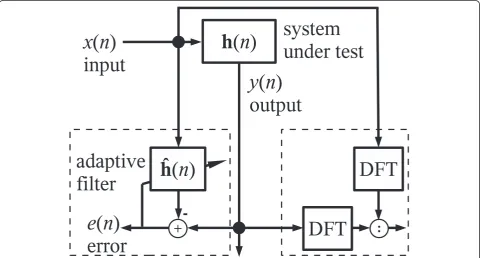
This section defines different ways of measuring fre-quency responses of the system or one of its subsystems. They are based on digital signal processing and thus assume that test stimuli and the output signal of the system under test are available as digital waveforms, as shown in Figure 2 where one digital waveform xenters the system under test and another one,y, is its output signal. For systems with analog transducers like hearing instruments, the signalsxand yhave to be interfaced to the system under test via a digital-to-analog and an ana-log-to-digital converter. This is omitted for simplicity in Figure 2.
NLMS-based measurementAs an improvement of the least mean squares (LMS) algorithm that has been intro-duced by Widrow and Hoff [14], Nagumo and Noda [15] have introduced thenormalized least mean squares (NLMS) algorithm. It iteratively approximates the impulse responseh(n) of the system under test with tap weight factors ĥ (n) of an adaptive filter whose fre-quency response can be used as an estimate of the sys-tem’s frequency response H(f).
DFT-based measurements Processing the signalsxand y with the Discrete Fourier Transform (DFT) can approximate the frequency response function H(f) of the systemh(n) [16,17]. For the specification of the detailed
computation, let the frequency bin number k of the DFT of one frame of signal xat discrete timen beXn (k). LetYn(k) be the according value of signaly. Then, the corresponding frequency bin Hn(k) of the approxi-mated frequency response is given by the equation below.
Hn(k) =
Yn(k)
Xn(k)
(1)
Differential measurements Observing the frequency response of one of a linear system’s subsystems is possi-ble bydifferential measurements[4], i.e., a combination of two separate measurements with an identical stimu-lus, once with the subsystem of interest activated and once having it deactivated. Dividing the frequency responses of both measurements can show the effect of the subsystem of interest on the frequency response of the whole system.
2.1.3 Modulation/modulation frequency
The modulation definition from the introduction was based on the signal envelope, which is often used in quantifying modulation (e.g., as the basis of the modula-tion spectrum like in [1]) and shall therefore also be used here as a basis of a first definition related to modu-lation: from the observation of signal envelope within one time frame let the observed minimum be the modu-lation valley, and let the maximum be the modulation peakaccordingly. We use mÎ [Mmin, Mmax] to denote
themodulation depthand define:
m/dB = 10·log10signal power at modulation peaks signal power at modulation valleys. (2)
This definition is a good basis for developing hearing instruments and is also valid for the samples used in the experimental part of this article; however, it is undefined if the denominator becomes zero, it relates to only one time frame and is furthermore dependent on time con-stants of envelope estimators and power estimators, which are usually not specified in the data sheet of a hearing instrument. For the construction of synthetic stimuli, we therefore propose another approach for defining the modulation depth: for a given subband with indexb, we define the corresponding modulation depth mbindirectly, by describing a reference signal that has this modulation depth. To describe this signal, we first need an auxiliary signal μbthat is fully modulated by a cosine term. It is given by the equation below.
μb(n,fm,b) =
2 3·
1 + cos
2πfm,b
fs
n+ϕb
·λb(n). (3)
Here,nis the sample index, fsis the sampling rate,fm,
bis the modulation frequencyin subbandb, andlbis a band-limited stationary signal with a constant envelope over time (which can in some cases only be approxi-mated, but is indeed achieved with the binary signals we will discuss later). Considerations on the signal’s band limits will follow further below.
Using the auxiliary signalμb, the reference signal,sb, can be constructed, as described by the equation below.
σb(n,fm,b) =ab·μb(n,fm,b) + (1−ab)·υb(n). (4)
Here, the signal νbis again a band-limited stationary signal with constant envelope and shall have the same RMS as the signallb, and the factorabis the link to the modulation depth via the following equation:
ab= ⎧ ⎨ ⎩1−10
− 1
20(mb/dB);mb<Mmax
1 ;mb=Mmax
(5)
2.2 Definitions related to verification
•Test coveragewould ideally describe the percentage of the system’s input or state parameter range used during tests. In the case of a signal processing sys-tem dealing with quasi-continuous signals, the range of possible input signals is dramatically large and has to be constrained to a moderate number of test sig-nals for practical testing. The selection of tests is here based on the hypothesis that one test signal from a certain class - an equivalence class - is
sufficient to test the whole class. This hypothesis shall be calleduniformity hypothesis [18] in the fol-lowing. Test coverage in the context of this article denotes the percentage of equivalence classes rather than the percentage of possible signals that is reached by the test. State space coverage is not considered.
•Atest step is a time interval during a test (defini-tion based on [8]).
•Atest sequenceis a composition of test steps that cover certain equivalence classes, optionally together with a specification of transitions between them. Note that for simplicity, this article does not distinguish between test sequences and test cases, as does [8].
3 Verification procedure
The procedure is applicable to signal processing systems that can be characterized by observing their output in dependency of systematically chosen input signals. The procedure has three steps to be described in the follow-ing sections:
1) Identifying the requirements against which to test 2) Designing tests
3) Performing tests
3.1 Identifying requirements against which to test Requirements engineering (e.g., [19]) typically ensures that testable requirements are available. However, this matter will not be covered here in more detail, because it is not actually relevant for this article how the requirements specification has been established. Here, it is important to have such a specification and, based on it, identify those requirements that are within the scope of the test.
3.2 Designing tests
3.2.1 Describing abstract test sequences with regard to test coverage
Test design should use a method that can ensure the desired test coverage. In the domain of signal processing systems, we propose the classification tree method for embedded systems (CT/ES) from [7,8]: the input domain of the system under test is partitioned into equivalence classes according to the original classifica-tion tree method from [20], then test sequences are defined in order to cover them with test steps that are abstract, i.e., independent of concrete test signals.
partitioning the system’s input domain. A main reason for this: we expect the main functionality of the signal processing systems targeted here to be a processing of input signals. The requirements thus have to specify how these input signals have to be processed and thus make statements about the system’s input domain.
The classification tree representation of equivalence classes, test sequences and test steps enables the assess-ment of test coverage and the further elaboration on the test, i.e., the verification of the test design and the synthesis of concrete stimuli that comply to it by cover-ing the correspondcover-ing equivalence classes of the sys-tem’s input space.
It may not be possible to have the classification tree method cover all system parameters specified by the requirements according to Sect. 3.1. Therefore the test designer should also identify those tests that are needed in addition to the ones from the identified test sequences in order to verify each requirement with at least one test.
3.2.2 Selecting the synthesis procedure for implementing the concrete test signals
This section discusses different stimuli from system identification and their use as a basis for synthesizing concrete test signals that match the abstract signal description as to the previous section. These signals should be designed for real systems whose usable signal range has its lower limit in a noise floor and its upper limit at a certain maximum level that is given by limited word lengths in the digital domain and/or limited ampli-tudes in the analog domain. Ideal stimuli would there-fore have a white power spectrum, such that the spectral components of the background noise are negli-gible compared to those of the stimulus at any fre-quency. To provide good signal-to-noise performance within the given level limitations, the peak factor [21] of the stimulus should also be small. Obviously, binary sig-nals have a minimum peak factor, but are reported to oppose challenges to some digital-to-analog converters [22] and cannot match every given power spectrum. Therefore, different kinds of signals will be considered in the following.
•Discrete-interval binary signals [23,24] result from algorithms that search a certain set of continuous-time binary signals for those ones whose power spectrum approximately matches a specified one. We define that a discrete-interval binary sequence (DIBS) is the discrete-time representation of a dis-crete-interval binary signal.
• Binary maximum length sequences (binary m-sequences) contain all possible sequences of storage initialization in a binary shift register of length L, except the initialization of all storages with zero
-resulting in a sequence length of 2L-1 [22]. For sys-tem identification they are usually synthesized with computer programs [25,26] rather than with shift registers. Binary m-sequences are perfect sequences and have a minimum peak factor.
•A periodicmulti-sine signal with a predefined dis-crete power spectrum can be obtained by adding sine waves of different frequencies. Their amplitudes result from the desired spectrum; phases, however, can be varied, e.g., for minimizing the signal’s peak factor [21,23,27,28]. Signal synthesis is most effi-ciently done using Fast Fourier Transform methods [29,30].
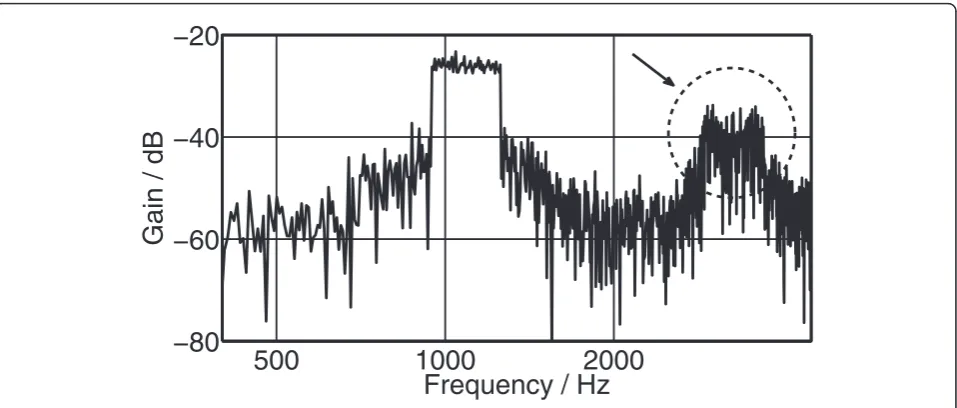
While DIBS are based on iterative approximation of the desired power spectrum, the synthesis of multi-sine sig-nals usually presets the amplitude spectrum and bases its optimizations on varying the phase. As a consequence, the synthesis of multi-sine signals usually reaches the desired power spectrum quite precisely, whereas DIBS can lack precision, particularly regarding the synthesis of band-limited signals. Figure 3 illustrates this in showing the spectrum level of a DIBS that has been synthesized according to the prescription of a band-limited white power spectrum in the band limits of a typical noise reduction subband around 1 kHz. The signal indeed has an approximately white power spectrum in this subband, but around 4 kHz there is a high amount of side-lobe energy, as indicated by the arrow in Figure 3.
Sect. 4.5 exemplarily demonstrates the different sti-muli that have been described with sample measure-ments. Their performance in these measurements will be discussed in Sect. 4.6. A more general discussion of stimuli can be found in the literature of system identifi-cation (e.g., [29]).
3.2.3 Selecting the measurement technique
There are different techniques for measuring the fre-quency responseH(f) of the system under test: for exam-ple, the measurement based on the adaptive LMS algorithm (Figure 2 bottom left) ofH(f) and the straight-forward computation of an estimate ofH(f) from the sig-nalsxandybased on the DFT (Figure 2 bottom right).
The impulse response of a system under test can be time varying and it may be desired to track the corre-sponding variations over time. The NLMS algorithm can achieve this under certain conditions and is there-fore a common choice in transfer function measure-ments (e.g., [13]).
is a multiple of the period length [29]. If this match of lengths is not possible, zero stuffing - the insertion of additional zeros into the DFT frame - can adjust the sig-nal frame to the DFT frame. It has been shown, how-ever, that this may reduce the measurement precision compared to a situation with matched lengths [32]. As a consequence, it shall be a prerequisite for all further considerations about DFT-based processing that the DFT window length matches the period length of the used stimulus. In case of signals whose length is not a power of two, this may mean that the Fast Fourier Transform algorithm cannot be used. Even in these cases, we expect the computation time to be sufficiently short, based on the assumption that measurement data will be post-processed with the computational power of a modern desktop computer.
Both LMS-based and DFT-based measurements ideally need stimuli with a white power spectrum. The DFT-based measurements only have optimum precision when used with periodic stimuli, whereas the LMS does not require periodicity of signals. The most important criter-ion for selecting the measurement approach is the time variance of the system under test: while LMS-based measurements can handle time variance under certain conditions, the DFT-based measurements only work with a time-invariant system. DFT-based measurements have the advantage that no convergence of an iterative algorithm is needed. This makes the measurement win-dow for a given frequency resolution small and thus the time resolution high.
3.3 Performing tests
How to perform the tests is dependent on the chosen test design. We can therefore not state a general flow of
activities for this part of the procedure. We rather use typical experiments to demonstrate the step of perform-ing tests. This will be done within the next section.
4 Measurements
This section demonstrates the application of the verifi-cation procedure in the hearing instrument domain, based on experiments with hearing instruments. The design of experiments is given by the proposed verifica-tion procedure. The device under test and the measure-ment setup will be presented in the following sections.
4.1 Device under test
In all experiments, the device under test was a hearing instrument with a modulation-based noise reduction subsystem. Most of the devices used for the experiments below were part of recent test plans at the Bernafon laboratories, allowing us to perform most of the shown experiments within the regular test plans of the labora-tory. As a consequence, different experiments have been performed with different hearing instrument models, because test plans do not necessarily foresee to sequen-tially perform all test cases with the same one. The noise reduction subsystems of the used hearing instru-ments were equivalent and thus satisfy the same requirements and design.
The requirements toward the noise reduction subsys-tem under test have been stated in Table 1, using“shall” clauses, which are a common practice in requirements engineering [19]. Table 1 identifies each of them with a unique code (ID) to be used for further reference in this article, but also to show the hierarchy of requirements (e.g., requirement 1.1.1 adds more detail to requirement 1.1). Literature references in the rightmost column of
500
1000
2000
−80
−60
−40
−20
Frequency / Hz
Gain / dB
Table 1 indicate sources of the information contained in the corresponding requirement.
The design of the investigated noise reduction subsys-tem is shown in Figure 4:
•The gray blocks compose a functional model of the noise reduction subsystem in the notation of the Simulink®software.
• The unfilled blocks indicate the IDs of require-ments from Table 1 that are fulfilled by the asso-ciated functional blocks.
The functionality of the noise reduction subsystem according to Figure 4 is explained in [3] and will only be briefly summarized here: The block“Filter” extracts subband contents of the input signal for each subband individually and feeds these into block“Compute modu-lation” to estimate modulation depths according to Equation 2. The block “Compute attenuation” deter-mines attenuation as a function of modulation depth
according to Figure 1. This attenuation will be applied in block “Apply attenuation” together with other attenuation in the system, which was zero for all experi-ments except the last one where it resulted from a tran-sient noise reduction system to be described later. The block“Synchronize” ensures that the signal in the lower signal path is delayed by the group delay of the upper path in order to ensure that the processing in block “Apply attenuation” will be based on correctly timed information.
4.2 Test setup
The setup for performing the designed test consisted of a combination of off-the-shelf hardware and software as well as customized computer programs. This section describes each of them.
4.2.1 Infrastructure for test design
An abstract description of test sequences was done using the tool CTE® [33,34] that supports the earlier-mentioned CT/ES method. The MATLAB® technical
Table 1 Requirements toward the noise reduction subsystem
ID Text Ref.
1 The noise reduction shall apply attenuation 1.1 Attenuation shall depend on modulation
1.1.1 The dependency between modulation depth (m) and attenuation (a) shall be as follows:
a dB=
⎧ ⎪ ⎪ ⎨ ⎪ ⎪ ⎩
A0 ;m≤M1
A0·
1− m−M1
M2−M1
;m∈]M1,M2[
0 ; else
(See Figure 1)
[3,12]
1.1.2 The noise reduction shall be sensitive to modulation frequencies in range [1-12 Hz] [1]
1.2 Attenuation shall be applied in individual subbands [3]
1.2.1 The crossover frequencies shall be { List of frequencies }
1.3 The attenuation by the noise reduction shall be superposed linearly with other attenuations in the system
computing environment was used to synthesize binary m-sequences according to [26]. One of its third-party toolboxes, the Frequency Domain Identification Toolbox (FDIDENT, [35]), was used for synthesizing discrete-interval binary sequences based on [23] and multi-sine signals according to [28].
4.2.2 Infrastructure for test execution
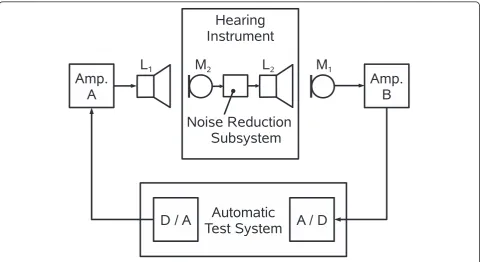
For all shown results, the test setup was the same: A test system was prepared for making measurements with synthetic test signals. Figure 5 illustrates the setup: The hearing instrument under test was located in an off-the-shelf acoustic measurement box with a loudspea-ker (L1) for presenting test stimuli to be picked up by
the hearing instrument’s input transducer (M2). The
hearing instrument’s output transducer (L2) was coupled
with a measurement microphone (M1) so tightly that
environment sounds can be neglected in comparison to the hearing instrument’s output. The coupler is a cavity that mimics the human ear canal. Here, we used a so-called 2cc-coupler.
Note that the described test setup differs from the usual condition in which a hearing instrument is worn, because the effect of the human head on the sound field from the sound source is not taken into account. The acoustic effect of the human head in wearing the hear-ing instrument has thus been neglected here, but it could easily be modeled by putting the hearing instru-ment under test on an artificial head within the test box.
The test system [36] was implemented using a National Instruments PXI™system running customized computer programs based on National Instruments Lab-VIEW. The test system was equipped with a NI-PXI 4461 analog input/output card that can play test signals originating from a hard disk, where they have been stored after creating them with the MATLAB®technical computing environment. The signals were presented via a digital-to-analog converter (D/A) of the input/output card, an audio amplifier (Amp. A) and the loudspeaker of the measurement box (L1), while recording the
hear-ing instrument’s output via the measurement micro-phone (M1), a microphone pre-amplifier (Amp. B) and
an analog-to-digital converter (A/D) of the input/output card.
The recorded digital data were stored in a file on a hard disk that could be read by the MATLAB®technical computing environment for further processing. The sampling rate for both playing and recording signals was set to 22,050 Hz. The test system ensured synchronous playback and recording.
4.3 Test design
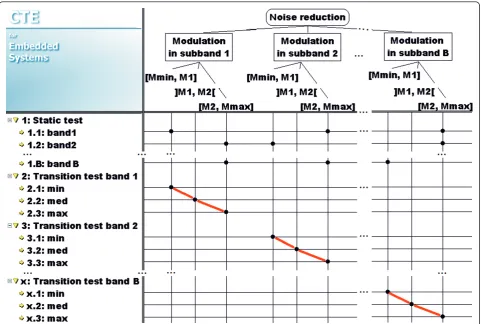
Testing a modulation-based noise reduction system should observe attenuation in different subbands as a function of modulation. Figure 6 uses the CT/ES meth-od’s proposed graphical notation of classification trees to show the partitioning of hearing instrument input
signals into equivalence classes as a basis for testing a multi-band noise reduction system with modulation-dependency:
• Input parameters (symbolized by rectangles) are the modulation depths (brief: modulations) in the different subbands, based on requirement 1.1 and 1.2 in Table 1.
• Equivalence classes (symbolized by range expres-sions in square brackets) have been derived from requirement 1.1.1 in Table 1.
• Test sequences ("1”, “2”, “3”,...) and test steps ("1.1”, “1.2”,...) are denoted by short verbal descrip-tions in the column on the left.
• Filled circles on the grid show that a test step should cover a certain equivalence class.
• A diagonal straight line between two circles denotes a gradual transition of the used test signal between different equivalence classes.
The circles and their connection lines in Figure 6 are an abstract description of test signals that should be
suited for verifying most multi-band modulation-based noise reduction systems.
Figure 6 shows two kinds of test sequences: On the one hand, a static test (1) that covers the extreme modulation classes of very low and very high modulation for all sub-bands, and on the other hand dynamic tests (2 tox, one per subband) that gradually vary modulation within the intermediate modulation range ]M1,M2[. Together, these
test sequences achieve sufficient test coverage: since all equivalence classes have at least one circle vertically below them, all equivalence classes are covered by tests.
The abstract test description from Figure 6 should now be mapped to concrete test signals that are used for frequency response measurements based on a suitable measurement technique. Although NLMS-based measure-ments are a common way of measuring acoustic frequency responses (e.g., [13]), we chose DFT-based measurements, because of the possibility to achieve high time resolution, which were required in one of the experiments. As a con-sequence, test signals had to be periodic.
concentrated in the frequency range of interest, and the most simple assumption is that it should approximate band-limited white noise. Some synthesis algorithms require the absolute values of Fourier coefficients of the signal as an input. If the desired period length in sam-ples isN, and frequency range of interest is fromf1tof2
(wheref1 > 0 andf2≥f1+N-1·fs) and the desired RMS of
the synthesized signal isr, then the target values for the synthesis algorithm are given by the following absolute values of Fourier coefficients c−
k (based on [4]):
c− k = ⎧ ⎪ ⎪ ⎪ ⎪ ⎪ ⎪ ⎪ ⎨ ⎪ ⎪ ⎪ ⎪ ⎪ ⎪ ⎪ ⎩ r 2
N·f2
fs
−
N·f1
fs
+ 1
; N·f
1
fs
≤ |k| ≤
N·f
2
fs
0 else
. (6)
Since system tests will acoustically stimulate the sys-tem under test, we would theoretically have to describe acoustic signals here, which are in continuous time. However, since the native format of the given test sys-tem is a digital waveform, we describe signals in discrete time. All stated sampling rates refer to the test system, not to the system under test.
Let Bbe the number of subbands, and let the lower and upper crossover frequency of subband numberb be fc,band fc, b+1respectively. Furthermore, let the signalsb be the reference signal from Equation 4. The signals in that equation shall be constructed as follows: the signal νbshall have a Fourier spectrum that approximates the one from Equation 6 with f1 = fc,b and f2 =fc,b+1. The
signal μbbe the one from Equation 3 where the signal
lbis synthesized the same way asνb, but withf1=fc,b+ fm,band f2 =fc,b+1 - fm,b[4]. Then, the following equa-tion defines a test signalθbthat has configurable modu-lation in subband numberb and maximum modulation in the other subbands:
θb(n)=σb
n,fm,b
+
i∈({1,2,...B}\{b})
μi
n,fm,i
. (7)
The parameterbon which the above signal depends via Equation 3 was left variable to allow for experiment-ing with different values of it.
The test steps from Figure 6 never require more than one subband at a time to have a modulation outside the range [M2,Mmax]. Using only maximum modulation to
cover the equivalence class of that range, one can use the signalθbfrom Equation 7 to establish all test steps from Figure 6, if a suitable modulation of signalsbis chosen in the one subband whose modulation falls into another equivalence class (note that for each test step in Figure 6, there is maximum one definition of such a subband).
So far, the described stimuli therefore cover all requirements from Table 1, except number 1.1.2, 1.2.1
and 1.3. These requirements can be covered with a sim-ple measurement approach that does not require an abstract test design. This will be demonstrated in Sect. 4.5.
4.4 Test procedure
For all experiments, the gain in the hearing instrument under test was set 20 dB below the maximum offered value to reduce non-linearities. Unless stated differently, all adaptive features of the hearing instrument, apart from noise reduction, were turned off for all test runs. The hearing instrument was furthermore configured for linear amplification, this means that there was no dynamic range compression.
Before each experiment, the test system was calibrated using built-in functionality, in order to ensure that transfer characteristics of all equipment in the signal path, particularly the acoustic transducers, were com-pensated in the digital signal processing of the test sys-tem. This ensured that the power spectra encoded in audio files of the input and output signals were equiva-lent to the acoustic power spectra at the input and out-put transducers of the device under test.
According to the earlier-mentioned differential mea-surement approach, two DFT-based meamea-surements were performed per stimulus: first with the noise reduction subsystem of the hearing instrument switched off, and second while having it switched on.
Only the output-related DFT spectra Yk(on)(n) of the system with noise reduction enabled and Yk(off)(n) of the system with noise reduction disabled were recorded to compute the noise reduction s transfer function
H(subsystem)k by the following equation that results from the definition of the differential measurement in Sect. 2.1.2, from Equation 1 and from the fact that the input signal was the same for both measurements:
Hk(subsystem)(n) = y
(on)
k (n)
Yk(off)(n)
(8)
In using the above equation, measurement samples
Yk(off)(n) = 0 would have been treated as invalid samples and discarded from the result to avoid division by zero, though in practice, such samples did not occur during the experiments that were made.
4.5 Experiments
4.5.1 Verification of crossover frequencies
reduction subsystem’s subbands. We separately defined a signal used for driving the noise reduction subsystem into a desired state and one used for measuring the sys-tem’s frequency response, which in combination -yielded the test signal according to the equation below.
s(n) =
⎧ ⎨ ⎩a·sin
2πf0
fs
n
+b·
1 + cos
2πfm
fs
n
·p(n) ;n
fs
≤T
p(n) ; else
. (9)
The signal pwas chosen to be a periodically repeated binary m-sequence of 1,023 samples period length, and the timeT that passes between the start of the measure-ment and the application of the signalpwas set to 40s. The inherent assumption of this procedure is: after time T the noise reduction subsystem has settled to steady state and maintains it while the signal s continues, such that a frequency response can be measured, based on the stimulus p. The signal applied before timeT con-tains a pure tone to stimulate the noise reduction sub-band around frequency f0, added to a modulated signal
that is constructed in a way similar to Equation 3. Based on empirical investigation of the procedure, the para-meters a and b were chosen such that the pure tone’s level was 15 dB higher than the level of the remaining signal components before time T, in order to make the unmodulated signal the dominant stimulus around fre-quency f0. The modulation frequency was set to fm =
4Hz, because this is the frequency at which the modula-tion spectrum of speech has its peak [1].
The frequency f0 was varied stepwise within the
band-width of the system under test. The step band-width was cho-sen between 40 and 250Hz, depending on the bandwidth of the noise reduction subbands in the given frequency region.
For each measurement, the signal p(n) was the input signal of the system under test between time T and the end of the measurement, allowing for frequency response measurements. Differential DFT-based mea-surements were performed to obtain the frequency response of the noise reduction subsystem immediately after time T. Averaging of the data resulting from three subsequent periods of the measurement stimulus was used for obtaining a smoothed frequency response [37]. The measured frequency responses were post-processed by a human observer: it was necessary to discard duplicate responses of the same subband as well as invalid measurements that were caused by f0
inbetween two sub-bands triggering the noise reduc-tion subsystem in both of them. Afterward, the obser-ver could determine crossoobser-ver frequencies by graphically intersecting the frequency responses of two adjacent subbands.
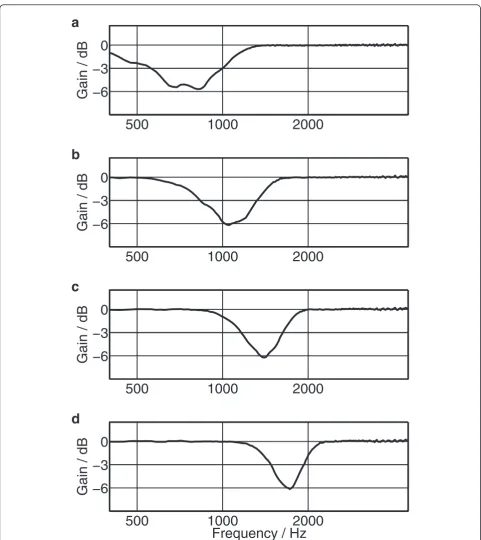
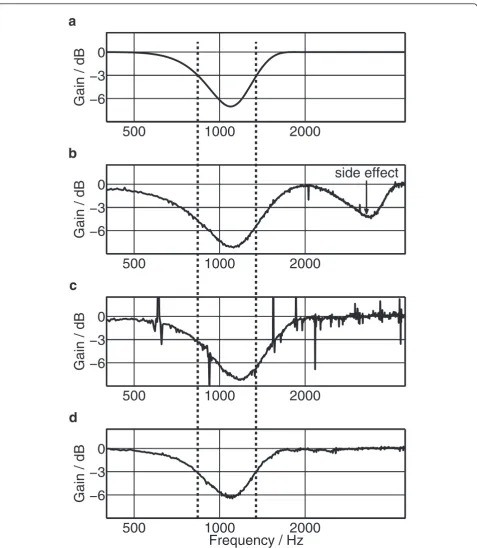
Figure 7 shows some examples of the responses that were measured. Subfigures a and b show cases in which
more than one noise reduction subband was triggered by the pure tone of frequency f0. The frequency
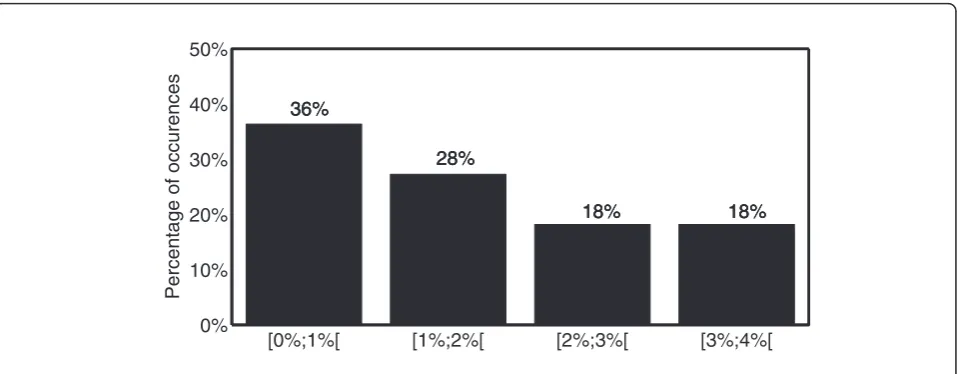
responses of such cases all had the shown characteristic shape for the given noise reduction subsystem, allowing the observer to identify such measurements and ignore them. Figure 7c, d are examples of valid measurements: the intersection of their graphs would show that the sys-tem under test has a crossover frequency at approxi-mately 1,550 Hz. To result in a passed test, the set of all obtained frequencies was verified to match specified cor-ner frequencies of the noise reduction sub-bands within a specified tolerance. Figure 8 shows how the absolute value of the difference between the specified and the measured crossover frequency was distributed over ele-ven valid measurements from the giele-ven experiment with an error-free system under test. The distribution shows that a typical 10% tolerance band would have resulted in a passed test, but even a 5% tolerance band would have been possible in the given case.
4.5.2 Verification of the frequency response for a static modulation pattern
This section describes the“static test” according to Fig-ure 6, that means a measFig-urement performed with a sig-nal composed of strongly modulated sigsig-nals with a modulation depth in range [M2;Mmax] in all subbands
except one - subband numberb, in which the modula-tion is in the range [Mmin; M1]. Based on Sect. 4.3, the
signal θb from Equation 7 was used as the test signal. The system of equations formed by Equations 7, 3 and 4 was used as the basis for signal synthesis, and the parameters of these equations were set to ab= 0 (thus choosingMmin= 0 as the modulation depth for subband
number b) and fm = 5.4 Hz [4]. The remaining para-meterbwas varied between the different subbands and between the different measurements between different empirically found values. The signals lband νbin the resulting equation were synthesized with a level of 70 dB SPL and a period length of 4,096 samples either as multi-sine signals or as signals of type DIBS. Table 2 lists the measurements that were performed and the corresponding choice of parameter b and the signal type of the mentioned signals.
For each measurement, the test stimulus was pre-sented during at least 15 s. Differential measurements of the noise reduction subsystem’s frequency response were made, averaging five DFT windows. These win-dows were taken from the last 5 s of the test run in order to observe the steady-state condition.
corner frequencies of the simulated subband b have been indicated with dashed lines.
Observations: From the measured responses, only the one of Figure 9d has the correct subband attenuation in
the sense that it produces the expected 3 dB corner fre-quencies. Furthermore, Figure 9b shows a side effect, the attenuation in a subband not adjacent to subband number b (as indicated with an arrow on the figure).
500
1000
2000
−6
−3
0
a
Gain / dB
500
1000
2000
−6
−3
0
b
Gain / dB
500
1000
2000
−6
−3
0
c
Gain / dB
500
1000
2000
−6
−3
0
d
Frequency / Hz
Gain / dB
Figure 7Determining crossover frequencies of the noise reduction subsystem: (a)f0= 750 Hz, (b)f0= 1,000 Hz, (c)f0= 1,480 Hz, (d)f0=
4.5.3 Investigation of the side effect in the DIBS-based measurement
Measurement data from different runs of measurement number 1 according to Table 2 with different hearing instruments were analyzed in order to investigate the side effect according to Figure 9b. The hearing instru-ments had been set to different noise reduction config-urations during the measurements. The measurement data were subdivided according to the sensitivity to unmodulated noise of the used noise reduction config-uration. The higher the configured first knee point“M1“
according to Figure 1, the more sensitivity to unmodu-lated noise was assumed in the classification. As a result, three classes were obtained: a“Low”class for low sensi-tivity, a “Med” class for medium sensitivity, and a “High” class for high sensitivity.
The data from different runs of the “static test” according to Figure 6 were plotted in graphs like the ones of Figure 9, and these were inspected visually. For each graph, the observer counted frequency bands not adjacent to subbandbwhose peak attenuation was more than 1 dB, thus bands with the side effect according to Figure 9b. The counted value was divided by the total number of subbandsB, and the result was multiplied by 100, resulting in a percentage of subbands with the side
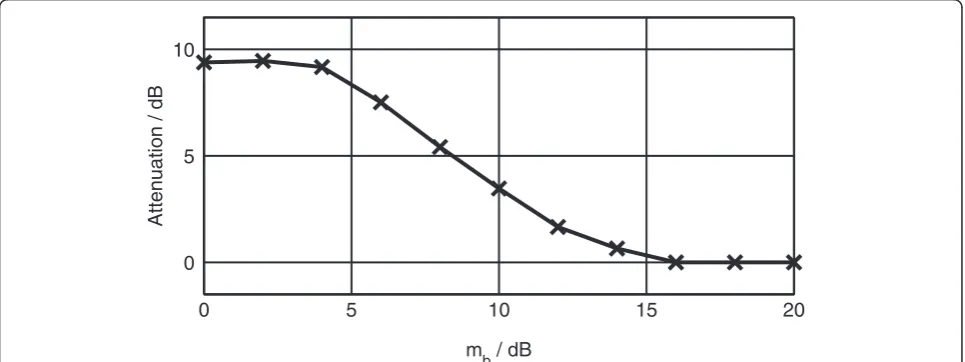
effect per hearing instrument per class of sensitivity to unmodulated noise. The results of this analysis are given in Table 3 for five sample hearing instruments that were known to have correctly operating noise reduction sub-systems from other verification activities not in the scope of this article. It can be observed that the percen-tage of side effects increases from the“Low”class to the “High” class for every observed hearing instrument. 4.5.4 Verification of attenuation with varying modulation Attenuation function measurements are needed to cover the“transition tests”according to Figure 6. They should characterize a modulation-based noise reduction system by measuring its typical performance characteristic according to Figure 1. Modulation depth can be varied by changing parameterabin Equation 4. This was done by varying parametermbin Equation 5 from 0 dB to 20 dB in steps of 2 dB. A test signal θ˜b was constructed as a modified version of signalθbfrom Equation 7 and was used for the measurements. One modification (accord-ing to [4]) was to choose a sum index range of ({1, 2,... B}\{b - 1,b, b+ 1}) instead of ({1, 2,... B}\{b}). The sub-bands that had been removed from the sum index range were instead targeted with signals of variable modula-tion according to Equamodula-tion 4. The modificamodula-tion should ensure that the stimulus of variable modulation spanned [0%;1%[ [1%;2%[ [2%;3%[ [3%;4%[
0% 10% 20% 30% 40% 50%
Relative deviation of measured frequency from specified frequency
Percentage of occurences
36%
28%
18% 18%
36%
28%
18% 18%
36%
28%
18% 18%
Figure 8Measured versus specified crossover frequencies.
Table 2 Parametrization of measurements
Measurement number Choice of parameterias a function of subband numberb Type of signallbandνb
1 ∀i:i= 0 DIBS
2 ∀i:i=0 multi-sine
3
ϕi= π
2 ;i=b 0 ;i=b
more than one subband of the noise reduction subsys-tem under test, thus making the procedure invariant to non-ideal subband split. The mentioned changes are consistent with the test design (Figure 6), whose
“transition test”sequences do not constrain the modula-tion of any subband except the one with the specified variation of modulation depth. Another modification of signalθbin constructing signal θ˜b was to filter out side
500
1000
2000
−6
−3
0
d
Frequency / Hz
Gain / dB
500
1000
2000
−6
−3
0
c
Gain / dB
500
1000
2000
−6
−3
0
b
Gain / dB
500
1000
2000
−6
−3
0
a
Gain / dB
side effect
lobe influences from the subband of interest [4]: if sub-band number bis this subband, then one can eliminate the influences from other subbands by using a band-stop filter whose band limits are outside of subband numberb(here, we chose each of them in the middle of one subband adjacent to b). Let h be the impulse response of such a band-stop filter and let “*” be the convolution operator. Then, θ˜b can be constructed according to the equation below.
˜
θb(n) =σ˜b(n) +h(n)∗
i∈({1,2,...B}\{b−1,b,b+1})
μi(n,fm,i).(10)
Here an auxiliary signal σ˜b was used according to the
following definition:
˜ σb(n) =
⎧ ⎨ ⎩
σb(n) +σb+1(n) ;b= 1 σb−1(n) +σb(n) ;b=B
σb−1(n) +σb(n) +σb+1(n) ; else
. (11)
The measurement parameters were set like for mea-surement number 1 from Table 2. For each measure-ment, the first test signal was presented during at least 15 s. Then, modulation was varied stepwise, as described above, and for each step, the test signal was presented long enough to measure in steady-state. Differential
measurements were made, averaging five DFT windows from the last 5 s of each measurement signal. Attenua-tion as a funcAttenua-tion of modulaAttenua-tion was extracted from the measurement data, following a procedure that is given in [4], which extracts the effective attenuation of sub-band numberb from the measured frequency responses. The obtained result is shown in Figure 10. The test is passed, because the figure shows that indeed the attenuation as a function of modulation depth is approximately as shown in Figure 1.
4.5.5 Verification of the superposition with transient noise reduction attenuation
Transient noise reduction systems target a special kind of noise that has been reported to be one reason for annoyance among hearing instrument users [38,39]: non-speech transient noises, i.e., signals with a fast change of level over time.
Since transient noise reduction systems should act in addition to traditional noise reduction, they are a good example for the superposition of additional attenuation according to requirement 1.3 from Table 1.
This section proposes a test that addresses the stated requirement. Since the scope of this article is limited to steady-state responses of modulation-based noise reduc-tion subsystems, we will not cover the verificareduc-tion of a
Table 3 Side effects in dependency of modulation sensitivity
Hearing instrument Percentage of subbands with side effect
in“Low”class (%) in“Med”class (%) in“High”class (%)
1 0 0 47
2 0 7 60
3 0 0 60
4 0 7 67
5 0 20 80
0 5 10 15 20
0 5 10
m b / dB
Attenuation / dB
transient noise reduction subsystem here. Rather, we show how to test that the traditional noise reduction subsystem has maintained its steady-state performance after a short intervention of a superposed transient noise reduction subsystem.
The challenge here is to insert a transient event into the test stimulus, but still enabling the observation of the fre-quency response. Although the given test case looks like a good application area for time-frequency approaches like wavelets, we have chosen to stay with the verification tech-niques that have been presented so far, because we con-sider the typical mutual exclusion of precise time resolution and precise frequency resolution in time-fre-quency techniques as a problem for the given test case.
The approach we propose here operates with absolute amplitude measurements in the time before and during a transient noise reduction interaction, and switches to a dif-ferential frequency response measurement right afterward. The test signalsis proposed in the equation below.
s(n) =
⎧ ⎪ ⎪ ⎪ ⎨ ⎪ ⎪ ⎪ ⎩
a·sine(n) +b·
1 + cos
2πfm
fs
n
·p(n) ;n
fs<
T1
c·sine(n) ;n
fs∈
[T1;T2]
p(n) ;else
. (12)
Here sine(n) = sin
2πf0
fs
n
; p is a periodically
repeated, 1,023 samples binary m-sequence of 70 dB SPL,nis the sample index,fsis the sampling rate,f0 is
the frequency of the stimulating sine (here:f0 = 1, 094
Hz), andfmis the modulation frequency for modulating the background noise,a and b were chosen such that the level of a· sine (n) was 65 dB SPL and was 15 dB
higher than the level of b·
1 + cos
2πfm
fs
n
·p(n). The modulation frequency was set tofm= 4 Hz, as ear-lier. The coefficient cwas chosen such that the corre-sponding sine signal had a level of 90 dB SPL. Furthermore, T1 = 40.0s;T2 = 40.1s, and the total
sti-mulus duration was 42.1 s.
The stimulussfrom Equation 12 uses a sine signal as a basis for stimulating both the noise reduction subsystem as well as the transient noise reduction subsystem: while a steady-state presentation of the sine signal would be sufficient for triggering the noise reduction, the dramatic change of the sine amplitude at timeT1is required to
trigger the transient noise reduction. One should note that sine-based signals would not necessarily be the opti-mum stimuli in testing transient noise reduction systems alone. In this case, however, the sine signal was chosen in order to make mainly the behavior of the modulation-based noise reduction subsystem predictable.
A sample hearing instrument with a modulation-based noise reduction subsystem and a transient noise
reduction subsystem was used for measurements based on the stimuluss from Equation 12. Differential DFT-based frequency response measurements were per-formed during the time afterT2. They were differential
in the sense that both noise reduction and transient noise reduction were disabled for the“off”measurement and were enabled for the“on” measurement.
The result of the measurement is shown in Figure 11: The top diagram shows the differential frequency response obtained in the time after T2. It shows the
steady-state frequency response of the noise reduction subsystem under test as a result of the stimulation with a pure tone of 1,094 Hz. The bottom sub-figure shows the time domain plot of the system under test’s output signal (acquired in a non-differential measurement). It captures the transient noise reduction event. It allows the tester to verify if the attenuation by the transient noise reduction was correctly superposed with the pre-sent steady-state noise reduction response. The attenua-tion of the transient noise reducattenua-tion subsystem is evident from the shape of the signal in the bottom sub-figure: while the input signal of the system under test has a sudden change in level at 40 s according to the above definition ofT1 in Equation 12, the output signal
has a smooth transition between the two levels, as a consequence of the transient noise reduction subsys-tem’s operation.
The tester can verify that the noise reduction subsys-tem’s response in the top subfigure equals the expected steady-state response. The tester can also verify that the envelope of the signal in the bottom subfigure is attenu-ated compared to cases with an inactive noise reduction subsystem. The additional amount of attenuation shall be exactly the steady-state attenuation of the noise reduction subsystem to pass the test of correct superpo-sition of both subsystems.
4.6 Discussion
The verification of isolated requirements like the sub-bands’ crossover frequencies or the superposition of noise reduction effect with effects of other subsystems could successfully be demonstrated. The core require-ments about the modulation-based behavior of the noise reduction subsystem, however, lead to measurements exposing side effects or imprecise results, like shown in Figure 9. Therefore, the results shown in that figure need to be discussed further.
seen that the side effect occurs in the same region where the unwanted side lobe in the power spectrum of the DIBS stimulus is present. An explanation for the side effect is that the unmodulated side lobe energy of the stimulus targeted at subbandb enters the subband that spans the frequencies at which the side effect can be observed. Since the stimulus targeted at these fre-quencies is unmodulated, the side-lobe energy can make the effective signal in that subband less modulated: it disturbs the modulation pattern. According to this the-ory, particularly noise reduction subsystems configured to have a high sensitivity to unmodulated noise would apply attenuation in the subband corresponding to the frequency range of the side lobe energy, which is consis-tent with the observations reported in Table 3.
Also Figure 9c shows a deviation of the measured fre-quency response from the expected response: at the upper 3 dB corner frequency of the subband of interest, the system applies more than 3 dB attenuation. Our the-ory for explaining this effect was derived from the spec-trogram [40] of the used multi-sine-based measurement signal θb with ∀i: i = 0, as shown in Figure 12. The darker the plot area, the more energy is present. The black stripe-like patterns in Figure 12 show that the energy in subbandb moves up and down in frequency similar to a chirp, where“predominantly one frequency [is] followed in time by another” [27].
The two white areas in the middle of Figure 12 display a modulation valley; this means a part of the signal in
which the cosine in Equation 3 is close to -1. During a modulation valley in subbands other than b, the chirp-like signal of subband bhas most of its energy close to its upper band limit. Our theory is that this disturbs the modulation pattern of subbandb+1 via non-idealities of band split filters in the noise reduction subsystem under test, and, in consequence, leads to application of unde-sirable attenuation in subbandb+ 1.
In the measurement according to Figure 9d, the phase shift∀i≠b:i=π/2 in the modulating cosine has moved the modulation valley to a point in time at which most energy in each subband is present close to the subband’s center frequency. This means that, during a modulation valley in most of the subbands, the unmodulated energy of subbandbis not dense close to this subband’s corner fre-quencies, where it could have an impact on other sub-bands. Our theory is that the unmodulated signal in subbandbcannot disturb the other subbands’modulation patterns withi=π/2, because at points in time at which the energy in subbandbcan have an impact on other sub-bands, these now have modulation peaks, which are only affected in a negligible way if additional energy enters the subband. This can explain why the measurement result according to Figure 9d is closest to the expected response of the subsystem under test, as shown in Figure 9a.
5 Limitations
In order to scope the application range of the presented work, this section discusses the limitations of both the
500 1000 1500 2000 2500 3000 3500 4000 4500
−10 −5 0
Differential response of the noise reduction after stimulation with 1094 Hz
Frequency / Hz
Gain / dB
39.98 40 40.02 40.04 40.06 40.08 40.1
−2 0 2
x 10−3
Transient noise reduction reaction at 1094 Hz
time / seconds
amplitude (linear)
general procedure that has been proposed and the con-crete techniques for stimulus-based measurement we demonstrated in the application to noise reduction sub-systems of hearing instruments.
5.1 Limitations of the procedure
5.1.1 Limitations of the scope
The presented procedure targets those kinds of signal processing systems whose processing functionality is based on input signals. This means that systems without signal inputs cannot be verified based on the procedure. This would for example disqualify a system for speech synthesis based on text files as a candidate for applying the procedure.
Since the procedure is based on synthetic stimuli, it cannot assess the performance of the system under test in realistic conditions. Therefore it can only be used in monitoring the technical performance of the system, but cannot be used in determining how well the system ful-fills user needs.
The application range of synthesized test signals is in general limited to the one system the stimuli have been targeted at, because the procedure does not address the effect of implementation changes in the system under test on the measurement results obtained with the syn-thetic stimuli. This means that the validity of test signals has to be re-assessed on product improvements affecting one or more of the subsystems that contribute to the processing of the test signals in the system under test. 5.1.2 Limitations of the concept
The procedure is based on the uniformity hypothesis and can therefore only produce valid test results if the partitioning of the system’s input domain into equiva-lence classes holds. Especially for systems with highly non-monotonic input-output relationships we expect difficulty in finding suitable equivalence classes.
The procedure also does not guarantee to find test signals for every given system, because it cannot
automatically derive test signals from system specifica-tions, meaning that the equations for signal synthesis have to be invented by the test designer.
5.2 Limitations of the demonstrated synthesis and measurement techniques
5.2.1 Limitations of the scope
As mentioned in the introduction, the presented proce-dure cannot replace clinical trials of a noise reduction subsystem in a hearing instrument. Whereas the proce-dure is generic enough to support various noise reduc-tion algorithms, the exemplarily demonstrated test signals are based on a modulation frequency of 4 or 5.4 Hz, and are thus only suitable for testing noise reduc-tion algorithms with time constants much greater than 250 or 190 ms, respectively. Furthermore, the used mea-surement procedure assumes a system that is time-invariant or has at least reached a steady-state condition in which it behaves like a time-invariant system. The exemplarily demonstrated tests are thus inappropriate for time varying systems.
5.2.2 Limitations of the concept
Adaptive features other than the one under test may need to be turned off during the measurement, because it is difficult or even impossible to find stimuli that keep all other subsystems in steady-state as a reaction to the stimuli.
Furthermore, the synthesis of test signals is dependent on the design. For example, if crossover frequencies of the demonstrated noise reduction subsystem would change in the course of product innovation, then test signals would need to be re-synthesized, based on the new set of crossover frequencies.
6 Conclusion and outlook
The procedure is based on identifying requirements toward the system under test and verifying if they have been met. A main goal is test coverage regarding the input parameters of the system under test. Where achieving test coverage is non-trivial, the procedure foresees the separate steps of first describing abstract test sequences in terms of equivalence classes of input parameters to be covered, and secondly synthesizing concrete measurement stimuli to be used with a particu-lar measurement technique.
The procedure has been explored using the stimulus-based verification of modulation-stimulus-based noise reduction subsystems in hearing instrument as a sample applica-tion. All requirements that had been stated for the sam-ple subsystem could be covered with a test.
The comparison of different stimuli showed that some stimuli are more exposed to producing side effects in certain tests than others. For example, it can be con-cluded from the results that multi-sine synthesis proce-dures are a good basis for the synthesis of stimuli, if their chirp-like nature is accounted for in test signal design. On the other hand it can be concluded that DIBS-based stimuli can produce side effects if they are used for narrow-band synthesis.
Test signal synthesis was based on the assumption that the noise reduction subsystem under test maintains its steady-state on the one hand during the stimulation with a modulated signal of 4 or 5.4Hz modulation fre-quency and on the other hand after the stimulation with a pure tone that is replaced by a different signal during the actual measurement. This assumption holds for slow noise reduction subsystems, but certainly not for all known noise reduction concepts.
Even though the proposed verification procedure may require new design of stimuli on implementation changes, its abstract way of describing tests provides flex-ibility with regard to changing assumptions: if the synthe-sized stimuli or the chosen measurement technique are no longer suited for a given noise reduction technology (e.g., because it does not provide sufficient linearity or time-invariance), then the test design can still be used, and only the choice of stimuli and/or measurement tech-nique has to be reconsidered. For example, NLMS-based measurements can be considered if the system under test is time-variant or too non-linear for the application of the DFT-based measurements we explored here.
8 Competing interests
The authors declare that they have no competing interests.
7 Acknowledgements
The authors would like to thank Mr. Miquel Sans, Bernafon AG, for contributing his knowledge and some indispensable ideas to the verification
techniques related to transient noise reduction systems. They also would like to thank The MathWorks, Inc. for supporting their work on this article.
Received: 30 January 2011 Accepted: 10 November 2011 Published: 10 November 2011
References
1. I Holube, V Hamacher, M Wesselkamp, Hearing instruments–noise reduction strategies, inProceedings 18th Danavox Symposium: Auditory Models and Non-linear Hearing Instruments, Kolding, Denmark, pp. 359–377 (1999) 2. V Hamacher, J Chalupper, J Eggers, E Fischer, U Kornagel, H Puder, U Rass,
Signal processing in high-end hearing aids: state of the art, challenges, and future trends. EURASIP J Appl Signal Process, 18: 2915–2929 (2005) 3. A Schaub,Digital Hearing Aids(Thieme Medical Publishers, New York, 2008) 4. JG Lamm, AK Berg, CG Glück, Synthetic stimuli for the steady-state
verification of modulation-based noise reduction systems. EURASIP J Adv Signal Process.2009(2009)
5. JG Lamm, AK Berg, CG Glück, Synthetic signals for verifying noise reduction systems in digital hearing instruments, inEUSIPCO 2008: Proceedings of the 16th European Signal Processing Conference, Lausanne, Switzerland (2008) 6. DJ Richardson, LA Clarke, A partition analysis method to increase program
reliability, inProceedings of the 5th International Conference on Software Engineering, IEEE, San Diego, pp. 244–253 (1981)
7. M Conrad, Systematic testing of embedded automotive software–the classification-tree method for embedded systems (CTM/ES), inPerspectives of Model-Based Testing, ser Dagstuhl Seminar Proceedings, ed. by E Brinksma, W Grieskamp, J Tretmans (Schloss Dagstuhl, Germany, 2005) http://drops. dagstuhl.de/opus/volltexte/2005/325. no 04371 (Dagstuhl, Germany): Internationales Begegnungs- und Forschungszentrum für Infor-matik (IBFI) [Online]
8. M Conrad,Modell-basierter Test eingebetteter Software im Automobil, PhD thesis (TU Berlin, Deutscher Universitätsverlag, 2004)
9. H Blume, M Haller, M Botteck, W Theimer, Perceptual feature based music classification–a DSP perspective for a new type of application. in
International Conference on Embedded Computer Systems: Architectures, Modeling, and Simulation, 2008. SAMOS 200892–99 (2008)
10. HW Gierlich, New measurement methods for determining the transfer characteristics of telephone terminal equipment, inProceedings IEEE International Symposium on Circuits and Systems, San Diego, pp. 2069–2072 (1992)
11. AE Hoetink, L Körössi, WA Dreschler, Classification of steady-state gain reduction produced by amplitude modulation based noise reduction in digital hearing aids. Int J Audiol.48, 444–455 (2009). doi:10.1080/ 14992020902725539
12. R Bentler, LK Chiou, Digital noise reduction: an overview. Trends Amplif.
10(2), 67–82 (2006)
13. C Antweiler, M Antweiler, System identification with perfect sequences based on the NLMS algorithm. Int J Electron Commun.49(3), 129–134 (1995)
14. B Widrow, M Hoff, Adaptive switching circuits. inIRE WESCON Convention Record, part 496–104 (1960)
15. J Nagumo, A Noda, A learning method for system identification. IEEE Trans Automat Contr.12(3), 282–287 (1967)
16. HA Barker, RW Davy, System identification using pseudorandom signals and the discrete Fourier transform. Proc IEE.122(3), 305–311 (1975). doi:10.1049/ piee.1975.0084
17. ST Nichols, LP Dennis, Estimating frequency response function using periodic signals and the FFT. Electron Lett.7(22), 662–663 (1971). doi:10.1049/el:19710452
18. L Bougé, N Choquet, L Fribourg, MC Gaudel, Test sets generation from algebraic specifications using logic programming. J Syst Softw.6, 343–360 (1986). doi:10.1016/0164-1212(86)90004-X
19. AT Bahill, FF Dean,Handbook of Systems Engineering and Management, Wiley, pp. 205–266. ch. 4 Discovering System Requirements) (2009) 20. M Grochtmann, K Grimm, Classification trees for partition testing. Softw Test
Verif Reliab.3(63-82) (1993)
21. MR Schroeder, Synthesis of low peak factor signals and binary sequences with low autocorrelation. IEEE Trans Inf Theory.16, 85–89 (1970). doi:10.1109/TIT.1970.1054411
23. A Van den Bos, RG Krol, Synthesis of discrete-interval binary signals with specified Fourier amplitude spectra. Int J Contr.30(5), 871–884 (1979). doi:10.1080/00207177908922819
24. K-D Paehlike, H Rake, Binary multifrequency signals–synthesis and application, inProceedings of the 5th IFAC Symposium on Identification and System Parameter Estimation, vol. 1. (Darmstadt, Germany, 1979), pp. 589–596
25. KR Godfrey, AH Tan, HA Barker, B Chong, A survey of readily accessible perturbation signals for system identification in the frequency domain. Contr Eng Pract.13(11), 1391–1402 (2005). doi:10.1016/j.
conengprac.2004.12.012
26. GT Buracas, GM Boynton, Efficient design of event-related fMRI experiments using m-sequences. Neuroimage.16(3 Part 1), 801–813 (2002)
27. WM Hartmann, J Pumplin, Periodic signals with minimal power fluctuations. J Acoust Soc Am.90(4), 1986–1999 (1991). doi:10.1121/1.401678
28. E Van der Ouderaa, J Schoukens, J Renneboog, Peak factor minimization using a time-frequency domain swapping algorithm. IEEE Trans Instrum Meas.37(1), 145–147 (1988). doi:10.1109/19.2684
29. R Pintelon, J Schoukens,System Identification: A Frequency Domain Approach
(IEEE Press, New York, 2001)
30. PE Wellstead, Pseudonoise test signals and the Fast Fourier Transform. Electron Lett.11(10), 202–203 (1975). doi:10.1049/el:19750154 31. L Ljung,System Identification(Prentice Hall, 1999)
32. JD Lamb, D Rees, Digital processing of system responses to pseudo-random binary sequences to obtain frequency response characteristics using the fast fourier transform. inThe Use of Digital Computers in Measurement, IEE Conference Publication.103, 141–146 (1973) 33. Classification Tree Editor (CTE©) (Razorcat Development GmbH, Berlin)
http://www.razorcat.com. Accessed Dec 2010
34. J Mischke,Classification Tree Editor for Embedded Systems, ISBN 3-8311-1848-5
(Books on Demand GmbH, 2001)
35. I Kollár,Frequency domain system identification toolbox V3.3 for Matlab
(Gamax Ltd, Budapest, 2004)
36. J Lamm, C Glück, Wey R, Effiziente Verifikation mit hörbarem Erfolg. Swiss Eng stz.04/2010, 22–23 (2010)
37. JS Bendat, AG Piersol,Random Data–Analysis and Measurement Procedures
(Wiley, 2000)
38. J Chalupper, TA Powers, New algorithm is designed to take the annoyance out of transient noise. Hear J.60(7), 42,44–46,48 (2007)
39. G Keidser, A O’Brien, M Latzel, E Convery, Evaluation of a noise-reduction algorithm that targets non-speech transient sounds. Hear J.
60(2,29,32,34,38-39) (2007)
40. AV Oppenheim, Speech spectrograms using the fast Fourier transform. IEEE Spectr.7(8), 57–62 (1970)
doi:10.1186/1687-6180-2011-100
Cite this article as:Lammet al.:Procedure for the steady-state verification of modulation-based noise reduction systems in hearing instruments.EURASIP Journal on Advances in Signal Processing2011 2011:100.
Submit your manuscript to a
journal and benefi t from:
7Convenient online submission
7Rigorous peer review
7Immediate publication on acceptance
7Open access: articles freely available online
7High visibility within the fi eld
7Retaining the copyright to your article
![Figure 4 Functional model of a noise reduction subsystem according tofulfilled by the different blocks [3], annotated with the requirements from Table 1 to be.](https://thumb-us.123doks.com/thumbv2/123dok_us/1144624.1143612/7.595.62.540.530.705/functional-reduction-subsystem-according-tofulfilled-different-annotated-requirements.webp)