ANNUAL TRAINING CONFERENCE 23
rd/24
thJune 2009:
CELEBRATING THE HANDLEY PAGE CENTENARY
Subject area:
Education and Training for the Future of the Aeronautical Industry
Paper to discuss:
Continuing Individual and Workforce Professional Development
-The Bristol and West of England Consortium for Continuing
Professional Development in Aerospace (CPDA)
Paper written by:
Mrs Wendy Fowles-Sweet, Prof Duncan Greenman, Dr Roger Moses,
1. Introduction
The Consortium for Continuing Professional Development in Aerospace (CPDA) has for eighteen years been providing education and training at master’s level to the Aeronautical industry.
The CPDA is a full partnership between the Universities of Bristol and the West of England, Bristol. It is an excellent example of HEI collaboration to provide educational deliverables which benefit industry directly, whilst conforming to full postgraduate academic standards. Aerospace and Defence organisations are also partners in the scheme, providing a high level of industry-led teaching, and all projects are industry-based.
Courses are modular and can be part of postgraduate awards or taken as individual short courses, depending on the need of the individual or their organisation. Award entrants come from a wide range of educational and vocational backgrounds, and awards are made dependent on individuals’ specific needs and achievements. Modules can be made bespoke for specific organisations, or companies’ own in-house modules can be validated and approved by the universities to the required standard. Students range from recent graduates to individuals with many years’ work experience – those with no first degrees often perform exceedingly well. The vast majority are sponsored by their organisations and develop their study programmes to meet both business and career development needs. The core award is a Masters degree, but students can study for Postgraduate Certificates and Diplomas, if these are more applicable to their learning needs.
assessment and project activities are designed to be relevant to the students’ workplace and many assessments have made a difference to the individuals’ jobs as well as given them academic credit. The projects take this further – with organisations and individuals identifying a specific business and/or technical need, using the opportunity to make a difference quickly whilst working for the academic award.
2. Why is the CPDA needed?
In his report “Skills in the UK: the long term challenge” (Leitch 2005), Lord Leitch states that “improvements in the skills of young people over recent years have contributed positively to the overall picture in the UK. However, even if further improvements are successful, the skills of young people alone will not improve the UK’s overall skills profile significantly enough by 2020 because:
70 per cent of the working age population in 2020 have already completed their compulsory school education; and
half of the working age population in 2020 is already over 25 years old. This is beyond the age when people are likely to participate in the traditional education route from school through to university.”
This implies that if industry wants to boost the capabilities of its current and future workforce, it needs to look outside its normal recruitment and traditional piecemeal development processes. It needs to focus on higher level development of overall business and technical capability in a structured and academically sustainable way. Industry cannot attempt this alone, it needs to be partnered by universities and other higher education institutions. Given the increasingly specialised nature of many industries, there is real advantage in these partnerships being formed with a particular university, or grouping of universities, that already excel in the same area of business and technology. In future, perhaps capability development (i.e. continuing
professional development, or CPD) should follow similar patterns as industry / academia research and development programmes.
In addition, if the collaboration of the appropriate professional institutions is sought to gain their accreditation of the academic development programmes, employees could achieve professional registration as well as additional capability.
3. What is the CPDA trying to achieve?
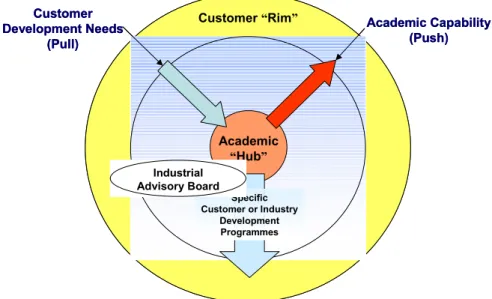
Figure 1: The Hub Concept
Manufacturing industry is once again being recognised as important to UK plc and the Aerospace industry is one of the few within the manufacturing scope to be well placed to take advantage of global opportunities. However new, skilled graduates are few and likely to get scarcer, whilst the demand for skilled employees is going to increase dramatically. In 2007, the South West of England had 16% of employees experiencing skills gaps (Bolden, 2008), and in 2009 graduate vacancies are already noticeably less than in previous years – as companies are not recruiting, they will have to retrain staff to maintain current levels of activity – and retain them.
CPDA can offer individuals the chance to improve their competencies in given subject areas, making them more likely to be retained by companies. It can also offer training to those wanting to convert into the Aerospace sector. Additionally, each student can study subjects very different to any covered before, thereby making them broader, more generalist employees. Each individual can choose the level of learning they need for their personal career development and the CPDA has range of graduates from different postgraduate awards (Table 1). There are also many students who study one course only, to improve their skills in a specialist subject.
Table 1: Range of Graduates
Postgraduate Award Graduates
Masters (Distinction) 49
Masters (Pass) 77
Diploma 39
Certificate 111
There are three MSc awards, two from the University of the West of England and one from the University of Bristol. In addition, the individual modules have attracted around 500 short course attendees.
Companies benefit by retaining well-educated and well-rounded employees who are able to cope with extra duties through their understanding of a wide range of topics
Academic “Hub” Customer “Rim”
Specific Customer or Industry
Development Programmes
Academic Capability (Push) Customer
Development Needs (Pull)
Academic “Hub” Customer “Rim”
Specific Customer or Industry
Development Programmes
Academic Capability (Push) Customer
Development Needs (Pull)
Industrial Advisory Board
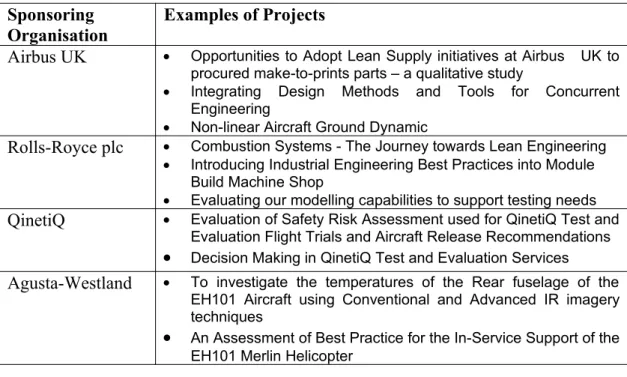
affecting the business processes. Such benefits have already been achieved by partner organisations, as the project subject areas show (Table 2) – many listed have achieved Masters Level distinction for the individual whilst helping to solve problems inside the sponsoring organisations. Most students are promoted at least once during their studies, often into areas they would not have considered before attending the course.
Table 2: Examples of Projects successfully completed for MSc awards
Sponsoring Organisation
Examples of Projects
Airbus UK Opportunities to Adopt Lean Supply initiatives at Airbus UK to procured make-to-prints parts – a qualitative study
Integrating Design Methods and Tools for Concurrent Engineering
Non-linear Aircraft Ground Dynamic
Rolls-Royce plc Combustion Systems - The Journey towards Lean Engineering
Introducing Industrial Engineering Best Practices into Module Build Machine Shop
Evaluating our modelling capabilities to support testing needs
QinetiQ Evaluation of Safety Risk Assessment used for QinetiQ Test and Evaluation Flight Trials and Aircraft Release Recommendations
Decision Making in QinetiQ Test and Evaluation Services
Agusta-Westland To investigate the temperatures of the Rear fuselage of the EH101 Aircraft using Conventional and Advanced IR imagery techniques
An Assessment of Best Practice for the In-Service Support of the EH101 Merlin Helicopter
Figure 2: Learning Needs Capture and Delivery
So, CPDA can offer a bridge between academia and industry, enabling those already in the workforce to continue their learning to their own and, as importantly, their
Requirements
Requirements
Customers Customers A ca de m ia A ca de m ia Taught Programmes (part-time) Taught Programmes (part-time) Undergraduate Post-Graduate Certificate Post-Graduate Diploma Master of Science Master of Research Engineering DoctorateShort Course
Training Needs Analysis Shell frameworks
Professional Institution Accreditation Shell frameworks
Professional Institution Accreditation
Continuing Professional Development Programmes
(Industry / Company bespoke)
e.g. CPDA
Continuing Professional Development Programmes
(Industry / Company bespoke)
e.g. CPDA
Don
Don’’t assume t assume companies know their
companies know their
staff development needs
sponsors’ benefit. However, it is critical for the CPDA to know what courses to offer industry – which often does not know itself (figure 2) (Greenman, 2009).
The CPDA is looking at alternative learning options to help industry decide what skills are needed and how they want them taught to their employees.
3. Learning Processes
The complementary nature of the teaching available from the two universities has always ensured a wide range of subject matter can be offered. In addition, across the modules, 25% of the teaching is done by experts from industry, ensuring that not only is academic best practice learnt, but also the conditions and requirements placed upon industry in the given subjects are understood and fully appreciated by the students. However, traditionally, the courses have been held as 5-day, face-to-face courses, with some pre-work in the form of a few hours distance learning, followed by a period in which to complete the assessed activity. At the request of partner organisations, a more flexible approach is being developed and tested. The driver behind such flexibility is the need to ensure employees are able to keep up with their jobs with “less time away from the desk”, yet still achieve the learning required.
However, it has been stressed that it is critically important to keep some contact time in a given course. The networking opportunities, as well as the learning experience provided by the lecturers, makes such contact invaluable.
Such a flexible approach will also appeal to a wider audience and allows the opportunity to expand the learning to a wider workforce environment:
Companies who would not normally be able to allow enough time for employees to be away – but are suffering from a lack of the necessary skills to enhance their businesses. They also have the chance to add their own bespoke aspects to the learning, in addition to the generic material from the taught courses;
Individuals, who have to balance full-time work commitments, family and study, and have a greater opportunity to study out of “office hours”. Some individuals will turn to the new learning processes who would have been put off by the traditional approach.
a. Flexible Learning Opportunities
Modular
o 5 days over one week
The majority of CPDA modules are currently run in this format. It is well suited to technical subjects that need to be built up over a series of days to achieve a comprehensive understanding.
o 3 days followed two / three weeks later by 2 days
return to the workplace and reflect on what they have learnt and develop their ideas on a particular issue they face for discussion in the second part of the programme.
o In-house accredited courses
Many organisations have tried and trusted courses that the universities can review for accreditation, providing assurance to the company that the standard of the learning meets their business needs. The Rolls-Royce Graduate Development Scheme, a subset of the CPDA, has used this option for over 10 years.
Distance / e-learning
o Pre-work in preparation for the module topic
Most existing modules have some form of pre-work to introduce the subject to the student in time for a steep learning curve during the contact period. This can be extended to add to the learning provided and can be made bespoke to specific company needs, if required.
o On-line material for short courses
On-line packages are being developed to extend learning further – and which can be picked up at any time of the day or night, depending on individual preference. This helps extend the knowledge provided and can be used to test individual learning and progress.
Additionally, on-line packages in specific topics are available for a much wider range of employees than those taking Masters programmes. These can be offered under licence to companies – and those individuals who need further learning in the topic can attend advanced courses to gain this learning.
Blended learning
A mixture of the above learning processes has been tried by the CPDA recently and has worked very well to date. Contact time was shortened, but the opportunity was retained, as it is recognised that it is vitally important for networking and general understanding. Extended e-learning, in the form of on-line activities - some with diagnostic tests to aid learning, was added before the assessment could be undertaken. So far, this has been tried on two CPDA modules. David Wornham, of the Bristol Business School at the University of the West of England, was one of those who tried out this blended learning approach on his long-standing Aerospace Strategic Management module. He notes that:
“The provision of blended learning units to strategic management students has strongly supported their learning: the opportunity for them to carry out a strategic planning simulation at their own pace and utilising a robust set of on-line resources, was reflected in the high standard of their post-module assignments.”
Preparation for such blended courses can take some time and on-line material can be expensive to build up and implement. However, once it is all in place, regular monitoring of the material is little different than that already done for traditional courses. It is also easier and quicker to update material on-line.
4. Case Studies Is this a good title for this section?
Individual Development
Students want qualifications to improve skills, knowledge and competencies to support their career progression. Gaining academic awards, whilst improving their competency, is a bonus. If the courses they take are also accredited by Professional Institutions then so much the better, in the aim to achieve Chartered Engineer recognition.
The CPDA MSc awards now have such accreditation through the Royal Aeronautical Society. Other Institutions are interested in the programmes offered, both at the full Masters programme level at the level of individual modules and short courses to meet specific needs, for example in Systems Engineering or Programme Management. With both academic and professional institution approval of the programmes studies, individuals can be sure they are competent in their field and have much to offer their organisations or future employers.
One of the CPDA graduates currently undertaking a PhD at the University of Bristol, Etienne Coetzee from Airbus, has this to say about the CPDA – what it meant to him and what his organisations gained from his studies:
"The creation of opportunities for the continued professional development of employees should be the aim of any company that wants to stay at the forefront of technology. Many companies recognise that the retention and development of skills gives them a competitive advantage, and that is why companies encourage their employees to attend postgraduate courses. In my case it was the CPDA in Aerospace.
New ideas are not only borne within the company, but also outside of Airbus, hence the CPDA in Aerospace gives us the opportunity to explore the latest thinking in pertinent areas. The structure of the CPDA allows for this because the lecturers are world-class in their respective fields, and many of the students have vast industrial experience. I have, in fact, found that the networking aspect of these courses has also been beneficial at later stages in my career.
The strong industrial focus of the CPDA was my original reason for taking the course. The flexibility of the course also allows you to refocus direction according to the needs of the business, and this has certainly allowed me to construct my modules in a way that is directly relevant to my day-job, thereby maximising the benefits to the company. Direct relevance also makes the coursework far more interesting and enjoyable. I would definitely recommend the CPDA to anybody who wants a good balance between theoretical and industrial applications."
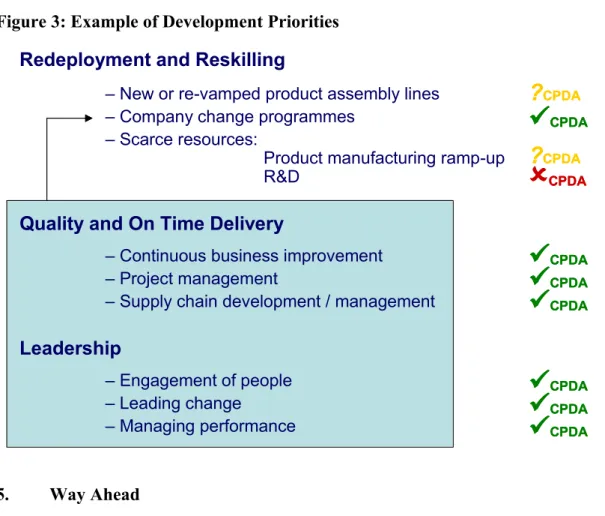
Although initially set up to offer Masters degrees, the CPDA is very aware that its market is split between the individuals who actually undertake the study and the sponsoring organisations. The latter are not particularly interested in university awards or professional recognition – they want the skills, knowledge and competencies to enable their businesses to improve their profits (Figure 3) (1). They are willing to provide support, financial and practical, to those who embark on study programmes, as they expect to get a wide range of extra benefits from the individuals as a result. The CPDA is able to support much of this, by being as flexible as possible. The flexibility offered by blended learning, for example, does meet some of industry’s needs:
Perhaps a statement from RR on benefits to organisation? Use Erica’s email responding to ND on MG1, why RR supports this method.
Organisations also have specific needs, for example “Engineering of Complex Systems” or “Airworthiness”, as well as more generic learning. The CPDA is supporting methods to enable training and learning in these subject areas, to appeal to a wide range of employees. In this particular example, some might need to understand how to write and capture Requirements, whilst others need more detailed architecture or integration learning. Companies have identified a need for this type of education and the CPDA is able to support it, at the levels required. As always, however, what organisations want does not automatically translate into people on courses:
There is no time for training
This is the wrong time for training
This is not quite what we want – but we cannot define exactly what we want….
Figure 3: Example of Development Priorities
5. Way Ahead
The CPDA is operating a very different world than that for which it was first designed. It has to adapt to the changing needs now faced by industry, especially during the current recession.
The core postgraduate award, the MSc, is not enough on its own to ensure the CPDA survives. Therefore, it needs to be prepared to provide a range of flexible courses and awards to meet both industry and individual requirements, both during the recession and as the industry begins to build up again.
CPD learning includes university-accredited modules, such as those currently in the CPDA awards. However, in many cases, it can also be easily achieved via non-accredited courses. Those planned as part of the CPDA will be unnon-accredited, but of a similar standard as the existing accredited modules, meaning industry can be assured of the quality of the courses on offer.
Flexibility removes the total dependency on weekly release for training and should, as a result, attract a wider audience. Blended learning, especially, should enable this. The aim of the evolving CPDA is to bridge the gap between academia and industry by bringing mutual understanding. This can be done by forming Capability Development Partnerships, which will be benefit all partners. The CPDA has already initiated such partnerships and will persist in doing so to ensure its continuation into the new industrially-focused learning environment. By this means it will continue to support and encourage individual and workforce development.
CPDA
CPDA
CPDA
CPDA
CPDA
CPDA?
CPDA?
CPDA
CPDA
CPDA
CPDA
CPDA
CPDA
CPDA
CPDA?
CPDA?
CPDA
CPDA
CPDA
CPDARedeployment and Reskilling
– New or re-vamped product assembly lines – Company change programmes
– Scarce resources:
Product manufacturing ramp-up R&D
Quality and On Time Delivery
– Continuous business improvement – Project management
– Supply chain development / management
Leadership
– Engagement of people – Leading change
References
Bolden R. and Petrov G., The Employer Engagement with Higher Education: A Literature Review, Page 26 Section 5.2, 2008, Centre for Leadership Studies, University of Exeter
Greenman D. C., Chairman’s opening remarks to the 1st CDPA Development Workshop – 29th April 2009 – University of the West of England, Bristol, Internal document, Unpublished.
.Leitch, Lord, Skills in the UK: the long term challenge, Interim Report, page 8 Section 18, 2005, HM Treasury, ISBN 1-84532-121-9
Paper written by: Wendy Fowles-Sweet
MSc(Dist), BSc(Hons) CEng MRAeS CPDA Co-ordinator
Department of Aerospace Engineering / Department of Design and Engineering University of Bristol / University of the West of England, Bristol
Duncan Greenman BSc(Eng) CEng FRAeS
Founder, Chair of CPDA Industrial Advisory Board
Visiting Professor & Senior Research Fellow, Bristol Institute of Technology, Faculty of Environment and Technology, University of the West of England Visiting Fellow, Department of Aerospace Engineering, University of Bristol
Roger Moses
PhD, BSc(Hons) MInstP CPDA Module Leader