Volume 2007, Article ID 37690,9pages doi:10.1155/2007/37690
Research Article
Digital-Signal-Type Identification Using an Efficient Identifier
Ataollah Abrahamzadeh,1Seyed Alireza Seyedin,2and Mehdi Dehghan3
1Faculty of Electrical and Computer Engineering, Noshirvani Institute of Technology, Mazandauan University, P.O. Box 47148-71167, Babol, Iran
2Faculty of Electrical Engineering, Department of Electrical Engineering, Ferdowsi University of Mashad, P.O. Box 91779-48974, Mashad, Iran
3Faculty of Computer Engineering and Information Technology, Amirkabir University of Technology, P.O. Box 15914, Tehran, Iran
Received 14 September 2006; Revised 10 February 2007; Accepted 4 April 2007
Recommended by Enis Ahmet Cetin
Automatic digital-signal-type identification plays an important role for various applications. This paper presents a highly efficient identifier (technique) that identifies a variety of digital signal types. In this technique, a selected number of the higher-order mo-ments and the higher-order cumulants up to eighth are utilized as the effective features. A hierarchical support-vector-machine-(SVMs) based structure is proposed for multiclass classification. A genetic algorithm is proposed in order to improve the perfor-mance of the identifier. Genetic algorithm selects the suitable parameters of SVMs that are used in the structure of the classifier. Simulation results show that the proposed identifier has high performance for identification of the considered digital signal types even at very low SNRs.
Copyright © 2007 Ataollah Abrahamzadeh et al. This is an open access article distributed under the Creative Commons Attribution License, which permits unrestricted use, distribution, and reproduction in any medium, provided the original work is properly cited.
1. INTRODUCTION
Automaticdigital-signal-type identification is a technique that recognizesthe type ofreceived signal and plays an im-portant role in various applications. For example, in mili-tary applications, it can be employed for electronic surveil-lance and monitoring; in civil applications, it can be used for
spectrum management, network traffic administration,
sig-nal confirmation, interference identification, software radios, multidrop networks, intelligent modems, and so forth.
In the past, signal-type identification relied mostly on operators scanning the radio frequency spectrum with a wide-band receiver and checking it visually on some sort of display [1]. Clearly, these methods relied very much on the operators’ skills and abilities. These limitations then led to the development of more automated modulation recogniz-ers. One semiautomatic approach was to run the received signal through a number of demodulators and then have an operator to determine the modulation format by listening to the output of each demodulator. This approach is however not very practical anymore due to the new digital techniques that transfer both voice and data. Then techniques for au-tomatic signal-type identification started to emerge. The
re-cent contributions in the subject focus more on the digital signal types, specially the higher-order digital signals, due to increasing usage of such types in many novel applications.
Automatic digital-signal-type identification techniques usually can be categorized in two main principles: the decision-theoretic (DT) and the pattern recognition (PR). DT techniques use probabilistic and hypothesis testing
ar-guments to formulate the recognition problem [2,3]. The
decision-theoretic (DT) techniques have many drawbacks. These techniques are not robust with respect to model
mis-match [4]. Another problem is the high computational
com-plexity [4]. Other problems are difficulties in forming the right hypothesis testing as well as careful analysis that are re-quired to set the correct threshold values [5]. However, PR techniques do not need such careful treatment [5]. They are easy to implement. PR techniques can be further divided into two main subsystems: the feature extraction and the clas-sifier. The former extracts the features and the latter deter-mines the membership of signal [4–17].
SNR =10 dB. In [4], the authors proposed a digital-signal type identification technique based on elementary fourth-order cumulant. When it was used for identification of the BPSK, PAM4, QAM16, and PSK8, the success rate was about
96% at SNR = 10 dB. In [8], the authors proposed a
tech-nique to discriminate among ASK, 4DPSK, 16QAM, and FSK digital signals. The chosen features are the kurtosis of the sig-nal, the number of peaks in the phase probability density function (PDF), and the mean of the absolute value signal frequency. A fuzzy classifier was used in this technique. For
SNR>5 dB, the identifier worked properly. When SNR was
less than 5 dB, the performance was worse. In [9], for the first time, Ghani and Lamontagne proposed using the mul-tilayer perceptron (MLP) neural network with backpropaga-tion (BP) learning algorithm for automatic signal-type iden-tification. They showed that neural network classifier outper-forms other classifiers such as K-nearest neighbor (KNN). In [10], the authors showed that the neural network classi-fier has a higher performance than the threshold classiclassi-fier. In [11], the authors proposed an identifier for the identifica-tion of PSK2, PSK4, PSK8, OQPSK, MSK, QAM16, QAM64, FSK2, and FSK4 signal types. The features chosen to charac-terize the signal types are the mean and the next three mo-ments of the instantaneous characteristics. They used diff er-ent classifiers and showed that the artificial neural network has better performance than K-nearest neighbor (KNN) clas-sifier and the well known binary decision trees. They re-porteda success rate of 93% with SNR range 15–25 dB. How-ever, the performance for lower SNRs is reported to be less than 80%. In [12], the authors proposed an identifier based on cyclic spectral features for identification of AM, USB, LSB, FM, ASK, FSK, BPSK, QPSK, and SQPSK. It was claimed that cyclic spectrum posses more advantage than power spec-trum in signal-type recognition. A full-connected backprop-agation neural network is used for classification in that re-search. The success rate of this identifier is reported around 90% with SNR range 5–25 dB. In [5], the authors have used a combination of spectral features and statistical features (sec-ond, third, and fourth orders of cumulants) for identifica-tion of ASK2, ASK4, PSK2, PSK4, FSK2, FSK4, V29, V32, QAM16, and QAM64. The classifier was an MLP neural net-work. They reported a high success rate at most of SNRs. The authors did not clarify the correction percentage of each of the modulations individually. Also they have used a fully connected neural network. This causes a long training time as well as the high complexity of the classifier. If the number of samples reduces, the performance will drop. In [13], the authors have done a comparative study of implementation of feature extraction and classification algorithms based on discrete wavelet decompositions and adaptive-network based fuzzy interference System (ANFIS) for recognition of ASK8, FSK8, PSK8, and QASK8.
It can be found that the techniques that use MLP neural networks as the classifier have high performances. However, with regard to effectiveness of MLP neural networks, there are some problems. For example, MLP neural networks have limitations on generalization ability in low SNRs. Another main drawback of the MLP models is that the training
proce-dure often gets stuck at a local optimum of the cost function [15].
In recent years, support vector machines (SVMs), based on statistical learning theory, are gaining applications in area of pattern recognition and detection of microcalcifications in digital mammograms, because of excellent generalization capability [18]. In [14], the authors proposed an identifier for signal-type identification that uses a binary SVM as the classifier. The features were extracted using wavelet packet analysis and biorthogonal wavelet. The accuracy of the pro-posed identifier exceeds 98% for SNR > 4 dB. In [15], Wu et al. introduced an identifier for automatic digital modu-lation recognition method based on SVMs. They have used the five key features that are introduced in [7]. It is shown that this method can achieve a satisfying performance at an SNR as low as 5 dB. This algorithm can recognize the modulation types of ASK2, ASK4, FSK2, FSK4, PSK2, and PSK2. As mentioned in [5], these features are only suitable for these low orders of signals that contain hidden infor-mation only in instantaneous amplitude, the instantaneous phase, and/or the instantaneous frequency. Using the higher-order statistics makes higher performances for fault detec-tion systems [18,19]. In [16], the authors proposed four fea-tures to classify ASK2, ASK4, PSK2, PSK4, FSK2, and FSK4. The features were extracted based on two main processing steps. The first step is the multiplication of two consecu-tive signal values. In the second step, the mean, the kurto-sis of real and imaginary parts of the quantity obtained in the first step were used as the input features of the SVMs. In [17], Gang et al. proposed an identifier for recognition of ASK4, PSK2, PSK4, PSK8, and QAM16. The probabil-ity of correct classification was about 98% at an SNR of 4 dB.
From the published works, it can be found that the iden-tifiers, which use the statistical features, are able to include the digital signal types such as QAM and higher orders of dig-ital signals. Also, the techniques that use SVMs as the classi-fier have high performances at low-level SNRs. In this paper, we propose a highly efficient identifier which contains the mentioned specifications. It uses a selected combination of the higher-order moments and the higher-order cumulants (up to eighth) as the effective features for representation of digital signals. We have proposed a new and simple multi-class SVM-based multi-classifier that has a hierarchical structure. Suitable parameters of SVMs can improve the performance of the identifier. We have proposed a genetic algorithm (GA) for tuning the parameters of SVMs that are used in the pro-posed classifier.
Figure 1shows the general scheme of the proposed iden-tifier. The preprocessing module performs actions such as rejection of noise outside of the signal bandwidth, carrier frequency estimation (or to be known), recovery of com-plex envelope. This stage is similar in most of the techniques, and hence we will not explain it more. The feature extrac-tion module is presented inSection 2. Also the digital signal-types set (DSTS) that is considered in this paper is introduced inSection 2. The classifier module is described inSection 3.
Feature extraction
Classifier Optimization Preprocessing
Received signal
Digital signal type
Figure1: General scheme of the proposed identifier.
Section 5shows some simulation results. Finally, Section 6
concludes the paper.
2. DSTS AND FEATURE EXTRACTION
Different types of digital signal have different characteris-tics. Therefore finding the proper features for the recognition of digital signals, particularly in case of higher-order and/or nonsquare kinds of digital signal, is a serious problem. In this paper, DSTS is ASK4, ASK8, PSK2, PSK4, PSK8, Star-QAM8, V29, QAM32, and QAM64. Because of simplifying the indi-cation, the digital signal types of ASK4, ASK8, PSK2, PSK4, PSK8, Star-QAM8, V29, QAM32, and QAM64 are substi-tuted with P1, P2, P3, P4, P5, P6, P7, P8, and P9, respectively.
Among the different features that we have computed and
ex-perimented, the higher-order moments and higher-order cu-mulants (up to eighth) make the highest performances for identification of DSTS. These features can provide a fine way to describe the shape of the probability density function. The following subsections briefly describe these features.
2.1. Moments
Probability distribution moments are a generalization of the concept of the expected value. Recall that the general expres-sion for theith moment of a random variable is given by [20]
μi=
∞
−∞(s−m)
if(s)ds, (1)
wheremis the mean of the random variable. The definition
for theith moment for a finite length discrete signal is given by
μi= N
k=1
sk−μ
i
fsk
, (2)
whereNis the data length. In this study, signals are assumed to be zero mean. Thus,
μi= N
k=1 si
kf
sk
. (3)
Next, the automoment of the random variable may be de-fined as follows:
Mpq=E
sp−qs∗q, (4)
Table1: Some of the features for a number of digital signal types.
P1 P3 P4 P6 P9
M41 1.64 1 0 0 0
M61 2.92 1 −1 2.92 −1.3
C63 8.32 16 4 .160 1.79
M84 5.24 1 1 5.25 3.96
C80 −30.1 −244 34 −88.9 −11.5
C82 −30.1 −244 −46 63.31 −27.1
where pis called the moment order ands∗stands for
com-plex conjugation ofs.
Assume a zero-mean discrete basedband signal sequence of the formsk =ak+ jbk. Using the definition of the
auto-moments, the expressions for different orders may be easily derived. For example,
M41=E(a+jb)3(a−jb)=Ea4−b4. (5)
2.2. Cumulants
Consider a scalar zero-mean random variableswith
charac-teristic function:
f(t)=E ejts. (6)
Expanding the logarithm of the characteristic function as a Taylor series, one obtains
logf(t)=k1(jt) +· · ·+kr(jt)
r
r! +· · ·. (7)
The constantskrin (7) are called the cumulants (of the
dis-tribution) ofs. The symbolism forpth order of cumulant is similar to that of thepth-order moment. More specially,
Cpq=Cum
s,. . .,s (p−q)terms
,s∗,. . .,s∗
(q)terms
. (8)
For example:
C81=Cums,s,s,s,s,s,s,s∗. (9)
We have computed all of the features for DSTS.Table 1
shows some of these features for a number of the consid-ered digital signal types. These values are computed under the constraints of unit variance and noise free.
3. CLASSIFIER
Suppose that thetraining set (xi,yi), i = 1, 2,. . .,l,x ∈
Rd, y ∈ {−1, +1}, can be separated by the hyperplane
wTx+b=0, wherewis the weight vector andbis the bias.
If this hyperplane maximizes the margin, then the following inequality is valid for all input data:
yi
wTxi+b
≥1, ∀xi,i=1, 2,. . .,l. (10)
Those training points, for which the equality in (10) holds, are called support vectors (SVs). The margin of the hyper-plane is equal to 2/w. Thus, the problem is the maximizing of the margin by minimizing ofw2subject to (10). This is
a convex quadratic programming (QP) problem. Lagrange multipliers (αi,i=1,. . .,l;αi≥0) are used to solve it.
Hav-ing done some computations, the optimal valueswandbare
achieved. Then the optimal decision function (ODF) is then given [21]:
f(x)=sgn l
i=1
yiα∗ixTxi+b∗
, (11)
whereα∗i’s are optimal Lagrange multipliers.
For inputs data with a high noise level, SVM uses soft margins that can be expressed as follows with the introduc-tion of the nonnegative slack variablesξi,i=1,. . .,l:
yi
wTx
i+b
≥1−ξi fori=1, 2,. . .,l. (12)
To obtain the OSH, theΦ =(1/2)w2+Cl
i=1ξik should
be minimized subject to (12), whereCis the penalty
param-eter, which controls the tradeoffbetween the complexity of
the decision function and the number of training examples, misclassified.
In the nonlinearly separable cases, the SVM map the training points, nonlinearly, to a high-dimensional feature space using kernel functionK(xi,xj), where linear
separa-tion may be possible. Gaussian radial basis funcsepara-tion (GRBF) is one of the kernelfunctions. It is given by
K(x,y)=exp −
x−y2
2σ2
, (13)
whereσ is the width of the RBF kernel. After a kernel func-tion is selected, the decision funcfunc-tion will become
f(x)=sgn l
i=1 yiα∗iK
x,xi
+b∗
. (14)
The performance of an SVM depends on penalty param-eter (C) and the kernel parameter, which are called hyperpa-rameters. In this paper, we have used the GRBF, because our extensive simulation shows that it has better performance than other kernels. Thus hyperparameters areCandσ.
There are two widely used methods to extend binary SVMs to multiclass problems: one-against-all (OAA) method
and one-against-one (OAO) method [22]. In this paper, we
have proposed a hierarchical SVM-based classifier.Figure 2
shows the scheme of this classifier. One of the advantages of this structure is that the number of SVMs is less than in cases of OAO and OAA.
SVM1 SVM3 SVM2 SVM4 SVM5 SVM6 SVM7 SVM8 V29 PSK2 ASK4 ASK8 PSK4 PSK8 QAM32 QAM64 Star-QAM8
Figure2: Hierarchical SVM-based classifier.
4. GA FOR SELECTION OF THE PARAMETERS OF SVMS
Finding the optimum values of the hyperparameters
im-proves the performance of SVMs; however, it is a difficult
problem [23]. GAs with their characteristics of high effi -ciency and global optimization are widely applied in many areas. In this paper, we have used GA for finding the opti-mum values of hyperparameters of SVMs. GA is a stochas-tic optimization algorithm, which adopts Darwin’s theory of survival of the fittest. To apply a genetic algorithm, one has to define its basic issues.
Selection of the parameters of SVM is an optimization problem with constraints. Here, real-encoded scheme is se-lected as the representation of the parameters. The research space of these parameters isC∈[2 : 4 : 50],σ∈[0.1 : 0.1 : 2]. The size of the population (pop size) is chosen to be 16 in order to avoid difficulties in the convergence of the popula-tion. For producing the initial population, the initial values of the designed parameters are distributed in the solution space as even as possible. According to the aforementioned analysis, the average performance of the SVM classifier is de-pendent onE{R2/γ2) and not simply on the large marginγ.
The radius-margin bound is proposed as the fitness function [23]:
T=1
l R2
γ2, (15)
whereγdenotes the margin,lis the size of the training
sam-ples, R is the radius of the smallest sphere containing the
training data,R=0.5.
Genetic operators include selection operator, crossover operator, and mutation operator. Here the method of sur-vival of the fittest was used to select the next-generation in-dividual. Given the fitness function fit(ai) of the individual
ai, the probability ofaiselected as the next generation one is
as follows:
Pai
= fit ai pop size
j=1 fit
aj
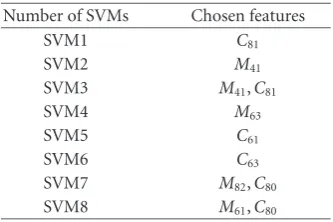
Table2: Chosen features for each SVM.
Number of SVMs Chosen features
SVM1 C81
SVM2 M41
SVM3 M41,C81
SVM4 M63
SVM5 C61
SVM6 C63
SVM7 M82,C80
SVM8 M61,C80
The crossover operator is defined as [24]
X=aX1+ (1−a)X2, (17)
whereXis the offspring aftercrossover operation,X1andX2
are two parents to be implemented in the crossover opera-tion, andais a constant which belongs to (0, 1). Herea=0.5. How the bigger value of the mutation operator is chosen to maintain the diversity of the population in the early GA oper-ation and avoid the precocity? The adaptive mutoper-ation proba-bility is adopted in this paper to solve the above two problems as follows:
Pm= exp(−b×t/
2)
pop size×√L, (18)
wheretis the generation of the genetic iteration, pop size is the size of the population,Lis the length of the individual,
b = 1.5 is a preset parameter. In this paper, genetic algo-rithm terminates the program when the best fitness has not changed more than a very small value, that is, 10−6over the
last generations.
5. SIMULATION RESULTS
We have used Matlab environment for simulations. The sim-ulated signals were band-limited and Gaussian noise was added according to SNR values−3, 0, 3, 6, 9, and 18 dB. For each signal type, 1260 samples are used for simulations. Six hundred and thirty samples are used for training phase and 630 samples are used for testing phase. Among the features that we have mentioned inSection 2,Table 2shows the cho-sen features that achieve the best results for identification of DSTS. These features were selected based on try and error.
5.1. Performance without optimization
Based on some experiments, the values σ=1 and C = 10
are selected for all SVMs.Table 3shows the diagonal matrix
(DM) or accuracy matrix (ACCM) at SNR =3 dB.Table 4
shows the identification results (performances) for DSTS in different SNR values. These are the averages of the values that appear in the diagonal of DM (or ACCM). It can be seen that the performance is generally very good even at very low SNRs. This is due to two facts: chosen features and novel clas-sifier. The chosen features have the effective properties in sig-nal representation. On the other hand, SVM-based classifier
has high generalization ability for classification of the con-sidered digital signals at low SNRs.
In order to compare the performance of the proposed hierarchical SVM-based classifier with another classifier, we have considered a hierarchical MLP-based classifier in which SVMs are replaced with MLP neural networks. These MLPs use backpropagation with momentum and adaptive learning rate algorithm. The simulation setups are the same. We name
this technique as TECH2.Figure 3shows the performances
of two identifiers in different SNR values. It can be seen that the proposed technique (PROTECH) that uses SVM in the structure of its classifier has higher accuracy than TECH2, particularly, in low levels of SNR. When SNR is low, TECH2 shows poor performance, while in higher SNR the accuracy is higher. The construction of neural network in low SNRs is not proper, which results in low generalization ability. In higher SNRs, the features are proper and closer to the noise-less state and it is easier to construct the neural network and results in high identification probability.
In order to indicate the effectiveness of the chosen fea-tures, we have used the features that have been introduced in [4]. The structure of the classifier and the simulation setups
are the same. We name this technique as TECH3. Figure 4
shows the performances of two identifiers. Results imply that our chosen features have highly effective properties in signal representation.
5.2. Performance with applying GA
In this section, we apply GA for finding the optimum pa-rameters of SVMs that are in the structure of the proposed classifier.Table 5shows the performances of the optimized
identifier for various SNRs. Figure 5 shows a comparison
between the performances of the nonoptimized technique (PROTECH) and optimized technique (OPROTECH). It can be seen that the optimization improves the performances of identifier for all SNRs, especially in lower SNRs.Table 6
shows the optimum parameters of SVMs that are used in the hierarchical structure.Table 7indicates the diagonal matrix of identifier at SNR=3 dB. Also, we have computed the per-formances of the optimized identifier at a high SNR value.
Table 8indicates the training performance of the identifier at SNR=40 dB. It can be seen that the proposed identifier can show up to 100% accuracy.
5.3. Performance comparison
Table3: Testing performance of the proposed identifier at SNR=3 dB.
P1 P2 P3 P4 P5 P6 P7 P8 P9
P1 97
P2 92
P3 99
P4 95
P5 93
P6 91
P7 92
P8 91
P9 92
Table4: Performances of the proposed identifier in different SNRs without optimization (%).
SNR Training Testing
−3 86.14 85.52
0 93.26 91.45
3 94.42 93.56
6 96.75 96.54
9 97.85 97.56
18 98.74 98.50
Table5: Performances of the identifier with applying of GA.
SNR (dB) Training Testing
−3 92.74 92.26
0 94.92 93.64
3 96.84 96.78
6 98.95 98.75
9 99.14 99.12
18 99.58 99.36
Table6: Optimum parameters of SVMs.
SVM’s number C σ
SVM1 2 1.2
SVM2 10 1.4
SVM3 14 0.9
SVM4 18 1
SVM5 42 0.9
SVM6 26 1.1
SVM7 16 0.9
SVM8 22 0.7
hyperplane in the space to realize signal recognition. This classifier avoids the overfitting and local minimum. It shows great generalization ability for identifying the considered dig-ital signal types. The proposed identifier has a success rate of
around 92% at SNR= −3 dB. The performance of the
iden-tifier is higher than 98% for SNR>6 dB. These performances are achieved with few samples.
50 80 100
Pc
−3 6 12 18
SNR PROTECH
TECH2
Figure 3: Comparison between the performances of PROTECH and TECH2.
6. CONCLUSIONS
Table7: Testing performance of the optimized identifier at SNR=3 dB.
P1 P2 P3 P4 P5 P6 P7 P8 P9
P1 98
P2 98
P3 100
P4 100
P5 97
P6 96
P7 96
P8 94
P9 92
Table8: Training performance of the optimized identifier at SNR=40 dB.
P1 P2 P3 P4 P5 P6 P7 P8 P9
P1 100
P2 100
P3 100
P4 99.8
P5 100
P6 100
P7 99.6
P8 100
P9 99.6
40 50 80 100
Pc
−3 6 12 18
SNR PROTECH
TECH3
Figure 4: Comparison between the performances of PROTECH and TECH3.
a genetic algorithm as an optimizer in order to achieve the optimum structure of the classifier. This work improves ef-ficiently the performance of the identifier, especially at very low SNRs. For future works, we can use another genetic al-gorithm and compare the respective results with the results
84 88 92 96 100
Pc
−3 6 12 18
SNR OPROTECH
PROTECH
Figure5: Comparison between the performances of the nonopti-mized technique (PROTECH) and optinonopti-mized technique (OPRO-TECH).
for optimization of the structure of the classifier. For future works, we can apply the genetic algorithm both for the fea-tures subset selection and the optimization of the structure of the classifier.
REFERENCES
[1] A. Iversen, “The use of artificial neural networks for auto-matic modulation recognition,” Tech. Rep. HW-MACS-TR-0009, Heriot-Watt University, Edinburgh, Scotland, December 2003.
[2] W. Wei and J. M. Mendel, “Maximum-likelihood classification for digital amplitude-phase modulations,”IEEE Transactions on Communications, vol. 48, no. 2, pp. 189–193, 2000. [3] P. Panagiotou, A. Anastasopoulos, and A. Polydoros,
“Likeli-hood ratio tests for modulation classification,” inProceedings of the 21st Century Military Communications Conference (MIL-COM ’00), vol. 2, pp. 670–674, Los Angeles, Calif, USA, Octo-ber 2000.
[4] A. Swami and B. M. Sadler, “Hierarchical digital modulation classification using cumulants,”IEEE Transactions on Commu-nications, vol. 48, no. 3, pp. 416–429, 2000.
[5] M. L. D. Wong and A. K. Nandi, “Automatic digital modu-lation recognition using artificial neural network and genetic algorithm,”Signal Processing, vol. 84, no. 2, pp. 351–365, 2004. [6] B. G. Mobasseri, “Digital modulation classification using con-stellation shape,”Signal Processing, vol. 80, no. 2, pp. 251–277, 2000.
[7] E. E. Azzouz and A. K. Nandi, “Automatic identification of dig-ital modulation types,”Signal Processing, vol. 47, no. 1, pp. 55– 69, 1995.
[8] J. Lopatka and M. Pedzisz, “Automatic modulation classifica-tion using statistical moments and a fuzzy classifier,” in Pro-ceedings of the 5th International Conference on Signal Processing (ICSP ’00), vol. 3, pp. 1500–1506, Beijing, China, August 2000. [9] N. Ghani and R. Lamontagne, “Neural networks applied to the classification of spectral features for automatic modulation recognition,” inProceedings of IEEE Military Communications Conference (MILCOM ’93), vol. 1, pp. 111–115, Boston, Mass, USA, October 1993.
[10] A. K. Nandi and E. E. Azzouz, “Algorithms for automatic mod-ulation recognition of communication signals,”IEEE Transac-tions on CommunicaTransac-tions, vol. 46, no. 4, pp. 431–436, 1998. [11] C. Louis and P. Sehier, “Automatic modulation recognition
with a hierarchical neural network,” in Proceedings of IEEE Military Communications Conference (MILCOM ’94), vol. 3, pp. 713–717, Fort Monmouth, NJ, USA, October 1994. [12] L. Mingquan, X. Xianci, and L. Leming, “Cyclic spectral
fea-tures based modulation recognition,” inProceedings of Inter-national Conference on Communication Technology (ICCT ’96), vol. 2, pp. 792–795, Beijing, China, May 1996.
[13] E. Avci, D. Hanbay, and A. Varol, “An expert discrete wavelet adaptive network based fuzzy inference system for digital modulation recognition,” Expert Systems with Applications, vol. 33, no. 3, pp. 582–589, 2007.
[14] A. Abrahamzadeh and S. A. Seyedin, “Automatic modulation type identification using WPA and SVM,”International Jour-nal of Tomography & Statistics, vol. 4, pp. 17–28, 2006. [15] Z. Wu, X. Wang, Z. Gao, and G. Ren, “Automatic digital
modu-lation recognition based on support vector machines,” in Pro-ceedings of International Conference on Neural Networks and Brain (ICNNB ’05), vol. 2, pp. 1025–1028, Beijing, China, Oc-tober 2005.
[16] H. Mustafa and M. Doroslovaˇcki, “Digital modulation recog-nition using support vector machine classifier,” in Proceed-ings of the 38th Asilomar Conference on Signals, Systems and Computers, vol. 2, pp. 2238–2242, Pacific Grove, Calif, USA, November 2004.
[17] H. Gang, L. Jiandong, and L. Donghua, “Study of modulation recognition based on HOCs and SVM,” inProceedings of the 59th IEEE Vehicular Technology Conference (VTC ’04), vol. 2, pp. 898–902, Milan, Italy, May 2004.
[18] I. El-Naqa, Y. Yang, M. N. Wernick, N. P. Galatsanos, and R. M. Nishikawa, “A support vector machine approach for detection of microcalcifications,”IEEE Transactions on Medical Imaging, vol. 21, no. 12, pp. 1552–1563, 2002.
[19] M. N. G¨urcan, Y. Yardimci, A. E. C¸etin, and R. Ansari, “Detec-tion of microcalcifica“Detec-tions in mammograms using higher or-der statistics,”IEEE Signal Processing Letters, vol. 4, no. 8, pp. 211–216, 1997.
[20] P. McCullagh,Tensor Methods in Statistics, Chapman & Hall, London, UK, 1987.
[21] C. Cortes and V. Vapnic, “Support vector network,”Machine Learning, vol. 20, no. 3, pp. 273–297, 1995.
[22] B. Sch¨olkopf, C. Burges, and V. Vapnik, “Extracting sup-port data for a given task,” inProceedings of the 1st Interna-tional Conference on Knowledge Discovery and Data Mining (KDD ’95), pp. 252–257, Montreal, Canada, August 1995. [23] O. Chapelle, V. Vapnik, O. Bousquet, and S. Mukherjee,
“Choosing multiple parameters for support vector machines,”
Machine Learning, vol. 46, no. 1–3, pp. 131–159, 2002. [24] Z. Michalewicz, Genetic Algorithms+Data
Structures=Evolu-tion Programs, Springer, New York, NY, USA, 3rd edition, 1999.
Ataollah Abrahamzadeh was born in Babolsar at the north of Iran. He received his Ph.D. degree in electrical engineering from Ferdowsi University of Mashad, Mashad, Iran, in 2006. Now he is an Assis-tant Professor in the Faculty of Electrical and Computer Engineering at Noushirvani Institute of Technology. His current scien-tific interests are in general area of signal processing, biomedical engineering, and artificial intelligence.
Seyed Alireza Seyedinwas born in Iran. He received the B.S. degree in electronics en-gineering from Isfahan University of Tech-nology, Isfahan, Iran, in 1986 and the M.E. degree in control engineering from Roorkee University, Roorkee, India, in 1992 and the Ph.D. degree in electrical engineering from the University of New South Wales, Sydney, Australia, in 1996. Since 1996, he has been with the Faculty of Engineering, Ferdowsi
Mehdi Dehghanreceived his B.S. degree in computer engineering from Iran University of Science and Technology (IUST), Tehran, Iran, in 1992, and his M.S. and Ph.D. de-grees from Amirkabir University of Tech-nology (AUT), Tehran, Iran, in 1995, and 2001, respectively. He is an Assistant Profes-sor of Computer engineering and informa-tion technology at Amirkabir University of Technology (AUT). Prior to joining AUT in