A Comprehensive Attack Flow Model and Security
Analysis for Wi-Fi and WPA3
Christopher P. Kohlios, MS1,†,‡ ID and Thaier Hayajneh, PhD2,‡*
1 Cyber Security Department, Fordham University, New York, USA; [email protected]
2 Cyber Security Department, Fordham University, New York, USA; [email protected]
* Correspondence: [email protected]; Tel.: +1-212-636-7785 † Current address: 113 W 60th St, New York, NY 10023, 616A ‡ These authors contributed equally to this work.
Version September 27, 2018 submitted to Preprints
Abstract: The presence of wireless communication grows undeniably more prevalent each year. 1
Since the introduction of the IEEE 802.11 standard for Wireless Local Area Networks (WLAN) in 2
1997, technologies have progressed to provide wireless accessibility to industries and consumers 3
with growing ease and convenience. As the usage of personal devices, such as phones and watches, 4
that connect to the Internet through Wi-Fi increases, wireless attacks on users are becoming more 5
critical. This paper provides a novel attack model to offer an organized and comprehensive view of 6
the possible attacks on WiFi latest security standards. All exiting attacks will be investigated, with 7
emphasis on more recent attacks, such as the KRACK and PMKID Dictionary attacks. This paper will 8
then analyze the technology offered in the new Wi-Fi Protected Access III (WPA3) security scheme 9
and provide a comprehensive security analysis and discussion to determine whether it has addressed 10
the vulnerabilities of its predecessor. An interesting finding of this paper is that WPA3 still lacks to 11
address all the issues existed in WPA2 and explore other mitigations for future research. 12
Keywords:WPA3; WiFi; Attack Flow; Security Analysis; WLAN
13
1. Introduction
14
In 1997, a standard was released by the Institute of Electrical and Electronics Engineers (IEEE) 15
that set guidelines for creating a network in which devices could connect to each other wirelessly, 16
known as Wireless Local Area Network (WLAN). The standard is referred to as IEEE 802.11 and has 17
gone through a few revisions since its inception [1]. Being connected in a wireless manner is a great 18
advantage, but without proper security it could cause more harm than good. If no security measures 19
are implemented into a WLAN system, then there is nothing stopping an attacker from joining your 20
network and capturing your traffic or injecting malicious traffic of his/her own. To counteract this 21
problem, security protocols have been created to ensure confidentiality, integrity, and authentication. 22
As of writing this paper, there have been three main security protocols implemented for IEEE 23
802.11: Wired Equivalent Privacy (WEP), Wi-Fi Protected Access (WPA), and Wi-Fi Protected Access II 24
(WPA2). A fourth protocol, Wi-Fi Protected Access III (WPA3), was recently released to the public by 25
the Wi-Fi Alliance on June 25th, 2018. The benefits and limitations of each of these protocols will be 26
discussed in this paper. Even though WEP is outdated and is no longer permitted to be implemented 27
in new routers and devices, however, older equipment still uses it in the field today. Each protocol will 28
be defined and analyzed for their benefits and limitations. Following will be a discussion on WPA3 29
and the problems it seeks to address in the current state of Wi-Fi security. 30
Other than attacking encryption schemes, there are several backdoors that enable hackers to attack 31
a network and cause a myriad of trouble. This paper will survey all the attacks one can perform on a 32
Wi-Fi network in an organized manner to better visualize the attacks based on timing and category. A 33
novel categorization model will be provided to assist future researchers in studying, visualizing, and 34
categorizing attacks on Wi-Fi networks. Each attack will be described in detail and analyzed, including 35
the new KRACK exploit released in 2017 [2]. An analysis of the WPA3 security protocol will be given 36
for each attack to determine whether or not the vulnerabilities have been addressed. This paper will 37
lastly propose defenses that users can practice to prevent the attacks on their networks and securing 38
their information when connecting to Wi-Fi networks. 39
Few existing research have surveyed the current security schemes from WEP to WPA2 [3–6]. This 40
paper, however, seeks to create a comprehensive survey, reiterating key points of previous literature to 41
provide the reader with enough information needed for understanding the encryption schemes, and 42
adding an analysis of WPA3, which has not yet been seen in publication at the writing of this paper. 43
Furthermore, several papers have described in detail different attacks that can be performed on a Wi-Fi 44
network [2,7–9]. This paper aggregates these attacks into one comprehensive reference model of all 45
attacks that one can perform against a Wi-Fi network. There have been papers surveying attacks on 46
mobile networks [10,11], sensor networks [12–15], and mesh networks [16], but a comprehensive attack 47
survey on Wi-Fi networks is yet to be seen. This paper serves its purpose by clearly identifying attacks 48
that can be executed on the state of Wi-Fi security, WPA2, before the introduction of WPA3. Likewise, 49
there is no literature that offers an attack flow diagram to clearly display the process an attacker would 50
take from the beginning of an attack to reach certain outcomes. This paper also analyzes the security 51
that WPA3 provides to a Wi-Fi network and identifies what attacks still need to be addressed in future 52
research. 53
The remainder of this paper is outlined as follows: a description of each of the current security 54
protocols up to WPA2 is given insection 2, whilesection 3outlines the limitations of each protocol. 55
Section 4provides the Attack Flow diagram, going into detail explaining each attack that can be 56
performed on a WPA2 protected Wi-Fi network.Section 5gives an overview of the features of WPA3 57
and provides a security analysis on the attacks described in this paper.Section 6discusses the benefits 58
provided by WPA3 given the security analysis with respect to the Attack Flow diagram from section 2. 59
Lastly, other mitigation methods for the remaining issues not addressed by WPA3 are given insection
60
7andsection 8concludes the paper with closing remarks and future research. 61
2. Wi-Fi Security Protocols
62
Security protocols were implemented to give security to Wi-Fi networks in the form of 63
authentication and encryption, as opposed to just providing a wireless medium to the Internet. At the 64
writing of this paper, WPA2 is the most used security protocol due to its high level of security and 65
time in the market. The release of WPA3 is still new and has not gained enough popularity yet, but 66
nevertheless has the highest level of security to date, which we will look into in detail. Even though 67
WEP is no longer accepted as a reliable security protocol and is not implemented in new devices, it is 68
still possible to see each protocol in some devices in today’s world [17]. 69
2.1. Wireless Equivalency Protocol (WEP) 70
WEP was the first protocol used to secure wireless networks. It was introduced as part of the 71
IEEE 802.11 security standard in September 1999 [17]. It was created to provide a similar degree of 72
security found in wired networks. It uses the Rivest Cipher 4 (RC4) stream cipher for encryption to 73
increase the overall speed of communication, compared to slower encryption schemes such as DES 74
[18]. In this algorithm, a 40-bit shared key is used with a 24-bit Initialization Vector (IV). The shared 75
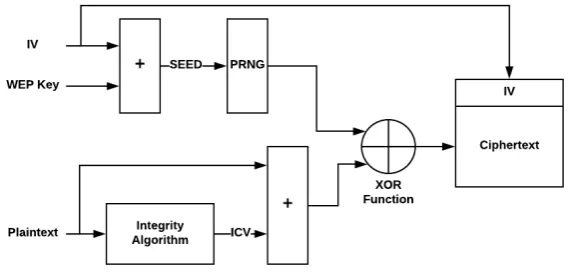
key and the IV are concatenated to create a 64-bit key. The 64-bit key is then a seed value for a pseudo 76
random number generator (PRNG) [17]. The plaintext is then sent to an integrity check algorithm 77
called CRC-32, where the product is the integrity check value (ICV), which is used to compare to the 78
plaintext for integrity. The key sequence generated by the PRNG is then XORed with the plaintext 79
concatenated to the ICV to produce the ciphertext. The IV is concatenated to the ciphertext to use for 80
decryption by the receiving party [18]. This same process is done in reverse to obtain a valid plaintext 81
Figure 1.WEP Encryption Diagram
2.2. Wi-Fi Protected Access (WPA) 83
WPA was created in 2003 by the Wi-Fi Alliance in order to overcome flaws in WEP. Version 1 84
was designed as an intermediate solution intended to correct the WEP cryptographic deficiencies 85
without requiring new hardware and uses the Temporal Key Integrity Protocol (TKIP) for encryption. 86
The 128-bit per packet key is dynamically generated for every packet. WPA is separated into 87
WPA-Personal or WPA-PSK (Pre-Shared Key) and WPA-Enterprise. The PSK is a static key used 88
to initiate communication between two parties. In WPA-Personal a 256-bit key is used to authenticate 89
the wireless devices, which is never transmitted over the air. The MIC key and encryption key are 90
derived from the PSK. 91
TKIP was created to fix the security problems with WEP. It is a collection of algorithms that 92
resolves the issue of having most of the cryptographic functions occurring in hardware. TKIP uses an 93
RC4 device (implemented in the hardware of a wireless network adapter) to alter the way the shared 94
key is used. WEP uses a shared key in encryption, while TKIP uses a shared key to generate other keys. 95
A major benefit of TKIP is that no additional hardware is required for implementation. TKIP made four 96
improvements to WEP: (1) it encrypted the message integrity code (MIC) to prevent falsifications, (2) 97
used Strict IV sequence to prevent replay attacks, (3) used improved key generation, and (4) refreshed 98
keys to prevent key repetition attacks [17]. 99
TKIP keys are used after a client is authenticated and associated. A 4-way handshake is performed 100
using the TKIP keys resulting in a 512-bit key that is shared between the client and the access point. A 101
128-bit temporal key and two 64-bit MIC keys are derived from this 512-bit key. One MIC key is for 102
the AP-to-client communication and the other for client-to-AP communication. The sender of a TKIP 103
frame calculates the MIC value of each data packet using an algorithm, called the Michael Algorithm, 104
which takes the MIC and a secret key. 105
The data packet concatenated with the MIC is then encapsulated using WEP so it can be 106
implemented on old WEP hardware. An ICV is appended then the packet is encrypted using RC4 and 107
a key that uses the function that combines the temporal key, transmitter MAC address, and the TKIP 108
Sequence Counter (TSC). The receiver will check to see if the TSC is in order and the ICV is correct. If 109
either of these checks are not valid, the frame will be dropped. The original data packet is reassembled, 110
and the MIC value is verified. If it is accepted the TSC replay counter is updated [19]. 111
WPA-Enterprise uses IEEE 802.1x and Extensible Authentication Protocol (EAP) to provide 112
stronger authentication. A Remote Authentication Dial In User Service (RADIUS) server is used 113
for security [17]. 802.1x uses EAP for the encapsulation of other authentication protocols. A valid 114
authentication between client and server is needed in order to allow traffic [3]. A RADIUS server is 115
used to validate credentials and authorize network access [17]. Based on this authentication the port is 116
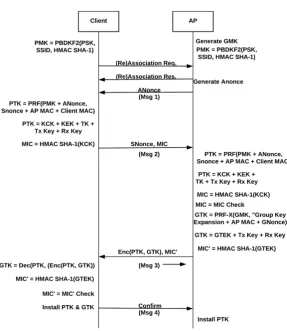
Figure 2.A detailed diagram of the 4-Way Handshake
EAP request [3]. Similarly to WEP, WPA uses an RC4 stream cipher but with a 48 bit TSC, as opposed 118
to the 24-bit TSC. The use of TKIP allows key mixing a 128-bit key and dynamic key sharing [20]. 119
2.3. Wi-Fi Protected Access Version 2 (WPA2) 120
WPA2 guarantees that all equipment with it installed can support 802.11i, which is a standard 121
to provide enhanced security in the Medium Access Control (MAC) layer [3]. This introduced 122
Counter Mode with Cipher Block Chaining Message Authentication Code Protocol (CCMP). It uses 123
the Advanced Encryption Standard (AES) block cipher for data encryption. TKIP is also available for 124
backwards compatibility with existing hardware. Additionally, WPA2 has PSK and Enterprise modes 125
[17]. Due to the nature of AES, WPA2 requires replacing older hardware because AES has extensive 126
processing demands [20]. In order to generate keys in WPA2, a 4-way handshake is needed to get a 127
Pairwise Transient Key (PTK) and a Group Temporal Key (GTK), as well as a Group Key handshake 128
for GTK renewal or host dissociation [17]. 129
In the beginning of the handshake, as depicted in Fig.2, both the client and AP have a Pairwise 130
Master Key (PMK), which is a PBDKF2 function of the PSK, the SSID of the AP, and an HMAC function. 131
After the client sends a request to connect and the AP acknowledges the request, the AP will generate 132
a nonce (Anonce) and send it to the client. A nonce is a random value that is known by the sender to 133
test that the receiver knows a certain piece of information. The client is tested by using the nonce along 134
with some other information to create a new value that the AP can test. To create the PTK, the client 135
will generate its own nonce (Snonce) and concatenate that with the Anonce, the PMK, and the MAC 136
sent in plaintext was not altered in transmission. Once the AP receives the Snonce and the MIC, it will 138
derive the PTK using the same information as th client and confirm that the MIC match. The PTK is 139
derived through the two random nonces exchanged, which will be different every session, making the 140
PTK fresh every session. 141
CCMP is based on the counter mode (CTR) with cipher-block chaining (CBC) message 142
authentication code of AES. CTR is used for data confidentiality and CBC message authentication code 143
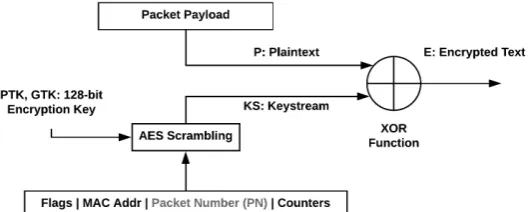
is used for authentication and integrity [21]. The protocol takes in the PTK or GTK (if the message is 144
unicast or broadcast respectively) encryption key and runs it through an AES encryption algorithm 145
along with the 802.11 headers and flags, MAC address of the transmitter, the Packet Number of the 146
message, and some counters that are required for counter mode in AES. AES is a block cipher algorithm 147
that supports 128-256 keys in sequences of 32 bits. The length of the key and the length of the block are 148
chosen independently. The value of these blocks is changed after each round is completed. The key 149
is enlarged into 44 32-bit words, with each word equaling 4 bytes. This creates 11 keys to be used in 150
10 rounds, the first of which being used for the initialization of the encryption and the last used for 151
initialization of the decryption. An increased number of rounds are used with an increased key size. 152
Each round consists of one permutation and three substitutions. This algorithm is considered secure 153
due to the complexity of the key extension as well as the complexity of the transformations, which, as 154
stated above, consist of a combination of permutations and substitutions in each round [3]. 155
Figure 3.CCMP Encryption Diagram
3. Limitations of Wi-Fi Security Protocols
156
Along with the benefits of each of these protocols and methods of encryptions, there are also 157
many limitations and vulnerabilities. The newest devices have the most updated security measures 158
and are capable of supporting all of the protocols discussed. However, since older devices still exist 159
and are being used in the world, it is still important to be aware of these limitations. 160
3.1. WEP 161
As previously stated, WEP was the first protocol used in securing wireless networks. It was 162
introduced and ratified according to the standard set forth by IEEE 802.11. However, WEP has been 163
proven to be easily broken [7][9][8]. One of the main vulnerabilities in WEP is the ability to broadcast 164
fake data packets. Due to the fact that WEP is using shared key authentication, it makes it easy for 165
an attacker to forge an authentication message. In shared key authentication, knowledge of a shared 166
WEP key is demonstrated by encrypting a challenge. An attacker can observe the challenge and the 167
encrypted response to determine the RC4 stream used for encryption. The attacker can use that same 168
stream in the future [18]. Another shortcoming of the WEP protocol is the reuse of the initialization 169
vector. Different cryptanalysis methods could then be used to decrypt the data [17]. 170
Key management is also a major vulnerability of WEP. Key distribution is not specified by the 171
Figure
4.
Attack
Flow
only one key is used so if more than one user is using the key there is an increased chance for key 173
decryption [17]. Along with a lack of key management, the small size of the keys is also a weakness to 174
this protocol. A 40-bit key is used making a brute force attack likely to decrypt the key [17]. 175
3.2. WPA 176
There are a number of major shortcomings with the WPA protocol. The first is the usage of RC4 177
algorithm over the more advanced AES algorithm [17]. As previously stated, having two or more RC4 178
keys computed under the same IV makes it easy for an attacker to compute the TK. 179
The next shortcoming is in WPA-PSK mode. It is vulnerable to brute force attacks if a poor 180
password is used. A dictionary attack can be used if the password is less than 20 characters. Another 181
shortcoming of WPA is that there is a greater performance overhead than WEP [17]. According to 182
research done by Tripathi and Damani [22], there is lower average throughput and greater overhead 183
when using WPA-TKIP when compared to the throughput and overhead when using WEP. 184
One other shortcoming of WPA is the complicated set-up needed for WPA-Enterprise [17]. As 185
previously stated, WPA-Enterprise uses 802.1x and EAP as well as a RADIUS server. 186
The main vulnerability of WPA is in TKIP. This is due to hash collisions when using hash functions 187
for TKIP key mixing [17]. It is easy for an attacker to compute the Temporal Key (TK) and decrypt any 188
packet if two or more RC4 keys are computed under the same IV [23]. This makes WPA susceptible to 189
threats related to hash collisions while using hash functions in TKIP key mixing. A per-packet key 190
mixing function exists to de-correlate the IVs from weak keys. A re-keying mechanism provides new 191
encryption and integrity keys. This function, called the temporal key hash, produces a 128-bit RC4 192
encryption key. If an attacker collects a few RC4 keys calculated under the same IV, he will be able to 193
recover the TK and the message integrity code (MIC) key, which is used to detect forged packets [24]. 194
Most new equipment being released today does not support a TKIP only option. In 2014, TKIP was 195
scheduled to be disallowed entirely. However, there is still legacy equipment in the field today that 196
supports and is using TKIP [19]. 197
3.3. WPA2 198
One limitation of WPA2 is the need for upgraded hardware in order to implement. This is 199
due to the fact that a CCMP and AES implementation requires a change to existing hardware. All 200
new hardware being released today can support WPA2. WPA2 is supported in all Wi-Fi devices 201
certified since 2006. However, for networks that have already been deployed it can be expensive to 202
replace all hardware with new hardware that supports CCMP and AES. Also, like WPA-Enterprise, 203
WPA2-Enterprise also consists of a complicated process [17]. 204
It has also been demonstrated that WPA2 can be exploited by a method known as key reinstallation 205
attack, or KRACK, which we will go into further depth in section5.2.7. This process exploits the 206
4-way handshake that wireless security protocols use to authenticate their users when connecting to 207
the network. For this attack, the attacker sets the counters to their initial values and can then replay 208
messages and decrypt them [2]. The vulnerability is that WPA2 allows reinitialization of keys, which a 209
secure system should not. 210
WPA2 also allows system information, known as management frames, to be sent in plaintext 211
packets from the client to the AP. With this vulnerability, an adversary can spoof the packets to make it 212
look like they are coming from the target client and preform attacks such as deauthentication. The 213
problem lies with a lack of encryption and authentication to maintain authenticity of the messages. 214
4. Attack Flow
215
In this section we will describe the main attacks an adversary can perform against a victim client 216
on a Wi-Fi network using WPA2-PSK security. To clearly identify all weaknesses in the design of current 217
Wi-Fi networks we have created a flow chart that walks the reader through the steps taken by the 218
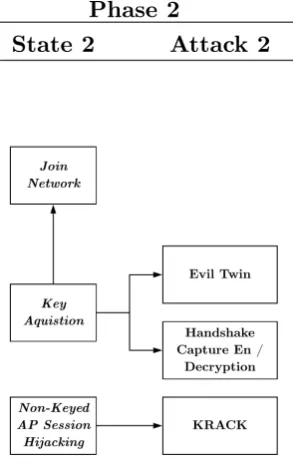
States, Attacks, and Outcomes. A state is the position the attacker is in with the ability to perform 220
an attack or achieve a desired outcome. Going from one state to the next is usually accomplished by 221
an attack but can also be done directly. An attack is an action preformed against the victim or AP by 222
the adversary to move to another state or achieve a desired outcome. An outcome is the malicious 223
goal of the attacker; in other words, what he/she plans to accomplish. The diagram is then further 224
broken down into 4 parts: Phase 1, Phase 2, Phase 3, and Phase 4. The four phases are used to separate 225
the types of attacks based on a given set of states at that portion of the attack flow. Some states and 226
attacks need to happen before another attack can be performed to makes sense chronologically. The 227
phases are used to illustrate this distinction. The rest of this section will be broken up into the 4 phases, 228
giving a description of each state in that phase, followed by each attack. The attacks and states will 229
give references to the states or outcomes they lead to. 230
4.1. Phase 1 231
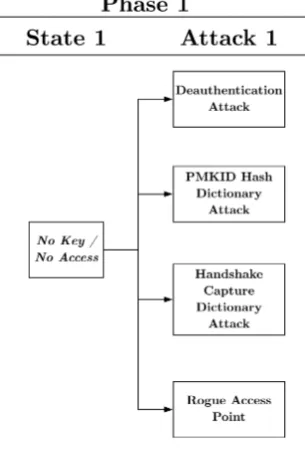
Figure 5.Phase 1
4.1.1. State - No Key / No Access 232
This is the beginning state of an adversary initializing his/her attack on a WiFi network, assuming 233
they have no advantages, such as the Wi-Fi passphrase or backdoor network access. In this state, the 234
adversary can only preform attacks listed in4.1to advance to a more advantageous state or reach a 235
desired outcome. 236
237
4.1.2. Attack - De-authentication Attack 238
The de-authentication attack is a straightforward attack that creates a denial of service (DoS) for 239
one or many users. When a client wants to connect with an access point (AP), it must first identify and 240
authenticate itself to the AP. The AP will then send a response back to the client acknowledging the 241
authentication. The client will then request an association with the AP and await the response for 242
connection. Once those initial steps are completed, the client and AP will perform a 4-way handshake 243
two devices can send encrypted data to each other. However, just as they can send authentication 245
frames to each other, they can also send de-authentication frames to tell the other device to cut 246
communication. De-authentication frames fall under the Management frames category. Management 247
frames are important system data packets sent from the AP to the client and vice verse. Unfortunately, 248
Management frames are sent through plaintext with no authentication protocol. The de-authentication 249
attack exploits this vulnerability by spoofing the MAC address of the devices, pretending to be the 250
client or AP, and sending de-authentication frames between them. The devices, thinking the flags are 251
coming from one another, will then cut connection with each other [25]. Multiple tools exist to perform 252
this attack, the most common being Aireplay-ng. 253
254
4.1.3. Attack - Handshake Capture Dictionary Attack 255
For a client to connect to an AP, the AP must first trust that the client is allowed to join the network 256
and give it the key that will be used in encryption of data. This trust is created and authenticated using 257
the 4-way handshake. 258
In this protocol, the client and the AP will communicate certain information to each other so that 259
the other can create several keys individually to arrive at an agreed upon key, the PTK, which will 260
be the fresh session key used for safe encrypted data transmission for that particular connection. For 261
each new connection made between the client and AP, a new PTK will be created for encryption. This 262
prevents a one-time derivation of the PTK by an adversary for decryption of future traffic. 263
To perform the off-line dictionary attack, the attacker will passively monitor the air for packets 264
going from a client to an AP. Being that Wi-Fi connection uses frequencies and sends information 265
through the air, an adversary can eavesdrop the packets destined for a specific AP and capture them. 266
The only components of this exchange making the connection and PTK fresh is the random nonces 267
in the handshake. By capturing the handshake, the attacker will have enough information to test to 268
see if a possible passphrase is correct. Referring back to Fig.2, the candidate passphrase is used to 269
derive the PMK, which is a PBDKF2 function of the PSK, derived from the passphrase, the SSID of the 270
AP, and an HMAC function. A PTK is created using the nonces that were captured, along with all 271
the other information that remains constant. The MIC is then derived from the PTK which will be 272
compared to the captured MIC. If the MIC’s match, that means the candidate passphrase was correct. 273
This process is repeated for every word in a wordlist until the correct passphrase is found [26]. 274
275
4.1.4. Attack - PMKID Hash Dictionary Attack 276
A new method of off-line dictionary attacks on a Wi-Fi network was discovered accidentally 6 277
years later in August of 2018 by researcher Jens "atom" Steube when attempting to break the WPA3 278
security scheme. In his post [27] he details a procedure in which an off-line dictionary attack can be 279
performed without needing to capture a handshake between another client and an AP. 280
The attack exploits the Robust Security Network Information Element (RSN) of a single EAPOL 281
frame. This EAPOL frame is received upon the Authentication phase of connection right before the 282
4-way handshake (see Fig.2). After examination of the captured frame using a packet capturing tool 283
(e.g. Wireshark), the RSN PMKID can be seen under the WPA Key Data section as a hash value. The 284
PMKID is calculated as: 285
PMKID=H(PMK, PMKName|MACAP|MACSTA) (1)
where the PMK is the key to the function and the data part is a fixed string PMK Name, the MAC 286
address of the AP, and the MAC address of the device trying to connect. With all this information 287
passphrases, and check the candidate PMKID hash against the PMKID sent in the EAPOL frame. If the 289
values match, then the passphrase attempted is the correct passphrase. 290
4.1.5. Attack - Rogue Access Point 291
A rogue access point is an unauthorized access point connected to a network that acts as a gateway 292
for users. A simple demonstration of this attack is to buy an AP and physically connect it to a port 293
that is connected to a specific network. With a wired connection, users can then access the network 294
wirelessly and interact with it as they please. This is dangerous as an attacker can set up an access 295
point with a known security key and create an unwanted backdoor into a network. However, this type 296
of attack may be difficult to perform, as gaining physical access to network ports is not always readily 297
available. 298
Attackers can also use rogue access points to acquire a network key using a phishing technique, 299
as opposed to brute force as described in sections4.1.3and4.1.4. This attack begins the same as 300
the Evil Twin attack, which will be discussed in section4.2.4, but the client will not fully connect to 301
the attackers AP. Instead, upon association the rogue AP will redirect the client to a landing page, 302
prompting the user to re-enter the Wi-Fi passphrase (e.g. for firmware update). The page will then use 303
a previously captured handshake that the legitimate AP used to authenticate a client and compare 304
the MIC to a computed PTK from the entered in passphrase that came through in plaintext from the 305
webpage. If incorrect, the webpage will tell the user to try again until the passphrase is correct. Many 306
may think this is suspicious and not partake, but it only takes one user out of many to enter in the 307
right passphrase. 308
Finally, an attacker can use a rogue AP to have a user connect to the AP, without knowing 309
the passphrase. This is done by imitating the SSID and MAC, as done int the Evil Twin attack in 310
section4.2.4, but create the AP on a different Radio Frequency (RF) channel. The AP will then send a 311
Channel Switch Announcement (CSA) beacon to prompt the user to switch channels from the genuine 312
APs channel to the malicious APs channel. The client will obey because it will think it is an authentic 313
frame from the AP due to the SSID and MAC address being spoofed. From there you can assume a 314
Non-Keyed AP Session Hijacking position to execute the KRACK attack, which will be discussed in 315
section4.2.6. 316
317
4.2. Phase 2 318
4.2.1. State - Key Acquisition 319
From the Brute Force / Dictionary and Rogue Access Point attacks preformed in4.1, the attacker 320
has gained the passphrase to the AP. This will now allow the execution of the Evil Twin attack, as well 321
as give the ability to legitimately join the network through the normal handshake process. Likewise, 322
from this position an adversary could monitor the air medium from packets being sent between clients 323
and APs, and using the passphrase can launch the Handshake Capture Decryption attack. 324
325
4.2.2. State - Join Network 326
In this state, the attacker has legitimate access to the network by using the passphrase to join as 327
an authenticated client. The state is reached only after the key acquisition state. From here, an attacker 328
can execute ARP spoofing on the AP and clients on the network. 329
Figure 6.Phase 2
4.2.3. State - Non-Keyed AP Session Hijacking 331
This is a unique state reached by preforming a rogue access point attack. The session created 332
between a client and a genuine AP is hijacked making the client believe he is still communicating with 333
the AP, when in reality, is connected to the attacker. This is done through channel switching. The 334
attacker, in this case, does not know the key, but merely redirected the connection. The connection 335
began with a handshake between the client and the genuine AP to create the sessions key. Since the 336
session was hijacked, encryption by the client using the original session key persists. Likewise, the 337
client expects encrypted packets to be decrypted using the original key. Without knowledge of the key, 338
handshake capture decryption is not possible. However, the attacker can perform the KRACK attack 339
to decrypt generated traffic by the client. 340
341
4.2.4. Attack - Evil Twin Attack 342
Another common practice is to trick the client into thinking they are connecting to a genuine AP, 343
while they are actually connecting to a rogue AP. This is a variant of the Rogue AP attack known as 344
the Evil Twin attack. The attacker impersonates a specific AP, in hopes that a user will connect to it. 345
Once the user connects to the malicious AP, the attacker will be a man-in-the-middle (MITM) and 346
will be able to decrypt, see, and manipulate traffic that the user is receiving and sending from their 347
device. The attacker will forward Internet access to the user, so the user will get what they want and 348
not suspect anything, but the attacker acts as a proxy which views all data first. 349
This is a problem for users that want to access the Internet in public areas such as coffee shops, 350
airports, and hotels, due to traveling or urgency of communication. The AP’s in these locations are 351
usually open to allow any user to connect and use the services. Since most of the time these APs do 352
not have a password, performing this attack becomes easier. However, as a safer practice these areas 353
will also have a password that is given out for specific, lenient reasons, such as making a purchase or 354
signing up, to at least allow some filtering and encryption can be applied to the traffic. Either way, the 355
This attack is simple in nature, due to the lack of authentication. To perform this attack, an attacker 357
either needs a router or wireless interface adapter on a laptop. For the router option, the attacker 358
must configure it, possibly changing the firmware, to have the same SSID (AP name), spoof the MAC 359
address of the real AP, and have the same encryption scheme. With the wireless adapter, an attacker 360
could use tools like Airbase-ng to achieve the same effect easily. However, this approach requires the 361
attacker to set up a DHCP on their machine and could be more complicated. Regardless, this attack is 362
simply imitating features of a valid AP to trick a connecting device. 363
Executing this attack ten years ago may have been easier than it is today due to human error. 364
Many newer models of Wi-Fi enabled devices implement the preferred networks feature which allows 365
the device to connect automatically to certain networks once the first handshake has been made. This 366
will stop the user from making a mistake and choosing the wrong network to connect to manually. 367
However, an attacker can trick the device into choosing the wrong network automatically by exploiting 368
signal strength. 369
Since all that is needed is the SSID and MAC address to be the same to trick the device, the 370
attacker will have that set up. Then the attacker will have to de-authenticate the user from the real AP 371
by sending de-authentication flags, as described in section4.1.2. Once the device is disconnected, it 372
will begin to look for connection again. When choosing between two AP’s with the same SSID, most 373
devices will usually choose the one with the stronger signal. Again, tools such as iwconfig can change 374
the AP’s signal strength to make sure yours is higher, however signal strength beyond a certain point 375
is illegal in certain countries. If the target router, however, contains a passphrase, then the attacker 376
must set up the malicious AP to have the same security protocol and the same passphrase, or else the 377
device will try to use the remembered passphrase for the handshake and get it wrong. 378
379
4.2.5. Attack - Handshake Capture Encryption / Decryption 380
This attack is fairly simple in its methodology after understanding the authentication process and 381
the 4-way handshake, which was explained in detail in2.3and in Fig.2. Using a wireless adapter 382
set to monitor mode and a traffic sniffing software, such as Wireshark, the attacker is able to view 383
and capture all traffic flowing from an client to an AP and vice versa, being the the messages are sent 384
through the air in a public medium. To a normal user, this traffic is useless because it is encrypted with 385
a different PTK for each user generated by the 4-way handshake upon connection. If the attacker, 386
however, was able to capture the handshake upon connection for a particular client and has knowledge 387
of the PSK, he would have enough information to derive the PTK for that client. The AP SSID and PSK 388
are already known by the attacker to generate the PMK. The attacker will then capture the two nonces 389
sent by the AP and the client and use them to derive the PTK, as shown in Fig.2. From there, the 390
attacker could use the PTK, along with the CCMP protocol shown in Fig.3, to derive all messages for 391
that session by the victim client and view the information being transmitted, as long as the attacker 392
keeps track of the message counter from the beginning of the connection, which is used in the CCMP 393
encryption. 394
395
4.2.6. Attack - KRACK Exploit 396
Vanhoef and Piessens discovered a vulnerability in the 4-way handshake that would give any 397
adversary the ability to decrypt a user’s traffic without needing to capture the handshake and have 398
knowledge of the key [2]. The vulnerability occurs in the installation of the PTK given a certain 399
message counter. To understand how this decryption can happen, we need to examine how the key 400
streams are used in encryption. 401
The CCMP encryption method is said to be highly secure due to its use of the AES-CTR encryption. 402
As mentioned earlier, this algorithm makes it extremely difficult for any computer to crack, impossible 403
creates the vulnerability that KRACK exploits. The encrypted message sent from the client to the AP is 405
simply the plaintext message XORed with the keystream, which is the PTK scrambled with several 406
other parameters using AES, as shown in Fig.3. 407
The vulnerability in this scheme is present in the last XOR step. There is a fundamental, 408
mathematical property of logical flow that makes the KRACK exploit possible. To create the Encrypted 409
textE, the PlaintextPis XORed with the KeystreamKSto yield the formula: 410
E=P⊕KS (2)
If an adversary were to capture two encrypted packets, he might be able to use these two packets 411
to decipher them. Given that the Key Streams are the same, an adversary could XOR the two Encrypted 412
texts together to cancel out the Key Streams and leave the two Plaintexts. 413
Given: 414
E1=P1⊕KS1 (3)
E2=P2⊕KS2 (4)
KS1=KS2=KS (5)
Then: 415
E1⊕E2= (P1⊕KS)⊕(P2⊕KS) =P1⊕P2 (6)
If the adversary were to be able guess or knowP1, then it is possible to decryptP2. This can be
416
done using a default known first messages that the AP or client will send upon connection. The WPA2 417
keystream is designed to change so that this exploit does not happen, but the KRACK researchers 418
found a way around this. The keystream is comprised of mainly static variables, such as the PTK, GTK, 419
flags, MAC addresses, and counters. The only variable that changes when encrypting messages is the 420
Packet Number (PN), as shown in gray in Fig.3. With a different packet number, the keystream will be 421
different for each encrypted message and the XOR cancellation will not be possible. 422
The KRACK exploit, however, takes advantage of a flaw in the design of the EAPOL handshake 423
to get two packets of the same keystream. After authentication and association, the client and the AP 424
begin to send 4 messages to each other, known as the 4-way handshake, which will give them both 425
the keys they need to construct each keystream and start encrypting data. Once the PTK & GTK are 426
installed on the client side, the client can begin sending data packets and encrypt using the CCMP 427
scheme shown in Fig.3. The first message sent after this key installation will have a packet number of 428
1. The AP will then know to decrypt the first incoming packet using the PTK and packet number 1. 429
They both then increment their packet number for the next packet sent. 430
This protocol, however, has a function designed to make the system more efficient, but results in 431
a vulnerability. There are occasions where the AP would need to resend message 3 if there was an 432
issue with message 4. In this scenario, the AP will resend message 3 (Msg 3; Fig.2) and the client 433
will respond by reinstalling the PTK & GTK and responding an acknowledgment (Msg 4). When this 434
happens, the Packet Number is also reset to 1. Knowing this, an adversary could hijack a session from 435
the AP, replay message 3 to the client, and start capturing packets from the client. This can then be 436
done again and again until you have several messages with an encryption using PN as 1, PN as 2, and 437
so on. XORing the packets with matching PNs and PTKs will then give you an XOR of two plaintexts. 438
If one of the plaintexts are known or guessed, then the adversary can derive all packets being sent. 439
This is especially dangerous as an adversary, in certain cases, can decrypt packets to obtain encryption 440
keys and forge arbitrary messages to inject into the communication. This applies only to TKIP and 441
GCMP encryption schemes however. It has been shown that this cannot work with CCMP, which 442
WPA2-PSK uses [5]. 443
4.3. Phase 3 445
Figure 7.Phase 3
4.3.1. State - Man in the Middle 446
The attacker in this state has placed himself between the client and a gateway by means of an Evil 447
Twin attack. In this position, all traffic that would normally be transmitted from the client to a genuine 448
AP first goes through the attackers machine. What makes this position so dangerous and powerful is 449
the fact that the client reconnects with the attackers AP and performs a handshake to create a session 450
key between them. This allows for simple packet sniffing without the need of a decryption attack. 451
Packets can also be easily altered going to and from the client to perform the attacks in4.4. Being a 452
MITM also creates a possibility of DoS, as the attacker can drop request and response packets going to 453
and from the client. 454
455
4.3.2. State - Packet Sniffing 456
Packet Sniffing is the state in which the attacker is able to capture traffic generated by the client 457
and/or AP and decrypt it. Handshake capture decryption can be performed with knowledge of the 458
key, given that the handshake of that client to the AP was captured, while the KRACK attack allows 459
this decryption without knowledge of they key. The packet sniffing state paired with Keyed AP Session 460
Hijacking allows the attacker to perform the Phase 4 attacks on the client. When paired with Keyed 461
Client Session Hijacking, the attacker will be able to Impersonate the client and request information 462
about the client. Packet sniffing ultimately leads to stolen information due to the decryption of data 463
packets to and from the client. 464
465
4.3.3. Attack - ARP Spoofing 466
ARP (Address Resolution Protocol) is used to map a client’s IP address to their MAC address in a 467
local network, such as a WLAN. Clients in this protocol have an ARP table which keeps track of all 468
other clients in the network to reference when a packet needs to be sent. When a client joins a network, 469
IP address and MAC address so that the client will be sure to acknowledge whom he is speaking with. 471
The other hosts will then send back ARP response packets identifying their IP and MAC addresses. 472
ARP will then form a table in which it will associate all the IP address with the MAC addresses which 473
it learned. 474
The main drawback of the ARP protocol is that it does not have any authentication procedure 475
before it is accepted into the table. The ARP packet is broadcasted in the network, everyone in the 476
network will get the packet, and any one can reply to that packet. This is called a Proxy ARP. Someone 477
else can answer the ARP broadcast, posing to be another host. Moreover, a malicious host can send an 478
ARP response irrespective of the requested ARP packets sent or not sent. ARP replies are accepted, 479
and the ARP table will be updated. 480
ARP spoofing can be used to hijack sessions with the AP and the Client. The attacker will send an 481
ARP reply to the client using its own MAC address, while using the IP address of the AP. At the same 482
time, attacker will send ARP reply to the AP with his own MAC address, using the IP address of the 483
client. This will change the ARP tables of both the AP and the client, thinking they have the right MAC 484
addresses for their respective IPs, but all packets sent for their specific IPs will be sent to the attacker 485
instead. In this attack, all the traffic flowing between the client and AP will be going through the 486
attacker’s machine. This attack can lead to Keyed AP Session Hijacking, Keyed AP Session Hijacking, 487
or both. 488
489
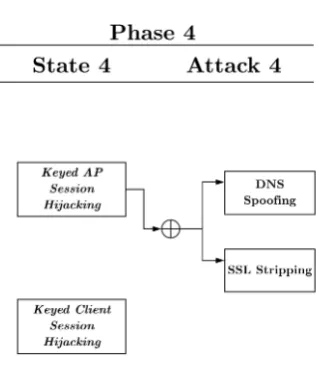
4.4. Phase 4 490
Figure 8.Phase 4
4.4.1. State - Keyed AP Session Hijacking 491
AP session hijacking from ARP spoofing accomplishes a similar task as the Non-Keyed AP 492
Sessions Hijacking explained in4.2.3in that it fools the client into believing it is communicating with a 493
genuine AP, when traffic is being sent to and from an adversaries machine. In this state alone, the 494
adversary, acting as the AP, can choose to not forward the clients requests out, consequently causing a 495
denial of service. ARP messages will constantly be sent to assure that the AP does not try to resolve the 496
problem by sending it’s own ARP packets to update the clients ARP table. The adversary, at this point 497
in time, has hijacked a session that was in progress between the AP and the client, meaning packets 498
have already been sent and the message counter in the CCMP protocol, shown in Fig.3, would have 499
incremented to an indistinguishable number, making the task of Handshake Capture Decryption and 500
has already been met, then the adversary would be capturing message packets from the client and AP, 502
and know what packet number they are up to. Therefore, when the adversary hijacks the session, he 503
will be able to decrypt the clients messages with the correct PTK and PN for CCMP decryption and 504
forge encrypted messages to send to the client to perform the attacks in4.4. 505
506
4.4.2. State - Keyed Client Session Hijacking 507
This state involves the attacker hijacking a current session that a victim client has with a genuine 508
AP be means of ARP spoofing. The attack is similar to the one discussed in4.4.1except ARP packets 509
are sent to the AP, instead of a client, to fool the AP into thinking the adversary is another client on the 510
network. Constantly sending ARP packets to the AP to update its ARP table so that the AP sends 511
a victim client’s packets to the attackers IP address will cause a DoS on the victim. Likewise, being 512
able to decrypt and forge messages with the previous techniques explained in4.4.1will allow the 513
attacker to send and receive messages on behave of the client. This can lead to impersonation, and 514
consequently, stolen information. 515
516
4.4.3. Attack - SSL Stripping 517
When an attacker performs a MITM attack or Keyed AP Session Hijacking with Packet Sniffing, 518
he has access to all traffic between a client and a gateway with the potential to view and manipulate 519
packets. If web traffic is being sent and received using HTTP, then the data will be sent in plain text 520
and the attacker can capture, read, and alter it. However, if the victim uses HTTPS webpages, which is 521
a combination of HTTP and SSL (Secured Socket Layer) protocols, even if the attacker captures the 522
packet, he will not be able to read the message because the text is encrypted by the SSL protocol. An 523
attacker can prevent the user, however, from accessing the HTTPS pages and allow the user to access 524
only HTTP version of the webpage with a technique known as SSL stripping. 525
The client sends an HTTPS request for a webpage over the Internet, which is then received by the 526
webserver who sends back the webpage with an encrypted SSL tunnel. If an attacker is proxying all 527
this traffic, however, he can alter the request for an HTTP webpage, instead of an HTTPS webpage. 528
The webpage stays the same, but the protocol being used lacks that extra layer of encryption between 529
the host and the webserver. Once the client receives the HTTP page, they will try to authenticate 530
with the webserver using his credentials, those credentials are in plain text and they are captured 531
by the attacker. The attacker will initiate a new HTTPS session using these credentials to the HTTPS 532
server. Then, the server will think that this connection is legitimate and accept it. There are two 533
different sessions that are formed; one is HTTP session formed between victim and attacker and 534
another between attacker and webserver. This will lead to leaked unencrypted credentials and stolen 535
information. 536
537
4.4.4. Attack - DNS Spoofing 538
DNS (Domain Name Server) spoofing is an attack that can be accomplished after a MITM 539
position or a Keyed Session Hijacking with Packet Sniffing. When a client sends a request in a web 540
browser using a domain name, an DNS request is sent to a DNS server asking for the IP address 541
of the requested domain name. The DNS server will then send the desired IP address back to the 542
client so that the client can send its HTTP request to the correct address. DNS spoofing works by 543
intercepting this DNS request, coming as a UDP packet from port 53, and checking the request 544
against a homemade text file with mappings of domain names an IP addresses. For example, when 545
a user is attempting to go to www.example.com, instead of getting the actual IP address of the 546
webserver of that domain name an attacker can map it to his own IP address and host a fake website 547
so similar to real webpages, that the user will be deceived into disclosing credentials or personal 549
information. They can also redirect them to a "Not Found" or "Under Maintenance" page to cause a DoS. 550
551
5. Wi-Fi Protected Access Version 3 (WPA3)
552
5.1. Overview 553
Released in June of 2018, WPA3 is the latest security scheme designed to strengthen security 554
in existing Wi-Fi networks and solve problems the previous versions encountered. WPA3 uses the 555
password-based Simultaneous Authentication of Equals (SAE) technique to authenticate the client to 556
the AP [28]. SAE was a protocol first introduced for use in WLAN mesh networks (IEEE 802.11s) by 557
Dan Harkins in 2008 [29], which was later proved to be vulnerable to passive and active attacks, as 558
well as off-line dictionary attacks, which it claimed to protect against [30]. After a revision of the RFC 559
7764 standard in 2015 [31], the improved protocol was shown to offer the protection promised [32]. 560
This resistance is achieved using a Dragonfly Handshake to leverage discrete logarithmic and elliptic 561
curve cryptography. The result of the handshake generates a PMK, which is then used in the standard 562
4-way handshake used in the WPA2 scheme. 563
The SAE protocol only uses the shared password for authentication, not for deriving the PMK. In 564
the dragonfly protocol, a Password ElementPEis used instead of the password for computing keys. 565
ThePEis determined at the time of the session, using an agreed upon set of elliptic curve parameters 566
p, which is a large prime number used to determine the prime field for the elliptic curve, andq, which 567
is another large prime number in the order of a groupG. agreed upon by the client and AP using 568
discrete logarithmic computation and a hunting-and-pecking technique with the password as a seed 569
value, described in [31]. 570
Figure 9.Dragonfly Handshake Diagram
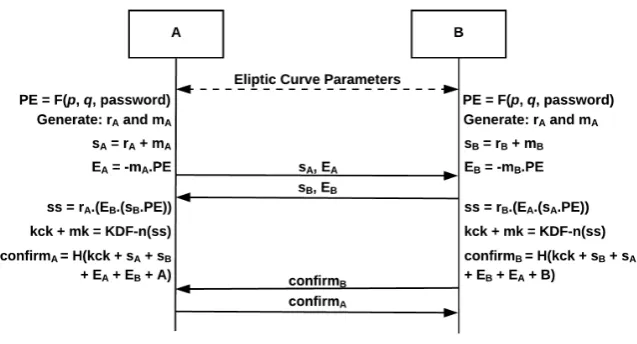
A detailed diagram of the Dragonfly handshake is provided in Fig.9, demonstrating a peer-to-peer 571
communication between two partiesAandB. After Elliptic Curve parameters are shared and thePE 572
is derived, both parties will then generate a privaterand maskm, which are randomly chosen large 573
numbers in the range{1...q}. They will then use those values to calculate a scalars, and along with the 574
PEcalculate an elementEusing the given Eqs. (7) and (8): 575
sA =rA+mA mod q (7)
Both parties then send these two calculated values to each other in the first two messages.Awill 576
then calculate the shared secretssby using the information sent byB, such that: 577
ss=rA.EB.sB.PE (9)
This can then be further simplified by canceling out operations. 578
ss=rA.(mB.PE)−1.(rB+mB).PE (10)
ss=rA.(mB.PE)−1.rB.PE+mB.PE (11)
ss=rA.rB.PE=rB.rA.PE (12)
Thesscalculated will then be used to derive the key confirmation keykckand the master keymk. 579
Thekckwill be put into a hash function, concatenated with the sender’s scalar, the receiver’s scalar, the 580
sender’s element, the receiver’s element, and the identity (in this case MAC address) of the sender to 581
confirm that the sender has calculated the correctss, and therefore has knowledge of the password. 582
con f irmA =H(kck+sA+sB+EA+EB+A) (13)
This confirmation message will be calculated on both sides in messages 3 and 4 with corresponding 583
variables for the sender. The order of concatenation and inclusion of corresponding identity adds 584
authenticity to the message to avoid replay of the other party’s message. Finally,mkwill be used as 585
the PMK in the 802.11i 4-way handshake that follows. 586
The security of this protocol lies in the intractable nature of the dot product operation in discrete 587
logarithmic computation. By knowingEAandPE, it is computationally intractable to findmA[33].
588
That way, even if an adversary were to compromise the password, he cannot use it to derive the PMK 589
himself and decrypt past messages. This provides an element of forward secrecy to the system. Since 590
users need to interact with the AP to derive the fresh PMK each time, attackers can only attempt to 591
obtain the shared password by trying one password at a time, receiving a correct or incorrect, then 592
trying again. This level of security strength allows for the user to have a less complicated password for 593
ease of use [28]. 594
The Wi-Fi CERTIFIED Enhanced Open program [34] implemented by the Wi-Fi Alliance applies 595
an extra layer of encryption to each message transmitted between the client and the AP, which allows 596
for private connection in open Wi-Fi networks with no password. This is done by the Elliptic Curve Key 597
Exchange explained above, simply without the 4-way handshake that follows. Protection Management 598
Frames (PMF), introduced in IEEE 802.11w, are also incorporated to encrypt system management 599
information between the client and AP so that an adversary cannot spoof management packets (such 600
as de-authentication requests) [35]. A Security Association (SA) mechanism is used to protect the 601
user and AP in the event of an unencrypted management frame. The SA query works by prompting 602
the sender to try the request at a later time within the designated time frame. The AP then sends an 603
encrypted SA request to the sender and waits for an encrypted response. If the sender is already in the 604
network, he will be able to send back an encrypted response within the given time. Otherwise, any 605
management frame will be ignored and dropped. 802.11w protects the following management frames 606
[36]: 607
• Spectrum Management 608
• QoS 609
• DLS 610
• Block Ack 611
• Radio Measurement 612
• Fast BSS Transition 613
• SA Query 614
• Protected Dual of Public Action 615
5.2. Security Evaluation and Analysis 617
As presented in this paper, there are many vulnerabilities in current security measures for WLAN 618
that attackers can leverage to cause all sorts of damage or gain undesired control. Researchers at the 619
Wi-Fi Alliance attempted to update the latest WPA2 system that was in place for 14 years, keeping 620
these vulnerabilities in mind. The release of WPA3 attempted to address these issues and enhance the 621
current state of security. This section will discuss the mitigation techniques for each attack mentioned 622
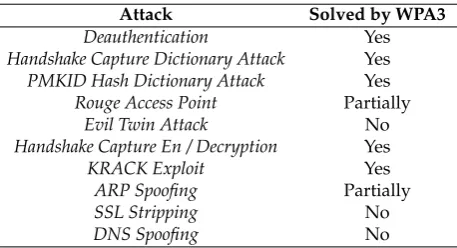
and whether WPA3 can offer a solution. Table 1 will outline the answer to the question and more 623
detailed analysis will follow. 624
Table 1.Attacks against Wi-Fi networks are listed and whether or not WPA3 addresses these attacks.
Attack Solved by WPA3
Deauthentication Yes
Handshake Capture Dictionary Attack Yes
PMKID Hash Dictionary Attack Yes
Rouge Access Point Partially
Evil Twin Attack No
Handshake Capture En / Decryption Yes
KRACK Exploit Yes
ARP Spoofing Partially
SSL Stripping No
DNS Spoofing No
In this section we will go through each attack in an analytical fashion and determine 625
whether WPA3 provides a solution to these vulnerabilities. The format will be as follows: a brief 626
introduction to the attack will be given along with what features could be used pose a defense, the 627
assumption of the attack and attacker, and the proof, which will either support or reject the assumption. 628
629
5.2.1. De-authentication 630
Here we will show how WPA3 provides protection to De-authentication attacks with the addition 631
of PMF and SA (Security Association) Query. Two cases will be given, followed by a security proof of 632
the resistance. 633
634
Case 1
635
An adversary would be able to send a de-authentication frame to the AP spoofing the MAC 636
address of the client to de-authenticate the client and cut connection with the AP. 637
Proof:When an AP receives an unencrypted de-authentication or dissociation frame from a client 638
who is already in session, the AP will trigger the SA mechanism and return an error response for the 639
client to try again later given a certain comeback time. The AP will then send an encrypted SA Query 640
request to the client and await a SA Query response within the response time. The adversary would 641
not be able to send back and encrypted response without the encryption key. Therefore, preforming a 642
de-authentication attack is unfeasible. 643
644
Case 2
645
An adversary would be able to send a de-authentication frame to one or more clients spoofing the 646
MAC address of the AP to de-authenticate the client and cut connection with the AP. 647
Proof:When a client receives an unencrypted de-authentication or dissociation frame from the 648
AP who is already in session, the client will send an encrypted SA Query request to the AP and await 649
a SA Query response within the response time. The real AP will be able to answer with a protected 650
de-authentication attack is unfeasible. 652
653
5.2.2. Handshake Capture Dictionary Attack 654
For off-line dictionary attacks WPA3 uses the SAE protocol as a defense. The protocol claims to be 655
resistant to passive, active and off-line dictionary attacks. 656
657
An adversary would not be able to able to go through a wordlist and compute a PMK that comes 658
from the dragonfly handshake to test the MIC of a PTK off-line without interacting with the AP. 659
Proof: The adversary will first try to capture messages from the dragonfly handshake, where 660
he will only obtainEA,EB,sA, andsB, as shown in Fig.9and defined in Eqs. (7) and (8). To obtain
661
the PMK used in the 4-way handshake, the adversary must compute the shared secretss, defined in 662
Eq. (12) which requires knowledge ofrAandrB, along with the password elementPE. A candidatePE
663
can be derived by brute forcing the password against a wordlist, which will be used as a seed in a 664
known function given the captured elliptic curve parameters pandq. However, from Eq. (8), it is 665
computationally intractable to obtainmAgivenEAandPE. Hence, the adversary would not be able to
666
derive a PMK and PTK to compare to a captured MIC and find the correct password that exists within 667
wordlist. Therefore, preforming this off-line dictionary attack is unfeasible. 668
669
5.2.3. PMKID Hash Dictionary Attack 670
As with the Handshake Capture Dictionary Attack, SAE protocol will defend against this form of 671
off-line dictionary attack. 672
673
An adversary would not be able to able to go through a wordlist and compute a PMKID that 674
comes from the dragonfly handshake to test the compare against a candidate PMKID to derive the 675
passphrase without actively going through the dragonfly handshake. 676
Proof:The AP does not have a static PMK derived from the PSK. Instead, the PMK comes from 677
the dragonfly handshake, which requires client interaction. Therefore, the PMKID would not be 678
available until after a valid execution of the dragonfly handshake. This is not feasible, as shown in the 679
Handshake Capture Dictionary Attack proof. Therefore, preforming this off-line dictionary attack is 680
unfeasible. 681
682
5.2.4. Rogue Access Point 683
Rouge APs are set up to deceive the user to connect to a false router that mimics a genuine one. 684
With the use of PMF some protection is given, but this problem persists. We break down the Rouge 685
AP analysis in two sections: Key Acquisition and AP Session Hijacking. The first will describe the 686
scenario where and adversary attempts to obtain a key using a malicious AP given two cases where the 687
client is either already connected or not connected yet. The second will demonstrate how an adversary 688
attempts to hijack the session from the AP, making the client think he/she is talking to a genuine AP 689
and not a malicious AP using two techniques. 690
691
Key Acquisition
692
Case 1: Client Connected
693
An adversary would be able to set up a malicious AP that impersonates the genuine APs SSID 694
and MAC address, as well as the correct security protocol with the wrong passphrase in an attempt to 695
have the user input the passphrase. The adversary will then not be able to de-authenticate an already 696
Proof: The adversary will identify the target AP and record its SSID, MAC address, and security 698
protocol. The adversary will wait until the client connects to the genuine AP to capture the handshake. 699
The adversary will then set up a rouge AP that matches the configurations of the target AP by spoofing 700
the SSID and MAC address. The adversary will then send de-authentication packets to the target client 701
to cut connection with the genuine AP. As demonstrated in the De-authentication proof, WPA3 will 702
not allow this to happen. The adversary is then forced to wait for abort the attack. 703
704
Case 2: Client not Connected
705
Continuing from the scenario in Case 1, the adversary will then wait for the client to try to connect 706
to the genuine AP and have them reconnect to the malicious AP instead by offering a stronger signal. 707
Proof: The adversary will identify the target AP and record its SSID, MAC address, and security 708
protocol. The adversary will wait until the client connects to the genuine AP to capture the handshake. 709
The adversary will then set up a rouge AP that matches the configurations of the target AP by spoofing 710
the SSID and MAC address. The adversary will strengthen the APs broadcast signal and wait for the 711
client to connect. Once the connection is made, before the handshake, the AP will redirect the user 712
to a landing page asking them to confirm the passphrase. The adversary will then take the plaintext 713
entries, calculate the PMK, PTK, and MIC to compare to the captured handshake and find the correct 714
key. Therefore, preforming a Rogue access point attack for obtaining network keys is feasible. 715
716
AP Session Hijacking
717
Technique 1: Physical Connection and ARP Spoofing
718
An adversary, assuming has connected a malicious AP physically to a network through wired 719
Ethernet, would not be able to send ARP packets to trick the client into thinking it is the real gateway. 720
Proof: The adversary will then send an ARP packet to the client spoofing the APs MAC address 721
with its own IP. The adversary will encrypt the message with the GTK, so the client can decrypt 722
the message with the same GTK, exploiting the Hole 196 vulnerability. A WPA3 router with Client 723
Isolation turned on, however, will not allow clients in a network to communicate with each other, or 724
know about each other for that matter. Therefore, performing this attack to hijack a client session from 725
a genuine AP is unfeasible. 726
727
Technique 2: Wireless Channel Switching
728
An adversary would not be able to send a message to the client to switch AP channels to the 729
malicious AP or de-authenticate from the real AP. 730
Proof: The adversary will set up an Evil Twin imitating the AP the client is connected to. The 731
adversary will send a CSA beacon to switch channels to from the legitimate AP to the malicious AP. 732
The PMF system should protect against this kind of message as it is under Spectrum Management [35] 733
and therefore be protected. If it is not, however, the client will try to switch over to the malicious AP. 734
The adversary will then try to de-authenticate the client to the AP to avoid any interference from the 735
AP. We have shown in the De-authentication proof that this cannot happen. Therefore, performing this 736
attack to hijack a client session from a genuine AP is unfeasible. 737
738
5.2.5. Evil Twin Attack 739
An Evil Twin is a malicious AP that attempts to trick a user into connecting to it by cloning a 740
genuine AP and offering a better signal in hopes the client will connect to it instead. Once the client is 741
deceived and connects to a malicious AP, the WPA3 protocol is out of its scope of protection. This 742
section gives two cases where the client is either already connected or not connected yet. 743
744
Case 1: Client Connected
An adversary would be able to set up a malicious AP that impersonates the genuine APs SSID 746
and MAC address, as well as the correct security protocol and passphrase being used to create a MITM 747
between the client and the Internet. The adversary will then be able to de-authenticate an already 748
connected client and have them reconnect to the malicious AP instead by offering a stronger signal. 749
Proof: The adversary will use a wireless adapter and set it to monitor mode to observe wireless 750
traffic in the air between clients and APs. The adversary will identify the target AP and record its SSID, 751
MAC address, and security protocol. The adversary will then set up a rouge AP that matches the 752
configurations of the target AP by spoofing the SSID and MAC address, and setting the passphrase to 753
be the same as the genuine AP. The adversary will then send de-authentication packets to the target 754
client to cut connection with the genuine AP. As demonstrated in the De-authentication proof, WPA3 755
will not allow this to happen. The adversary is then forced to wait for abort the attack. 756
757
Case 2: Client Not Connected
758
Continuing from the scenario in Case 1, an adversary will then wait for the client to try to connect 759
to the genuine AP and have them reconnect to the malicious AP instead by offering a stronger signal. 760
Proof: The adversary will use a wireless adapter and set it to monitor mode to observe wireless 761
traffic in the air between clients and APs. The adversary will identify the target AP and record its SSID, 762
MAC address, and security protocol. The adversary will then set up a rouge AP that matches the 763
configurations of the target AP by spoofing the SSID and MAC address, and setting the passphrase to 764
be the same as the genuine AP. The adversary will strengthen the APs broadcast signal and wait for 765
the client to connect. The client will enter the same passphrase shared with the genuine AP. This will 766
create a trusted connection with the malicious AP where the adversary can decrypt all traffic using 767
the PTK. Once out of the network, the WPA3 protocol no longer protect the client’s data. Therefore, 768
preforming a Rogue access point attack for creating a MITM is feasible. 769
770
5.2.6. Handshake Capture En / Decryption 771
In WPA2, an adversary was able to capture the two random nonces generated in the 4-way 772
handshake and sent over plaintext, and use them, along with the passphrase, to derive the PTK and 773
decrypt traffic. The WPA3 protocol uses the SAE protocol which utilizes both the dragonfly handshake 774
and the 4-way handshake. 775
776
An adversary would not be able to capture information from the two handshakes and derive a 777
PTK with knowledge of the password for a specific client to decrypt traffic. 778
Proof: The adversary will first try to capture messages from the dragonfly handshake, where 779
he will only obtainEA,EB,sA, andsB, as shown in Fig.9and defined in Eqs. (7) and (8). To obtain
780
the PMK used in the 4-way handshake, the adversary must compute the shared secretss, defined in 781
Eq. (12) which requires knowledge ofrAandrB, along with the password elementPE. ThePEcan be
782
derived by using the known password as a seed in a known function given the captured elliptic curve 783
parameterspandq. However, from Eq. (8), it is computationally intractable to obtainmAgivenEA
784
andPE. Hence, the adversary would not be able to derive a PMK and PTK to compare to a captured 785
MIC and find the correct password that exists within wordlist. Therefore, preforming Handshake 786
Capture Decryption is unfeasible. 787
788
5.2.7. KRACK Exploit 789
The KRACK exploit leverages the venerability of resending the message 3 in the 4-way handshake. 790
Patches to APs and devices have been released to not allow this retransmission. 791