Composite Likelihood Methods Based on Minimum
2Density Power Divergence Estimator
3Elena Castilla1*, Nirian Martín2, Leandro Pardo1and Konstantinos Zografos3 4
1 Department of Statistics and O.R. I, Complutense University of Madrid, 28040 Madrid, Spain; 5
2 Department of Statistics and O.R. II, Complutense University of Madrid, 28003 Madrid, Spain; 7
3 Department of Mathematics, University of Ioannina, 45110 Ioannina, Greece; [email protected] 9
* Correspondence: [email protected] 10
Abstract: In this paper a robust version of the Wald test statistic for composite likelihood is
11
considered by using the composite minimum density power divergence estimator instead of the
12
composite maximum likelihood estimator. This new family of test statistics will be called Wald-type
13
test statistics. The problem of testing a simple and a composite null hypothesis is considered and
14
the robustness is studied on the basis of a simulation study. Previously, the composite minimum
15
density power divergence estimator is introduced and its asymptotic properties are studied.
16
Keywords: composite likelihood; maximum composite likelihood estimator; Wald test statistic;
17
composite minimum density power divergence estimator; Wald-type test statistics.
18
1. Introduction 19
It is well-known that the likelihood function is one of the most important tools in the classical
20
inference and the resultant estimator, the maximum likelihood estimator (MLE), has nice efficient
21
properties although it has no so good robustness properties.
22
Tests based on MLE (likelihood ratio test, Wald test, Rao’s test, etc.) have, usually, good efficient
23
properties but in presence of outliers the behavior is not so good. To solve these situations many
24
robust estimators have been introduced in the statistical literature, some of them based on distance
25
measures or divergence measures. In particular, density power divergence measures introduced in [1]
26
have given good robust estimators: minimum density power divergences estimators (MDPDE) and,
27
based on them, some robust test statistics have been considered for testing simple and composite null
28
hypotheses. Some of these tests are based on divergence measures (see [2] and [3]) and some other
29
are used to extend the classical Wald test, see [4], [5], [6] and references therein.
30
The classical likelihood function requires exact specification of the probability density function
31
but in most applications the true distribution is unknown. In some cases, where the data distribution
32
is available in an analytic form, the likelihood function is still mathematically intractable due to the
33
complexity of the probability density function. There are many alternatives to the classical likelihood
34
function; in this paper we focus on the composite likelihood. Composite likelihood is an inference
35
function derived by multiplying a collection of component likelihoods; the particular collection
36
used is a conditional determined by the context. Therefore, the composite likelihood reduces the
37
computational complexity so that it is possible to deal with large datasets and very complex models
38
even when the use of standard likelihood methods is not feasible. Asymptotic normality of the
39
composite maximum likelihood estimator (CMLE) still holds with Godambe information matrix to
40
replace the expected information in the expression of the asymptotic variance-covariance matrix. This
41
allows the construction of composite likelihood ratio test statistics, Wald-type test statistics as well as
42
Score-type statistics. A review of composite likelihood methods is given in [7]. We have to mention
43
at this point that CMLE, as well as the respective test statistics, are seriously affected by the presence
44
of outliers in the set of available data.
45
The main purpose of the paper is to introduce a new robust family of estimators, namely,
46
composite minimum density power divergence estimators (CMDPDE) as well as a new family of
47
Wald-type test statistics based on the CMDPDE in order to get broad classes of robust estimators and
48
test statistics.
49
In Section2we introduce the CMDPDE and we obtain the estimating system of equations to
50
find it. The asymptotic distribution of the CMDPDE is obtained in Subsection2.1. Subsection2.2 51
is devoted to the definition of a family of Wald-type test statistics, based on CMDPDE, for testing
52
simple and composite null hypotheses. The asymptotic distribution of these Wald-type test statistics
53
is obtained as well as some asymptotic approximations to the power function. A numerical example,
54
presented previously in [8], is studied in Section3. A simulation study based on this example is
55
also presented (Subsection 3.1), in order to study the robustness of the CMDPDE as well as the
56
performance of the Wald-type test statistics based on CMDPDE. Proofs of results are presented in
57
the AppendixA.
58
2. Composite Minimum Density Power Divergence Estimator 59
We adopt here the notation by [9], regarding composite likelihood function and the respective
60
CMLE. In this regard, let {f(·;θ),θ ∈ Θ ⊆ Rp,p ≥ 1} be a parametric identifiable family of 61
distributions for an observationy, a realization of a randomm-vectorY. In this setting, the composite
62
density based onKdifferent marginal or conditional distributions has the form
63
CL(θ,y)= K
∏
k=1fwk
Ak(yj,j∈Ak;θ)
and the corresponding composite log-density has the form
64
c`(θ,y) = K
∑
k=1wk`Ak(θ,y),
with
65
`Ak(θ,y) =logfAk(yj,j∈ Ak;θ),
where {Ak}Kk=1 is a family of random variables associated either with marginal or conditional 66
distributions involving some yj, j ∈ {1, ...,m} and wk, k = 1, ...,K are non-negative and known
67
weights. If the weights are all equal, then they can be ignored. In this case all the statistical procedures
68
produce equivalent results.
69
Let alsoy1, ...,ynbe independent and identically distributed replications ofy. We denote by
70
c`(θ,y1, ...,yn)= n
∑
i=1c`(θ,yi)
the composite log-likelihood function for the whole sample. In complete accordance with the classic
71
MLE, the CMLE,bθc, is defined by 72
bθc=arg max θ∈Θ
n
∑
i=1c`(θ,yi)=arg max
θ∈Θ
n
∑
i=1K
∑
k=1wk`Ak(θ,yi). (1)
It can be also obtained by the solution of the equations
73
u(θ,y1, ...,yn)=0p,
where
u(θ,y1, ...,yn)= ∂c
`(θ,y1, ...,yn)
∂θ =
n
∑
i=1K
∑
k=1wk
∂`Ak(θ,yi)
∂θ .
We are going to see how it is possible to get the CMLE,bθc, on the basis of the Kullback-Leibler 75
divergence measure. We shall denote by g(y) the density generating the data with respective
76
distribution function denoted byG. The Kullback-Leibler divergence between the density function
77
g(y)and the composite density functionCL(θ,y)is given by 78
dKL(g(.),CL(θ, .)) = Z
Rm
g(y)log g(y)
CL(θ,y)dy =
Z
Rm
g(y)logg(y)dy−
Z
Rm
g(y)logCL(θ,y)dy.
The term
79
Z
Rm
g(y)logg(y)dy
can be removed because it does not depend onθ; hence, we can define the following estimator ofθ, 80
based on the Kullback-Leibler divergence
81
b
θKL=arg min
θ
dKL(g(.), CL(θ, .))
or equivalently
82
bθKL = arg min θ
−
Z
Rm
g(y)logCL(θ,y)dy
= arg min
θ
−
Z
Rm
logCL(θ,y)dG(y)
. (2)
If we replace in (2) the distribution functionGby the empirical distribution functionGnwe have
83
b
θKL = arg min
θ
−
Z
Rm
logCL(θ,y)dGn(y)
= arg min
θ
−1
n n
∑
i=1c`(θ,yi) !
and this expression is equivalent to the expression (1). Therefore, the estimatorbθKLcoincides with 84
the CMLE. Based on the previous idea we are going to introduce, in a natural way, the composite
85
minimum density power divergence estimator (CMDPDE).
86
The CMLE,bθc, obeys asymptotic normality, see [9], and in particular 87
√
n(bθc−θ) −→L n→∞N
0,G−∗1(θ)
,
whereG∗(θ)denotes Godambe information matrix, defined by 88
G∗(θ)=H(θ)J−1(θ)H(θ),
with H(θ)being the sensitivity or Hessian matrix and J(θ) being the variability matrix, defined, 89
respectively, by
H(θ)=Eθ[−∂∂θuT(θ,Y)],
J(θ)=Varθ[u(θ,Y)] =Eθ[u(θ,Y)u
T( θ,Y)],
where the superscriptTdenotes the transpose of a vector or a matrix.
91
The matricesH(θ)andJ(θ)are, by definition, nonegative definite matrices but throughout this 92
paper both,H(θ)and J(θ), are assumed to be positive definite matrices. Since the component score 93
functions can be correlated, we haveH(θ) 6= J(θ). Ifc`(θ,y)is a true log-likelihood function then 94
H(θ)= J(θ) = IF(θ), being IF(θ)the Fisher information matrix of the model. Using multivariate 95
version of the Cauchy-Schwarz inequality we have that the matrix G∗(θ)−IF(θ)is non-negative 96
definite, i.e., the full likelihood function is more efficient than any other composite likelihood function
97
(cf. [10], Lemma 4A).
98
We are going now to proceed to the definition of the CMDPDE which is based on the density
99
power divergence measure, defined as follows. For two densities p and q associated with two
100
m-dimensional random variables respectively, density power divergence (DPD) betweenpandqwas
101
defined in [1] by
102
dβ(p,q) = Z
Rm
q(y)1+β−
1+1
β
q(y)βp(y) + 1
β p(y)
1+β
dy, forβ>0, while forβ=0 it is defined by
103
lim
β→0
dβ(p,q) =dKL(p,q).
For more details about this family of divergence measures we refer to [11].
104
In this paper we are going to consider DPD measures between the density functiong(y)and the
105
composite density functionCL(θ,y), i.e., 106
dβ(g(.),CL(θ, .)) = Z
Rm
CL(θ,y)1+β−
1+ 1
β
CL(θ,y)βg(y) + 1
β g(y)
1+β
dy (3)
forβ>0, while forβ=0 we have,
107
lim
β→0dβ(g(.),CL(θ, .)) =dKL(g(.),CL(θ, .)).
The CMDPDE,bθ β
c, is defined by 108
b
θcβ=arg min
θ∈Θ
dβ(g(.),CL(θ, .)).
The term
109
Z
Rm
g(y)1+βdy
does not depend onθand consequently the minimization of (3) with respect to θis equivalent to 110
minimize
111
Z
Rm
CL(θ,y)1+β−
1+ 1
β
CL(θ,y)βg(y)
dy
or
Z
Rm
CL(θ,y)1+βdy−
1+ 1
β
Z
Rm
CL(θ,y)βdG(y).
Now, we replace the distribution functionGby the empirical distribution functionGnand we get
113
Z
Rm
CL(θ,y)1+βdy−
1+1
β
1
n n
∑
i=1CL(θ,yi)β. (4)
In consequence, for a fixed value of β, the CMDPDE of θcan be obtained by minimizing the 114
expression given in (4). Or equivalently by maximizing the expression
115
1
nβ
n
∑
i=1CL(θ,yi)β− 1
1+β
Z
Rm
CL(θ,y)1+βdy. (5)
Under differentiability of the model the maximization of the function in equation (5) leads to an
116
estimating system of equations of the form
117
1
n n
∑
i=1CL(θ,yi)β∂c `(θ,yi)
∂θ −
Z
Rm
∂c`(θ,y)
∂θ CL(θ,y)
1+βdy=0. (6)
The system of equations (6) can be written as
118
1
n n
∑
i=1CL(θ,yi)βu(θ,yi)− Z
Rm
u(θ,y)CL(θ,y)1+βdy=0. (7)
and the CMDPDEbθ β
c ofθis obtained by the solution of (7). 119
2.1. Asymptotic Distribution of the Composite Minimum Density Power Divergence Estimator 120
Equation (7) can be written as follows
121
1
n n
∑
i=1Ψβ(yi,θ) =0
with
122
Ψβ(yi,θ) =CL(θ,yi)βu(θ,yi)− Z
Rm
u(θ,y)CL(θ,y)1+βdy.
Therefore the CMDPDE, bθ β
c, is an M-estimator. In this case it is well-known (cf.[12]) that the 123
asymptotic distribution ofbθ β
c is given by 124
√
n(bθ β
c −θ) −→L n→∞N
0,H−β1(θ)Jβ(θ)H−β1(θ)
,
being
125
Hβ(θ) =Eθ
−∂Ψβ(Y,θ) ∂θT
and
126
Jβ(θ) =Eθ h
Ψβ(Y,θ)Ψβ(Y,θ) Ti
.
∂Ψβ(y,θ)
∂θT
= βCL(θ,y)β−1CL(θ,y)u(θ,y)Tu(θ,y)+CL(θ,y)β∂u(θ,y) T
∂θ
−
Z
Rm
∂u(θ,y)T
∂θ CL(θ,y)
1+βdy−(1+
β)
Z
Rm
CL(θ,y)βCL(θ,y)u(θ,y)Tu(θ,y)dy
and
128
Hβ(θ) =Eθ
−∂Ψβ(Y,θ) ∂θT
=
Z
Rm
CL(θ,y)β+1u(θ,y)Tu(θ,y)dy. (8)
In relation toJβ(θ)we have, 129
Ψβ(Y,θ)Ψβ(Y,θ)
T = CL(
θ,y)βu(θ,y)− Z
Rm
u(θ,y)CL(θ,y)1+βdy
CL(θ,y)βu(θ,y)T− Z
Rm
u(θ,y)TCL(θ,y)1+βdy
= CL(θ,y)2βu(θ,y)u(θ,y)T− CL(θ,y)βu(θ,y) Z
Rm
u(θ,y)TCL(θ,y)1+βdy
−CL(θ,y)βu(θ,y)T Z
Rm
u(θ,y)CL(θ,y)1+βdy +
Z
Rm
u(θ,y)CL(θ,y)1+βdy Z
Rm
u(θ,y)TCL(θ,y)1+βdy
.
Then
130
Jβ(θ) = Eθ h
Ψβ(Y,θ)Ψβ(Y,θ) Ti
= Z
Rm
CL(θ,y)2β+1u(θ,y)u(θ,y)Tdy (9)
−
Z
Rm
CL(θ,y)β+1u(θ,y)dy Z
Rm
u(θ,y)TCL(θ,y)1+βdy. (10)
Based on the previous results we have the following Theorem.
131
Theorem 1. Under some regularity conditions (cf. [13], pp.58 or [14], pp.144) we have 132
√
n(bθ β
c −θ) −→L n→∞N
0,H−β1(θ)Jβ(θ)H−β1(θ)
,
where the matricesHβ(θ)andJβ(θ)were defined in (8) and (9), respectively. 133
Remark 1. If we apply the previous theorem for β = 0 then we get the CMLE and the asymptotic
134
variance covariance matrix coincides with Godambe information matrix because
135
Hβ(θ) =H(θ)andJβ(θ) =J(θ),
forβ=0.
136
2.2. Wald-Type Tests Statistics Based on Composite Minimum Power Divergence Estimator 137
Wald-type test statistics based on MDPDE have been considered with excellent results in relation
138
to the robustness in different statistical problems, see for instance [4], [5] and [6].
139
Motivated by those works, we focus in this section on the definition and the study of Wald-type
140
test statistics which are defined by means of CMDPDE estimators instead of MDPDE estimators. In
141
this context, if we are interested in testing
H0:θ=θ0againstH1:θ6=θ0, (11)
we can consider the family of Wald-type test statistics
143
Wn0,β=n(bθ β c−θ0)T
H−β1(θ0)Jβ(θ0)H
−1 β (θ0)
−1 (bθ
β
c −θ0). (12)
Forβ=0 we get the classical Wald type test statistic considered in the composite likelihood methods
144
(see, for instance, [7]).
145
In the following Theorem we present the asymptotic null distribution of the family of the
146
Wald-type test statisticsWn0,β.
147
Theorem 2. The asymptotic distribution of the Wald-type test statistics given in (12) is a chi-square 148
distribution with p degrees of freedom. 149
The proof of this Theorem2is given in the AppendixA.1.
150
Theorem 3. Letθ∗be the true value of the parameterθ, withθ∗6=θ0.Then it holds 151
√
nlbθ β c
−l(θ∗)
L
−→
n→∞N(0,σ 2 W0
β
(θ∗)),
being 152
l(θ) = (θ−θ0)T
H−β1(θ0)Jβ(θ0)H
−1 β (θ0)
−1
(θ−θ0)
and 153
σW20
β
(θ∗) =4(θ∗−θ0)T
H−β1(θ0)Jβ(θ0)H
−1 β (θ0)
−1
(θ∗−θ0). (13)
The proof of the Theorem is outlined in the AppendixA.2.
154
Remark 2. Based on the previous result we can approximate the power, βW0
n, of the Wald-type test
155
statistics inθ∗, by 156
βW0
n,β
(θ∗) = Pr
Wn0,β>χ2p,α/θ=θ∗
= Pr lbθ β c
−l(θ∗)>
χ2p,α
n −l(θ
∗
)
θ=θ∗ !
= Pr √nlbθ β c
−l(θ∗)
>√n χ 2 p,α n −l(θ
∗)
!
θ=θ∗ !
= Pr
√
n
lbθ β c
−l(θ∗)
σW0
n,β
(θ∗) >
√
n σW0
n,β
(θ∗)
χ2p,α
n −l(θ
∗)
!
θ=θ∗
= 1−Φn
√
n σW0
n,β
(θ∗)
χ2p,α
n −l(θ
∗)
!
,
where Φn is a sequence of distributions functions tending uniformly to the standard normal 157
distribution functionΦ(x).
158
It is clear that
lim
n→∞βW0
n,β
(θ∗) =1
for allα∈(0, 1). Therefore the Wald-type test statistics are consistent in the sense of Fraser.
160
In many practical hypothesis testing problems, the restricted parameter spaceΘ0⊂Θis defined 161
by a set ofrrestrictions of the form
162
g(θ) =0r (14)
onΘ, whereg :Rp→Rris a vector-valued function such that thep×rmatrix 163
G(θ) = ∂g T(θ)
∂θ (15)
exists and is continuous inθand rank(G(θ)) =r; where0rdenotes the null vector of dimensionr. 164
Now we are going to consider composite null hypotheses,Θ0⊂Θ, in the way considered in (14) 165
and our interest is in testing
166
H0:θ∈Θ0againstH1:θ∈/Θ0 (16)
on the basis of a random simple of sizen,X1, ....Xn. 167
Definition 4. The family of Wald-type test statistics for testing (16) is given by
168
Wn,β =ng
b θcβ
Th GT(bθ
β
c)H−β1(bθ β c)Jβ(bθ
β
c)H−β1(bθ β c)G(bθ
β c)
i−1 gbθ
β c
, (17)
where the matrices G(θ),Hβ(θ)and Jβ(θ)were defined in (15), (8) and (9), respectively and the 169
functiongin (14).
170
If we considerβ= 0 thenbθβ coincides with the MLE,bθ, ofθandH
−1
β (bθ)Jβ(bθ)H
−1
β (bθ)with the 171
inverse of the Fisher information matrix and then we get the classical Wald test statistic considered in
172
the composite likelihood methods.
173
In the next theorem we present the asymptotic distribution ofWn,β. 174
Theorem 5. The asymptotic distribution of the Wald-type test statistics, given in (17), is a chi-square 175
distribution with r degrees of freedom. 176
The proof of this Theorem is presented in the AppendixA.3.
177
Consider the null hypothesis H0 : θ ∈ Θ0 ⊂ Θ. By Theorem5, the null hypothesis should 178
be rejected if Wn,β ≥ χ2r,α. The following theorem can be used to approximate the power function. 179
Assume thatθ∗∈/Θ0is the true value of the parameter so thatbθβ a.s. −→
n→∞θ
∗.
180
Theorem 6. Letθ∗be the true value of the parameter, withθ∗6=θ0.Then it holds 181
√
nl∗bθ β c
−l∗(θ∗)
L
−→
n→∞N(0,σ 2 Wβ(θ
∗))
being 182
l∗(θ) =ng(θ)T h
GT(θ0)H−β1(θ0)Jβ(θ0)H
−1
β (θ0)G(θ0) i−1
g(θ)
σ2W
β(θ ∗
) =
∂l∗(θ)
∂θ T
θ=θ∗
H−β1(θ0)Jβ(θ0)H
−1 β (θ0)
∂l∗(θ)
∂θ
θ=θ∗
. (18)
3. Numerical Example 184
In this section we shall consider an example, studied previously by [8], in order to study the
185
robustness of CMLE. The aim of this section is to clarify the different issues which are discussed in
186
the previous sections.
187
Consider the random vector Y = (Y1,Y2,Y3,Y4)T which follows a four dimensional normal 188
distribution with mean vectorµ= (µ1,µ2,µ3,µ4)Tand variance-covariance matrix 189
Σ=
1 ρ 2ρ 2ρ
ρ 1 2ρ 2ρ
2ρ 2ρ 1 ρ
2ρ 2ρ ρ 1
, (19)
i.e., we suppose that the correlation betweenY1andY2is the same as the correlation betweenY3and 190
Y4. Taking into account thatΣshould be semi- positive definite, the following condition is imposed, 191
−1
5 ≤ ρ ≤ 13. In order to avoid several problems regarding the consistency of the CMLE of the 192
parameterρ(cf. [8]), we shall consider the composite likelihood function
193
CL(θ,y) = fA1(θ,y)fA2(θ,y),
where
194
fA1(θ,y) = f12(µ1,µ2,ρ,y1,y2), fA2(θ,y) = f34(µ3,µ4,ρ,y3,y4),
wheref12and f34are the densities of the marginals ofY, i.e. bivariate normal distributions with mean 195
vectors(µ1,µ2)Tand(µ3,µ4)T, respectively, and common variance-covariance matrix 196
1 ρ
ρ 1
!
,
with densities given by
197
fh,h+1(µh,µh+1,ρ,yh,yh+1) =
1 2πp1−ρ2
expn− 1
2(1−ρ2)Q(yh,yh+1) o
, h∈ {1, 3}, being
198
Q(yh,yh+1) = (yh−µh)2−2ρ(yh−µh)(yh+1−µh+1) + (yh+1−µh+1)2, h∈ {1, 3}.
Byθwe are denoting the parameter vector of our model, i.e,θ= (µ1,µ2,µ3,µ4,ρ)T. We are going to
199
get the system of equations that it is necessary to solve in order to obtain the CMDPDE
200
b θcβ=
b
µβ1,c,µb β 2,c,µb
β 3,c,µb
β 4,c,bρ
β c
T
.
The estimatorbθ β
c is obtained by maximizing the expression (4) with respect toθ.Firstly we are going 201
to get
Z
R4
∂CL(θ,y)1+β
∂θ dy =
∂
∂θ Z
R4
CL(θ,y)1+βdy
= ∂
∂θ Z
R4
f12(µ1,µ2,ρ,y1,y2)β+1f34(µ3,µ4,ρ,y3,y4)β+1dy1dy2dy3dy4
= ∂
∂θ Z
R2
f12(µ1,µ2,ρ,y1,y2)β+1dy1dy2 Z
R2
f34(µ3,µ4,ρ,y3,y4)β+1dy3dy4
.
Based on [13] (pp. 32)
203
Z
R2
f12(µ1,µ2,ρ,y1,y2)β+1dy1dy2= Z
R2
f34(µ3,µ4,ρ,y3,y4)β+1dy3dy4=
1−ρ2− β
2
β+1 (2π) −β.
Then
204
Z
R4
∂CL(θ,y)1+β
∂θ dy=
∂
∂θ Z
R4
CL(θ,y)1+βdy= ∂
∂θ
1−ρ2−β
(β+1)2
(2π)−2β
and
205
∂
∂µi
1−ρ2−β
(β+1)2
(2π)−2β =0, i=1, 2, 3, 4,
while
206
∂
∂ρ
1−ρ2−β
(β+1)2
(2π)−2β = β(2π) −2β
(β+1)2
2ρ
(1−ρ2)β+1
.
Now, we are going to get
207
1
nβ
n
∑
i=1∂CL(θ,yi)β
∂θ
in order to obtain the CMDPDE,bθ β
c, by maximizing (4) with respect toθ. 208
We have,
209
CL(θ,y)β= f12(µ1,µ2,ρ,y1,y2)βf34(µ3,µ4,ρ,y3,y4)β.
Therefore,
210
∂CL(θ,yi)β
∂µ1
=βf12(µ1,µ2,ρ,y1i,y2i)β−1
− 1
2(1−ρ2)[−2(y1i−µ1) +2ρ(y2i−µ2)]
f34(µ3,µ4,ρ,y3i,y4i)β
and the expression
211
1
nβ
n
∑
i=1∂CL(θ,yi)β
∂µ1
=0
1
n n
∑
i=1f12(µ1,µ2,ρ,y1i,y2i)β−1f34(µ3,µ4,ρ,y3i,y4i)β
− 1
2(1−ρ2)[−2(y1i−µ1) +2ρ(y2i−µ2)]
=0.
(20) In a similar way
213
∂CL(θ,yi)β
∂µ2
=βf12(µ1,µ2,ρ,y1i,y2i)β−1
− 1
2(1−ρ2)[−2(y2i−µ2) +2ρ(y1i−µ1)]
f34(µ3,µ4,ρ,y3i,y4i)β,
∂CL(θ,yi)β
∂µ3
=βf12(µ1,µ2,ρ,y1i,y2i)β
− 1
2(1−ρ2)[−2(y3i−µ3) +2ρ(y4i−µ4)]
f34(µ3,µ4,ρ,y3i,y4i)β−1
and
∂CL(θ,yi)β
∂µ4
=βf12(µ1,µ2,ρ,y1i,y2i)β
− 1
2(1−ρ2)[−2(y4i−µ4) +2ρ(y3i−µ3)]
f34(µ3,µ4,ρ,y3i,y4i)β−1.
Therefore the equations
214
1
nβ
n
∑
i=1∂CL(θ,yi)β
∂µ2
=0, 1
nβ
n
∑
i=1∂CL(θ,yi)β
∂µ3
=0 and 1
nβ
n
∑
i=1∂CL(θ,yi)β
∂µ4
=0
lead to the estimators ofµ2,µ3andµ4, which should be read as follows 215
1
n n
∑
i=1f12(µ1,µ2,ρ,y1i,y2i)β−1f34(µ3,µ4,ρ,y3i,y4i)β
− 1
2(1−ρ2)[−2(y2i−µ2) +2ρ(y1i−µ1)]
=0,
(21)
1
n n
∑
i=1f12(µ1,µ2,ρ,y1i,y2i)β−1f34(µ3,µ4,ρ,y3i,y4i)β
− 1
2(1−ρ2)[−2(y3i−µ3) +2ρ(y4i−µ4)]
=0
(22) and
216
1
n n
∑
i=1f12(µ1,µ2,ρ,y1i,y2i)βf34(µ3,µ4,ρ,y3i,y4i)β
− 1
2(1−ρ2)[−2(y4i−µ4) +2ρ(y3i−µ3)]
=0.
(23) Now it is necessary to get
217
∂CL(θ,yi)β
∂ρ =
∂f12(µ1,µ2,ρ,y1i,y2i)βf34(µ3,µ4,ρ,y3i,y4i)β
∂ρ
= βf12(µ1,µ2,ρ,y1i,y2i)β−1f34(µ3,µ4,ρ,y3i,y4i)β
∂f12(µ1,µ2,ρ,y1i,y2i)
∂ρ
+βf12(µ1,µ2,ρ,y1i,y2i)βf34(µ3,µ4,ρ,y3i,y4i)β−1
∂f34(µ3,µ4,ρ,y3i,y4i)
But∂f12(µ1,µ2,ρ,y1i,y2i)
∂ρ is given by
218
1 2π
(−1) (1−ρ2)
(−2ρ)
2(1−ρ2)
1 2
exp
(−1)
2(1−ρ2)
h
(y1i−µ1)2−2ρ(y1i−µ1) (y2i−µ2) + (y2i−µ2)2 i
+ 1
2π(1−ρ2)
1 2
exp
(−1)
2(1−ρ2)
h
(y1i−µ1)2−2ρ(y1i−µ1) (y2i−µ2) + (y2i−µ2)2 i
" −ρ
(1−ρ2)2
(y1i−µ1)2−2ρ(y1i−µ1) (y2i−µ2) + (y2i−µ2)2
+ 1
(1−ρ2)(y1i−µ1) (y2i−µ2)
#
= ρ
1−ρ2f12(µ1,µ2,ρ,y1i,y2i) +f12(µ1,µ2,ρ,y1i,y2i)
" −ρ
(1−ρ2)2
(y1i−µ1)2−2ρ(y1i−µ1) (y2i−µ2) + (y2i−µ2)2
+ 1
(1−ρ2)(y1i−µ1) (y2i−µ2)
#
= f12(µ1,µ2,ρ,y1i,y2i)
ρ
1−ρ2
1− 1
1−ρ2
(y1i−µ1)2−2ρ(y1i−µ1) (y2i−µ2) + (y2i−µ2)2
+1
ρ (y1i−µ1) (y2i−µ2)
.
In a similar way∂f34(µ3,µ4,ρ,y3i,y4i)
∂ρ is given by
219
f34(µ3,µ4,ρ,y3i,y4i)
ρ
1−ρ2
1− 1
1−ρ2
(y3i−µ3)2−2ρ(y3i−µ3) (y4i−µ4) + (y4i−µ4)2
+1
ρ(y3i−µ3) (y4i−µ4)
.
Therefore,
220
∂CL(θ,yi)β
∂ρ =
ρ
1−ρ2βf12(µ1,µ2,ρ,y1i,y2i)
βf
34(µ3,µ4,ρ,y3i,y4i)β
2+ 1
ρ{(y1i−µ1) (y2i−µ2) + (y3i−µ3) (y4i−µ4)}
− 1
1−ρ2
(y1i−µ1)2−2ρ(y1i−µ1) (y2i−µ2) + (y2i−µ2)2
− 1
1−ρ2
(y3i−µ3)2−2ρ(y3i−µ3) (y4i−µ4) + (y4i−µ4)2
. (24)
So the equation in relation toρis given by
221
1
nβ
n
∑
i=1∂CL(θ,yi)β
∂ρ −
1
β+1
Z
Rm
∂CL(θ,yi)β+1
∂ρ dy=0
being
222
Z
Rm
∂CL(θ,yi)β+1
∂θ dy=
β(2π)−2β
(β+1)2
2ρ
(1−ρ2)β+1
(25)
and
223
∂CL(θ,yi)β
was given in (24).
224
Finally,
225
b θcβ=
b
µβ1,c,µb2,βc,µbβ3,c,µb4,βc,bρβc T
will be obtained as the solution of the system of equations given by (20), (21), (22), (23) and (25).
226
After some heavy algebraic manipulations specified in Appendix, SectionA.4, the sensitivity
227
and variability matrices are given by
228
Hβ(θ) =
Cβ (β+1)(1−ρ2)
1 −ρ 0 0 0
−ρ 1 0 0 0
0 0 1 −ρ 0
0 0 −ρ 1 0
0 0 0 0 2(ρ2+1)+2ρ2β2
(1−ρ2)(1+β)
(26)
and
229
Jβ(θ) =H2β(θ)−ξβ(θ) T
ξβ(θ), (27)
whereCβ= 1
(β+1)2
1
(2π)2(1−ρ2) β
andξβ(θ) = (0, 0, 0, 0,( 2ρβCβ β+1)(1−ρ2))
T. 230
3.1. Simulation Study 231
A simulation study, developed by using the R statistical programming environment, is presented
232
in order to study the behavior of the CMDPDE as well as the behavior of the Wald-type test statistics
233
based on them. The theoretical model studied in the previous example is considered. The parameters
234
in the model are
235
θ= (µ1,µ2,µ3,µ4,ρ)T
and we are interested in studying the behavior of the CMDPDE
236
b θcβ=
b
µβ1,c,µb2,βc,µbβ3,c,µb4,βc,bρβc T
as well as the behavior of the Wald-type test statistics for testing
237
H0:ρ=ρ0 against H1:ρ6=ρ0. (28)
ThroughR=10, 000 replications of the simulation experiment we compare, for different values
238
ofβ, the corresponding CMDPDE through the root of the mean square errors (RMSE), when the true
239
value of the parameters isθ∗ = (0, 0, 0, 0,ρ∗)andρ∗ ∈ {−0.1, 0, 0.15}. We pay special attention to
240
the problem of the existence of some outliers in the sample, generating a 5% of the samples with ˜θ= 241
(1, 3,−2,−1, ˜ρ)and ˜ρ∈ {−0.15, 0.1, 0.2}, respectively. Notice that, although the caseρ∗=0 has been
242
considered, this case is less important since taking into account the way of the theoretical model under
243
consideration and having the case of independent observations, the composite likelihood theory is
244
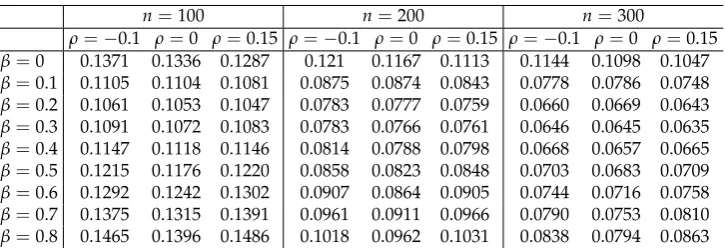
useless. Results are presented in Table1and Table2. Two points deserve our attention. The first one
245
is that, as expected, RMSEs for contaminated data are always greater than RMSEs for pure data and
246
that the RMSEs decrease when the sample sizen increases. The second is that, while in pure data
247
RMSEs are greater for big values of β, when working with contaminated data the CMDPDE with
248
medium-low values ofβ(β∈ {0.1, 0.2, 0.3}) present the best behavior in terms of efficiency.
249
For a nominal sizeα=0.05, with the model under the null hypothesis given in (28), the estimated
250
significance levels for different Wald-type test statistics are given by
b
α(nβ)(ρ0) =Prb(W β
n >χ21,0.05|H0) = R
∑
i=1
I(Wnβ,i)>χ21,0.05|ρ0)
R ,
withI(S)being the indicator function (with value 1 ifSis true and 0 otherwise). Empirical levels with
252
the same previous parameter values are presented in Table3(pure data) and Table4(5% of outliers).
253
While medium-high values ofβare not recommended at all, CMLE is the best when working with
254
pure data. However the lack of robustness of CMLE test is impressive, as it can be seen in Table4. The
255
effect of contamination in medium-low values ofβis much lighter, while for medium-high values of
256
βit can return deceptively beneficial.
257
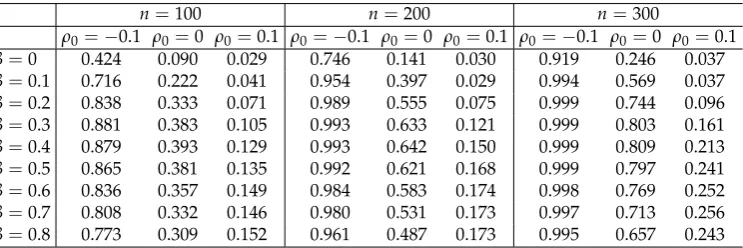
For finite sample sizes and nominal sizeα=0.05, the simulated powers are obtained underH1 258
in (28), whenρ∗ ∈ {−0.1, 0, 0.1}, ˜ρ =0.2 andρ0=0.15 (Table5and Table6). The (simulated) power 259
for different composite Wald-type test statistics is obtained by
260
β(nβ)(ρ0,ρ∗) =Pr(Wnβ >χ21,0.05|H1) and βb
(λ)
n (ρ0,ρ∗) =
R
∑
i=1
I(Wnβ,i>χ21,0.05|ρ0,ρ∗)
R .
As expected, when we get closer to the null hypothesis and when decreasing the sample sizes, the
261
power decreases. With pure data the best behavior is obtained withβ = 0 and with contaminated
262
data the best results are obtained for medium values ofβ.
263
Table 1.RMSEs for pure data
n=100 n=200 n=300
ρ=−0.1 ρ=0 ρ=0.15 ρ=−0.1 ρ=0 ρ=0.15 ρ=−0.1 ρ=0 ρ=0.15 β=0 0.0958 0.0950 0.0948 0.0683 0.0668 0.0666 0.0553 0.0552 0.0551 β=0.1 0.0972 0.0961 0.0966 0.0693 0.0676 0.0677 0.0560 0.0559 0.0561 β=0.2 0.1009 0.0991 0.1007 0.0718 0.0697 0.0704 0.0581 0.0575 0.0585 β=0.3 0.1061 0.1034 0.1062 0.0754 0.0727 0.0742 0.0612 0.0599 0.0619 β=0.4 0.1123 0.1087 0.1127 0.0797 0.0762 0.0787 0.0649 0.0628 0.0659 β=0.5 0.1195 0.1147 0.1200 0.0845 0.0803 0.0837 0.0691 0.0661 0.0702 β=0.6 0.1274 0.1215 0.1280 0.0898 0.0848 0.0892 0.0737 0.0697 0.0748 β=0.7 0.1361 0.1291 0.1369 0.0955 0.0897 0.0952 0.0786 0.0736 0.0797 β=0.8 0.1456 0.1374 0.1467 0.1015 0.0905 0.1016 0.0839 0.0778 0.0849
Table 2.RMSEs for contaminated data
n=100 n=200 n=300
ρ=−0.1 ρ=0 ρ=0.15 ρ=−0.1 ρ=0 ρ=0.15 ρ=−0.1 ρ=0 ρ=0.15 β=0 0.1371 0.1336 0.1287 0.121 0.1167 0.1113 0.1144 0.1098 0.1047 β=0.1 0.1105 0.1104 0.1081 0.0875 0.0874 0.0843 0.0778 0.0786 0.0748 β=0.2 0.1061 0.1053 0.1047 0.0783 0.0777 0.0759 0.0660 0.0669 0.0643 β=0.3 0.1091 0.1072 0.1083 0.0783 0.0766 0.0761 0.0646 0.0645 0.0635 β=0.4 0.1147 0.1118 0.1146 0.0814 0.0788 0.0798 0.0668 0.0657 0.0665 β=0.5 0.1215 0.1176 0.1220 0.0858 0.0823 0.0848 0.0703 0.0683 0.0709 β=0.6 0.1292 0.1242 0.1302 0.0907 0.0864 0.0905 0.0744 0.0716 0.0758 β=0.7 0.1375 0.1315 0.1391 0.0961 0.0911 0.0966 0.0790 0.0753 0.0810 β=0.8 0.1465 0.1396 0.1486 0.1018 0.0962 0.1031 0.0838 0.0794 0.0863
4. Conclusions 264
The likelihood function is the basis of the maximum likelihood method in estimation theory and
265
it also plays a key role in the development of log-likelihood ratio tests. However, it is not so tractable
266
in many cases, in practice. Maximum likelihood estimators are based on the likelihood function
267
and they can be easily obtained, however, there are cases where they do not exist or they cannot
Table 3.Levels for pure data
n=100 n=200 n=300
ρ0=−0.1 ρ0=0 ρ0=0.15 ρ0=−0.1 ρ0=0 ρ0=0.15 ρ0=−0.1 ρ0=0 ρ0=0.15
β=0 0.067 0.059 0.070 0.068 0.046 0.062 0.072 0.045 0.075
β=0.1 0.067 0.060 0.072 0.062 0.046 0.070 0.085 0.045 0.079
β=0.2 0.072 0.061 0.084 0.069 0.051 0.084 0.097 0.049 0.102
β=0.3 0.081 0.062 0.093 0.084 0.053 0.100 0.112 0.051 0.121
β=0.4 0.094 0.069 0.099 0.103 0.055 0.111 0.127 0.055 0.142
β=0.5 0.105 0.071 0.111 0.118 0.056 0.122 0.149 0.051 0.155
β=0.6 0.122 0.083 0.129 0.131 0.062 0.136 0.167 0.051 0.165
β=0.7 0.135 0.088 0.141 0.139 0.063 0.146 0.181 0.055 0.177
β=0.8 0.153 0.099 0.158 0.151 0.071 0.156 0.198 0.056 0.179
Table 4.Levels for contaminated data
n=100 n=200 n=300
ρ0=−0.1 ρ0=0 ρ0=0.15 ρ0=−0.1 ρ0=0 ρ0=0.15 ρ0=−0.1 ρ0=0 ρ0=0.15
β=0 0.357 0.223 0.081 0.638 0.429 0.155 0.788 0.623 0.24 0
β=0.1 0.121 0.113 0.056 0.207 0.191 0.077 0.287 0.284 0.100
β=0.2 0.065 0.074 0.048 0.066 0.099 0.049 0.086 0.129 0.059
β=0.3 0.057 0.067 0.071 0.057 0.066 0.059 0.065 0.077 0.073
β=0.4 0.075 0.066 0.087 0.067 0.058 0.081 0.079 0.060 0.095
β=0.5 0.090 0.062 0.107 0.080 0.061 0.110 0.105 0.051 0.128
β=0.6 0.096 0.063 0.126 0.095 0.063 0.131 0.117 0.049 0.151
β=0.7 0.109 0.073 0.137 0.101 0.061 0.141 0.127 0.047 0.159
β=0.8 0.125 0.083 0.147 0.109 0.061 0.149 0.141 0.049 0.171
Table 5.Powers for pure data,ρ∗=0.15
n=100 n=200 n=300
ρ0=−0.1 ρ0=0 ρ0=0.1 ρ0=−0.1 ρ0=0 ρ0=0.1 ρ0=−0.1 ρ0=0 ρ0=0.1
β=0 0.945 0.603 0.141 1 0.871 0.180 1 0.962 0.265
β=0.1 0.954 0.588 0.157 1 0.863 0.207 1 0.96 0.299
β=0.2 0.952 0.557 0.158 1 0.825 0.213 1 0.944 0.315
β=0.3 0.941 0.510 0.153 0.999 0.783 0.213 1 0.913 0.313
β=0.4 0.925 0.465 0.154 0.999 0.734 0.210 1 0.885 0.301
β=0.5 0.904 0.424 0.159 0.996 0.677 0.202 1 0.845 0.289
β=0.6 0.873 0.395 0.153 0.990 0.618 0.197 0.999 0.789 0.277
β=0.7 0.830 0.361 0.153 0.985 0.555 0.183 0.999 0.733 0.261
β=0.8 0.789 0.322 0.161 0.974 0.499 0.179 0.997 0.678 0.246
Table 6.Powers for contaminated data,ρ∗=0.15
n=100 n=200 n=300
ρ0=−0.1 ρ0=0 ρ0=0.1 ρ0=−0.1 ρ0=0 ρ0=0.1 ρ0=−0.1 ρ0=0 ρ0=0.1
β=0 0.424 0.090 0.029 0.746 0.141 0.030 0.919 0.246 0.037
β=0.1 0.716 0.222 0.041 0.954 0.397 0.029 0.994 0.569 0.037
β=0.2 0.838 0.333 0.071 0.989 0.555 0.075 0.999 0.744 0.096
β=0.3 0.881 0.383 0.105 0.993 0.633 0.121 0.999 0.803 0.161
β=0.4 0.879 0.393 0.129 0.993 0.642 0.150 0.999 0.809 0.213
β=0.5 0.865 0.381 0.135 0.992 0.621 0.168 0.999 0.797 0.241
β=0.6 0.836 0.357 0.149 0.984 0.583 0.174 0.998 0.769 0.252
β=0.7 0.808 0.332 0.146 0.980 0.531 0.173 0.997 0.713 0.256
be obtained. In such a case, composite likelihood methods constitute an appealing methodology in
269
the area of estimation and testing of hypotheses. On the other hand, distance or divergence based
270
on methods of estimation and testing have increasingly become fundamental tools in the field of
271
mathematical statistics. The work in [15] is the first, to the best of our knowledge, which links the
272
notion of composite likelihood with divergence based on methods for testing statistical hypotheses.
273
In this paper, MDPDE are introduced and they are exploited to develop Wald type test statistics
274
for testing simple or composite null hypotheses, in a composite likelihood framework. The validity
275
of the proposed procedures is investigated by means of simulations. The simulation results point
276
out the robustness of the proposed information theoretic procedures in estimation and testing, in the
277
composite likelihood context. There are several areas where the notions of divergence and composite
278
likelihood are crucial, including spatial statistics and time series analysis. These are areas of interest
279
and they will be maybe explored elsewhere.
280
Acknowledgments: This research is supported by Grant MTM2015-67057-P, from Ministerio de Economia y 281
Competitividad (Spain). 282
Conflicts of Interest:The authors declare no conflict of interest. 283
Abbreviations 284
The following abbreviations are used in this manuscript: 285
MLE Maximum likelihood estimator
CMLE Composite maximum likelihood estimator DPD Density power divergence
MDPDE Minimum density power divergence estimator
CMDPDE Composite minimum density power divergence estimator 286
Appendix Proof of Results 287
Appendix A.1 Proof of Theorem2 288
The result follows in a straightforward manner because of the asymptotic normality ofbθ β c, 289
√
n(bθ β c−θ0)
L
−→
n→∞N
0,H−β1(θ0)Jβ(θ0)H
−1 β (θ0)
.
Appendix A.2 Proof of Theorem3 290
A first order Taylor expansion ofl(θ)atbθ β
c aroundθ∗gives 291
lbθ β c
−l(θ∗) =
∂l(θ)
∂θ
θ=θ∗
b θcβ−θ∗
+op bθ
β c−θ∗
.
Now the result follows because the asymptotic distribution oflbθ β c
−l(θ∗)
coincides with the
292
asymptotic distribution of√n∂l(θ)
∂θ
θ=θ∗
b θcβ−θ∗
.
293
Appendix A.3 Proof of Theorem5 294
We have
295
g(bθ β
c) = g(θ0) +G(θ0)T
b θβc−θ0
+op bθ
β c−θ0
= GT(θ0)
b θβc −θ0
+op bθ
β c−θ0
,
becauseg(θ0)=0r . 296
Therefore
√
ngbθ β c
L
−→
n−→∞N(0,Gβ(θ0) TH−1
β (θ0)Jβ(θ0)H
−1
β (θ0)Gβ(θ0))
because
298
√
nbθ β c −θ0
L
−→
n−→∞N(0,H
−1
β (θ0)Jβ(θ0)H
−1 β (θ0)).
Now
299
Wn,β=ng
b θβ
Th
GT(θ0)H−β1(θ0)Jβ(θ0)H
−1
β (θ0)G(θ0) i−1
gbθβ
L
−→
n−→∞χ 2 r.
Appendix A.4 Computation of Sensitivity and Variability Matrices in the Numerical Example 300
We want to compute
301
Hβ(θ) = Z
Rm
CL(θ,y)β+1u(θ,y)Tu(θ,y)dy Jβ(θ) =
Z
Rm
CL(θ,y)2β+1u(θ,y)Tu(θ,y)dy
−
Z
Rm
CL(θ,y)β+1u(θ,y)dy Z
Rm
(u(θ,y))TCL(θ,y)β+1dy.
First of all, we can see that
302
CL(θ,y)β+1= fA1(θ,y)fA2(θ,y) β+1
= 1
2πp1−ρ2
expn−2(1−1
ρ2)Q(y1,y2)
o
· 1
2πp1−ρ2
expn−2(1−1
ρ2)Q(y3,y4)
o !β+1
=
1
(2π)2(1−ρ2)
β+1
expn− β+1
2(1−ρ2)[Q(y1,y2) +Q(y3,y4)]
o
= 1
(β+1)2
1
(2π)2(1−ρ2)
β (
β+1)2
(2π)2(1−ρ2)exp
n − β+1
2(1−ρ2)[Q(y1,y2) +Q(y3,y4)] o
=Cβ· CL
∗
β,
whereCβ= 1
(β+1)2
1
(2π)2(1−ρ2) β
andCL∗β =CLβ(θ,y)∗∼ N(µ,Σ∗), withΣ∗= β+11Σ. 303
304
Whileu(θ,y)= ∂logCL(θ,y)
∂θ we will denote asu(θ,y)
∗
tou(θ,y)∗=
∂logCL∗β
∂θ . Then
305
u(θ,y)= ∂logCL(θ,y)
∂θ =
1
β+1
∂logCL(θ,y)β+1
∂θ =
1
β+1
∂log(Cβ· CL∗β) ∂θ
= 1
β+1
∂logCβ
∂θ +
∂logCL∗β
∂θ !
= 1
β+1
∂logC β
∂θ +u(θ,y)
∗
. (29)
Further,
Z
Rm
CL(θ,y)β+1u(θ,y)dy= Z
Rm
CL(θ,y)β+1∂logCL(θ,y)
∂θ dy=
Z
Rm
CL(θ,y)β∂CL(θ,y)
∂θ dy
= Z
Rm
1
β+1
∂CL(θ,y)β+1
∂θ dy=
1
β+1 ∂
∂θ Z
Rm
CL(θ,y)β+1dy
= 1
β+1 ∂Cβ
∂θ = (0, 0, 0, 0,
2ρβCβ
(β+1)(1−ρ2))
T =
ξβ(θ). (30)
Now
307
Z
R4
CLβ+1u(
θ,y)Tu(θ,y)dy (31) =
Z
R4
(Cβ· CL∗β) 1 (β+1)2
∂logCβ
∂θ +u(θ,y)
∗T∂logCβ
∂θ +u(θ,y)
∗
dy
= Cβ (β+1)2
Z
R4 "
∂logCβ
∂θ
T
∂logCβ
∂θ
CL∗β
+CL∗β u(θ,y)∗T
∂logCβ
∂θ +CL
∗
β
∂logCβ
∂θ T
u(θ,y)∗+CL∗β(u(θ,y)∗)Tu(θ,y)∗ #
dy
= Cβ (β+1)2
"
∂logCβ
∂θ
T
∂logCβ
∂θ Z
R4
CL∗βdy+ Z
R4
CL∗βu(θ,y)∗dy T
∂logCβ
∂θ
+
∂logCβ
∂θ TZ
R4
CL∗βu(θ,y)∗dy+ Z
R4
CL∗β(u(θ,y)∗)Tu(θ,y)∗dy #
= Cβ (β+1)2
" KTK+
Z
R4
CL∗βu(θ,y)∗dy T
K+KT Z
R4
CL∗βu(θ,y)∗dy+ Z
R4
CL∗β(u(θ,y)∗)Tu(θ,y)∗dy #
,
whereK= ∂logCβ
∂θ = (0, 0, 0, 0, 2ρ·β 1−ρ2). But 308
Z
R4
CL∗βu(θ,y)∗dy= Z
R4
1
Cβ
CL(θ,y)β+1 !
(β+1)u(θ,y)−
∂logCβ ∂θ
dy
= β+1 Cβ
Z
R4
CL(θ,y)β+1u(θ,y)dy
− K
Cβ Z
R4
CL(θ,y)β+1dy
= 1 Cβ
∂Cβ
∂θ −K=K−K=0,
and thus (31) can be expressed as
309
Z
R4
CL(θ,y)β+1u(θ,y)Tu(θ,y)dy= Cβ (β+1)2
KTK+
Z
R4
CL∗β(u(θ,y)∗)Tu(θ,y)∗dy
.
On the other hand, it is not difficult to prove that
310
Z
R4
CL∗β(u(θ,y)∗)Tu(θ,y)∗dy=C· Z
R4
CL(θ,y)(u(θ,y))Tu(θ,y)dy=C·H0(θ),
whereC=diag(β+1,β+1,β+1,β+1, 1)and ([15])
H0(θ) =
1 1−ρ2
−ρ
1−ρ2 0 0 0
−ρ 1−ρ2
1
1−ρ2 0 0 0
0 0 1−1
ρ2
−ρ 1−ρ2 0
0 0 −ρ
1−ρ2 1
1−ρ2 0
0 0 0 0 2(ρ2+1)
(1−ρ2)2
. (32)
So
312
Hβ(θ) = Cβ (β+1)2
h
C·H0(θ) +KTK i
,
this is
313
Hβ(θ) =
Cβ (β+1)(1−ρ2)
1 −ρ 0 0 0
−ρ 1 0 0 0
0 0 1 −ρ 0
0 0 −ρ 1 0
0 0 0 0 2(ρ2+1)+2ρ2β2
(1−ρ2)(1+β)
. (33)
Note that, forβ=0, (33) equals to (32).
314
On the other hand, the expression of the variability matrix Jβ(θ) can be obtained from 315
expressions (26) and (30) as
316
Jβ(θ) =H2β(θ)−ξβ(θ) T
ξβ(θ). (34)
References 317
1. Basu, A.; Harris, I.R.; Hjort, N.L. and Jones, M.C. Robust and efficient estimation by minimizing a density 318
power divergence.Biometrika,1998,85, 549–559. 319
2. Basu, A.; Mandal, A.; Martín, N. and Pardo, L. Testing statistical hypotheses based on the density power 320
divergence.Ann. Inst. Stat. Math.,2013,65, 319–348 321
3. Basu, A.; Mandal, A.; Martín, N. and Pardo, L. Robust tests for the equality of two normal means based on 322
the density power divergence.Metrika,2015,78, 611–634. 323
4. Basu, A.; Mandal, A.; Martín, N. and Pardo, L. Generalized Wald-type tests based on minimum density 324
power divergence estimators.Statistics,2016,50, 1, 1-26. 325
5. Basu, A.; Ghosh, A. Mandal; Martín, N. and Pardo, L. A Wald-type test statistic for testing linear hypothesis 326
in logistic regression models based on minimum density power divergence estimator.Electon. J. Stat.,2017, 327
11, 2, 2741–2772. 328
6. Ghosh, A.; Mandal, A.; Martín, N. and Pardo, L. Influence analysis of robust Wald-type tests.J. Multivariate 329
Anal.,2016,147, 102–126. 330
7. Varin, C.; Reid, N. and Firth, D. An overview of composite likelihood methods.Stat. Sin.,2011,21, 1, 4-42. 331
8. Xu, X. and Reid, N. On the robustness of maximum composite estimate.J. Stat. Plan. Inference.,2011,141, 332
3047-3054. 333
9. Joe, H., Reid, N.; Somg, P.X.; Firth, D. and Varin, C. Composite likelihood methods.Report on the Workshop 334
on Composite Likelihood.2012Available at http://www.birs.ca/events/2012/5-day-workshops/12w5046. 335
10. Lindsay, G. Composite likelihood methods.Contemp. Math.,1998,80, 221-239. 336
11. Basu, A.; Shioya, H. and Park, C.Statistical inference. The minimum distance approach. Chapman & Hall/CRC. 337
Boca Raton, 2011. 338
12. Maronna, R. A., Martin, R. D. and Yohai, V. J. Time Series, in Robust Statistics: Theory and Methods, John 339
Wiley & Sons, Ltd, Chichester, UK., 2006. 340
13. Pardo, L.Statistical inference based on divergence measures. Chapman & Hall/CRC. Boca Raton, 2006. 341
15. Martín, N.; Pardo, L. and Zografos, K. On divergence tests for composite hypotheses under composite 343