Secure Key Exchange and Sessions Without Credentials
Ran Canetti?, Vladimir Kolesnikov??, Charles Rackoff? ? ?, and Yevgeniy Vahlis†
Abstract. Secure communication is a fundamental cryptographic primitive. Typically, se-curity is achieved by relying on an existing credential infrastructure, such as a PKI or passwords, for identifying the end points to each other. But what can be obtained when no such credential infrastructure is available?
Clearly, when there is no pre-existing credential infrastructure, an adversary can mount successful “man in the middle” attacks by modifying the communication between the legitimate endpoints. Still, we show that not all is lost, as long as the adversary’s control over the communication is not complete: We present relatively efficient key exchange and secure session protocols that provide the full guarantee of secure communication
as long as the adversary fails to intercept even a single messagebetween the legitimate endpoints.
To obtain this guarantee we strengthen the notion of key exchange to require that the keys exchanged in any two sessions are independent of each other as long as each ses-sion has at least one honest endpoint,even if both sessions has an adversarial endpoint.
We call this notioncredential-free key exchange.We then strengthen the existing no-tion of secure session protocols to provide the above guarantee given a CFKE (existing definitions and constructions are insufficient for this purpose). We provide two alterna-tive definitions and constructions of CFKE, a game-based one with a construction in the RO model, and a UC one with a construction in the CRS model.
?
Tel-Aviv University,[email protected] ??
Bell Labs,[email protected] ? ? ?
University of Toronto,[email protected]
†
1 Introduction
Secure communication over adversary-controlled channels is one of the most widely and frequently used achievements of cryptography. The standard approach to secure communication involves two steps. First, the two conversing partiesA andB securely establish asession key, and second, they use the key to encrypt and authenticate the exchanged messages. The first step,key exchange(KE), ensures that only authorized players are able to successfully compute the keys. This guarantee holds even if the adversary is capable of complete control of the channel, including arbitrary message ob-servation, alteration and scheduling.
Traditionally, the ability of communicating parties to authenticate themselves almost always re-quires possession of secrets, and corresponding authorization architectures and protocols employ some kind ofinfrastructure, which manages these secrets. Common examples include Public Key Infrastructure (PKI), shared long term private keys, and human memorizable passwords.
In this work, we focus on efficiently achieving a strong security guarantee for the problems of key exchange and secure sessions in the credential-free setting.
Practical need for authentication without credentials. While trusted infrastructure aids greatly in certifying the identities, capabilities or permissions of communicating paties, its heavy cost is not justified in many non-security-critical applications. In some cases, there may not be an authority who is qualified or trusted to operate the infrastructure and issue credentials. Some applications may use infrastructure opportunistically and use PKI when available, but may fall back on weak authentication without credentials. In yet other scenarios, such as ad-hoc peer-to-peer information sharing networks, it is not required to associate a network entity with a real-life entity, but rather there is a need to ensure the persistence of the connection.
The practical importance of the problem has led to a rich body of network security research. Several techniques ofweak authenticationhave emerged, were standardized, and successfully widely deployed. Our work is a more formal approach that achieves much stronger security.
1.1 The Setting and Our Contributions
In our setting, two partiesAandB have decided to have a communication session over an insecure channel.AandBdo not share any information other than which channel to use for communication, and possibly a global public reference string. The decision itself may have been made in an insecure way; for example,Amay have really been invited by an adversary Advrather than byB. As there is no infrastructure to support authentication,Advmay falsely claim any identity. The channelAand B will use for their session may also be controlled byAdv, who can read from it and write to it at will. Without credentials, we have no hope of preventingAdvfalsely taking another player’s identity or playing man-in-the-middle (MIM).
Motivated by today’s networking architectures (e.g., the difficulty of the adversary to always be an active MIM), we present a candidate for what we believe is the “next best” achievable security guarantee in this setting. Namely, we require thatthe adversary must remain continuously active on the channel throughout the entire session to avoid detection.
a security property of secure session protocols, which we call MIM-integrity, which ensures that the MIM-adversary must remain continuously active on the channel throughout the entire session to avoid detection. We show that combining above KE and secure sessions guarantees secure communication in the above sense. In this work we:
1. Present definitions of secure credential-free key exchange (CFKE) in the standalone and univer-sally composable (UC) [Can00] settings. Our definitions guarantee that if two parties participate in a CFKE protocol, they either output the same key which is completely hidden from the ad-versary, or output two keys that are uniformly random given the transcript of the view of the adversary.
2. Present simple definitions of secure credential-free secure sessions (CFSS), which, in addition to the standard security properties, guarantee that MIM must be continuously active to avoid detection.
3. We show that composing any CFKE and CFSS results in secure communication in the credential-free setting. We also show that, in contrast, session protocols, even those standardized by the Internet bodies, areinsecurein our setting.
4. Describe a construction of a CFKE protocol in the standalone model with a global common reference string (CRS), and prove its security in the standard model. We then show how to construct a secure session with a new integrity property (MIM-integrity) that guarantees that an adversary must modify every message in transit fromAtoBor be detected.
5. Analyze two existing KE protocols: we show that the well known hashed Diffie-Hellman proto-col satisfies a variant of our standalone definition in the random oracle model. We additionally compare our standalone protocol to the instantiation of our UC definition using the construction of [BCL+05], and show that it provides a useful tradeoff in settings with high latency, where low round complexity is crucial.
1.2 Intuition for Our Constructions
CFKE. The key difference between a CFKE protocol and an unauthenticated key exchange (such as the basic Diffie-Hellman protocol) is that neither party should be able to influence the outcome too much. This is necessary to achieve independence of keys in the man-in-the-middle scenario.
A naive CFKE approach may be to use a coin toss protocol as a black box, and simply encrypt its messages. However, there is no key infrastructure that would allowAandB to encrypt! Indeed, the whole purpose of CFKE is to attempt to establish such an infrastructure. Moreover, simply exchanging public keys to be used for encryption won’t work since the adversary may be able to replace (or modify) the public keys on the way, stripping the coin toss protocol from any privacy. This leads us to the following intuitive observation: any cryptographic keys that are sent across the channel and are used for the security of KE, must be strongly tied to the randomness used to generate the final key.
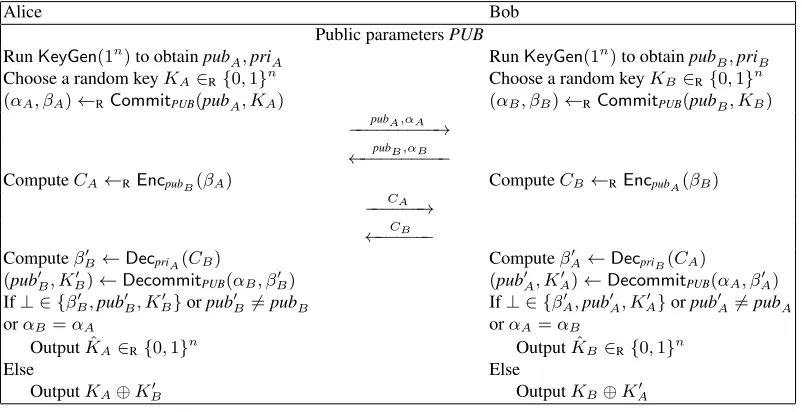
Overview of the construction.Our credential-free key exchange protocol is symmetric, and con-sists of two rounds whereAandBsimultaneously send messages to each other. It proceeds as follows:
1. AandBgenerate and announce public keys, and commit to the public keystogether withrandom nonces. Here the commitment must have strong non-malleability properties (which we identify and formally define).
2. Using the public keys announced in the first round,AandBsend to each other encrypted decom-mitment strings for the comdecom-mitments they announced in the first round.
Relying on the non-malleability property of the commitment scheme, we get that no adversary can modify eitherA’s public key or her nonce, without changing the other (similarly forB). Moreover, since the nonce is hidden by the commitment, the adversary is unable to commit to a related nonce, if she decides to modify the public key. On the other hand, if she leaves the public key untouched, she will not be able to learnB’s decommitment when he sends it in the next round.
Using CFKE for communication. CFKE can be used to construct secure session protocols with security against MIM-adversaries. We show that the following is a secure credential-free secure ses-sion (CFSS): a secure sesses-sion protocol in the traditional sense, where additionally the sender sim-ply attaches to each message, in the clear, a dedicated part of the secret key. That is, ifA’s key is KA = (KA,1, KA,2), thenKA,1 is used for the underlying secure session protocol, andKA,2 is
at-tached as an authenticator to each message. Now, whenBreceives a message fromAwith an attached authenticatorKA,2, he checks ifKA,2 =KB,2, and aborts if the check fails. It is easy to see that any
adversary that does not change the authenticator on each message will be caught as soon as a single message is transmitted directly.
1.3 Discussion
Password-authenticated key exchange (PAKE) [BM92,KOY01,GL01,GL03,CHK+05,KV11,CDSVW12], when executed with fixed publicly known password, achieves guarantees somewhat similar to those
of CFKE, and at the first glance may seem sufficient for our task. There are, however, important differences between CFKE and PAKE, which render PAKE inapplicable to our setting.
Firstly, the definitional approach to PAKE fundamentally differs from our approach: a successful
Advin PAKE may be able to fix the output key to an arbitrary value, which would render such KE useless for CFSS (indeed, MIMAdvcan set the two players’ key to be equal and known to him, and thus break the CFSS protection).
Beyond just definitions, many natural PAKE protocols in fact do allow a player to set the session key (and, to our knowledge, no protocols prove otherwise). Indeed, such a PAKE can be easily con-structed from any secure PAKE by adding a round where the successfully authenticated players (now presumed honest by PAKE definitions) are allowed to set the session key to anything of their choice. More importantly, many existing protocols from the literature, e.g., of Canetti et al. [CDSVW12] have the above feature. We stress that it is a natural property of their approach; provably avoiding it would complicate their construction and would require a new definition and a proof. In [CDSVW12], UC-secure PAKE is built from Oblivious Transfer (OT), roughly as follows: the two players run several OT instances, where the secrets are randomly chosen strings, and the password defines the selection bits. The session key of OT receiver is the XOR of the received secrets, and OT sender’s key is the XOR of the secrets corresponding to his password. It is easy to see that in the above PAKE, the OT sender can set the session key to any string of his choice. We note that the above PAKE OT idea is the basis for two constructions of [CDSVW12], and in both of them the property of OT sender being able to set the key is preserved.
Practical Impact of MIM-Integrity. Despite seeming simplicity, MIM-integrity is a subtle concept and can be violated by seemingly secure natural protocols. Consider a session protocol where players periodically refresh the session key. Typically, one player chooses a nonce n, and each player up-dates his keyskto PRFsk(n). One prominent example of such a protocol is in EAP-TLS [ALE09].
nA, nBwhich would set the refreshed keysKA=KB, allowing the adversary to withdraw and only
occasionally interfere with communication when needed.
Open directions. The main open direction left by our work is to design new secure session protocols and notions of security against MIM adversaries that rely on other (possibly weaker or incomparable) properties of networks in practice. For example, one may be able to design secure sessions that always detect a MIM adversary assuming network delay, or that messages are sent in pieces and that an adversary is unable to predict future content (this idea was used in the Interlock protocol [RS84]). We believe that our notion (and constructions) of CFKE can be used as a formal basis for such future explorations.
1.4 Related Work
The problem of unauthenticated secure communication over insecure channels traces back to the work of Dolev, Dwork, and Naor in [DDN91]. They introduced the non-malleability guarantee: any adversary controlling the channel between two parties either remains essentially passive, or is forced to run two independent instances of the protocol, one with each honest party. The study of non-malleability has led to a rich body of research that can be roughly classified according to two types of constructions: constructions of specific non-malleable primitives such as encryption, zero-knowledge proof systems, commitments, etc; and non-malleable “meta-protocols” that are used to establish per-session infrastructures. These include non-malleable coin tossing [Bar02], establishing a public key infrastructure [BCL+05], and a shared secret key infrastructure [CCGS10]. Such protocols can then provide setup for the protocols that need it.
Barak [Bar02] defines and constructs non-malleable coin tossing protocols, where two parties wish to agree on an almost unbiasedpublicrandom string in the presence of MIM adversary. This coin tossing guarantees that an adversary must either allow the players to output the same random string, or cause them to output two separate and independently generated random strings. The protocols of [Bar02] work withoutanyinfrastructure, but provide no privacy guarantee (the outcome of the coin toss is always known to the adversary).
In [BCL+05] Baraket al.define split functionalities – a variant of ideal functionalities of the UC framework. Split functionalities allow an adversary to partition the set of honest partiesPinto disjoint “authentication sets”. The idea is that all parties within each setHi ⊆Phave successfully established
an authenticated session. The adversary is then unable to impersonate any party inHi to any other
party inHi, but can impersonate any party inP\Hito any party inHi. Since the adversary determines
the authenticated sets, this allows her, for example, to set all authenticated sets to be singletons, in which case no authenticated communication between honest parties is possible. This indeed seems unavoidable since the adversary has complete control over the communication channels. Camenisch
et al.[CCGS10] define, among other things, split key exchange and give a construction based on the decisional Diffie-Hellman assumption.
2 Preliminaries
Notation. We write PPT to denote Probabilistic Polynomial Time. When we wish to fix the random bits of a PPT algorithmMto a particular value, we writeM(x;r)to denote runningMon inputxand randomnessr. We writetimen(M)to denote the running time of algorithmMon security parameter
n. We usex∈R S to denote the fact thatxis sampled according to a distributionS. Similarly, when describing an algorithm we may writex ←R S to denote the action of sampling an element fromS and storing it in a variablex.
Discrete Logarithm Assumption. LetGbe a probabilistic group generator such thatG ←R G(1n) is a group of orderpwherepis a prime of length aboutnbits. The Discrete Logarithm assumption forGis that givenG,g,gx, whereG←RG(1n),g∈RG,x∈RZp, it is infeasible to findx.
Non-Malleable Public Key Encryption (PKE). LetPKE = hKeyGen,Enc,Decibe a public key encryption scheme. We say thatPKEis non-malleable if no adversary can distinguish the encryptions of two messages of her choice, even if she is allowed to make a single decryption query after seeing the challenge ciphertextC∗. The decryption query is of course restricted to all strings that are not
equal toC∗.
Target Collision Resistant Hash Functions. A family H = {Hk}k∈{0,1}∗ of hash functions is
target collision resistant if no efficient adversary can win the following game: (i) the adversary selects a target inputx; (ii) a random keyk ∈R {0,1}n is chosen; (iii) the adversary is givenk and must output another inputysuch thatHk(x) =Hk(y).
3 Definition of Secure Key Exchange Without Credentials
We start with a syntactic definition of a credential-free key exchange (CFKE) protocol. A CFKE protocol is a tripleCF KE =hKEInit,KEA,KEBiwhereKEInittakes as input a security parameter
1nand outputs a common reference stringPUB. The protocol itself consists of the actions performed by a role-A party, specified byKEA, and a role-B party whose actions are specified byKEB(the roles
are assigned to break the symmetry, e.g. to determine who moves first). The pairKE=hKEA,KEBi
is a two party protocol in the common reference string model. We shall useKEto discuss the protocol as a whole, and distinguish betweenKEAandKEBwhen such a distinction is warranted.
Adversary for a CFKE protocol is a triple of PPT algorithmsAdv = (Ake, Adist, Amal). To define
security of CFKE we describe three experiments where the first experiment models the interaction of
Advwith the protocolKE, and the other experiments captureprivacyandnon-malleabilityproperties.
Security Experiments. We start with the description of the experimentExpCFKEwhich defines the interaction of the adversary with the protocol: letKE be a CFKE and letAkebe a PPT algorithm. ExperimentExpCFKE(1n,KE, Ake)
1. KEInit(1n)is run to obtain public parametersPUB, which are given toAke.
2. The key exchange protocol is run between two partiesAandB, whereAacts according toKEA
andBacts according toKEB. All the communication is routed throughAke. During this process
Akecan inject, delete, and modify messages between the two parties at will.
3. After KE concludes, let Kout
A andKBout be the outputs of the protocol, and let view(Ake) be
the view ofAke during its execution. The view consists of the randomness ofAke, and all the
Intuitively, we wish to achieve the following security guarantee: either the two parties agree on a key and the adversary knows nothing about it, or the adversary is forced to perform two indepen-dent key exchanges (one with each party) resulting in the parties outputting indepenindepen-dently random keys. We capture this intuition by describing two security experiments for CFKE: privacy and non-malleability.
The first experiment ExpCFKEInd requires the adversary to distinguish a key agreed upon by the two parties in the protocol from a random key. If the two parties do not agree on a key (i.e.
Kout
A 6= KBout) then the adversary automatically loses in the privacy experiment. This is enforced
by setting the outcome of the experiment by flipping an unbiased coin. Letb ∈ {0,1}, the privacy experiment is defined as follows:
ExperimentExpCFKEInd(1n,KE, A
ke, Aind, b)
1. Run experimentExpCFKE(1n,KE, Ake)to obtain(KAout, KBout, view(Ake)).
2. IfKAout6=KBout, flip an unbiased coinb0 ∈R {0,1}and set the outcome of the experiment tob0. 3. Else, let K0 = KAout, K1 ∈R {0,1}n. Letb0 ←R Aind(view(Ake), Kb). The outcome of the
experiment isb0.
Definition 1. LetKE = (KEInit,KE)be a credential-free key exchange. We say thatKE isprivateif for every CFKE adversaryAdv = (Ake, Adist, Amal), there exists a negligible functionneg(·), such that for alln∈N
|Pr[ExpCFKEInd(1n,KE, Ake, Aind,0) = 1]−
Pr[ExpCFKEInd(1n,KE, Ake, Aind,1) = 1]| ≤neg(n)
In the second experiment ExpCFKENMal the goal of the adversary is to make the two parties output different keys with some correlation that may depend on the adversary’s view. We require that for every adversary there exists a simulator such that the view of the adversary in an interaction that causes the parties to output two different keysKA, KBis simulatable given random keysKA, KB.
The simulated view should be indistinguishable from the real one even givenKAandKB.
This captures the intuition that the only way the adversary can make the parties output different keys is by making them output independent random keys. As we discussed in the introduction, we cannot completely prevent the adversary from influencing the output of the parties since she always has the option to omit the message that determines that outcome, unless the outcome satisfies some property (e.g. the keyKA has zero as its first bit). We require that this is essentially the only way
the adversary can influence the outputs of the parties. This is captured by allowing the simulator to sample polynomially many pairs of uniformly random keys, and pick one pair for the output. This essentially grants the simulator exactly the ability to try a new key unless the current key satisfies a relatively likely property. Forb∈ {0,1}and a simulatorSthe non-malleability experiment is:
ExperimentExpCFKENMal(1n,KE, Ake, Amal, S, b)
1. Run experimentExpCFKE(1n,KE, Ake)to obtain(KAout, KBout, view(Ake)).
2. IfKAout=KBout, flip an unbiased coinb0 ∈R {0,1}and set the outcome of the experiment tob0. 3. Else, run simulatorS(1n)and allowSto sample a polynomial number of uniformly random key
pairs(KA, KB)∈({0,1}n)2. Letview0be the output of the simulator and(KA, KB)be the last
pair of keys sampled byS.
4. SetY0 = (KAout, KBout, view(Ake)), andY1 = (KA, KB, view0), and let b0 ←R Amal(Yb). The
Definition 2. Let KE = (KEInit,KE) be a credential-free key exchange. We say that KE is non-malleableif for every CFKE adversary Adv = (Ake, Adist, Amal), there exists an expected PPT simulatorS, and a negligible functionneg(·), such that for alln∈N
|Pr[ExpCFKENMal(1n,KE, Ake, Amal, S,0) = 1]−
Pr[ExpCFKENMal(1n,KE, Ake, Amal, S,1) = 1]| ≤neg(n)
Finally, we say that a CFKE protocol is secure if it satisfies both properties described above.
Definition 3. LetKE = (KEInit,KE)be a credential-free key exchange. We say thatKE issecureif it satisfiesprivacy, andnon-malleability.
On concurrent CFKE executions. In contrast to many definitions of KE with credentials, we do not need to include any additional players in our model. This is because in our setting the adversary can simulate all parties, except the two that he decides to target. There are no secrets associated with the communicating parties. Thus, there is no advantage in corrupting an honest party, since none of the other parties are even aware of its existence. Further, allowing for multiple protocol runs confers no advantage to the adversary, as there are no secrets that are re-used across runs the participant.
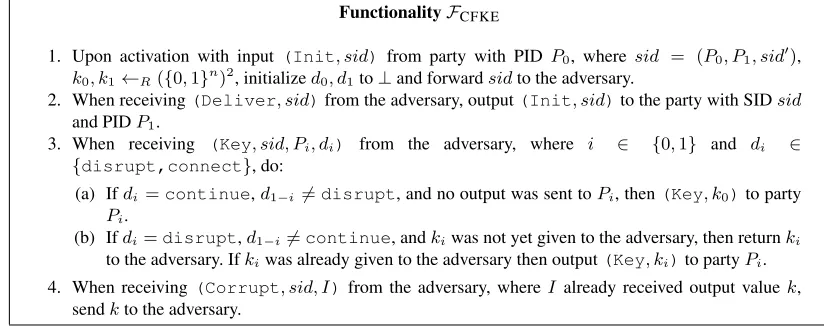
Universally composable CFKE. To allow for formal composability of CFKE protocols, we also provide a UC definition and construction of the CFKE notion. Due to limited space, this is presented in Appendix D.
4 Two Credential-Free Key Exchange Protocols
We present two constructions of CFKE protocols. Our main protocol is shown to be secure in the standard model, and requires two simultaneous rounds of communication. The second protocol that we present is what is commonly known as “Hashed Diffie-Hellman”. We show that HDH isnot a secure CFKE protocol in the standard random oracle model. However, we show that if one is willing to assume that HDH uses its own random oracle, that is not later used by other protocols, it is a secure CFKE protocol.
4.1 Protocol 1: Standard Model
We now present our main protocol (see Section 1.2 for its intuition). For our construction, we rely on a non-interactive equivocal commitment scheme with a specialized non-malleability property. Com-mitments are discussed in detail in Appendix B. We note that while our definition is specialized to allow us to prove the security of our CFKE protocol, it may be of independent interest as a property of non-interactive commitment schemes.
LetCOM=hComInit,Commit,Decommitibe a 2-strongly non-malleable commitment scheme (discussed in detail in Appendix B), and letPKE =hKeyGen,Enc,Decibe a non-malleable public key encryption scheme. We construct a two-flow credential-less key exchange protocolCF KE1 =
hKEInit,KEA,KEBibased onCOMandPKE.
Alice Bob Public parametersPUB
RunKeyGen(1n)to obtainpubA,priA
Choose a random keyKA∈R{0,1}n (αA, βA)←RCommitPUB(pubA, KA)
RunKeyGen(1n)to obtainpubB,priB
Choose a random keyKB∈R{0,1}n (αB, βB)←RCommitPUB(pubB, KB)
pubA,αA
−−−−−−−−−→
pubB,αB
←−−−−−−−−−
ComputeCA←REncpubB(βA) ComputeCB←REncpubA(βB)
CA
−−−−−−→
CB
←−−−−−− ComputeβB0 ←DecpriA(CB)
(pub0B, K
0
B)←DecommitPUB(αB, βB0 )
If⊥ ∈ {β0B,pub
0
B, K
0
B}orpub
0
B 6=pubB
orαB =αA
OutputKAˆ ∈R{0,1}n
Else
OutputKA⊕KB0
ComputeβA0 ←DecpriB(CA)
(pub0A, K
0
A)←DecommitPUB(αA, β0A)
If⊥ ∈ {βA0,pub
0
A, K
0
A}orpub
0
A6=pubA
orαA=αB
OutputKBˆ ∈R{0,1}n
Else
OutputKB⊕KA0
Fig. 1.The CFKE ProtocolCF KE1
messages at each round can be sent in parallel, without either side waiting for the other to send first. The complete description of the protocol is given in Figure 1.
Privacy. To achieve privacy, the protocol must guarantee that if the two parties agree on a key (i.e. output the same string) then the adversary is unable to distinguish that key from a random one. we prove the following theorem:
Theorem 1 IfPKEis a non-malleable public key encryption scheme andCOMis a computationally binding, 2-strongly non-malleable commitment scheme, then the protocolCF KE1isprivateaccording
to Definition 1.
Intuitively, this follows from the following two facts: (i) if the adversary modifiesA’s a public key (the case ofBis symmetric), then because of the strong non-malleability of the commitment scheme, she must choose a new nonce to accompany the modified public key. However, if she does so, the probability thatAandB output the same key is negligible. On the other hand, if she allowsAandB to exchange public keys, then privacy follows from the semantic security of the encryption scheme. Due to limited space we present the details of the proof in Appendix C.1.
Non-Malleability. To show non-malleability, we must describe a simulator that can simulate the view of the adversary given a choice of one of polynomially many pairs of random outputs for the two parties. We prove the following theorem:
Theorem 2 IfCOMis a 2-strongly non-malleable commitment scheme then the protocolCF KE1is
non-malleableaccording to Definition 2.
ScheduleEA ScheduleEB αA
−−−−−→ αB
←−−−−−
α0A
−−−−−→
βB
←−−−−−
α0B
←−−−−−
βA
−−−−−→
βB0
←−−−−− β
0 A
−−−−−→
αA
−−−−−→ αB
←−−−−−
α0B
←−−−−−
βA
−−−−−→
α0A
−−−−−→
βB
←−−−−−
β0B
←−−−−− β
0 A
−−−−−→
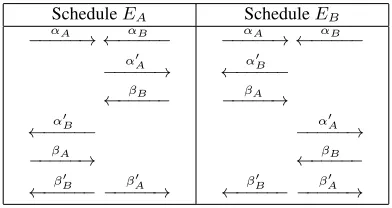
Fig. 2.Two possible schedules for adversarial commitments
pair of random keysKˆAandKˆBand guess at which iterationSimwill lock each key. Then, generate
the rest of the keys randomly. This procedure is repeated until the guess is correct.
The simulatorSimitself is described in Figure 4 of Appendix C. On a high level the simulator works as follows. Let us denote byEA(EB) the event that the adversary submits bothα0AandαB0
before seeing an encryption ofβA(βB). Note that since each party outputs the encrypted
decommit-ment after obtaining the commitdecommit-ment of the other party, at least one of these events must always occur (see Figure 2 for an illustration of the two possible schedules). Specifically, according to scheduleEA
the adversary submits bothα0A andα0B before seeing an encryption ofβA. Similarly, according to
scheduleEB the adversary submits both commitments before obtainingβB. The simulator first
gen-erates a tupleγ of the form(PUB,pubA, αA,pubB, αB, radv). This commits the adversary to one of
the two schedules described in Figure 2 (see proof of Claim C.1). Assuming thatEAis the schedule
that the adversary follows conditioned onγ, the simulator proceeds to extract a decommitment for α0Aby simulating the interaction of the adversary with the protocol to completion (the case when the schedule induced byγ isEB is symmetric). Now, by making use of the strong non-malleability of
the commitment scheme, and ignoring (for the moment) the possibility that the adversary chooses to provide an invalid decommitment forαA0 , we know that there is a unique valueKA0 thatα0Awill be decommitted to. Therefore, the decommitmentβ0A obtained by the simulator, together with the commitmentα0A, allow the simulator to obtainKA0 .
At this point, the simulator fixes a key KˆB to be output by Bob, and rewinds the adversary to
the point where she submitted her commitmentα0A. The simulator then uses the equivocability of the commitment scheme to decommitαBtoKB
def
= ˆKB⊕KA0 A similar extract-then-adjust procedure is
repeated with the Alice side of the interaction: fixing(γ, α0A, βB)the simulator obtains a commitment
α0Bfrom the adversary and simulates the protocol to completion to obtain a decommitmentβB0 . Again, ignoring invalid commitments and applying the strong non-malleability property of the commitment scheme, there is only a single value to which the adversary can decommitα0B. That value,KB0 , is obtained by the simulator fromαB0 andβB0 . The simulator then rewinds the adversary to the point where(γ, α0A, βB, αB0 )are fixed, fixes a keyKˆAto be output by Alice, and decommitsαAtoKA
def
= ˆ
KA⊕KB0 . As a result,KAandKBare properly distributed in the transcript of the protocol – uniformly
random, and the simulator successfully forces the correct outputsKˆA and KˆB for Alice and Bob
respectively.
adversary still has a choice whether to decommit toKA0 (KB0 ) or to produce an invalid decommitment. To accommodate this possibility the actual simulator may rewind the adversary many times until the “right” kind of commitment is produced. For example, if the adversary first decommitsα0A toKA0 then after rewinding the simulator will keep trying new random keysKˆBfor Bob until the adversary
decommitsα0AtoKA0 again. This repeated rewinding is what causes the running time of our simulator to be expected rather than strict polynomial. The only computational part of our argument concerns the inability of the adversary to decommit a single commitmentα0A or α0B to more than one non-⊥value. If this were not the case then our simulator would potentially not be able to predict the valueKA0 to whichα0Awill be decommitted, and therefore fail to setβA0 appropriately. However, no efficient adversary can violate this requirement without breaking the strong non-malleability of the commitment scheme.
We give the complete details in Appendix C.2.
4.2 Protocol 2: Hashed Diffie-Hellman as CFKE
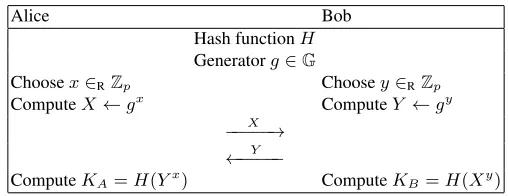
We next analyze the hashed Diffie-Hellman (HDH) [DH76] protocol (cf. Figure 3) in the context of CFKE. Note, HDH (and natural variants) are insecure in the sense of Definition 2. Indeed, a MIM adversary in HDH can learn the pre-images under the hash function H of the keys KA and KB
by running a separate instance of the protocol with each party. This violates the non-malleability requirement of CFKE. One can then design (contrived) session protocols that become insecure when the adversary has this information. For example, a secure CFKE protocol can stop encrypting and authenticating messages if Alice receives a message containing the pre-image of her key underH.
At the same time, protocols such as HDH are natural and useful CFKE protocols, and should be allowed by the definition (especially since “incompatible” CFSS protocols can be naturally excluded – see below). A simple amendment to the definition of non-malleability resolves this. To accom-modate protocols that output a hash of a value as the final key, we let the simulator in experiment
ExpCFKENMalfix the output key pair to be the outcome of the last two queries that the simulator makes to the random oracle before terminating. More precisely, we modify step 3 in the experiment as follows:
30. Run simulatorS(1n)and allowS to query the random oracleH. Letview0 be the output of the simulator and(KA, KB)be the last two values returned byHas responses to queries made byS. Definition 4. LetKE = (KEInit,KE)be a credential-free key exchange in the random oracle model. We say thatKEissecureif it satisfiesprivacy, andamended non-malleability.
We note that the original version of Step 3 can be simulated in the above variant simply by querying the random oracle on pairs of random inputs.
As discussed above, Definition 4 requires excluding “incompatible” CFSS protocols, namely those that may query the same RO used in CFKE. Hence, a simple way to ensure security of composed CFKE (Definition 4 version) and CFSS is to require that different RO are used for the two types of protocols. This is achieved in practice by using a protocol name as a prefix in all hash function calls.
Theorem 3 Suppose that the hash functionHin the description ofCF KE2 is modeled as a random function Then,CF KE2is a secure CFKE according to Definition 4.
Alice Bob Hash functionH
Generatorg∈G Choosex∈RZp
ComputeX←gx
Choosey∈RZp
ComputeY ←gy X
−−−−−→
Y
←−−−−− ComputeKA=H(Yx)
ComputeKB=H(Xy)
Fig. 3.The Hashed Diffie-Hellman protocolCF KE2
5 Definition and Construction of Credential-Free Secure Sessions
The notion of secure session protocol (with a supposedly shared session key) appears intuitive, and is often omitted from formal discussion. However, existing formalizations of secure sessions and secure channels [Sho99,CK02] show that subtleties arise even in these “simple” settings. Further, as we pointed out in Section 1.3, standard definitions (and even constructions!) of secure sessions don’t work in our credential-free scenario. In this section, we justify and formalize the new notion.
We simplify presentation by only considering one-way sessions where Acommunicates a long message toB. This message arrives in “pieces” toA, which are encrypted (using encryption function EN C) and sent toB one at a time. The adversary sees the encryptions and chooses the pieces in a very adaptive manner: he chooses the first piece, sees its encryption, chooses the second piece, sees its encryption, etc.Bdecrypts the pieces one at a time (usingDEC). Each such decryption will involve an integrity test; if any such test fails, we say thatB outputs a special symbolFAILfor the piece, and for simplicity we will assume thatBmust then outputFAILfor all succeeding pieces.
Formally, a session protocol is a tuplehEN C, DECi, which satisfies correctness in the absence of an adversary. That is, ifENCandDECare given the same keyK, and ifENCis given a sequence of message piecesm0, m1, . . . , mw, and if the resulting encryptions are fed intoDEC, thenDECwill
output message piecesm0, m1, . . . , mw. A standard secure session must satisfy the standard notions
ofintegrityandprivacy.
Definition of Credential-Free Secure Sessions (CFSS). We say a session protocol is a CFSS, if it satisfies:Integrity, Privacy, and MIM-Integrity. We omit formalization of the first two standard properties. To define MIM-integrity (and hence CFSS), fix a session protocol (ENC,DEC).
MIM-Integrity:Consider an adversaryAdvon input security parameter1n.Advis a probabilistic algorithm that runs in time polynomial inn. We define an experiment that begins with two random n-bit strings KA andKB being chosen; Advsees both KAand KB; KA is given to A (who uses ENC) andKBis given toB(who usesDEC).
Advinteractively choosesm0, m1, . . . , mwwhile seeinge0, e1, . . . , ew. (Note that sinceA– that
is ENC – is allowed to be probabilistic, Adv might not be able to compute e0, e1, . . . , ew on his
own.)Advthen computes and sendse00, e01, . . . , e0j toB, where0 ≤j ≤wande0j =ei for somei,
0 ≤ i ≤ w. IfB doesn’t output FAILin response to e0j, we say thatAdv wins. LetpAdv(n) be the
probability thatAdvwins.
MIM-Integrity means that for every such Adv for every c, for sufficiently large n,pAdv(n) ≤
1/nc.
Construction. Say that the session key consists of two parts: an n bit privacy key k1 and an n
bit integrity key k2. Assume we have two pseudo-random function generators F and F0, where
Fk1 : {0,1}n → {0,1}n and Fk20 : {0,1}2n → {0,1}n. A encrypts the ith n-bit piece mi, by
computingα=Fk1(i)⊕miand letting the encryption beei =αFk20 (iα). (Here,idenotes then-bit
representation ofi.)B decrypts in the obvious way: given thei-th encryptionei0 = α0β0,B FAILs ifβ0 6=Fk20 (iα0), and otherwise outputsFk1(i)⊕α0. It is easy to see that this satisfies integrity and
privacy, but it does not necessarily satisfy MIM-integerity. In order to satisfy MIM-integrity, we add toeithe stringFk1(1n), and we add toBthe additional stipulation that givene0i =α0β0γ0,BFAILs if
γ0 6= Fk1(1n). Alternatively, we could add a dedicated partk3 of the key to each message, however,
addingFk1(1n)allows for shorter keys.
5.1 Composing CFKE and CFSS
In this section we informally argue that composing CFKE and CFSS provides the guarantee that “the adversary must remain continuously active on the channel throughout the entire session to avoid detection”.
This is indeed easy to see. In one case, CFSS (namely, its standard integrity and privacy properties) guarantees that if the keys are random and unknown to Adv, then channel is fully secure in the standard strong sense. In the other case,Advknows the keys of the players, and the keys are random and independent of each other, the MIM-integrity property of CFSS guarantees that as soon asAdv
allows an unmodified message to pass between the players, it is immediately detected. Finally, the CFKE definition is tailored to explicitly guarantee that the keys that the players output fall under one of the two of the above cases.
References
ALE09. J. Arkko, V. Lehtovirta, and P. Eronen. RFC 5448: Improved extensible authentication protocol method for 3rd generation authentication and key agreement (EAP-AKA’). http://tools.ietf.org/html/ rfc5448, May 2009.
Bar02. Boaz Barak. Constant-round coin-tossing with a man in the middle or realizing the shared random string model. InFOCS, pages 345–355. IEEE Computer Society, 2002.
BCL+05. Boaz Barak, Ran Canetti, Yehuda Lindell, Rafael Pass, and Tal Rabin. Secure computation without authenti-cation. In Victor Shoup, editor,CRYPTO, volume 3621 ofLecture Notes in Computer Science, pages 361–377. Springer, 2005.
BM92. Steven M. Bellovin and Michael Merritt. Encrypted key exchange: Password-based protocols secureagainst dictionary attacks. InSP ’92: Proceedings of the 1992 IEEE Symposium on Security and Privacy, page 72, Washington, DC, USA, 1992. IEEE Computer Society.
Can00. Ran Canetti. Universally composable security: A new paradigm for cryptographic protocols. Cryptology ePrint Archive, Report 2000/067, 2000.http://eprint.iacr.org/.
CCGS10. Jan Camenisch, Nathalie Casati, Thomas Groß, and Victor Shoup. Credential authenticated identification and key exchange. In Tal Rabin, editor,CRYPTO, volume 6223 ofLecture Notes in Computer Science, pages 255–276. Springer, 2010.
CDSVW12. Ran Canetti, Dana Dachman-Soled, Vinod Vaikuntanathan, and Hoeteck Wee. Efficient password authenti-cated key exchange via oblivious transfer. In Marc Fischlin, Johannes Buchmann, and Mark Manulis, editors,
PKC 2012: 15th International Workshop on Theory and Practice in Public Key Cryptography, volume 7293
ofLecture Notes in Computer Science, pages 449–466, Darmstadt, Germany, May 21–23, 2012. Springer,
Berlin, Germany.
CF01. R. Canetti and M. Fischlin. Universally composable commitments. pages 19–40. Springer, 2001.
CK02. Ran Canetti and Hugo Krawczyk. Universally composable notions of key exchange and secure channels. In
Advances in Cryptology – EUROCRYPT 2002, volume 2332 ofLNCS, pages 337–351, London, UK, 2002.
Springer.
CKOS01. Giovanni Di Crescenzo, Jonathan Katz, Rafail Ostrovsky, and Adam Smith. Efficient and non-interactive non-malleable commitment. InEUROCRYPT, pages 40–59, 2001.
DCIO98. G. Di Crescenzo, Y. Ishai, and R. Ostrovsky. Non-interactive and non-malleable commitment. InProceedings
of the thirtieth annual ACM symposium on Theory of computing, pages 141–150. ACM, 1998.
DDN91. Danny Dolev, Cynthia Dwork, and Moni Naor. Non-malleable cryptography (extended abstract). InSTOC, pages 542–552. ACM, 1991.
DDN00. Danny Dolev, Cynthia Dwork, and Moni Naor. Nonmalleable cryptography. SIAM J. Comput., 30(2):391– 437, 2000.
DG03. I. Damgard and J. Groth. Non-interactive and reusable non-malleable commitment schemes. InProceedings
of the thirty-fifth annual ACM symposium on Theory of computing, page 437. ACM, 2003.
DH76. Whitfield Diffie and Martin E. Hellman. New directions in cryptography.IEEE Transactions on Information
Theory, IT-22(6):644–654, 1976.
FF00. Marc Fischlin and Roger Fischlin. Efficient non-malleable commitment schemes. InCRYPTO, pages 413– 431, 2000.
GL01. Oded Goldreich and Yehuda Lindell. Session-key generation using human passwords only. InAdvances in
Cryptology – CRYPTO 2001, volume 2139 ofLNCS, pages 408–432, London, UK, 2001. Springer.
GL03. Rosario Gennaro and Yehuda Lindell. A framework for password-based authenticated key exchange. In
Advances in Cryptology – EUROCRYPT 2003, volume 2656 ofLNCS, pages 524–543, 2003.
KOY01. Jonathan Katz, Rafail Ostrovsky, and Moti Yung. Efficient password-authenticated key exchange using human-memorable passwords. InAdvances in Cryptology – EUROCRYPT 2001, volume 2045 of LNCS, pages 475–494, 2001.
KV11. Jonathan Katz and Vinod Vaikuntanathan. Round-optimal password-based authenticated key exchange. In
Theory of Cryptography - 8th Theory of Cryptography Conference, TCC 2011, volume 6597, page 293, 2011.
Lin11a. Y. Lindell. Highly-efficient universally-composable commitments based on the ddh assumption.Advances in
Cryptology–EUROCRYPT 2011, pages 446–466, 2011.
Lin11b. Yehuda Lindell. Highly-efficient universally-composable commitments based on the ddh assumption. In
Advances in cryptology, EUROCRYPT’11, pages 446–466, Berlin, Heidelberg, 2011. Springer-Verlag.
NT94. B.C. Neuman and T. Ts’o. Kerberos: an authentication service for computer networks. Communications
Magazine, IEEE, 32(9):33 –38, sep 1994.
Ped91. Torben P. Pedersen. Non-interactive and information-theoretic secure verifiable secret sharing. InCRYPTO, pages 129–140, 1991.
PR05. R. Pass and A. Rosen. New and improved constructions of non-malleable cryptographic protocols. In
Pro-ceedings of the thirty-seventh annual ACM symposium on Theory of computing, page 542. ACM, 2005.
RS84. Ronald L. Rivest and Adi Shamir. How to expose an eavesdropper.Commun. ACM, 27:393–394, April 1984. Sho99. Victor Shoup. On formal models for secure key exchange. Technical Report RZ 3120 (#93166), IBM, 1999.
A Probabilistic Lemma
We make use of the following simple fact about sampling from conditional distributions.
Lemma 1. LetDbe a probability distribution over some sample spaceX. LetE ⊆Xbe any event. Then, the following procedure outputs a random element sampled according to the distributionD|E:
1. SamplexfromXaccording toD. 2. Ifx∈E outputx, otherwise repeat.
Furthermore, the expected number of samples until a value is output is1/Pr[E].
B Strongly Non-Malleable Commitments
A non-interactive commitment scheme consists of a triple of PPT algorithms: (ComInit,Commit,
Decommit)and a length parameterd∈N. Forn∈N,m ∈ {0,1}nd
,ComInit(1n)outputs a public parameter string PUB, Commit(1n,PUB, m) outputs a commitment α and decommitment β, and
Decommit(1n,PUB, α, β)outputs a stringm0 ∈ {0,1}dor a special string⊥.
Definition 5. A commitment scheme (ComInit,Commit,Decommit) is correct if for all n ∈ N,
m∈ {0,1}d, random tapesr
1, r2, r3 ∈ {0,1}poly(n),Decommit(1n,PUB, α, β;r1) =mif PUB=
ComInit(1n;r2)and(α, β) =Commit(1n,PUB, m;r3).
Non-interactive commitment schemes come in two flavors: “perfectly binding”, where each com-mitment can be decommitted to a unique value, and that value is computationally hidden without the decommitment string; and “perfectly hiding”, where a commitment string contains no information about the underlying message, but a computationally bounded adversary is only able to decommit to one value. In this work we use perfectly hiding commitment schemes that are also equivocal. Infor-mally, a commitment scheme is equivocal if there is an alternative method of generating the public parameters PUB that provides a trapdoor, and given that trapdoor any commitment string can be decommitted to any message. Furthermore, if the alternatively generatedPUBhas the same distribu-tion as the actualPUBthen the commitment scheme isperfectly equivocal. We now define perfect equivocability formally:
Definition 6. A commitment scheme (ComInit,Commit,Decommit) is perfectly equivocalif there exists a triple of PPT algorithms(EInit,ECom,EDecom)such that
1. EInit(1n)outputs(PUB, s), wheresis trapdoor information about PUB.
2. For allm∈ {0,1}dthe following two random variables are identically distributed:
{(PUB, α, β)|(PUB, s)←EInit(1n); α←ECom(1n,PUB); β ←EDecom(s, α, m)}
{(PUB, α, β)|PUB←ComInit(1n); (α, β)←CommitPUB(m)}
Strong Non-Malleability Another property of commitment schemes that we require is non-malleability. Two definitions of non-interactive non-malleable commitments have appeared in the literature, both aiming to capture variants of the following intuitive property: no efficient adversary should be able, given a commitment α to a message m, to produce a commitment to a related message m0. One definition, non-malleability with respect tocommitment[DDN91], requires exactly this. That is, that no efficient adversary can produce a commitment to a related message. The second definition, non-malleability with respect toopening[DCIO98,FF00], requires the adversary to successfully decommit to the related message after producing the commitment. We note that for statistically hiding com-mitment schemes, non-malleability with respect to comcom-mitment is not a meaningful notion since a commitment can be decommitted to many different messages (in the information theoretic sense). Consequently, non-malleability with respect to opening is considered the right notion for statistically and perfectly hiding commitments.
adversary is able to produce decommitments ofα0 to different messages. We believe that in many natural applications of non-malleable commitments the adversary will, in fact, be able to choose a decommitment forα0after seeing a decommitment forα. One such application is our credential-free key exchange protocol.
In this paper we propose a new, stronger, definition of non-interactive non-malleable commitment schemes. Our definition is described as a game and does not require specifying any particular relation that must hold between the strings in question. Instead, we require that no efficient adversary can win in the following game: the adversary is given an equivocal commitment α, and must produce a different commitment α0 such that given two decommitments for α that decommit to different messages the adversary must produce decommitments for α0 that decommit to different messages. For our analysis, we actually require an even stronger type of non-malleability: where the adversary is unable to win the above game even if given equivocation of multiple commitments. Somewhat counter-intuitively, security with respect to a single commitment does not imply security relative to multiple commitments (we direct the reader to [DDN00] for a discussion). It may be instructive to first provide a definition with respect to one commitment, and then extend to multiple commitments. However, to avoid confusing the reader with numerous definitions we directly provide the definition of strong non-malleability with respect to multiple commitments, and merely state that the single commitment variant is a special case.
Formally, strong non-malleability with respect tokcommitments is defined through the following experiment:
ExperimentExpSNMal(1n, k, Adv)
1. EInitis run to obtain a tuple(PUB, s)andEComis runktimes to obtain commitmentsα1, . . . , αk.
PUBand(α1, . . . , αk)are given to the adversary.
2. The adversary submits a commitment stringα and2k messagesm1, . . . , mk andm01, . . . , m0k.
Letwbe the current state of the adversary.
3. 2mdecommitments are computedβi ←EDecom(s, αi, mi)andβi0 ←EDecom(s, αi, m0i).
4. Two copies of the adversary are run in parallel with statew. One copy is givenβ1, . . . , βk. The
other copy is givenβ01, . . . , βk0. Each copy then outputs a decommitment forα. Letβ andβ0 be the decommitments produced by the first and second copies of the adversary respectively. 5. Letm = DecommitPUB(α, β)andm0 = DecommitPUB(α, β0). The outcome of the experiment
is 1 ifm6=m0and⊥ 6∈ {m, m0}. Otherwise, the outcome of the experiment is 0.
Definition 7. Fork ∈N, a perfectly equivocal commitment scheme(ComInit,Commit,Decommit,
EInit,ECom) isk-strongly non-malleableif for every PPT adversary Advthere exists a negligible functionneg(·)such that for alln∈N,Pr[ExpSNMal(1n, k, Adv) = 1]≤neg(n).
In the following section we present an adaptation of the commitment scheme of [CKOS01] that is2-strongly non-malleable.
A Strongly Non-Malleable Commitment Scheme We show that an adaptation of the discrete loga-rithm based commitment scheme of Di Crescenzoet al.[CKOS01] is 2-strongly non-malleable. Our proof essentially follows the proof in [CKOS01], and perhaps surprisingly is somewhat simpler. We start with a full description of the commitment scheme. The scheme makes use of a computational group generatorG, and consists of three PPT algorithms COM = hComInit,Commit,Decommiti, which are defined as follows:
Commitment. Generater1, r2, r3, r4, r5 ←R Zp, setA←g1r1g
r2
2 g
r3
3 g
r4
4 γ ←H(A),D←g
γ2
1 g
γ
2g3,
B ← Dmg4r5, σ ← MACr1,r2(B). The commitment isα = (A, B, σ). The decommitment is
β = (m, r1, r2, r3, r4, r5). Output(α, β)
Decommitment. Decommit(PUB, α, β): Parse α = (A, B, σ), β = (m, r1, r2, r3, r4, r5). If the
parsing fails output⊥. VerifyA =? g1r1g2r2g3r3g4r4; B = (? g1γ2gγ2g3)mgr54 ; σ
?
= MACr1,r2(B) If
verification succeeds outputm. Otherwise, output⊥.
Theorem 4 The commitment scheme COMis perfectly hiding, computationally binding, perfectly equivocal, and 2-strongly non-malleable.
B.1 Proof of Theorem 4
Perfect hiding and equivocability are self evident. The computational binding property follows by a simple reduction to the binding property of the Pedersen commitment scheme [Ped91]. We concen-trate on an adaptation of the non-malleability proof from [CKOS01] to our scheme and the stronger security definition. Letα1 = (A1, B1, σ1)andα2 = (A2, B2, σ2)be the two commitments given to
the adversary, and let(A0, B0, σ0)be the commitment produced by the adversary. Following the proof in [CKOS01], we consider the following cases:
Case 1: A0 = A1 or A0 = A2. Suppose without loss of generality that A0 = A1. Then, the
argument proceeds as in [CKOS01], that is, if the adversary later produces a decommitment where (r1, r2, r3, r4) = (r10, r20, r03, r04) then it can be used to break the binding property of the Pedersen
commitment scheme. If(r1, r2, r3, r4)6= (r01, r02, r03, r40)then with overwhelming probability the
de-commitment will result in⊥since the MAC key(r1, r2)is information theoretically hidden given
(α1, α2).
Case 2: A0 6= A1 andA0 6= A2 butγ0 =γ1 orγ0 =γ2. Again, similarly to [CKOS01], in this
case we are able to find a collision inH.
Case 3: A0 6= A1, A0 6= A2, γ0 6= γ1 and γ0 6= γ2. We show that if an adversary is able to
successfully decommitα0to two different messages then we can use it to produce two different valid decommitments to a related Pedersen commitment. Then, using the reduction described in [CKOS01] we can compute the discrete logarithm of a given group element. More precisely, we describe a new adversaryAdv0 that is giveng1andg4, and proceeds as follows:
- Generateri, si, r2,i, r3,i, ui ∈RZpfori∈ {1,2}, and generatet, t0∈R Zp.
- SetAi =g1rigs4i,Bi =ui,σi =MACr1,i,r2,i(Bi).
- Setr1,i= (γ1+γ2)r2,i−γ1γ2r3,i+riandr4,i=−tr2,i−t0r3,i+si.
- SetPUB= (g1, g2, g3, g4),αi = (Ai, Bi, σi)ands= (r1,1, r1,2, r2,1, r2,2, r3,1, r3,2, r4,1, r4,2, t, t0, u1, u2).
The tuple(PUB, α1, α2) is given to Adv, which in turn submits a commitment α0 = (A0, B0, σ0)
and two pairs of messages(m1,1, m1,2) and(m2,1, m2,2). Adv0 then computes decommitments for
1≤i, j≤2
βi,j = (r1,j, r2,j, r3,j, r4,j, uj−mi,j(tγj+t0))
Letwbe the state ofAdvat this point.Adv0runs two copies ofAdvin parallel starting from statew. Copyireceives decommitments (βi,1, βi,2). It is easy to verify that the public parameters,
commit-ments, and decommitments produced byAdv0are properly distributed. Note that fori∈ {1,2}
Di=g
γ2
i
1 g
γi
2 g3 =gtγi+t
0
There are two subcases to consider:
Case 3.1: D0 = g1(γ0)2g2γ0g3 = gtγi+t
0
4 for some i ∈ {1,2}. In this case, if it also holds that
B0 = Bi, then α0 can be decommitted using any decommitment for αi. However, we argue that no
efficient adversary can construct a commitment that matches this case: ifD0 =gtγi+t0
4 then
g1(γ0)2−(γ1+γ2)γ0+γ1γ2gtγ4 0+t0 =gtγi+t0
4
Sinceγ0 6∈ {γ1, γ2}, it is not a root of the polynomial in the exponent ofg1, this allows us to recover
the discrete logarithm ofg4relative tog1by solving a linear equation.
Case 3.2: D0 = g(γ
0)2
1 g
γ0
2 g3 6=gtγi+t
0
4 for bothi ∈ {1,2}. In this case, similarly to [CKOS01]
we obtain two different valid decommitments for a Pedersen commitment using generatorsg4 and
g1(γ0)2−(γ1+γ2)γ0+γ1γ2gtγ4 0+t0. Using the reduction in [Ped91], we can now compute the discrete loga-rithm ofg4relative tog1.
C Analysis of CFKE Protocol
C.1 Privacy
In this section we prove Theorem 1. We reduce the security of our construction to the chosen cipher-text security ofPKEand the security of the commitment schemeCOM. Our proof proceeds through a series of hybrid experiments, where the initial experiment is the original experiment of privacy, and the final experiment is such that the transcript of the protocol contains no information about the key thatAandB agree on (if they do indeed agree on some key). We show that the adversary cannot distinguish between participating in the original and final experiments, and conclude that she must have almost identical advantage in breaking privacy in these experiments. This immediately implies the privacy property since the advantage of the adversary in the final experiment is zero.
We start with a description of the hybrid experiments. In each experimentiwe denote byXithe
random variable which is 1 if the adversary successfully guesses the bitb, and 0 otherwise.
Game1. Game1is the original privacy security game.
Game2. Game2proceeds identically to Game1, except that in the beginning of the game a random stringzA ∈R {0,1}n is chosen, and if, after the second round,CB0 decrypts tozA thenA outputs
KA⊕KB.
The modification in Game 2 introduces a secret string that allows A to output the correct key without ever receiving a decommitment for the commitmentαBthat was sent byBin the first round.
The two games proceed identically unless the adversary manages to produce an encryptionCB0 ofzA.
However, sincezAis uniformly random, and the adversary is given no information about it, this event
occurs with negligible probability. The proof of the following claim is trivial, and is omitted.
Claim. LetF2 be the event that the adversary produces a ciphertextCB0 that decrypts to zA. Then,
|Pr[X1= 1]−Pr[X2= 1]| ≤Pr[F2], andPr[F2] = 21n.
Game3. Game 3 proceeds identically to Game 2 with the following exception. In game 3, if the adversary submits a public keypub0A=pubAthenCBis modified to be an encryption ofzAinstead
ofβB.
unmodified then she either has to forward the ciphertextCB toA without changing it, or compute
a new ciphertextCB0 with an unrelated plaintext. Suppose that an adversary can distinguish between games 2 and 3. This gives a way to break the security ofPKE: if the adversary does not modify CB, then in both gamesAwill outputKA⊕KB, therefore the adversary must be distinguishing the
content ofCB in game 2 (the decommitmentβB) from its content in game 3 (the stringzA). If the
adversary produces a modified ciphertextCB0 6= CB, then we can decryptCB0 using the decryption
oracle. This allows us to simulate the adversary perfectly.
Claim. Letε= |Pr[X2 = 1]−Pr[X3 = 1]|. Then, we can construct an adversary that breaks the
non-malleability of the public key encryption schemePKE with advantageε.
Proof. We construct an adversaryApkethat simulatesAdv, and breaks the non-malleability ofPKE.
InitiallyApke is given a public key pub. Apke then proceeds as follows. It sets pubA = pub, and
generates the values(KA, KB, αA, βA, αB, βB,priB,pubB) from the appropriate distributions, and
chooseszA∈R {0,1}n.Apkethen submitsβBandzAas its two messages in the security experiment
ofPKE, and obtains a challenge ciphertextC∗.
The adversary Advthen proceeds to submit either (pub0A, α0A) or(pub0B, α0B). If the adversary submits(pub0B, α0B)first thenApkecomputesCA=Encpub0B(DecA)and givesCAtoAdv. When the
adversary submits(pub0A, α0A), Apke checks whetherpub0A 6= pubA, and if so stops the simulation
and flips a coin in the security experiment ofPKE. Note that ifpub0A 6= pubA then games 2 and 3 proceed identically, and soAdvwill behave identically in both cases.
Suppose that Adv submits(pub0A, α0A) wherepubA0 = pubA. Then,Apke setsCB = C∗, and
givesCBtoAdv.Advthen submitsCB0 and stops. At this pointApke proceeds in one of two ways:
ifCB0 =CBthenCB0 is either an encryption ofβBorzA. In both cases, the output ofAisKA⊕KB
in both game 2 and 3. IfCB0 6=CB thenApkesubmitsCB0 to its decryption oracle to obtainβB0 , and
proceeds to computeKAoutaccording to the protocol.
Finally,Apkeuses the private keypriB to decryptCA0 and computeKBout. IfKAout =KBoutthen
KAoutis given toAdv, andApkeoutputs whateverAdvoutputs. Otherwise,Apkeflips a fair coin and
outputs the outcome. It is now easy to see thatApke simulatesAdv perfectly in game 2 ifC∗ is an
encryption ofβB, and in game 3 if it is an encryption ofzA. The claim follows.
We now define games 4 and 5 analogously forB:
Game4 Game4proceeds identically to Game3, except that in the beginning of the game a random stringzB ∈R {0,1}n is chosen, and if, after the second round,CA0 decrypts to zB thenB outputs
KA⊕KB.
Game5. Game 5 proceeds identically to Game 4 with the following exception. In game 5, if the adversary submits a public keypub0B =pubBthenCAis modified to be an encryption ofzBinstead
ofβA.
The proofs of the following two claims are almost identical to the proofs of Claim C.1 and Claim C.1, and are omitted.
Claim. LetF4 be the event that the adversary produces a ciphertextCA0 that decrypts tozB. Then,
|Pr[X3= 1]−Pr[X4= 1]| ≤Pr[F4], andPr[F4] = 21n.
Claim. Letε= |Pr[X4 = 1]−Pr[X5 = 1]|. Then, we can construct an adversary that breaks the
Game6. Game 6 proceeds identically to Game 5 except that ifpub0A6=pubAbutα0A =αAthenB
always outputs a random keyKˆB, regardless of whatCA0 decrypts to.
Intuitively, an adversary that manages to modifypubAwithout changing the commitmentαAis
able to equivocateαA. We use this fact to break the computational binding property ofCOM. LetF6
be the following event:
F6 =
pub0A6=pubA; αA0 =αA; DecommitP U B(αA,DecpriB(C
0
A))6=⊥; pub 00 A=pub
0 A Claim. Letε= |Pr[X6 = 1]−Pr[X5 = 1]|. Then, we can construct an adversary that breaks the
binding property of the commitment schemeCOMwith advantageε.
Proof. We first show that unlessF6 occurs, games 5 and 6 proceed identically. Clearly, this is true if
pub0A =pubAorα0A 6=αA. Suppose thatDecommitP U B(αA,DecpriB(C
0
A)) =⊥orpub
00 6=pub0 A.
Then, in both gamesB outputs a random keyKˆB.
Now, letε= Pr[F6]. We construct an adversaryAbindthat simulatesAdvand violates the
compu-tational binding property ofCOMwith probabilityε.Abindinitially receivesPUB, and has to produce
a commitmentα, and two different decommitments that decommit to different, non⊥values. Abind proceeds as follows. It performs a perfect simulation ofAdv in game 5 up to the point
whereB is about to output a keyKBout. At this point,Abind can tell whether eventF6 occurred. If
it did,AbindoutputsαAas its commitment, and(βA, β0A)as the decommitments. We know thatβA
decommitsαAto a string of the form(pubA, KA), and thatβA0 decommits to(pub0A, KA0 ). The fact
thatpubA6=pub0Aimplies thatAbindhas successfully broken the binding property.
Game7. Game 7 proceeds identically to Game 6 except that ifpub0B 6=pubBbutα0B =αB thenA
always outputs a random keyKˆA, regardless of whatCB0 decrypts to.
EventF7, and Claim C.1 are symmetric to eventF6 and Claim C.1.
F7 =
pub0B6=pubB; α0B =αB; DecommitP U B(αB,DecpriA(C
0
B))6=⊥; pub00B=pub0B Claim. Letε= |Pr[X7 = 1]−Pr[X6 = 1]|. Then, we can construct an adversary that breaks the
binding property of the commitment schemeCOMwith advantageε.
Game8. Proceeds identically to Game 7 except that ifαA =αA0 orαB =α0B then the outcome of
the experiment is determined by flipping a fair coin.
Claim. Pr[X7= 1] = Pr[X8= 1]≤ 21n
Proof. We show that ifαA=α0Athen the outcome of the experiment is 1 with probability1/2in both
game 7 and 8. The case ofαB=α0Bis symmetric. There are two cases to consider:pubA=pub 0 Aand pubA6=pub0A. IfpubA=pub0Athen according to the modification introduced in game 3 the ciphertext CB sent from Bob to Alice is an encryption ofzA, which is a uniformly random string independent
from KB. Consequently, the adversary never sees (information theoretically) a decommitment to
KB. Since the commitment scheme is perfectly hiding, the adversary never gains any information
aboutKB, and so the valueKA⊕KBis a uniformly random string. Therefore, ifpubA =pub0Athe
adversary wins in game 7 with probability 1/2.
IfpubA6=pub0Athen Bob always outputs a random keyKˆB. Therefore, in the privacy experiment
Game9. Proceeds identically to Game 8 except that the public parametersPUB, commitment strings αAandαB and the decommitmentsβAandβB are generated using the equivocal algorithmsEInit, ECom and EDecom instead of the regular commitment algorithms. More formally, the following values are sampled:
(PUB, s)←REInit(1
n); α
A←REComPUB(s); αB←REComPUB(s)
(pubA,priA)←RKeyGen(1
n); (pub
B,priB)←R KeyGen(1
n); K
A, KB←R{0,1}
n
βA←REDecom(αA, s,(KA,pubA)); βB ←REDecom(αB, s,(KB,pubB))
The valuesPUB,pubB,pubA, αA, αB, βA, βBare then to generate the communication between Alice
and Bob. By the perfect equivocability of the commitment scheme we get
Claim. Pr[X8= 1] = Pr[X9= 1]
Game10. Game 10 proceeds identically to Game 9 except that if{αA, αB} ∩ {α0A, α 0
B} 6=∅then
the outcome of the experiment is determined by flipping a fair coin.
Claim. Letεdef= |Pr[X9 = 1]−Pr[X10= 1]|. Then, we can construct an adversary that breaks the
2-strong non-malleability property ofCOMwith advantage ε22 − 1 2n+1.
Proof. First, let us consider the case whereα0B =αAorα0A =αB. Then, according to the protocol
a random key is chosen for the party in question. Consequently, games 9 and 10 proceed identically in this case. Let F9 be the event that αA 6= α0A, αB 6= α0B, KAout = KBout, and let ε = Pr[F9].
Also, let us denote byEA(EB) the event that the adversary submits bothα0Aandα0Bbefore seeing an
encryption ofβA(βB). Note that since each party outputs the encrypted decommitment after obtaining
the commitment of the other party, at least one of these events must always occur (see Figure 2 for an illustration of the two possible schedules).
Consider tuples of the form(PUB, αA, αB, radv)wherePUBare the global public parameters,αA
andαBare the non-adversarial commitments of Alice and Bob respectively, andradvare the random
bits used by the adversary. A tupleγ of this form determines whether event EA,EB, orEA∧EB
occurs. Let us denoteεγ = Pr[F9|γ].
We shall now describe an adversaryA0 that usesAketo break the 2-strong non-malleability of
the commitment scheme.A0 starts by receiving PUB, α∗, and flipping a fair coinc1 ∈R {0,1} to guess whether eventEAorEB will occur. Suppose without loss of generality that A0 guesses that
EAoccurs.A0 then generates two random keysKA,0, KA,1 ∈R {0,1}n, a random commitmentαB,
random bitsradv, and setsαA=α∗. Letγ be the tuple(PUB, αA, αB, radv).A0 then verifies thatγ
causes eventEAto occur by checking thatAke, when givenPUB, αA, αBoutputsα0A(note that the
adversary always has to submitα0Bbefore she is givenβA, therefore submittingα0Aguarantees that
eventEAoccurs) or a pair(α0A, α0B). If this is not the case thenA0aborts.
Suppose thatEAoccurs. The adversaryAkehas now committed to mauling the commitmentαA,
but is still free to decide which of the two commitmentsα0Aandα0Bshe will equivocate. In fact, the adversary may make that decision adaptively based on the decommitment that she receives forαA. It
is therefore instructive to recall that the two messages chosen byA0 are the random keysKA,0 and
KA,1. Consequently, conditioning on the tupleγ, the distributions on the decommitment given toA0
are identical for both messages.
We shall now argue that if, conditioned onγ,Akecauses eventF9to occur with probabilityεγthen
in two independently generated continuations ofγ,Ake is likely to decommit at least one ofα0Aor
of the protocol are onlyβAandβB. The decommitment βBdoes not affect the value thatαAis
de-committed to. Therefore, we can fix it for both executions: letKB∈R {0,1}nand letβBbe a random decommitment ofαB toKB. We now focus on the extended tupleγ0 = (PUB, αA, αB, βB, radv).
Letεγ0 be the probability thatF9 occurs conditioned onγ0, where the probability is over KA and
the randomness needed to generate a decommitmentβAofαAtoKA. Consider two independently
generated transcriptsδ andδ0 that are continuations of γ0. Since the transcripts are independently generated usingγ0 as a starting point we have
Pr[δ, δ0 ∈F9] =ε2γ0
We now show that if δ, δ0 ∈ F9 and, in addition, KA,0 6= KA,1, then the adversary Ake has to
decommit at least one of the commitmentsα0Aorα0B to two different values given decommitments ofαAtoKA,0 andKA,1 respectively. Let us denote byKA,boutandKB,boutthe keys output byAandB
respectively due to the transcriptsδandδ0. Then we get
KA,out0 =KA,0⊕KB,0 0; KB,out0 =KB⊕KA,0 0
KA,out1 =KA,1⊕KB,0 1; KB,out1 =KB⊕KA,0 1
The eventδ, δ0 ∈ F9implies that KA,bout = KB,boutforb ∈ {0,1}. Therefore, ifKA,0 6= KA,1then we
get that eitherKB,0 0 6= KB,0 1 orKA,0 0 6= KA,0 1. Let us denote these events byEquivB andEquivA
respectively. Clearly,Pr[KA,0 =KA,1] = 1/2n. Consequently, the above argument shows that
Pr[EquivA∨EquivB|γ0]≥ε2γ0 −
1 2n
Consequently, we can assume without loss of generality that
Pr[EquivA|γ0]≥ ε
2
γ0
2 − 1
2n+1 (1)
Getting back to the construction ofA0,A0 submits(α0A, KA,0, KA,1)in the strong non-malleability
experiment. At this point two copies ofA0 are run independently. One is given a decommitmentβA,0
that decommitsαA toKA,0. The other is given a decommitmentβA,1 that decommits toKA,1. A0
now continues to simulateAke to obtain the decommitmentsβ0A,0 andβ
0
A,1 in the two independent
copies. Note thatA0 generated the public keyspubAandpubB herself and can therefore decrypt the ciphertextsCA0 andCB0 to obtain the decommitments. Each copy ofA0then verifies that the protocol concludes successfully (without any values being set to⊥) and thatKAout =KBout. If the verification fails thenA0aborts. Otherwise, the two copies ofA0outputβA,0 0 andβA,0 1respectively. It is now easy to verify that the success probability ofA0 conditioned onγ0 is exactly Pr[EquivA|γ0]. Let us now calculate the overall probability of success ofA0:
Pr[A0wins] = 1 2
X
γ0
Pr[EquivA|γ0] Pr[γ0]
≥X
γ0
ε2γ0
2 − 1 2n+1
!
Pr[γ0]
≥ Eγ
0[ε2 γ0]
2 −
1 2n+1
≥ ε
2
2 − 1 2n+1
where the first equality holds becauseA0 has to guess correctly (through the coinc1) which schedule