_____________________________________________________________________________________________________ *Corresponding author: Email: [email protected];
ISSN: 2231-0614
SCIENCEDOMAIN international
www.sciencedomain.org
Effect of Group Cognitive Behavioural Therapy with
Compassion Training on Depression: A Study
Protocol
Kenichi Asano
1*, Haruna Koike
1,2, Hiromi Isoda
1,3, Toshihiro Inoue
4,
Kimiko Sato
4, Akiko Asanuma
4, Michiko Nakazato
1, Akiko Nakagawa
1,
Eiji Shimizu
1and Masaomi Iyo
11Research Center for Child Mental Development, Chiba University, Chiba, Japan. 2United Graduate School of Child Development, Osaka University, Osaka, Japan.
3
University of Tsukuba Hospital, Tsukuba, Japan.
4
Mental and Emotional Health Center, Chiba, Japan.
Authors’ contributions
This work was carried out in collaboration between all authors. Author KA designed the study questions, will conduct the intervention and statistical analyses of the data, and drafted the article; authors HK and HI will conduct intervention; authors TI, KS and AA will assess the pre- and post-intervention outcomes; authors MN, AN, ES and MI designed the study questions and revised the
article for important intellectual content. All authors read and approved the final manuscript.
Article Information
DOI: 10.9734/BJMMR/2015/19206 Editor(s): (1) Domenico De Berardis, Department of Mental Health, National Health Service, Psychiatric Service of Diagnosis and Treatment, “G. Mazzini” Hospital, Italy. Reviewers: (1) Elisabeth Meyer, Department of Psychiatry, Federal University of Rio Grande do Sul, Brazil. (2)Kenan Topal, Department of Family Medicine, Pamukkale University, Medical Faculty, Turkey. Complete Peer review History: http://sciencedomain.org/review-history/10228
Received 30th May 2015 Accepted 30th June 2015 Published 17th July 2015
ABSTRACT
Aims: Cognitive behavioural therapy (CBT) is one of the evidence-based treatments for depression. However, some patients high in self-criticism do not respond to CBT. Compassion-focused therapy (CFT) is featured in treating self-criticism and shame, and some trials have reported its effectiveness on depression in individual and group settings. The aim of this study is to adapt an established combined manual of group CBT and CFT, evaluate its efficacy as a pilot study, and discuss the advantages of group CBT (GCBT) program using compassion as a depression therapy in a Japanese community setting.
Asano et al.; BJMMR, 9(10): 1-5, 2015; Article no.BJMMR.19206
Design and Methods: In this single group study, participants will receive 10 sessions of GCBT with compassion training that was provided through the CFT. All sessions will last for 1 hour and be provided weekly. The outcome measure is the Beck Depression Inventory II, and the secondary outcome is the Self-Compassion Scale in Japanese. Both outcomes will be measured pre- and post-program. The sample size will be 15 participants due to the limited capacity for intervention within the community.
Discussion: It is expected that the program will show a larger effect size than that of GCBT reported in previous studies on depression and self-compassion. The results will show an effect size that justifies the introduction of a randomized controlled study to improve the program.
Trial Registration: UMIN Clinical Trials Registry 000015007
https://upload.umin.ac.jp/cgi-open-bin/ctr/ctr.cgi?function=brows&action=brows&type=summary&language=J&recptno=R000016862.
Conclusion: CFT or compassion training can augment the treatment of major depression using CBT. Despite several limitations, this clinical trial may help estimate the effectiveness of CFT, which will aid in the design of a further controlled study.
Keywords: Group cognitive behavioural therapy; compassion training; depression; community.
1. INTRODUCTION
It is known that major depression is one of the most common mental disorders worldwide. In Japan, the lifetime prevalence rate of major depression is 6.6% and the 12-month prevalence is 2.2% [1].
To treat depression, cognitive behavioural therapy (CBT) is recommended in typical guidelines as evidence-based psychotherapy. A recent meta-analysis demonstrated the effectiveness of CBT for depression, despite potential overestimation because of publication bias [2]. At the same time, however, some clients are unable to generate alternative thoughts in CBT, even though they understand the logic of alternative thinking. High self-criticism can predict treatment responses in CBT [3]. These problems can be attributed to self-criticism or shame.
To help clients with high shame and self-criticism, compassion-focused therapy (CFT) has been developed [4]. CFT values the development of people’s capacity to deal with motives and emotions and cultivate inner compassion [5]. The effectiveness of CFT is also revealed in group settings, showing significant reductions in negative indicators (depression, anxiety, self-criticism, shame, inferiority, and submissive behaviour) and significant increases in self-soothing ability, as well as focus on feelings of warmth and self-reassurance [6]. The effectiveness of group CFT (GCFT) has also been effective in significantly reducing depression and anxiety [7]. These trials suggest that compassion therapy may relieve obstacles in generating alternative thoughts and cultivate a
compassionate mind. Given this perspective, compassion therapy may optimize the effectiveness of CBT. However, there is no report of CBT with compassion training in Japanese population.
The aim in this study is to adapt an established combined manual for group CBT (GCBT) with CFT and estimate its efficacy in a pilot study. Then, we will discuss the advantages of a GCBT program using compassion training in treating depression.
2. METHODOLOGY
2.1 Study Design
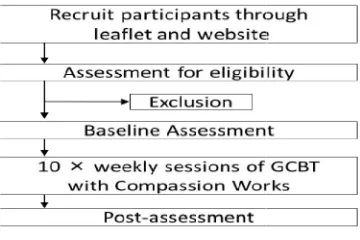
This study will adopt a single-arm design (Fig. 1). The study will be conducted at the Mental and Emotional Health Center in Chiba City, Japan. All procedures will be performed in accordance with the Helsinki Declaration. Required ethical approval were obtained from the Ethics Committee of the Chiba University Graduate School of Medicine (#1872). This study will be conducted according to the TREND statement [8]. The participants will be enrolled from December 2013 to March 2016.
2.2 Participants
Fig. 1. Flow in this study
The eligibility criteria is a primary diagnosis of major depression disorder according to the DSM IV for individuals aged 20–65 years. To ensure that the study population reflects routine clinical practice, comorbid diagnoses will be permitted clearly secondary. The exclusion criteria is as follows: psychosis, personality disorders, bipolar disorder, high risk of suicide, substance abuse or dependence in the past 6 months, unstable medical condition, pregnancy, or lactation.
All patients will be asked to bring a referral form from their psychiatrist together with confirmation of their treatment history. Then, they will be evaluated by a psychiatrist at the Mental and Emotional Health Center in Chiba City for eligibility and exclusion criteria. This evaluation will be based on the Japanese version of the Structured Clinical Interview for DSM
to confirm the primary diagnosis of major depression [9]. The Mini
Neuropsychiatric Interview (MINI), Japanese version 5.0.0., will be used to determine whether there are any comorbidities [10].
2.3 Interventions
Participants will receive 10 sessions of GCBT with compassion training. All sessions will be provided weekly, and each session will last for 1 hour. The therapists will be a clinical psychologist and a nurse or psychologist with a master’s degree who were trained through a CBT Training course at Chiba University. Peer supervision will be held weekly, consisting of therapists and a psychologist and a psychiatric social worker of the Mental and Emotional Health Center in Chiba City.
The GCBT with compassion training is based on a self-help book on CBT and compassion training compiled using free access resources [11, The program consists of 10 sessions as follows: Introduction to GCBT and psycho
Asano et al.; BJMMR, 9(10): 1-5, 2015; Article no.
this study
The eligibility criteria is a primary diagnosis of major depression disorder according to the
DSM-65 years. To ensure that the study population reflects routine clinical practice, comorbid diagnoses will be permitted if clearly secondary. The exclusion criteria is as follows: psychosis, personality disorders, bipolar disorder, high risk of suicide, substance abuse or dependence in the past 6 months, unstable medical condition, pregnancy, or lactation.
ll be asked to bring a referral form from their psychiatrist together with confirmation of their treatment history. Then, they will be evaluated by a psychiatrist at the Mental and Emotional Health Center in Chiba City for a. This evaluation will be based on the Japanese version of the Structured Clinical Interview for DSM-IV (SCID-I), to confirm the primary diagnosis of major depression [9]. The Mini-international Neuropsychiatric Interview (MINI), Japanese will be used to determine whether
Participants will receive 10 sessions of GCBT with compassion training. All sessions will be provided weekly, and each session will last for 1 hour. The therapists will be a clinical psychologist and a nurse or psychologist with a master’s trained through a CBT Training course at Chiba University. Peer supervision will be held weekly, consisting of therapists and a psychologist and a psychiatric social worker of the Mental and Emotional Health Center in Chiba
training is based on help book on CBT and compassion training ing free access resources [11,12]. The program consists of 10 sessions as follows: Introduction to GCBT and psycho-education of
emotion (Session 1); Instructions on self monitoring as per the CBT model when distressed (Session 2); Behavioural activation (Session 3); Behavioural activation and monitoring of cognitions when distressed (Session 4); Challenging one’s own negative cognitions (Session 5 and 6); Psycho
for perfectionism (Session 7); Working with shame and self-criticism (Session 8); Self compassion work (Session 9); Compassion letters to self and other participants and relapse prevention (Session 10).
From sessions 7 to 10, the contents include CFT work. In sessions 7 and 8, psycho
be conducted for perfectionism and working with shame and self-criticism. Perfectionism induces shame and self-criticism, which become barriers to creating alternative thoughts that are an important component of CBT
education will increase the awareness of one’s own perfectionism and help identify the relationship between perfectionism, self
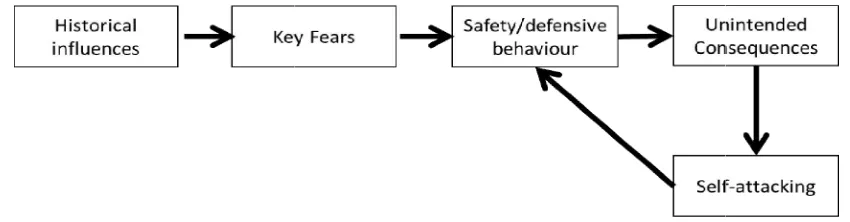
and shame. Therefore, participants will review and share the functions of shame and self criticism, including key fears and safety behaviours, through the case formulation (Fig The reviewing and sharing will enable them to identify the disturbing mechanisms that led to alternative thoughts. Additionally, it helped them recognize that their pathology an
were not their fault [13].
In sessions 9 and 10, participants will work on developing a compassionate attitude to counteract the self-criticism. Self
work includes stopping safety behaviour and developing a compassionate mind by usin compassionate images, compassionate letters, and behavioural experiences of compassion. To evoke compassionate images, the participants will be guided to remember others being kind to them and recall times when they were kind to others. Participants will also be requested to send compassionate letters to each other, expressing with kindness, their gratitude for attending the sessions together.
2.4 Outcomes
The outcome measure is the Beck Depression Inventory II (BDI-II), which is a self
measure of depression severity [14]. The BDI contains 21 items on a 4-point Likert scale from 0–3. The Japanese version of the BDI been standardized and demonstrates excellent reliability and validity [15]. The BDI
measured pre- and post-program.
; Article no.BJMMR.19206
emotion (Session 1); Instructions on self-oring as per the CBT model when distressed (Session 2); Behavioural activation (Session 3); Behavioural activation and monitoring of cognitions when distressed (Session 4); Challenging one’s own negative cognitions (Session 5 and 6); Psycho-education erfectionism (Session 7); Working with criticism (Session 8); Self-compassion work (Session 9); Compassion letters to self and other participants and relapse
From sessions 7 to 10, the contents include CFT sessions 7 and 8, psycho-education will be conducted for perfectionism and working with criticism. Perfectionism induces criticism, which become barriers to creating alternative thoughts that are an [4]. Psycho-education will increase the awareness of one’s own perfectionism and help identify the relationship between perfectionism, self-criticism, and shame. Therefore, participants will review and share the functions of shame and
self-uding key fears and safety behaviours, through the case formulation (Fig. 2). The reviewing and sharing will enable them to identify the disturbing mechanisms that led to alternative thoughts. Additionally, it helped them recognize that their pathology and symptoms
In sessions 9 and 10, participants will work on developing a compassionate attitude to criticism. Self-compassion work includes stopping safety behaviour and developing a compassionate mind by using compassionate images, compassionate letters, and behavioural experiences of compassion. To evoke compassionate images, the participants will be guided to remember others being kind to them and recall times when they were kind to also be requested to send compassionate letters to each other, expressing with kindness, their gratitude for
Fig. 2. Case formulation in this study on the basis of
The secondary outcome is the Self
scale in Japanese (SCS-J) which is a self reported measure of self-compassion [16]. The original version of this scale contains 23 items on a 6-point Likert scale from 1–5 [17]. The SCS has been standardized and has demonstrated acceptable reliability and validity. The SCS be measured pre- and post-program.
2.5 Sample Size
The sample size in this study was not statistically determined due to the limited resources for conducting group cognitive behavioural therapy in Chiba city.
2.6 Statistical Methods
The analyses will be based on the intention treat principle. Descriptive statistics will be calculated for all demographic variables and the BDI-II and SCS-J scores. The change in outcomes will be analysed using a linear mixed model assuming that missing values occur randomly. It will include the baseline score and time as the fixed effects, and the participant as a random effect. Further, the restricted maximum likelihood method will be used, and Cohen’s will be employed to compare the outcomes pre and post-program implementation.
All statistical analyses will be performed using EZR (Saitama Medical Center, Jichi Medical University, Saitama, Japan), which is a graphical user interface for R (The R Foundation for Statistical Computing, Vienna, Austri
significance level of P < 0.05 will be adopted.
3. DISCUSSION
The aim of this study is to estimate the effectiveness of group psychotherapy with compassion training into a GCBT program in a Japanese community setting. It is expected that the program will show a larger effect size than
Asano et al.; BJMMR, 9(10): 1-5, 2015; Article no.
in this study on the basis of compassion focused therapy
The secondary outcome is the Self-Compassion J) which is a self-compassion [16]. The original version of this scale contains 23 items on 5 [17]. The SCS-J nd has demonstrated acceptable reliability and validity. The SCS-J will
program.
The sample size in this study was not statistically determined due to the limited resources for behavioural therapy
The analyses will be based on the intention-to-treat principle. Descriptive statistics will be calculated for all demographic variables and the J scores. The change in outcomes will be analysed using a linear mixed g values occur randomly. It will include the baseline score and time as the fixed effects, and the participant as a random effect. Further, the restricted maximum likelihood method will be used, and Cohen’s d
will be employed to compare the outcomes pre-
All statistical analyses will be performed using EZR (Saitama Medical Center, Jichi Medical University, Saitama, Japan), which is a graphical user interface for R (The R Foundation for Statistical Computing, Vienna, Austria) [18]. A
< 0.05 will be adopted.
The aim of this study is to estimate the effectiveness of group psychotherapy with compassion training into a GCBT program in a Japanese community setting. It is expected that the program will show a larger effect size than
that obtained in GCBT without co
training. The results will suggest that compassion training enhances the effectiveness of GCBT for depression.
Despite the value noted above, this study design has two limitations. At present, it will use an uncontrolled design and open trials.
more reliable evidence, controlled and blinded trial will need to be conducted with reference to the ultimate results of this study. Second, the assessment tools in this study are subjective assessment tools. To more reliably demonstrate its effectiveness, structured interviews should also be used.
4. CONCLUSION
CFT or compassion training can augment the treatment of major depression using CBT. Despite several limitations, this clinical trial may help estimate the effectiveness of CFT, which aid in the design of a further controlled study. As no study has reported the use of CFT or compassion training for clinical samples, this trial will indeed be the first to do so in Japan.
CONSENT
It is not applicable.
ETHICAL APPROVAL
All procedures will be performed in accordance with the Helsinki Declaration. Requir
approval were obtained from the Ethics Committee of the Chiba University Graduate School of Medicine (#1872).
COMPETING INTERESTS
Authors have declared that no co interests exist.
; Article no.BJMMR.19206
compassion focused therapy [12]
that obtained in GCBT without compassion training. The results will suggest that compassion training enhances the effectiveness of GCBT for
Despite the value noted above, this study design has two limitations. At present, it will use an uncontrolled design and open trials. To establish more reliable evidence, controlled and blinded trial will need to be conducted with reference to the ultimate results of this study. Second, the assessment tools in this study are subjective assessment tools. To more reliably demonstrate ffectiveness, structured interviews should
CFT or compassion training can augment the treatment of major depression using CBT. Despite several limitations, this clinical trial may help estimate the effectiveness of CFT, which will aid in the design of a further controlled study. As no study has reported the use of CFT or compassion training for clinical samples, this trial will indeed be the first to do so in Japan.
procedures will be performed in accordance with the Helsinki Declaration. Required ethical were obtained from the Ethics Committee of the Chiba University Graduate
Asano et al.; BJMMR, 9(10): 1-5, 2015; Article no.BJMMR.19206
REFERENCES
1. Bromet E, Andrade LH, Hwang I, Sampson NA, Alonso J, de Girolamo G, et al. Cross-national epidemiology of DSM-IV major depressive episode. BMC Med. 2011;9:90. 2. Cuijpers P, Berking M, Andersson G, Quigley L, Kleiboer A, Dobson KS. A meta-analysis of cognitive-behavioural therapy for adult depression, alone and in comparison with other treatments. Can J Psychiatry. 2013;58:376-85.
3. Rector NA, Bagby RM, Segal ZV, Joffe RT, Levitt A. Self-criticism and dependency in depressed patients treated with cognitive therapy or pharmacotherapy. Cognit Ther Res. 2000;24:571-84.
4. Gilbert P. Compassion focused therapy: distinctive features. New York: Routledge; 2010.
5. Gilbert P. The origins and nature of compassion focused therapy. Br J Clin Psychol. 2014;53:6-41.
6. Gilbert P, Procter S. Compassionate mind training for people with high shame and self-criticism: overview and pilot study of a group therapy approach. Clin Psychol Psychother. 2006;13:353-79.
7. Noorbala F, Borjali A, Ahmadian-Attari MM, Noorbala AA. Effectiveness of compassionate mind training on depression, anxiety, and self-criticism in a group of Iranian depressed patients. Iran J Psychiatry. 2013;8:113-7.
8. Des Jarlais DC, Lyles C, Crepaz N. Improving the reporting quality of nonrandomized evaluations of behavioural and public health interventions: the TREND statement. Am J Public Health. 2004;94:361-6.
9. Takahashi S, Kitamura N, Okano T, Tomita T, Kikuchi A: Japanese version of Structured clinical interview for DSM-IV axis I disorders SCID-I. Tokyo: Nihon Hyoronsha; 2003. (Japanese).
10. Sheehan DV, Lecrubier Y, Otsubo T, Miyaoka H, Kamijima K. Mini-international neuropsychiatric interview Japanese version 5.0.0. Tokyo; Seiwa Shoten Publishers; 2003. (Japanese).
11. Oshima F, Yasumoto M. Using CBT for every stress in your life. Tokyo: Kongoshuppan; 2011. (Japanese). 12. Gilbert P. An introduction to the theory &
practice of compassion focused therapy and compassionate mind training for shame based difficulties. The Compassionate Mind Foundation; 2010. Available:http://www.compassionatemind.c o.uk/downloads/training_materials/1. Workbook_2010.pdf
(Accessed 31 March 2015)
13. Gilbert P. An Introduction to Compassion Focused Therapy in Cognitive Behavior Therapy. Int J Cogn Ther. 2010;3:97-112. 14. Beck AT, Steer RA, Brown GK. Beck
depression inventory-second edition, manual. San Antonio: The Psychological Corporation; 1996.
15. Hiroe T, Kojima M, Yamamoto I, Nojima S, Kinoshita Y, Hashimoto N, et al. Gradations of clinical severity and sensitivity to change assessed with the Beck Depression Inventory-II in Japanese patients with depression. Psychiatry Res. 2005;135:229-35.
16. Miyakawa Y, Yu N. The development of self-compassion scale Japanese version. In: The 54th Annual Meeting of Japanese Society of Social Psychology. 2013;295. 17. Neff KD. The development and validation
of a scale to measure self-compassion. Self Identity. 2003;2:223-50.
18. Kanda Y. Investigation of the freely available easy-to-use software ‘EZR’ for medical statistics. Bone Marrow Transplant. 2013;48:452-8.1. Hilly M, Adams ML, Nelson SC. A study of digit fusion in the mouse embryo. Clin Exp Allergy. 2002;32(4):489-98.
© 2015 Asano et al.; This is an Open Access article distributed under the terms of the Creative Commons Attribution License (http://creativecommons.org/licenses/by/4.0), which permits unrestricted use, distribution, and reproduction in any medium, provided the original work is properly cited.
Peer-review history: