c
Owned by the authors, published by EDP Sciences, 2018
ZU-TH 39/
Leptoquarks in Flavour Physics
Dario Müller1,2,a
1Paul Scherrer Institut, CH–5232 Villigen PSI, Switzerland
2Physik Institut, Universität Zürich, Winterthurstrasse 190,CH-8057 Zürich, Switzerland
Abstract.While the LHC has not directly observed any new particle so far, experimental results from LHCb, BELLE and BABAR point towards the violation of lepton flavour universality inb→s+−andb→cν. In this context, also the discrepancy in the anomalous magnetic moment of the muon can be interpreted as a sign of lepton flavour universality violation. Here we discuss how these hints for new physics can also be explained by introducing leptoquarks as an extension of the Standard Model. Indeed, leptoquarks are good candidates to explain the anomaly in the anomalous magnetic moment of the muon because of anmt/mµenhanced
contribu-tion giving correlated effects inZboson decays which is particularly interesting in the light of future precision experiments.
1 Introduction
So far the LHC has not directly observed any particles be-yond the ones in the Standard Model of particle physics (SM). While in the SM the Higgs boson couplings to fermions are the only source of lepton flavour universal-ity violation (LFUV), in the past years several hints for additional LFUV have been accumulated. The ratios of semi-leptonicBdecays
RK(∗)=BrB→K(∗)µ+µ− BrB
→K(∗)e+e−,
RD(∗)=BrB→D(∗)τν BrB→D(∗)ν,
RJ/Ψ
=Br
B+
c →J/Ψτ+ν
BrBc→J/Ψµ+ν
,
show sizeable deviations from the SM predictions. Consideringb→s+−transitions,R(K) [1] andR(K∗) [2] show a combined significance for LFUV at the 4σ level [3–7]. If we also take into account all other b →
sµ+µ− observables, in several scenarios the global fit prefers new physics (NP) above the 5σlevel [8].
InR(D(∗)) BaBar [9], BELLE [10, 11] and LHCb [12, 13] found a significance for LFUV of about 4σ[14]. In this context it is interesting to mention that LHCb recently measured a deviation of about 2σinR(J/Ψ) [15]. This is consistent with the anomaly inR(D) andR(D∗). The tension in the anomalous magnetic moment of the muon (aµ) between measurement [16] and SM prediction is at the 3σlevel [17, 18]. Also this discrepancy can be interpreted as a sign of LFUV even though the anoma-lous magnetic moments are already in the SM flavour non-universal: If we assume that NP coupled with the same
ae-mail: [email protected]
strength to electrons and to muons,aewould be more
sen-sitive for NP. Since no deviation from the SM prediction inaehas been observed so far, the tension inaµcan be in-terpreted as another sign for LFUV induced by NP. Motivated by these anomalies, we study leptoquarks (LQ) which provide a possible solution of them. Firstly we con-centrate on each anomaly itself and discuss which LQ rep-resentations suit best for an explanation and consider cor-related effects in other observables. Finally, we will inves-tigate if we can explain the described anomalies simulta-neously.
2
a
µIn order to explain the descrepancy inaµ, a rather large ef-fect of the order of the SM weak interaction contribution is required. Among the set of new particles that can give the desired effect, LQ are interesting candidates [19–23]. Even though the LQ must be rather heavy due to LHC con-straints (above 1 TeV), one can still get relevant effects in
aµ. For some representations of LQ, the amplitude can be enhanced by a factormt/mµ O(103) ormb/mµ O(10) compared to the SM.
To achieve an enhancement of factormt/mµ, the LQ must couple to left- and right-handed top or anti-top quarks si-multaneously. However, not all LQ representations have this feature. Among the 10 scalar and vector LQ represen-tations generating lepton-quark interaction terms that are invariant under the SM gauge group [24], only two scalars can possess this enhancement: An SU(2) singletΦ1 and an SU(2) doubletΦ2with quantum numbers
QΦ1:
3,1,−23
, Q(Φ2) :
¯3,2,−73
µ− µ− Φ−5/3
Φ−1/3
t(tc)
γ mt
Z0
ℓ− f
ℓ+ i Φ−5/3
Φ−1/3
t(tc)
t(tc)
mt
mt
Figure 1.Feynman diagrams that contribute toaµandZ→i+−f. The crosses on the fermion lines stand for chirality flips, involving a top mass.
These representations couple to the fermions of the SM as follows
Lint =λ1f iRuc
fi+λ1f iLQcfiτ2Li
Φ†1, (2)
Lint =λ2f iRLufLi+λ2f iLRQfiτ2iΦ†2. (3)
QandLare SU(2) doublets,uandare SU(2) singlets and
cdenotes charge conjugation. f andiare flavour indices. The Feynman diagrams involving Φ1 andΦ2 are shown left in Fig. 1.
For simplicity, we only consider couplings of top quarks to muons and setλ132L,1Randλ322RL,2LRequal toλLµ,R. Besides the contribution toaµ, we also obtain correlated effects in
Z → µ+µ−(see the right Feynman diagram in Fig. 1), in b → sν¯ν (for Φ1) and inb → sµ+µ− (for Φ2). Fig. 2 shows the allowed regions inλLµ-λRµparameter space for a LQ with mass of 1 TeV, to respect constraints from direct searches. ForZ →µ+µ−the expected bounds from GigaZ [25] and TLEP [26] are shown as well. Additionally, for Φ1 the expected BELLE II limit forB→ K(∗)ν¯νis taken into account. Φ2 gives a C9 = C10-like contribution to b→s+−which provides a slight improvement of 1σin the global fit.
If we also allow for couplings of the top quark to taus or electrons, lepton flavour violating processes asτ→µγor
Z → µewill be possible. A more detailed discussion can be found in Ref. [27].
3
b
→
s
+−
Dealing with b → s+− transitions, one usually works
with an effective Hamiltonian of the form
Hfi eff =−
4GF
√ 2VtbV
∗
ts
a=9,10
Caf iOaf i+Caf iOaf i, (4)
O9(10)f i = α 4π[ ¯sγ
µP
Lb] [¯fγµ(γ5)i], (5)
O9(10)f i = α
4π[ ¯sγµPRb] [¯fγµ(γ5)i]. (6)
Then, for several scenarios with NP inC9only,C9=−C10 or C9 = −C9, the global fit prefers NP above the 5σ level [8].
We consider the case where NP contributes asC9=−C10.
While in the muon channel the preferred value deviates from the SM prediction with a tension of 5σ, in the case with electrons the SM contribution is sufficient to give a good fit to the data. To reach the central value, anO(10%) NP effect in the muon channel is required. b → s+− is suppressed by a loop and a CKM factor because it is a flavour changing neutral current. Therefore, the effect of NP does not have to be very large to account for the data. There are several suggestions to explain the anomaly in
b→sµ+µ−with LQ, see e.g. [28–41].
There are three LQ representations that give aC9 =−C10 -like contribution tob→s+−
Φ3:
3,3,−23
, Lint=λ3f iQcfiτ2(τ·Φ3)†Li, (7)
Vµ
1 :
¯3,1,−43
, Lint=κ1f iRdfγµi+κ1f iLQfγµLiV1µ†,
(8)
Vµ
3 :
3,3,4 3
, Lint=κ3f iQfγµ
τ·Vµ
3
Li. (9)
If we only allow for couplings to muons, these LQ will give tree-level effects inb→ sµ+µ−but contribute at loop-level in other flavour observables. This is why LQ can explain the anomalies inb→ sµ+µ−transitions but are not in conflict with other observables.
Including couplings to electrons, we get additional effects in b → se+e− as well as in the lepton flavour violating processesµ→eγandb→ sµe. We can write
Brµ→eγ∝χCee9 +C µµ
9 χ 2
, (10)
BrB→Kµe∝C
ee 9 γ 2
+γCµµ
9 2
, (11)
whereχ=y32/y21andγ=y21/y22, withy=λfor scalar LQ andy = κfor vector LQ. Note that one can avoid an effect inµ → eγcompletely ifCµµ9 = −χ2Cee9. For real values of χ this means that sign[Cee
9 ] = −sign[C
µµ
9 ]. In Fig. 3 you find a detailed analysis for the scalar tripletΦ3. ForVµ
1 andV
µ
µ− µ− Φ−5/3
Φ−1/3
t(tc)
γ mt
Z0
ℓ− f
ℓ+ i Φ−5/3
Φ−1/3
t(tc)
t(tc)
mt
mt
Figure 1.Feynman diagrams that contribute toaµandZ→i+−f. The crosses on the fermion lines stand for chirality flips, involving a top mass.
These representations couple to the fermions of the SM as follows
Lint=λ1f iRuc
fi+λ1f iLQcfiτ2Li
Φ†1, (2)
Lint=λ2f iRLufLi+λ2f iLRQfiτ2iΦ†2. (3)
QandLare SU(2) doublets,uandare SU(2) singlets and
cdenotes charge conjugation. f andiare flavour indices. The Feynman diagrams involving Φ1 andΦ2 are shown left in Fig. 1.
For simplicity, we only consider couplings of top quarks to muons and setλ132L,1Randλ322RL,2LRequal toλLµ,R. Besides the contribution toaµ, we also obtain correlated effects in
Z → µ+µ−(see the right Feynman diagram in Fig. 1), in b → sν¯ν (for Φ1) and inb → sµ+µ− (for Φ2). Fig. 2 shows the allowed regions inλµL-λRµparameter space for a LQ with mass of 1 TeV, to respect constraints from direct searches. ForZ→µ+µ−the expected bounds from GigaZ [25] and TLEP [26] are shown as well. Additionally, for Φ1 the expected BELLE II limit forB → K(∗)ν¯νis taken into account. Φ2 gives a C9 = C10-like contribution to b→s+−which provides a slight improvement of 1σin the global fit.
If we also allow for couplings of the top quark to taus or electrons, lepton flavour violating processes asτ→µγor
Z → µewill be possible. A more detailed discussion can be found in Ref. [27].
3
b
→
s
+−
Dealing with b → s+− transitions, one usually works
with an effective Hamiltonian of the form
Hfi eff =−
4GF
√ 2VtbV
∗
ts
a=9,10
Caf iOaf i+Caf iOaf i, (4)
O9(10)f i = α 4π[ ¯sγ
µP
Lb] [¯fγµ(γ5)i], (5)
O9(10)f i = α
4π[ ¯sγµPRb] [¯fγµ(γ5)i]. (6)
Then, for several scenarios with NP inC9only,C9=−C10 or C9 = −C9, the global fit prefers NP above the 5σ level [8].
We consider the case where NP contributes asC9 =−C10.
While in the muon channel the preferred value deviates from the SM prediction with a tension of 5σ, in the case with electrons the SM contribution is sufficient to give a good fit to the data. To reach the central value, anO(10%) NP effect in the muon channel is required. b → s+− is suppressed by a loop and a CKM factor because it is a flavour changing neutral current. Therefore, the effect of NP does not have to be very large to account for the data. There are several suggestions to explain the anomaly in
b→sµ+µ−with LQ, see e.g. [28–41].
There are three LQ representations that give aC9=−C10 -like contribution tob→s+−
Φ3 :
3,3,−23
, Lint =λ3f iQcfiτ2(τ·Φ3)†Li, (7)
Vµ
1 :
¯3,1,−43
, Lint =κ1f iRdfγµi+κ1f iLQfγµLiV1µ†,
(8)
Vµ
3 :
3,3,4 3
, Lint=κ3f iQfγµ
τ·Vµ
3
Li. (9)
If we only allow for couplings to muons, these LQ will give tree-level effects inb→sµ+µ−but contribute at loop-level in other flavour observables. This is why LQ can explain the anomalies inb→ sµ+µ−transitions but are not in conflict with other observables.
Including couplings to electrons, we get additional effects in b → se+e− as well as in the lepton flavour violating processesµ→eγandb→ sµe. We can write
Brµ→eγ∝χCee9 +C µµ 9 χ 2 , (10)
BrB→Kµe∝C
ee 9 γ 2
+γCµµ
9 2
, (11)
whereχ=y32/y21andγ=y21/y22, withy=λfor scalar LQ andy = κfor vector LQ. Note that one can avoid an effect inµ → eγcompletely ifCµµ9 = −χ2Cee9. For real values of χ this means that sign[Cee
9 ] = −sign[C
µµ
9 ]. In Fig. 3 you find a detailed analysis for the scalar tripletΦ3. ForVµ
1 andV
µ
3 the situation is quite similar, albeit the blue bands are more narrow. For more information see Ref. [42].
-1.5 -1.0 -0.5 0.0 0.5 1.0 1.5
-1.5 -1.0 -0.5 0.0 0.5 1.0 1.5 L R
BK*
BK*(BELLE II) Z(LEP)
Z(GigaZ)
Z(TLEP)
a(2) bs
-0.6 -0.4 -0.2 0.0 0.2 0.4 0.6 -0.6 -0.4 -0.2 0.0 0.2 0.4 0.6
λμL λμ
R
Figure 2.Allowed regions in theλµL-λRµparameter space from current limits of LEP and expected future constraints of GigaZ and TLEP
withMLQ=1 TeV. Left: SU(2) singletΦ1. Right: SU(2) doubletΦ2. Note that if the expected sensitivity of TLEP was reached and no
excess in theZµµ¯-coupling was found, an explanation of the anomaly inaµwould strongly be disfavoured.
4
b
→
c
τν
The transitionb → cτνis a charged current process and is therefore generated at tree-level in the SM. Since an explanation of R(D) and R(D∗) requires an O(10%) ef-fect, also the NP must contribute at tree-level. Charged Higgses [44–48], W bosons [31] and LQ [22, 23, 32, 33, 35, 49, 49–54] are NP candidates. However,Bc
life-time [55, 56] andq2distributions [57] in combination with direct searches [58] strongly disfavour charged Higgses andWbosons.
Hence, we are left with LQ. If we want to explain the ex-cess inR(D) andR(D∗) by modifying the couplings to tau neutrinos and/or taus, we also get effects in b → sτ+τ− andb → sν¯ν. It can be shown in a model independent way that these effects are of the order of 103 compared to the SM [33]. This is due to the fact that the processes
b → sτ+τ−andb → sν¯νoccur at loop-level in the SM, while LQ contribute at tree-level with considerably large couplings in order to explainR(D(∗)). AnO(103) effect is in strong conflict with experimental results ofB→K(∗)ν¯ν. Hence, a model that explainsR(D) andR(D∗) must avoid a major effect inb → sν¯ν. One possibility is the vector LQ singlet Vµ
1 (see Eq. (8)). Another model was pro-posed in Ref. [59], where instead of Vµ
1 two scalar LQ (the SU(2) singletΦ1in Eq. (2) and the SU(2) tripletΦ3 in Eq. (7)) are required. If Fig. 4 we can see for which parameters we can explain R(D(∗)) without violating the limits ofb→sν¯ν.
Besides explainingR(D(∗)), it also enhancesBs → τ+τ− up to a factor 103 compared to the SM and therefore lies within experimental reach. The current limit is BrBs→τ+τ−<6.8×10⁻³[60]. Fig. 5 shows the
corre-lation ofR(D(∗)) and BrB
s→τ+τ−.
5 Simultaneous Explanation
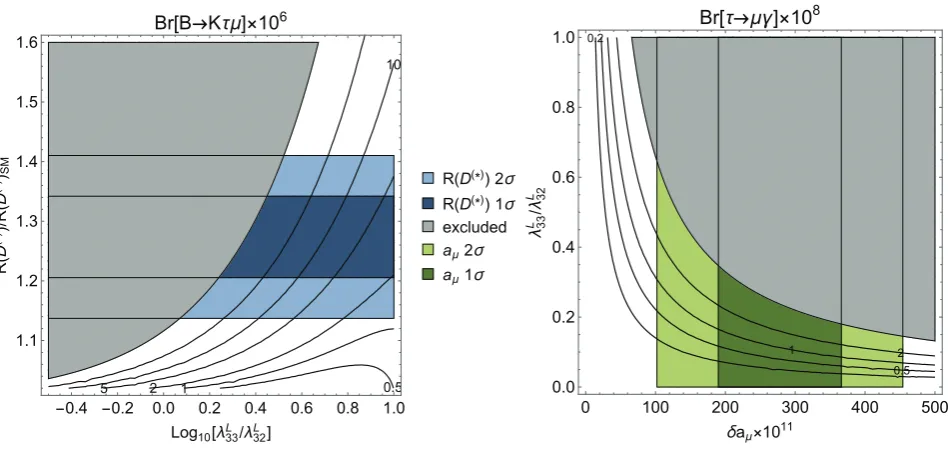
We may ask if one can explain the three types of anoma-lies inaµ,b→sµ+µ−andR(D(∗)) simultaneously. If we take the model that we proposed in Sec. 4 and insert a discrete symmetry for the couplingsλ1jkL =eiπjλ3jk≡λLjk the effect in b → sν¯νwill be cancelled exactly. If we include b → sµ+µ−, B → D(∗)µν/B → D(∗)eν will be affected. However, these observables remain compatible with experiments. Additionally the LFV processτ→ µγ andb → sτµappear. Both processes give constraints on our parameter space. On the left-hand side of Fig. 6 the allowed regions for MLQ = 1 TeV are shown, under the
assumption thatb → sµ+µ−matches the central value of
the global fit. As we can see easily, the explanation of
R(D(∗)) requires λL
33/λL32 > 1. On the right-hand side of Fig. 6 we needλL33/λL32<0.6 to explainaµwithout getting in conflict with experimental constraints ofτ→µγ. With this contradiction, we cannot explain all three anomalies simultaneously. However, if we abandon anyone of them, it is possible to explain the other two anomalies. If we abandon the assumptionλ1jkL = eiπjλ3jkone can avoid the discussed constraints and explain all three anomalies. Another good candidate is the vector LQ singlet Vµ
1 be-cause it does not affect theb→sν¯νtransitions but gives a
C9 =−C10effect inb→ s+−. It can also be used to ex-plainR(D(∗)). Ina
µwe can obtain anmb/mµcontribution which is not as large as for the two scalar LQΦ1 andΦ2 (see Sec.2), but still may be significant.
phe--1.0 -0.5 0.0 0.5 1.0
-1.0
-0.5 0.0 0.5 1.0
C
9=-
C
10C
9ee
=-C
10ee
=1
=4
=0.25
Br[ e] <5.7·10-13Scalar Triplet
bs+-(1)
bs+-(2)
Br[BK±e]·108with=1
Figure 3.The darker (lighter) red region shows the global fit at 1σ(2σ) forb→se+e−andb→sµ+µ−transitions. In blue, the allowed region constrained by the current limit Brµ→eγ<4.2×10⁻¹³[43] withχ={1/4,1,4}for the scalar tripletΦ
3withMLQ=1TeV. The outer (inner) green contour shows the case where BrB→Kµe=2×10⁻⁸(0.2×10⁻⁸). For real values ofχonly the region with
Cµµ
9 <0 andCee9 >0 seems to be compatible with experimental limits. Indeed this is also where the central value of the global fit lies.
However, if in the future the global fit prefersCµµ
9 <0 andCee9 <0, LQ with real couplings will not be able to explainb→ s+−
transitions without violating the constraints fromµ→eγ.
-0.6 -0.4 -0.2 0.0 0.2 0.4 0.6
-0.6 -0.4 -0.2 0.0 0.2 0.4 0.6
sign[231L331L] 231L331L/M1[1/TeV]
sign
[
23
3
33
3]
23
3
33
3
/
M3
[
1
/
Te
V
]
R(D(*))2
R(D(*))1
bsallowed
Figure 4.In lighter (darker) blue you see the 1σ(2σ) preferred
region of the weighted sum ofR(D) andR(D∗), in yellow the allowed region ofb→sνν¯.M1(3)is the mass of the LQΦ1(Φ3).
nomenologically consistent and leads to a massive vector LQ. This vector LQ has the properties ofVµ
1 in Eq. (8).
6 Conclusion
In these proceedings we reviewed which LQ are good can-didates to explain flavour anomalies: For the deviation in
aµthe scalar LQΦ1andΦ2give anmt/mµenhanced con-tribution. This is a useful feature to explain the rather large
1.0 1.2 1.4 1.6
0.000 0.002 0.004 0.006 0.008
R(D(*))/R(D(*))SM
Br
[
Bs
]
R(D(*))2
R(D(*))1
Bsexcluded
Bs
Figure 5. In blue we have the weighted sum of R(D) and R(D∗) and the red line depicts the correlated prediction of Br [Bs→τ+τ−]. The grey region shows the current experimental
bounds.
discrepancy. Consideringb→ s+−transitions, the three
LQ representationsΦ3,V1µandV3µare required by the fit, because they giveC9=−C10.R(D(∗)) can be explained ei-ther byVµ
-1.0 -0.5 0.0 0.5 1.0
-1.0
-0.5 0.0 0.5 1.0
C
9=-
C
10C
9ee
=-C
10ee
=1
=4
=0.25
Br[ e] <5.7·10-13Scalar Triplet
bs+-(1)
bs+-(2)
Br[BK±e]·108with=1
Figure 3.The darker (lighter) red region shows the global fit at 1σ(2σ) forb→se+e−andb→sµ+µ−transitions. In blue, the allowed region constrained by the current limit Brµ→eγ<4.2×10⁻¹³[43] withχ={1/4,1,4}for the scalar tripletΦ
3withMLQ=1TeV. The outer (inner) green contour shows the case where BrB→Kµe=2×10⁻⁸(0.2×10⁻⁸). For real values ofχonly the region with
Cµµ
9 <0 andCee9 >0 seems to be compatible with experimental limits. Indeed this is also where the central value of the global fit lies.
However, if in the future the global fit prefersCµµ
9 <0 andCee9 <0, LQ with real couplings will not be able to explainb→ s+−
transitions without violating the constraints fromµ→eγ.
-0.6 -0.4 -0.2 0.0 0.2 0.4 0.6
-0.6 -0.4 -0.2 0.0 0.2 0.4 0.6
sign[231L331L] 231L331L/M1[1/TeV]
sign
[
23
3
33
3]
23
3
33
3
/
M3
[
1
/
Te
V
]
R(D(*))2
R(D(*))1
bsallowed
Figure 4.In lighter (darker) blue you see the 1σ(2σ) preferred
region of the weighted sum ofR(D) andR(D∗), in yellow the allowed region ofb→sνν¯. M1(3)is the mass of the LQΦ1(Φ3).
nomenologically consistent and leads to a massive vector LQ. This vector LQ has the properties ofVµ
1 in Eq. (8).
6 Conclusion
In these proceedings we reviewed which LQ are good can-didates to explain flavour anomalies: For the deviation in
aµthe scalar LQΦ1andΦ2give anmt/mµenhanced con-tribution. This is a useful feature to explain the rather large
1.0 1.2 1.4 1.6
0.000 0.002 0.004 0.006 0.008
R(D(*))/R(D(*))SM
Br
[
Bs
]
R(D(*))2
R(D(*))1
Bsexcluded
Bs
Figure 5. In blue we have the weighted sum of R(D) and R(D∗) and the red line depicts the correlated prediction of Br [Bs→τ+τ−]. The grey region shows the current experimental
bounds.
discrepancy. Consideringb→ s+−transitions, the three
LQ representationsΦ3,V1µandV3µare required by the fit, because they giveC9=−C10.R(D(∗)) can be explained ei-ther byVµ
1 or, as we proposed, by a combination of a scalar LQ singletΦ1and scalar LQ tripletΦ3without getting in conflict withb → sν¯νobservables. We also showed that this model is able to explain any two of the three anomalies (aµ,b→ sµ+µ−andR(D(∗)) simultaneously.
0.5 1
2 5
10
-0.4 -0.2 0.0 0.2 0.4 0.6 0.8 1.0
1.1 1.2 1.3 1.4 1.5 1.6
Log10[33L/32L ]
R
(
D
(*))/
R
(
D
(*))
SM
Br[BK]×106
R(D(*))2
R(D(*))1
excluded
a2
a1
0.2
0.5
1 2
0 100 200 300 400 500
0.0 0.2 0.4 0.6 0.8 1.0
a×1011
33
L/
32
L
Br[]×108
Figure 6.Left: In blue we have the weighted sum ofR(D) andR(D∗). The contour lines show BrB→Kτµ×106. Right: The anomaly
inaµcombined with the contour lines depicting Brτ→µγ×108. In both plots the grey region is excluded by experiments.
Acknowledgments
D.M. thanks the organizing committee, and especially Gi-ancarlo D’Ambrosio, for the invitation and for giving the opportunity to present his work.
D.M. is supported by an Ambizione Grant of the Swiss National Science Foundation (PZ00P2_154834).
References
[1] R. Aaij et al. [LHCb Collaboration], Phys. Rev. Lett. 113 (2014) 151601 doi:10.1103/PhysRevLett.113.151601
[arXiv:1406.6482 [hep-ex]].
[2] R. Aaij et al. [LHCb Collaboration], JHEP
1708 (2017) 055 doi:10.1007/JHEP08(2017)055 [arXiv:1705.05802 [hep-ex]].
[3] W. Altmannshofer, P. Stangl and D. M. Straub, Phys. Rev. D 96 (2017) no.5, 055008 doi:10.1103/PhysRevD.96.055008 [arXiv:1704.05435 [hep-ph]].
[4] G. D’Amico, M. Nardecchia, P. Panci, F. Sannino, A. Strumia, R. Torre and A. Urbano, JHEP1709(2017) 010 doi:10.1007/JHEP09(2017)010 [arXiv:1704.05438 [hep-ph]].
[5] G. Hiller and I. Nisandzic, Phys. Rev. D 96 (2017) no.3, 035003 doi:10.1103/PhysRevD.96.035003 [arXiv:1704.05444 [hep-ph]].
[6] L. S. Geng, B. Grinstein, S. Jäger, J. Martin Camalich, X. L. Ren and R. X. Shi, Phys. Rev. D 96 (2017) no.9, 093006 doi:10.1103/PhysRevD.96.093006 [arXiv:1704.05446 [hep-ph]].
[7] T. Hurth, F. Mahmoudi, D. Martinez Santos and S. Neshatpour, Phys. Rev. D 96(2017) no.9, 095034
doi:10.1103/PhysRevD.96.095034 [arXiv:1705.06274 [hep-ph]].
[8] B. Capdevila, A. Crivellin, S. Descotes-Genon, J. Ma-tias and J. Virto, arXiv:1704.05340 [hep-ph].
[9] J. P. Lees et al. [BaBar Collabo-ration], Phys. Rev. Lett. 109 (2012) 101802 doi:10.1103/PhysRevLett.109.101802 [arXiv:1205.5442 [hep-ex]].
[10] M. Huschle et al. [Belle Collabora-tion], Phys. Rev. D 92 (2015) no.7, 072014 doi:10.1103/PhysRevD.92.072014 [arXiv:1507.03233 [hep-ex]].
[11] S. Hirose et al. [Belle Collaboration], arXiv:1709.00129 [hep-ex].
[12] R. Aaij et al. [LHCb Collaboration], Phys. Rev. Lett. 115 (2015) no.11, 111803 Erratum: [Phys. Rev. Lett. 115 (2015) no.15, 159901] doi:10.1103/PhysRevLett.115.159901, 10.1103/ Phys-RevLett.115.111803 [arXiv:1506.08614 [hep-ex]]. [13] F. Betti [LHCb Collaboration], arXiv:1705.10651
[hep-ex].
[14] Y. Amhiset al., arXiv:1612.07233 [hep-ex].
[15] R. Aaij et al. [LHCb Collaboration], arXiv:1711.05623 [hep-ex].
[16] G. W. Bennett et al. [Muon g-2 Collab-oration], Phys. Rev. D 73 (2006) 072003 doi:10.1103/PhysRevD.73.072003 [hep-ex/0602035]. [17] A. Nyffeler, Phys. Rev. D 94 (2016) no.5, 053006
doi:10.1103/PhysRevD.94.053006 [arXiv:1602.03398 [hep-ph]].
[18] F. Jegerlehner and A. Nyffeler, Phys. Rept.
[19] A. Djouadi, T. Kohler, M. Spira and J. Tutas, Z. Phys. C46(1990) 679. doi:10.1007/BF01560270
[20] S. Davidson, D. C. Bailey and B. A. Campbell, Z. Phys. C61(1994) 613 doi:10.1007/BF01552629 [hep-ph/9309310].
[21] G. Couture and H. Konig, Phys. Rev. D53 (1996) 555 doi:10.1103/PhysRevD.53.555 [hep-ph/9507263]. [22] M. Bauer and M. Neubert, Phys.
Rev. Lett. 116 (2016) no.14, 141802 doi:10.1103/PhysRevLett.116.141802
[arXiv:1511.01900 [hep-ph]].
[23] D. Das, C. Hati, G. Kumar and N. Ma-hajan, Phys. Rev. D 94 (2016) 055034 doi:10.1103/PhysRevD.94.055034 [arXiv:1605.06313 [hep-ph]].
[24] W. Buchmuller, R. Ruckl and D. Wyler, Phys. Lett. B 191 (1987) 442 Erratum: [Phys. Lett. B
448 (1999) 320]. doi:10.1016/ S0370-2693(99)00014-3, 10.1016/0370-2693(87)90637-X
[25] H. Baeret al., arXiv:1306.6352 [hep-ph].
[26] M. Bicer et al. [TLEP Design Study Working Group], JHEP 1401 (2014) 164 doi:10.1007/JHEP01(2014)164 [arXiv:1308.6176 [hep-ex]].
[27] E. Coluccio Leskow, G. D’Ambrosio, A. Crivellin and D. Müller, Phys. Rev. D 95 (2017) no.5, 055018 doi:10.1103/PhysRevD.95.055018 [arXiv:1612.06858 [hep-ph]].
[28] B. Gripaios, M. Nardecchia and S. A. Renner, JHEP1505(2015) 006 doi:10.1007/JHEP05(2015)006 [arXiv:1412.1791 [hep-ph]].
[29] S. Fajfer and N. Košnik, Phys. Lett. B755(2016) 270 doi:10.1016/j.physletb.2016.02.018 [arXiv:1511.06024 [hep-ph]].
[30] D. Beˇcirevi´c, S. Fajfer and N. Košnik, Phys. Rev. D 92 (2015) no.1, 014016 doi:10.1103/PhysRevD.92.014016 [arXiv:1503.09024 [hep-ph]].
[31] A. Greljo, G. Isidori and D. Marzocca, JHEP
1507 (2015) 142 doi:10.1007/JHEP07(2015)142 [arXiv:1506.01705 [hep-ph]].
[32] L. Calibbi, A. Crivellin and T. Ota, Phys. Rev. Lett. 115 (2015) 181801 doi:10.1103/PhysRevLett.115.181801
[arXiv:1506.02661 [hep-ph]].
[33] R. Alonso, B. Grinstein and J. Martin Camalich, JHEP1510(2015) 184 doi:10.1007/JHEP10(2015)184 [arXiv:1505.05164 [hep-ph]].
[34] R. Barbieri, G. Isidori, A. Pattori and F. Senia, Eur. Phys. J. C76(2016) no.2, 67 doi:10.1140/epjc/ s10052-016-3905-3 [arXiv:1512.01560 [hep-ph]].
[35] D. Beˇcirevi´c, S. Fajfer, N. Košnik and O. Sumen-sari, Phys. Rev. D 94 (2016) no.11, 115021 doi:10.1103/PhysRevD.94.115021 [arXiv:1608.08501 [hep-ph]].
[36] D. Beˇcirevi´c, N. Košnik, O. Sumensari and R. Zukanovich Funchal, JHEP 1611 (2016) 035 doi:10.1007/JHEP11(2016)035 [arXiv:1608.07583
[hep-ph]].
[37] D. Beˇcirevi´c and O. Sumensari, JHEP1708(2017) 104 doi:10.1007/JHEP08(2017)104 [arXiv:1704.05835 [hep-ph]].
[38] D. Aloni, A. Dery, C. Frugiuele and Y. Nir, JHEP1711(2017) 109 doi:10.1007/JHEP11(2017)109 [arXiv:1708.06161 [hep-ph]].
[39] B. Chauhan, B. Kindra and A. Narang, arXiv:1706.04598 [hep-ph].
[40] O. Sumensari, arXiv:1705.07591 [hep-ph].
[41] C. H. Chen, T. Nomura and H. Okada, Phys. Lett. B774 (2017) 456 doi:10.1016/j.physletb.2017.10.005 [arXiv:1703.03251 [hep-ph]].
[42] A. Crivellin, D. Mueller, A. Signer and Y. Ulrich, arXiv:1706.08511 [hep-ph].
[43] A. M. Baldiniet al.[MEG Collaboration], Eur. Phys. J. C76(2016) no.8, 434 doi:10.1140/epjc/ s10052-016-4271-x [arXiv:1605.05081 [hep-ex]].
[44] A. Crivellin, C. Greub and A. Kokulu, Phys. Rev. D86(2012) 054014 doi:10.1103/PhysRevD.86.054014 [arXiv:1206.2634 [hep-ph]].
[45] M. Tanaka and R. Watanabe, Phys. Rev. D87(2013) no.3, 034028 doi:10.1103/PhysRevD.87.034028 [arXiv:1212.1878 [hep-ph]].
[46] A. Celis, M. Jung, X. Q. Li and A. Pich, JHEP1301(2013) 054 doi:10.1007/JHEP01(2013)054 [arXiv:1210.8443 [hep-ph]].
[47] A. Crivellin, A. Kokulu and C. Greub, Phys. Rev. D 87 (2013) no.9, 094031 doi:10.1103/PhysRevD.87.094031 [arXiv:1303.5877 [hep-ph]].
[48] A. Crivellin, J. Heeck and P. Stof-fer, Phys. Rev. Lett. 116 (2016) no.8, 081801 doi:10.1103/PhysRevLett.116.081801 [arXiv:1507.07567 [hep-ph]].
[49] R. Barbieri, C. W. Murphy and F. Senia, Eur. Phys. J. C77 (2017) no.1, 8 doi:10.1140/epjc/ s10052-016-4578-7 [arXiv:1611.04930 [hep-ph]].
[50] B. Chauhan and B. Kindra, arXiv:1709.09989 [hep-ph].
[51] I. Doršner, S. Fajfer, D. A. Faroughy and N. Košnik, JHEP1710(2017) 188 doi:10.1007/JHEP10(2017)188 [arXiv:1706.07779 [hep-ph]].
[52] O. Popov and G. A. White, Nucl. Phys. B
923 (2017) 324 doi:10.1016/j.nuclphysb.2017.08.007 [arXiv:1611.04566 [hep-ph]].
[53] G. Hiller, D. Loose and K. Schönwald, JHEP
1612 (2016) 027 doi:10.1007/JHEP12(2016)027 [arXiv:1609.08895 [hep-ph]].
[54] S. Sahoo, R. Mohanta and A. K. Giri, Phys. Rev. D 95 (2017) no.3, 035027 doi:10.1103/PhysRevD.95.035027 [arXiv:1609.04367 [hep-ph]].
[19] A. Djouadi, T. Kohler, M. Spira and J. Tutas, Z. Phys. C46(1990) 679. doi:10.1007/BF01560270
[20] S. Davidson, D. C. Bailey and B. A. Campbell, Z. Phys. C61(1994) 613 doi:10.1007/BF01552629 [hep-ph/9309310].
[21] G. Couture and H. Konig, Phys. Rev. D53 (1996) 555 doi:10.1103/PhysRevD.53.555 [hep-ph/9507263]. [22] M. Bauer and M. Neubert, Phys.
Rev. Lett. 116 (2016) no.14, 141802 doi:10.1103/PhysRevLett.116.141802
[arXiv:1511.01900 [hep-ph]].
[23] D. Das, C. Hati, G. Kumar and N. Ma-hajan, Phys. Rev. D 94 (2016) 055034 doi:10.1103/PhysRevD.94.055034 [arXiv:1605.06313 [hep-ph]].
[24] W. Buchmuller, R. Ruckl and D. Wyler, Phys. Lett. B 191 (1987) 442 Erratum: [Phys. Lett. B
448 (1999) 320]. doi:10.1016/ S0370-2693(99)00014-3, 10.1016/0370-2693(87)90637-X
[25] H. Baeret al., arXiv:1306.6352 [hep-ph].
[26] M. Bicer et al. [TLEP Design Study Working Group], JHEP 1401 (2014) 164 doi:10.1007/JHEP01(2014)164 [arXiv:1308.6176 [hep-ex]].
[27] E. Coluccio Leskow, G. D’Ambrosio, A. Crivellin and D. Müller, Phys. Rev. D95 (2017) no.5, 055018 doi:10.1103/PhysRevD.95.055018 [arXiv:1612.06858 [hep-ph]].
[28] B. Gripaios, M. Nardecchia and S. A. Renner, JHEP1505(2015) 006 doi:10.1007/JHEP05(2015)006 [arXiv:1412.1791 [hep-ph]].
[29] S. Fajfer and N. Košnik, Phys. Lett. B755(2016) 270 doi:10.1016/j.physletb.2016.02.018 [arXiv:1511.06024 [hep-ph]].
[30] D. Beˇcirevi´c, S. Fajfer and N. Košnik, Phys. Rev. D 92 (2015) no.1, 014016 doi:10.1103/PhysRevD.92.014016 [arXiv:1503.09024 [hep-ph]].
[31] A. Greljo, G. Isidori and D. Marzocca, JHEP
1507 (2015) 142 doi:10.1007/JHEP07(2015)142 [arXiv:1506.01705 [hep-ph]].
[32] L. Calibbi, A. Crivellin and T. Ota, Phys. Rev. Lett. 115 (2015) 181801 doi:10.1103/PhysRevLett.115.181801
[arXiv:1506.02661 [hep-ph]].
[33] R. Alonso, B. Grinstein and J. Martin Camalich, JHEP1510(2015) 184 doi:10.1007/JHEP10(2015)184 [arXiv:1505.05164 [hep-ph]].
[34] R. Barbieri, G. Isidori, A. Pattori and F. Senia, Eur. Phys. J. C76(2016) no.2, 67 doi:10.1140/epjc/ s10052-016-3905-3 [arXiv:1512.01560 [hep-ph]].
[35] D. Beˇcirevi´c, S. Fajfer, N. Košnik and O. Sumen-sari, Phys. Rev. D 94 (2016) no.11, 115021 doi:10.1103/PhysRevD.94.115021 [arXiv:1608.08501 [hep-ph]].
[36] D. Beˇcirevi´c, N. Košnik, O. Sumensari and R. Zukanovich Funchal, JHEP 1611 (2016) 035 doi:10.1007/JHEP11(2016)035 [arXiv:1608.07583
[hep-ph]].
[37] D. Beˇcirevi´c and O. Sumensari, JHEP1708(2017) 104 doi:10.1007/JHEP08(2017)104 [arXiv:1704.05835 [hep-ph]].
[38] D. Aloni, A. Dery, C. Frugiuele and Y. Nir, JHEP1711(2017) 109 doi:10.1007/JHEP11(2017)109 [arXiv:1708.06161 [hep-ph]].
[39] B. Chauhan, B. Kindra and A. Narang, arXiv:1706.04598 [hep-ph].
[40] O. Sumensari, arXiv:1705.07591 [hep-ph].
[41] C. H. Chen, T. Nomura and H. Okada, Phys. Lett. B774 (2017) 456 doi:10.1016/j.physletb.2017.10.005 [arXiv:1703.03251 [hep-ph]].
[42] A. Crivellin, D. Mueller, A. Signer and Y. Ulrich, arXiv:1706.08511 [hep-ph].
[43] A. M. Baldiniet al.[MEG Collaboration], Eur. Phys. J. C76(2016) no.8, 434 doi:10.1140/epjc/ s10052-016-4271-x [arXiv:1605.05081 [hep-ex]].
[44] A. Crivellin, C. Greub and A. Kokulu, Phys. Rev. D86(2012) 054014 doi:10.1103/PhysRevD.86.054014 [arXiv:1206.2634 [hep-ph]].
[45] M. Tanaka and R. Watanabe, Phys. Rev. D87(2013) no.3, 034028 doi:10.1103/PhysRevD.87.034028 [arXiv:1212.1878 [hep-ph]].
[46] A. Celis, M. Jung, X. Q. Li and A. Pich, JHEP1301(2013) 054 doi:10.1007/JHEP01(2013)054 [arXiv:1210.8443 [hep-ph]].
[47] A. Crivellin, A. Kokulu and C. Greub, Phys. Rev. D 87 (2013) no.9, 094031 doi:10.1103/PhysRevD.87.094031 [arXiv:1303.5877 [hep-ph]].
[48] A. Crivellin, J. Heeck and P. Stof-fer, Phys. Rev. Lett. 116 (2016) no.8, 081801 doi:10.1103/PhysRevLett.116.081801 [arXiv:1507.07567 [hep-ph]].
[49] R. Barbieri, C. W. Murphy and F. Senia, Eur. Phys. J. C77 (2017) no.1, 8 doi:10.1140/epjc/ s10052-016-4578-7 [arXiv:1611.04930 [hep-ph]].
[50] B. Chauhan and B. Kindra, arXiv:1709.09989 [hep-ph].
[51] I. Doršner, S. Fajfer, D. A. Faroughy and N. Košnik, JHEP1710(2017) 188 doi:10.1007/JHEP10(2017)188 [arXiv:1706.07779 [hep-ph]].
[52] O. Popov and G. A. White, Nucl. Phys. B
923 (2017) 324 doi:10.1016/j.nuclphysb.2017.08.007 [arXiv:1611.04566 [hep-ph]].
[53] G. Hiller, D. Loose and K. Schönwald, JHEP
1612 (2016) 027 doi:10.1007/JHEP12(2016)027 [arXiv:1609.08895 [hep-ph]].
[54] S. Sahoo, R. Mohanta and A. K. Giri, Phys. Rev. D 95 (2017) no.3, 035027 doi:10.1103/PhysRevD.95.035027 [arXiv:1609.04367 [hep-ph]].
[55] A. G. Akeroyd and C. H. Chen, Phys. Rev. D 96 (2017) no.7, 075011 doi:10.1103/PhysRevD.96.075011 [arXiv:1708.04072 [hep-ph]].
[56] M. Freytsis, Z. Ligeti and J. T. Ruder-man, Phys. Rev. D 92 (2015) no.5, 054018 doi:10.1103/PhysRevD.92.054018 [arXiv:1506.08896 [hep-ph]].
[57] A. Celis, M. Jung, X. Q. Li and A. Pich, Phys. Lett. B 771 (2017) 168 doi:10.1016/j.physletb.2017.05.037 [arXiv:1612.07757 [hep-ph]].
[58] D. A. Faroughy, A. Greljo and J. F. Ka-menik, Phys. Lett. B 764 (2017) 126 doi:10.1016/j.physletb.2016.11.011 [arXiv:1609.07138 [hep-ph]].
[59] A. Crivellin, D. Müller and T. Ota, JHEP
1709 (2017) 040 doi:10.1007/JHEP09(2017)040 [arXiv:1703.09226 [hep-ph]].
[60] R. Aaij et al. [LHCb Collabora-tion], Phys. Rev. Lett. 118 (2017) no.25, 251802 doi:10.1103/PhysRevLett.118.251802 [arXiv:1703.02508 [hep-ex]].
[61] L. Di Luzio, A. Greljo and M. Nardec-chia, Phys. Rev. D 96 (2017) no.11, 115011 doi:10.1103/PhysRevD.96.115011 [arXiv:1708.08450 [hep-ph]].
[62] L. Calibbi, A. Crivellin and T. Li, arXiv:1709.00692 [hep-ph].
[63] M. Bordone, C. Cornella, J. Fuentes-Martin and G. Isidori, arXiv:1712.01368 [hep-ph].