Active Mutator Elements Suppress the Knotted Phenotype and Increase
Recombination at the K n l - 0 Tandem Duplication
Brenda
Lowe,Julie Mathern and Sarah
Hake'
uSDA-ARS Plant Gene Expression Center, Albany, Calijornia 94710, and Department of Plant Biology, University of CalifiOfornia, Berkeley, Calijornia 94720
Manuscript received February 5, 1992 Accepted for publication July 10, 1992
ABSTRACT
T h e KNOTTED-1 (KNZ) locus is defined by a number of dominant mutations that affect leaf development. T h e K n l - 0 mutation is characterized by outpocketings of tissue along lateral veins of the maize leaf and by displacement of ligule tissue from the junction of the blade and sheath into the blade. K n l - 0 results from a tandem duplication of 17 kb; each repeat includes the entire 8-kb K N l transcription unit. Mutator (Mu) transposable elements inserted at the junction of the two repeats diminish the mutant phenotype. T h e M u insertions affect the K n l - 0 mutation in several distinctive ways. (1) Two of the three M u elements, a M u 1 and a M u 8 element, diminish the mutant phenotype only when active as indicated by hypomethylation; when methylated o r inactive, the phenotype is comparable to the K n l - 0 progenitor. (2) Additional rearrangements have arisen in these derivatives that further reduce the mutant phenotype. (3) A 100-2000-fold increase in the loss of one repeat occurs in the presence of M u elements as compared to K n l - 0 without elements. T h e high frequency of loss only occurs when the M u elements are hypomethylated. T h e frequency is also influenced by
the specific allele carried at the same locus on the homologous chromosome. Reciprocal exchange of flanking markers does not accompany the
-
loss events. Various recombination models that address the events occurring at K n l - 0 are presented."
T
RANSPOSABLE elements affect gene expres- sion in several different ways. Transposon in- sertions into coding regions often result in loss or diminution of gene expression. Insertions into regu- latory regions may alter gene expression either by interrupting the normal regulatory sequences [seeCOEN et al. (1989) for review] or by placing the gene under the regulation of that element or unlinked elements (MASSON et al. 1987; CORCES and GEYER
199 1). Transposable elements also affect gene expres- sion by serving as a substrate for recombination.
Crossing over between members of a transposon gene family may lead to inversions or deletions which in turn may alter regulation of nearby genes (LIM 1988;
DAVIS, SHEN and JuDD 1987; NEVERS, SHEPHERD and
SAEDLER 1986; ROBERTSON and STINARD 1987;
MONTGOMERY et al. 199 1). Dispersed transposons may also undergo recombination-mediated changes that do not alter the flanking D N A sequences, but may affect expression of adjacent genes (ROEDER and FINK
1982).
Transposable elements of the ROBERTSON'S (1 987)
M u t a t o r ( M u ) system in maize are characterized by terminal inverted repeats of approximately 200 bp that flank unrelated internal sequences [for reviews see WALBOT (1991) and CHANDLER and HARDEMAN
(1992)l. Most M u elements do not encode a transpos-
' To whom correspondence should be sent.
Genetics 132: 813-822 (November, 1992)
ase and are considered nonautonomous. Recently, an element has been characterized in several laboratories that has the genetic features of an autonomous ele- ment (CHOMET et al. 1991 ; QIN, ROBERTSON and
ELLINGBOE 199 1 ; HERSHBERGER, WARREN and WAL-
BOT 1991). Presumably, it encodes the transposase
required for transposition of all nonautonomous ele- ments. T h e Mutator system is characterized by a high forward-mutation rate presumably due to the numer- ous M u elements present, and by occasional activity loss. In an inactive line, new mutant phenotypes are no longer generated (ROBERTSON et al. 1985), the M u
elements are methylated (CHANDLER and WALBOT
1986; BENNETZEN 1987), and M u elements do not excise somatically (WALBOT 1986; BROWN and SUN-
DARESAN 1992). Inactivity is correlated with, and pre- sumably a direct consequence of, loss or inactivation of the autonomous element (CHOMET et al. 1991 ;
QIN,
ROBERTSON and ELLINGBOE 1 99 1 ; HERSHBERGER, WARREN and WALBOT 199 1).
814 B. Lowe, J. Mathern and S. Hake
SASS 1941; GELINAS, POSTLETHWAIT a n d NELSON
1969; FREELINC a n d HAKE 1985). K N I was cloned by transposon tagging using a Ds2 element (HAKE, VOLL-
BRECHT a n d FREELINC 1989) and subsequently shown t o e n c o d e a homeodomain-containing protein (VOLL-
BRECHT et al. 1991). While most dominant K n l mu- tations result from the insertion of transposons into introns (HAKE, VOLLBRECHT a n d FREELINC 1989; o u r unpublished data), the K n l - 0 mutation is caused by a 17-kb tandem duplication (VEIT et al. 1 9 9 0 ) . T h e duplication leaves the surrounding regulatory se- quences of the distal transcription unit unaltered,
while the proximal transcription unit is placed in a novel context 500 bp from the repeat junction (see Figure 1). T h e p h e n o t y p e of K n l - 0 is fully penetrant. In addition, both juvenile and adult leaves display
some level of ligule displacement or knots. From a screen of 10,000 heterozygous K n l - O / + plants in a Mu background, nine normal or near-normal appear- ing plants were identified. Southern analysis of DNA
isolated from each individual plant demonstrated that five plants had lost one copy of the 17-kb repeat and four had sustained an insertion at the junction of t h e two repeats. Three of the four insertions are Mu elements (VEIT et al. 1990). N o derivatives have been recovered that disrupt the normal context transcrip- tion unit. These findings suggest that the K n l - 0 mu- tation is caused not by the duplication per se, b u t r a t h e r by the juxtaposition of novel sequences 5 ’ t o the proximal transcription unit (see Figure 1).
To gain a better understanding of t h e K n l - 0 mu- tation, we analyzed several independent Mu-induced derivatives. We find that the phenotypic effect of two Mu element insertions depends on whether the Mu
elements are methylated; however, the effect of a third Mu insertion is independent of Mu methylation. T h e insertions generate subsequent rearrangements and increase the frequency of repeat loss a t K n l - 0 . The frequency of repeat loss is affected by t h e specific allele present on the homologous chromosome and by methylation of the Mu elements. Models are discussed concerning the recombination mechanisms involved in Mu-associated repeat loss a t K n l - 0 .
MATERIALS AND METHODS
Plasmids, and statistical analysis: T h e genomic frag- ments used in Southern hybridization were derived from the lambda clones of Knl-2Fll (HAKE, VOLLBRECHT and FREELING 1989) and K n l - 0 (VEIT et al. 1990). T h e Mu clones were either a 500 bp PstI to PvuII internal fragment of Mu8 (FLEENOR et al. 1990) or the internal subclone of Mul, pA/B5 (CHANDLER, RIVIN and WALBOT 1986). The frequency of loss of a repeat from the tandem duplication was statistically analyzed using Fisher’s exact test (STEEL and TORRIE 1980) for 2 x 2 tables (computer program furnished by G. DALLAL, Malden, Massachusetts) (Table 1).
Alleles and genetic strategies: T h e Adhl-F6 allele (D. SCHWARTZ, University of Indiana) is linked to the K n l - 0
TABLE 1
Significance values of repeat in allelic comparisons
Alleles P Values’ Allele P ValuesU
1691” vs. 169*/+ 0.015 169/+ vs. 1691169 0.045
174/+ vs. 174*/+ 0.34 174/+ vs. I741174 0.76
169al+ vs. 169a*/+ 0.0073 167/+ vs. 1671167 0.15
1671174 vs. 1671167 0.23
1671169a vs. 1671167 0.60
167/+ VS. 167*/+ 0.069 167/+ VS. 1671- 0.007
* The P values were obtained using Fisher’s “exact test” for 2 X 2 tables. P values of 0.05 or smaller are considered significant, P values of 0.1 are only marginally significant.
*
denotes methylated;“+”
is the wild-type allele; “-” represents the deletion.derivative alleles, Adhl-F and Adhl-S are linked to the wild- type knl alleles. All three Adhl alleles can be distinguished on a starch gel (FREELING and BIRCHLER 1981). Adhl is approximately one map unit distal to KNl (J. MATHERN and S. HAKE, Maize Genetics Coop. Newsl. 63: 2). The wild-type plants carry 0-2 inactive Mu elements and are referred to as non-Mu lines in the text. The crossing strategy to select for the Mu-induced derivatives of Knl-0 has been described (VEIT et al. 1990). Three derivatives were recovered that contain Mu elements, Knl-0174 (174), Knl-0169 (169), and Knl-0167 (167). A fourth derivative, Knl-0204, was found in that experiment but does not contain a Mu element. A deletion of Knl that was recovered in an X-ray mutagen- esis experiment (HAKE, VOLLBRECHT and FREELING 1989; J. MATHERN and S. HAKE, Maize Genetics Coop. Newsl. 63: 2)
will be referred to as Def(Knl)O; it was previously referred to as Knl-Od (VEIT et al. 1990). The 169 revertants were isolated from a cross of 169 Adhl-F6/169 Adhl-F6 by wild- type (knl Adhl-Flknl Adhl-F) pollen. Two knotted individ- uals were noted in two separate plantings of 100 seedlings. 1696 was found by a similar strategy of crossing 169a Adhl- F6/169a Adhl-F6 plants by wild-type pollen. In general, the crosses were performed with the Mu derivative as female to avoid the possibility of pollen contamination.
Southern analysis, polymerase chain reaction (PCR) and sequencing: Genomlc DNA was isolated primarily from seedling leaves (K. CONE, personal communication, Maize Genetics Coop. Newsl. 63: 68), restricted, electrophoresed, blotted to nytran, and hybridized with appropriate probes labelled by the random priming method as described (SAM- BROOK, FRITSCH and MANIATIS 1989). Primers flanking the ends of the duplicated regions of Knl-0 were used to amplify genomic DNA from plants that had lost one repeat. Primers flanking the central junction of the tandem repeat were used to amplify genomic DNA from plants that had lost the Mu8 insertion. PCR conditions were as follows: 1 min 94”, 2 min 55” and 2 min 72” for 30 cycles using Promega reaction buffer and Taq polymerase. BV8 and El 7 amplify the region that covers the distal end, BVl and BV3 amplify the proximal end, BV 1 and SH4 amplify the repeat junction as indicated in Figure 1: BV3 5“GAAGTAACA- CAGGGTAATAGTATT-3’; BV 1 5”TCTAGTAAC- CAGCAC-3’; E17 5’-CAACTCTACAGGTCCTACAC-3’; BV8 5’-GTCGACGAGAATTAACCATAT-3’; SH4 5” CTGGAGGCCAATGCAGCTGCCT-3’. PCR products were filled in with Klenow (SAMBROOK, FRITSCH and MAN- IATIS 1989), blunt-ligated into the EcoRV site of pSK+ and sequenced in one direction using synthetic oligonucleotides
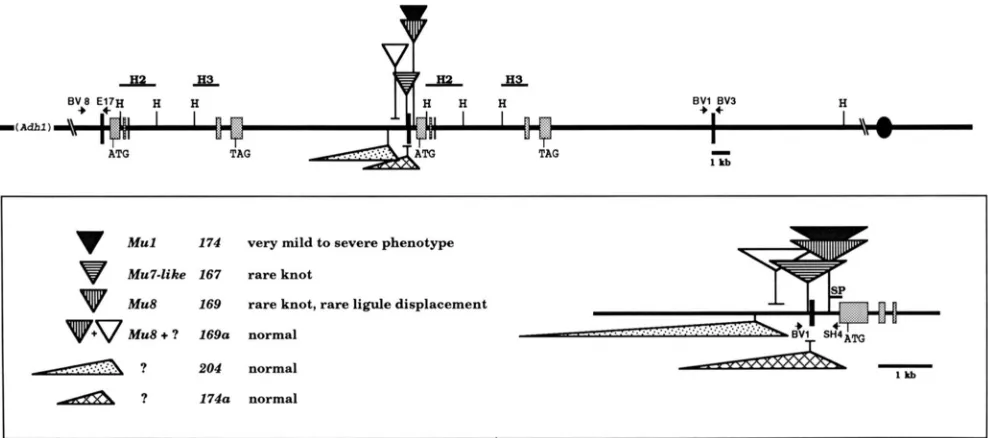
Mu1 174 very mild to severe phenotype
Mu7-like 167 rare knot
Mu8 169 rare knot, rare ligule displacement
v+v
Mu8 + ? 1690 normalA ?
._.._. ::.::.. 204 normal& ? 1740 normal
FIGURE 1.-Organization of the K n l - 0 tandem duplication. The hatched boxes are exons, the solid line is non coding. The ATG and TAG show the start of translation and termination codons, respectively (VOLLBRECHT et al. 1991). The solid, vertical bars indicate the extent of the 17-kb region that is duplicated. The centromere is shown to the right (not to scale), Adh1 is 1 map unit distal, and shown on the left. The lower box is a detail from the upper map. The non-Mu insertion of K n l - W O 4 is located 1 105 bp distal to the repeat junction. The Mu7-
like element of Knl-0167 (167) is located 6 bp distal to the repeat junction and 446 bp 5' from the start of transcription. The Mu1 element of K n l - 0 1 7 4 ( 1 7 4 ) and the Mu8 element of K n l - 0 1 6 9 ( 1 6 9 ) are inserted in the same position, 310 bp proximal to the repeat junction and 120 bp 5' from the start of transcription (VOLLBRECHT et al. 1991; VEIT et al. 1990). All three Mu insertions resulted in a 9-bp target site duplication. The position of the additional insertion in 169a is approximate within 1 kb. The rearrangement of 174a is near the repeat junction. H = HindIII. Fragments that were used as hybridization probes in Southern blots are H2, H3 or SP (in box). Short arrows at the
ends of the duplication and across the repeat junction illustrate the position of primers for PCR and sequencing.
RESULTS
Phenotypic changes are correlated with further structural alterations: In the initial characterization of K n l - 0
Mu
derivatives (VEIT et al. 1990), it was noted that certain aspects of the mutant phenotype persisted (Figure 1). Plants carrying the K n l - 0 1 6 7 ( 1 6 7 ) allele display an occasional knot on an adult leaf. Plants with either the K n I - 0 1 6 9 ( 1 6 9 ) or K n l - 0 1 7 4 ( 1 7 4 ) allele often display mild ligule displace- ment on early leaves. Occasionally, 169 or 174 plants give rise to individuals displaying a severe knotted phenotype or a completely normal phenotype. T h e variants transmit the altered phenotype to their prog- eny.To better understand the basis for these derivative phenotypes, progeny of I 6 9 and 174 that appeared normal were analyzed by Southern analysis. We found that most of these individuals (93%) lost one repeat of the tandem duplication (for example, see lane 8 in Figure 2), but a few sustained further insertions or rearrangements at the locus while retaining the dupli- cation. One such individual, 169a, was identified in a sample of 10 sibling 169 plants. Southern blot analysis of DNA isolated from a 169 homozygote reveals two bands, 19 and 16.4 kb in length, when hybridized to the H3 probe (Figure 2). Similar analysis of a 169a
homozygote indicates that the 19 kb band is still
0
14 b
10 b
c
.*
.
-
FIGURE 2.-Southern blot of Mu derivatives. DNA was digested with HindIII, electrophoresed and transferred to nytran. The blot was hybridized to H3 (Figure 1). The
+
refers to a wild-type allele. 167L is used to designate a 167 individual that lost a repeat of the tandem duplication. The 19- and 21-kb bands of 169a appear as a single broad band in this Southern blot.present, but the 16.4-kb band has been replaced by a novel 21 kb band, appearing as a doublet in Figure 2. Further analysis shows that the Mu8 insertion of 169
is retained in its normal location, and that in 169a an additional 4.3-kb insertion is located approximately 500 bp distal to the junction of the two repeats (data not shown). 1696 was detected in a population of 54
169a/+ plants as the only individual with any knots (see MATERIALS AND METHODS for crosses). 1696 ap-
816 B. Lowe, J. Mathern and S. Hake
174a, isolated from a sample of 20 174 individuals,
is also indistinguishable from wild type in appearance. T h e hybridization pattern of 174 is the same as 169 when Southern blots are hybridized to the H3 probe, due to the fact that similar sized elements inserted into the same location (VEIT et al. 1990). Southern analysis of 174a demonstrates that the 16.4-kb band of 174 is absent and is replaced by a novel 18.5-kb band (Figure 2). T h e
Mu1
insertion of 174 is absentin 174a, and instead, a 3.5-kb insertion is present in
the region of the repeat junction (data not shown). Preliminary data suggest that a rearrangement of
K n l - 0 sequences has occurred. Consistent with the
notion of a rearrangement, the alterations at I74a are relatively stable; knotted progeny have not been found in a population of 500 heterozygous I74a/+ individuals.
Mu insertions at K n I - 0 were found at a frequency of 3 in 10,000, a frequency similar to the recovery of y l and yg mutants from Mu lines by ROBERTSON (1 985). T h e subsequent derivatives, 174a and 169a, were recovered in relatively small populations, suggesting that the original insertions increased the re- arrangement frequency at the locus. T h e propensity for transposable elements to cause additional re- arrangements is also documented at other loci (TAY-
LOR and WALBOT 1985; B. KLOECKENER-GRUISSEM and M. FREELINC, personal communication) [see COEN et al. (1989) for review].
Methylation of
Mu
elements in 174 and 169 cor- relates with increased severity of the knotted phe- notype: We examined the DNA of individual deriva- tives that expressed a severely knotted phenotype to determine whether the Mu element had excised, re- sulting in reversion to the progenitor allele, K n l - 0 . Of 28 I74 individuals examined, all retained the Mu1 insertion, demonstrating that expression of the severe mutant phenotype was not related to an excision event. However, two knotted 169 plants that arose following pollination of a homozygous 169 female with wild-type pollen lost the insertion (data notshown). Within the limitations of Southern blot analy- sis, the 169 knotted revertants appear the same as
K n l - 0 . DNA was amplified using primers BVl and
SH4 (Figure 1). Sequencing of one PCR product showed that the revertant and K n l - 0 progenitor se- quence are identical (data not shown).
We examined the extent of Mu methylation among various derivatives since it is correlated with loss of
Mu
activity (CHANDLER and WALBOT 1986; BEN-NETZEN 1987) and in certain Mu induced mutations,
the mutant phenotype is dependent on the element's activity state (MARTIENSSEN et al. 1990; BARKAN and
MARTIENSSEN 1991). DNA samples from I74/+ het- erozygotes that varied in phenotype from severely knotted to almost normal were digested with Hinfl
4
FIGURE 3.-Methylation of Mutator elements correlates with se- verity of the knotted phenotype in 174. DNA was digested with
Hinfl, electrophoresed, transferred to nytran and hybridized to the
Mu1 probe, pA/B5. The arrow indicates the 1.3-kb fragment pres- ent in unmethylated Mu1 elements. Severely knotted and mildly affected plants are designated by "sev" and "mild," respectively. 1348-7, 1348-8, 1348-1 and 1348-1 1 were siblings. 1348-7 was crossed by a nonMu male to generate the 1691 family. 1348-1 1
was crossed by a male of the same non-Mu line to generate the 1692 family. 1348-8 was crossed by 1348-1 to generate the 1683 family.
and the resulting Southern blot was hybridized with an internal Mu1 fragment (Figure 3). Mildly knotted siblings, such as 1348-7 or 1348-1, carry primarily unmethylated Mu1 elements, whereas severely knot- ted siblings, such as 1348-1 1 or 1348-8, carry primar-
ily methylated elements. When 1348-7 was crossed to a non-Mu line, two of the three progeny examined remained unmethylated, one individual was methyl- ated. When 1348-1 1 was outcrossed to the same non- Mu line, all six progeny examined were severely knot- ted and their DNA was methylated. The methylation of severely knotted 1348-8 was reversible in the cross to 1348-1, a mild individual. One of the four progeny examined was still severely knotted and carried meth- ylated Mu1 elements, while the other three were mildly affected and carried unmethylated elements (Figure 3). T h e ability to segregate severely knotted and mildly knotted (methylated and unmethylated) individuals in the same family suggests that the 1348 family is segregating for one autonomous Mu element (CHOMET et al. 199 1 ; QIN, ROBERTSON and ELLINGBOE
carry methylated M u elements. These individuals ap- peared normal in phenotype. T h e M u 8 element in
169a is also methylated (data not shown) and these individuals are normal in appearance. Since 169a has a M u 8 element in the same position as 169, the addi- tional insertion is the likely cause of the persistent normal phenotype despite methylation of the resident
M u 8 element. Thus, K n l - 0 alleles containing either a
M u 1 or a M u 8 element 5' to the transcription start site are regulated by methylation of the M u elements, suggesting that the position of the element is critical to the regulation and not the type of element itself.
Tandem duplication instability is enhanced by
Mu
insertions: K n l - 0 spontaneously reverts to wild type at a frequency of approximately in the absence of active transposable elements. Southern analysis re- vealed that the normal appearing plants lost one re- peat of the tandem duplication (VEIT et al. 1990). In progeny of 167, 169 and 174, the repeat containing the M u element is lost at a higher frequency (10"-
1 O-'). T o further assess the effect M u insertions have
on the frequency of repeat loss, the following crosses and progeny analyses were performed. Individuals that were homozygous or heterozygous for the M u
insertions at K n l - 0 were analyzed by Southern blots to ensure that the duplication and M u insertion were present and to determine whether the M u elements were methylated. T h e plants were outcrossed as male or female to lines that are wild-type for K N I . T h e wild-type lines carry 1-2 inactive M u elements and differ in restriction fragment lengths when hybridized to K N l probes. T h e wild-type knl alleles are linked to either Adhl-F or Adhl-S, while the M u K n l - 0
derivatives are linked to Adhl-F6. Progeny from the heterozygotes backcrossed to wild type yield two se- gregant classes; those homozygous for the wild-type allele, and those heterozygous for the derivative allele. T h e heterozygotes were selected by screening for
Adhl-F6. Seedlings were scored phenotypically for the knotted phenotype and apparently normal individuals were examined by Southern analysis. Individuals that lost one repeat of the tandem duplication always car- ried the 19-kb band from the M u K n l - 0 parent and a 10 kb band from the wild-type parent (see Figure 2 for example). All progeny from 167 and 169a were examined by Southern analysis for the presence of the tandem duplication.
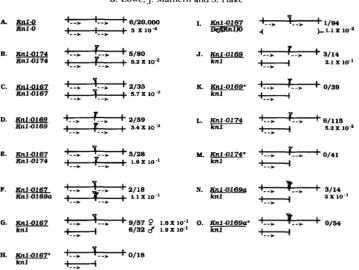
T h e repeat loss occurs approximately 100 times more frequently in homozygous M u derivatives, 174,
167 and 169 than in K n l - 0 (Figure 4, B, C and
D;
5/ 80, 2/35 and 2/59 losses per analyzed progeny). T h e repeat loss occurred at a slightly higher frequency when the 167 or 169 parent was heterozygous with wild-type (Figure 4, G and J, 15/89 and 3/14), but was not statistically different when heterozygous with a different M u derivative (see Table 1 for significancevalues). T h e mode of transmission, whether from the male or female, did not alter the frequency. However, the loss of one repeat was significantly reduced in progeny of 167 when the 167 parent was heterozygous for a deletion (Figure 41, 1/94). T h e deletion,
DefKnl)O, removes the entire tandem duplication but not more than two or three map units within the long arm of chromosome 1 (HAKE, VOLLBRECHT and FREELING 1989; J. MATHERN and S. HAKE, Maize Genetics Coop. Newsl. 63: 2). Thus, the repeat is lost at a higher frequency when it contains a M u insertion. T h e loss appears sensitive to the influence of the specific allele on the homologous chromosome, sug- gesting that the loss is mediated by a recombination event.
We examined genomic
D N A
of an individual that lost a repeat of the tandem duplication to determine if basepair changes occured during the loss event. T h e individual was self-pollinated andD N A
was prepared from homozygous individuals identified by the linkedAdhl allele. Primers BV8 and E17 were used to am- plify sequences at the distal end of the remaining repeat, and primers BV1 and BV3 were used to amplify sequences at the proximal end (Figure 1 and MATERIALS AND METHODS). The sequence matched the ends of the entire tandem duplication of K n l - 0 ,
suggesting that the repeat containing the M u element was lost precisely with no base pair alterations (data not shown).
Lack of flanking marker exchange during repeat loss: T o investigate the mechanism involved in the repeat loss, flanking markers served to monitor the occurrence of coincident or correlated reciprocal ex- change. The K n l - 0 derivative alleles are linked to
Adhl-F6, whereas wild-type knl alleles are linked to
Adhl-F or Adhl-S. ADHl is approximately 1 map unit distal to K N l . T h e K N l alleles are also distinguished by different HindIII fragments proximal to the central junction of the tandem duplication when hybridized
818 B. Lowe, J. Mathern and S. Hake
I I I
I - - * I--* ' 6/20,000 I. Knl-0167
I I ; 3 X I O "
1") '"*
wwm
I I
I--+ I - - * ' 6/80
I"* '"*
I P I
I - - *
I - - * ' 2/36 It. Knl-0169' I"*
I"*
I ; 6 . 2 X 10⁻² J. Knl-0169 knl
I ; 5.7 x 1 0 - 2 knl
a -
K n l - 0
B. Kn1-0174 Kn1-0174
C. pnl-016 7 Kn1-0167
D. Knl-0169 Kn1-0169
E. Knl-0167 Kn1-0174
F. Knl-0167 Knl-0169a
G. Kn1-0167 knl
H. Kn1-0167* knl
I P I
I - - * I", ' 1/94
4 )- 1.1 x 10⁻¹
Y
1
I - - * I - - * ' 6/1155.a x IO-*
I
1
:
3/142 x 10-1
I B
I--* "-* ' 0/54
FIGURE 4.-Repeat loss is enhanced by Mu insertions. The parental alleles are diagrammed for each genotype analyzed. The distance between the vertical bars represents the 17-kb repeat. The arrows refer to the K n l - 0 transcriptional unit. The triangles depict the Mu
insertion of the K n l - 0 derivatives. k n l is the wild-type allele. The derivative parent was crossed by k n l plants.
P
or 8 denote which parent was used as the Mu derivative parent. In general, the derivative was crossed as the female. Families with methylated Mu elements at K n l - 0are indicated by an asterisk (*). The fraction is the number of individual repeat losses observed over the number of progeny analyzed.
Methylation of
Mu
decreases the frequency of repeat loss: We exploited derivatives that varied in the state of M u methylation to determine whether M uactivity modulates the frequency of repeat loss. We detected no repeat loss in 41 plants that arose from a
174/+ parent with methylated M u elements or in 39 plants from a 169/+ parent with methylated M u ele- ments. We also did not detect any losses in 18 progeny from a methylated 167/+ parent. T h e frequency of loss for 167, 169 and 174 was higher in the unmeth- ylated state (15/89, 3/14 and 6/115, respectively; Figure 4, G, J and L).
We also examined the progeny of the 167 hemizy- gotes to ensure that the low frequency of repeat loss was due to the hemizygous condition and not because the elements were methylated. We examined 20 of the 94 progeny (Figure 41) by Hinfl digestion, and found the M u elements were all hypomethylated (data not shown).
Although the 169a derivative sustained a further insertion, the M u 8 element is retained in the original position as in the 169 progenitor (data not shown). T h e M u 8 element is methylated in 169a. We detected no instance of repeat loss in 54 progeny from a 169a/
+
heterozygote. T h e lowered frequency could reflect the presence of the second insertion or the methylated element. T o distinguish between these alternatives,I69a was crossed to 167 plants that carried active M u
elements in order to reverse the methylation (BEN-
NETZEN 1987; MARTIENSSEN et al. 1990; BROWN and
SUNDARESAN 1992). T h e 169a/167 heterozygote was then crossed to a wild-type line carrying a different
A d h l allele, Adhl-F. DNA was prepared from a few individuals to determine which carried the 169a allele and to ensure that the M u elements were no longer methylated. T h e 169a/+ individual was crossed again to a similar wild-type line and the individuals carrying the 169a allele were identified by the linked Adhl-F6
polymorphism. The progeny were analyzed for the presence of the tandem duplication by Southern analysis. Among 14 progeny derived from a 169a/+
parent with active M u elements, three individuals lost a repeat compared to zero in 54 when 169a carried methylated M u elements. This finding indicates that the reduced frequency of repeat loss in 169a is asso- ciated with M u methylation and not with the addi- tional rearrangement. T h e destabilization of the tan- dem duplication in the presence of active M u elements suggests that the putative M u transposase may play a role in the high frequency of loss events.
DISCUSSION
M u elements, most notably are the losses of one copy of the tandem repeat. T h e frequency of repeat loss is affected by the allele carried on the homologous chro- mosome and by whether the M u element is methyl- ated.
Two insertions, a M u 1 and a M u 8 element located upstream from the start of transcription, diminish the mutant phenotype only when hypomethylated. When the elements are methylated, the phenotype is identi- cal to the K n l - 0 progenitor. M u methylation affects the expressivity of another maize mutant, hcfl06 (high chlorophyll jlourescence) (MARTIENSSEN et al. 1990). This recessive mutation is caused by a M u 1 insertion in the untranslated leader of the transcription unit. When M u 1 is active, i.e., not methylated, a pale green and lethal phenotype is manifested and mRNA accu- mulation is prevented. However, when the element is methylated, transcription is initiated within the M u
element and immediately downstream, permitting an apparent wild-type phenotype (BARKAN and MAR- TIENSSEN 199 1). T h e interaction we describe is anal- ogous in that methylation returns the phenotype to that of the progenitor, only in our case the progenitor is knotted in phenotype. Unlike the findings at hcf106,
we have no evidence for transcription initiating in the
M u element. T h e K n l - 0 transcripts are the same size on Northern blots in the presence or absence of M u
insertions (unpublished data). This difference is pos- sibly due to the fact the M u insertions at K n l - 0 are further 5’ from the transcription start site.
T h e correlation of knotted phenotype with meth- ylated M u elements does not apply to all the M u
insertions or their derivatives. Plants with a M u 7 in- sertion immediately distal to the repeat junction ( 1 6 7 )
are nearly normal whether the insertion is methylated or not. T h e methylation dependence in 169 does not occur when an additional insertion is present distal to the repeat junction (169a). Finally, the non-Mu inser- tion of K n l - 0 2 0 4 also distal to the junction (VEIT et al. 1990) completely abolishes the mutant phenotype (Figure 1). Thus, insertions proximal to the junction affect expression depending on their state of methyl- ation, but distal insertions abolish expression regard- less of the state, further implicating sequences distal to the junction as causing the K n l - 0 mutant pheno- type (VEIT et al. 1990).
Different recombination mechanisms exist by which repeated sequences increase or decrease their copy number (PETERSON and LAUGHNAN 1963; JACKSON and FINK 1985; MALONEY and FOGEL 1987; WELCH, MALONEY and FOGEL 1990; reviewed by PETES and HILL 1988). One such mechanism involves unequal crossing over between repeats on homologous chro- mosomes and is generally accompanied by an ex- change of flanking markers (STURTEVANT and MOR- GAN 1923; STADLER and NEUFFER 1953; MANGELS-
DORF and GALINAT 1964; DOONER and KERMICLE 1971). T h e change in repeat copy number we docu- mented in the M u derivatives of K n l - 0 is not accom- panied by flanking marker exchange. Moreover, the frequency of repeat loss is increased 100-2000-fold compared to the frequency at K n l - 0 without inser- tions. T o rationalize the loss events observed, we present three different but plausible mechanisms (Fig- ure 5).
In mechanism A, repeats on one chromatid undergo reciprocal exchange. Such crossovers have been in- ferred in yeast (JACKSON and FINK 1985; MALONEY and FOCEL 1987), but are less frequent than other recombination events. Because the repeats of K n l - 0
are identical, we have no data to support or eliminate this mechanism.
In mechanism B, unequal crossing over between repeats on sister chromatids would also fail to generate flanking marker exchange. Sister chromatid exchange has been inferred for repeat number changes at the Bar duplication of Drosophila that occur without flanking marker exchange (PETERSON and LAUGHNAN 1963). It is the primary mechanism of copy number change in tandem repeats of rDNA in yeast (PETES 1980). However, it is not the principal mechanism implicated in copy number change at other loci (JACK-
SON and FINK 1985; FOGEL, WELCH and MALONEY 1988). T h e predicted reciprocal products at K n l - 0
would be one chromatid with three 17-kb repeats, two of which contain M u insertions, and one chro- matid with a single 17-kb repeat. Plants with three repeats carrying M u elements might not be distin- guished by phenotype. However, they could be iden- tified via Southern analysis, manifested as a shift in hybridization intensity between the 19- and 14-kb bands from an approximately equal ratio (Figure
2)
to a 1:2 ratio. We detected a hybridization intensity shift in one individual among 177 tested (data not shown), suggesting that though sister strand exchange does occur, this exchange reaction does not represent the primary mechanism involved in loss of a repeat.
820 B. Lowe, J. Mathern and S. Hake
BSkterehmmatid
exchaaee
FIGURE 5.-Mechanisms for repeat loss. In these diagrams all four chromatids carry the tandem duplication, illustrated as a speckled box. The Mu element (solid box) is located just to the right of the central junction of the two repeats. The alleles are drawn as homozygous, but could be heterozygous. In mechanism A, pairing between two repeats on one chromatid occurs. The circle represents one of the recombination products obtained. In mechanism B, sister chromatid exchange gives rise to one chromatid with three repeats and one chromatid with one repeat. In mechanism C, a double strand break initiates gene conversion. The central region of the tandem repeat is lost by exonuclease activity. A free 3' end invades the homologous region of the wild-type repeat on the non-sister chromatid. The gene conversion event proceeds as described (SZOSTAK, ORR-WEAVER and ROTHSTEIN 1983). The gene conversion could also occur between sister chromatids.
break is enlarged to a gap and a free 3' end invades the homologous region on the donor duplex. T h e invaded duplex serves as a template to repair the double strand gap.
We propose that gene conversion may be the op- erative mechanism responsible for loss of one repeat in the K n l - 0 derivatives. In support of this view is the dependence on active Mu elements and the effect of the allele on the homologous chromosome. Neither of these factors would be expected to affect recombi- nation frequency in mechanisms A or B. Gene con- version could either replace both repeats with one repeat, or replace the Mu-containing repeat with the wild-type repeat while maintaining the tandem dupli- cation. T h e latter event would appear as an excision and may account for the two 1 6 9 revertants we de- tected. Gene conversion was proposed by DOSEFF, MARTIENSSEN and SUNDARESAN (1 99 1) to explain cer- tain Mu excision events occurring at the maize b z l -
mum9 allele. Sequence analysis of somatic excision
sites suggested that gene conversion occurred using neighboring bronze sequences as a template. Gene conversion was also documented in tobacco after se- lective pressure for recombination between closely linked inverted duplications (TOVAR and LICHTEN- STEIN 1992). In Drosophila, precise excision of a P
element at the white locus is clearly attributable to
gene conversion (GLOOR et al. 1991). T h e frequency of P element excision was also affected by the allele carried on the homologous chromosome. Excision failed to occur when the allele was homozygous or heterozygous with a deletion (ENGELS et al. 1990).
T h e increase in repeat loss in unmethylated Mu lines suggests that a transposase is involved since the transposase is presumably not present in lines with methylated Mu elements (CHOMET et al. 1991 ; QIN,
ROBERTSON and ELLINGBOE 199 1 ; HERSHBERGER, WARREN and WALBOT 1991). Transposable elements at the P locus in maize also increase recombination. T h e P gene, which conditions red pericarp (STYLES and CESKA 1977, 1989), is comprised of two 5.2-kb direct repeats separated by an 8.2-kb sequence. T h e spontaneous loss of one repeat and intervening se- quence, resulting in colorless pericarp, occurs at the frequency of 3.1 x 1 0-4 somatically. T h e frequency increases 300 fold in the P-ovov allele, in which the autonomous element, Ac, has inserted between the two repeats (ATHMA and PETERSON 1991). Transpo- sases are thought to initiate excision by causing a staggered double strand break (SAEDLER and NEVERS 1985). T h e broken chromosome ends that result from a double strand break following M u excision could initiate gene conversion.
markers in the
27
individuals for which it would be possible to detect. Although 50% of meiotic gene conversions are accompanied by conventional genetic exchange of outside flanking marker exchange in yeast (FOGEL, MORTIMER and LUSNAK 1981), gene conversion-like events such as mating type switching in yeast and P element excision in Drosophila may not be accompanied by flanking marker exchange (Mc- GILL, SHAFER and STRATHERN 1989; GLOOR et al.199 1). These results suggest that recombination events initiated by certain double strand breaks, such as transposon excision, are resolved by other mecha- nisms than those operating during meiotic recombi- nation.
We found a 14-fold decrease in frequency of repeat loss when the
Mu
derivative was heterozygous with a deletion compared to heterozygous with wild-type. Hemizygosity also decreased the frequency of P ele- ment excision (ENGELS et al. 1990). However, hemi- zygosity did not affect loss of one repeat at the Ab-Peru complex in maize, which consists of a serial
duplication of the A 1 gene (LAUGHNAN 1961). We found 1/94 losses from Knl-O167/Dej(Knl)O, while Laughnan reported a frequency of loss at approxi- mately 1 0-3 for Ab-Peru when paired with a deficiency. We propose that
Mu
element-induced gene conver- sion occurs at a higher frequency than sister chroma- tid exchange or intrachromatid recombination events which may not be affected by the homolog.We can not argue unequivocally that the recombi- nation events we are documenting are mitotic or meiotic. T h e allele carrying the
Mu
insertion was generally the female parent, thus, loss of the duplica- tion that occured premeiotically could be observed as an ear sector. Preliminary evidence from one ear has shown both a three kernel sector and scattered events (data not shown). Either there were numerous, small (1 kernel) mitotic sectors or a coincidental clustering of three meiotic events. We tend to favor the latter possibility, especially when considering the fact that homologous chromosomes are not known to pair dur- ing mitosis and yet, we see an effect of the homologous chromosome on repeat loss.T h e duplication of K n l - 0 is highly recombinagenic in the presence of
Mu
insertions. Not only is there a greater than 1 00-fold increase in recombination, but new rearrangements also occur at a high frequency. Transposons such as Mu are intrinsic to the polymor- phism found in the maize genome and are part of the restructuring of genomes throughout evolution. In balance with the transposon-induced alterations are mechanisms such as gene conversion of active transpo- sons that act to remove these highly recombinagenic sites and thereby temper the rapid rate of genome change (NICHOLAS et al. 1990).We wish to thank SEYMOUR FOGEL for his advice, consultations
and critical reading of the manuscript. We also thank B. VEIT, R. KERSTETTER, E. VOLLBRECHT and V. SUNDARESAN for reading the manuscript; G. DALLAL for use of his STAT-SAK computer pro- gram; and R. WELLS for preparing the manuscript. T h e work was supported by a National Science Foundation grant DMB8819325 to S.H. and by the U.S. Department of Agriculture.
L I T E R A T U R E CITED
ATHMA P., and T. PETERSON, 1991 Ac induces homologous re- combination at the maize P locus. Genetics 128: 163-173. BARKAN A,, and R. A. MARTIENSSEN, 1991 Inactivation of maize
transposon M u suppresses a mutant phenotype by activating an outward-reading promoter near the end of M u l . Proc. Natl. Acad. Sci. USA 88: 3502-3506.
BENNETZEN J. L., 1987 Covalent DNA modification and the reg- ulation of Mutator element transposition in maize. Mol. Gen. Genet. 208: 45-5 1 .
BROWN J., and V. SUNDARESAN, 1992 Genetic study of the loss and restoration of Mutator transposon activity in maize: evi- dence against dominant negative regulator associated with loss of activity. Genetics 1 3 0 889-898.
BRYAN A. A., and J. E. SASS, 1941 Heritable characters in maize.
J. Hered. 32: 343-346.
CHANDLER V. L., and K. J. HARDEMAN, 1992 T h e Mu elements of Zea mays. Adv. Genet. 3 0 77-122.
CHANDLER V., C. RIVIN and V. WALBOT, 1986 Stable non-muta- tor stocks of maize have sequences homologous to the MuZ
transposable element. Genetics 1 1 4 1007-1 02 1.
CHANDLER V. L., and V. WALBOT, 1986 DNA modification of a maize transposable element correlates with loss of activity. Proc. Natl. Acad. Sci. USA 83: 1767-1771.
CHOMET D., D. LISCH, K. HARDEMAN, V. L. CHANDLER and M. FREELING, 199 1 Identification of a regulatory transposon that controls the Mutator transposable element system in maize. Genetics 1 2 9 261-270.
COEN E. S., T. P. ROBBINS, J. ALMEIDA, A. HUDSON and R. CAR-
PENTER, 1989 Consequences and mechanisms of transposition in Antirrhinum majus, pp. 413-436 in Mobile DNA, edited by
D. E. BERG and M. M. HOWE. American Society for Microbi- ology, Washington, D.C.
CORCES V. G., and P. K. GEYER, 1991 Interactions of retrotrans- posons with the host genome: the case of the gypsy element of
Drosophila. Trends Genet. 7: 86-90.
DAVIS P. S., M. W. SHEN and B. H. JUDD, 1987 Asymmetrical pairings of transposons in and proximal to the white locus of
Drosophila account for four classes of regularly occurring ex- change products. Proc. Natl. Acad. Sci. USA 8 4 174-178. DOONER H . K., and J. L. KERMICLE, 1971 Structure of the R’
tandem duplication in maize. Genetics 67: 427-436.
DOSEFF A., R. MARTIENSSEN and V. SUNDARESAN, 1991 Somatic excision of the MuZ transposable element of maize. Nucleic Acids Res. 19: 579-584.
ENGELS W. R., D. M. JOHNSON-SCHLITZ, W. B. EGGLESTON and J. SVED, 1990 High-frequency P element loss in Drosophila is homolog dependent. Cell 62: 515-525.
FLEENOR D., M. SPELL, D. ROBERTSON and S. WESSLER, 1990 Nucleotide sequence of the maize Mutator element, Mu8. Nucleic Acids Res. 18: 6725.
FOGEL S., R. K. MORTIMER and K. LUSNAK, 1981 Mechanisms of meiotic gene conversion, or “Wanderings on a foreign strand,” pp. 289-339 in The Molecular Biology of the Yeast Saccharomyces,
Vol. 1 , edited by J. N. STRATHERN, E. W . JONES and E. R.
BROACH. Cold Spring Harbor Laboratory, Cold Spring Harbor, N.Y.
822 B. Lowe, J. Mathern and S. Hake
adigm for non-conventional yeasts. J. Basic Microbiol. 28: 147- 160.
FOGEL S., J. W. WELCH and D. H. MALONEY, 1989 Meiotic copy number changes at CUPI' are mediated by gene conversion, pp. 287-295 in Vectors as Tools for the Study of Normal and Abnormal Growth and DiJerentiation, edited by H. LOTHER, R. DERNICK and W. OSTERTAG. Springer-Verlag, Heidelberg. FREELING M., and J. A. BIRCHLER, 1981 Mutants and variants of
the alcohol dehydrogenase-1 gene in maize, pp. 223-264 in
Genetic Engineering: Principles and Methods, edited by J. K. SETLOW and A. HOLLAENDER. Plenum, New York.
FREELING M., and S. HAKE, 1985 Developmental genetics of mutants that specify Knotted leaves in maize. Genetics 111:
GELINAS D., S. N. POSTLETHWAIT and 0. E. NELSON, 1969 Characterization of development in maize through the use of mutants. 11. T h e abnormal growth conditioned by the
Knotted mutant. Am. J. Bot. 56: 671-678.
GLWR G. B., N. A. NASSIF, D. M. JOHNSON-SCHLITZ, C. R. PRESTON and W. R. ENGELS, 1991 Targeted gene replacement in Dro- sophila via P element-induced gap repair. Science 253: 1 1 10-
1117.
HAKE S., E. VOLLBRECHT and M. FREELING, 1989 Cloning Knot- ted, the dominant morphological mutant in maize using Ds2 as a transposon tag. EMBO J. 8: 15-22.
HERSHBERGER R. J., C. A. WARREN and V. WALBOT, 1991 Mutator activity in maize correlates with the presence and expression of the M u transposable element M u 9 . Proc. Natl. Acad. Sci. USA 88: 10198-10202.
JACKSON J. A., and G. R. FINK, 1985 Meiotic recombination between duplicated genetic elements in Saccharomyces cerevisiae.
Genetics 109: 303-332.
LIM J. K., 1988 Intrachromosomal rearrangements mediated by
hobo transposons in Drosophila melanogaster. Proc. Natl. Acad. Sci. USA 85: 9153-9157.
MALONEY D. H., and S. FOGEL, 1987 Gene conversion, unequal crossing-over and mispairing at a non-tandem duplication dur- ing meiosis of Saccharamyces cerevisiae. Curr. Genet. 12: 1-7. MANGELSDORF P. C., and W. C. GALINAT, 1964 T h e tunicate
locus in maize dissected and reconstituted. Proc. Natl. Acad. Sci. USA 51: 147-150.
MARTIENSSEN R., A . BARKAN, W. C. TAYLOR and M. FREELING, 1990 Somatically heritable switches in the DNA modification o f M u transposable elements monitored with a suppressible mutant in maize. Genes Dev. 4: 331-343.
MASSON P., R. SUROSKY, J. A. KINGSBURY and N. V. FEDOROFF, 1987 Genetic and molecular analysis of the Spm-dependent
a-M2 alleles of the maize a locus. Genetics 117: 1 17-1 37. MCGILL C., B. SHAFER and J. STRATHERN, 1989 Coconversion of
flanking sequences with homothallic switching. Cell 57: 459- 467.
MONTGOMERY E. A,, S.-M. HUANG, C. H. LANGLEY and B. H. JUDD, 199 1 Chromosome rearrangement by ectopic recombination in Drosophila melanogaster: Genome structure and evolution. Genetics 129: 1085-1089.
NEVERS P., N. S. SHEPHERD and H. SAEDLER, 1986 Plant trans- posable elements. Adv. Bot. Res. 12: 103-203.
NICOLAS A,, D. TRECO, N. P. SCHULTES and J. W. SZOSTAK, 1989 An initiation site for meiotic gene conversion in the yeast Saccharomyces cerevisiae. Nature 338: 35-39.
ORR-WEAVER T. L., J. W. SZOSTAK and R. J. ROTHSTEIN, 1981 Yeast transformation: a model system for the sudy of recombination. Proc. Natl. Acad. Sci. USA 78: 6354-6358. 6 17-634.
PETES T. D., 1980 Unequal meiotic recombination within tandem arrays of yeast ribosomal DNA genes. Cell 1 9 765-774. PETFS T. D., and C. W. HILL, 1988 Recombination between
repeated genes in microorganisms. Annu. Rev. Genet. 22: 147- 168.
QIN M., D. S. ROBERTSON and A. H. ELLINGBOE, 1991 Cloning o f the Mutator transposable element MuA2, a putative regulator of somatic mutability of the aI-Mum2 allele in maize. Genetics
ROBERTSON D. S., 1978 Characterization of a mutator system in maize. Mutat. Res. 51: 21-28.
ROBERTSON D. S., 1985 Differential activity of the maize mutator
M u at different loci and in different cell lineages. Mol. Gen. Genet. 200: 9-13.
ROBERTSON D. S., and P. S. STINARD, 1987 Genetic evidence of
Mutator induced deletions in the short arm of chromosome 9 of maize. Genetics 115: 353-361.
ROBERTSON D. S., P. S. STINARD, J. G . WHEELER and D. W. MORRIS, 1985 Genetic and molecular studies on germinal and somatic instability in Mutator-induced aleurone mutants of maize, pp. 317-331 in Plant Genetics, edited by M. FREELING. Alan R.
Liss, New York.
ROEDER G. S., and G. R. FINK, 1982 Movement of yeast transpos- able elements by gene conversion. Proc. Natl. Acad. Sci. USA
SAEDLER H., and P. NEVERS, 1985 Transposition in plants: a molecular model. EMBO J. 4: 585-590.
SAMBROOK, J., E. F. FRITSCH and T . MANIATIS, 1989 Molecular
Cloning: A Laboratory Manual. Cold Spring Harbor Laboratory Press, Cold Spring Harbor, N.Y.
STADLER L. J., and M. G . NEUFFER, 1953 Problems of gene structure. 11, separation of R' elements (S) and (P) by unequal crossing over. Science 117: 471-472.
STEEL R. G. D., and J. H. TORRIE (Editors), 1980 pp. 504-506 in
Principles and Procedures of Statistics, A Biometrical Approach.
McGraw-Hill, New York.
STURTEVANT A. H., and T. H . MORGAN, 1923 Reverse mutation of the bar gene correlated with crossing over. Science 57: 746- 747.
STYLES E. D., and 0. CESKA, 1977 T h e genetic control of flavon- oid biosynthesis in maize. Can. J. Genet. Cytol. 1 9 289-302. STYLES E. D., and 0. CESKA, I989 Pericarp flavonoids in genetic
strains of Zea mays. Maydica 34: 227-237.
SZOSTAK J. W., T . L. ORR-WEAVER and R. J. ROTHSTEIN, 1983 T h e double-strand-break repair model for recombina- tion. Cell 33: 25-35.
TAYLOR L. P., and V. WALBOT, 1985 A deletion adjacent to the maize transposable element Mu-I accompanies loss of Adhl
expression. EMBO J. 4: 869-876.
VEIT B., E. VOLLBRECHT, J. MATHERN and S. HAKE, 1990 A tandem duplication causes the K n l - 0 allele of Knotted, a dom- inant morphological mutant of maize. Genetics 125: 623-631. VOLLBRECHT E., B. VEIT, N. SINHA and S. HAKE, 1991 T h e
developmental gene Knotted-I is a member of a maize homeo- box gene family. Nature 350: 241-243.
WALBOT V., 1986 Inheritance of mutator activity in Zea mays as assayed by somatic instability of the br2-mu1 allele. Genetics
WALBOT V., 1991 T h e Mutator transposable element family of maize. Genet. Eng. 13: 1-37.
WELCH J. W., D. H. MALONEY and S. FOGEL, 1990 Unequal crossing-over and gene conversion at the amplified CUP1 locus of yeast. Mol. Gen. Genet. 222: 304-310.
129: 845-854.
79: 5621-5625.
114: 1293-1312.