ISSN: 2319-8753
I
nternational
J
ournal of
I
nnovative
R
esearch in
S
cience,
E
ngineering and
T
echnology
(An ISO 3297: 2007 Certified Organization)
Vol. 3, Issue 3, March 2014
Copyright to IJIRSET www.ijirset.com 10067
Multistructure Diffeomorphic Brain
Registration
Sathish Kumar.C1, Pradhip.K, Shiyam.T, Surjithkumar.K2
Assistant Professor, Biomedical Engineering, Adhiyamaan College of Engineering, Hosur, Tamilnadu, India1. U.G Student, Biomedical Engineering, Adhiyamaan College of Engineering, Hosur, Tamilnadu, India2.
Abstract: A new method to constrain brain MRI registration, and perform experiments evaluating the alignment of manually traced structures, reduction of intersubject variance, and morphmetric results using group wise registration is compared against traditional MRI. Structure-specific information is be used to initialize and constrain registration to improve accuracy and robustness. By using image registration, it restrict the scope of structures to those that can be represented volumetrically as images, such as MRI volumes or anatomical segmentations. This method uses Mean Shift algorithm to efficiently segment the gray and white matter and thus the average gray matter was taken to find the dice overlap. It uses concurrent subcortical and cortical shape matching to guide the overall registration.
Keywords: Morphmetric, brain registration, MRI, dice overlap.
I.INTRODUCTION
Brain image registration is a useful for studying morphometry and pooling information in a central space. Registration can be a difficult task considering the anatomical variability and structural complexity present in the human brain, motivating the use of structure-specific information (anatomical guidance) to initialize and constrain registration in a meaningful way. Then Mean shift algorithm is used to segment the gray matter and white matter of the brain to its maximum extent and does not interpret in a false manner. It[2] shows how the individual brain structures could be used to perform an initial low and high dimensional alignment, leading to improved registration of specific subregions in the brain. More direct shape-matching approaches[10] have shown that using manually traced segmentations to drive the registration instead of MRI intensities can also improve registration of specific cortical and neocortical regions.
The main contribution of this study is registration that concurrently employs shapematching with automated segmentations of multiple structures, and image-matching to obtain an anatomically guided diffeomorphic registration that can more accurately align the individual structures in images. However, because of limitations in how the segmentation and registration models can be simultaneously optimized, these methods have not been able to take advantage of more sophisticated or specialized approaches. In contrast, by employing registration and segmentation sequentially[8],where the contribution becomes how one applies the results of one to aid the other, specialized and potentially disparate techniques, such as surface-based and volume-based segmentation, can be combined to provide a more accurate result.
II.LITERATURE SURVEY
ISSN: 2319-8753
I
nternational
J
ournal of
I
nnovative
R
esearch in
S
cience,
E
ngineering and
T
echnology
(An ISO 3297: 2007 Certified Organization)
Vol. 3, Issue 3, March 2014
This is important because it suggests that the findings are generalizable to new subject populations that are labeled or evaluated using different labeling protocols. A fully automated MRI post processing pipeline is aimed to reduce the registration error during group studies and demonstrate its superiority over two widely used registration methods by conducting a comprehensive surface to surface distance quantifications over both cortical and sub cortical regions[3].They are more accurate making better use of the information available in the data, scanning time is relatively expensive but computing time is relatively cheap. Finally, it increases the accuracy of functional maps over these regions with performing group analysis.
III.METHODOLOGY
A. Multistructure Registration
Diffeomorphic registration algorithms that ensure the resulting transformations are one to one, invertible and smooth, are desirable because they preserve the topological properties ofthe underlying anatomy [7], [9]. It employs a large deformation diffeomorphic registration algorithm in this study for thesereasons; however, it is possible to implement the proposed registration scheme using other frameworks as well, including demons [6] or a B-spline parameterized registration [4]. The registration is driven by the intensities of the corresponding MR images, using differences and mutual information.
1) Mean Shift Algorithm:
Here Gaussian filter is used to process the input images. Then Segment the white matter with a Meanshift segmentation will be applied. The edge weights are computed from the relative positions of the voxels. The method is very effective when applied in the segmentation of the average gray matter segmentation .Then brain registration algorithm will be applied. Multiple structure segmentations to drive local whole brain registration shows for the first time that, as expected, incorporation of individual segmentations.
Finally, it will provide the segmented neuropathological images. In mean shift clustering algorithms maintain a set of data points the same size as the input data images. Initially, this set is copied from the input set. Then this set is iteratively replaced by the mean of those points in the set that are within a given distance of that point.
For each data point, Mean shift defines a window around it and computes the mean of the data point . Then it shifts the centre of the window to the mean and repeats the algorithm till it converges. After each iteration, we can consider that the window shifts to a more denser region of the dataset. Therefore by employing structure segmentations in the energy functional as such, point correspondences between segmented volumes do not have to be found, since it is effectively theboundary differences that drive the deformations.
2) Locally Optimal Large Deformation Diffeomorphism:
An LDDMM optimizes over the full space-time flow and is thus has heavy computational and memory requirements. Whendealing with large databases of full resolution whole brain MRIand multiple structures, these requirements can become restrictive.If it is not necessary to find the shortest path [7]connecting two images, that is, if one is interested in diffeomorphic registration and not concerned with computing metric distances, then a locally optimal (or greedy) solution to the variational problem can be used.
Christensen et al. [12] proposed a large deformation fluid flowregistration exploiting the fact that if the operator L does notdifferentiate in time, then the space-time optimization can be split into a sequence of optimizations that solve for the locallyoptimal velocity at each time index. In this setting as describedin [11], the locally optimal velocity fields satisfy the partialdifferential equation,
L†L t + bt=0 (1)
WhereL is related to the self-adjoint operator K by K(L†L)f =f. In the single-channel locally optimal LDDMM, it is denoted as LDDMM-MRI, the body force bt accounting for the image mismatch is given as,
ISSN: 2319-8753
I
nternational
J
ournal of
I
nnovative
R
esearch in
S
cience,
E
ngineering and
T
echnology
(An ISO 3297: 2007 Certified Organization)
Vol. 3, Issue 3, March 2014
Copyright to IJIRSET www.ijirset.com 10069 bt=- MR( ^a,tMR - ^bMR) ∇ ^a,tMR–∑ Seg,i( ^a,tseg,I - b,seg,i)∇ ^a,tseg,i (3)
Therefore, the different structures of the brain was identified and it is registered.
IV. RESULTS
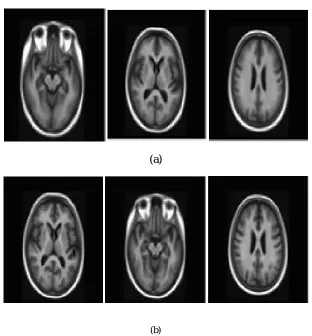
To qualitatively evaluate the performance of our multistructure and MRI-based group wise average atlas generation, it has been performed on the subject set, generating an LDDMM MultiStruct average and an LDDMM MRI average. To further inspect alignment of cortical anatomy with our approaches, it performs a cortical surface reconstruction of the average MRI images using the Freesurfer image analysis suite. This processing also includes a cortical labelling using curvature-based surface registration to an atlas. Here, the multistructure-based cortical surface shows much greater detail and consistency, closer to what one would see in an individual’s cortical surface, demonstrating the superioralignment of cortical regions as compared to single-channel MRI-based registration. This can be quantified for the alignment of these group-wise approaches by computing the
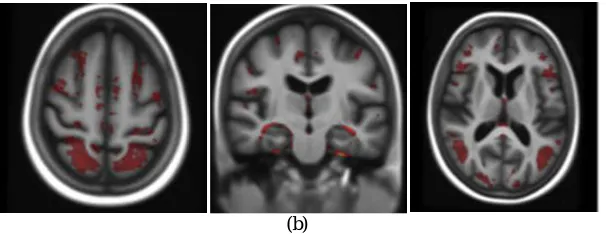
residual variance in the intensitiesof the aligned MRI images[8]. Hence, the variance of prenormalized MRI intensities at each voxel, is to compare the residual variance for the multistructure and MRI-based registration approaches.
ISSN: 2319-8753
I
nternational
J
ournal of
I
nnovative
R
esearch in
S
cience,
E
ngineering and
T
echnology
(An ISO 3297: 2007 Certified Organization)
Vol. 3, Issue 3, March 2014
(a)
(b)
Fig. 2. Average MRI images from groupwise registration of all subjects in comparing the average obtained via (a) MRI-based and (b) multistructure registration.
ISSN: 2319-8753
I
nternational
J
ournal of
I
nnovative
R
esearch in
S
cience,
E
ngineering and
T
echnology
(An ISO 3297: 2007 Certified Organization)
Vol. 3, Issue 3, March 2014
Copyright to IJIRSET www.ijirset.com 10071 (b)
Fig. 3.GroupWise registration of all subjects comparing the (a) MRI-based approach (b) to the multistructure approach. The variance at each voxel was computed using the MRI image intensities in the average space.
V.CONCLUSION
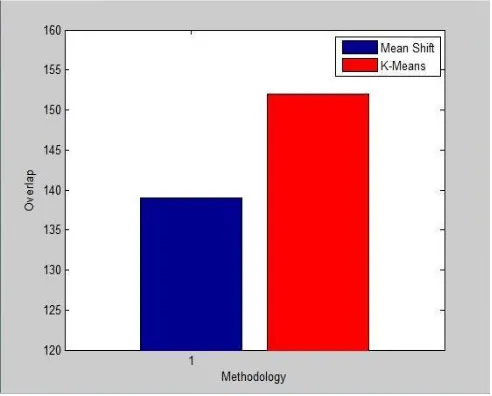
The combination of different structure segmentations in the whole brain registration proposed allows the incorporation of a prior relative weights reflecting confidence levels for variability of individual ROIs(Region of Interest) as well as confidence in segmentation accuracy. At this time, these weights are fixed to be equal; however, these could be optimized over a small training database for best whole brain registration in a principled of frontal lobe alignment with the multistructure approach. This could be due to the relatively larger size of Free surfer cortical percolations in the frontal region; if the parcellations are smaller, the effective correspondences through shape matching are at a finer scale. Hence the structures of the brain was registered using the mean shift algorithm and the overlap between the structures was found accurately.
REFERENCES
[1] A. Dale, B. Fischl, and M. Sereno, “Cortical surface-based analysis—PartI: Segmentation and surface reconstruction,” Neuroimage, vol. 9, no.
2,pp. 179–194, 1999.
[2] A. R.Khan, L.Wang, andM. F.Beg, “Freesurfer-initiated fully-automatedsubcortical brain segmentation inMRI using large deformation
diffeomorphicmetric mapping,” Neuroimage, vol. 41, no. 3, pp. 735–46, 2008.
[3] B. A. Ardekani, S. Guckemus, A. Bachman, M. J. Hoptman, M.Wojtaszek, and J. Nierenberg, “Quantitative comparison of algorithms for
inter-subject registration of 3D volumetric brain MRI scans,” J. Neurosci. Methods, vol. 142, no. 1, pp. 67–76, 2005.
[4] B. Fischl, D. Salat, E. Busa, M. Albert, M. Dieterich, C. Haselgrove,A. van der Kouwe, R. Killiany, D. Kennedy, and S. Klaveness, “Wholebrain segmentation: Automated labeling of neuroanatomical structures in
the human brain,” Neuron, vol. 33, no. 3, pp. 341–355, 2002.
[5] C. Ceritoglu, K. Oishi, X. Li, M.-C. Chou, L. Younes, M. Albert, C. Lyketsos, P. C. M. van Zijl, M. I. Miller, and S. Mori, “Multi-contrast large
deformation diffeomorphic metric mapping for diffusion tensor imaging,” Neuroimage, vol. 47, no. 2, pp. 618–627, 2009.
[6] C. L. Guyader and L. Vese, “A combined segmentation and registrationframework with a nonlinear elasticity smoother,” Comput. Vis. Imag.
Understand.,vol. 115, no. 12, pp. 1689–1709, 2011
[7] F. Wang and B. C. Vemuri, “Simultaneous registration and segmentationof anatomical structures from brain MRI,” Proc. SPIE, vol. 8, pp. 17–
25,2005.
[8] G. E. Christensen, S. C. Joshi, and M. I. Miller, “Volumetric transformationof brain anatomy,” IEEE Trans. Med. Imag., vol. 16, no. 6, pp. 864–
877, Dec. 1997.
[9] K. M. Pohl, J. Fisher, W. E. L. Grimson, R. Kikinis, and W. M. Wells,“A bayesian model for joint segmentation and registration,”
Neuroimage,vol. 31, no. 1, pp. 228–39, 2006.
[10] M. A. Yassa and C. E. Stark, “A quantitative evaluation of crossparticipantregistration techniques for MRI studies of the medial temporallobe,”
Neuroimage, vol. 44, no. 2, pp. 319–327, 2009.
[11] M. F. Beg, M. I. Miller, A. Trouv´e, and L. Younes, “Computing largedeformation metric mappings via geodesic flows of diffeomorphisms,”Int.
J. Comput.Vis., vol. 61, no. 2, pp. 139–157, 2005.
[12] R. D. Rabbitt, G. E. Christensen, andM. I. Miller, “Deformable templatesusing large deformation kinematics,” IEEE Trans. Imag. Process., vol.