Multi-Response Optimization In Turning Of
Titanium Alloy Using Grey Relational
Analysis
Vishnu Narayan
1, Aswathy V G
2Assistant professor, Department of Mechanical Engineering, GISAT, Kerala, India1 Assistant professor, Department of Mechanical Engineering, GISAT, Kerala, India2
ABSTRACT: This study was conducted to finding the effects of machining parameters on surface roughness, Material removal rate and roundness error in wet turning of Ti-6Al-4V. This Titanium alloy was commonly used in aerospace applications. It is an alpha beta alloy. It provides exceptional strength to weight ratio, corrosion resistance etc. Multi layered CVD coated carbide tool with different nose radius are chosen for this work. Combined effects of four cutting parameters, namely cutting speed, feed rate, depth of cu and nose radius on performance measures such as surface roughness, Material removal rate and roundness error , are explored by Grey relational analysis. These responses are important factors to evaluate cutting performance and also influences the product quality, product cost etc. to name a few. Taguchis L9 OA was used as experimental design.
KEYWORDS: Turning, Ti-6Al-4V, Grey relational analysis, Taguchi design, CVD coated carbide tool
I. INTRODUCTION
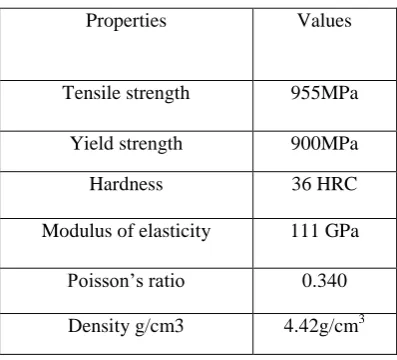
Manufacturing process is the process of shaping metals, machining them and joins them to produce different component part. Manufacturing processes are different types. Metal machining process is one type of manufacturing process. This process involved turning, boring, drilling etc. Automation of manufacturing process could be the ideal solution to today‟s development revolution in terms of the new materials, cutting tools, and machining equipment. Computer numerical control system is a machine tool having dedicated computer to prepare and control the operations of the machine tool. Advanced engineering material is used in aerospace, medical and electronics applications. Titanium alloys are commonly used in aerospace applications. Adding different alloying elements to titanium provides a wide range of physical and mechanical properties . Ti-6Al-4V is an alpha beta alloy of titanium .The hexagonal close-packed crystalline structure of alpha phase in pure titanium remains stable from room temperature to approximately 1,620°F. The body centered cubic structure of beta phase in pure titanium is stable from approximately 1,620°F to the melting point of about 3,040°F. Chemical composition, mechanical of Ti-6Al-4V are given the below table1 and table 2.
Table 1: Chemical composition Table 2: Mechanical properties
II. LITERATUREREVIEW
Literature review is conducted with an intention to provide more insights into the issues related to the machining operations in manufacturing enterprises. . Most of the researchers around the globe have conducted experimental studies on the optimization of various parameters and their effects on single responses in turning process, only few studies investigate the multi objective optimization. Ersan Aslan et al (2006) performed an optimization study of turning experiment on hardened AISI 4140 grade (63HRC) steel using Al2O3 and TiCN coated ceramic inserts at three different Cutting velocity, feed rate and depth of cut. Taguchi analysis was used to determine the optimal parameter combination. Surface roughness and flank wear are taken as performance measures . From the analysis they found that cutting velocity is the most significant factor influencing the tool wear.
Nambi Muthukrishnan and Paulo Davim, 2011, conducted a study of TTI 15 ceramic insert (80% Aluminum oxide and 20% Titanium carbide) on machining Ti-6Al-4V at moderate speed with and without the application of water soluble servo cut S coolant. Based on the analysis they found that in wet turning of Ti-6Al-4V, tool wear reduces ,tool life improved by 30% and gives good surface finish. Reddy Sreenivasulu and Srinivasa Rao, 2012, carried out a study on Design of experiments based Grey Relational Analysis in various machining processes. Many methods such as statistical technique,fractional factorial experiments and analysis of variance (ANOVA), has been employed to investigate the influence of cutting parameters.
J. Laxman, Dr. K. Guru Raj, 2013, made an attempt to optimize the EDM process parameters to achieve less tool wear and high material removal rate (MRR) using grey relational analysis. Positive indicators of machining efficiency in machining process are decrease of tool wear and increase of MRR. In this study they concluded that grey relational analysis is the most suitable method for the parametric optimization of EDM process of Titanium super alloys. Sudhansu Ranjan Das et al.,(2013) developed the prediction model for surface roughness in turning operation. The regression model was developed based on the cutting parameter. By using multiple regression and Analysis of Variance (ANOVA) a strong linear relationship among the parameters (velocity, feed rate and depth of cut) and the response (surface roughness) was found.
J Nithyanandam etal., 2014, performed an experiment on titanium alloy (Ti-6Al-4V) with nano coated carbide insert tool. The three input parameters such as cutting speed, feed rate, nose radius and depth of cut are taken and taguchi
Elements Percentage
Ti Balance
Al 6.1
V 4
Fe 0.25
C 0.08
Properties Values
Tensile strength 955MPa
Yield strength 900MPa
Hardness 36 HRC
Modulus of elasticity 111 GPa
Poisson‟s ratio 0.340
method of approach has been implemented for parametric optimization. The analysis of variance (ANOVA) was employed to determine the most significant factor that affects the output responses. They concluded that feed rate is the most significant factor affect the surface roughness followed by cutting speed when compared to other parameters the nose radius and depth of cut. Prakash Kumar Sahu and Sukhomay Pal (2014) focussed on the Multi-response optimization of process parameters in friction stir welded AM20 magnesium alloy by Taguchi grey relational analysis. ANOVA is also carried out for determining the most significant factors affect the friction stir welded AM20 magnesium alloy.
III.OBJECTIVESANDSCOPE
The primary objective of the study is to finding the influence of various machining parameters on output parameters such as surface roughness, material removal rate and roundness error in the wet turning process of Ti-6Al-4V using CVD coated carbide tools and to evaluate the optimum level of selected parameters for minimum surface roughness, roundness error and maximum material removal rate using Grey relational analysis. The study also aims at validating the results using mathematical software PYTHON. The scope the study lies in the fact that different process parameters affect differently in each performance measures. In this advanced manufacturing world looks for good surface finish with low manufacturing cost and high productivity. Ti-6Al-4V is the most important alloy used in many special applications like aerospace and biomedical.
IV.WORKPIECE,CUTTINGTOOLUSEDANDEXPERIMENTALDETAILS
A.
Details of work piece and measuring devices
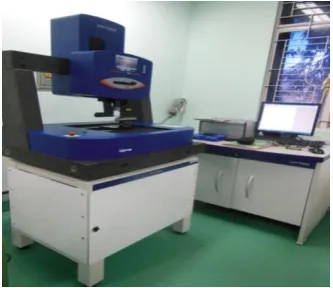
The work piece material used for the study is cylindrical shaped titanium alloy(Ti-6Al-4V) having 37.9 mm diameter and length of 125 mm. The stylus type instrument Taylor Hobson Talysurf (Figure 1) device was used to measure the surface quality of work material. Measurement of diameter provides the material removal rate measurement. The roundness measurement is carried out using the Taylor/Hobson Precision Form Talyrond 265 L.
Fig. 1 Taylor/Hobson Precision Instrument
B. Cutting tool insert
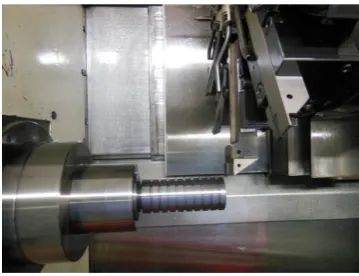
Experimental set up shown in the figure 2.The workpiece material used for the study is cylindrical shaped titanium alloy(Ti-6Al-4V) having 37.9 mm diameter and length of 125 mm. The stylus type instrument Taylor hobson Talysurf (Figure 1) device was used to measure the surface quality of work material. Measurement of diameter provides the material removal rate measurement. The roundness measurement is carried out using the Taylor/Hobson Precision Form Talyrond 265 L.
Fig. 2. Text Experimental Setup
C. Experimental details
The impact of a certain process factors on the output of the process determined with the help of experimental design. It is a scientific approach. The experiments were planned and conducted using Taguchi's orthogonal array. The four machining parameters selected for the present investigation were cutting speed, feed rate , depth of cut and nose radius. Since the considered parameters were multi-level variables and their effects were not linearly related, it was decided to use three level tests for each factor. Cutting conditions employed in the machining trials are listed in Table 3
Minitab 16 software provides the Taguchi‟s Orthogonal Array based upon the level and number of parameters selected. From the standard designs available we can select a L9 or L27 Orthogonal Array. L9 Orthogonal Array design is selected for this experimental study..
Table 3: Cutting process variables and their levels
Levels Velocity (m/min)
Feed (mm/rev)
Depth of cut (mm)
Nose radius (mm) Level 1 50 0.010 0.02 0.1 Level 2 60 0.020 0.035 0.4 Level 3 70 0.030 0.05 0.5
V. RESULTSANDDISCUSSION
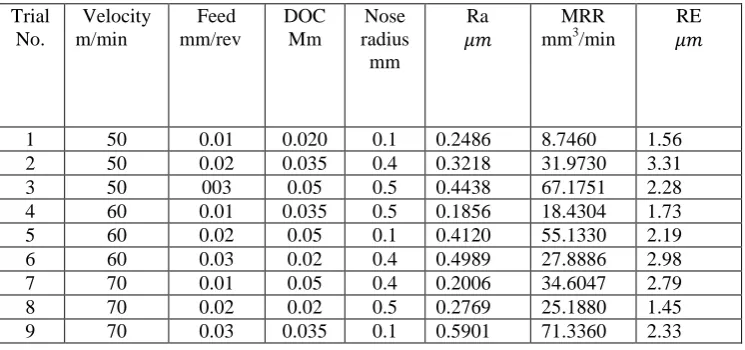
Table 4: Experimental observations
Trial No.
Velocity m/min
Feed mm/rev
DOC Mm
Nose radius
mm
Ra
𝜇𝑚
MRR mm3/min
RE
𝜇𝑚
1 50 0.01 0.020 0.1 0.2486 8.7460 1.56 2 50 0.02 0.035 0.4 0.3218 31.9730 3.31 3 50 003 0.05 0.5 0.4438 67.1751 2.28 4 60 0.01 0.035 0.5 0.1856 18.4304 1.73 5 60 0.02 0.05 0.1 0.4120 55.1330 2.19 6 60 0.03 0.02 0.4 0.4989 27.8886 2.98 7 70 0.01 0.05 0.4 0.2006 34.6047 2.79 8 70 0.02 0.02 0.5 0.2769 25.1880 1.45 9 70 0.03 0.035 0.1 0.5901 71.3360 2.33
In this work, as the process is with multi –performance characteristics (Ajay Mishraa and Anshul Gangele, 2013), therefore, the grey relational analysis is that uses grey relational grade as performance index is specially adopted to determine the optimal combination of cutting parameters. Based on the experimental got normalized values which are shown in Table 5.
Table 5: Normalized values of performance measures
Trial No. Combinations Normalized value Surface roughness
Normalized value of MRR
Normalized value of Roundness error 1 𝑣1𝑓1𝑑1𝑟1 0.8442 0 0.9408
2 𝑣1𝑓2𝑑2𝑟2 0.6632 0.3710 0
3 𝑣1𝑓3𝑑3𝑟3 0.3616 0.9333 0.5537
4 𝑣2𝑓1𝑑2𝑟3 1 0.1547 0.8494
5 𝑣2𝑓2𝑑3𝑟1 0.4425 0.7411 0.6021
6 𝑣2𝑓3𝑑1𝑟2 0.2254 0.3058 0.1774
7 𝑣3𝑓1𝑑3𝑟2 0.9629 0.4131 0.2795
8 𝑣3𝑓2𝑑1𝑟3 0.7742 0.2626 1
9 𝑣3𝑓3𝑑2𝑟1 0 1 0.5268
Following data pre-processing, a grey relational coefficient φ_(i ) (k) calculated. Then taking the average of grey relational coefficients, grey relational grade γi obtained.
𝜑𝑖 𝑘 =
∆𝑚𝑖𝑛 + 𝛿∆𝑚𝑎𝑥
∆𝑜𝑖 𝑘 + 𝛿∆𝑚𝑎𝑥
𝛾
𝑖=
1
𝑛
𝜑
𝑖(𝑘)
𝑛
𝑘=1
Table 6: Grey Relational coefficient and Grey relational grade of Performance measures
Trial No.
Combinations GRC Surface roughness
GRC of MRR
GRC Roundness error
GRG Rank
1 𝑣1𝑓1𝑑1𝑟1 0.7624 0.3333 0.8941 0.6632 3
2 𝑣1𝑓2𝑑2𝑟2 0.5975 0.4428 0.3333 0.4578 8
3 𝑣1𝑓3𝑑3𝑟3 0.4392 0.8823 0.5283 0.6127 5
4 𝑣2𝑓1𝑑2𝑟3 1 0.3716 0.7685 0.7133 1
5 𝑣2𝑓2𝑑3𝑟1 0.4728 0.6588 0.5568 0.5628 7
6 𝑣2𝑓3𝑑1𝑟2 0.3922 0.4186 0.3780 0.3962 9
7 𝑣3𝑓1𝑑3𝑟2 0.9309 0.4600 0.4096 0.6001 6
8 𝑣3𝑓2𝑑1𝑟3 0.6888 0.4040 1 0.6976 2
9 𝑣3𝑓3𝑑2𝑟1 0.3333 1 0.5137 0.6156 4
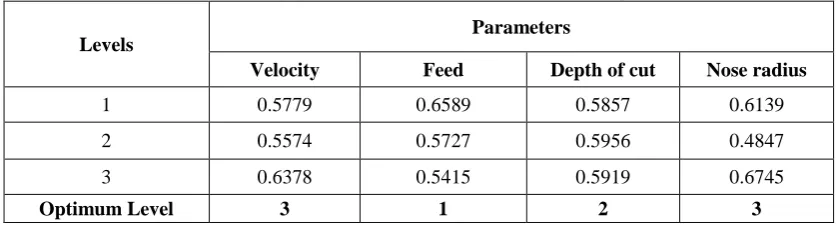
Table 6 shows that the turning process parameter setting of experiment no.4 has the highest grey relational grade. Thus the experiment no 4 gives the best multi- performance characteristics among the 9 experiments. Then the average grey relational grade for each factor level is calculated. Optimum condition is obtained by data means of Grey relational grade given in the Table 7.
Table 7: Average grey relational grade for factor and levels of the experiment
Levels
Parameters
Velocity Feed Depth of cut Nose radius
1 0.5779 0.6589 0.5857 0.6139
2 0.5574 0.5727 0.5956 0.4847
3 0.6378 0.5415 0.5919 0.6745
Optimum Level 3 1 2 3
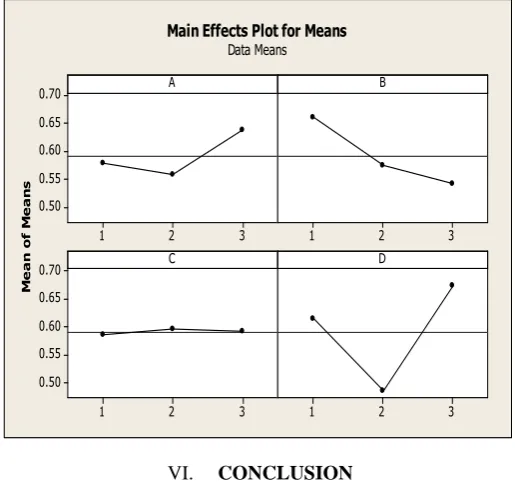
Larger grey relation grade means comparability sequence exhibits a stronger correlation with the reference sequence. Therefore the comparability sequence has larger value of grey relation grade for the surface roughness, material removal rate and roundness error. Based on these premise, this study select the level that provides largest average response. In Table 7 and Fig 3, v3 f1 d 2 r 3 shows the largest value of grey relational grade for factors Velocity, Feed,
Depth of cut and Nose radius respectively. Therefore v3 f1 d 2 r 3 is the condition for optimal parameter combination of
Fig 3: Levels of controllable factors and average grey relational grade 3 2 1 0.70 0.65 0.60 0.55 0.50 3 2 1 3 2 1 0.70 0.65 0.60 0.55 0.50 3 2 1 A M e a n o f M e a n s B C D
Main Effects Plot for Means Data Means
VI. CONCLUSION
This paper presents research work of the optimal combination of various cutting parameters affecting the surface roughness, material removal rate and roundness error in wet turning of Ti-6Al-4V alloy using CVD coated carbide tools. An orthogonal array with grey relational analysis was used to optimize the multi response characteristics of the Ti-6Al-4V turning process. The performance characteristics such as the minimum surface roughness, roundness error and maximum material removal rate were improved using the method proposed in this study. According to the Taguchi L_9 Orthogonal array, 9 experiment need to be conducted to find the optimal parameter conditions at three levels, four factor Ti-6Al-4V turning. Grey relational analysis found that the feed and nose radius are the most influencing factors followed by the velocity and depth of cut. The optimal parameter combinations obtained by the analysis is at velocity 70 m/min, Feed 0.010 mm/rev, Depth of cut 0.035mm and Nose radius 0.5mm.
REFERENCES
[1] Sahin, Y. and A.R. Motorcu, “Surface roughness model for machining mild steel with coated carbides tool”, Materials and Design,
26:321-32.2005.
[2] A. Ersan Aslan, Necip Causcu,Burak Birgoren, “Design Optimization Of Cutting Parameters When Turning Hardened AISI 4140 Steel (63
HRC) With Al2O3+ TiCN Mixed Ceramic Tool” ,Material and Design 28, pp.1618-1622, 2006.
[3] Milton C. Shaw, “ Metal cutting principles”, Oxford series on advanced manufacturing, 2010, Second Edition.
[4] Ajay Mishraa and Anshul Gangele , “ Multi-Objective Optimization In Turning Of Cylindrical Bars Of AISI 1045 Steel Through Taguchi‟s
Method And Utility concept”, International Journal of Sciences, Basic and Applied Research, Vol. 12, pp 28-36, 2013.
[5] J. Laxman, Dr. K. Guru Raj, “Optimization of EDM Process Parameters on Titanium Super Alloys Based on the Grey Relational Analysis”,
International Journal of Engineering Research, Volume No.3, Issue No.5, pp : 344-348, 2013.
[6] Reddy Sreenivasulu and Srinivasa Rao, „Design of Experiments based Grey Relational Analysis in Various Machining Processes - A
Review” , Research Journal of Engineering science, Vol. 2(1), pp. 21-26,2013.
[7] Sudhansu Ranjan Das, Amaresh Kumar, and Debabrata Dhupal, “Effect of Machining Parameters on Surface Roughness in Machining of
Hardened AISI 4340 Steel Using Coated Carbide Inserts”, International Journal of Innovation and Applied Studies, Vol. 2, pp. 445-453, 2013.
[8] Prakash Kumar Sahu and Sukhomay Pal, “Multi-response optimization of process parameters in friction stir welded AM20 magnesium alloy
by Taguchi grey relational analysis”, Journal of Magnesium and Alloys, pp.36-46, 2014.