ISSN(Online): 2319-8753 ISSN (Print) : 2347-6710
I
nternational
J
ournal of
I
nnovative
R
esearch in
S
cience,
E
ngineering and
T
echnology
(A High Impact Factor, Monthly Peer Reviewed Journal)
Vol. 5, Issue 2, February 2016
Determination of Productive Potential of
Bottleneck Machines through Work Sampling
Suman Balany
P.G. Student, Dept. of Production and Industrial Management, College of Engineering, Shivaji Nagar, Pune, India
ABSTRACT:Work study is divided into two parts: a) Method Study b) Work Measurement and work sampling is one of the work measurement techniques. It is a technique of industrial engineering used to measure the productivity potential of men, machines orworkplaces through random observations and alsoused to calculate the standard time. In this study we have taken the observation at random interval of time to determining the frequency of occurrence of job events with respect to one or more machines. Job events considered in this case study are: Machine working, parts loading, parts unloading, machine idle due to operator, machine idle due to breakdown, machine idle due to inspection. This study let us know how the application of work sampling is used to identify the productive potential of bottleneck machines.
KEYWORDS:Work Sampling, Productivity, Bottleneck Machines, Job Events, Accuracy.
I. INTRODUCTION
Productivity concept operationalized as the ratio of output to input, the productivity measures aims at identifying how efficiently theresources in a system are used in producing thedesired output[9].Understanding how craftsmen use their work hours to carry out activities isthe primary step in a productivity improvement program[6].Work Sampling was pioneered by L.H.C. Tippet in a British Textile Mill. Work Sampling has been defined in a B. S. Glossary as a technique in which a statistically competent number of instantaneous observations are taken, over a period of time, of a group of machines, process or workers [2].Work sampling measures time utilization, and therefore, it is only an indirect measurement of actual productivity [4].Work sampling is very useful for the study of non-repetitive activities or when the work method is nonspecific, and the cycle times are long [1]. To make a productive measurements, only activities directly result in measurable physical progress could be considered as work [8].To get the clear picture of machine idle time and working time, machine has to be observed continuously. But to observe the machine continuously is not possible because it will require large number of resources. Therefore, other method is to observe the machine at random interval and note machine is working or not, this method has the high probability to reflect the true situation with some margin of error. This is the basis of work sampling. Work Sampling is not beneficial to study a single operator or a machine or machines spread over a large area because time is wasted in movement.
Work Sampling can be applied to any field like education (college, schools), Hospitals, banks, etc. In industries itcan be applied in any department like purchase, production, finance, etc. Work sampling gives actual data whereas any continuous study can give a manipulated data because all are aware when continuous study is taken but while taking the work sampling study only management is aware about the study. Work sampling is taken over a period of days. Therefore it gives more accurate results. Any interruptions in study do not affect the results. It is bit difficult to understand by everyone. Work Sampling and related methods use probability theory to reduce the amount of time necessary to observe events or activities that do not occur in systematic manner without loss of information [7].
II. RELATED WORK
ISSN(Online): 2319-8753 ISSN (Print) : 2347-6710
I
nternational
J
ournal of
I
nnovative
R
esearch in
S
cience,
E
ngineering and
T
echnology
(A High Impact Factor, Monthly Peer Reviewed Journal)
Vol. 5, Issue 2, February 2016
study was performed. The methodology proposed in J. de la Riva, A. I. Garcia, R. M. Reyes and A. Woocay (2015) study allows the determination of the allowance percentage for any activity.Because it includes: the person’s physical effort, physiologic and work environment that is reflected in the heart rateduring the accomplishment of the task.Work sampling is a subjective measure and is prone to manysources of error in addition to statistical sampling error (Thomas 1982). H. Randolph Thomas (1991) paper examined the hypothesis that direct-work percentages from work sampling studies can be used to predict labor productivity measured as the work hours per unit of output.Abraham Assefa TSEHAYAEand Aminah Robinson FAYEK (2012)paperpresented a research framework to develop a crew-based work sampling study, with an illustration of how work sampling and productivity data can be used to establish comparative proportions of direct and support activities for different trades.Established proportions can be then used as baselines for construction labourproductivity improvement efforts.The results of H. Randolph Thomas, Jose M. Guevara, and Carl T. Gustenhoven (1984) study indicate that work sampling can be used as a reliable estimator of construction productivity provided the definition of direct work is narrowly defined.Sanjay S.Patil and Nanadkumar K. Hukeri (2010) in their text book, given the work sampling procedure as: 1) Decide the objectives of the study. 2) Explain objectives to related persons. 3) Fix up work and delay elements. 4) Decide duration of study. 5) Determining the desired accuracy and confidence level of final result. 6) Make a preliminary estimate of percentage activity or delay to be measured. 7) Design actual study (Determination of number of observations, Determination of number of rounds, Fixation of time required to make a round, Comparison of average time to make a round, Preparation of schedule for the rounds, Design of observation data sheet.) 8) Record the Observations 9) Summarize the result 10) Check the accuracy of the data. 11) Prepare the report.
III.CASE STUDY
This case study was conducted in automobile parts manufacturer company, where they are used to produce the diesel injectors which are of two types: a) Conventional injectors b) Common rail injectors. There are several bottleneck machines in different value streams of plant, from which some are selected for the study. Methodology followed to apply work sampling technique in this study is given below in fig.1.
IV.METHODOLOGY
ISSN(Online): 2319-8753 ISSN (Print) : 2347-6710
I
nternational
J
ournal of
I
nnovative
R
esearch in
S
cience,
E
ngineering and
T
echnology
(A High Impact Factor, Monthly Peer Reviewed Journal)
Vol. 5, Issue 2, February 2016
Objective of the study was to determine productivity potential of bottleneck machines through work samplingtechnique i.e. we need to find out how much productivity of bottleneck machines can be increasedby eliminating the machine idlenessdue to operator. After fixing the objective, next is to fix the job events, job events are as follows:
Job Events:
Machine Working
Machine Utilized Parts Loading
Parts Unloading
Machine
Conditions Operator
Machine Idle Inspection
Breakdown
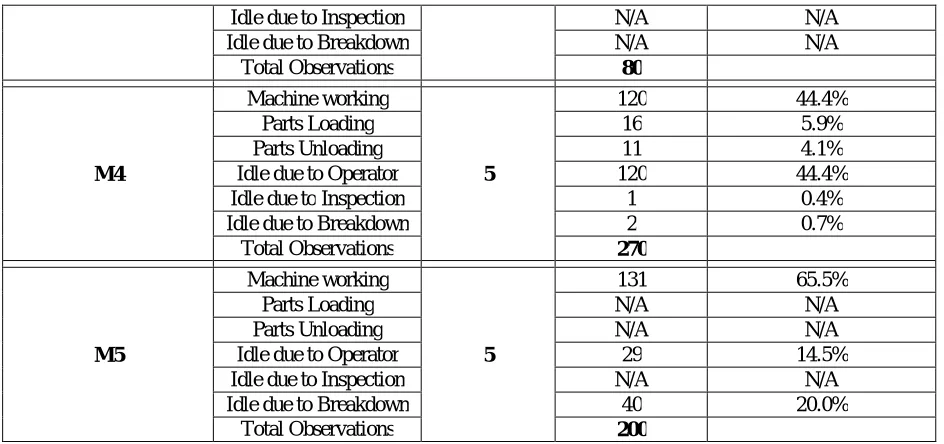
Observation points and observation sequence was fixed to carry out the observations.Preliminary observations were carried out as shown in table 1.
Machines Job Events No. of
Machines
Preliminary
Readings Percentage of Job Event
M1
Machine working
4
124 74.7%
Parts Loading N/A N/A
Parts Unloading N/A N/A
Idle due to Operator 40 24.1%
Idle due to Inspection N/A N/A
Idle due to Breakdown 2 1.2%
Total Observations 166
M2
Machine working
4
147 54.0%
Parts Loading N/A N/A
Parts Unloading N/A N/A
Idle due to Operator 84 30.9%
Idle due to Inspection N/A N/A
Idle due to Breakdown 41 15.1%
Total Observations 272
M3
Machine working
1
70 87.5%
Parts Loading N/A N/A
Parts Unloading N/A N/A
ISSN(Online): 2319-8753 ISSN (Print) : 2347-6710
I
nternational
J
ournal of
I
nnovative
R
esearch in
S
cience,
E
ngineering and
T
echnology
(A High Impact Factor, Monthly Peer Reviewed Journal)
Vol. 5, Issue 2, February 2016
Idle due to Inspection N/A N/A
Idle due to Breakdown N/A N/A
Total Observations 80
M4
Machine working
5
120 44.4%
Parts Loading 16 5.9%
Parts Unloading 11 4.1%
Idle due to Operator 120 44.4%
Idle due to Inspection 1 0.4%
Idle due to Breakdown 2 0.7%
Total Observations 270
M5
Machine working
5
131 65.5%
Parts Loading N/A N/A
Parts Unloading N/A N/A
Idle due to Operator 29 14.5%
Idle due to Inspection N/A N/A
Idle due to Breakdown 40 20.0%
Total Observations 200
Table 1:Preliminary Observations
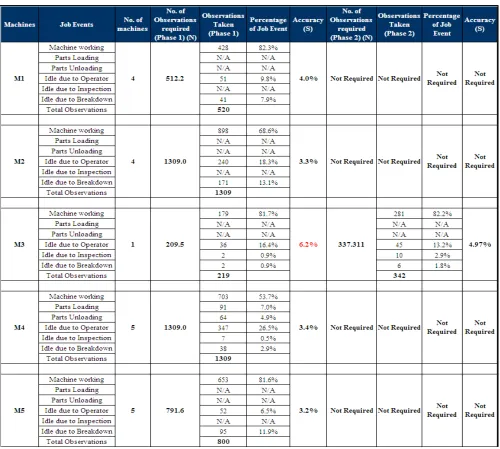
Next step is to calculate the number of observationsrequired for the 95% of confidence level and 5% ofaccuracy because any manual element is timed, there will be an error. To reduce the error, sufficient amount of observations are taken.After knowing the number of observations required, schedule to carry out observations was prepared by using random number table. Table 2 shows the number of observations required, actual observations taken and the accuracy of the data.
Calculations:
Observations required for 5% Accuracy: N= Z2*(1-P)/ (S2*P)
N= 1.962 *(1-P)/ (0.052*P) N= 1536.64*(1-P)/P
Accuracy can be calculated as: S = 1.96*√(1-P)/N*P
N= Number of Observations required. P= Working Percentage
Z= Confidence Level (95%)
S= Accuracy or Acceptable Error (5%)
ISSN(Online): 2319-8753 ISSN (Print) : 2347-6710
I
nternational
J
ournal of
I
nnovative
R
esearch in
S
cience,
E
ngineering and
T
echnology
(A High Impact Factor, Monthly Peer Reviewed Journal)
Vol. 5, Issue 2, February 2016
Table 2: Observations and Accuracy
V. RESULTS
ISSN(Online): 2319-8753 ISSN (Print) : 2347-6710
I
nternational
J
ournal of
I
nnovative
R
esearch in
S
cience,
E
ngineering and
T
echnology
(A High Impact Factor, Monthly Peer Reviewed Journal)
Vol. 5, Issue 2, February 2016
Machines No. of machines
Productivity potential
Process wise
M1 4 9.8%
M2 4 18%
M3 1 13.2%
M4 5 27%
M5 5 7%
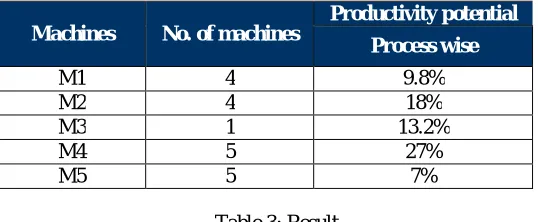
Table 3: Result
To eliminate the machine idleness due to operator and to increase the productivity, discussion with the union is a way forward to be made.
VI. CONCLUSION
Therefore from the study it is proved that work sampling technique can be used successfully to identify the productive potential of men/machines/workplaces.
REFERENCES
[1] J. de la Riva, A. I. Garcia, R. M. Reyes, A. Woocay, “Methodology to determine time allowance by work sampling using heart rate”, 6th International Conference on Applied Human Factors and Ergonomics and the Affiliated Conferences, Vol.3, pp.6490 – 6497, 2015.
[2] Sanjay S.Patil and Nanadkumar K. Hukeri, “Industrial Engineering and Production and Operations Management”, Electrotech Publication:
Engineering Series,Satara, Fourth edition, pp. 281-291, 2010.
[3] Fwu-ShiunLiou and John P. Borcherding, “Work Sampling Can Predict Unit Rate Productivity”, Journal of Construction Engineering and
Management, Vol. 112, No. 1, pp.90-103, 1986.
[4] H. Randolph Thomas, Jose M. Guevara, and Carl T. Gustenhoven, “Improving Productivity Estimates by Work Sampling”, Journal of
Construction Engineering and Management, Vol. 110, No. 2, pp.178-188, 1984.
[5] H. Randolph Thomas, “Labor Productivity and Work Sampling: The Bottom Line”, Journal of Construction Engineering and Management, Vol.
117, No. 3, pp.423-444, 1991.
[6] Abraham AssefaTsehayae and Aminah Robinson Fayek, “A Research Framework for Work Sampling and its Application in Developing
Comparative Direct and Support Activity Proportions for Different Trades”, Construction Research Congress 2012, pp.1420-1429,2012
[7] Mary Besterfield-Sacre, Elaine Newcome, Matt Tokorcheck, Larry Shuman and Harvey Wolfe, “Work in Progress - Work Sampling of
Behavioral Observations for Process-Oriented Outcomes”, 34th ASEE/IEEE Frontiers in Education Conference, Vol. 2, pp.20-21, 2004.
[8] Max L. Hailey and Iain Andrew, “Measuring Project Progress by Work Sampling”, Technology Management: The New International Language,
pp.272-274, 1991.
[9] IshwarBhiradi and B.K.Singh, “Work Measurement Approach for Productivity Improvement in a Heavy Machine Shop”, 5th International &