Implementation of Effective Learning Model
and Analysis for Improvement of Teaching
Learning Process in Selected Schools
Prof.Anita Anandrao Patil, Prof. A.V.Nikam,
Assistant Professor, BVDU, YMIM, Karad, Maharashtra, India
Associate Professor and HOD (Comp.) BVDU, YMIM, Karad, Maharashtra, India
ABSTRACT: World is moving rapidly into digital media and information. The role of ICT in education is becoming more and more important in school education.
Implementation ICT various growth in education field like Student also Teacher get more confidential in his school also benefited his real life it can be beneficial in social environment also To improve overall performance of a system and faster response time, many systems allow multiple users to update the data simultaneously. In such environment, interaction of concurrent updates may result inconsistent data.
In the development of inclusive knowledge societies the education and training sector is mainly responsible for producing skilled human resources required by education, industry as well as citizens who can participate in building a well governed society. ICT in turn can contribute to widening access to education, improving educational management and addressing issues of quality.
In this paper, a research has tried to focus on effective use of ICT learning model for Education, along with ICT use in the teaching learning process; quality and accessibility of education and learning motivation in schools of rural area. It is seen ICT and scholastic performance of Government schools are poor as compared to private schools.
KEYWORDS: ICT, scholastic performance,Data Analysis and intrepretation
I. INTRODUCTION
In dynamic world computer is must researchers focus in this paper we reviewed the empirical studies that connect EPL with changes in teaching practices and student learning. This focus clearly limited the scope of the review as few published studies have looked at the impact of learniong on teacher practice or student learning. However, studies which have been done clearly demonstrate that a learning community model can have positive impact on both teachers and students. Just as important, our act of interpreting the literature has led us to draw conclusions that are significant to future research.
That is, the professional development activity is based on the premise that knowledge and expertise are best generated by university researchers outside of the day-to-day work of teaching. Through professional development, teachers acquire and then implement this knowledge. In addition, the knowledge presented is usually advocated as a prescription for better teaching. The learning model represents a fundamental shift away from this traditional model of professional development. That is, “it is assumed that the knowledge teachers need to teach well is generated when teachers treat their own classrooms and schools as sites for intentional investigation at the same time that they treat the knowledge and theory produced by others as generative material for interrogation and interpretation”
Objective of Research Paper
Following are the objectives of the research paper
The research work is concerned with the prime objective of identifying the various problems and solution thereof in schools education using ICT. The major objectives of the proposed research are:
3) To analyze the effective of ICT implementation in the selected schools.
4) To develop a working model for efficient and effective ICT implementation in schools education. 5) To suggest measures for effective implementation of ICT in Schools.
II. HYPOTHESES OF THE STUDY
1) The researcher has set out the following hypotheses:
2) ICT helps to enhance innovative learning and self-study of the students. 3) The availability of ICT infrastructure affects the teaching learning process.
4) There is significant difference in the level of ICT implementation in Private and Government schools. 5) Computer aided instruction brings clarity of concepts
SCOPE OF THE STUDY:
In order to have an exhaustive study and to achieve maximum accuracy the scope has been determined as under:
Geographical Scope: This research will be undertaken in the selected secondary schools.
Topical Scope: The focus of this research will be critical study of ICT implementation in the selected schools of Satara District.
Functional Scope: This research will cover various aspects of increased effectiveness of teaching –learning-evolution process due to ICT implementation in selected schools.
Analytical Scope: The data collected, as part of the study, will be analyzed to fulfill the objectives and to test the hypotheses.
Research Design
Researcher has selected secondary schools from Satara district using stratified random sampling method, strata has been defined using medium of school (Marathi,Urdu,and English).
The Satara district consists of 11 talukas namely Jaoli, Karad, Khandala, Khatav, Koregaon, Mahabaleshwar, Man, Patan, Phaltan, Satara, Wai.
Researcher has selected English, Urdu and Marathi medium secondary schools from all talukas for study purpose.
Fig: 1: Present Status of Satara District: in ICT Awareness
SR.NO TALUKA NAME
TOTAL
NO OF
SCHOOLS
TOTAL NO OF
SECONDARY
SCHOOLS
POPULATION OF SECONDARY
SCHOOL(9TH
AND 10TH
STANDARD)
MARATHI URDU ENGLISH
1
JAOLI
250 30 28 00 02
2
KARAD
510 118 99 03 16
3
KHANDALA
168 32 28 00 04
4
KHATAV
340 69 65 00 04
5
KOREGAON
9
PHALTAN
412 73 69 00 04
10
SATARA
484 110 89 01 20
11
WAI
254 45 38 01 06
TOTAL 3854 715 614 06 95
Source: From Zilla Parishid, Satara.and ps karad
Developed Module;
In the education sector education is developed, there are six ways in which we can use ICT to improve education, following are the six areas as under:-
Fig: Dynamic Learning Model
EPL Model is divided in six entity researcher is explaining in detail:-
In this model main entity is ICT, Content writing, Methodology ,Awareness, and Resources is very important each entity is dependent upon each other .we discuss one by one entity
Data Analysis and Interpretation:
Sample Distribution of student
1) by Gender 2) by Taluka
3) by Medium of school
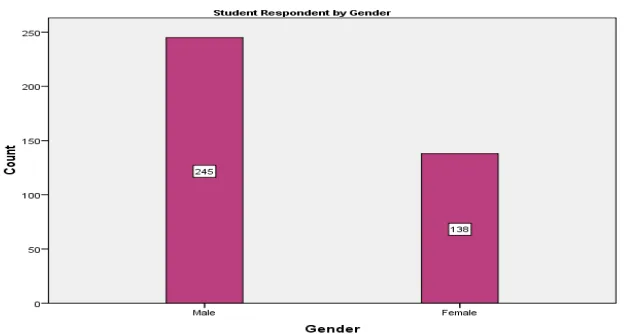
Q: No: 1 Student Respondent by Gender
Table No.1 Analysis of Gender
Distribution of Respondents
Gender Frequency Percentage
Male 245 63.96
Female 138 36.03
Total 383 100
Gender is an important variable in a given Indian social situation which is variably affected by any social or economic phenomenon and globalization is not an exception to it. Hence the variable gender was investigated for this study. Data related to gender of the respondents is presented in the Table 1.It is quite clear that out of the total respondents investigated for this study, overwhelming majority (63.96 %) of them were males whereas about 36.03 per cent female respondents included in the sample.
Q:No: 2 Student Respondent by Taluka
Table No.2 Distribution of Respondents By Taluka
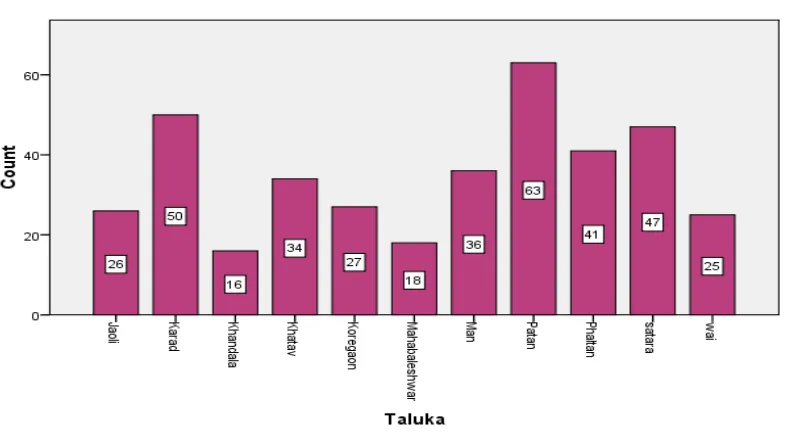
Table No. 2 indicates the distribution of respondents on the basis of taluka covered by researcher. Researcher surveyed in 12 taluka and contacted with 383 students. Majority of respondents belongs from Patan (63), Karad (50), Satara (47), Phaltan (41)Man (36) and rest from other taluka.
Graph. No.2
Taluka Frequency Jaoli 26
Karad 50
Khandala 16
Khatav 34
Koregaon 27
Mahabaleshwar 18
Man 36
Patan 63
Phaltan 41
Satara 47
wai 25
Q: No: 3 Respondent by Medium of school
Description of Student and category of school on the basis of medium
Table No.3:
Medium of school Frequency Percentage
Marathi 328 85.63
Urdu 3 0.78
English 52 13,57
Total 383 100
Table No. 3 shows the description of school on the basis of medium and number of students from different medium. It is notable from the table that high proportion of students belongs to Marathi medium with 85.63% followed by 0.78% Urdu and 13.57 English medium schools.
Table No.4 Description of ICT usage
Number of Year How long ICT being used
Frequency Percent
0-1 Year 178 46.5
1-2 Year 144 37.6
2-5 Year 13 3.4
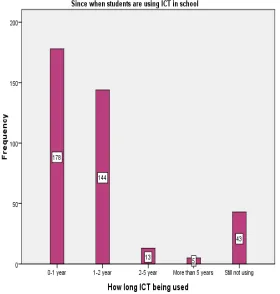
using ICT between 1-2 year, 13 (3.4%) were using since last 2-5 years and only 1.3% respondents reported that they were using ICT with more than 5 year. Data further reveals that out of 383 sample respondents 43 (11.2%) respondents had never used the ICT which shows the level of illiteracy towards ICT among the respondents.
Q. 5 Do you think that ICT Implementation is costly for school management
Analysis of Management Opinion on Cost of ICT Implementation
Table No.5
Student ICT Implementation is Costly for school Management
Frequency Percent
Yes 125 32.6
No 258 67.4
Graph. No. 5
A question was asked to analyze the management opinion on the cost aspect if ICT is implemented in their school. Data shows that majority of respondents 258 (67.4%) were positive for ICT implementation and don not think that this is costly affair for school management.
III. CONCLUSION
It is concluded that according to student gender quite clear that out of the total respondents investigated for this study, overwhelming majority of the male and female is the less compare to male.
Researcher surveyed in 12 taluka and contacted with 383 students. Majority of respondents belongs from Patan (63), Karad (50), Satara (47), Phaltan (41)Man (36) and rest from other taluka.
The basis of medium and number of students from different medium. It is notable from the table that high proportion of students belongs to Marathi medium with 85.63% followed by 0.78% Urdu and 13.57 English medium schools. Researcher conducted the survey research on the use of ICT usage by students this question aimed to evaluate ICT use by students. Responses showed that 178 (46.5%) respondents use ICT between 0-1 year, 144 (37.6%) respondents were using ICT between 1-2 year, 13 (3.4%) were using since last 2-5 years and only 1.3% respondents reported that they were using ICT with more than 5 year. Data further reveals that out of 383 sample respondents 43 (11.2%) respondents had never used the ICT which shows the level of illiteracy towards ICT among the respondents.
REFERENCES
1. ‘Introducing ICT into schools in Rwanda: educational’ ‘Challenges and Opportunities’, ‘volume 31’,issue-1’,’january 2011’,’pages 37-43’
2. Teaching reading in the primary schools, David fultan, 2000,
3. http://www.gesci.org/ , date 10 Jan 2015
4. http://www.ictinedtoolkit.org/usere/login.php date 142015
5. Gurumurthy k and k Vishwanath, 2010, international journal of information and communication technology (IJICT), ICTs programmes in
schools in India
ANNEXURE -I
QUESTIONNAIRE FOR A CRITICAL STUDY OF ICT IMPLEMENTATION IN SCHOOL EDUCATION WITH SPECIAL REFERENCE TO SELECTED SCHOOLS OF SATARA DISTRICT
Notes:
The contents of this form will be treated as strictly confidential. The information given will be used only for academic purposes. Please tick mark appropriate boxes.
Please write required information in the appropriate boxes.
Medium of School: Marathi / Urdu / English Taluka: ______________________
Name of Respondent: _____________________________________________________
Respondent Type:Student / Teacher / Administrative Staff
Name of School:_____________________________________________________