Copyright to IJIRSET www.ijirset.com 3546
IRIS RECOGNITION USING CIRCULAR
HOUGH TRANSFORM
Matsoso Samuel Monaheng
1, Padmaja Kuruba
2Department Electronics and Communication, SET, Jain University, Bangalore, India1
Assistant Professor, Department Electronics and Communication, Global Academy of Technology, Bangalore, India2
Abstract: The demand for an accurate biometric system that provides reliable identification and verification of an individual has increased over the years. A biometric system that provides reliable and accurate identification of an individual is an iris recognition system. This reliability is provided by unique patterns of human iris which differs from person to person up to an extent of identical twins having different iris patterns. In this paper, we propose circular Hough transform with horizontal and vertical derivatives for edge mapping for iris recognition. The results shows that 95.6 % accuracy is achieved compared to 88.1% attained by previous system.
Keywords: Iris Segmentation, Normalization, Circular Hough Transform, Matching, Feature Extraction, Gabor Filter, Biometric Templates
I. INTRODUCTION
Human identification or authentication in computer visions has always been an attractive goal. These authentication systems that are based on human characteristics such as face, iris and voice are known as biometric systems. Biometric systems can either be physiological or behavioural depending on the characteristics used. Human signatures and voice are classified as behavioural while face, figure print and iris traits are physiological. The first step of any biometric system is capturing a sample of a feature, such as recording a digital sound signal for voice recognition, or taking a digital eye image for iris recognition. Among the various traits, iris recognition has advantages like high speed of computation because of sample size, simplicity and accuracy compared to other biometric traits [1]. Iris recognition relies on the unique patterns of the human iris in identification and verification of an individual.
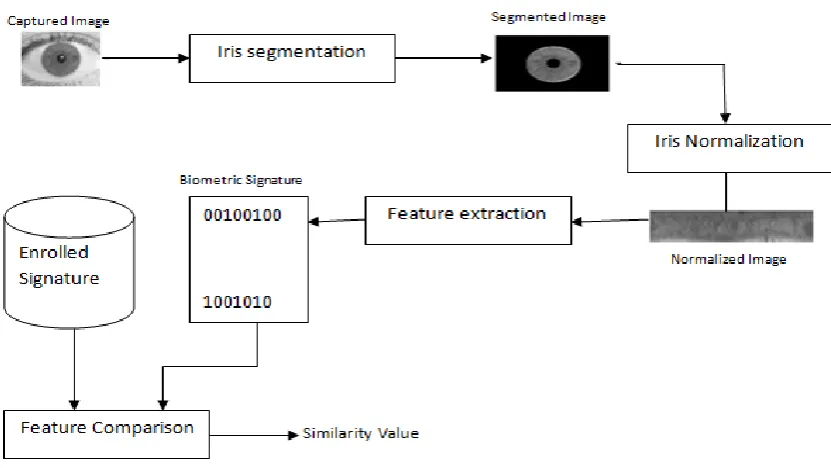
Iris recognition systems are divided into four blocks, iris segmentation, iris normalization, and feature extraction and matching. Iris segmentation separates an iris region from the entire captured eye image. Iris normalization fixes the dimensions of segmented iris region to allow for accurate comparisons. Feature extraction draws out the biometric templates from normalized image and matches this template with reference templates. The performance of an iris system closely depends on the precision of the iris segmentation. The existing methods assume that pupil is always central to an iris, hence both pupil and iris share a central point. This inaccurate assumptions results in wrong a segmentation of an iris region. The upper and the lower parts of the outer iris boundary are generally obstructed by eyelids and eyelashes, this provides problems during segmentation. These eyelids and eyelashes act as noise which needs to be eliminated to achieve optimum segmentation results
In order to solve these problems, a system is proposed that uses circular Hough transform to deduce the radius and centre coordinates of the pupil and iris regions. Biasing the derivatives in horizontal direction during edge mapping detects the eyelids and biasing the derivatives in the vertical direction helps in detecting the circular boundary of the iris.
II. RELATEDWORK
Iris segmentation step plays an important role in iris recognition systems. Related to this subject, many different works have been done. In this section, we present the most prominent works.
Copyright to IJIRSET www.ijirset.com 3547 Daugman [2], makes use of an integro-differential operator for locating the circular iris and pupil regions, and also the arcs of the upper and lower eyelids. The operator searches for the circular path where there is maximum change in pixel values, by varying the radius and centre x and y position of the circular contour [3]. The operator is applied iteratively with the amount of smoothing progressively reduced in order to attain precise localisation. Eyelids are localised in a similar manner, with the path of contour integration changed from circular to an arc.
B. Active Contour Models
Ritter et al. [17] make use of active contour models for localising the pupil in eye images. Active contours respond to pre-set internal and external forces by deforming internally or moving across an image until equilibrium is reached. The contour contains a number of vertices, whose positions are changed by two opposing forces, an internal force, which is dependent on the desired. For localisation of the pupil region, the internal forces are calibrated so that the contour forms a globally expanding discrete circle. The external forces are usually found using the edge information. In order to improve accuracy Ritter et al. use the variance image, rather than the edge image.
A point interior to the pupil is located from a variance image and then a discrete circular active contour (DCAC) is created with this point as its centre. The DCAC is then moved under the influence of internal and external forces until it reaches equilibrium, and the pupil is localised [19].
C. Eyelash and Noise Detection
Kong and Zhang [15] present a method for eyelash detection, where eyelashes are treated as belonging to two types, separable eyelashes, which are isolated in the image, and multiple eyelashes, which are bunched together and overlap in the eye image. Separable eyelashes are detected using 1D Gabor filters, since the convolution of a separable eyelash with the Gaussian smoothing function results in a low output value [16]. Thus, if a resultant point is smaller than a threshold, it is noted that this point belongs to an eyelash. Multiple eyelashes are detected using the variance of intensity. If the variance of intensity values in a small window is lower than a threshold, the centre of the window is considered as a point in an eyelash. The Kong and Zhang model also makes use of connective criterion, so that each point in an eyelash should connect to another point in an eyelash or to an eyelid. Specula reflections along the eye image are detected using thresholding, since the intensity values at these regions will be higher than at any other regions in the image.
D. Daugman’s Rubber Sheet Model
The rubber sheet model devised by Daugman [1] remaps each point within the iris region to a pair of polar coordinates (r,θ) where r is on the interval [0,1] and θ is angle [0,2π]. This rubber sheet model converts the Cartesian coordinates into polar coordinates form. These Cartesian coordinates corresponds to the coordinates of the pupil and iris boundaries along the θ direction. The rubber sheet model takes into account pupil dilation and size inconsistencies in order to produce a normalised representation with constant dimensions. In this way the iris region is modelled as a flexible rubber sheet anchored at the iris boundary with the pupil centre as the reference point
E. Virtual Circles
In the Boles [8] system, iris images are first scaled to have constant diameter so that when comparing two images, one is considered as the reference image. This works differently to the other techniques, since normalisation is not performed until attempting to match two iris regions, rather than performing normalisation and saving the result for later comparisons. Once the two irises have the same dimensions, features are extracted from the iris region by storing the intensity values along virtual concentric circles, with origin at the centre of the pupil [7]. A normalisation resolution is selected, so that the number of data points extracted from each iris is the same. This is essentially the same as Daugman‟s rubber sheet model, however scaling is at match time, and is relative to the comparing iris region, rather than scaling to some constant dimensions. Also, it is not mentioned by Boles, how rotational invariance is obtained.
F. Haar Wavelet
Copyright to IJIRSET www.ijirset.com 3548
III.MODEL
The proposed system is shown in figure 2 below
. Fig. 1 Block diagram of a proposed iris recognition system
A. Iris segmentation
The first step of iris recognition system is to isolate the actual iris region from the captured digital eye. The iris region can be approximated by two circles, one for the iris/sclera boundary and another for interior of the iris/pupil boundary. The eyelids and eyelashes normally obstruct the upper and lower parts of the iris region. Specular light reflections can occur within the iris region corrupting the iris pattern and hence a technique is required to isolate and exclude these artefacts as well as locating the circular iris region. For our proposed system circular Hough transform technique is used..
B. Iris Normalisation
Once the iris region is successfully segmented from a captured image, the next process is to fix the dimensions of the segmented image in order to allow for comparisons. There are various causes inconsistencies between eye images .Some of them are due to pupil dilation, rotation of the camera, head tilt, and rotation of the eye within the eye ball and changing of the imaging distance. The most affected inconsistency is due to the variation in the light intensities and illumination causes pupil dilation resulting in stretching of the iris. In order to remove these inconsistencies, segmented image is normalised. The normalisation process will produce iris regions, which have the same constant dimensions, so that two images of the same iris under different conditions will have the same characteristic features.
IV.ALGORITHM
A. Segmentation Algorithm
In the proposed work, circular Hough transform is used for detecting the iris and pupil boundaries. This involves generating an edge map using the canny edge detection.
Bias the derivative in the horizontal direction for detecting the eyelids
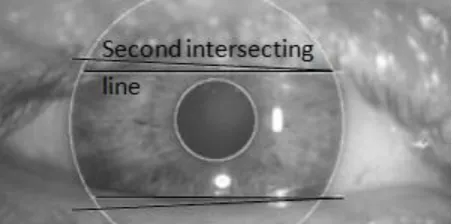
Copyright to IJIRSET www.ijirset.com 3549 Gradients were biased in the vertical direction for the outer iris/sclera boundary. Vertical and horizontal gradients were weighted equally for the inner iris/pupil boundary. The range of radius values to search for was set manually based on theoretical values depending on the database used. For all CASIA database versions, values of the iris radius range from 90 to 150 pixels, while the pupil radius ranges from 28 to 75 pixels. Since the pupil is always within the iris region, Hough transform for the detection of iris/sclera boundary was performed first, then the Hough transform for the iris/pupil boundary was performed within the iris region. This makes the circle detection process more efficient and accurate. After completion of this process, six parameters are stored, the radius, and x and y centre coordinates for both circles. Eyelids are treated as noise during segmentation. Their isolation is done by first fitting a line to the upper and lower eyelid. A second horizontal line is drawn, which intersects with the first line at the iris edge that is closest to the pupil as shown in figure 2,3,4and 5. This is done for both top and bottom of eye.
Fig. 2 An eye image with eyelids and eyelashes obstructing the iris outer boundaries.
Fig. 3 A segmented image with first line fitting
Copyright to IJIRSET www.ijirset.com 3550 Fig. 5 Accurate detection and elimination of the eyelids and eyelashes
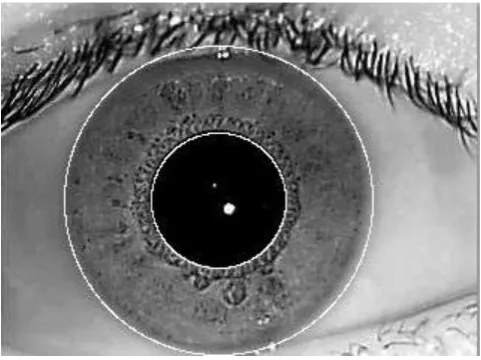
Example of Successful segmentation results using this proposed system circular Hough transform is shown in figure 6.
Fig. 6 Successful segmentation using CASIA database
V. EXPERIMENTAL RESULTS AND PERFORMANCE ANALYSIS
The proposed system was evaluated using CASIA version 1 and 3 and Indian Institute of technology Delhi (IITD). The Chinese Academy of Sciences - Institute of Automation (CASIA) eye image database contains 756 greyscale eye images with 108 unique eyes and 7 different images of each unique eye [13]. IITD database contain 1120 images [14].
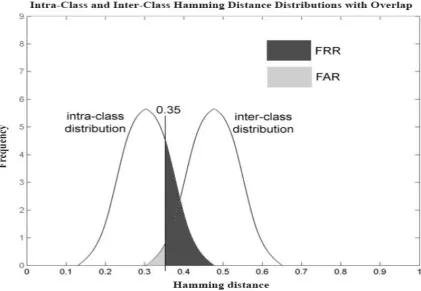
Copyright to IJIRSET www.ijirset.com 3551 Fig. 7 False Accept and False Reject Rates for two distributions with a separation Hamming distance of 0.35. To reduce the amount of overlap between intra-class and inter class distributions, different separation points were tested per database and a separation point with minimum overlap was selected. Table 1and 2 shows various thresholds or separation points on IITD and CASIA databases respectively
Table I False Accept And False Reject Rates For The „Iitd‟ Data Set With Different Separation Points
Separation Point FAR(%) FRR(%)
0.20 0.000 74.046
0.25 0.000 45.802
0.30 0.000 25.191
0.35 0.000 4.580
0.40 0.000 0.000
0.45 2.494 0.000
0.50 92.819 0.000
Table II False Accept And False Reject Rates For The „Casia-A‟ Data Set With Different Separation Points
Separation Point FAR(%) FRR(%)
0.20 0.000 99.047
0.25 0.000 82.787
0.30 0.000 37.880
0.35 0.000 5.181
0.40 0.005 0.238
0.45 7.599 0.000
Copyright to IJIRSET www.ijirset.com 3552
CASIA datasets with a separation point of 0.4, a false accept rate and false reject rate of 0.005% and 0.238%
respectively is achieved. This reduction of overlap between the intra class and inter class allows for overall proposed system performance with existing systems. Table 3 shows comparison between proposed system and existing systems in terms of accuracy of recognition using CASIA database.Table III Comparison Of Proposed System And Existing Systems Using Casia Database.
The table shows that with a proper separation point, the results in terms of accuracy improve reasonably. The proposed system attains 7.5 % [95.6-88.1] more accuracy compared with Daugman system which uses integro differential operation rather than circular Hough transform. .
VI.CONCLUSION
The level of accuracy of an iris recognition system depends on the precision of the segmentation of an iris region. The eyelids and eyelashes which obstruct the upper and lower parts of the outer iris boundary are removed perfectly. This enhances the accuracy of the system in that, only the iris region can be converted to biometric templates for matching. Circular hough transform method proposed on this paper proofed to be more effective compared to existing methods. The proposed system has achieved a recognition accuracy of 95.6%.
ACKNOWLEDGMENT
The author wishes to thank Jain University for providing all necessary resource for this research to be successful. On top of it all assistant professor Padmaja K for the guidance. The databases used for testing purpose were provided by the Chinese Academy of Sciences - Institute of Automation (CASIA) and Indian Institute of Technology Delhi (IITD) and these are highly appreciated.
REFERENCES
[1] S. Sanderson and J. Erbetta, “Authentication for secure environments based on iris scanning technology”, IEE Colloquium on Visual Biometrics, pp 1-6, 2000.
[2] J. Daugman. How iris recognition works. Proceedings of 2002 International Conference on Image Processing, Vol. 1, pp 16-22 2002.
[3] E. Wolff. Anatomy of the Eye and Orbit. 7
th
edition. H. K. Lewis & Co. LTD, 1976.
[4] R. Wildes, “Iris recognition: an emerging biometric technology”. Proceedings of the IEEE, Vol. 85, No. 9, pp 1349 13-60, 1997. [5] J. Daugman, “Biometric personal identification system based on iris analysis”, United States Patent, Patent Number: 5,291,560, 2010. [6] J. Daugman. High confidence visual recognition of persons by a test of statistical independence. IEEE Transactions on Pattern Analysis and Machine Intelligence, Vol. 15, No. 11, pp 1148-1160 , 2011
[7] R. Wildes, J. Asmuth, G. Green, S. Hsu, R. Kolczynski, J. Matey and S. McBride, “A system for automated iris recognition”, Proceedings IEEE Workshop on Applications of Computer Vision, Sarasota, FL, pp. 121-128, 2011.
[8] W. Boles and B. Boashash, “A human identification technique using images of the iris and wavelet transform”, IEEE Transactions on Signal Processing, Vol. 46, No. 4, pp 1185-1188 ,1998.
[9] Lim, K. Lee, O. Byeon and T. Kim, “ Efficient iris recognition through improvement of feature vector and classifier”, ETRI Journal, Vol. 23, No. 2, Korea, pp 1220-1225, 2001.
[10] S. Noh, K. Pae, C. Lee and J. Kim “Multiresolution independent component analysis for iris identification”, The 2002 International Technical Conference on Circuits/Systems, Computers and Communications, Phuket, Thailand, 2002.
System[reference] FAR FRR Overall % Accuracy
Avila [5] 0.03 2.08 82.2%
Li Ma [9] 0.02 1.98 83.4%
Tisse [13] 1.84 8.79 74.5%
Daugman [15] 0.01 0.09 88.1%
Copyright to IJIRSET www.ijirset.com 3553 [11] Y. Zhu, T. Tan and Y. Wang “Biometric personal identification based on iris patterns”, Proceedings of the 15th International Conference on Pattern Recognition, Spain, Vol. 2, 2000.
[12] C. Tisse, L. Martin, L. Torres and M. Robert, “ Person identification technique using human iris recognition”, International Conference on Vision Interface, Canada, 2002.
[13] Chinese Academy of Sciences – Institute of Automation. Database of 756 Greyscale Eye Images. http://www.sinobiometrics.com Version 1.0, 2003.
[14] Indian Institute of Technology Delhi, iris Database for research. http://web.iitd.ac.in/~biometrics/Database_Iris.html ,2013
[15] W. Kong and D. Zhang, “Accurate iris segmentation based on novel reflection and eyelash detection model”, Proceedings of 2001 International Symposium on Intelligent Multimedia, Video and Speech Processing, Hong Kong, 2001.
[16] L. Ma, Y. Wang and T. Tan, “Iris recognition using circular symmetric filters”, National Laboratory of Pattern Recognition, Institute of Automation, Chinese Academy of Sciences, 2002.
[17] N. Ritter, “Location of the pupil-iris border in slit-lamp images of the cornea”, Proceedings of the International Conference on Image Analysis and Processing, 1999.
[18] M. Kass, A. Witkin, D. Terzopoulos and Snakes, “Active Contour Models”, International Journal of Computer Vision, 2008.
[19] D. Field, “Relations between the statistics of natural images and the response properties of cortical cells”, Journal of the Optical Society of America, 2011.
[20] A. Oppenheim and J. Lim, “The importance of phase in signals”, Proceedings of the IEEE 69, 529-541, 2007.
[21] P. Burt and E. Adelson, “The laplacian pyramid as a compact image code”, IEE Transactions on Communications, Vol. COM-31, No. 4, 2009.
BIOGRAPHY
Matsoso Samuel Monaheng received his bachelor of engineering in Electronics in 2009 from National University of Lesotho (NUL) in Maseru, Lesotho. In 2011 he was awarded a scholarship of two years to study in Jain University, Bangalore, India, to pursue Master of Technology in signal processing and VLSI. His research areas of interests include Image processing, Computer Vision, Pattern Recognition, Biometrics, and Communication Engineering
Padmaja Kuruba completed her B.E in Electronics and Communications Engineering from
vijayanagara college of Engineering and Technology, Bellary affiliated to Visveswaraiah Technology University, Belgaum Karnataka India, and received M.Tech from Sri Dharmastala College of Engineering and technology, Dharwad affiliated to Visveswaraiah Technology University, Belgaum Karnataka India. Her research area is Image processing and Wireless Sensor networks. She is presently working as assistant professor in Department of Electronics and Communication Engineering at Global Academy of Technology, Bangalore, Karnataka, India. She has served at industry, working on wireless communication with hands on Wimax, LTE and Audio and Video processing. She was resource person at Nation Level workshops for faculty development on recent trends in Wireless communication. She is a received award for excellence performance at industry for two projects. Member of IETE, India.
PHOTOGRAPH