Enabling Workload Allocation for Macro
Cells and RRH in H-CRAN
G.Saratha Devi
1, B.P.Sreeja
2, G.Ashok Kumar
3Assistant Professor, Department of IT, Karpagam College of Engineering, Coimbatore, Tamil Nadu, India 1 Assistant Professor, Department of IT, Karpagam College of Engineering, Coimbatore, Tamil Nadu, India 2 Assistant Professor, Department of CSE, Karpagam College of Engineering, Coimbatore, Tamil Nadu, India 3
ABSTRACT: The heterogeneous cloud radio access network (H-CRAN) has become the most prominent way to handle interference and data traffic challenges. The main idea of the H-CRAN is incorporating cloud computing into a heterogeneous network (HetNet) to enhance coordinated multipoint transmission and reception, cooperative radio resource management, and self-organizing networks, which improve both spectral and energy efficiencies of cellular systems. One of the main challenges to balance the data transmission in back haul by decreasing the bandwidth of the backhaul is implemented previously. In this paper we propose that we can also allocate the workload between macro cells and RRHs.
KEY WORDS: H-CRAN, HetNet, LPN, CoMP, BBU.
I. INTRODUCTION
Now a days, mobile data traffic has experienced record growth among the world’s operators as subscribers use more smart phones and mobile devices, such as tablets. As the spectral efficiency for the Long Term Evolution (LTE) standard is approaching the Shannon limit, further improvements in system spectral density of access nodes. In a relatively sparse deployment of macro base stations (BSs), adding more BSs does not severely increase intercell interference, and solid cell splitting gains are easy to achieve. However, as the density of BSs is already quite large today, cell splitting gains are greatly reduced due to the intercell interference that is severe under such circumstances. In addition, costs concerning site acquisition in a capacity-limited dense urban area can become extremely expensive. Furthermore, the current cellular network architecture is 40 years old and was primitively designed for coverage and mobility considerations, instead of achieving high energy efficiency (EE) and spectral efficiency (SE) performance. To deal with such challenging goals, revolutionary approaches concerning novel wireless network architectures supported by advanced signal processing and networking technologies are urgently needed.
Challenges associated with the dense deployment of traditional macro BSs can be partly avoided by the utilization of low power nodes (LPNs), which are normally classified into pico BSs, femto BSs, and relays. A network that consists of macro cells and LPNs, where some of them are configured with restricted access and some may be lacking in wired backhaul, is referred to as a heterogeneous network (HetNet). LPNs are usually deployed in the coverage of the macro BSs to offload the traffic of these macro BSs and support users with high data rate requirements. As a result, HetNets can serve customers in traffic hot zones by deploying dense LPNs and providing ubiquitous coverage to all user equipment through the powerful macro BSs. However, they still face the problem of severe interference when the distribution of LPNs is too dense, which is expected in 5G. Therefore, it is of great significance to suppress interference through advanced signal processing techniques to fully exploit the potential of HetNets. Coordinated multiple point (CoMP) transmission and reception is increasingly seen as a promising solution to improve the performance of HetNets. Unfortunately, it also has disadvantages in practical cellular networks as its performance gain relies heavily on the backhaul constraints degrade as the density of LPNs increases.
communication networks. As a consequence, heterogeneous cloud radio access networks (H-CRANs) are proposed as a cost-effective alternative to suppress inter-tier interference and enhance cooperative processing gains in HetNets accompanied by cloud computing technology. The motivationbehind H-CRANs is to improve the capabilities of macro BSs with massive multiple-input multiple- output (MIMO) technology and simplify LPNs by building connections between LPNs and a signal processing cloud (BBU pool in the H-CRANs) through high-speed optical fibers. To be more specific, the baseband data processing and radio resource control in traditional LPNs are transferred to the BBU pool to take advantage of cloud computing capabilities .H-CRANs have been researched in the literature in the areas of resource assignment and interference coordination. These works mainly focus on mitigating inter-tier interference among remote radio heads (RRHs) and macro BSs, and allocating resources in an energy-efficient manner. However, the critical problem concerning backhauls that hinders the implementation of H-CRANs has not been fully investigated. These are effective in decreasing data transmission in backhaul for the given amount of data.A method for allocating the workload between macro cells and RRHs is proposed, where the key idea is based on workload balancing. The challenging issues related to the proposal and possible research directions are discussed.
II. RELATED WORK
Heterogeneous networks (HetNets) have attracted intense interest from both academia and industry [1]. The low-power node (LPN)(e.g., pico base station, femto base station, small cell base station) is identified as one of the key components to increase capacity of cellular networks in dense areas with high traffic demands. When traffic is clustered in hotspots, such LPNs can be combined with a high-power node (HPN, e.g., macro or micro base station) to form a Het-Net. HetNets have advantages of serving hotspot customers with high bit rates through deploying dense LPNs, providing ubiquitous coverage and delivering the overall control signaling to all user equipments (UEs) through powerful HPNs. In actuality, too dense LPNs incur severe interference, which restricts performance gains and commercial development of HetNets. Therefore, it is critical to control interference through advanced signal processing techniques to fully unleash the potential gains of HetNets. Coordinated multipoint (CoMP) transmission and reception is presented as one of the most promising techniques in 4G systems. Unfortunately, CoMP has some disadvantages in real networks because its performance gain depends heavily on the backhaul constraints and even degrades with increasing density of LPNs [2]. Furthermore, it was reported that the average spectral efficiency (SE) performance gains from the uplink CoMP field trials in downtown Dresden were only about 20 percent with non-ideal backhaul and distributed cooperation processing located at the base station in [3]. To overcome the SE performance degradations and decrease the energy consumption in dense HetNets, a new paradigm for improving both SE and EE through suppressing inter-tier interference and enhancing the cooperative processing capabilities is needed in the practical evolution of HetNets. Meanwhile, cloud computing technology has emerged as a promising solution for providing high EE together with gigabit data rates across software defined wireless communication networks, in which the virtualization of communication hardware and software elements place stress on communication networks and protocols. Consequently, heterogeneous cloud radio access networks (H-CRANs) are proposed in this article as a cost-effective potential solution to alleviate inter-tier interference and improve cooperative processing gains in HetNets through combination with cloud computing. The motivation of H-CRANs is to enhance the capabilities of HPNs with massive multiple antenna techniques and simplify LPNs through connecting to a signal processing cloud with high-speed optical fibers. As such, the baseband data path processing as well as radio resource control for LPNs are moved to the cloud server to take advantage of cloud computing capabilities. In the proposed H-CRANs, the cloud-computing-based cooperation processing and networking gains are fully exploited, the operating expenses are lowered, and energy consumption of the wireless infrastructure is decreased.
III. ARCHITECTURE OF H-CRAN
consumption cooperating with each other and a centralized BBU pool facilitated to achieve high performance gains. As mentioned earlier and specifically marked in Fig. 1, only simple symbol processing and the front radio frequency (RF) are conducted in the RRHs, while other baseband processing and upper layer procedures are conducted in the BBU pool. On the other hand, H-CRANs differ from C-RANs with macro cells.
Macro cells play a significant role in H-CRANs as they connect with the centralized BBU pool to alleviate cross-tier interference between RRHs and macro cells with centralized cooperative processing techniques based on cloud computing. Moreover, with the help of macro cells, the backhaul requirements are alleviated as the control signals and data are decoupled in H-CRANs. To be more specific, all control signals are delivered through macro cells to user equipment (UE), which weakens the capacity and delay constraints in backhauls between RRHs and the BBU pool. Furthermore, as has been discussed in [9, 10], services with a small amount of data, moving at high speed or requiring a low data transmission rate, can be supported efficiently by macro cells, while applications that require a high data trans-mission rate or have low mobility are allocated to RRHs.
Fig. 1.Heterogenous C-RAN
To enhance coverage and capacity, MIMO serves as an effective technology to be applied to macro BSs. With the help of centralized processing in the BBU pool, cooperative processing techniques inherited from virtual MIMO can achieve multiplexing gains. As with C-RANs, inter-RRH interference can be restrained by the cooperative processing techniques in the BBU pool. Moreover, the interference among macro cells and RRHs can be mitigated through cooperative resource management via an interface between macro cells and the BBU pool.
IV.BACKHAULS OF DATA TRANSMISSION IN H-CRANS
Various data compression techniques have been investigated to cope with the BBU-RRH signal transmission bandwidth problems. In time domain, reducing the signal sampling rate is a solution of low complexity and has minimal impact on protocols while conducting efficient compression of up to 66 percent with some performance degradation. Non-linear quantization serves as an alternative. More quantization levels are specified in a magnitude where more values are likely to be presented, which improves quantization signal to noise radio (QSNR). Interface-in-phase and quadrature (IQ) data compression is another well-developed compression technique. It is based on reducing the signals’ dynamic range by normalizing their power to the average power reference. Even though high compression efficiency can be achieved, it has high complexity, real-time and compression distortion issues, and there is no mature algorithm available.
The differences in the widths of backhaul lines reflect the gaps between transmission bandwidths required by different RRHs. Besides, as users are typically shifting between different areas, e.g. residential and office, during the day, peak transmission bandwidth requirements may be as much as 10 times higher than during off-peak hours. In order to guarantee robust data transmission at any time and any place, the transmission bandwidth of the backhaul for the RRH is designed for the peak transmission bandwidth required. As a result, transmission bandwidth resources are largely wasted, because most of the time these RRHs do not need to communicate with the BBU pool at full rate. The waste of transmission bandwidth is partly reflected in the waste of transmission links such as optical fibers that have been constructed. Obviously, if we balance the data transmitted in backhauls among RRHs in real time, the peak transmission bandwidth required can be greatly decreased. As a consequence, balancing the workload among backhauls followed by compression techniques can greatly reduce the amount of data to be transmitted. Besides, costs spent on construction of backhauls can be decreased, as the backhauls of RRHs can now be equipped with lower transmission bandwidth. Furthermore, thanks to the aggregation of BBUs into a BBU pool, the distribution of traffic demands can be easily obtained, making it possible to balance the workload among backhauls. Finally, as is known to all, the BBU pool is capable of workload balancing due to the aggregation of processing units and its natural capability of central management. However, the function of workload balancing executed in the BBU pool is mainly designed to balance the workloads among different processing units while being ignorant of the workloads of backhauls. For practical cellular networks, workload balancing among backhauls must be executed in the user association part among RRHs, which relies on the geometrical partitioning of the practical service area for the purpose of workload balancing, not just the BBU pool.
V. WORKLOAD ALLOCATION IN MACRO CELLS AND RRH OF H-CRANS
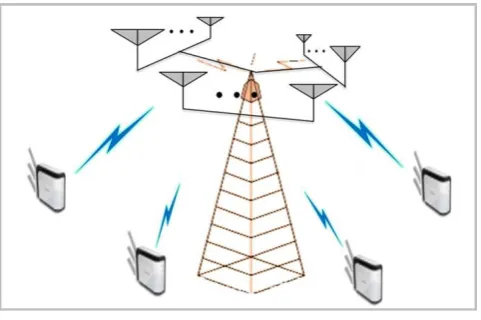
A macrocell provides the largest area of coverage within a mobile network. The antennas for macrocells can be mounted on ground-based masts, rooftops or other existing structures. They must be positioned at a height that is not obstructed by terrain or buildings. Macrocells provide radio coverage over varying distances depending on the frequency used, the number of calls made and the physical terrain. Macrocell base stations have a typical power output in tens of watts.The RRH concept constitutes a fundamental part of a state-of-the-art base station architecture. RRH-based system implementation is driven by the need to reduce both CAPEX and OPEX consistently, which allows a more optimized, energy-efficient, and greener base deployment. Figure 2 illustrates an architecture where a 2G/3G/4G base station is connected to RRHs over optical fibers. Either CPRI or OBSAI may be used to carry RF data to the RRH to cover a three-sector cell.
network. This dissertation is concerned with achieving fairness in the joint allocation of multiple heterogeneous workloads. We consider resources as either prioritized (such as bandwidth and buffer resources) or essential (such as processing and bandwidth resources). For each type of these systems, we present a simple but powerful general principle for defining fairness in such systems based on any of the classic notions of fairness such as max-min fairness, proportional fairness and utility max-min fairness defined for a single resource. Using max-min fairness as an example, we apply the principles to a system with a shared buffer and a shared link, and a system with a shared processor and a shared link, and pro- pose practical and provably fair algorithms for the joint allocation of buffer and bandwidth xiii resources, and the joint allocation of processing and bandwidth resources. We demonstrate the fairness achieved by our algorithms through simulation results using both synthetic traffic and real traffic traces. The principles and the algorithms detailed in this dissertation may also be applied in a variety of other contexts involving resource sharing.
Figure 2.Workload Allocation in H-CRAN
VI.EXPERIMENTAL RESULTS
Based on the understanding of the workload balancing scheme proposed above, we would ask a question. H-CRANs are made up of RRHs as well as macro cells, and they can be seen as two tier networks. Considering that our proposal above is mainly focused on one tier of H-CRANs (the tier of RRHs), we wonder why conducting workload balancing in one tier without considering the influence of other tiers (the tier of macrocells) makes sense. In practice, due to differences in deployment and propagation environments, RRHs and macro BSs have separate path loss exponents and spatial densities.
VII. CONCLUSION
H-CRANs have been recommended as one of the most promising ways to handle the challenges faced by today’s HetNets, H-CRANs have the advantages of higher energy efficiency, much larger capacity, suppressed inter-tier interference, and adaptability to scalability. On the other hand, large costs of data transmission in backhauls caused by centralization make H-CRANs less feasible, and they will even become intolerable when the density of RRHs becomes ultra dense, which is expected in the coming 5G. Due to the unevenly distributed traffic and the huge gap between peak transmission rate and the transmission bandwidth required during off-peak hours, transmission bandwidth is not fully used most of the time since mobile operators must provide users with the bandwidth required during peak hours to guarantee robust communication quality. Such waste is partly reflected in the costs spent on the construction of backhauls. Various compressions techniques have been proposed to decrease the amount of data to be transmitted on backhauls. In this article we proposed to allocate the workload between macro cells and RRHs. The key challenges of our proposal were discussed.
REFERENCES
[1] M. Peng et al., ―Heterogeneous Cloud Radio Access Networks: A New Perspective for Enhancing Spectral and Energy Efficiencies,‖ IEEE Wireless Commun., vol. 21, no. 6, Dec. 2014, pp. 126–35.
[2] A. Damnjanovic et al., ―A Survey on 3GPP Heterogeneous Networks,‖ IEEE Wireless Commun., vol. 18, no. 3, June 2011, pp. 10–21.
[3] A. Checko et al., ―Cloud RAN for Mobile Networks — A Technology Overview,‖ IEEE Commun. Surv. Tut., vol. 17, no. 1, 1 Quarter 2015, pp. 405–26.
[4] C.-L. I et al.,―Recent Progress on C-RAN Centralization and Cloudification,‖ IEEE Access, vol. 2, Sept. 2014, pp.1030–39.
[5] M. Peng et al., ―System Architecture and Key Technologies for 5G Heterogeneous Cloud Radio Access Networks,‖ IEEE Network, vol. 29, no. 2, Mar. 2015, pp. 6–14.
[6] China Mobile Research Institute, ―C-RAN: The Road Towards Green RAN,‖ Tech. Rep., Oct. 2011.
[7] P. Rost et al., ―Cloud Technologies for Flexible 5G Radio Access Networks,‖ IEEE Commun. Mag., vol. 52, no. 5, May 2014, pp. 68–76. [8] D. Wubben et al., ―Benefits and Impact of Cloud 17 Computing on 5G Signal Processing: Flexible Centralization Through Cloud-RAN,‖ IEEE Signal Process. Mag., vol. 31, no. 6, Nov. 2014, pp. 35–44.
[9] W. H. Chin, Z. Fan, and R. Haines, ―Emerging Technologies and Research Challenges for 5G Wireless Networks,‖ IEEE Wireless Commun., vol. 21, no. 2, Apr. 2014, pp. 106–12.
[10] P. K. Agyapong et al., ―Design Considerations for a 5G Network Architecture,‖ IEEE Commun. Mag., vol. 52, no. 11, Nov. 2014, pp. 65–75. [11] S.-H. Park et al., ―Robust and Efficient Distributed Compression for Cloud Radio Access Networks,‖ IEEE Trans. Vehic. Tech., vol. 62, no. 2, Feb. 2013, pp. 692–703.
[12] O. Baron et al., ―The Equitable Location Problem on the Plane,‖ Eur. J. Oper. Res., vol. 183, no. 2, Dec. 2007, pp. 578–90.