Vol. 4, Issue 4, April 2015
Performance and Emission Analysis on
C.I Engine with Palm Oil Biodiesel Blends at
Different Fuel Injection Pressures
R.Samsukumar
1, M.Muaralidhararao
2, A. Gopala Krishna
3, Y.Jayaraju
4, P.Surya Sri Vatsav
5,
V.H.Manikanta
6, S.V.V.Satish
7, S.A.C.Bhuvannaidu
8Associate Professor, Department of Mechanical Engineering, Swarnandhra College of Engineering &Technology, Narasapuram, W.G Dist., A.P, India 1
Professor, Department of Mechanical Engineering, Swarnandhra College of Engineering &Technology, Narasapuram, W.G Dist., A.P, India 2
UG Students, Department of Mechanical Engineering, Swarnandhra College of Engineering &Technology, Narasapuram, W.G Dist., A.P, India4-8
Professor, Department of mechanical engineering, JNTUK, Kakinada, AP, India3
ABSTRACT: In the present days the price and usage of petroleum products are increased more and more, due to this the search of alternative fuels has gain more importance in order to replace it. Coming to the diesel engines the best alternative fuel is Biodiesel, because it can be used directly without changing the engine modifications. The methyl esters of vegetable oil are known as Biodiesel. That means the fatty acids present in the vegetable oil are mainly responsible for the production of Biodiesel. The methyl esters of palm oil can be derived through Transesterification process. Experiments have carried out to examine the properties of palm oil biodiesel, performance and emissions of the engine with different blends (20%PBD, 40%PBD, 80%PBD, and 100% PBD) at different fuel injection pressures (190, 210, and 230bar) and the results obtained are compared with diesel (base line test values). A “computerized variable compression ratio multi fuel direct injection water cooled engine” is used for the performance analysis. The main parameters considered for the performance analysis were Brake power and Brake thermal efficiency. Indus Six Gas Smoke analyzer and Smoke Meter were used for Emission analysis. The parameters considered for the emissions analysis were percentages of Carbon monoxide (CO) and Nitrogen oxides (NOx), because those are the very dangerous gases.
KEYWORDS: POME, Transesterifiation, fuel injection pressures, Exhaust gas, Performance, PBD (palm oil biodiesel)
I. INTRODUCTION
The concept of using vegetable oil as an engine fuel is developed by Rudolf Diesel
Vol. 4, Issue 4, April 2015
running of the engine because these have high viscosity, high density and low volatility. These properties of the oil may cause poor atomization of fuel, sticking of piston ring, cold starting trouble etc. Hence the required properties of the fuel for this oil can be enhanced through a process called “Transesterification” [3-4]. The main purpose of producing biodiesel is, it produces fewer emissions compared to diesel and it is also a renewable source. Today many people doing researches on the performance and emission of the engine with different oils such as Palm oil, Pongamia oil, Jatropa oil, Neemseed oil, Fish oil etc. Recently one of the experiment is done with fish oil and its blends without engine modifications , the results says that by using this; the performance of the engine (B.P, Brake thermal efficiency) is slightly less compared to diesel. Coming to emissions it produces less HC, CO and SMOKE emissions compared to diesel but, the NOx were increased [5]. Another experiment is done by using a HHO generator for the existing engines to reduce pollution and to increase fuel efficiency. By using this they conclude that; the performance of the engine is increased 30-40% than the previous [6]. Coming to Palm oil, there are many advantages are there by using palm oil for the production of biodiesel. Because, Oil palm, an oleaginous tropical plant, has the highest oil productivity per unit of land on earth. The yield of palm oil is 5000 kg/hectare, which is high compared to the yielding capacity of others oils. Among other crops for producing fuel, palm oil demonstrates good competitiveness. Palm oil blended diesel has emerged as an alternative fuel for an internal Combustion engine satisfying certain criteria, such as requiring minimum engine modification, Offering uncompromised engine life and not being hazardous to human health and the Environment during production, transportation, storage and utilization [7]. In order to increase the performance and controlling the emissions, the engine modifications were done, the modifications effect on both performance and emissions of the engine. [8] One of the modifications was changing the fuel injection pressure. Fuel injection pressure is the common modification done on the engine to change the pressure of fuel injected into the combustion chamber. [9] By changing the fuel injection pressure 240bar with linseed oil they get the good results. [10]
II. PRODUTION OF BIODIESEL & CHECKING PROPERTIES
Palm oil is selected for the analysis. Palm oil is converted into Biodiesel through Transesterifiation. In
Transesterification reaction we mix palm oil with Methanol and heated to a temperature 60-700C, in the presence of a base catalyst alcoholic KOH (potassium hydroxide). The ratio of proportions of palm oil, methanol, and base solution are 10:5:3. After the reaction is completed we got two products, one is Biodiesel and other is Glycerin. Now we separate Biodiesel from Glycerin by means of a separating funnel. After that the Biodiesel obtained is water washed twice to get pure Biodiesel. The chemical reaction is represented as
CH2OCOR’ + 3ROH CH2OH + R’COOR [11]
(Vegetable oil) (Alcohol) (Glycerin) (Biodiesel)
Vol. 4, Issue 4, April 2015
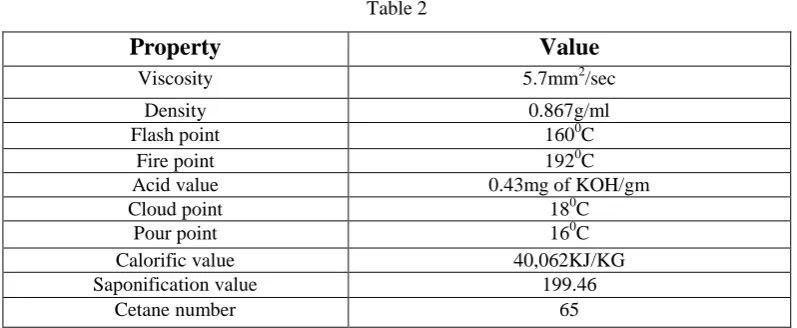
PROPERTIES OF THE PALM OIL BIODIESEL
Table 2
Property
Value
Viscosity 5.7mm2/sec Density 0.867g/ml Flash point 1600C
Fire point 1920C Acid value 0.43mg of KOH/gm Cloud point 180C
Pour point 160C Calorific value 40,062KJ/KG Saponification value 199.46
Cetane number 65
III. EXPERIMENTAL APPARATUS AND PROCEDURE
The analysis is done on the Computerized Variable Compression ratio multi fuel direct injection water cooled
engine. The experiment is done at constant compression ratio (16.5) of the engine. Initially we have done the base line tests, which are with diesel at three fuel injection pressures 190, 210 and 230bar, and then experiment is repeated with different ratios of palm oil biodiesel blends (20%PBD, 40%PBD, 80%PBD, and 100% PBD). For each blend the experiment is repeated for different fuel injection pressures i.e.at 190bar, 210bar, 230bar. After that we compare the values of performance and emissions obtained from each blend with the base line test values at the particular fuel injection pressure.
Engine specifications
Engine: 4 stroke computerized variable compression ratio multi fuel direct injection water cooled engine Make: TECH-ED
Basic engine: Kirloskar Rated power: 5 HP (DIESEL) Rated power: Up to 3 HP (PETROL) Bore diameter: 80mm
Stroke length: 110mm
Connecting rod length: 234mm Swept volume: 551cc
Compression ratio: 5:1 to 20:1 Rated speed: 1500 rpm
Vol. 4, Issue 4, April 2015
FIGURE3.1(1)WATER INLET TO THE CALORIMETER AND ENGINE (T10C),(2)WATER OUTLET FROM THE ENGINE
JACKET(T20C),(3)WATER OUTLET FROM CALORIMETER(T30C),(4)EXHAUST GAS INLET TO CALORIMETER(T40C)'(5)EXHAUST GAS
OUTLET FROM THE CALORIMETER(T50C),(6)ATMOSPHERIC AIR TEMPERATURE(T60C),(7)FUEL FLOW,(8)PRESSURE TRANSDUCER.
EGA: EXHAUST GAS ANALYER,SM : SMOKE METER,PC: PERSONAL COMPUTER
IV. RESULTS AND DISCUSSION
The analysis is done using palm oil biodiesel blends at different proportions and at different
fuel injection pressures, the results obtained is compared with the base line test values (diesel).
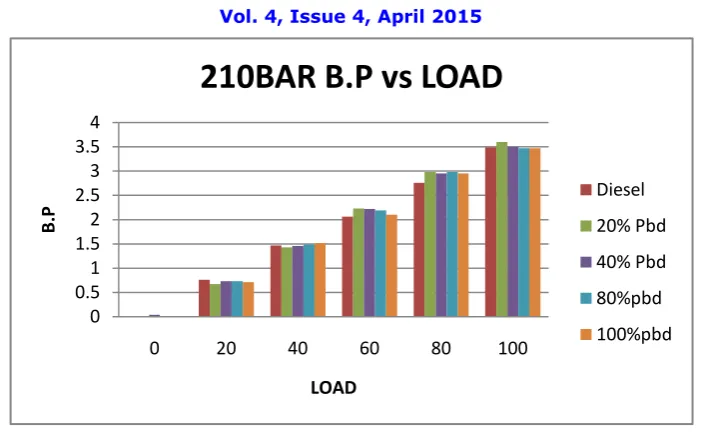
Comparison of Break Power
The break power of all blends is compared with diesel at three fuel injection pressures separately
At 210bar fuel injection pressure:
Vol. 4, Issue 4, April 2015
Figure 4.1.1 B.P vs LOAD
At 230bar fuel injection pressure:
The figure 4.1.2 shows break power produced by various blends at various loads at a pressure of 230bar. Here also the brake power produced is almost same in all cases, but the 100%PBD gives the best results than diesel at higher loads.
Figure 4.1.2 B.P vs. LOAD
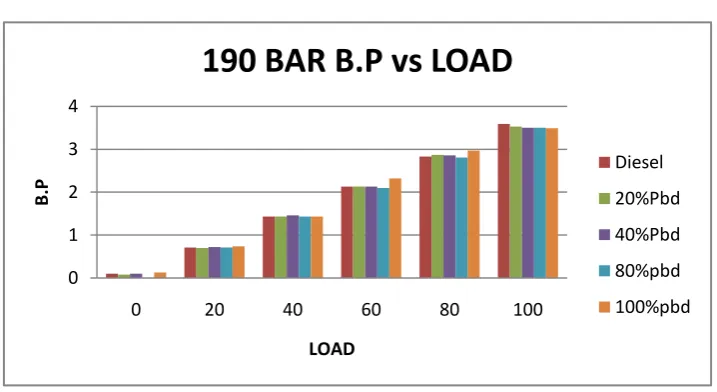
At 190bar fuel injection pressure:
Figure 4.1.3 shows the shows break power produced by various blends at various loads at pressure of 190bar. From the figure we can say that at 190bar diesel shows the best results compared to all blends at higher loads. Coming to blends here 20% blend shows the best results at higher loads.
0 1 2 3 4
0 20 40 60 80 100
B
.P
LOAD
230 BAR B.P VS LOAD
Diesel
20%Pbd
40%Pbd
80%pbd
100%pbd 0
0.5 1 1.5 2 2.5 3 3.5 4
0 20 40 60 80 100
B
.P
LOAD
210BAR B.P vs LOAD
Diesel
20% Pbd
40% Pbd
80%pbd
Vol. 4, Issue 4, April 2015
Figure4.1.3 B.P vs. LOAD
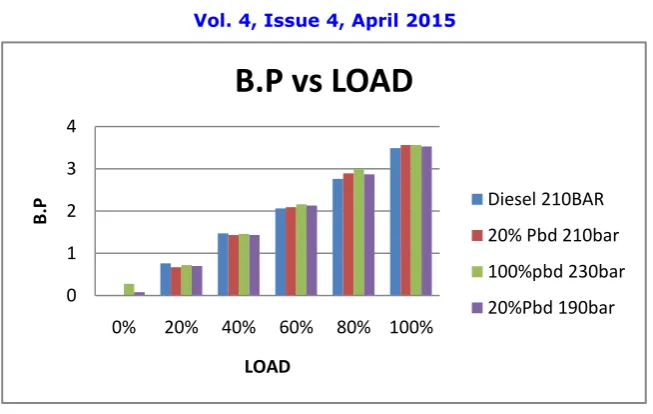
From above analysis we can finally say the 20%PBD is best at 210 bar and 190bar fuel injection pressures and 100%PBD is best at 230bar fuel injection pressures in terms of performance.
Emissions analysis:
The emission analysis is mainly concentrated on the percentages of Co and Nox,
because those are the dangerous gases.The emission analysis was done as follows.
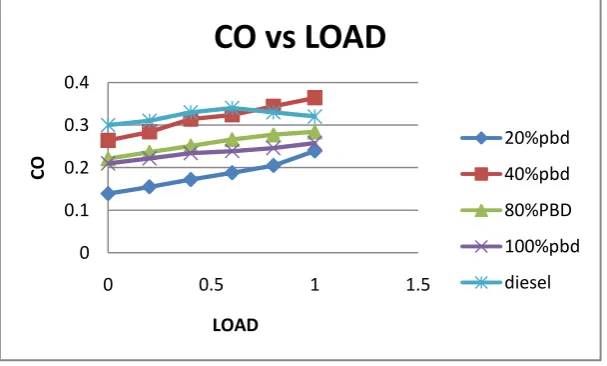
At 210bar fuel injection pressure:
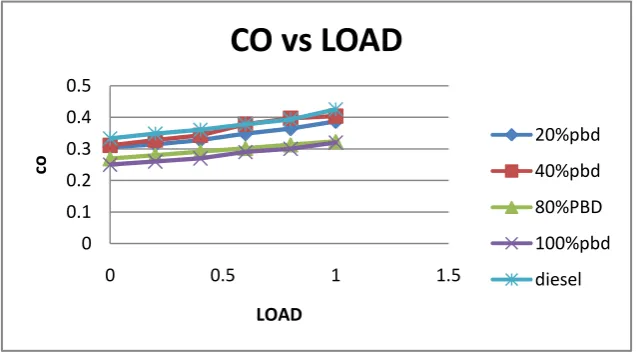
The figures below shows the emissions (CO and NOx) coming from the engine exhaust with various blends at various loads and at a fuel injection pressure of 210 bar. From the figures 4.2.1.a and 4.2.1.b we can say that CO emissions are low for 20%PBD when compared with other blends and diesel.
Figure 4.2.1.a
0 0.1 0.2 0.3 0.4
0 0.5 1 1.5
CO
LOAD
CO vs LOAD
20%pbd
40%pbd
80%PBD
100%pbd
diesel 0
1 2 3 4
0 20 40 60 80 100
B
.P
LOAD
190 BAR B.P vs LOAD
Diesel
20%Pbd
40%Pbd
80%pbd
Vol. 4, Issue 4, April 2015
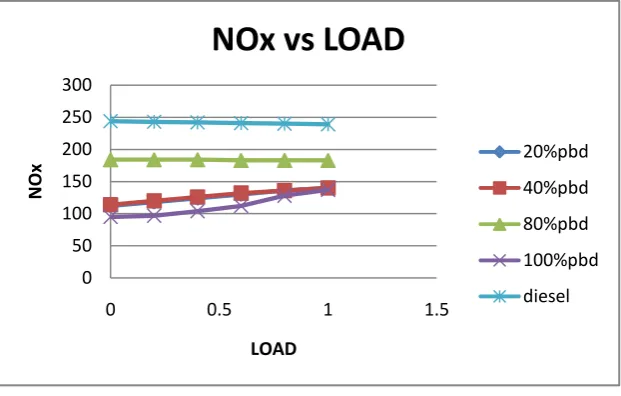
Coming to NOx emissions 100%PBD, 80%PBD, 20%PBD are emitting less NOx compared to diesel. Finally (by
taking the average) 20%PBD at 210bar Fuel injection pressure gives the best results in terms of emissions (CO and Nox)
.
Figure 4.2.1.b
At 230bar fuel injection pressure:
The figures below shows the emissions (CO and NOx) coming from the engine exhaust with various blends at various loads and at a fuel injection pressure of 230bar. From the figure4.2.2.a and 4.2.2.b, 100%PBD, 20%, 40% gives lower CO emissions than diesel.
Figure 4.2.2.a
0 0.1 0.2 0.3 0.4
0 0.5 1 1.5
CO
LOAD
CO vs LOAD
20%pbd
40%pbd
80%PBD
100%pbd
diesel 0
50 100 150 200 250 300 350
0 0.5 1 1.5
NO
X
LOAD
NO
X vs
LOAD
20%pbd
40%pbd
80%pbd
100%pbd
Vol. 4, Issue 4, April 2015
Coming to NOx emissions 100%, 20% PBD gives lower emissions compared to diesel and other blends. Finally we can say that 100%PBD gives best results at 230bar fuel injection pressure in terms of emissions.
Figure 4.2.2.b
At 190bar fuel injection pressure:
The figures below shows the emissions (CO) coming from the engine exhaust with
various blends at various loads and at a fuel injection pressure of 190bar. From the figure4.2.3.a, at 190bar fuel injection pressure all the blends gives best results in terms of emissions (CO).
Figure 4.2.3.a
Figure 4.2.3.b, at 190bar fuel injection pressure all the blends gives best results in terms of emissions ( NOx). Finally we found 20%,100% PBD gives lower emissions compared to diesel and others blends.
0 0.1 0.2 0.3 0.4 0.5
0 0.5 1 1.5
co
LOAD
CO vs LOAD
20%pbd
40%pbd
80%PBD
100%pbd
diesel 0
50 100 150 200 250 300
0 0.5 1 1.5
N
Ox
LOAD
NOx vs LOAD
20%pbd
40%pbd
80%PBD
100%pbd
Vol. 4, Issue 4, April 2015
But taking the performance (B.P) into consideration 20% blend gives best results.
Figure 4.2.3.b
From the overall comparisons above, we found three best results both in terms of performance and emissions (by taking the average of both performance and emissions). Those are
20% PBD at 210bar, 190bar fuel injection pressures &
100%PBD at 230bar fuel injection pressure.
Now in order to find the one best result we again compare these three with the results of diesel at 210bar (standard result).
Best results comparison: Brake power comparison:
The figure below shows the brake power produced with various blends at various loads(brake power produced in best results).From the figure 4.3.1, we can say that 20%PBD at 210bar fuel injection pressure and 100%PBD at 230bar fuel injection pressure gives the best results in terms of performance.
0 50 100 150 200 250 300
0 0.5 1 1.5
N
Ox
LOAD
NOx vs LOAD
20%pbd
40%pbd
80%pbd
100%pbd
Vol. 4, Issue 4, April 2015
Figure 4.3.1
Emission comparison:
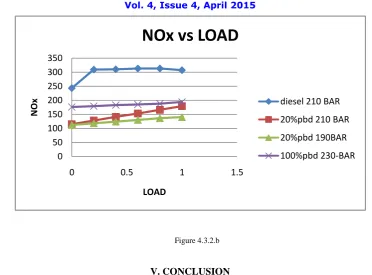
The figures below shows the comparison of emissions (CO and NOx) coming from the engine exhaust at best results. From the figures 4.3.2.a and 4.23.2.b, 20%PBD at 210bar and 100%PBD at 230bar gives lower emissions compared to other.
From Figure 4.23.2.b, we can say that NOx at 210bar and 100%PBD at 230bar gives lower emissions compared to other. 20% pbd at 210 bar NOx has lesser emission when compared to 100%pbd at 230 bar
Figure 4.3.2.a
0 0.1 0.2 0.3 0.4 0.5
0 0.5 1 1.5
CO
LOAD
CO vs LOAD
diesel 210 BAR
20%pbd 210 BAR
20%pbd 190BAR
100%pbd 230-BAR 0
1 2 3 4
0% 20% 40% 60% 80% 100%
B
.P
LOAD
B.P vs LOAD
Diesel 210BAR
20% Pbd 210bar
100%pbd 230bar
Vol. 4, Issue 4, April 2015
-
V. CONCLUSION
Without engine modifications (i.e. at 210bar standard engine pressure) 20%PBD gives the best results both in performance and emissions
With engine modifications (i.e. by changing the fuel injector pressure to 230bar) 100% PBD shows the best results both in performance and emissions.Words used:
PBD –palm oil biodiesel
Acknowledgement:
We were thankful to AICTE, as this research work was carried out by the experimental setup (Computerize VCR Engine, Exhaust Gas Analyser & Smoke meter) funded by AICTE under RPS (Research Promotion Scheme) sanctioned to Dr.M.Muralidhara Rao, Swarnandhra College of Engineering and Technology, Narasapur.
REFERANCES
1. Jawad Nagi, Syed Khaleel Ahmed, Farrukh Nagi (2008). “Palm Biodiesel an Alternative Green Renewable Energy for the Energy Demands of the Future” ICCBT 2008 - F - (07) – pp79-94, 2008.
2. Can Hasimoglu, Murat Ciniviz, Ibrahim Ozsert, Yakup Icingur, Adnan Parlak, and M.Sahir Salman. “Performance characteristics of a low heat rejection diesel engine operating with Biodiesel. Renewable energy” 33(2008) 1709-1719, 2008.
3. M.Anandan, G.Lakshmi Narayana Rao, S. Sampath. “Emission characteristics of a direct injection diesel engine fuelled with plam oil methyl ester and its blends” International conference on IC engines ,Dec 6-9, PP :187-191,2007.
4. A.E.Pillay, S.C.Fok, M.Elkadi, S.Stephen, J.Manuel, M.Z.Khan, S.Unnithan. “Engine emissions and performance with alternative Biodiesels”. Vol: 5, No.:4, ISSN 1913-9063 2012.
5. T. Hari Prasad, M.Muralidhara Rao. “Combustion, performance analysis of diesel engine fuelled with methyl ester of fish oil”, Vol. 2, No.1, and ISSN: 1793-8236, February, 2010.
6. R.Sam Sukumar, M.Muralidhara Rao. “Performance of an Automobile by using HHO generator. International conference on engineering and technology and management” 18-20-july,2013 Colombo, srilanka
7. Jawad Nagi, Syed Khaleel Ahmed, Farrukh Nagi (2008). “Palm Biodiesel an Alternative Green Renewable Energy for the Energy Demands of the Future” ICCBT 2008 - F - (07) – pp79-94,2008.
Figure 4.3.2.b
0 50 100 150 200 250 300 350
0 0.5 1 1.5
N
Ox
LOAD
NOx vs LOAD
diesel 210 BAR
20%pbd 210 BAR
20%pbd 190BAR
Vol. 4, Issue 4, April 2015
8. K.Venkateswarlu, B.S.R Murthy. “Effect of engine modifications on performance and emission characteristics of Diesel engines with alternative fuels”. Vol.2, Issue 2(2010)69-78,2008.
9. M.Ravi1, Dr.A.Aruna kumari2, Dr.K.Vijaya Kumar Reddy. Performance analysis of stationary CI Diesel engine with assorted fuel injection pressures.Vol. 2, Issue 11,ISSN: 2319-8753 , , November 2013.
10. Sukumar Puhan, R. Jegan, K. Balasubbramanian, G. Nagarajan. Effect of injection pressure on performance, emission and combustion characteristics of high linolenic linseed oil methyl ester in a Diesel engine. Renewable Energy vol.3,Issue 6, Nov-Dec2013.