TWO-WAY SELECTION FOR BODY SIZE IN RATS, WITH OBSERVATIONS ON SIMULTANEOUS CHANGES IN
COAT COLOR PATTERN AND HOOD SIZE'
LOIS M. ZUCKER
Laboratory of Comparative Pathology,* Stow, Massachusetts
Received September 30, 1959
I N the course of a two-way selection experiment for body size in rats, we ob- served a number of differences, other than size, between the resulting lines
(T. F. ZUCKER 1953,1957). The question arose as to whether the observed correla- tions with body size were chance or obligate. To answer this question we are car- rying on a second size selection experiment quite independent of the first. Results for the various characters possibly correlated with size and observed in both ex- periments will be reported elsewhere. Here we wish to describe the second size selection experiment now in its tenth generation of selection and will consider the effects of body size selection and restricted population size upon some char- acters not observed in the first experiment-coat color and pattern as determined at three major loci and the many loci affecting size of hood.
TABLE 1
Constitution of foundation stock*
(cc
hh
aa)
q a =
.75
1
3
c
(C
H
c
H h Aa)
(cch hAA)
S i x or seven rats of each stock were used, about half of each sex, not sibs or half-sibs.
1 This investigation was supported by research grants C-2471 and C-4241 from the National 2 Formerly Department of Pathology, Columbia University, New York, N.Y.
468 L. M. ZUCKER
MATERIAL A N D METHODS
Foundation stock
The 4St stock was set up (see Table 1) from four established rat stocks each of which has been maintained for many years as a closed colony with avoidance of close inbreeding. LE (Long-Evans) was obtained from the branch colony estab- lished in the 1920's in the Anatomy Department of Columbia University by DR.
P. E. SMITH. The Long-Evans stock originated somewhat earlier in California, from a crossing of laboratory albino females with local wild males. M (Merck) was developed at the Merck Institute for Therapeutic Research, Rahway, N. J.,
also from a cross between laboratory albino females (Sherman stock) and local wild males. M is a true-breeding black self extracted from this cross some years ago. Branches of this black stock are located at the National Institutes of Health (there called NIH black) and at Columbia University (formerly colony of DR.
MAURICE SHILS. Public Health Institute, now of DR. W. B. STEWART, Department of Pathology). FR (Food Research) is originally of Wistar origin (Wistar non- inbred albino colony brought to the Institute by DR. H. H. DONALDSON) and obtained from the branch colony of the Food Research Laboratories, Long Island City, N. Y., DR. B. L. OSER. 13C is of originally Sherman stock (colony of DR.
H. C. SHERMAN, Department of Chemistry, Columbia University), which was in turn a branch of the Osborne-Mendel stock of the Connecticut Agricultural Experiment Station. This was originally a rather small rat. At Connecticut it has been bred up to a very large size, and in our hands it was selectively bred both up and down for body size. 13C was a moderately large line, but not the largest obtained from this first size selection experiment. After ten generations of selec- tion, selection was relaxed' for another eight generations. Of the other stocks em- ployed, FR is definitely small, M and LE are middle-sized as rat stocks go.
The foundation stock 4St was heterozygous at three loci affecting coat color or pattern-albinism (c,C), hood-self ( h , H ) and agouti ( a , A )
.
C(nona1bino) and A (agouti) are fully dominant; H (self) is not. The initial allelic frequencies for these three genes, shown in Table 1, were calculated from the constitutions of the parent stocks which were either apparent from their phenotypes or established by the results of the crosses. Thus FR is phenotypically albino (cc).
LE is heterq- zygous at the three loci in question, but we chose to use only phenotypically black (i.e., nonagouti) hooded individuals, which are hhaa, with one C and the other allele at this locus either C or c. The offspring of the FR x LE cross were, by litters, either all phenotypically black hoods, or about half black hoods, half albinos. This confirms the hhaa constitution for the FR rats, which we had expected since it is the known constitution of the Wistar noninbred albino colon$ It also fixes the condition at the albino locus for each LE rat used.SELECTION FOR BODY SIZE 469
hooded locus (MUDGE 1908; CASTLE 1940, Figures 62 and 74 for Irish, Table 40 for h'; see also CASTLE 1951). The 13C is, therefore, indicated to be A A and
hh.
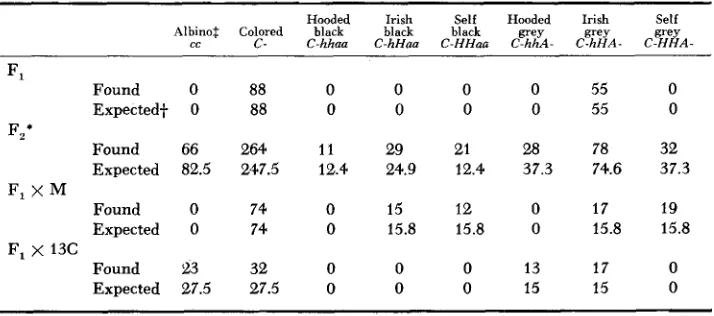
Further results of this cross are summarized in Table 2 covering F, and back- crosses. No other known coat color variants have appeared in the two lines selected for large and small body size, called 4StL and 4StS, nor in the 13M stock resulting from the 13C X M cross, which has been carried on for nine generations. The original M stock occasionally shows a white spot in the groin indicating some spotting factor, but none of the individuals used showed this, and it has not turned up since.
Breeding plan
The F, generation of 4St was subjected to some size selection but not according to the same formal scheme as all the later generations. The F, (parents 13M and
FB)
comprised 14 litters, and one of each sex was chosen from each litter at random. They were later mated according to size, and the six largest pairs were called 4StL; the six smallest were called 4StS. This was then a mass selection procedure of low selectivity (nearly 50 percent retained). Beginning with the second 4St generation, selection was handled according to the scheme used byFALCONER (1953a) in his mouse selection studies with selection purely within litters. In each generation there are six litters, each of four females and four males, totalling 48 rats. The best (i.e., largest or smallest as the case may be) male and best female of each litter are the breeders for the next generation, so that 25 percent of the population is selected, and there are six breeding pairs per genera- tion. The most distantly related animals are mated, and if the female of litter A
is mated with the male of litter B, the reverse pairing is avoided. We have TABLE 2
Cross between 13C (albino) and M (black self)
Hooded Irish Self Hooded Irish Self Albinot: Colored black black black grey grey grey
cc C- C-hhaa C-hHaa C-HHUG C-hhA- C h H A - C-HHA
F l
F,'
F, X M
Found Expected+ Found Expected Found Expected Found Expected F, x 13C
0 0 66 82.5 0 0 23 27.5 88 88 264 247.5 74 74 32 27.5
0 0 0 0 55 0
0 0 0 0 55 0
11 29 21 28 78 32
12.4 24.9 12.4 37.3 74.6 37.3
0 15 12 0 17 19
0 15.8 15.8 0 15.8 15.8
0 0 0 13 17 0
0 0 0 15 15 0
* The deficit of albinos in F2 and Fl X 13C is possibly real (exceeds 5 percent level of significance).
+
Expectations are based on the assumptions that the albino stock 13C is cchhAA, the black self stock M is CCHHaa,$ The albino count was made at birth; classification of colored rats was made at weaning and thus involves a smaller and there is no linkage.
470 L. M. Z U C K E R
generally mated the two best females of each litter to the best male of the chosen litter for mating for ten days, and then after a two-day interval mated them to the second best male, so that if the chosen best is sterile or slow breeding, the second best can be used without loss of time. Until recently the litter size was large enough (10 to 20) to allow the scheme to be carried through on the basis of one litter per pair, litters being reduced to eight shortly after birth in random fashion. In this way we have gotten nearly three generations per year, with both strains coming to breeding age at the same time. Recently, however, litter size in the small line has fallen below eight so that second litters are needed, causing some delay. The unselected 4St stock was not carried along to serve as control, and this is a flaw in the experiment. We do, however, have observations in the 13M strain that is not under size selection pressure and carried on with a com- parable effective population size.
R E S U L T S
Body size selection
Animals were weighed at weekly or semiweekly intervals throughout their lives, and the resulting growth data will be discussed elsewhere. For present purposes of describing the progress of size selection we will use simply the weight at nine weeks, which was the principal determinant in selection. There is a large sex difference in rat growth; unlike the case with mice, the male grows relatiuely
(as well as absolutely) much faster than the female, so that the ratio of male to female weight increases rapidly with age. This presents a problem in combining male and female size data. We have had a considerable degree of success in fitting
indiuidual as well as average postweaning growth curves with the equations
log W = log Ww-3.65/age (weeks) for males
log W = log Ww-2.73/age (weeks) for females
with W m (weight at l/age = 0, or age = a ) , being the sole adjustable quantity for any individual curve (L. M. ZUCKER 1942, 1953). The equations illustrate the fact that weight ratios within the same sex remain constant with age, while the ratio of male to female weight increases continuously with age, being made up of the limiting weight ratio and an exponential factor containing the age and the difference between the characteristic male and female slopes (3.65-2.73). In groups of rats of very different average sizes, we find a constant ratio of male to female weight at nine weeks, with the value very close to 1.45. We will then assume that any observed female weight at nine weeks of age, when multiplied by 1.45, supplies the weight which the rat would have shown had it been a male. Female weights, so corrected, are averaged with male weights to give the average nine-week weight f o r any group.
SELECTION FOR BODY SIZE 471
A
Lorgo s W k . w S n o l l 9 Wh. W
2 . o i
F 6 I i
Gon. of 5 IO Soloellon
0 0
.50
)p
Smolt' 5 4 '55 ' 5 8 '57 ' 5 0 '5s
C o l a n d o r Time ( D o t o of B l r t h )
b
"7-
1.0 Id 2 0
Cumulotad Selection Diff wont io1 (Rolio)
FIGURE 1.- Progress of body size selection. A. Ratio of nine-week weights of large and small strains against generation of selection. B. Separate plots of nine-week weights for large and small lines, and control line not selected for body size. Abscissa is calendar time. The first points for both 4St and 13M may possibly be high due to heterosis. The weight scale used is logarithmic. We have used ratios, or logs, or CVs throughout rather than differences or absolute weights or variance of absolute weights. The standard deviation tends to be proportional to mean weight, to be more constant on log W scale (cf. similar spreads of weight histograms in Figure 2B where successive class means are i n geometric progression.) The ratio, not difference, of weights of two well- nourished and healthy individuals or groups of the same sex but different size remain constant during postweaning life. At any age the ratio, not difference, of male and female weights is con- stant. Consideration of ratios rather than absolute differences make much more hiological sense. C. Cumulated selection differential (calculated as weight ratio, not difference) against cumu- lated response (as weight ratio). This corrects the plot of section B for effects of more favorable selection differential in one line than i n the other (as suggested by FALCONER 1953b). The slopes Ere realized heritability, and were calculated from the regression of response on selection differ- ential.
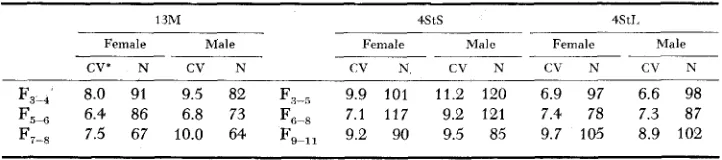
C shows the same data in the form suggested by FALCONER (1953b)-cumulated response against cumulated selection differential. Sections B and C show marked irregularities not found in A, which must be due to environmental variation af- fecting both strains alike. The most prominent effect is that of going through the most rapid growth period during the hot summer weather (New York City, no air cooling). The summer of 1957 was relatively cool and free of long hot spells, and the graph shows it. Under these conditions it is not surprising that the co- efficient of variation of the nine-week weight is highly variable and rather unin- terpretable (see Table 3 ) .
4 52 L. M. ZUCKER TABLE 3
Coeflicient of variation {or nine-week body weight in control line and selected lines
13M 4StS 4StI.
Female Male Female Male Female Male
CV' N CV N CV N CV N CV N CV N
F3-4 8.0 91 9.5 82 F3-5 9.9 101 11.2 120 6.9 97 6.6 98 F,-, 6.4 86 6.8 73 F,-8 7.1 117 9.2 121 7.4 78 7.3 87
F7-* 7.5 67 10.0 64 F+,, 9.2 90 9.5 85 9.7 105 8.9 102
~ - ~~ ~
' CV's as calculated for each generation are extremely variable We have included a l l available rats, some of them not in the main line of selectlon (1 e litters of which one parent was second choice) in order to get as large numbeis as possible For further smoothing, wk have averaged CV's for two or three successivd generations coniprismg In each rase approx<mately one calendar year All data on one line are approximately coritemporarj
(nine-week weight about 230) than 4St, selection up was very much more SUC-
cessful than selection down (unpublished data). Two important factors contribut- ing to asymmetry in two-way selection are dominance and the position of the initial phenotype in relation to the possible extreme phenotypic values (FALCONER
1953b). Dominance always favors selection towards the recessive. The effect of the initial phenotypic position is to favor selection towards the further phenotypic extreme and inhibit selection towards the nearer extreme. This effect, unlike dominance, can therefore cause reversal in relative rates of up and down selec- tion as the initial phenotypic value in different selection experiments varies. Since, in mice and rats subjected to size selection, symmetry and opposite asym- metries have all been observed, it seems likely that the position of the initial phenotype in relation to the extremes has been an important variable, whatever the dominance situation may be.
S'ize of hood
CASTLE
and co-workers (see reviews in CASTLE 1940, 195 1 ) have shown that the size of the hood in hh rats responds readily to two-way selection, leading to two lines with very large and very small hoods, with ranges outside the range of the original stock. The genetic variability was not completely exhausted even by20 generations of intensive selection. It was first concluded that "the genetic modification secured by selection did not involve the hooded gene itself but only the residual heredity (consisting probably of an association of genes which modi- fied the somatic effect of the hooded gene itself)
."
There was later some evidence that eventually the selection also profited from a change at the hooded locus it- self, with the appearance of a new allele hr (true Irish) in the plus line, and pos- sibly of the new allele h" (notch) in the minus line.SELECTION FOR BODY SIZE 473
by mutation during the course of selection. At any rate the two characters, body size and hood size, are alike in their continued response for many generations to two-way selection and in the conceptual structure which can be built u p around the observed facts. It is of interest to see whether selection for the one character has any influence on the other.
Observations have been of two kinds. (1) Hood size was classified in four degrees for the first five and for the tenth generations. There has been no change of the average in either line. (2) I n the tenth generation (ninth of body size se- lection), careful measurements were made of hood size in the two lines. As
described by
WRIGHT
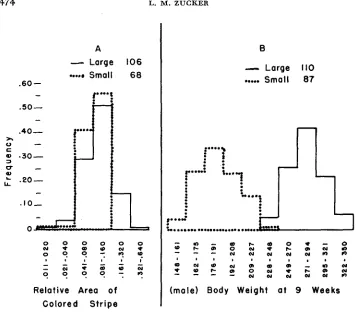
and CHASE (1936), a drawing was made within a rubber stamp outline, one for the dorsal and one for the ventral aspect. This was done by one person, and when the rats were four- to six- weeks old. Areas were measured by a planimeter. Two different areas were measured-the area of the colored stripe down the back starting at the edge of the band of solid color covering head and shoulders, and the total area of color over the whole body. The second meas- ure includes a large nearly constant colored area, and the total is principally modified by variation in the first measurement-the stripe itself-although there is also some variation in the amount of white on the forelegs and in occa-sional small colored spots which show on the belly. Results with the two areas were very similar in sense. Figure 2 shows the distribution of measurements of the stripe area, compared with the distribution of nine-week body weights for the two lines. It is clear that selection for body size is having little if any effect on hood size; the only effect is the greater dispersion of hood size in the large line, with two new classes added to the histogram. At the present stage of selection there is no real difference between the two lines in respect to hood size.
One view of quantitative characters is that they are determined by a network of gene loci, very large in number and probably spread over all or many
chromo-
474 L. M. ZUCKER
.60-
-
. 5 0 -
.40- h 0
c
3 U
-
W
LL
0 ) -30-
.20-
-
.IO,
0 0
N *
0 9
9 9
I ,
-
-- ( U
A
-
Large....
Small106
6 8
Relative Area o f
Colored S t r i p e
B
-
Large 110...
Small 87(male) B o d y Weight a t 9 Weeks
FIGURE 2.-Effect of nine generations of two-way selection for body size on size of colored hood. Our six classes of stripe area can be compared to the scale used by CASTLE and PHILIPS (see CASTLE 1941)) as follows:
Our class 1 2 3 4 5 6
CASTLE and PHILIPS -0.5,O 0.5 1 1.5 2 2.5,3,3.5
Three maior coat color genes
SELECTION FOR BODY SIZE 475
Calculation of allelic frequencies: Initial values of all three allelic frequencies qc, qh, and q. are known from the constitutions of the four stocks crossed. Subse- quently, exact q’s can be calculated only if the heterozygote is distinguishable from both homozygotes, and this is true only for the hooded locus. Table 4 shows successive values in the two lines for qh calculated as the frequency of hooded rats plus half the frequency of pseudo-Irish. Table 4 also includes approximate values for qh, from the square root of the frequency of hooded individuals. This approxi- mate calculation assumes Hardy Weinberg equilibrium-i.e., random breeding. It is apparent that this is a very good approximation, although there is a slight tendency for the approximate calculation to be too low; we shall come back to this small discrepancy later. The close approach to Hardy Weinberg equilibrium in the population for one locus means that it should hold for the other two loci; this gives us a method for calculating qc and q..
Gemtic drift and g e m fixation: Figure 3 shows the course of the three allelic frequencies during size selection. A character associated with body size would be
TABLE 4
Frequency of hooded allele h
F no. 2 3 4 5 6 7 8 9 1 0 1 1 1 2
Selectionno. 1 2 3 4 5 6 7 8 9 10 1 1
4StS
.78 .74 .72 .53 .59 .64 .69 .75 .76 .72 .78 exact
.74 .71 .73 .50 .56 .59 .66 .71 .79 .71 .78 approx.
.76 .80 .79 .81 .83 .93
.a
.95 1.00 1.00 1.00 exact.77 .77 .78 .78 .85 .93 .91 .94 1.00 1.00 1.00 approx. 4stL
-
Exact calculation: 9 = / h h l +% [hHI,
Approximate calculation, assuming Hardy Weinberg equilibrium: 9 = d / h h I .
Albino ( c ) Hooded (h) Non-opouti ( 0 )
0 Lorge Line
-8%
-
\fie
?\
o Small Line--+--+ctttt-+ccctt)
$> , : x0-
5 I O 5 IO 5 I O
G e n r r a t l o n 8
476 L. M. ZUCKER
expected to move in opposite directions in the two lines, and it appears that there are no continuing opposite trends. The possibilities for large cumulative geno- typic changes due to chance-genetic drift-are considerable in small popula- tions (CROW 1954; LI 1955, p. 316 et seg.). In the present case we are drawing a sample of 12 out of the possible infinite offspring population, and each individual is very poorly able to represent the average q of that infinite population, since
q ' s for individuals can be only 0, 0.5 or 1. Therefore, a group of 12 is quite un- likely to give the same q as the previous group of 12. If the sampling error chances to go in the same direction for several generations there is drift, and long continued drift can lead to gene fixation. In the size selection experiment one of the six genes is probably fixed ( h in 4StL, in doubt because of the possi- bility of albinos carrying H ) , and others are very close to being fixed. But if h were fixed in 4StL because of obligate association with size, one would certainly expect rather different behavior in 4StS than that shown.
As will be seen below (Table 5 ) , the probability due to genetic drift of fixation
TABLE 5
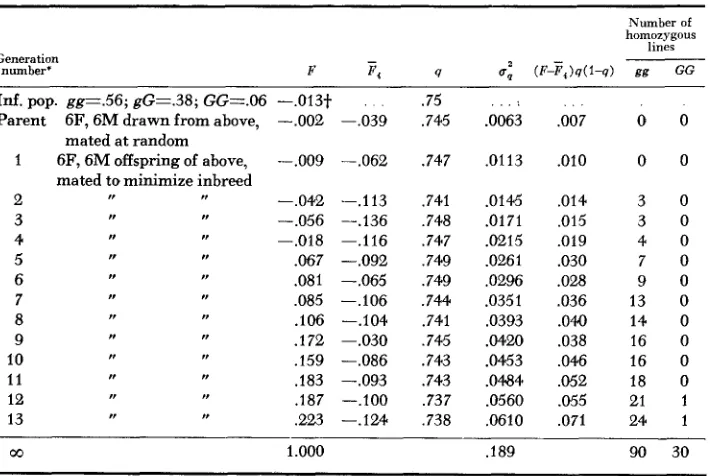
Results of model breeding experiment replicated 120 times
Generation number*
Id. pop. gg1.56; gG=.38; GGz.06 -.013t .75
Parent 6F, 6M drawn from above, -.002 -.039 .745 .0063
1 6F, 6M offspring of above, -.009 -.062 .747 .0113 mated at random
mated to minimize inbreed
2 -.042 --.I13 ,741 .0145
3 -.056 -.I36 ,748 .0171
4 --.018 -.116 .747 .0215
5 .067 -.092 ,749 .0261
6 .081 --.065 .749 .0296
7 ,085 -.lo6 .744 .0351
8 .lo6 -.I04 .741 .0393
9 .172 -.030 ,745 .0420
10 .159 -.086 .743 .0453
11 .I83 --.093 .743 .OM4
12 .187 -.lo0 ,737 .0560
13 ,223 -.124 ,738 .0610
r,
R
,, rr
r, ,, , ,I ,, ,P
00 1.000 .189
,007 0 0
.010 0 0
,014 3 0
,015 3 0
.019 4 0
.030 7 0
.028 9 0
.036 13 0
.040 14 0
.038 16 0
,046 16 0
,052 18 0
. a 5 21 1
,071 24 1
90 30
* Generation number comparable to the number of generations of selection for 4St, and one less than the F number for 4St.
t Not zero, as it should be for a n infinite population; the frequencies of the three genotypes were rounded off to two digits for convenience.
SELECTION FOR BODY SIZE 477
of one gene by the 11th generation of this breeding scheme and an initial q of 0.75, is 0.154, so that in sets of four trials (corresponding to our four rat cases with initial q of 0.75), the expectation would be
none fixed 1 fixed 2 fixed 3 fixed 4 fixed
0.512 0.373 0.102 0.012 0.000
The rat results-one out of four probably fixed-are in gaod agreement with this expectation.
Expectation for fixation at the albino locus, with initial q = 0.58, would be less because the starting point is farther from either end. The near fixation in one out of two trials as has developed in the 4St breeding experiment is, therefore, not the most probable finding, although quite possible. However, in the data of the 13C x NI cross (Table 2) there is a just significant deficit of albinos, suggest- ing that in one, at least, of the original albino stocks c may be linked to a gene unfavorable for early survival. If this were the case, it would also explain the fact that in the first four generations of selection albinism decreases rapidly in both lines. As the populations approach equilibrium with regard to this linkage, drift can send the albinism back up again, as in the 4StL. Or conceivably, albin- ism might even yet turn out to be associated with large body size, a relation ob- scured by a n opposing linkage phenomenon; opposite trends have indeed been maintained since the fourth generation. It is of course also possible that for the other loci there is some partial association with size which is so far obscured by genetic drift operating to oppose the directed change.
Inbreeding and outbreeding eflects: The fact that in Table
4
the approximate calculation for q h is usually slightly below the exact one is a reflection of the fact that these populations usually deviate from Hardy Weinberg equilibrium by showing a slight deficit of homozygotes and an excess of heterozygotes. The ap- parent inbreeding coefficient calculated for the hooded locus is about - 0.1 (cor- responding to a difference between the two calculations of Table 4 of 0.01, 0.02 or 0.025 for q of 0.1 or 0.9, 0.7 or 0.3, and 0.5 respectively). The inbreeding co- efficient for this breeding plan should be positive, rising by about 0.02 per gen- eration. The reason for this apparent discrepancy is twofold; the first element in the discrepancy is the fact that the expectation of a positive F applies to a sta- tistically large population made up of many subpopulations each carried on by this breeding plan, and not to any subpopulation alone.It has been shown (WAHLUND; see account in LI 1955, p. 297 et seq.) that small subpopulations each carried on with random breeding (subpopulation F i averaging zero) combine into large populations in which the over-all F rises steadily with generation number; the value of F depends on the spread in qi
478 L. M. ZUCKER
rises steadily. There is, therefore, no inconsistency between an expected posi- tive F and observed
Fi
of zero.However, our Fi values average near - 0.1. This deviation from Hardy Wein-
berg equilibrium cannot be explained by any hypothetical linkage to genes under selection. In the selected breeder population one can of course expect deviations from equilibrium with regard to genes under selection, and therefore with regard to any linked genes not yet in linkage equilibrium. But no matter how distorted the parent population, the offspring population must be in Hardy Weinberg equilibrium with regard to each gene, provided the selected rats are mated at random. It is the use of non random mating which produces the observed Hardy Weinberg disequilibrium in the offspring population, and this statement will now be verified in a model experiment involving the same breeding plan, but no selection and no linkage.
Model breeding experiment
The breeding scheme employed in the rat experiment involves two necessary consequences of small population size (CROW 1954) : ( 1 ) the piling up of common ancestors and (2) large random sampling error, or (1) inbreeding and (2) ge- netic drift, together with a third feature, the mating of the most distantly related, which was introduced to minimize inbreeding effects. The coat color data illus- trate the effects of sampling error and of mating the most distantly related, but are incapable of illustrating the effects of the piling up of common ancestors and the interplay of this feature with the others. To illustrate this interplay more completely, and to obtain readily some quantitative expectations for the behavior in our rat subpopulations, we have carried out a model breeding experiment. The model is a single gene locus with the random feature supplied by a table of ran- dom numbers and the breeding plan as in the rat experiment except that there is no selection. This is a proper model for our results on the coat color genes, as- suming there was no (direct or indirect) selection for these. The model experi- ment was repeated 120 times. Then we can see empirically how inbreeding co- efficient, gene equilibrium and genetic drift operate both in subpopulations and in the total population.
Procedure: Let us start with an allelic frequency qs = 0.75 (where g and G
are the two alleles at a locus) and with an equilibrium population. Then the fre- quencies of the three genotypes gg, gG and GG are (in two-digit numbers) 0.56,
0.38 and 0.06. Let us assign the numbers one through 56 to genotype gg, 57
through 94 to gG, 95 through 00 to GG; draw 12 two-digit numbers from a ran- dom number table and write out the corresponding 12 genotypes. This gives US the first I 2 breeders; we will call the first six females, the last six males, and mate one with seven, two with eight etc., to get a random mating. Matings gg
x
gg, GGx
gg and GG x GG have only one kind of offspring. In g Gx
gG, assign the numbers one and two to gg offspring, three through six to gG, seven and eight toSELECTION FOR BODY SIZE 479
matings gg X
g G
or GG X gG, assign numbers one through four to one type of off-
spring, four through eight to the other, and proceed as before. In this way one cam set up the six matings in each generation and draw at random the two offspring from each pair, which constitute the 12 breeders of the next generation, and so on as long as one likes. As in the rat experiment, the most distantly related individ- uals are mated. The allelic frequency for each generation is that of the 12 parents of that generation, the value which would also be found in a large population com- posed of equal numbers of offspring of those 12 parents; it differs by sampling error from the allelic frequency of the actual 12 individuals drawn froml this infinite population.Model breeding eqperiments to illustrate effects of close inbreeding, using a random number table in this way, have been published by BONNIER ('1955). We were not aware of this until after we had done a good deal of work w h h our procedure.
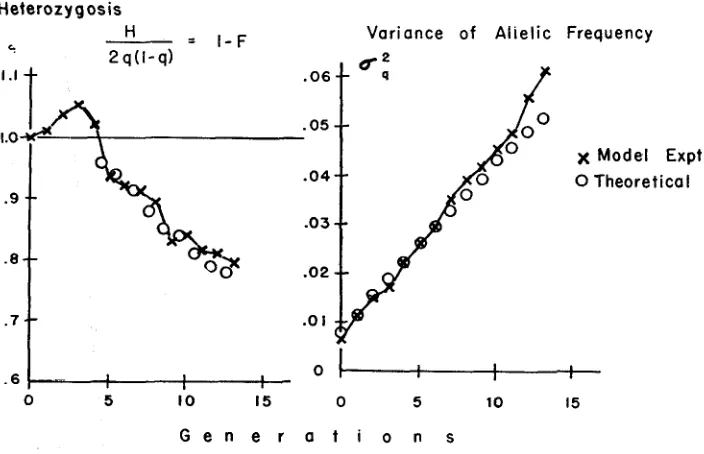
Results: Table 5 summarizes the results in terms of inbreeding coefficierits (for total population and average for the 120 subpopulations), allelic frequency and its variance, and gene fixation. It seemed advisable to check the procedure by comparing the results with theory where possible. Figure 4 compares the k d i n g s with expectation for the variance of allelic frequencies and for populaition in- breeding coefficient, or rather, the inverse function heterozygosis (l-F) . The ex- pected steady increase in variance of q (corresponding to drift in the individual
q ' s ) begins at once because the sampling error is present in each generation. The expected decrease in heterozygosis due to breeding from small population begins only after the fourth generation, when the 16 great great grandparents required for each rat must have been supplied by the 12 individuals of the first set, so that some were used twice. Up to this point there were no common ancestors; there- fore, no loss of heterozygosis on this account; and, in fact, there is in the early generations a n actual rise in heterozygosis (negative F ) due to the avoidance of matings of close relatives. Thus we have for a few generations inbreeding and dispersion of q effects dissociated from each other in sense. CROW (1954) has dis- cussed another case in which these two generally related effects of small popula- tion size can diverge from each other.
As in the rat experiment, the average subpopulation inbreeding coefficient fluctuates around -0.1 (actual average -0.09), which presumably simply reflects the avoidance of mating of close relatives in the preceding generatioins and is not cumulative. Within each subpopulation there is a noncumulating relative excess of heterozygotes in relation to the qi for that subpopulation, while in the total population there is a steadily growing deficit of heterozygotes in relation to the pooled q for the entire population.
480 L. M. ZUCKER
efficient due to common ancestors-has relatively more loci in a homozygous condition than would be expected by chance.
Unexpectedly it was found (cf. Table 5) that
U; E z (F--F,)q(l--q)
This looks like an extension of the equation (WRIGHT, WAHLUND; see LI 1955, p. 298) for subpopulations of small size within which breeding is fully random,
Heterozygosis
Frequency
x
Model Expt0 Theoretical
. 6
0 5 I O 15 0 5 10 15
G e n e r a t i o n s
FIGURE 4.---Comparison of empirical model with theory.
Heterozygosis: theoretical values calculated as the average of the predictions for 16 and for eight breeders, when only the most distantly related are mated (WRIGHT; see LI 1955, p. 209, Table 59). The quantity plotted is H,/2 9( 1-9). Results are not plotted against generation num- ber because the common ancestry which lowers heterozygosis makes a first partial appearance in the fourth generation (four of the I 2 individuals of F, each provide two great great grandparents), and a more complete appearance in the fifth generation et se9. (where all 12 individuals of the
(2-4) th generation appear more than once as an ancestor in each individual’s ancestry) ; therefore, the calculated values are plotted midway between 4th and 5th, then 5th and 6th, etc. The values for the model were calculated as ( 1 - F ) from the data of Table 5 .
Vuriunce of q: Theoretical values were calculated from the equation given by CROW (1954)
SELECTION FOR BODY SIZE 48 1
so that
E
would be zero. This equation is: and is readily derived:U: = Fq ( 1 -q)
,
T:
rgg.1 iFq(1-q) [gg] - q2 = N - q 2
I:
q: 1 For random breeding i n the N subpopulations, [gg] = q f , so Fq ( 1 -q) = --q2and this is the same as variance of qi if we ignore the difference between N and N--1. If one tries to carry out a similar derivation for the extended equation by writing out the values of F and of the Fils in terms of q and the qi’s, this does not reduce to the variance of q without two quite impossible simplifications. The equation must, therefore, rest on some other derivation, possibly involving a relation between inbreeding coefficient of the offspring and the parent q or vari- ance of q. (It should be noted that since F is indeterminate in value for a homozy- gous population, E i s calculated for only those lines not yet fixed, whereas F , q
and variance of q include all lines.) The relation is certainly very closely true in this experiment and applies equally well to a similar model breeding experiment with the same breeding scheme but with two-way selection (L. M. ZUCKER 1960),
where in one line fixation finally reaches 100 percent with the observed relation continuing to apply up to the end.
Gene fixation amounts to 18 out of 120 cases by the eleventh generation (see Table 5 ) . Obviously the immediate basis for this is the genetic drift, not the inbreeding (common ancestors) per se. Fixation has already started by the second generation when the heterozygosis in the general population is greater than one; fixation proceeds steadily during the next three generations at which point, for the first time, inbreeding-loss of heterozygosis makes its appearance.
For each gene there is random drift of the allelic frequency until it gets too close to one or zero. Although eventually, when all genes are fixed, a fourth of the loci will be fixed GG and three fourths gg (because initially qB =
%),
the early fixations are all necessarily gg because the starting point for the drift is SO much closer to one than to zero. Actually drift towards lower q is faster than drift towards one; by the eleventh generation, when 18 have been fixed gg (i.e., have at some time reached q = 1 ) ,27 loci have at some time reached 0.5, an equal distance in the other direction, but of course they are not caught at q = 0.5. The larger number moving to 0.5 than to one is probably a real difference. The possible rate of drift differs with the type of mating; thus gG x gG is the most favorable for drift, since in extreme cases the offspring can differ by 0.5 unit of q from the parents, while matings of heterozygote with homozygote allow a maximal change of only 0.25. Thus the rate of drift should be greatest when q is near 0.5, while asymmetry of gene fixation is greatest when q is near one end.N
Euidence of obligate association between characters
482 L. M. ZUCKER
may be purely a chance one, due to genetic drift. If, however, one is dealing with a truly polygenic character, determined by equivalent contributions from many loci, with a plus contribution from one locus capable of neutralizing a minus contribution from another, such a character should be quite stable under the effects of genetic drift. Hood size is possibly such a character. Obligate association between two such characters should be readily obvious without confusion from drift. (If such a character starts near the extreme end of its range, however, a slow net drift away from the end is likely. This is because drift towards the near end cannot be as numerically large as drift towards the center. This effect is possibly illustrated by the slight downward trend of q in Table 5.) One can also readily envisage a type of character dependent on many loci where a favorable change at one locus cannot counterbalance an unfavorable change at another locus. Fertility is probably a n example. Unfavorable drift at any one locus tends to spoil the character irrespective of favorable changes at other loci. Such characters should be practically as much subject to genetic drift in small populations as are unit characters. It is, therefore, usually necessary to get independent evidence that an apparent satellite character is obligately so, either by a repetition of the selection experiment de nouo, or even better, by selecting for the satellite charac- ter to see whether the other character will then also be concentrated ( SOKAL and
HUNTER 1954; WEIR et al. 1953). We will report elsewhere on several characters associated with body size in two independent size selection experiments.
SUMMARY
A two-way size selection experiment is being carried out on a rat stock heterozy- gous for three major coat color genes and an unknown large number of genes modifying the size of the colored area in hooded rats. After ten generations of within-litter selection there is a nearly 80 percent difference in mean body size, with rate of progress in the two directions about the same. So far there is no evi- dence of correlation between any coat color character and body size.
The three single gene loci are subject to marked genetic drift owing to the small population size (12; effective size 24), with one locus probably fixed and others near to fixation.
SELECTION FOR BODY SIZE 483
LITERATURE CITED
BONNIER, G., 1955
BUTLER, L., 1954
CASTLE, W. E., 1940
Teaching inbreeding. J. Heredity 46: 105-108.
The effect of the coat color dilution gene on body size i n the mouse. Heredity
Mammdlian Genetics. Harvard University Press. Cambridge, Massachusetts. Influence of certain color mutations on body size i n mice, rats, and rabbits. Genetics
Variation in the hooded pattern of rats, and a new allele of hooded. Genetics 36: 254-266. Breeding structure of populations. 11. Effective population number. pp. 543- 556. Statistics and Mathematics in Biology. Edited by 0. KEMPTHORNE. Iowa State College Press. Ames, Iowa.
FALCONER, D. S., 1953a
8: 275-278.
1941
1951
26: 177-191.
CROW, J. F., 1954
Selection for large and small size i n mice. J. Genet. 51 : 470-501. 1953b Asymmetric response i n selection experiments. pp. 16-41. I.U.B.S. Symposium on
Size inheritance and growth i n a mouse species cross. J. Exptl. Zool. 59: Genetics of Population Structure. Pavia, Italy.
21 3-263. GREEN, C. V., 1931
LI, C. C., 1955
MACARTHUR, J. W., 1949
MUDGE, G. P., 1908
SOKAL, R. R., and P. E. HUNTER, 1954
WEIR, J. A., R. H. COOPER, and R. D. CLARK, 1953
WRIGHT, S., and H. B. CHASE, 1936
ZUCKER, L. M., and T. F. ZUCKER, 1942
ZUCKER, L. M., 1953
Population Genetics. University of Chicago Press. Chicago, Illinois.
Selection for small and large body size in the house mouse. Genetics
On some features in the hereditary transmission of the albino character and
Reciprocal selection for correlated quantitative characters
The nature of genetic resistance to infection
On the genetics of the spotted pattern of the guinea pig. Genetics 21 : 758-787.
A simple time weight relation observed in well-nour- ished rats. J. Gen. Physiol. 25: 445-463.
Grow criteria. pp. 3-22. Rat Quality, a Consideration of Heredity, Diet and Disease, a Symposium. The National Vitamin Foundation. New York.
Model breeding experiment for two-way selection in small populations showing direc- tional dominance. Genetics 45 : 4 8 5 4 8 .
Problems i n breeding for quality. pp. 48-70. Rat Quality, a Consideration of
Heredity, Diet and Disease, a Symposium. The National Vitamin Foundation. New York. 34: 194-209.
the black piebald coat in rats. Proc. Roy. Soc. B. 80: 97-118; 388-393.
in Drosophila. Science 119: 649-651.
i n mice. Science 117: 328-330.
1960
ZUCKER, T. F., 1953