EFFECTS OF FLOWER NODE POSITION
ON THE
MUTABLEV
AND STABLER
LOCI IN A CLONE OF NICOTIANASEAWARD A. SAND
Genetics Department, The Connecticut Agricultural Experiment Station, New Haven, Conn.
Received December 19, 1960
ENETIC analysis implying mutable alleles of the gene V to account for flower color variegation in a Nicotiana culture has been presented by SMITH
and SAND (1957). These plants also contain stable genes for flower color and have been found useful for the study of interaction between environmental factors and genetic systems of varying stability (SAND 1957; SAND, SPARROW and
SMITH 1960). The goal has been to elucidate differences and similarities between mutable and stable gene systems.
Data are presented here for both somatic and germinal effects due to flower node position on a mutable allele of the V gene and on the stable R gene in a clone of Nicotiana. Results for flowers from various node positions are not homogeneous, but vary according to a pattern that is related to the sequence of node positions on the main flowering axis. It is inferred that metabolic changes associated with development of the branch, and correlated with growth rate, influence the muta- tion rates of both the stable and the mutable genes. This work has been sum- marized previously ( SAND 1960).
MATERIALS A N D M E T H O D S
Nicotiana clone 95230-5, selected from cultures of interspecific hybrid origin, was employed here as used previously in studies of temperature and chronic gamma irradiation effects on mutation. Flowers of this clone are illustrated and detailed procedures appear in the earlier papers, cited above. Only general methods and limited details will be outlined here.
Replicated cuttings of the clone were grown in sand culture with a standard nutrient solution. Banks of fluorescent lights were operated to provide a 14-hour day, and the room temperature was automatically controlled at 68°F -+ 2".
The clone is heterozygous for the mutable V gene ( v s 3 / u 8 ) and for the stable R gene ( R / r )
,
which affect flower color. The somatic effect on a mutable gene system was compared with a stable gene system in the same tissue by counting speckled sectors (changes from us3 to us phenotype) and purple sectors (changes from R to I phenotype) on flowers from successive nodes of the main floweringaxis of each plant. Similarly, germinal effects on the same gene systems were studied by counting speckled and purple individuals in progeny obtained by self-pollinating flowers at selected node positions.
5 70
SOMATIC
4 0
--
SECTORS
3 2
PER
2 4 - -
FLOWER
S. A. S A N D
--
RESULTS
SECTOR FREQUENCY VERSUS NODE P O S I T I O N NICOTIANA CLONE S 5 2 3 0 - 5
48
c
2 2 2 FLOWERS SCOREDPURPLE S E C T O R S X I 0 0
8
I 8 I I I
I ,
I
1
0 2 4 6 8 I O I 2 14 16
FLOWER NODE P O S I T I O N
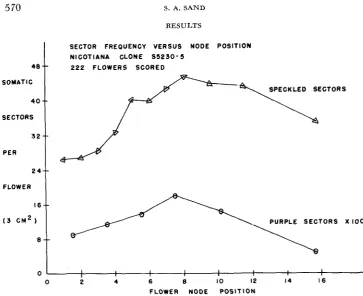
FIGURE 1.-Response curves showing the frequencies of somatic sectors on flowers from succassive node positions. Purple sectors (associated with the stable locus R) are about 300 times less fr?quent, but respond in a pattern similar to that for speckled sectors (associated with the mutable locus V ) .
different flowering branches and cover a total range of node positions from one to 21. Data for all members of the clone were pooled within node position groups. Each point plotted represents an average for 16 or more flowers. The purple sector frequency has been graphed on a scale 100 times larger than that for speckled sectors Actually, purple sectors are nearly 300 times less frequent than speckled sectors, providing a phenolypic basis for designating R as a stable gene and us3 as mutable. The average somatic sectoring rates for both the mutable and stable genes vary with node position in a manner that suggests direct corre- lation with the natural change in rate of growth of the flowering branch. Sector frequencies at mid-branch are about twice as high as f o r proximal and distal nodes.
G E N E SYSTEMS I N N I C O T I A N A
TABLE 1
Analysis of variance of speckled-sector sums for flowers f r o m low,
middle and high node positions
571
Source d.f. Sum of squares Mean square
Among 3 node positions 2 5,774 2,887**
(Low
+
high) us. mid nodes 1 5,572 5,572* *LOW us. high nodes 1 202 202 n.s.
Error (within node positions) 21 9 85,100 389
Total (C.F.M.) 221 90,874
n.s. Not significant at 5 percent level. * * Significant at 1 percent level.
A similar analysis of purple-sector sums fails to show statistically significant differences among the three groups of pooled node positions. The difficulty lies in the extremely low frequency with which purple sectoring OCCUTS. The 222 flowers scored were an adequate sample for speckled sectoring (7,984 total sectors counted), but were an inadequate sample for purple sectoring (27 total sectors counted). Nevertheless, the purple-sector data are not random in distribution, but instead show a pattern of variation with node position similar to that for speckled sectors. The averages for low, middle, and high node groups are respec- tively 0.1 1,0.16, and 0.05 purple sectors per flower.
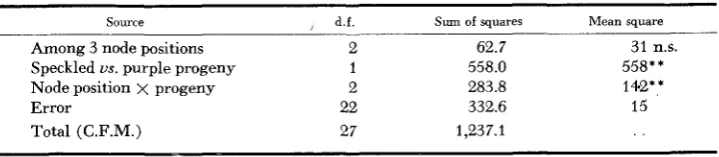
Progeny segregation was tested by growing plants from self-pollinated seed produced at selected node positions on five members of the clone. This seed was pooled within each of 14 node position groups, distributed from six percent to 96 percent of the total nodal range. The 14 corresponding families containing 1192 individuals were scored for their frequencies of speckled and purple progeny. Table 2 summarizes an analysis of variance for these data obtained after grouping the 14 families into three categories representing low, middle and high node positions. It can be seen that the interaction between node position and progeny type is highly significant. Apparently the node position response for speckled progeny is different from the node position response for purple progeny. The pattern of this interaction is shown in Figure 2. For the frequency of speckled
TABLE 2
Analysis of variance of frequency of speckled and purple progeny from low, middle and high node positions
~~~~~~ ~
Source
,
d.f. Sum of squares Mean squareAmong 3 node positions 2 62.7 31 n s .
Node position x progeny 2 283.8 142**
Error 22 332.6 15
Speckled us. purple progeny 1 558.0 558**
Total (C.F.M.) 27 1,237.1 . .
-
5 72
4 2
3 8
3 4
PERCENT
3 0 RECESSIVE
2 6 PROGENY
2 2
14
S. A. S A N D
PROGENY SEGREGATION VERSUS NODE P O S I T I O N
NICOTIANA CLONE S 5 2 3 0 - 5
I I 9 2 INDIVIDUALS SCORED
SPECKLED
PURPLE
LOW MID-BRANCH HIGH
0 2 0 4 0 6 0 8 0 100
AVERAGE N O D E , PERCENT OF BRANCH T O T A L
FIGURE 2.-Response curves showing influence due to node position of self-pollinated flowers of the heterozygous parental clone upon the progeny segregations obtained. The frequencies of recessive progeny (speckled and purple) vary inversely for the mutable locus V and the stable locus R.
progeny an effect due to node position of about ten percent is indicated, with the
minimum observed in families from mid-branch pollinations. However, mid- branch pollinations give the maximum purple progeny frequencies.
DISCUSSION
GENE SYSTEMS I N NICOTIANA
5
73esses normal to organisms, illustrating the existence of interaction systems made readily observable by partial loss of their coordination (SAND, SPARROW and SMITH 1960).
With such sensitized genetic systems it is then possible to demonstrate the influence of other factors including internal environment upon expression and reproduction of the system. For example, VAN SCHAIK ( 1955) has reported studies on the variegated pericarp allele in corn for which a correlation of metabolic vigor with mutation rate seems the best integrating principle for both environ- mental and hybrid effects that were observed. Also for variegated pericarp in maize, ANDERSON and EYSTER (1928) found an increased rate of mutation as ontogeny of the ear shoot and kernel proceeds. I n addition, LEWIS (1953) detected a higher frequency of rogue tomatoes among plants produced by seed from the third and fourth inflorescence in comparison with the first and second inflores- cence. The present studies with Nicotiana confirm this type of phenomenon and extend it to show relation between mutable gene response and flower node position throughout the grand period of growth of the branch. The inverse pattern of somatic and germinal response in this case suggests not merely a n effect of tissue environment on response, but also a dramatic effect on the direction of the response.
OGUR, OGUR and ST. JOHN (1960) offer a model of differential temperature effect upon cell division versus particle division to interpret the temperature dependence of mutation rate to respiration deficiency in Saccharomyces. Lower relative rates of particle reproduction at low and at high temperatures increase the probability of particle loss and thus increase the rate of mutation. The possibility exists in other systems for alteration of chromosomal differentiations or alteration of the statistical probability of exact genic reproduction by meta- bolic conditions related to growth and development. That reactions affecting heritable alterations in genetic material are not independent of normal physiolog- ical cycles is also indicated by work of OTTOLENGHI and HOTCHKISS (1960), who have found that the rate of genetic transformation in mixed Pneumococcal cul- tures is related to the stage of growth of the culture.
5 74 S. A. S A N D
S U M M A R Y
Data are presented for somatic and germinal effects due to flower node position on a mutable allele of the V gene and on the stable R gene both of which affect flower color in a clone of Nicotiana. Replicated cuttings of the heterozygous clone ( usJ/u,, R / r ) were grown in sand culture under conditions of controlled temper- ature and light. The somatic effect on a mutable gene system was compared with a stable gene system in the same tissue by counting speckled sectors (changes from uR3 to us phenotype) and purple sectors (changes from R to T- phenotype) on
flowers from successive nodes of the main flowering axis. Germinal effects on the same gene systems were studied by counting speckled and pulple individuals in progeny obtained by self-pollinating flowers at selected node positions.
At mid-branch nodes somatic sectoring rates for both the mutable and stable genes are about twice as high as for proximal and distal nodes. In progeny segre- gation both genes also respond to node position, but in an inverse pattern: families from mid-branch pollinations give the minimum frequency of speckled progeny but the maximum frequency of purple progeny. It is concluded that stable genetic loci, as well as unstable loci, may exhibit differential sensitivity to heritable change in varying metabolic o r cellular environments.
L I T E R A T U R E C I T E D
ANDERSON, E. G.. and W. H. EYSTER, 1928 Pericarp studies in maize. 111. The frequency of
BRINK, R. A., 1960 Paramutation and chromosome organization. Quart. Rev. Biol. 35: 120-137.
LEWIS, D., 1953 The rogue tomato: a problem in nuclear, cytoplasmic and environmental
OGUR, M., S. OGUR, and R. ST. JOHN, 1960 Temperature dependence of the spontaneous muta-
OTTOLENGHI, E., and R. D. HOTCHKISS, 1960 Appearance of genetic transforming activity in
SAND, S. A., 1957 Phenotypic variability and the influence of temperature on somatic instability in cultures derived from hybrids between Nicotiana langsdorffii and N . sanderae. Genetics 42: 685-703.
Relation between Sachs’ grand period of growth and mutation at two loci in Nicotiana. (Abstr.) Genetics 45: 1009.
Chronic gamma irradiation effects on the mutable V and stable R loci in a clone of Nicotiana. Genetics 45: 289-3023,
mutation in variegated maize pericarp. Genetics 13 : 11 1-120.
control. Heredity 7: 337-361.
tion rate to respiration deficiency in Saccharomyces. Genetics 45: 189-1 94.
Pneumococcal cultures. Science 132 : 1257-1258.
1960
SAND, S. A., A. H. SPARROW, and H. H. SMITH, 1960
SHIFRISS, O., 1955
SMITH, H. H., and S. A. SAND, 1957
VAN SCHAIK, T., 1955
WHYTE, L. L., 1960
Genetics and origin of the bicolor gourds. J. Heredity 46: 213-222. Genetic studies on somatic instability in cultures derived
Effect of plant vigor on stability of the variegated pericarp allele. J. from hybrids between Nicotiana langsdorfii and N . sanderae. Genetics 42 : 560-582.
Heredity 46: 100-104.