Classes of Quadratic APN Trinomials and Hexanomials
and Related Structures
Lilya Budaghyan
∗and
Claude Carlet
†Abstract
A method for constructing differentially 4-uniform quadratic hexanomials has been recently introduced by J. Dillon. We give various generalizations of this method and we deduce the constructions of new infinite classes of almost perfect nonlinear quadratic trinomials and hexanomials from F22m to F22m. We check for m = 3 that some of these functions are CCZ-inequivalent to power functions.
Keywords. Affine equivalence, Almost bent, Almost perfect nonlinear, CCZ-equivalence, Differential uniformity, Nonlinearity, S-box, Vectorial Boolean function.
1
Introduction
A functionF :Fn2 →F2n is calleddifferentially δ-uniform[33] if for every a6= 0 and every b inFn2, the equationF(x)+F(x+a) =badmits at mostδsolutions. Vectorial Boolean func-tions used as S-boxes in block ciphers must have low differential uniformity to allow high resistance to the differential cryptanalysis (see [3]). In this sense differentially 2-uniform functions, called almost perfect nonlinear (APN), are optimal (since for any function, we
have δ ≥ 2). The notion of APN function is closely connected to the notion of almost
bent (AB) function [18]. A function F :Fn2 → Fn2 is called AB if the minimum Hamming distance between all the Boolean functions v·F, v ∈Fn
2 \{0} (called the component func-tions of F), and all affine Boolean functions on Fn2 is maximal. AB functions exist for n odd only and oppose an optimum resistance to the linear cryptanalysis (see [31]). Besides, every AB function is APN [18], and in the n odd case, any quadratic function is APN if and only if it is AB [17].
The APN and AB properties are preserved by some transformations of functions [17, 33]. If F is an APN function, A1, A2 are affine permutations and A is affine then the function
F′ = A
1 ◦F ◦A2 +A is also APN (the functions F and F′ are then called extended
∗Department of Mathematics, University of Trento, I-38050 Povo (Trento), ITALY; e-mail:
[email protected]; supported by a postdoctoral fellowship of MIUR-Italy via PRIN 2006
†Department of Mathematics, University of Paris 8 (MAATICAH); also with INRIA, Projet CODES,
affine equivalent (EA-equivalent) and simply affine equivalent if A = 0). Besides, the inverse of any APN permutation is APN too. Until recently, the only known constructions of APN and AB functions were EA-equivalent to power functions F(x) = xd over finite
fields (F2n being identified with Fn2). Table 1 gives all known values of exponents d (up to
multiplication by a power of 2 modulo 2n−1, and up to taking the inverse when a function
is a permutation) such that the power function xd over F
2n is APN. For n odd, the Gold,
Kasami, Welch and Niho APN functions from Table 1 are also AB (for the proofs of AB property see [14, 15, 26, 27, 29, 33]).
Table 1
Known APN power functions xd on F2n.
Functions Exponentsd Conditions References Gold 2i+ 1 gcd(i, n) = 1 [26, 33]
Kasami 22i−2i+ 1 gcd(i, n) = 1 [28, 29]
Welch 2t+ 3 n= 2t+ 1 [23]
Niho 2t+ 2t
2 −1,teven n= 2t+ 1 [22]
2t+ 23t+1
2 −1,todd
Inverse 22t−1 n= 2t+ 1 [2, 33]
Dobbertin 24t+ 23t+ 22t+ 2t−1 n= 5t [24]
In [17], Carlet, Charpin and Zinoviev introduced an equivalence relation of functions, more recently called CCZ-equivalence, which corresponds to the affine equivalence of the graphs of functions and preserves APN and AB properties. EA-equivalence is a particular case of CCZ-equivalence and any permutation is CCZ-equivalent to its inverse [17]. In [11, 12], it is proven that CCZ-equivalence is more general than EA-equivalence, and classes of APN and AB functions being EA-inequivalent to power functions are constructed in [5, 11, 12] by applying CCZ-equivalence to the Gold mappings.
These new results on CCZ-equivalence have raised several interesting questions and the problem of classification (under CCZ-equivalence) of APN functions is wide open. This problem includes three open subproblems: the existence of APN power functions being CCZ-inequivalent to the mappings from Table 1, the existence of APN polynomials being CCZ-inequivalent to power mappings and to quadratic functions and the classification of quadratic APN functions. Regarding the first subproblem, it has been conjectured by Dobbertin that the classification is complete, that is, any APN power function belongs to some of the six classes from Table 1. Some results on CCZ-inequivalence among the classes of APN power functions can be found in [8]. The second of the above mentioned subproblems is an entirely open question. The third question (classifying quadratic APN functions) is wide open too; nevertheless, there are several recent results on quadratic APN functions (see [1, 6, 7, 8, 9, 20, 25, 32]). The present paper is also focused on this problem. Different approaches for constructing quadratic APN functions being CCZ-inequivalent to power functions are proposed in [6, 20, 25, 32]. Also it is proven in [1] that any function of the type Pn−1
i=0 cix2
i+1
, ci ∈ F2n, is not APN, unless only one coefficient is nonzero.
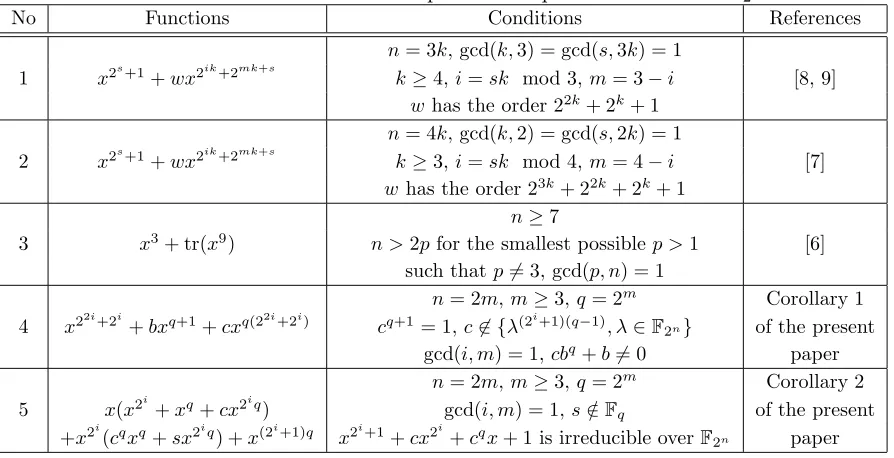
Table 2
Known APN functions CCZ-inequivalent to power functions onF2n.
No Functions Conditions References
n= 3k, gcd(k,3) = gcd(s,3k) = 1 1 x2s
+1+wx2ik +2mk+s
k≥4,i=sk mod 3,m= 3−i [8, 9]
whas the order 22k+ 2k+ 1
n= 4k, gcd(k,2) = gcd(s,2k) = 1 2 x2s
+1+wx2ik +2mk+s
k≥3,i=sk mod 4,m= 4−i [7]
whas the order 23k+ 22k+ 2k+ 1
n≥7
3 x3+ tr(x9) n >2pfor the smallest possiblep >1 [6]
such thatp6= 3, gcd(p, n) = 1
n= 2m,m≥3,q= 2m Corollary 1
4 x22i +2i
+bxq+1+cxq(22i +2i
) cq+1= 1,c6∈ {λ(2i
+1)(q−1), λ∈F
2n} of the present
gcd(i, m) = 1,cbq+b6= 0 paper
n= 2m,m≥3,q= 2m Corollary 2
5 x(x2i
+xq+cx2i
q) gcd(i, m) = 1,s /∈
Fq of the present
+x2i
(cqxq+sx2i
q) +x(2i
+1)q x2i
+1+cx2i
+cqx+ 1 is irreducible over
F2n paper
constructed in [6, 7, 8, 9]. They are presented in Table 2. It is proven in [4] that there exists no APN function being CCZ-inequivalent to power mappings on F2n for n≤ 5. However,
the classification of quadratic APN functions is far away from being complete. Already
for n = 6 there are at least 9 mutually CCZ-inequivalent quadratic APN polynomials
which are CCZ-inequivalent to power functions [20]. In the present paper, we develop the method of constructing differentially 4-uniform quadratic polynomials introduced by Dillon [20]. We construct a new infinite class of quadratic APN trinomials and a new potentially infinite class of quadratic APN hexanomials (presented in Table 2 by cases 4 and 5) which we conjecture to be CCZ-inequivalent to power functions for n ≥ 6 and we confirm this conjecture for n = 6.
2
Preliminaries
Let Fn
2 be the n-dimensional vector space over the field F2. Any function F from Fn2 to itself can be uniquely represented as a polynomial on n variables with coefficients in Fn2, whose degree with respect to each coordinate is at most one:
F(x1, ..., xn) =
X
u∈Fn
2
c(u)
n
Y
i=1
xui
i
, c(u)∈Fn2.
Besides, the field F2n can be identified with Fn2 as a vector space. Then, viewed as a
function from this field to itself, F has a unique representation as a univariate polynomial over F2n of degree smaller than 2n:
F(x) = 2n−1
X
i=0
cixi, ci ∈F2n.
For any k, 0 ≤ k ≤ 2n −1, the number w2(k) of the nonzero coefficients k
s ∈ {0,1} in
the binary expansion Pn−1
s=0 2sks of k is called the 2-weight of k. The algebraic degree of
F is equal to the maximum 2-weight of the exponentsi of the polynomial F(x) such that
ci 6= 0, that is,d◦(F) = max0≤i≤n−1,ci6=0w2(i) (see [17]).
A function F : Fn2 → Fn2 is linear if and only if F(x) is a linearized polynomial over
F2n, that is,
n−1 X
i=0
cix2
i
, ci ∈F2n.
The sum of a linear function and of a constant is called an affine function.
Let F be a function fromF2n to itself and A1, A2 :F2n →F2n be affine permutations.
The functionsF andA1◦F◦A2are then calledaffine equivalent. Affine equivalent functions have the same algebraic degree (i.e. the algebraic degree is affine invariant).
As recalled in the Introduction, we say that the functions F and F′ are extended affine equivalent ifF′ =A
1◦F◦A2+Afor some affine permutationsA1,A2 and an affine function
A. If F is not affine, then F and F′ have again the same algebraic degree.
Two mappingsF andF′from
F2n to itself are called Carlet-Charpin-Zinoviev equivalent
(CCZ-equivalent) if the graphs ofF andF′, that is, the subsetsG
F ={(x, F(x))|x∈F2n}
and GF′ ={(x, F′(x)) | x∈F2n} of F2n ×F2n, are affine equivalent. Hence, F and F′ are
CCZ-equivalent if and only if there exists an affine automorphismL = (L1, L2) ofF2n×F2n
such that
y =F(x)⇔L2(x, y) =F′(L1(x, y)).
Note that since Lis a permutation then the function L1(x, F(x)) has to be a permutation too (see [8]). As shown in [17], EA-equivalence is a particular case of CCZ-equivalence and any permutation is CCZ-equivalent to its inverse.
For a function F :F2n →F2n and any elements a, b∈F2n we denote
δF(a, b) =|{x∈Fn2 :F(x+a) +F(x) = b}|.
F is called a differentially δ-uniform function if maxa∈F∗
2n,b∈F2nδF(a, b) ≤ δ. Note that
δ ≥ 2 for any function over F2n. Differentially 2-uniform mappings are called almost
perfect nonlinear.
For any function F :F2n →F2n we denote
λF(a, b) =
X
x∈F2n
where tr(x) = x+x2 +x4 +...+x2n−1 is the trace function from F2n into F2. The set
ΛF ={λF(a, b) :a, b∈F2n, b6= 0} is called the Walsh spectrum of the function F and the
multiset {|λF(a, b)| : a, b∈ F2n, b 6= 0} is called the extended Walsh spectrum of F. The
value
N L(F) = 2n−1− 1
2a∈Fmax2n,b∈F∗ 2n
|λF(a, b)|
equals the nonlinearity of the function F. The nonlinearity of any functionF satisfies the inequality
N L(F)≤2n−1−2n−21
([18, 35]) and in case of equality F is called almost bent or maximum nonlinear.
Obviously, AB functions exist only fornodd. It is proven in [18] that every AB function is APN and its Walsh spectrum equals{0,±2n+12 }. Ifn is odd, every APN mapping which
is quadratic (that is, whose algebraic degree equals 2) is AB [17], but this is not true for nonquadratic cases: the Dobbertin and the inverse APN functions are not AB (see [15, 17]). When n is even, the inverse function x2n−2
is a differentially 4-uniform permutation [33] and has the best known nonlinearity [30], that is 2n−1−2n
2 (see [15, 21]). This function
has been chosen as the basic S-box, with n = 8, in the Advanced Encryption Standard
(AES), see [19]. A comprehensive survey on APN and AB functions can be found in [16].
It is shown in [17] that, if F and G are CCZ-equivalent, then F is APN (resp. AB)
if and only if G is APN (resp. AB). More generally, CCZ-equivalent functions have the same differential uniformity and the same extended Walsh spectrum (see [11]). Further invariants for CCZ-equivalence are given in [25] (see also [20]) in terms of group algebras. Let G=F2[F2n×F2n] be the group algebra of F2n×F2n overF2. It consists of the formal
sums
X
g∈G
agg
where ag ∈ F2. If S is a subset of F2n×F2n then it can be identified with the element
P
s∈Ss of G. For any APN mapping F we denote
∆F ={(a, b) :F(x) +F(x+a) =b has 2 solutions} ⊂F2n×F2n.
The dimensions of the ideals ofGgenerated by ∆F and by the graphGF ofF are called
∆-and Γ-ranks, respectively. According to [25] (∆-and also [20]), ∆- ∆-and Γ-ranks of a function are CCZ-invariant.
3
Constructions of differentially 4-uniform quadratic
mappings
Gold power functions. Using this approach two quadratic APN binomials onF210 andF212,
which are CCZ-inequivalent to power maps, are introduced in [25]. The APN binomial of the fieldF212 has been proven in [8, 9] for being part of infinite sequences of quadratic APN
binomials (given in Table 2 by the first and the second cases) while the APN function of the field F210 from [25] is not explained yet by any infinite family.
Another approach for constructing quadratic APN polynomials CCZ-inequivalent to power functions is introduced in [6]. This approach is based on the fact that for any APN functionF and any functionGthe function F(x) + tr(G(x)) has differential uniformity at most 4. The third class of APN polynomials presented in Table 2 is obtained by application of this method.
A third approach, given in [20], is to consider quadratic hexanomials of the type
F(x) =x(Ax2+Bxq+Cx2q) +x2(Dxq+Ex2q) +Gx3q (1) over F22m with q = 2m as good candidates for being differentially 4-uniform. This
ap-proach gives new examples of quadratic APN functions over F26 and F28 which are
CCZ-inequivalent to power functions [20]. Besides, the infinite family of APN functions in-troduced in the next section and presented by the fourth case in Table 2 is based on construction (1). It should be noted that similar approach was used to construct new quadratic APN quadrinomials over F26 in [32].
Below we suggest natural generalizations of the method from [20], but first let us recall the arguments leading to the construction (1). Let a functionF be defined by (1). SinceF
is quadratic then in order to determine its differential uniformity it is enough to know the numbers of solutions of the equationsF(x+a) +F(x) +F(a) = 0 for all nonzero elements
a of F22m. We get
f1 = F(x+a) +F(x) +F(a) = a1x+a2x2+a3xq+a4x2q = 0
f2 = aq2f1+a4f1q =b1x+b2x2+b3xq = 0
f3 = b23f1+a3b3f2+a4f22 =c1x+c2x2+c3x4 = 0.
Hence, if either c1, c2 or c3 is different from 0 then F can have differential uniformity at most 4. In practice this condition on coefficients is very important. Indeed, the construction (1) gives all quadratic functions on the fieldF24 and we have checked by running a computer
that only about 3/4 of them are differentially 4-uniform. For the fieldF26 only about 18/41
of all functions generated by (1) are differentially 4-uniform. Let us now consider the construction
F′(x) =x(Ax2+Bx4+Cxq+Dx2q+Ex4q) +x2(Gx4+Hxq+Ix2q+Jx4q) +x4(Kxq+Lx2q+Mx4q) +xq(Nx2q+P x4q) +Qx2q+4q.
For the function F′ and for any nonzero elements a of
F22m we get f′
1 = F(x+a) +F(x) +F(a) =a′1x+a′2x2+a′3x4+a′4xq+a′5x2q+a′6x4q = 0
f′
2 = a
′q
3f1′ +a′6f1′
q
=b′
1x+b′2x2 +b′3x4+b′4xq+b′5x2q = 0
f′
3 = b′3f1′ +a3′f2′ =c′1x+c2′x2+c′3xq+c4′x2q+c′5x4q = 0
f4′ = c
′q
5f2′ +b′3f3′
q
Thus, if some of the coefficients d′
2, d′3, d′4 are different from 0 then we see that f4′ has the same form as f1. Therefore, applying the Dillon method to f1 = f4′, we get that if some of the coefficients d′
2, d′3, d′4, and some of the coefficients c1, c2, c3, are different from 0 then
F′ is differentially 4-uniform. Obviously, the probability that we can prove this way that
the function F′ is differentially 4-uniform is less than in the case of construction (1) since
we have an additional condition (on coefficients d′
2, d′3, d′4). And actually, we checked by computer investigation that only about 1/4 of the quadratic functions on the fieldF26 are
differentially 4-uniform (while all of them have the same form as F′).
Obviously, construction (1) can be further generalized. For any i we denote
F(i)(x) = X 0≤t<j≤i
atjx2
t+2j
+ X
0≤t,j≤i
btjx2
t+2jq
+ X
0≤t<j≤i
ctjxq(2
t+2j)
and considerF(i) overF
22m with m≥i+ 1. Obviously, the casesi= 1,2 correspond to the
functionsF andF′. For arbitraryi, using induction, we get that, under a condition on the
coefficients translating that no relation obtained in the process completely vanishes, the function F(i) is differentially 4-uniform. Note that all quadratic functions have the form
F(i)(x) for i = m−1. But clearly, with increasing i the probability that we can prove this way that F(i) is differentially 4-uniform decreases since the number of conditions on coefficients grows. Nevertheless, we exhibit in the next section two subcases where these constructions succeed in providing differentially 4-uniform polynomials, and we can even deduce two new infinite classes of APN quadratic functions.
4
New infinite classes of APN functions
Functions whose nonzero derivatives are all 2k-to-1 mappings (i.e. reach any value either
0 or 2k times) are studied in [10]. The simplest examples of such functions over
F2n are x2i+1
when gcd(i, n) = k. The following theorems give new classes of such functions - of
APN functions when k= 1.
4.1
Trinomials
Theorem 1 Let m andibe any integers, q= 2m, n= 2m, gcd(i, m) = k andc, b∈F
2n be
such thatcq+1 = 1, c6∈ {λ(2i+1)(q−1)
, λ∈F2n}, cbq+b6= 0. Then all the nonzero derivatives
of the function
F(x) = x22i+2i+bxq+1+cxq(22i+2i)
are 2k-to-1 mappings of F
2n.
Proof. Since F is quadratic, then for any nonzero a in F2n the function F(x+a) +F(x)
is 2k-to-1 if and only if the equation
f1 =F(x+a) +F(x) +F(a) =baqx+a2
2i
has 2k solutions. This equation implies
f1+cf1q= (cbq+b)(axq+aqx) = 0 and, since cbq+b 6= 0, then x=au, u∈
Fq. The equation f1 = 0 becomes
(a22i+2i +caq(22i+2i))(u2i+u22i) = 0.
The condition c 6∈ {λ(2i+1)(q−1)
, λ ∈ F2n} implies that a2
2i+2i
+caq(22i+2i)
6
= 0. Hence, if
gcd(i, m) =k then F(x+a) +F(x) is 2k-to-one for any nonzero a. 2
Clearly, for k equal 1 and 2 Theorem 1 gives differentially 2- and 4-uniform functions respectively.
Corollary 1 Let m be any integer, q = 2m, n = 2m, i be such that gcd(i, m) = 1, and
c, b∈F2n be such that cq+1 = 1, c6∈ {λ(2
i+1)(q−1)
, λ∈F2n}, cbq+b6= 0. Then the function
F(x) = x22i+2i+bxq+1+cxq(22i+2i)
is APN on F2n.
Note that vectors c, b satisfying the hypotheses of Theorem 1 do exist for every odd
m and i. Indeed, an element c such that cq+1 = 1 and c 6∈ {λ(2i+1)(q−1)
, λ ∈ F2n} exists
because for iodd 2i+ 1 is divisible by 3 and 3(q−1) divides q2−1 and we can take for c any (q−1)-th power of a primitive element which is not the 3(q−1)-th power of an element of the field and b clearly exists too (take for instance b = 1). When i = 1 this sufficient condition on m is also necessary since if m is even then gcd(3(q−1), q2 −1) = q−1, so there does not exist such c.
4.2
Hexanomials
Theorem 2 Let n be any even integer, q = 2n/2, gcd(i, n/2) = k, and c, s ∈
F2n be such
that s /∈Fq. If the equation
x2i+1+cx2i+cqx+ 1 = 0
has no solution x such that xq+1 = 1, and in particular if the polynomial X2i+1
+cX2i
+
cqX+ 1 is irreducible over F
2n, then all the nonzero derivatives of the function
F(x) =x(x2i +xq+cx2iq) +x2i(cqxq+sx2iq) +x(2i+1)q
are 2k-to-1 mappings of F
2n.
Proof. SinceF is quadratic then for any nonzero a the functionF(x+a) +F(x) is 2k-to-1 if and only if the equation F(x+a) +F(x) +F(a) = 0 has 2k solutions.
We have
(a2i+aq+ca2iq)x+ (a+cqaq+sa2iq)x2i+ (a+cqa2i+a2iq)xq+ (ca+sa2i +aq)x2iq
and
(F(x+a) +F(x) +F(a))q =
(a2iq+a+cqa2i)xq+ (aq+ca+sqa2i)x2iq+ (aq+ca2iq+a2i)x+ (cqaq+sqa2iq+a)x2i.
The sum of this two expressions equals (s+sq)(a2iq x2i
+a2i x2iq
). Hence, since s+sq 6= 0
then F(x+a) +F(x) +F(a) = 0 and x 6= 0 imply xq−1 = aq−1, that is, x = ua where
u∈F∗q. Replacing x by ua, we get
F(x+a) +F(x) +F(a) =
(u2ia2i +uaq+cu2ia2iq)a+ (ua+cquaq+su2ia2iq)a2i+ (ua+cqu2ia2i +u2ia2iq)aq
+(cua+su2ia2i +uaq)a2iq = (u+u2i)(a2i+1+a(2i+1)q+ca2iq+1+cqa2i+q).
The equationu+u2i
= 0 has 2ksolutions. We deduce thatF(x+a) +F(x) is 2k-to-1 if the
equationx2i+1
+x(2i+1)q
+cx2iq+1
+cqx2i+q
= 0 admits no nonzero solution or, equivalently, the equation x(2i+1)(q−1)
+cx2i(q−1)
+cqxq−1+ 1 = 0 has no solutions, or in other words, if the equation
y2i+1+cy2i+cqy+ 1 = 0
has no solution y such that yq+1 = 1. This happens (for instance) when the polynomial
X2i+1
+cX2i
+cqX+ 1 is irreducible over F
2n. 2
Obviously, for the special casek = 2, Theorem 2 gives differentially 4-uniform functions and for k = 1, it gives a class of APN functions.
Corollary 2 Let n be any even integer, q= 2n/2, gcd(i, n/2) = 1, and c, s∈ F
2n be such
that s /∈Fq. If the equation
x2i+1+cx2i+cqx+ 1 = 0
has no solution x such that xq+1 = 1, and in particular if the polynomial X2i+1
+cX2i
+
cqX+ 1 is irreducible over F
2n, then the function
F(x) =x(x2i +xq+cx2iq) +x2i(cqxq+sx2iq) +x(2i+1)q
is APN on F2n.
The class of APN functions of Corollary 2 depends on existence of elements c ∈ F2n
for which the polynomialx2i+1
+cx2i
+cqx+ 1 is irreducible over F
2n. We checked with a
computer that for i = 1 such elements always exist at least for all even n, 6 ≤ n ≤ 1000, not divisible by 3. In case n divisible by 6, 6 ≤n ≤1000, such elements exist at least for 140 out of 166 checked fields. We also checked that for 6≤n ≤26 the number of elements
4.3
Their inequivalence with power functions
The Dobbertin APN functions have unique Walsh spectra which are different from the Walsh spectra of quadratic APN functions (see [14, 34]). Since the extended Walsh spec-trum of a function is invariant under CCZ-equivalence then we can make the following conclusion.
Proposition 1 The functions of Corollaries 1 and 2 are CCZ-inequivalent to the Dob-bertin APN functions.
The APN functions from Corollaries 1 and 2 are CCZ-inequivalent to power functions at least for n = 6. Indeed, their Γ-ranks equal 1146, while the only APN power function x3 onF26 has the Γ-rank 1104.
Proposition 2 The functions of Corollaries 1 and 2 are CCZ-inequivalent to power func-tions on F26.
Acknowledgement
The authors are indebted to John Dillon for nice observations.
References
[1] T. Berger, A. Canteaut, P. Charpin and Y. Laigle-Chapuy. On almost perfect nonlin-ear functions over Fn
2. IEEE Trans. Inform. Theory, vol. 52, no. 9, Sept. 2006.
[2] T. Beth and C. Ding. On almost perfect nonlinear permutations. Advances in
Cryptology-EUROCRYPT’93, Lecture Notes in Computer Science, 765, Springer-Verlag, New York, pp. 65-76, 1993.
[3] E. Biham and A. Shamir. Differential Cryptanalysis of DES-like Cryptosystems. Jour-nal of Cryptology, vol. 4, No.1, pp. 3-72, 1991.
[4] M. Brinkman and G. Leander. On the classification of APN functions up to dimension five. To appear in the proceedings of WCC 2007.
[5] L. Budaghyan. The simplest method for constructing APN
polyno-mials EA-inequivalent to power functions. Submitted, available at
http://eprint.iacr.org/2007/058
[6] L. Budaghyan, C. Carlet, G. Leander. Constructing new APN functions from known ones. Preprint, available at http://eprint.iacr.org/2007/063
[7] L. Budaghyan, C. Carlet, G. Leander. Another class of quadratic APN
bi-nomials over F2n: the case n divisible by 4. Submitted, available at
[8] L. Budaghyan, C. Carlet, G. Leander. A class of quadratic APN binomials inequivalent to power functions. Submitted, available at http://eprint.iacr.org/2006/445.pdf
[9] L. Budaghyan, C. Carlet, P. Felke, G. Leander. An infinite class of quadratic APN functions which are not equivalent to power mappings. Proceedings of the IEEE In-ternational Symposium on Information Theory 2006, Seattle, USA, Jul. 2006.
[10] L. Budaghyan and A. Pott. On Differential Uniformity and Nonlinearity of Functions. Submitted, 2006.
[11] L. Budaghyan, C. Carlet, A. Pott. New Classes of Almost Bent and Almost Perfect
Nonlinear Functions. IEEE Trans. Inform. Theory, vol. 52, no. 3, pp. 1141-1152,
March 2006.
[12] L. Budaghyan, C. Carlet, A. Pott. New Constructions of Almost Bent and Almost
Per-fect Nonlinear Functions. Proceedings of the Workshop on Coding and Cryptography
2005, P. Charpin and Ø. Ytrehus eds, pp. 306-315, 2005.
[13] A. Canteaut, P. Charpin and H. Dobbertin. A new characterization of almost bent
functions. Fast Software Encryption 99, LNCS 1636, L. Knudsen edt, pp. 186-200.
Springer-Verlag, 1999.
[14] A. Canteaut, P. Charpin and H. Dobbertin. Binary m-sequences with three-valued
crosscorrelation: A proof of Welch’s conjecture. IEEE Trans. Inform. Theory, 46 (1), pp. 4-8, 2000.
[15] A. Canteaut, P. Charpin, H. Dobbertin. Weight divisibility of cyclic codes , highly nonlinear functions onF2m, and crosscorrelation of maximum-length sequences.SIAM
Journal on Discrete Mathematics, 13(1), pp. 105-138, 2000.
[16] C. Carlet. Vectorial (multi-output) Boolean Functions for Cryptography. Chapter of
the monography Boolean Methods and Models, Y. Crama and P. Hammer eds,
Cam-bridge University Press, to appear soon. Preliminary version available at http://www-rocq.inria.fr/codes/Claude.Carlet/pubs.html
[17] C. Carlet, P. Charpin and V. Zinoviev. Codes, bent functions and permutations suitable for DES-like cryptosystems. Designs, Codes and Cryptography, 15(2), pp. 125-156, 1998.
[18] F. Chabaud and S. Vaudenay. Links between differential and linear cryptanalysis, Advances in Cryptology -EUROCRYPT’94, LNCS, Springer-Verlag, New York, 950, pp. 356-365, 1995.
[19] J. Daemen and V. Rijmen. AES proposal: Rijndael.
[20] J. F. Dillon. APN Polynomials and Related Codes. Polynomials over Finite Fields and Applications, Banff International Research Station, Nov. 2006.
[21] H. Dobbertin. One-to-One Highly Nonlinear Power Functions on GF(2n). Appl.
Algebra Eng. Commun. Comput. 9 (2), pp. 139-152, 1998.
[22] H. Dobbertin. Almost perfect nonlinear power functions over GF(2n): the Niho case.
Inform. and Comput., 151, pp. 57-72, 1999.
[23] H. Dobbertin. Almost perfect nonlinear power functions overGF(2n): the Welch case.
IEEE Trans. Inform. Theory, 45, pp. 1271-1275, 1999.
[24] H. Dobbertin. Almost perfect nonlinear power functions overGF(2n): a new case for
n divisible by 5. D. Jungnickel and H. Niederreiter eds. Proceedings of Finite Fields and Applications FQ5, Augsburg, Germany, Springer, pp. 113-121, 2000.
[25] Y. Edel, G. Kyureghyan and A. Pott. A new APN function which is not equivalent to a power mapping. IEEE Trans. Inform. Theory, vol. 52, no. 2, pp. 744-747, Feb. 2006.
[26] R. Gold. Maximal recursive sequences with 3-valued recursive crosscorrelation func-tions. IEEE Trans. Inform. Theory, 14, pp. 154-156, 1968.
[27] H. Hollmann and Q. Xiang. A proof of the Welch and Niho conjectures on crosscor-relations of binary m-sequences. Finite Fields and Their Applications 7, pp. 253-286, 2001.
[28] H. Janwa and R. Wilson. Hyperplane sections of Fermat varieties inP3 in char. 2 and some applications to cyclic codes. Proceedings of AAECC-10, LNCS, vol. 673, Berlin, Springer-Verlag, pp. 180-194, 1993.
[29] T. Kasami. The weight enumerators for several classes of subcodes of the second order binary Reed-Muller codes. Inform. and Control, 18, pp. 369-394, 1971.
[30] G. Lachaud and J. Wolfmann. The Weights of the Orthogonals of the Extended
Quadratic Binary Goppa Codes. IEEE Trans. Inform. Theory, vol. 36, pp. 686-692,
1990.
[31] M. Matsui. Linear cryptanalysis method for DES cipher. Advances in
Cryptology-EUROCRYPT’93, LNCS, Springer-Verlag, pp. 386-397, 1994.
[32] N. Nakagawa and S. Yoshiara. A construction of differentially 4-uniform functions from commutative semifields of characteristic 2. Preprint.
[34] K. Nyberg. S-boxes and Round Functions with Controllable Linearity and Differential Uniformity. Proceedings of Fast Software Encryption 1994, LNCS 1008, pp. 111-130, 1995.