ABSTRACT
DOORN, DAVID JOHN. Three Essays on Trend Analysis and Misspecification in Structural Econometric Models. (Under the direction of Alastair Hall)
The purpose of this research has been to look into several econometric issues of concern to researchers doing applied work in macroeconomics. The first essay looks at Bureau of Economic Analysis data on inventories and sales of finished goods often used in studies of inventory behavior. Applying recently developed methods, the series are rigorously tested to determine their stationarity properties. Results indicate that neither first differencing nor linearly detrending the data is appropriate. For most series a trend function with one or more breaks offers a better fit and also generates stationarity. The results are used to determine the impact on estimation in a simple production-smoothing model of inventory behavior. The impact of different trend specifications on univariate forecasting of inventories is also considered.
The second essay considers an alternative method of detrending time series data – the Hodrick-Prescott (HP) filter. Previous research has shown that HP filtering can have serious adverse consequences when used to analyze co-movements between data series at business cycle frequencies. Despite this, the filter has also been used to induce stationarity in a data series prior to estimation of structural econometric models. Little work has been done in analyzing the possible effects this may have on parameter estimates from such models. A simulation study is conducted to assess the impact of HP filtering on parameter estimation and a comparison is made to other detrending methods. It is shown that the HP filter induces bias in the parameter estimates and also increases the root mean squared error of the estimates from the simulations. In addition, there is some adverse impact on the size of certain test statistics.
THREE ESSAYS ON
TREND ANALYSIS AND MISSPECIFICATION
IN STRUCTURAL ECONOMETRIC MODELS
by
DAVID JOHN DOORN
A dissertation submitted to the graduate faculty of
North Carolina State University
in partial fulfillment of the
requirements for the Degree of
Doctor of Philosophy
ECONOMICS
Raleigh
2003
APPROVED BY:
___________________________ ___________________________
Chair of Advisory Committee
Biography
Contents
List of Tables v
List of Figures vii
1 Trend Breaks in Finished Goods Inventories and Sales of Non-Durables 1
1.1 Introduction . . . 1
1.2 The Data . . . 3
1.3 Unit Root Testing . . . 4
1.3.1 Augmented Dickey-Fuller Tests . . . 6
1.3.2 Point-Optimal Tests . . . 6
1.3.3 Tests Allowing For Breaks In The Trend Function . . . 8
1.4 Choice of Detrending Models . . . 10
1.5 Impact on Parameter Estimates from a Linear-Quadratic Model of Inventory Behavior . . 15
1.5.1 The L-Q Model . . . 15
1.5.2 Impact on Parameter Estimates . . . 18
1.5.3 Other Implications . . . 19
1.6 Forecasting . . . 20
2 Consequences of Hodrick-Prescott Filtering for Parameter Estimation in a Structural
Model of Inventory Behavior 40
2.1 Introduction . . . 40
2.2 The Hodrick-Prescott Filter . . . 42
2.3 The Model . . . 48
2.4 Estimation Technique . . . 56
2.5 Empirical Example . . . 60
2.6 Simulation Results . . . 61
2.7 Conclusions . . . 63
3 Misspecification Issues in Structural Econometric Models 79 3.1 Introduction . . . 79
3.2 GMM Background and Definitions . . . 82
3.3 The Model . . . 84
3.3.1 The Full Model . . . 84
3.3.2 Alternative Specifications . . . 86
3.4 A Note on Moment Restrictions . . . 89
3.5 Simulating the Data . . . 92
3.6 Probability Limits of the Parameter Estimates . . . 99
3.7 Specification Testing . . . 101
3.7.1 Hansen’s J-Test . . . 102
3.7.2 Noise Ratios . . . 104
3.8 Impact of HI Asymptotics . . . 107
3.8.1 Estimation Results . . . 109
3.9 Application . . . 120
List of Tables
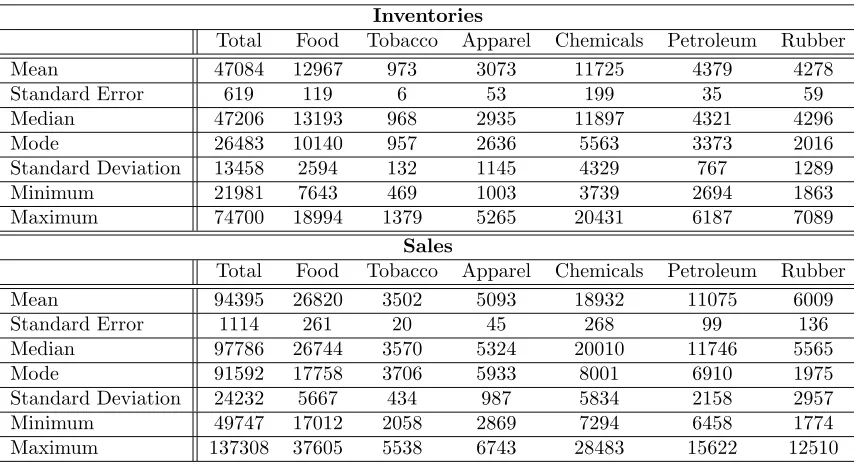
1.1 Summary Statistics . . . 24
1.2 Adjustment Factors . . . 24
1.3 Prior Research . . . 25
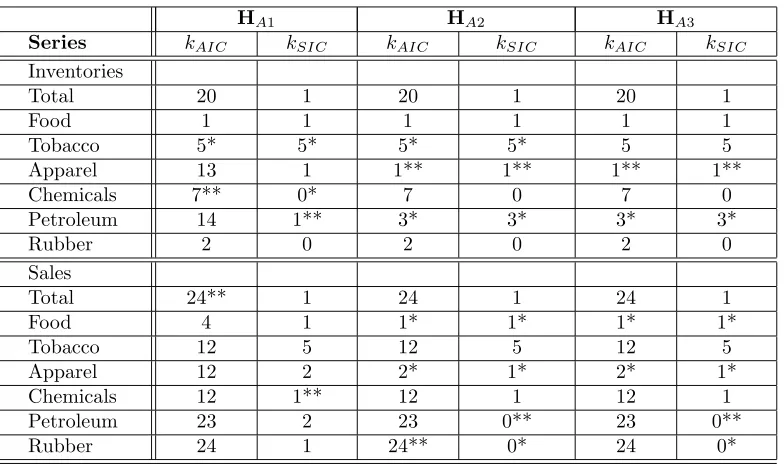
1.4 ADF Test: Optimal Lags and Results . . . 25
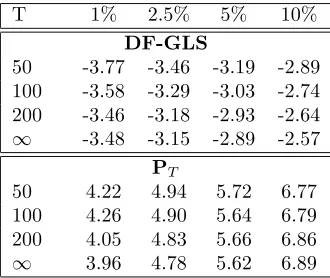
1.5 Elliot et al. Critical Values . . . 26
1.6 Test Results . . . 26
1.7 Zivot and Andrews’ Critical Values . . . 26
1.8 Lumsdaine and Papell Critical Values . . . 27
1.9 Structural Breakpoints and Test Results for Single-Break Models . . . 27
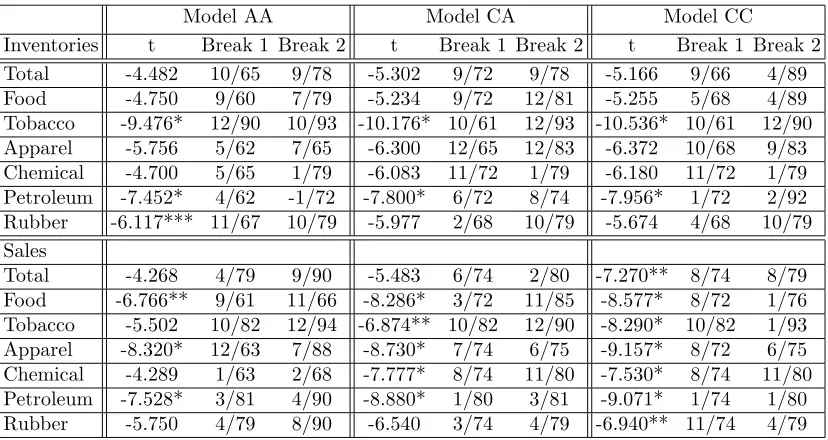
1.10 Breakpoints and Test Results for Two Breaks in Trend . . . 28
1.11 Selected Models For Detrending . . . 28
1.12 Estimation Results From Deterministic Detrending Procedures . . . 29
1.13 Choice ofpfrom SIC . . . 29
2.1 Cost Parameters for Simulation Study . . . 66
2.2 Specification of Sales Process and Cost Shock Parameters . . . 66
2.3 Implied Parameters of Inventory Process . . . 66
2.4 Implied Values of Regression Coefficients . . . 66
3.1 Examples of Papers Performing Inference Based on Misspecified Models . . . 127
3.2 Calibrated Parameter Values By Industry . . . 128
3.3 Implied Population Values of Model Parameters . . . 129
3.4 Large Sample Probability Limits By Specification & Weight Matrix . . . 130
3.5 Rejection Rates of JT-test (%), Average Noise Ratios (NR¯ ), and Noise Ratio Model Selection by Specification and Weight Matrix. . . 131
3.6 Limiting Distributions for Alternative GMM Estimators and the JT Test Statistic . . . . 132
3.7 Estimation Results for the Full Model . . . 133
3.8 Estimation Results for the Pure Model . . . 135
3.9 Estimation Results for the Stockout Avoidance Model . . . 136
3.10 t-statistic Rejection Rates: Pure Model . . . 138
3.11 t-statistic Rejection Rates: Stockout Avoidance Model . . . 139
List of Figures
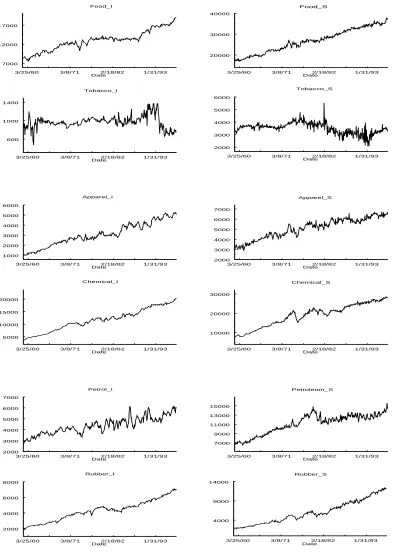
1.1 Time Series of BEA Inventory and Sales Data . . . 30
1.2 Time Series of BEA Inventory and Sales Data . . . 31
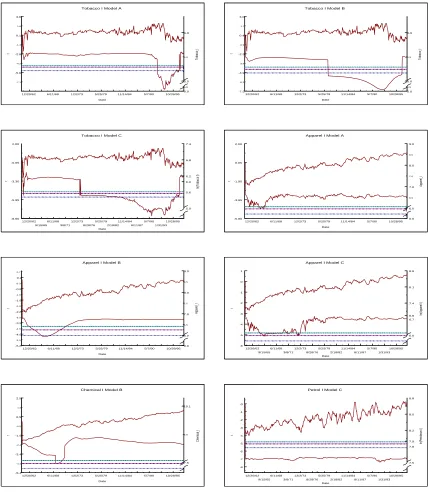
1.3 Sequential t-tests: Selected Models — Inventories . . . 32
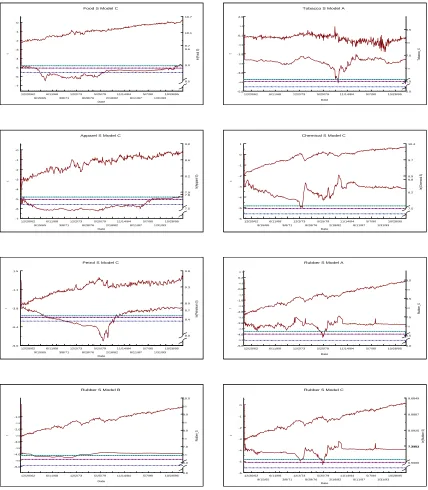
1.4 Sequential t-tests: Selected Models — Sales . . . 33
1.5 Detrending Models and Residuals . . . 34
1.6 Detrending Models and Residuals . . . 35
1.7 Detrending Models and Residuals . . . 36
1.8 Forecasts . . . 37
1.9 Forecasts . . . 38
1.10 Forecasts . . . 39
2.1 Frequency Response of HP Cyclical Filter . . . 70
2.2 Spectral Density of Total Aggregate Inventories of Non-Durables . . . 71
2.3 HP and Linear Trends . . . 72
2.4 Residuals . . . 73
2.5 ACF . . . 74
2.6 Density ofβ1 Estimates. . . 75
2.7 Density ofβ2 Estimates. . . 76
Chapter 1
Trend Breaks in Finished Goods
Inventories and Sales of
Non-Durables
1.1
Introduction
Much research in recent years has focused on the role of inventories in explaining business cycles. While
inventory investment is generally a very small component of GDP, it has been noted in the literature
that most recessions tend to be periods of high inventory dis-investment, with changes in inventories
accounting for 87% of the fall in GDP, on average, for postwar recessions in the U.S. (see, for example,
Blinder and Maccini (1991) or Ramey and West (1997)). This indicates the importance of looking at
inventory behavior when considering the possible causes of business cycles as well as their persistence.
Unfortunately, most models of inventory behavior perform poorly with respect to the empirical facts
and there has not yet been a widely accepted solution to this problem.
inap-stationary for the asymptotic econometric theory to hold. The widely applied Generalized Method of
Moments (GMM) in particular requires stationarity of the variables contained in the moment condition
on which estimation is based. Prior research has tended to choose data transformations that are based
upon little or no formal testing prior to estimation, often choosing a linear or quadratic de-trending
procedure. This study takes advantage of recent advances in the unit root literature and applies a
num-ber of previously unavailable testing procedures to data on inventory and sales for six industries and
aggregate non-durables. This allows for a more informed determination of the stationarity properties of
the data prior to estimation, rather than just choosing a convenient transformation based upon a small
amount of evidence or common practice.
Initially, the commonly used Augmented Dickey-Fuller test for unit roots is applied to the data
and the results presented. Then a more powerful class of tests is applied in an attempt to get stronger
results. Lack of convincing evidence from these tests indicates the need for further testing, which initially
includes the presence of a single break in the trend function for the stationary alternative in the unit
root tests. These tests are then expanded to include the possibility of a second break in trend for these
series. Most of the series tested are found to contain either one or two breaks in trend and this result is
then applied in detrending the data. The resulting transformations do result in stationary series.
Given these results, a comparison is made to see if there is a significant impact on estimation results
from a commonly used inventory model. The model is estimated using three different detrending
pro-cedures to attain stationarity in the data. These include detrending based on the presence of a linear
trend, a quadratic trend, and a piecewise linear trend. Surprisingly, there is not a lot of difference in
results obtained from the three deterministic detrending methods. We also find that first-differencing
does give quite different results, but these tend to be implausible given both the underlying theory and
the empirical facts.
In addition, the different detrending procedures imply quite different time paths for the series. A look
at the implications of these results for forecasting of inventories is also undertaken. Not surprisingly,
choosing a forecasting model and also illustrates the impact that the use of unit root tests may have on
this selection.
The paper will proceed as follows: Section 1 describes the data series used in the analysis and
includes an update of the adjustment suggested in West (1983) to put the inventory and sales series
on a comparable measurement basis. Section 2 describes the unit root tests applied to the series and
presents the results. Section 3 discusses the choice of detrending model for each series based on the tests
in Section 2. Section 4 describes a simple model of inventory behavior and compares estimates using
different detrending procedures. Section 5 discusses the implications of the test results from section 2
for forecasting of inventories. Section 6 concludes with a summary of the results.
1.2
The Data
The data series used in this study is one that is commonly employed in the Inventory literature. This is
the Bureau of Economic Analysis (BEA) data on end-of-month finished goods inventories and sales. The
BEA series are gleaned from the Census Bureau’s Manufacturer’s Shipments, Inventories, and Orders
(M3) survey and are used in estimation of the National Income and Product Accounts (NIPA) for the
calculation of GDP. The data are adjusted to constant chained 1992 dollars from the book values reported
by firms in the raw M3 data. The procedures used are described in the Survey of Current Business,
published monthly by the BEA. The data employed here are consistent with the procedures described
in the August 1998 issue of the Survey. The monthly series are also seasonally adjusted, using the X-12
method, and cover the periods January 1959 through May 1998. This yields 473 observations.
To be consistent with prior research using the linear-quadratic model of inventory behavior, we
concentrate on the six two-digit SIC industries commonly considered as being production to stock.
These include Food, Tobacco, Apparel, Chemicals, Petroleum, and Rubber. Also considered is the series
for overall non-durables manufacturing, which adds Textiles, Paper, Printing, and Leather to the above.
cost. To make the data consistent across series it is necessary to adjust either inventories or sales by the
ratio of market price to unit cost, evaluated in the base year. West suggests an approximation to this
ratio that can be constructed from IRS data. This approximation takes the form: (business receipts)
÷(cost of sales and operations + rent + repairs + depreciation + taxes). Table 1.2 gives the resulting
adjustment factor using a 1992 base for each of the six two-digit industries and for total non-durables.
In incorporating the adjustment the sales series were divided by the adjustment factor. The adjusted
sales series should then be used in estimation. For much of the single series descriptive analysis that
follows, however, this adjustment is inconsequential and so the unadjusted series are used.
A precursory look at the time series plots of the data suggests the possibility of a deterministic
trend for all of the series, except perhaps for Tobacco sales and Tobacco inventories. It is of course
also possible that the data follow a unit root with drift process. Most of the literature using this data
tends to assume some kind of polynomial time trend and so de-trend the data using standard methods
to attain stationarity. Very few of the studies actually discuss any unit root testing of the data to
determine its stationarity properties, and those that do tend to report somewhat ambiguous results.
Nearly all of the studies end up using deterministically detrended data, with some also repeating their
work with differenced data, e.g. Eichenbaum (1989); Durlauf and Maccini (1995). Table 1.3 lists some
of the prior research on inventories and what, if any, testing was reported on the data used, as well
as the transformations applied prior to its use. Because there seems to be no compelling evidence in
the literature, this study rigourously investigates the stationarity properties of the data using recently
developed tests from the unit root literature.
1.3
Unit Root Testing
In analyzing the data several different tests for the presence of unit roots were applied. These include the
standard Augmented Dickey-Fuller test, the point optimal tests of Elliot et al. (1996), and extensions of
the ADF test that include the possibility of breaks in the trend function.1 All of these tests are based
on some form of equation 1.1 withd(t) indicating a deterministic function of time. The specification of
d(t) is the primary difference between the tests applied.
yt= ˆαyt−1+d(t) + k
j=1
ˆ
cj∆yt−j+ ˆet (1.1)
Thekautoregressive ∆yt−j terms are included to allow for the possibility of auto-correlation in the
disturbances, which may cause problems in the limiting distributions of the test statistics. It has been
noted in the literature on unit-roots that the number of extra regressors, k, included in Equation 1.1 can impact the power and the size of unit root tests. Hall (1994) shows that using pretest data-based
model selection procedures to choosekcan greatly increase the power of the ADF test. We employ two of these procedures here to choose the number of extra regressors to include for each data series in each
test, the Akaike information criteria (AIC) and the Schwartz information criteria (SIC).2
Both the AIC and the SIC are designed to choose thekthat minimizes a criterion function over all possible lag lengths considered, with the difference being in the specified criterion function. The criterion
to be minimized takes the form:
T ln(T−1SSRk) +CR, (1.2)
whereSSRk is the sum of squared residuals from 1.3 and CR is 2(k+ 2) for AIC and (k+ 2)ln(T) for
SIC. Under certain conditions it can be shown that the probability that ˆkSIC is the truekis one in the
limit, while there is a positive probability that ˆkAIC is greater than the true k.3 This means that it is
possible for AIC to overfit the model. In finite samples the nature of the penalty functions, CR, requires
that ˆkSIC ≤ ˆkAIC once T attains a certain size. Of the following testing procedures, the three ADF
tests make use of both AIC and SIC, while the rest only apply SIC to determine the number of lags to
include. Unless otherwise noted, the maximum lag-length allowed was 25 for all series.
2We also used the Hannan and Quinn procedure reported in Hall (1994), but found the results to be virtually identical
to either the SIC or AIC for every series and so chose not to report it.
1.3.1
Augmented Dickey-Fuller Tests
The first tests undertaken were standard augmented Dickey-Fuller (ADF) tests. Three versions of these
tests were applied to the data, with the first being a test of the unit root with drift hypothesis against
a single-mean stationarity alternative and the second being the same null against stationarity about a
linear trend. In addition, some of the authors in Table 1.3 specified a quadratic trend function when
detrending the data, so a third test of the unit root null against quadratic-trend stationarity was also
applied. The trend function for these tests is of the form
d(t) =µ+βt+γt2, (1.3)
withβ andγrestricted to zero for tests against the single-mean stationarity alternative andγrestricted to zero for the linear-trend specification.
The null hypothesis based on equation 1.1 is H0 : α= 1 and a t-statistic is constructed from the regression to test this assertion. This t-statistic is then compared to the tables formulated in Dickey and
Fuller (1979, 1981) for the single-mean and linear-trend alternatives andH0is rejected for small values of t. For the quadratic-trend alternative p-values were calculated using the response-surface methods outlined in MacKinnon (1994). The number ofk extra regressors chosen and the results of these tests are given in Table 1.4.
1.3.2
Point-Optimal Tests
In addition to the ADF tests, two tests proposed by Elliot et al. (1996) were used, both of which
were shown to have better size and power properties than the above tests and several others that have
been suggested in the literature. The first of these is a modified version of the ADF test used above,
which Elliot et al. term the DF-GLS test, since it uses a type of generalized least-squares procedure
in generating the test statistic. The second test is a simple scaled likelihood-ratio constructed by the
Equation 1.1. ¯αis chosen to be the alternative for which maximal power of the tests are approximately .5, which Elliot et al. show will cause the statistic to lie close to the Gaussian power envelope over a large
range. They suggest using ¯α= 1 + ¯c
T, where ¯c =−7 for tests against a constant mean and ¯c=−13.5
for tests against a linear trend specification. The tests used here are only those against the alternative
of linear trend stationarity.
The DF-GLS test uses a procedure to demean and detrend the series of interest, yt, to obtainyDt ,
which is then used in place of yt in equation 1.1. In this cased(t) becomes zero, so the test using the
transformed series is against zero-mean stationarity.
The detrending procedure involves a number of steps. To begin with, the data series is transformed
to obtainyα¯= (y1, y2−αy¯ 1, ..., yT −αy¯ T−1). Then define the trend specification in aT×qmatrix,Z,
wherezt= (1) for the constant mean case andzt= (1, t) for the linear trend case. TransformZto obtain Zα¯= (z1, z2−αz¯ 1, ..., zT−αz¯ T−1). We then run a regression ofyα¯ onZα¯ to obtain an estimate for the
coefficient vector on the trend specification, ˆβ. This estimate is then used to constructyD
t =yt−βˆzt,
the detrended and demeaned series used in the test.
The PT-statistic is constructed as
PT =
[S( ¯α)−αS¯ (1)] ˆ
ω2 (1.4)
whereS(x) is the sum of squared residuals from the regression ofyxonZx, withyx= (y1, y2−xy1, ..., yT− xyT−1) and Zx = (z1, z2−xz1, ..., zT −xzT−1) and the ztare as above. The denominator, ˆω2, is an
estimator of ω2 = ∞k=−∞γ(k), where γ(k) = Evtvt−k are the autocovariances of the error. The
estimator used here is the autoregressive estimator described in Elliot et al.. This is
ˆ
ωAR2 =
ˆ
ση2
(1−pi=1ˆai)2
(1.5)
with ˆση2 and ˆai being the OLS estimates from the regression
∆yt=a0yt−1+ p
i=1
These test statistics do not follow any of the usual tables of critical values, so Elliot et al. conduct
Monte Carlo simulations to generate appropriate critical values. The critical values for each of these
tests against the alternative of linear trend stationarity are reproduced in Table 1.5. The results for the
inventory and sales series are given in Table 1.6, using the asymptotic critical values from Elliot et al..
1.3.3
Tests Allowing For Breaks In The Trend Function
One conclusion from the literature on unit roots has been that a mis-specification of the trend function,
d(t), can result in the appearance of a unit root when in fact one does not exist. Because of this we also conduct tests that allow for the possibility of shocks to the series at certain dates. These shocks,
if they exist, may cause a break, or a shift, in the trend of an otherwise trend-stationary series. One
way of testing this in the context of unit roots in general was derived by Perron (1989), in which several
macroeconomic data series were tested. Perron performed a visual inspection of the series and concluded
that there were two possible trend breaks, the Great Depression and the 1973 oil crisis. The series were
then tested for unit roots using a specification that allowed for the possibility of a break in trend at one
of these points.
For many of the inventory and sales series in the current study a visual inspection of the data is an
unsatisfactory means of determining the possible existence of a structural breakpoint, and so other ways
of making this determination are desirable. Zivot and Andrews (1992) and Banerjee et al. (1992) also
take issue with Perron’s method of determining breakpoint and devise procedures to choose the most
likely date for a break in trend for each series. Their procedures assume that the structural change at
these points is endogenous, and so data dependent, rather than exogenous. This leads to tests in which
the null hypothesis of a unit root with drift, which implies there is no structural change, is set against
the alternative of stationarity about a deterministic trend, with possible changes in the trend function
at some point in time. This null can be formulated as
While these authors only consider the possibility of a single break in trend, Ben-David et al. (1996)
and Lumsdaine and Papell (1997) derive a general extension to include two breaks in the trend function.
The general form for the trend function in all of these models becomes:
d(t) = ˆµ+ ˆβt+ ˆθDU1t(ˆλ) + ˆγDT1t(ˆλ) + ˆωDU2t(ˆλ) + ˆψDT2t(ˆλ) (1.7)
where λi = TBi/T, with TBi being the date at which the break occurs for i = 1,2; DU it(λ) = 1 if t > T λ, 0 otherwise;DT it(λ) =t−T λift > T λ, 0 otherwise.
We conduct tests based on equation 1.1 with six variants of this trend function, three that allow for
the presence of a single break, and three that allow for two breaks. Model A imposes the restriction
ˆ
γ= ˆω= ˆψ= 0, and so only allows for the possibility of a one-time shift in the overall level of the series, or its mean. Model B includesd(t) with ˆθ= ˆω= ˆψ= 0, which only allows for a one-time change in the slope of the deterministic trend. Model C includes d(t) with ˆω = ˆψ= 0, which allows for a change in both mean and level at a single date. These three models are identical to those considered in Zivot and
Andrews (1992). Banerjee et al. also consider models A and B,4 but in a more complex notation, and
attain similar results to those of Zivot and Andrews.
In addition we consider the two-break models of Ben-David et al. (1996) and Lumsdaine and Papell
(1997). Model AA includesd(t) with ˆγ= ˆψ= 0, and so allows for two shifts in the mean of the series.
Model CA imposes only ˆψ = 0, and so allows for one break in which the mean shifts and another in
which both the mean and the slope of the series change. Finally, Model CC makes no restrictions ond(t) in equation 1.7, which allows for both a shift in mean and a change in slope at two possible breakpoints.
The testing strategy is to construct at-statistic testingα= 1 at each possible trend breakpoint, or combination of breakpoints, and then choosing those breakpoints that produce the minimum t-statistic
as being the ones of interest.5 This results in choosing breakpoints which give the most weight to the
alternative of trend stationarity. In practice this requires estimation of each model at each possible
breakpoint, or set of breakpoints, using ordinary least squares. This process includes determining the
this, the SIC procedure described above was employed for each possibleλ, with the maximum possible lag length of 25 for the single-break models and, due to the extra computational burden, 12 for the
two-break versions.6
As in the ADF testing above, the t-statistics here will not have the same distribution as the standard
t-statistic, due to the inclusion of lagged first-differences of the regressor. Nor are they comparable to the
ADF tables. For the single-break tests, Zivot and Andrews have compiled the appropriate tables for each
of the three models mentioned above using Monte Carlo methods, both for the asymptotic distribution
and for the finite-sample distribution of the test statistic. Due to the relatively large sample size employed
here, we consider the asymptotic results to be the more appropriate tables to use for comparison. The
findings of Banerjee et al. with regard to sample size indicate there is little variation in the critical values
for sample sizes greater than 250, again lending support to the use of the asymptotic critical values. The
critical values generated by Zivot and Andrews are reproduced in Table 1.7.7 Similarly, the appropriate
critical values for the two-break tests have been calculated by Lumsdaine and Papell (1997) and are
given in Table 1.8.
Table 1.9 gives the minimum t-statistic for each series and for each model in the single breakpoint
case, also indicating the date at which the corresponding structural break is determined to have taken
place. Similar results for the two-break tests are reported in Table 1.10. The significance of the test
for each series and each model is also given. For the single-break tests it will also be useful to look at
selected results graphically. Figures 1.3 and 1.4 plot a few of the time series along with the t-statistic
generated using each date as a breakpoint. To save space only selected plots are given. The 1%, 5%,
and 10% asymptotic critical values are indicated as well in each diagram.
1.4
Choice of Detrending Models
We now have plenty of test results with which to determine the fate of our data. By looking at each
series separately we can combine the results from the standard unit root tests with those found using
6It should be noted that Zivot and Andrews use a different procedure to determine k. However, we chose the SIC
other methods from the literature, along with visual inspection of the time series, to decide upon the
most likely trend specification. In doing this we are ignoring the possible implications of the results
for any type of modeling that might be done using these data. These results are solely the product of
univariate testing procedures to determine the time series properties of each series and to aid in choosing
the best transformations to achieve stationarity.
To begin with, three of the fourteen series would appear be linear trend stationary. Petroleum
inventories, Food sales, and Apparel sales all provided strong evidence against a unit root in the initial
ADF, as well as in the more powerful DF-GLS and PT testing procedures. Tests allowing for a break
in trend produced evidence against unit roots at nearly every possible breakpoint for these three series.
This can be seen in the plot of Model C for these series.8 Additional ADF tests for stationarity on either
side of the most likely breakpoints also seems to lend support to this finding. This points to a simple
linear detrending procedure as the best transformation for these series.
For Tobacco inventories, while there was evidence of linear trend stationarity in the initial tests, the
evidence was somewhat weaker using the DF-GLS and the PT tests. A visual inspection of the series
also gives a clear indication of a break in trend at one or more points. Including the possibility of a single
breakpoint resulted in Model A giving the most plausible result, with a break in trend in December of
1993. Allowing for a second break in trend at some point also seemed to give plausible results, with
December 1993 again showing up as a possible breakpoint, along with various earlier possibilities. In
deciding between the use of a single break model or a two break model in detrending the data it would
seem most appropriate to choose the model which requires the least amount of changes to the original
series and still attain stationarity. Even though the two break results are somewhat visually appealing,
this criterion would lead us to choose the single break model for this series. Tests on the resulting
subsamples indicate linear-trend stationarity on the first period, but cannot reject a unit root in the
later subsample. This may be due to the short length of this subsample.
Apparel inventories, Chemical inventories, and Petroleum sales all presented little or no evidence
did result in rejections of the null for all three series, with Model B proving the most plausible approach
for the two inventory series and Model C for Petroleum sales. Tests allowing for two breaks in the trend
function found no evidence against unit roots for Apparel inventories or Chemical inventories, but did for
the Petroleum sales series. This leads to the choice of single break models for the two inventory series,
with a break in trend in September 1966 for Apparel and March 1969 for Chemicals. While for the
Apparel series this choice is well supported by tests of subsamples on either side of the break, the same
is not true for the Chemical series. It remains the only choice, however, given the other test results. For
Petroleum sales we do have significant two-break tests for each model, but again we have the case where
a less intrusive procedure will give the desired result, and so Model C with a single break at February
of 1980 is chosen for detrending this series. This choice also is well supported by tests on either side of
the break.
There was no evidence against the presence of a unit root for any of the initial tests or for the
single break tests on the Rubber inventory series. Only Model AA of the two break tests provided any
significant evidence for detrending this series. This leads us to choose this model with breakpoints at
November 1967 and October 1979 for transforming the data. Tests of the subsamples on either side of
and in between these breakpoints found significant evidence against a unit root only for the subsample
after the last breakpoint, and then only at a 10% significance level.
Total sales also presented evidence against a unit root only for one of the double trend break tests.
This was model CC, which gave break dates of August 1974 and August 1979. Tests on the subsamples
surrounding these dates provided evidence against unit roots for all three at the 5% level.
Tobacco sales and Chemical sales each found little support for a linear trend specification using the
first three tests. The single break models also found only weak evidence against the null, with tests on
either side of the breakpoints adding little support. Model CC of the two-break tests found strong support
at the 1% level for rejection of a unit root for both of these series, however. The indicated breakpoints
are October 1982 and January 1993 for the Tobacco series and August 1974 and November 1980 for
Tobacco, both the subsample up to the first break and that after the second found support for linear
trend stationarity at the 10% level. The middle subsample could not reject the presence of a unit root.
For Chemicals, only the subsample after the second breakpoint was significant in its rejection of a unit
root, and this at the 5% level. Despite this the double break specification would seem to be the most
appropriate to use in transforming the series.
While there seems to be some support for specifying a linear trend with no breaks for the Rubber
sales series, the evidence isn’t as strong as it was for the three series above for which we decided upon
this specification. In tests for a single break in trend for this series there was strong evidence against
a unit root for both Models C and A, with both giving the same break date of April 1979. Tests on
either side of this date found only weak evidence of trend stationarity for the subsample prior to this
date. Testing for two breaks in trend produced the same break date as above and also the earlier date
of November 1974. All tests on the subsamples about the two breaks were significant in their rejections
of unit roots at the 5% level. This lends strong support for using model CC for detrending.
This leaves two series for which we have yet to make a determination. Both the Total Inventories
and Food inventories series found no evidence for rejecting the unit root in any of the above testing
situations, aside from the PT test on Total Inventories. It is likely that the reason for this is that we
haven’t found a trend specification which adequately fits the data, since this may lead to the appearance
of a unit root process. It is possible that allowing for more breaks in the trend may solve this problem.
Unfortunately the computational burden of extending the two-break test above to include three or more
possible breaks is prohibitive. In addition, new critical values would need to be calculated. Applying
the single-break tests to subsamples on either side of the breakpoints chosen initially also did not result
in any significant rejections of the null. Arguably, the best choice to make in this case would be a model
that is most likely to be closest to the true trend specification, so we should include as many breaks
as possible. Also, since tests on either side of the breakpoints given by the single break models were
insignificant, it would seem that a two-break specification is more appropriate. For the Food series, a
at the 5% level against a unit root for the fairly long sample in between. The other two subsamples
indicated no rejection of a unit root process. For Total inventories we had two models give the same
break dates of September 1966 and April 1989. Tests of the resulting subsamples again found rejection
of the null at the 5% level for the middle sample while no evidence for rejection in the others. This
would seem to be as good as we can get for these two series.
The models chosen for transformation of the individual series to attain stationarity are summarized
in Table 1.11. Graphs of the detrending models and the resulting stationary residuals are presented in
Figures 1.5 through 1.7.9 ADF tests on the detrended series found all of them to reject the presence of
a unit root at a 5% confidence level against a zero mean stationarity alternative.
While prior researchers have generally chosen to apply a linear detrending procedure to this data, they
seemed to base this decision on little evidence. The results shown here indicate that, while detrending
may be the correct thing to do, simply removing a linear trend from all of the series is inappropriate.
Even though inventory and sales behavior may be similar across industries, there is no reason to expect
that shocks to these series will happen in all of the industries at the same time or that their trends will
be affected in the same way.10 It is likely that, while things that affect the economy as a whole may
affect these industries in similar ways, idiosyncratic shocks may take place within each industry that
cause the paths taken in their inventory and sales behavior to be divergent. This indicates that each
industry should have its own trend specification.
One of the main results of the unit root literature has been in pointing out the importance of correct
specification of trend functions. Lack of this results in the appearance of unit roots and the problems in
inference that go along with them. Here we have attempted to discover trend specifications that at least
are likely to result in stationary series after their use in detrending. There is fairly strong evidence that
the trend specifications chosen here do this. One potential problem with these results is that for many
of the industries we found breaks in trend for the inventory series that do not seem to be related in any
way to breaks in the sales series. The papers in which the trend break methods were introduced applied
9These graphs were generated using theEasyReg program of Herman Bierens.
them only to single data series, with no mention of the implications when those series are then used in
combination to estimate some structural model of the economy. The implications of this for models of
inventory behavior are not entirely clear.
1.5
Impact on Parameter Estimates from a Linear-Quadratic
Model of Inventory Behavior
1.5.1
The L-Q Model
One model of inventory behavior that has been prevalent in the literature is the linear-quadratic (L-Q)
model, so called because it assumes that demand is linear and both production costs and inventory costs
are quadratic, indicating rising marginal costs. Generally, the model is expressed in such a manner that it
includes several possible motivations for and characteristics of inventories. These may include production
smoothing, stock-out avoidance, costs of adjusting production, autocorrelated cost shocks, exogenous or
endogenous sales, and demand shocks.11 While the theoretical constructs of the model seem plausible,
empirical work has by and large rejected the L-Q model in its different forms. In particular, the many
studies using this model have come up with a wide range of parameter estimates that are often at odds
with each other and difficult to defend given the empirical facts. The most contentious result has been
that the estimated speed of adjustment between actual inventories and desired levels tends to be much
too slow given industry production capacity.
A simple form of the linear-quadratic inventory model is based on a representative firm choosing the
level of inventories that will minimize the present value of costs, including both costs of production and
of holding inventories. This can be represented by the following equations:
min
It+j ∞
j=0
βjEt[CQ(Qt+j) +CI(It+j, St+j)] (1.8)
CQ(Qt+j) = ( δ
2)Q
2
t+j (1.10)
CI(It+j, St+j) = ( φ
2)(It+j−ωSt+j)
2 (1.11)
where It is end of period inventories,St is exogenous real sales,Qt is real production,β is a constant
discount rate, andEt(•) =Et(• |Ωt) is the mathematical expectations operator, with Ωtthe information
available at time t. The three structural parameters of the model include δ, the marginal cost of
production, φ, the cost associated with inventories being other than the desired level, and ω, the cost associated with back-orders or stock outs.
All of the parameters are assumed to be non-negative constants. This assumption indicates that
production costs are convex. With δ > 0, a production-smoothing motive is implied, meaning firms
will meet demand shocks partially out of inventories to avoid additional production costs. Forω = 0,
φ reflects holding costs of inventories, with costs rising with stock. This also will result in production smoothing, given that all the other parameters are greater than zero. Forω >0, there is a buffer stock motive — firms will want to hold inventories to fill unexpected orders rather than risk back ordering.
The firm must then weigh the cost of holding extra inventory against that of stock outs.
The solution to the above results in the following Euler equation:
Et[δQt+φ(It−ωSt)−βδQt+1] = 0 (1.12)
This implies that the firm will choose an inventory level such that the cost of making and storing an
additional unit this period provides no cost benefit over waiting to produce the unit in the next period.
Substituting in for production yields
Et[δ(St+It−It−1) +φ(It−ωSt)−βδ(St+1+It+1−It)] = 0 (1.13)
which can then be solved forIt+1:
This can be rearranged and expressed as the second-order difference equation
Et[(1−λL)(1−(λβ)−1L)It+1] =Et[ α
βSt−St+1] (1.15)
with α= 1−φωδ , L representing the lag operator, and λand (λβ)−1 being the roots of the equation: 1−ΦL+β−1L2 , where Φ = (1+ββ)+βδφ. With the structural parameters all non-negative, 0< λ <1 andα≤1.
Solving the equation for optimalItyields
It=λIt−1−St+ (1−αλ)Et[ ∞
j=0
(λβ)jSt+j] (1.16)
This relation implies several characteristics for firm’s inventory decisions. Inventories are positively
related to expected future sales, while being negatively related to current sales. This indicates that firms
meet current sales out of inventories rather than increase production. It can be shown that the above
model accommodates the stock adjustment model sometimes seen in the literature (see Eichenbaum
(1989) for details), a basic version of which is: It= (1−λ)[It∗−It−1]. HereIt∗ is some desired level of
inventories, usually dependent onEtSt, and 1−λthe per period speed of adjustment towards that level.
In order to estimate the model, Equation 3.9 is usually expressed as a moment condition and then the
Generalized Method of Moments (GMM) is applied to attain parameter estimates. While the structural
parameters are not all identified, it is possible to come up with estimates for λ and α. Most of the literature restrictsβ to be .995 in estimation. The moment condition becomes
EtF(Ht+1;θ) =Et[(1−λL)(1−(λβ)−1L)It+1+St+1− α
βSt] = 0 (1.17)
where Ht+1 = [It+1 It It−1 St+1 St] and θ = [α λ β]. Expanding the right hand side yields the
following estimable version of the equation:
EtF(Ht+1;θ) =Et[It+1−(λ+ (λβ)−1)It+β−1It−1+St+1− α
βSt] = 0 (1.18)
Unfortunately, the various studies using this model have come up with a wide range of parameter
output being more variable than sales in most industries. Of course the inclusion of a buffer stock
motive may help to explain this. Also the model implies a negative relationship between current sales
and inventory investment, which again is at odds with the empirical facts. This also may be partially
explained through the positive relationship between inventories and expected future sales. If current
sales are unexpectedly high, it is likely that firms will adjust forecasts of future sales to reflect this, thus
explaining the pro-cyclicality of inventories. Despite these problems the linear-quadratic model has been
used in a great number of studies to date, mostly in attempts to find reasonable speeds of adjustment
to desired inventory levels, which can be represented as approximately 1−λ.
1.5.2
Impact on Parameter Estimates
The main point of unit root testing is to attain stationarity in the data series used in estimation of
economic models. This is necessary for the statistical theory underlying most estimation procedures
to hold. While the effects of differencing when there is a deterministic trend or, in the opposite case,
applying a deterministic detrending procedure to a stochastically trending process are well documented,
it may be interesting to look at the effects of different deterministic detrending specifications on the
parameter estimates from our inventory model. The following is a comparison of the GMM estimation
results from the L-Q inventory model when three different detrending procedures are used on the data.12
All results are from iterated GMM estimation with instrument set including a constant and two lags
each of inventories and sales.13 The detrending procedures include a linear trend specification for both
sales and inventories, a quadratic trend specification for both series, and finally the piecewise linear
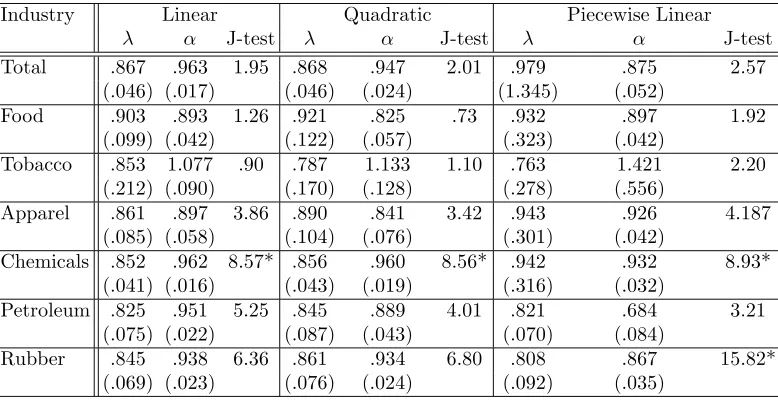
detrending implied by the above results. Parameter estimates and the J-test of model specification are
shown in Table 1.12 .
Given the imprecision of the parameter estimates, particularly forλ, it is difficult to gauge whether
12The model was also estimated with differenced data. However the resulting estimates forαwere either greater than
one or negative, which is counter to the assumptions of the model. Therefore we do not report these estimates.
13In estimating the model, equation 1.18 was multiplied by−βλto obtain a different normalization. The result gives
the different detrending procedures have a great impact. It is notable, however, that use of piecewise
linear detrending results in decidedly larger standard errors in most instances. In addition, there seems
to be little impact on the J-statistics testing model specification. Only in the case of the Rubber industry
does the change in detrending procedure affect the results of the specification test.
1.5.3
Other Implications
Despite the fact that there seems to be little effect on the outcome for this model, the above trend
specifications do imply permanent changes in the growth paths of the sales and inventory series at the
break dates. While previous research has indicated persistence in the inventory-sales relationship,14 if
a shift in trend for the sales series is not accompanied by a corresponding shift in inventories, then the
relationship between these two variables is permanently changed. Likewise for shifts in inventories that
do not induce shifts in sales. In the context of the L-Q model, this implies that the structural parameters
may change at these breakpoints. This can be seen in reference to the moment condition in Equation
1.18.
In order for this moment condition to remain true after a permanent shift in the growth path of just
one of the series, there must be a change in one or more of the parameters at that point. This means
that marginal costs will have changed at these points. One possible way to test for this would be to
estimate the model using subsets of the data defined by the breakpoints. If the resulting estimates differ
significantly, then this conclusion is supported. Other tests of structural change could also be applied
to the model to determine if the parameters do in fact change over the series’ histories. However, the
current study is intended to determine if different detrending methods will affect the parameter estimates
and such structural change tests are left for future consideration.
14Ramey and West (1997), using quarterly and annual data for the U.S., report impulse response curves indicating that
1.6
Forecasting
Another area where choice of model specification in a univariate sense can have an impact is in forecasting
models. In this case stationarity is not the goal. Instead we are looking to develop a model that performs
well in producing accurate forecasts. It has recently been shown in Diebold and Kilian (2000) that using
the results from unit-root tests to decide between use of a random walk with drift or a linearly trending
AR(1) process in forecasting a data series can lead to lower prediction mean squared errors (PMSE).
Given this, it is also likely that different choices of trend specification will result in markedly different
forecasting results.
Using the inventory series from above, we can look at the impact of three different model specifications
on out-of-sample forecasts. These models are a random walk with drift, a linearly trending AR(p) process, and an AR(p) with piecewise linear trend using the breakdates specified in Table 1.11.15 The choice ofp
is that chosen by the SIC pre-test model selection procedure outlined above. These choices are listed in
Table 1.13. The trend specifications given in the table are the result of unit root tests using this selection
procedure, so it seems prudent to include those autoregressive terms in our forecasting models.16 We are
interested in looking at the differences in time paths implied by the out-of-sample forecasts from these
different models. Determining the correct trend specification ought to greatly improve forecasts from
any model. It would be expected that basing out-of-sample forecasts on a model with breaks should
give quite a different result than the other models, since the breaks represent a discreet change in the
deterministic path of the series which isn’t present in the linear model. The question then becomes how
far out in the forecast horizon do we get before this difference becomes significant. Figures 1.8 through
1.10 show the out-of-sample forecasts for each model applied to each series.17 The results are in levels
(millions of dollars) so as to get a better idea of the magnitude of the differences between them. The
15Using a quadratic trend in a forecasting model does not seem to be a reasonable specification. Since the coefficient
on the quadratic trend term is generally negative, the longer the forecast horizon, the more dominant this term is likely to be as the forecasts converge to the series’ long run trend. We did look at this for the inventory series and for three of the series the quadratic trend model resulted in declining inventories into the future. For the three series in which this specification does not result in a declining forecast, the quadratic trend coefficient is either insignificant or very nearly so. For Total inventories a quadratic trend model did not converge to give parameter estimates.
16Campbell and Perron (1991) and Cochrane (1991) do simulations which include such pre-determined lagged variables
forecast horizon goes out to 120 periods, or ten years.
Notably, for Rubber inventories the forecasts of all three models are nearly indistinguishable for the
whole forecast horizon. The maximum difference, after 120 periods, is $52million between the linear
forecast and the piecewise linear. Recall, however, that a unit root was not rejected for this series for
any of the tests with the exception of Model AA, which rejected at the 10% level. It is interesting to see
that the wrong choice of forecasting model in this case would not have a great impact on the results,
even at long horizons. Unfortunately, this is unlikely to be true for most other forecasting applications,
as we shall see.
Also interesting are the forecasts for the Tobacco industry. The random walk model forecasts declining
inventories right from the start. Both the linear and piecewise linear models give a different picture,
with forecasts being very close to each other for several periods before diverging. It is difficult to see in
the figure, but these two forecasts reach a maximum difference at 68 periods. From there the piecewise
forecasts level out somewhat and the difference between the two shrinks as the forecasts from the linear
model approach those from the piecewise. Apparently they will cross at some point in the distant horizon.
Despite this, it is still obviously important to choose the right model from the start, as the maximum
difference in levels between the linear and piecewise models is over $100 million and the random walk
model gives an even greater difference in levels. In this case, the piecewise linear model was chosen in
the unit root testing and therefore should give the most reliable forecasts.
For Food inventories we found that a unit root was not rejected in any of the above testing procedures.
This suggests that the random walk model should be the one chosen for forecasting. Surprisingly, the
piecewise linear model gives forecasts that are fairly close to those from the random walk at short
horizons. The difference doesn’t reach $100 million for thirty-two periods, nearly three years. With
inventories in the twenty billion dollar range, this may be acceptable. The forecasts from the linear
model are lower and quickly diverge from those of the other two.
For Apparel inventories our testing indicates that the piecewise linear model is the best choice. Again
However, at the end of the 120 periods we have a difference of more than $800 million between these
models. Again there is a quick divergence in the linear model’s forecasts, resulting in a difference of
more than $1400 million from the piecewise model at the end of the forecast horizon. Again we see that
the choice of model clearly will have a significant impact at long horizons.
For Total inventories we had no rejections of a unit root from any of our testing other than the PT
test. This indicates a random walk model for forecasting. In this case, the linear model remains fairly
close to the random walk for several periods before reaching a difference of $100 million at the 12th
period. The maximum difference between these two is $910 million at the end of the forecast horizon,
which may not be too bad considering the inventory levels are in the $100 billion range. However, the
piecewise linear model results in a difference of nearly $5 billion from the random walk forecast at the
end of the horizon.
Finally, for both Chemicals and Petroleum we have a quick divergence between the two models
applied in each case. For Petroleum, a linear trend model was strongly indicated by the tests. Using
a random walk model quickly leads to a difference of more than $10 million within two periods and
a difference of more than $760 million by the end of the horizon. Clearly the choice of model has an
impact in this case regardless of forecast horizon. For Chemicals our tests indicate a single break model
as the best fit. Applying a random walk results in extreme differences in forecasts almost immediately,
$48 million in the first period and rising to more than $.5 billion in nine months. At the end of the
forecast horizon we see a difference of more than $5.6 billion.
While the figures indicate point forecasts that can differ greatly as we move further out in the forecast
horizon, by billions of dollars in some cases, only for three of the industries do the point forecasts for
the random walk with drift or the linear trend specification follow paths which takes them outside of the
forecast interval for the piecewise linear model. These are Food, Apparel, and Chemicals. For Food it
takes 74 periods for the linear model to give a forecast result that lies outside of this interval. For Apparel
it takes 75 periods for this to happen. For Chemicals, the linearly trending model did not converge, but
These results give an indication that choosing forecasting models on the basis of unit root tests can
result in a significant difference from just choosing a linear trend or random walk model. By including
the possibility of breaks in trend for these series we get another choice in our modelling. Apparently
this also can have a significant impact on forecasting results. Interestingly, at short horizons there was
not a great difference in forecasts from some of the models in some of the industries. As Diebold and
Kilian (2000) suggest, it would be interesting to expand their study to see whether these types of trend
specifications being included in unit root tests actually result in better forecasts when choosing models
on that basis.
1.7
Summary
This study has conducted a rigourous analysis of the time series properties of a widely used set of
inventory data. Applying recent advances in the unit root testing literature we find that when including
the possibility of one or more breaks in trend for each series, we can reject the presence of a unit root
in most cases. With these results in hand we choose models for detrending that remove piecewise linear
or linear deterministic trends from each of the series to attain stationarity. The resulting transformed
data is then used to test if there is any impact on the estimation results from a popular model of
inventory behavior when using different trend specifications for detrending. We find that the type
of trend specification does not greatly affect parameter estimates from the model or tests of model
specification based on GMM. However, standard errors do seem to be significantly affected by the type
of detrending procedure used.
In addition, there has been much interest in determining whether unit root tests are useful in the
selection of forecasting models. Again using the results from the unit root tests above we look at the
impact that different models have on forecasts out to 120 periods. We find that in many cases the models
other than the one selected in testing result in quite different forecasts, especially at long horizons. While
Table 1.1: Summary Statistics
Inventories
Total Food Tobacco Apparel Chemicals Petroleum Rubber
Mean 47084 12967 973 3073 11725 4379 4278
Standard Error 619 119 6 53 199 35 59
Median 47206 13193 968 2935 11897 4321 4296
Mode 26483 10140 957 2636 5563 3373 2016
Standard Deviation 13458 2594 132 1145 4329 767 1289
Minimum 21981 7643 469 1003 3739 2694 1863
Maximum 74700 18994 1379 5265 20431 6187 7089
Sales
Total Food Tobacco Apparel Chemicals Petroleum Rubber
Mean 94395 26820 3502 5093 18932 11075 6009
Standard Error 1114 261 20 45 268 99 136
Median 97786 26744 3570 5324 20010 11746 5565
Mode 91592 17758 3706 5933 8001 6910 1975
Standard Deviation 24232 5667 434 987 5834 2158 2957
Minimum 49747 17012 2058 2869 7294 6458 1774
Maximum 137308 37605 5538 6743 28483 15622 12510
Data is in in millions of chained 1992 dollars
Table 1.2: Adjustment Factors
Series Adjustment Factor
Food 1.3354
Tobacco 1.7044
Apparel 1.3056
Chemicals 1.4998
Petroleum 1.1465
Rubber 1.3185
Table 1.3: Prior Research
Paper Data Years Transformation Reported
Unit Root Tests
Blinder (1986) BEA 1959:2 - 1981:12 detrended none
Blinder and Maccini (1991) BEA 1959:1 - 1986:10 detrended none
Durlauf and Maccini (1995) BEA 1959:1 - 1990:6 detrended yes, but
un-specified
Eichenbaum (1989) BEA 1959:1 - 1984:12 separately
de-trended and
differenced
none
Fuhrer et al. (1995) BEA 1967:1 - 1991:8 none none
McCarthy and Zakrajsek (1998) BEA
Trade Goods
1959:1 - 1997:8 differenced panel data
version of
ADF
Miron and Zeldes (1988) BEA &
M3
1967:5 - 1982:12 detrended only none
Ramey (1991) BEA &
M3
1959:1 - 1979:12 detrended none
Ramey and West (1997) BEA &
Citibase
1959:1 - 1996:4 none none
Schuh (1996) M3LRD 1985 - 1993 detrended none
West (1990) Citibase 1947:1 - 1986:4 differenced Said-Dickey
Table 1.4: ADF Test: Optimal Lags and Results
HA1 HA2 HA3
Series kAIC kSIC kAIC kSIC kAIC kSIC
Inventories
Total 20 1 20 1 20 1
Food 1 1 1 1 1 1
Tobacco 5* 5* 5* 5* 5 5
Apparel 13 1 1** 1** 1** 1**
Chemicals 7** 0* 7 0 7 0
Petroleum 14 1** 3* 3* 3* 3*
Rubber 2 0 2 0 2 0
Sales
Total 24** 1 24 1 24 1
Food 4 1 1* 1* 1* 1*
Tobacco 12 5 12 5 12 5
Apparel 12 2 2* 1* 2* 1*
Chemicals 12 1** 12 1 12 1
Petroleum 23 2 23 0** 23 0**
Rubber 24 1 24** 0* 24 0*
Table 1.5: Elliot et al. Critical Values
T 1% 2.5% 5% 10%
DF-GLS
50 -3.77 -3.46 -3.19 -2.89
100 -3.58 -3.29 -3.03 -2.74
200 -3.46 -3.18 -2.93 -2.64
∞ -3.48 -3.15 -2.89 -2.57
PT
50 4.22 4.94 5.72 6.77
100 4.26 4.90 5.64 6.79
200 4.05 4.83 5.66 6.86
∞ 3.96 4.78 5.62 6.89
Table 1.6: Test Results
DF-GLS PT
Inventories
Total -0.798 1.148*
Food -2.058 9.788
Tobacco -2.462 6.033***
Apparel -1.409 18.114
Chemicals -0.542 95.417
Petroleum -3.509* 1.927*
Rubber -1.30 26.206
Sales
Total -0.939 36.349
Food -3.501* 3.815*
Tobacco -1.979 12.542
Apparel -2.679*** 4.435**
Chemicals -0.799 61.212
Petroleum -2.716*** 6.303***
Rubber -2.453 5.501*
* indicates significance at the 1% level ** indicates significance at the 5% level *** indicates significance at the 10% level
Table 1.7: Zivot and Andrews’ Critical Values
Model 1% 2.5% 5% 10% 50% 90% 95% 97.5% 99%
A -5.34 -5.02 -4.80 -4.58 -3.75 -2.99 -2.77 -2.56 -2.32
Table 1.8: Lumsdaine and Papell Critical Values
Model 1% 2.5% 5% 10%
AA -6.94 -6.53 -6.24 -5.96
CA -7.24 -7.02 -6.65 -6.33
CC -7.34 -7.02 -6.82 -6.49
Table 1.9: Structural Breakpoints and Test Results for Single-Break Models
Model A Model B Model C
Inventories t Date t Date t Date
Total -3.564 Sept. 1978 -3.175 Jan. 1967 -3.515 Nov. 1971
Food -4.217 July 1979 -3.558 May 1988 -4.391 Dec. 1981
Tobacco -8.205* Dec. 1993 -7.281* July 1992 -8.267* Dec. 1990
Apparel -4.770*** Oct. 1964 -5.022* Sept. 1966 -5.135** Nov. 1965
Chemical -3.926 May 1965 -4.449* March 1969 -4.561 July 1972
Petroleum -7.087* April 1962 -7.045* May 1963 -7.415* Feb. 1992
Rubber -4.236 Oct. 1979 -2.881 Dec. 1968 -4.374 Oct. 1979
Sales
Total -3.734 April 1979 -3.964 July 1972 -4.740 April 1979
Food -6.516* Nov. 1966 -6.122* Oct. 1972 -6.489* Nov. 1966
Tobacco -4.954** Oct. 1982 -2.925 May 1993 -4.654 Oct. 1982
Apparel -6.068* July 1988 -6.162* Dec. 1967 -6.253* Dec. 1978
Chemical -3.975 Feb. 1968 -4.222*** Feb. 1972 -5.000*** Aug. 1974
Petroleum -5.115** Feb. 1981 -6.234* Nov. 1976 -8.346* Feb. 1980
Rubber -5.110** April 1979 -4.298*** April 1972 -5.327* April 1979
Table 1.10: Breakpoints and Test Results for Two Breaks in Trend
Model AA Model CA Model CC
Inventories t Break 1 Break 2 t Break 1 Break 2 t Break 1 Break 2
Total -4.482 10/65 9/78 -5.302 9/72 9/78 -5.166 9/66 4/89
Food -4.750 9/60 7/79 -5.234 9/72 12/81 -5.255 5/68 4/89
Tobacco -9.476* 12/90 10/93 -10.176* 10/61 12/93 -10.536* 10/61 12/90
Apparel -5.756 5/62 7/65 -6.300 12/65 12/83 -6.372 10/68 9/83
Chemical -4.700 5/65 1/79 -6.083 11/72 1/79 -6.180 11/72 1/79
Petroleum -7.452* 4/62 -1/72 -7.800* 6/72 8/74 -7.956* 1/72 2/92
Rubber -6.117*** 11/67 10/79 -5.977 2/68 10/79 -5.674 4/68 10/79
Sales
Total -4.268 4/79 9/90 -5.483 6/74 2/80 -7.270** 8/74 8/79
Food -6.766** 9/61 11/66 -8.286* 3/72 11/85 -8.577* 8/72 1/76
Tobacco -5.502 10/82 12/94 -6.874** 10/82 12/90 -8.290* 10/82 1/93
Apparel -8.320* 12/63 7/88 -8.730* 7/74 6/75 -9.157* 8/72 6/75
Chemical -4.289 1/63 2/68 -7.777* 8/74 11/80 -7.530* 8/74 11/80
Petroleum -7.528* 3/81 4/90 -8.880* 1/80 3/81 -9.071* 1/74 1/80
Rubber -5.750 4/79 8/90 -6.540 3/74 4/79 -6.940** 11/74 4/79
* indicates significance at the 1% level ** indicates significance at the 5% level *** indicates significance at the 10% level
Table 1.11: Selected Models For Detrending
Inventories Model Break Dates
Total CC September 1966 and April 1989
Food CC May 1968 and April 1989
Tobacco A December 1993
Apparel B September 1966
Chemical B March 1969
Petroleum Linear None
Rubber AA November 1967 and October 1979
Sales
Total CC August 1974 and August 1979
Food Linear None
Tobacco CC October 1982 and January 1993
Apparel Linear None
Chemical CC August 1974 and November 1980
Petroleum C February 1980
Table 1.12: Estimation Results From Deterministic Detrending Procedures
Industry Linear Quadratic Piecewise Linear
λ α J-test λ α J-test λ α J-test
Total .867 .963 1.95 .868 .947 2.01 .979 .875 2.57
(.046) (.017) (.046) (.024) (1.345) (.052)
Food .903 .893 1.26 .921 .825 .73 .932 .897 1.92
(.099) (.042) (.122) (.057) (.323) (.042)
Tobacco .853 1.077 .90 .787 1.133 1.10 .763 1.421 2.20
(.212) (.090) (.170) (.128) (.278) (.556)
Apparel .861 .897 3.86 .890 .841 3.42 .943 .926 4.187
(.085) (.058) (.104) (.076) (.301) (.042)
Chemicals .852 .962 8.57* .856 .960 8.56* .942 .932 8.93*
(.041) (.016) (.043) (.019) (.316) (.032)
Petroleum .825 .951 5.25 .845 .889 4.01 .821 .684 3.21
(.075) (.022) (.087) (.043) (.070) (.084)
Rubber .845 .938 6.36 .861 .934 6.80 .808 .867 15.82*
(.069) (.023) (.076) (.024) (.092) (.035)
* indicates the model specification is rejected at the 95% level
Table 1.13: Choice ofpfrom SIC
Model
Industry Linear Piecewise Linear
Total 2 1
Food 2 2
Tobacco 6 1
Apparel 2 2
Chemicals 1 2
Petroleum 4 na
3/25/60 3/8/71 2/18/82 1/31/93 Date 7000 12000 17000 Food_I
3/25/60 3/8/71 2/18/82 1/31/93 Date
20000 30000 40000
Food_S
3/25/60 3/8/71 2/18/82 1/31/93 Date
600 1000 1400
Tobacco_I
3/25/60 3/8/71 2/18/82 1/31/93 Date 2000 3000 4000 5000 6000 Tobacco_S
3/25/60 3/8/71 2/18/82 1/31/93 Date 1000 2000 3000 4000 5000 6000 Apparel_I
3/25/60 3/8/71 2/18/82 1/31/93 Date 2000 3000 4000 5000 6000 7000 Apparel_S
3/25/60 3/8/71 2/18/82 1/31/93 Date 5000 10000 15000 20000 Chemical_I
3/25/60 3/8/71 2/18/82 1/31/93 Date
10000 20000 30000
Chemical_S
3/25/60 3/8/71 2/18/82 1/31/93 Date 2000 3000 4000 5000 6000 7000 Petrol_I
3/25/60 3/8/71 2/18/82 1/31/93 Date 7000 9000 11000 13000 15000 Petroleum_S
3/25/60 3/8/71 2/18/82 1/31/93 Date 2000 4000 6000 8000 Rubber_I
3/25/60 3/8/71 2/18/82 1/31/93 Date
4000 9000 14000
Rubber_S
3/25/60 3/8/71 2/18/82 1/31/93 Date
20000 30000 40000 50000 60000 70000 80000
Total_I
3/25/60 3/8/71 2/18/82 1/31/93 Date
40000 50000 60000 70000 80000 90000 100000 110000 120000 130000 140000
Total_S