447
Volume LIX 48 Number 7, 2011
BARRIERS TO DEVELOPMENT OF THE
INNOVATION POTENTIAL IN THE SMALL
AND MEDIUM-SIZED ENTERPRISES
J. Tabas, M. Beranová, J. Vavřina
Received: August 31, 2011
Abstract
TABAS, J., BERANOVÁ, M., VAVŘINA, J.: Barriers to development of the innovation potential in the small and medium-sized enterprises. Acta univ. agric. et silvic. Mendel. Brun., 2011, LIX, No. 7, pp. 447–458
It is a common fact, that innovations are the necessary prerequisite of economic development. With regard to the gradual globalization of the world economy, it is obvious that the strategic objectives of every country are directed to own economic wealth which is lead especially by the small and medium-sized enterprises. Due to the fact that these business entities are creating the most of economic growth of every country, the necessity of research, support and development of their innovation potential is obvious. The last and also the least that one could starve for is the building up the barriers to innovativeness of domestic companies, and to decrease competitiveness of the country.
In the paper, the authors are focused on the determination of barriers to innovation potential of small and medium-sized enterprises. For this reason, the secondary research of recent studies on innovation barriers has been elaborated. Subsequently, the primary research has been realized on the statistical sample of 173 SMEs. Based on the data analyses, the authors have proved four statistical interactions between innovation potential and factors which stand as barriers to innovation potential development.
This paper is based on the confrontation of outcomes of primary research with the secondary research on world-wide perceived barriers to innovations. Data obtained from the primary research had mostly the qualitative and categorical character. Due to this fact, especially Chi-square Test, normalized Pearson coeffi cient of contingence and Chuprov’s coeffi cient have been applied.
barriers to innovations, Chi-square test, innovation, innovation potential, small and medium-sized enterprise
The gradual economic globalization causes more intensive competition in every domestic market, while mentioned domestic markets are the focus business area for small and medium-sized enterprises (SMEs). It inevitably causes, that SMEs proceed their business activity with relatively high overheads, namely personal ones, and that is why it is diffi cult to face foreign competitors, especially from Asia and Eastern Europe (Tiwari & Buse, 2007). Ongoing globalization increases pressure on SMEs’ competitiveness, respectively on their innovative activities. The innovation strategy is a special activity area of each enterprise and no universal approach to innovation management exists. In accordance to this fact, many alternatives of assessing the
innovation behaviour of companies can be accepted (Nečadová & Scholleová, 2011). As the matter of fact, the most serious reason to enterprises’ innovation performances is undoubtedly to gain the long lasting market eff ect which would be a result of ongoing enterprises’ competitiveness. On that account it can be presumed, that larger enterprises are less innovate than SMEs despite existence of studies which states the opposite situation (e.g. Vossen, 1998).
OBJECTIVES AND METHODS
absolutely opposed elements. Nevertheless, there is always the requirement of a newness in most defi nitions, and many defi nitions set up a condition of bringing the innovation into practise, i.e. a precondition of economic lifespan and social utility. Innovation can be determined as a change which leads to gaining profi t for an individual, for an enterprise or for the whole society while this profi t is not the accounting one, but the economic profi t (see Tabas, Beranová & Polák, 2010). As it was mentioned above, the innovations could be essential precondition for lifespan and competitiveness of enterprises. On the other hand, there are a lot of objective and subjective factors, which limit the enterprises’ innovation potential or which can even eliminate any innovative activities of enterprises. These factors are consequently spoken as barriers of innovations.
Objective of the paper is to defi ne innovation barriers of SMEs in the Czech Republic. For this objective the secondary research has Been proceeded in order to identify barriers to innovations defi ned in recent studies. Subsequently, the primary research has been realized on the statistical set of 173 small and medium-sized enterprises from various branches where 11 statistical characteristics, mainly qualitative and categorical, have been observed. These characteristics have been selected as possible factors infl uencing the innovation potential of the SMEs. Selection of these characteristics has been made based on the secondary research on studies of the focused topic. In order to determine the interaction between these variables and the innovation potential, analyses of variables dependence have been applied, especially the Chi-square test, Pearson coeffi cient of contingence and Chuprov’s coeffi cient have been used while mainly the XLStatistics has been used at analysing data from the primary research. The results of provided analyses are consequently compared with results coming out from secondary research.
Specifi cation of innovation barriers Innovation barriers can be primarily dived into two groups, external or exogenous barriers, which cannot be infl uenced on the side of business entity, and internal or endogenous barriers objectively or subjectively occurring on the side of enterprise where these barriers can be minimized or eliminated by the actions of business entity.
Hadjimanolis (1999) further divides innovation barriers into those connected with a supply, those connected with demand, and barriers connected with a general environment. The supply side barriers involve e.g. scarcity of raw materials or unavailability of fi nancial resources. The demand side barriers are connected with customers’ needs and their attitude to risk of innovation, and with limitations of domestic or foreign market. Barriers of general environment consist in diff erent government regulations, anti-trust interventions of relevant government authorities etc.
The endogenous factors can be further divided into factors, which are connected with resources, i.e. for instance lack of internal resources, technical and technological facilities or also lack of time, and those related to the corporate culture and corporate systems, e.g. obsolete management system and mainly the factors of human nature like a managers’ perception of risk or employees’ attitudes toward changes (Hadjimanolis, 1999; Rush & Bessant, 1992).
Madrid-Guijarro et al. (2009) then classify internal and external barriers to innovations as follows: • Internal barriers
•
• lack of fi nancial resources,
•
• inappropriate human resources,
•
• weak corporate’s fi nancial position,
•
• high costs and high risk. • External barriers
•
• turbulent business environment,
•
• lack of external cooperation opportunities,
•
• lack of information,
•
• lack of government support.
Innovations require permanent overcoming of both types of innovations barriers mentioned above consisting especially in forthcoming changes which are inevitably connected with innovation processes. Innovation in its substance, inevitably force an enterprise to face more or less serious risk of both, exogenous and endogenous factors (Madrid-Guijarro et al., 2009; Genus & Coles, 2006). According to Borgelt & Falk (2007), negative impacts of possible risk can be very serious constraint of innovations.
A number of studies (see Tab. I) proved that the most serious barriers to innovations are mainly: • High costs, more precisely fi nancial
demandingness of innovations, • Institutional limitations, • Human resources, • Corporate culture, • Information fl ows, • Government policy.
corporate management of innovative enterprises is characterised mainly by their inclination to risk.
Andrew (2006) calls the barriers arising from institutional organization of an enterprise as siloing when the entities starve to create and to protect their own identity and to stay themselves somehow and to protect themselves. But at the same time, they build the frontiers establishing responsibility and determining strict internal corporate rules. This contradicts the basic fundamentals of innovations which are characterized by crossing the borders, by overcoming the barriers, and by creation of new categories. In this context, Nečadová & Scholleová (2011) state that innovation activities are more likely weaker in large enterprises, where the corporate management is separate from the stakeholders that leads to bureaucratization of a business entity. Bureaucracy also on the enterprise level inevitably causes prolongation of administrative processes and lead to strict following of internal corporate rules (Tiwari & Buse, 2007).
On the other hand, the outcomes of above mentioned studies are opposed by other studies (see e. g. Madrid-Guijarro et al., 2009; McAdam et al., 2004; Mosey et al., 2002; Storey, 2000 etc.) pointing out the fact that from the viewpoint of management, organizational culture and human resources the SMEs are likely resistant to the innovations while this resistance appeared especially where the very low sharing of management functions and managing competences and authorities exist, and where a manager-owner applies tight directive management style. From this point of view, it is possible to conclude that the size of a business entity is on a driving factor, these are especially corporate culture and organization, and the applied management style what creates the barriers to innovations here.
Creation and implementation of innovations naturally request loyalty and eff ort of employees. A weak support of the management eliminate and eff ort to build an innovative environment within the enterprise because innovation undoubtedly disturb any standard processes, routines or formulas (Baldwin & Lin, 2002; Shauteau & Rohrbaugh, 2000; Amenoglu & Pishke, 1999). The SMEs’ owners, who are their managers at the same time, have very o en lack suitable education in and experience with creating a successful innovation strategy (Hausman, 2005; Freel, 2000).
Another barrier even if it is connected with a corporate culture but more or less standing alone, is human resources. The frequently mentioned innovation barrier here is the lack of qualifi ed labour force, respectively an incapability of SMEs to hire and to maintain such a qualifi ed labour force (see e.g. Janasz, 2010; Stattev et al., 2010; D’Este et al., 2009; Giedraitis & Rasteniene, 2009 etc.).
This problem area is also associated with a lack of fi nancial resources in SMEs. SMEs, compared to larger companies are more sensitive to loss of qualifi ed labour force than the larger, fi nancially more stable business entities which usually present themselves as an attractive and prestige brand. Such a prestige brand also ensures a direct access to human capital abroad or access to human capital through a close cooperation with universities.
The lack of qualifi ed labour force is generally caused by two main factors, namely:
• Demographic development, respectively ageing of population,
• Decresing concern of students in technical education.
(Kejhová, 2010; Tiwari & Buse, 2007; Reinberg & Hummel, 2004).
Barriers to innovations concerning the human resources can be also found within labour code and other related codes, e.g. in the sense of high costs of social and health insurance which are again related to the problem of limited fi nancial resources of SMEs. Problems in the area human resources are also o en caused by internal employing policy of SMEs that is o en based on LIFO principle1 (Ylinenpää, 1998). It means that if there is a need to reduce a number of employees, the fi rst who are leaving are usually those who were hired as last. Nevertheless, newly hired employees are o en just the persons, who lead enterprises towards innovations. Already Schumpeter (1934) in his works where he has presented three elementary characteristics of innovative processes defi ned one of them in the way that innovations are implemented mainly by “new” people who have never played any managing role in business activities before.
Many authors (see e.g. Finley, 2010; Hilkevics & Stefenberga, 2010; Andrews, 2006; Loewe & Dominiquini, 2006; Hadjimanolis, 1999 etc.) have connected the innovation barrier of labour force with the lack of time. This in the context of other factors like a high level of risk, uncertain perspectives or need of a complex change implementation, create additional psychological stress that both, employees and especially managers have to face (Hilkevics & Stefenberga, 2010). According to Andrews (2006), time is a very scarce and expensive commodity. Subsequently it is important to take into account that the part of working time fund invested in employees’ education, personal development, extending contact portfolio, proceeding of experiments etc. create not only explicit costs but also implicit costs of uncertain economic settlement. Nevertheless, creation and sustainable development of innovative competences requires such expenditures.
Information fl ows as another identifi ed barrier to innovation, among others is also coherent with membership in diff erent professional bodies or
with placing the company in a technological park or enterprise incubator. An important role is also played by research and development (R&D), and by sharing the knowledge. It is obvious, according to diff erent points of view on innovations and innovation process and their defi nitions that innovations could be seen as an interactive process that requires creation of interactions among diff erent participant of a given process (Sebestyen & Parag, 2010; Tudor, 2010). According to Nazarova (2009) one of the reasons of insuffi cient institutional development of innovative enterprises is the absence of a developed infrastructure which maintains innovative processes. This infrastructure is not taken only as supplies of energy and raw materials, communication services, traffi c accessibility etc. (Tejinder, 2010), but it is mainly such a superstructure over this obvious and necessary basis, i.e. technological infrastructure, infrastructure for knowledge sharing etc. These components over an ordinary infrastructure are characteristic just for technological parks and enterprise incubators.
A number of defi nitions and descriptions of technological park exits providing the list of concepts of technological parks (Sokol, 2011; Marciniec, 2007). In the Czech Republic, there are concurrently about 40 technological parks,
when the biggest concentration of these parks is in Capital City of Prague, Central Bohemia and South Moravian Region2 while the reason for such a concentration is mainly location of important universities.
Information and knowledge fl ows are not related only to the presence of an enterprise in the technological park, but clusters play important role as well. For example Porter (1998) states, that clusters represent one of important business perspectives related to impact on innovations, competitiveness and economic wealth of regions. That is why the competitiveness is not discussed from a single business entity point of view only. The clusters potentially infl uence not only innovations within an enterprise, but also its competitiveness and economic performance, they reduce costs due to the business cooperation, and last but not least clusters create new working opportunities etc. (Zeibote, 2009). It can be stated, that clusters generally increase effi ciency of entrepreneurial activities (Ylinenpää, 1998).
The last barrier of innovation which is introduced in the list of most serious barriers is the government policy while mainly a low public support of enterprises’ innovation activities are mentioned in this context.
I: The overview of studies demarcating barriers to innovations
Barrier Study
Financial limitations of SMEs
• high costs of innovation
• accessibility of external fi nancial resources • high economic risk
Madrid-Guijarro et al. (2009); Silva et al. (2007); Tiwari & Buse (2007); Rammer et al. (2006); Mohen & Roller (2005); Baldwin & Gellatly (2004); Galia & Legros (2004); Frenkel (2003); Zwick (2002); Baldwin & Lin (2002); Garcia Martinez & Briz (2000); Storey (2000); Hadjimanolis (1999)
Lack of qualifi ed personnel
• fi nding and keeping qualifi ed employees • employee resistance to change
• management resistance to change • training of employees
Madrid-Guijarro et al. (2009); Silva et al. (2007); Tiwari & Buse (2007); Rammer et al. (2006); Mohen & Roller (2005); Galia & Legros (2004); Frenkel (2003); Zwick (2002); Baldwin & Lin (2002); Garcia Martinez & Briz (2000); Hadjimanolis (1999)
Organizational barriers
• limited internal know-how of innovation management
• managing style
• bureaucratization of business entity • corporate culture
Madrid-Guijarro et al. (2009); Tiwari & Buse (2007); Hewitt-Dundas (2006); Rammer at al. (2006); Mohen & Roller (2005); Baldwin & Gellatly (2004); Galia & Legros (2004); Frenkel (2003); Zwick (2002); Baldwin & Lin (2002); Garcia Martinez & Briz (2000); Hadjimanolis (1999); Ylinenpää (1998)
Innovation infrastructure
• technological parks and incubators • knowledge sharing
• external partners cooperation • information about technologies • marketing know-how
Sokol (2011); Sebestyen & Parag (2010); Madrid-Guijarro et al. (2009); Marciniec (2007); Tiwari & Buse (2007); Hewitt-Dundas (2006); Mohen & Roller (2005); Hausman (2005); Rammer et al. (2005); Scozzi et al.
(2005); Galia & Legros (2004); Frenkel (2003); Baldwin & Lin (2002); Zwick (2002); Freel (2000); Hadjimanolis (1999); Mohnen & Rosa (1999)
Insuffi cient government support Madrid-Guijarro Freel (2000); Hadjimanolis (1999)et al. (2009); Tiwari & Buse (2007); Frenkel (2003);
Source: Authors elaboration
Studies in the area of barriers to innovations provide, propose and discuss also other barriers which limit development of innovative potential of SMEs. Their overview is presented in Tab. I.
Barriers to innovations of SMEs in the Czech Republic
Based on secondary research of which results are presented in previous part of this paper, the authors identifi ed the variables possibly infl uencing the innovation potential of SMEs. Their interaction with the innovation potential has been tested on the statistical sample of 173 small and medium-sized enterprises. Regarding the structure of the questionnaire used in the primary research, the observed variables were not defi ned identically to variables which had been identifi ed within elaborated secondary research on recent studies. Selected variables in the primary research are as follows:
• Size of business entity, • Legal form of business entity, • Type of business activity,
• Membership in professional bodies,
• Ownership of business entity (foreign owners of company),
• Independence of business entity (daughter company in a group),
• Financial resources of funding the innovation, • R&D in a company,
• Place of doing business, • Government support.
Infl uence of the size of business entity is rather disputable. As it was mentioned in the previous part of this paper, some studies assumes that bigger innovation potential, due to their higher fl exibility, is on the side of SMEs. Some other studies oppose that bigger innovative potential is on contrary on the side of larger companies mainly due to their better access to fi nancial and other resources, e.g. human resources. Chi-square Test for independence of two nominal variables that was applied on the values observed on the statistical sample of SMEs on signifi cance level of = 0.05 accepted the null hypothesis that there is no statistical dependence between innovation potential and the size of business entity. In this context, and also regarding to divergences in current studies, it is possible to objectively assume that the size of business entity have factually no infl uence on its innovation potential. It is more likely institutional organization, corporate culture and other similar factors, what infl uence innovation potential of a company. The same methodical approach was applied in order to prove the interaction between innovation potential and legal form of business entity when it has been proved that statistical interaction between these variables exist neither. The results of these Chi-square Tests are presented in Fig. 1 and 2.
The type of business activity, as another possible factor infl uencing the innovation potential is considered especially because of a fact that some types of business activities are pointed out as a highly innovative and on the other hand, there are types of business activities which are not connected with innovations at all. Nevertheless, considering that innovations need not to be inevitably the technical ones, and as innovations can be defi ned also on the level of processes and activities, it is not excluded that innovation potential can be assigned to any enterprise, regardless the type of business activity. This hypothesis was proved by test for independence of variables of innovative potential and type of business activity. On signifi cance level
= 0.05 it was proved that there is no statistical dependence between these two variables.
It has come out from several studies of various authors that enterprises’ participation in professional bodies or its presence in clusters should support development of innovation potential through access to information, respectively through sharing the knowledge and know-how. Here, the Chi-square test on signifi cance level of = 0.05 has
Analysis of r x c tables
(Pearson) Chi-square test (For independence of V and H)
H0: Variables are independent (no interaction between variables) H1: Variables are dependent (interaction between variables)
Chi-square 3.282851065 DF 2
p-value = 0.193703
1: Results of Chi-square test between innovation potential and size of business entity
Analysis of r x c tables
(Pearson) Chi-square test (For independence of V and H)
H0: Variables are independent (no interaction between variables) H1: Variables are dependent (interaction between variables)
Chi-square 5.291000387 DF 4
p-value = 0.258721
2: Results of Chi-square test between innovation potential and legal form of business entity
Analysis of r x c tables
(Pearson) Chi-square test (For independence of V and H)
H0: Variables are independent (no interaction between variables) H1: Variables are dependent (interaction between variables)
Chi-square 21.66331049 DF 16
p-value = 0.154399
rejected the null hypothesis about independence between these two variables. It means that statistical interaction between these two variables exists. The results of Chi-square Test are presented in Fig. 4. Considering the fact that it was tested only variables specifying participation of business entity in professional bodies, chambers etc., but not other forms of cooperation, the stated dependence can be pointed out as relatively low.
Another investigated infl uence on existence of innovation potential was ownership of business entity, respectively if there is a foreign owner of business entity. This variable is in coherence with possible providing of resources by economically stronger foreign partner. The resources are considered to be not only in fi nancial form however also in a form of know-how base, managerial skills etc. Proceeded Chi-square Test for independence of variables on the signifi cance level = 0.05 has accepted the null hypothesis, i.e. there is no statistical dependence between innovation potential and ownership of business entity. The results of Chi-square Test are presented in Fig. 5.
The ownership of business entity also corresponds with other observed variable, namely independence of business entity, i.e. capital interconnection of certain business entity with other companies, i.e. if the business entity is a part of group of enterprises, namely part of holding. In the Czech Republic, is a common practise that a mother company is drawing the resources of its daughter companies. In such a case the daughter companies have to face the lack of resources for fi nancing innovations. On the other hand, there are cases, when parental company
fi nances development of its daughter companies. Chi-square Test does not provide information about direction of dependence. It can only accept or reject the hypothesis about the independence between two nominal of categorical variables. Chi-square Test for independence of variables on the level of signifi cance = 0.05 accept the null hypothesis, i.e. there is no statistical dependence between mentioned variables.
The variable which is very o en a subject of great discussions is the fi nancial resources for funding the innovation activities, especially because of the lack of equity and diffi cult access to external capital for fi nancing the innovation. Null hypothesis within the Chi-square Test has been rejected on signifi cance level = 0.05, i.e. the statistical dependence between innovation potential and fi nancial resources exists there. In this context, it should be suitable to mention that almost 66 % of investigated business entities have fi nanced the implemented innovation only from internal fi nancial resources. A combination of internal and external fi nancial resources has been used by 31.5 % of business entities.
Dependence between price of innovation and type of innovation has been tested as well in the connection to the area of fi nancial resources. Chi-square test on the signifi cance level = 0.05 has proved that there exist statistical dependence between price of innovation and type of innovation. Results of Chi-square Test are presented in Fig. 8.
Analysis of r x c tables
(Pearson) Chi-square test (For independence of V and H)
H0: Variables are independent (no interaction between variables) H1: Variables are dependent (interaction between variables)
Chi-square 4.040675024 DF 1
p-value = 0.044416
4: Results of Chi-square test between innovation potential and professional bodies participation
Analysis of r x c tables
(Pearson) Chi-square test (For independence of V and H)
H0: Variables are independent (no interaction between variables) H1: Variables are dependent (interaction between variables)
Chi-square 0.636188538 DF 1
p-value = 0.425094
5: Results of Chi-square test between innovation potential and ownership of business entity
Analysis of r x c tables
(Pearson) Chi-square test (For independence of V and H)
H0: Variables are independent (no interaction between variables) H1: Variables are dependent (interaction between variables)
Chi-square 3.859309935 DF 2
p-value = 0.1451983
6: Results of Chi-square test between innovation potential and independence of business entity
Analysis of r x c tables
(Pearson) Chi-square test (For independence of V and H)
H0: Variables are independent (no interaction between variables) H1: Variables are dependent (interaction between variables)
Chi-square 6.758712821 DF 2
p-value = 0.034069
Many authors in their studies state and prove that innovation potential of a business entity is dependent on whether the enterprise has its own R&D. The coherence between innovation potential and R&D was another object of Chi-square Test on signifi cance level = 0.05. This test has proved that there exist statistical dependence between these two variables, and it proves results of previous studies of dependence between innovation potential and R&D. Results of Chi-square Test are presented in Fig. 9.
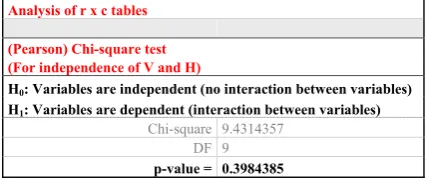
Regarding the innovation potential in connection with infrastructure available, the authors have tested also a dependence of innovation potential and settlement of business entity, respectively the size of municipality. Authors presumed that developed infrastructure of towns have a positive infl uence on innovation potential of settled business entities. However this presumption was not proved. Chi-square Test on the signifi cance level of = 0.05 pointed out the independence between variables of innovation potential and size of settlement despite the fact that most enterprises with innovative potential settle in towns with more than 50 thousand inhabitants. On the other hand, in these towns, there have been identifi ed also the biggest share of enterprises without innovative potential. Regarding these fi ndings, it could be deducted that the size of settlement infl uences only concentration of business entities, but it does not infl uence innovation potential of them at all.
The last tested variable was dependence between innovation potential of SMEs and government support. Result of the test for independence of two mentioned variables on signifi cance level of
= 0.05 has led to acceptation of the null hypothesis about independence between these two variables. Regarding to this result, it can be stated that concurrent government support of innovations in the Czech Republic does not have an essential infl uence on development of innovation potential of SMEs and that is why the current support of SMEs innovation potential can be considered as insuffi cient. According to these fi ndings, results of previous studies on government support and innovation potential, which pointed out the insuffi cient government support as the barrier to innovations, are possible to be agreed. Results of Chi-square Test are presented in Fig. 11.
In coherence with investigated relation between innovation potential of SMEs and government support, the perception of government support in the context of anti-crisis government arrangements as a reaction to worldwide economic crisis, has been tested as well. The Chi-square Test on signifi cance level of = 0.05 has rejected the null hypothesis, i.e. the statistical dependence between variables of perception of government support and innovation potential exists. Results of the test are presented in Fig. 12. According to this result it can be stated that perception of government support of SMEs infl uences competitiveness of business entities and even more, it can infl uence the whole national economies. Current government activities for supporting development of business entities are percept as insuffi cient, and this way, they could be pointed out as the barrier to development of innovation potential.
Analysis of r x c tables
(Pearson) Chi-square test (For independence of V and H)
H0: Variables are independent (no interaction between variables) H1: Variables are dependent (interaction between variables)
Chi-square 61.92760889 DF 18
p-value = 9.94983E-07
8: Results of Chi-square test between price of innovation and type of innovation
Analysis of r x c tables
(Pearson) Chi-square test (For independence of V and H)
H0: Variables are independent (no interaction between variables) H1: Variables are dependent (interaction between variables)
Chi-square 9.705539058 DF 1
p-value = 0.001837
9: Results of Chi-square test between innovation potential and R&D
Analysis of r x c tables
(Pearson) Chi-square test (For independence of V and H)
H0: Variables are independent (no interaction between variables) H1: Variables are dependent (interaction between variables)
Chi-square 2.158787181 DF 4
p-value = 0.706581109
10: Results of Chi-square test between innovation potential and size of settlement
Analysis of r x c tables
(Pearson) Chi-square test (For independence of V and H)
H0: Variables are independent (no interaction between variables) H1: Variables are dependent (interaction between variables)
Chi-square 9.4314357 DF 9
p-value = 0.3984385
DISCUSSION OF RESULTS AND
CONCLUSION
The objective of the paper was to determine the barriers to innovations, respectively the barriers to development of innovation potential of small and medium-sized enterprises in the Czech Republic. The authors have defi ned these barriers on both, on the general level based on the secondary research as well as on the specifi c level based on the primary research and data analysis. The primary research has been initially based on the premise that innovation potential of business entities is necessarily infl uenced by general conditions of the current business environment, e.g. Reynolds et al. (2002) defi nes these general conditions as availability of capital for business entities, government policy and government support programmes for entrepreneurship, level of education in population, skills and abilities to application of knowledge into practise, transfer of the outcomes of research and development results into business sphere, mentality of entrepreneurs, infrastructure of regions etc. Concerning to this list of general conditions, it is obvious that many of these factors can be and are
taken into account as barriers to innovations, and that these conditions have a power to form the innovation potential of a business entity either positively, or negatively. By the Ministry of Industry and Trade of the Czech Republic, domestic business environment is generally assessed as below-average compared to the European Union while it makes a list of barriers to innovation in the Czech Republic which are considered to be most serious. Regarding the given assessment, these barriers are as follows3: • Lack of fi nancial resources,
• Structure of tertiary education that does not answer future needs of industry,
• Insuffi cient mutual relation between research and development and business entities.
Realized primary research aimed at identifi cation of barriers to innovations of small and medium-sized enterprises in the Czech Republic, included 173 business entities. The data obtained were tested for 12 possible dependences between nominal variables. In this context, four dependences have been proved. These statistically signifi cant interactions have been proved between innovation potential and:
• Research and development proceeded by a business entity itself,
• Perception of Government support to business entities’ innovative potential,
• Financial resources,
• Participation of business entities in professional bodies and chambers.
Dependence between these variables and innovation potential has been proved by Chi-square Test on signifi cance level = 0.05. Nevertheless, this test does not express the strength of existing statistical dependence. Considering this fact,
Analysis of r x c tables
(Pearson) Chi-square test (For independence of V and H)
H0: Variables are independent (no interaction between variables) H1: Variables are dependent (interaction between variables)
Chi-square 8.457322473 DF 3
p-value = 0.037447875
12: Results of Chi-square test between innovation potential and perception of government support
3 According to the Ministry of Industry and Trade of the Czech Republic, Operational Programme Enterprise and Innovation. Available from: http://www.mpo.cz/dokument78086.html
normalized Pearson coeffi cient of contingence and Chuprov’s coeffi cient have been used in order to measure the strength of dependence between innovative potential and identifi ed barriers to innovations. The methodologies of the coeffi cient calculations are diff erent and that is why the single results are not the same fi gures. Nevertheless, the order of variables according to the strength of interaction with the innovation potential is the same. The strength of dependency between each investigated factors and innovative potential of an enterprise is displayed in Fig. 13.
Fig. 13 clearly shows that the strongest dependence exists between innovation potential of business entities and research a development realized by their selves. It is followed by the second strongest dependency, namely perception of government support to innovative potential. As the third most serious barrier to innovations the factor of fi nancial resources for innovations is assessed. On
the other hand, the weakest dependence of proved dependencies between variables is the interaction between innovation potential of business entity and its participation in professional bodies. Considering the structure and possibilities of realized primary research, it was not possible to prove relationship between innovation potential and human resources.
The ultimate results of this paper correspond to National Innovation Strategy of the Ministry of Industry and Trade of the Czech Republic which is implemented in the Operational Programme Enterprise and Innovation. This operational programme can be considered as very important public fi nancial resource for funding the innovations of small and medium-sized enterprises involving co-fi nance from EU’s public budget. Authors are able to prove correctness of set objectives within the Operational Programme Enterprise and Innovation.
SUMMARY
Currently, innovations are infl ected in various connections as they are perceived as the necessary precondition to develop and to maintain the competitiveness of business entities as well as the competitiveness of the whole regions. Despite of the importance of innovations, some factors decreasing the ability to innovate still exist there. These factors are presented as barriers to innovations. Objective of this paper is to determine the barriers to innovations of small and medium-sized enterprises in the Czech Republic. In order to fulfi l this objective, the authors have realized secondary research as well as own primary research. The aim of the secondary research was to observe barriers to innovations described in precedent studies elaborated by various authors from diff erent countries. Outcome of this secondary research consists in fi ve main groups of innovations barriers which are agreed by nearly all the researchers. These factors stand particularly on the side of fi nancial resources, human resources, organization and management, infrastructure, and government support of innovations.
The primary research has included 173 SMEs from the Czech Republic. The authors defi ned 11 factors potentially infl uencing the innovation potential of business entities, and they have analysed the interactions between given variables. As these variables are defi ned as nominal, the Chi-square test for independence of variables have been applied while the signifi cance level in every test has been set as = 0.05. From 11 hypothesized interactions, only four have been proved as statistically signifi cant, respectively the null hypothesis about independence of variables has been rejected. One of the factors which are o en discussed in various studies that may potentially infl uence an innovation potential of business entity is the size of an enterprise. But this variable is quite disputable; some authors argument that big companies have higher innovation potential than SMEs because of easies access to fi nancial resources and generally stronger position. Other authors oppose when they state that innovation potential of small and medium-sized enterprises is higher because of they are more fl exible. At application of the Chi-square test, the null hypothesis about independence between the innovation potential and the size of a business entity, has been accepted, i.e. no interaction between these two variables exists. In this context, it is possible to conclude that it is not the size of enterprise, but it’s mainly organizational structure and culture what is infl uencing the innovation potential there.
The factors which infl uence has been proved as statistically signifi cant for the innovation potential than are:
• R&D;
• Perception of government support; • Financial resources;
• Company’s participation in professional bodies.
of contingence and with Chuprov’s coeffi cient. The order of variables according to the strength of interaction corresponds with the order of bullets above.
This way, outcomes and conclusion of the realized primary research correspond with the innovation strategy of the Ministry of the Industry and Trade of the Czech Republic which is implemented into the Operational Programme Enterprise and Innovation with the purpose to support development and maintenance of innovation potential of business entities in the Czech Republic.
Acknowledgements
This paper is the outcome of the project IGA: Identifi kace bariér zvyšování inovačního potenciálu malých a středních podniků v ČR (No. 37/2011).
REFERENCES
AMENOGLU, D., PISHKE, J. S., 1999: Beyond Becker: Traning in Imperfect Labor Markets. The Economic Journal, Vol 109, No. 453, pp. 112–143, February 1999.
ANDREWS, P., 2006: Five barriers to innovation: Key questions and answers. IBM Executive Business Institute, November 2006.
BALDWIN, J. R., GELLATLY, G., 2004: Innovation Strategies and Performance in Small Firms. Northampton: Edward Elgar Publishing. 392 pages. ISBN 1 84376 370 2.
BALDWIN, J., LIN, Z., 2002: Impediments to advanced technology adoption for Canadian manufactures. Research Policy, Vol. 31, pp. 1–18, 2002.
BORGELT, K., FALK, I., 2007: The leadership/ management conundrum: Innovation or risk management. Leadership and Organization Development Journal, Vol. 28, No. 2, pp. 122–136, 2007. ISSN 0143-7739.
Czech Invest, 2006: Technologické parky a vědecko-technologické parky. [On-line] http://www. c e n t e r s . c z / P RO J E C T % 2 0 P RO P E RT Y % 2 0 ARCHIVE/2006/zima/52_57_technologicke%20 parky.pdf.
D’ESTE et al., 2009: Revealed versus Deterring Barriers to Innovation. Evidence from the 4th
Community Innovation Survey (CIS4), DIUS Research Report 09–09, May 2009.
FINLEY, K., 2010: The Top 5 Barriers to Enterprise Innovation. October 2010. [On-line] http:// www.readwriteweb.com/enterprise/2010/10/ enterprise-innovation.php.
FREEL, M. S., 2000: Barriers to product innovation in small manufacturing fi rms. International Small Business Journal, Vol. 18, No. 2, pp. 60–80.
FRENKEL, A., 2003: Barriers and Limitations in the Development of Industrial Innovation in the Region. European Planning Studies, Vol. 11, No. 2, pp. 115–137, March 2003. ISSN 1469-5944.
GALIA, F., LEGROS, D., 2004: Complementarities between barriers to innovation: evidence from France. Research Policy, Vol. 33, No. 8, pp. 1185– 1199, October2004.
GARCIA MARTINEZ, M., BRIZ, J., 2000: Innovation in the Spanish food & drink industry. International
Food and Agribusiness Management Review, Vol. 3, No. 2, pp. 155–176, June 2000.
GENUS, A., COLES, A. M., 2006: Firm strategies for risk management in innovation. International Journal of Innovation Management, Vol. 10, No. 2, pp. 113–126, Jun 2006. ISSN 1757-5877.
GIEDRAITIS, V., RASTENIENE, A., 2009: Crisis as a catalyst: the role of Schumpeterian innovation in the Lithuanian economy. Perspectives of Innovations, Economics and Business, Vol. 2, No. 2, pp. 11–13, 2009. HADJIMANOLIS, A., 1999: Barriers to innovation for SMEs in small less developer country (Cyprus). Technovation, Vol. 19, pp. 561–570, 1999.
HAUSMAN, A., 2005: Innovativeness Among Small Businesses: Theory and Propositions for Future Research. Industrial Marketing Management, Vol. 34, No. 8, pp. 773–782, November 2005. ISSN 0019-8501.
HEWITT-DUNDAS, N., 2006: Resource and Capability Constraints to Innovation in Small and Large Plants. Small Business Economics, Vol. 26, No. 3, pp. 257–277, April 2006. ISSN 0921-898X.
HILKEVICS, S., STEFENBERGA, D., 2010: Business functions approach to innovative and non-innovative business comparison in Latvia. Perspectives of Innovations, Economics and Business, Vol. 5, No. 2, pp. 14–16, 2010. ISSN 1804-0527.
JANASZ, K., 2010: Capital and fi nancing innovation processes in enterprises in Poland: selected aspects. Perspectives of Innovations, Economics and Business, Vol. 4, No. 1, pp. 26–28, 2010. ISSN 1804-0527.
KEJHOVÁ, H., 2010: Klempíři, zedníci jsou profese, které vymírají. Hospodářské noviny, 1.3.2010. [On-line] http://hn.ihned.cz/c1-40805770-klempiri-zednici-jsou-profese-ktere-vymiraji.
LOEWE, P., DOMINIQUINI, J., 2006: Overcoming the barriers to eff ective innovation. STRATEGY & LEADERSHIP, Vol. 34, No. 1, pp. 24–31, 2006. ISSN 1087-8572.
MADRID-GUIJARRO, A. et al., 2009: Barriers to Innovation among Spanish Manufacturing SMEs. Journal of Small Business Management, Vol. 47, No. 4, pp. 465–488, 2009.
MARCINIEC, B., 2007: Rola parków naukowo-technologicznych w rozwoju małych I średnich
przedsiębiorstw. Poznań: Wydawnictwo Poznańskie,
McADAM, R. et al., 2004: Barriers to innovation within small fi rms in a peripheral location. International Journal of Entrepreneurial Behaviour & Research, Vol. 10, No. 3, pp. 206–221, ISSN 1355-2554.
MOHEN, P., ROLLER, L-H., 2005: Complementari-ties in innovation policy. European Economic Review, Vol. 49, No. 6, pp. 1431–1450, August 2005. MOHEN, P., ROSA, J., 1999: Barriers to Innovation
in Services Industries in Canada. Sciences & Technologies: Statistics Canada, No. 7, November 1999. Catalogue No. 88F0017MIE1999007.
MOSEY, S. et al., 2002: Innovation Decision Making in British Manufacturing SME’s. Integrated Manufacturing Systems, Vol. 13, No. 3, pp. 176–184. ISSN 0957-6061.
NAZAROVA, R., 2009: Management of innovative activity under economic and fi nancial changes. Perspectives of Innovations, Economics and Business, Vol. 2, No. 2, pp. 18–19, 2009.
NEČADOVÁ, M., SCHOLLEOVÁ, H., 2011: Motives and barriers of innovation behaviour of companies. Economics and Management, Vol. 16, 2011. ISSN 1822-6515.
PORTER, M., 1998: Clusters and competition: New agendas for companies, governments, and institutions. In: M. Porter, On competition. Boston: Harvard Business School Press, pp. 197–287. ISBN 0-87584-795-1.
RAMMER et al., 2006: Innovationspotenziale von kleinen und mittleren Unternehmen. Baden-Baden: Nomos. pages 196. ISBN 978-3-8329-1788-3.
REINBERG, A., HUMMEL, M., 2004: Fachkrä e-mangel bedroht Wettbewerbsfähigkeit der deut-schen Wirtscha . Aus Politik und Zeitgeschichte, Vol. B 28, pp. 3–10, July 2004.
REYNOLDS, P. D. et al., 2002: Global Entrepreneurship Monitor: 2002 Executive Report. Kansas City (USA): Kauff man Center for Entrepreneurial Leadeship, 2002.
RUSH, H., BESSANT, J., 1992: Revolution in three-quarter time: lessons from diff usion of advanced manufacturing technologies. Technology Analysis and Strategic Management, Vol. 4, No. 1, pp. 3–19, 1992.
SCOZZI, B. et al., 2005: Methods for modeling and supporting innovation processes in SMEs. European Journal of Innovation Management, Vol. 8, No. 1, pp. 120–137. ISSN 1460-1060.
SEBESTYEN, T., PARAG, A., 2010: The dynamics of link formation in patent innovator networks. Perspectives of Innovations, Economics and Business, Vol. 4, No. 1, pp. 21–25, 2010. ISSN 1804-0527.
SHANTEAU, J., ROHRBAUGH, C., 2000: Social/ psychological barriers to successful management of technological innovation. In B. Green, et al. (Eds.), Risk behaviour and risk management in business life. Dordrecht: Kluwer Academic Publishers, pp. 151–159. ISBN 978-0-7923-5868-8.
SCHUMPETER, J. A., 1934: Theory of Economic Development. Cambridge: Harvard University Press, Mass.
SILVA, M. J. et al., 2007: Barriers to Innovation faced by Manufacturing Firms in Portugal: How to overcome it? Munich Personal RePEc Archive, Paper No. 5408, November 2007.
SOKOL, A., 2011: A technology park as an institution that supports transfer of innovation and knowledge to the SME sector companies. Perspectives of Innovations, Economics and Business, Vol. 7, No. 1, pp. 35–39, 2011. ISSN 1804-0527.
SOUITARISE, V., 2001: Strategic Infl uences of Technological Innovation in Greece. British Journal of Management, Vol. 12, No. 2, pp. 131–147, June 2001. ISSN 1467-8551.
STATTEV, S. et al., 2010: Barriers and future policy directions to knowledge demand and absorption in South end East Bulgaria. Perspectives of Innovations, Economics and Business, Vol. 5, No. 2, pp. 7–13, 2010. ISSN 1804-0527.
STOREY, J., 2000: The management of innovation problem. International Journal of Innovation Management, Vol. 4, No. 3, pp. 347–369, September 2000. ISSN 1757-5877.
TABAS, J., BERANOVÁ, M., POLÁK, J., 2010: Zhodnocení přístupů ke kategorizaci inovací. Acta Universitatis agriculturae et silviculturae Mendelianae Brunensis, Vol. LVIII, No. 6, pp. 563–570. ISSN 1211-8516.
TEJINDER, S., 2010: Role of innovation in growth of countries. Perspectives of Innovations, Economics and Business, Vol. 4, No. 1, pp. 15–17, 2010. ISSN 1804-0527.
TIWARI, R., BUSE, S., 2007: Barriers to Innovation in SMEs: Can the Internationalization of R&D Mitigate Their Eff ects? In: First European Conference on Knowledge for Growth: Role and Dynamics of Corporate R & D – CONCORD 2007, Seville, 8–9th October 2007.
TUDOR, F., 2010: The minimis aid, a possible alternative for supplementing the budgets of SMEes for enhancing competitiveness through the capacity of innovation – the Romanian case. Perspectives of Innovations, Economics and Business, Vol. 4, No. 1, pp. 45–48, 2010. ISSN 1804-0527.
VOSSEN, R. W., 1998: Combining Small and Large Firm Advantages in Innovation: Theory and examples. SOM Research Report, 1998.
YLINENPÄÄ, H., 1998: Measures to overcome barriers to innovation in Sweden – Fits and Misfi ts. In EFMD European Small Business Seminar in Vienna.
Vienna, 16–18th September 1998.
ZEIBOTE, Z., 2009: Stimulation of innovations: case of the Latvian IT cluster. Perspectives of Innovations, Economics and Business, Vol. 2, No. 2, pp. 7–10, 2009. ZWICK, T., 2002: Employee resistance against
Address