IJEDR1401069
International Journal of Engineering Development and Research (www.ijedr.org)398
A Review on 3D Face Recognition Techniques
1
Chintan J. Kavathiya,
2Anurag P. Lakhlani,
3Yatish Y. Jani
1PG-EC student, 2Assistent Professor, 3 PG-EC student
Marwadi Education Foundation’s Faculty of P.G.Studies & Research in Engineering & Technology, Rajkot, Gujarat, India 1 [email protected], 2 [email protected],
____________________________________________________________________________________________________ Abstract—In this paper, the exploration of new face recognition technology that is 3D face recognition is being analyzed. Face Recognition is widely used for security at many places like airport, organizations, many devices etc. The challenges faced in 2D face recognition technology is been solved through various approaches mentioned in the paper. The various techniques are adapted for 3D face recognition like Principal Component Analysis , Independent Component Analysis, Linear Discriminate Analysis but we focus on Linear Discriminate Analysis. The various implementation approaches widely accepted is been discussed. Each process in the face recognition consists of sub-process and the sub-process is categorized into registration, representation, extraction of discriminative features.
Index Terms— Face recognition; range image; PCA; LDA; ICA; Eigen faces.
I.INTRODUCTION
Now a days with the network world, the way for crime is become easier than before. Because of this reason, network security has become one of the biggest concerns facing today's IT departments. .We heard a lot about hackers way to steal any password or pin code, crimes of ID cards or credit cards fraud or security breaches in any important building and then reach any information or important data from any organization or company. These problems allow us to know the need of strong technology to secure our important data. This technology is based on a technique called “biometrics". Biometric is a form of bioinformatics that uses biological properties to identify people. Since biometric systems identify a person by biological characteristics, they are difficult to fake. Examples of biometrics are iris scanning, signature authentication, voice recognition and hand geometry. Face Recognition is the process to identify the input test face from the stored dataset. Face Recognition Technology (FRT) is used in several disciplines such as image processing, pattern recognition, computer vision etc. in which research is been continuously carried out. More recently face recognition as a “biometric technology (whereby the face is physiological trait that uniquely identifies an individual) has become a hot topic of modern day research as a result of the growing pressure to exploit faces as a means of identification from both the commercial and law enforcement. New databases have been created and evaluations of recognition techniques using these databases have been carried out. Now, the face recognition has become one of the most active applications of pattern recognition, image analysis and understanding.Automated face recognition technologies are also in use in both the civilian and Law enforcement areas.Face Recognition fall into two categories: verification and identification. Face verification is a 1:1 match that matches a face against the template face images whose identity is to be claimed. Face identification is 1:N problem that compares a query face image against all image templates in face database to determine the identity of the query face. During 1964 and 1965, Bledsoe, along with Helen Chan and Charles Bisson [2], worked on using computers to recognize human faces at Stanford institute. Bledsoe designed and implemented a semi-automatic system. Some face coordinates were selected by a human operator, and then computers used this information for recognition. He described most of the problems that even 50 years later Face Recognition still suffers - variations in illumination, head rotation, facial expression, and aging. Researches on this matter still continue, trying to measure subjective face features as ear size or between-eye distance. For instance, this approach was used in Bell Laboratories by A. Jay Goldstein, Leon D. Harmon and Ann B. Lesk [3] in which how well can human faces be identified by humans and by computers, using subjectively judged "feature" descriptions like long ears, wide-set eyes. Although the first fully functional implementation of an automated faces recognition system was not produced until Kanade‟s paper [4] in 1977. They described a vector, containing 21 subjective features like ear protrusion, eyebrow weight or nose length, as the basis to recognize faces using pattern classification techniques. In the last five years, a rapid increase for the need to design 3D face recognition algorithms has taken place both in academy and industry. However, it is clearly visible that the 3D face recognition technology is at the beginning steps. The motivation to use 3D technology was to overcome the disadvantages of 2D face recognition systems that arise especially from significant pose, expression and illumination differences. However, with the exception of few recent works, most of the 3D systems generally study controlled frontal face recognition. With the construction of bigger 3D face databases that contain enough samples for different illumination, pose, and expression variations, it is expected to develop more realistic 3D face recognition.
II.CHALLENGESINFRT
There are two major challenges faced during the testing, those are illumination problem and pose variation problem. Both these problems are serious and cause the degradation of the existing system. These problems can be formulated and a common approach could be followed by sequencing the operations face detection, face normalization and inquire database.
A. Illumination Problem
IJEDR1401069
International Journal of Engineering Development and Research (www.ijedr.org)399
illumination-invariant and the measure of the same object changes when illumination changes. An illumination subspace can be constructed but one drawback of this method is that many of the faces of one person are needed to construct the subspace. Methods have been developed to solve the illumination problem the approaches have been divided into four categories: First is heuristic methods including and discarding the leading principal components. Second, image comparison methods where various image representations and distance measures are applied. In class-based methods where multiple images of one face under a fixed pose but different lighting conditions are available. Finally in model-based approaches 3D models are employed.B. Pose Problem
Researchers have proposed various methods to handle the rotation problem. Basically they can be divided into three classes: a). multiple images based methods: when multiple images per person are available. This method is based on illumination cone to deal with illumination variation. For variations due to rotation, it needs to completely resolve the GBR (generalized-bas-relief) ambiguity when reconstructing 3D surface. b). hybrid methods: when multiple training images are available during training, but only one database image per person is available during recognition. Numerous algorithms of the second type have been proposed and are by far the most popular ones. Possible reasons for this are: i) It is probably the most successful and practical method up to now, ii) It utilizes prior class information., and c).single image/shape based methods when no training is carried out. In these methods, face shape is usually represented either by a polygonal model or a mesh model which simulates issue.
III.DEPTH BASED APPROACH
It is very popular to convert 2.5D facial data to a depth image, also called the range image. Each pixel in the depth image represents the distance of the corresponding 3D facial point to the camera. Although some sensors are capable of producing range images directly, point cloud data acquired from sensors is usually converted to yield depth images. During the conversion, some information may be lost. Most importantly, two sources of information loss should be mentioned: Firstly In the surface areas whose normal are almost perpendicular to the camera view, such as the lower nose regions, a significant portion of the depth measurements is generally under-represented in the depth images, and Secondly, 8-bit standard gray-level quantization may lose accuracy information. Another important concern in depth image construction is the conversion of irregularly sampled 3D points to a regular (x, y) grid. To accomplish this task, interpolation methods are generally used.
A.Principal Component Analysis (PCA)
IJEDR1401069
International Journal of Engineering Development and Research (www.ijedr.org)400
B.Independent Component Analysis (ICA)
In [14], While PCA decorrelates the input data using second-order statistics and thereby generates compressed data with minimum mean-squared reprojection error, ICA minimizes both second-order and higher-order dependencies in the input. It is intimately related to the blind source separation (BSS) problem, where the goal is to decompose an observed signal into a linear combination of unknown independent signals. Let s be the vector of unknown source signals and x be the vector of observed mixtures. If A is the unknown mixing matrix, then the mixing model is written as x = As It is assumed that the source signals are independent of each other and the mixing matrix A is invertible. Based on these assumptions and the observed mixtures, ICA algorithms try to find the mixing matrix A or the separating matrix W such that u =Wx =WAs is an estimation of the independent source signals ICA can be viewed as a generalization of PCA. As previously discussed, PCA decorrelates the training data so that the sample covariance of the training data is zero. Whiteness is a stronger constraint that requires both decorrelation and unit variance. The whitening transform can be determined as D-1/2RT where D is the diagonal matrix of the eigenvalues and R is the matrix of orthogonal eigenvectors of the sample covariance matrix. Applying whitening to observed mixtures, however, results in the source signal only up to an orthogonal transformation. ICA goes one step further so that it transforms the whitened data into a set of statistically independent signals. Signals are statistically independent when the probability density function is equivalent to say that the vectors u is uniformly distributed.Unfortunately, there may not be any matrix W that fully satisfies the independence condition, and there is no closed form expression to find W. Instead, there are several algorithms that iteratively approximate W so as to indirectly maximize independence. Since it is difficult to maximize the independence condition above directly, all common ICA algorithms recast the problem to iteratively optimize a smooth function whose global optima occurs when the output vectors u are independent.
C.Linear Discriminant Analysis (LDA)
This approach is also known as fisher-surface approach. In LDA we find the linear transformations such that feature cluster are most separable after transformation. We apply PCA and LDA to surface representations of 3D face models, producing a subspace projection matrix, taking advantage of „within-class‟ information, minimizing variation between multiple face models of the same person, yet maintaining high class separation. To accomplish this we use a training set containing several examples of each subject, describing facial structure variance (due to influences such as facial expression), from one model to another. From the training set we compute three scatter matrices, representing the within-class (SW), between-class (SB) and total (ST) distribution from the average surface and classes‟ averages. The training set is partitioned into c classes, such that all surface vectors in a single class are of the same person and no person is present in multiple classes. Calculating eigenvectors of the matrix, and taking the top 250 (number of surfaces minus number of classes) principal components, we produce a projection matrix. This is then used to reduce dimensionality of the within-class and between-class scatter matrices (ensuring they are non-singular) before computing the top c-1 eigenvectors of the reduced scatter matrix ratio. Finally, the matrix Uff is calculated, such that it projects a face surface vector into a reduced space of c-1 dimensions, in which the ratio of between-class scatter to within class scatter is maximized for all c classes. Like the eigenface system, components of the projection matrix Uff can be viewed as images, as shown in Figure. 4 for the depth map surface space. Once surface space has been defined, we project a facial surface into reduced surface space by a simple matrix multiplication. The vector is taken as a „face key‟ representing the facial structure in the reduced dimensionality space. Face-Keys are compared using either Euclidean or cosine distance measures. An acceptance (facial surfaces match) or rejection (surfaces do not match) is determined by applying a threshold to the distance calculated. Any comparison producing a distance value below the threshold is considered an acceptance.
IV.FACE RECOGNITION TECHNOLOGY
A.Definition
As we all know that almost the security system in the airports, huge hotel and especially in the police led depend on the use of advanced protection system that based on the computer programs. Theses program verifying people present and also thieves. This system is based database for pictures of people criminals, thieves and others with picture captured by a surveillance camera. So a facial recognition system is a computer application for automatically identifying a person digital image that its source is already sorted in the database. Actually, it is works by comparing the selected facial features from the image and a facial database.
B.Face Measure
Every human face has many distinctive features are in a various meandering on the face. The program is based on these parameters nodal points. Each face has approximately 80 nodal points. Almost facial recognition programs analyze the relative position, size, and/or shape of the eyes, nose, cheek boons and jaw. The most famous features of the face measured by a program are:
1. The distance between the eyes. 2. The depth of the eye.
3. Nasal breadth.
4. The form of the cheek boon. 5. Along the jaw line.
IJEDR1401069
International Journal of Engineering Development and Research (www.ijedr.org)401
C.Face Recognition Types
2D System In the past [4], facial recognition programs depended on two dimension (2D) picture to compare it with the image sorted in the data base, but these programs did not succeed only if the person is looking just to the camera. Of course anyone suspect will be warned that he/she will see a camera in place, and here lies the problem where this fails by depending on the 2D system. Beside, the additional changes in the environment surrounding the person, such as light will produce images the computer cannot have in the corresponding memory, also the changes in the same person can cause a system failure in face recognition [5, 6].
3D System Modern system for face recognition based on the pattern of three-dimensional (3D) [8], where the special cameras will captured images of three-dimensional views of the suspected person, and using the special main features of each face that are not changed significantly with time , such as eye hole, the distance between the eyes, nose shape and others mentioned above. These features are a source of information for a facial recognition system as the changes in the lighting or surrounding environmental conditions do not affect these measurements, for example: can operate these systems in any lighting conditions even if the place was dark and even if the person is not in the face of camera.
D.3D Face Recognition
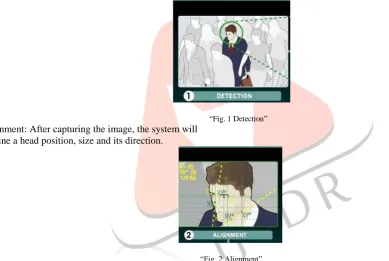
How 3D Procedure Work: The use of depth and focus of the face that does not affect the change in lighting is known as three-dimensional face recognition system. The software system that relay on three-three-dimensional technique with a series of steps to eventually be able to perform a face recognition procedure. We can divide the whole process by the following steps. Steps involve in the face recognition system are: (fig 1)
Fig. 1 the steps of 3D face recognition system.
1) Detection: Capture a digital image by a two dimensional digital camera or even using a video camera.
“Fig. 1 Detection” 2) Alignment: After capturing the image, the system will
determine a head position, size and its direction.
“Fig. 2 Alignment”
3) Measurement: The software (specific program) will calculate the curves and meanders on the face to an accuracy of part OS the millimeter. Then the program ready to convert that information to establish a face model or pattern.
“Fig. 3 Measurement”
IJEDR1401069
International Journal of Engineering Development and Research (www.ijedr.org)402
“Fig. 4 Representation”
5) Matching: In the case that the picture is threedimensional and corresponding to the three- dimensional images that stored in the database, the comparisons between the images are immediately. But the challenge facing these systems is that most of the images stored in database are in two-dimensional.
“Fig. 5 Matching”
The development of a new technology support the use of three different points to get to know any face sorted in database. Some of these points are outside of the eyes, inside the eyes and the tip of the nose. The conduct of the system will carry out these measurements on the dimensions between these points of three-dimensional picture and begin to be converted to two-dimensional images through the application of complex mathematical algorithms. After the conversion process, of this part, the system begins to work of comparison.
6) Verification or Identification: In the step of recognition, the program will compared the images and match them with pictures of the database sorted by the system in the Previous step. But if the goal is verify the result of the previous step, the system compares the image with all images in the database and then matching results are displayed in percentages [3].
“Fig. 6 Verification or Identification”
V.REFERENCES
[1] R. Chellappa, C.L. Wilson, and Sirohey, “Human and Machine Recognition of Faces, A survey,” Proc. of the IEEE, Vol. 83, pp. 705-740, 1995.
[2] “Face Recognition Algorithms” Proyecto Fin de Carrera June 16, 2010I on Marqu´es
[3] A. Jay Goldstein, Leon D. Harmon, Ann B. Lesk , "Man Machine Interaction in Human Face Identification", Proceedings of IEEE, USAF, AFIT/GREENG/87D-35; "Neural Networks Primer, Part I", Maureen Caudill.
[4] Jeffrey F. Cohn, Adena J. Zlochower, James Lien, and Takeo Kanade , “Automated face recognition”
[5] Belhumeur, P.N.; Hespanha, J.P.; Kriegman, D.J., “Eigenfaces vs. Fisher faces: recognition using class specific linear projection” Pattern Analysis and Machine Intelligence, IEEE Transactions on , Volume: 19 Issue: 7 , Jul 1997 Page(s): 711 -720
[6] Boulbaba Ben Amor1, Karima Ouji1, Mohsen Ardabilian1, Liming Chen , “3D Face recognition BY ICP-based shape matching” LIRIS Lab, Lyon Research Center for Images and Intelligent Information Systems, UMR 5205 CNRS Centrale Lyon, France.
[7] G. Gordon, “Face Recognition from Depth Maps and Surface Curvature", in Proc. of SPIE, Geometric Methods in Computer Vision, San Diego, July 1991. Vol. 1570.
[8] Beumier, C. and M. Acheroy, “Face verification from 3D and grey level cues", Pattern Recognition Letters, Vol. 22, pp. 1321-1329, 2001.
IJEDR1401069
International Journal of Engineering Development and Research (www.ijedr.org)403
[10] Zhang, L., A. Razdan, G. Farin, J. Femiani, M. Bae, and C. Lockwood, “3D face authentication and recognition basedon bilateral symmetry analysis", Visual Comput (22), p. 4355, 2006.
[11] Feng, S., H. Krim, I. Gu, and M. Viberg, “3D Face Recognition using Affine Integral Invariants", Proc. of. ICASSP, pp. 189-192, 2006.
[12] Tanaka, H., M. Ikeda, and H. Chiaki, “Curvature-based face surface recognition using spherical correlation principal directions for curved object recognition", Third International Conference on Automated Face and Gesture Recognition, pp. 372- 377, 1998.
[13] Turk, M. and A. Pentland, “Eigenfaces for recognition", Journal of Cognitive Neurosciences, Vol. 3, No. 1, pp. 71-86, 1991.
[14] Hyvarinen, A. and E. Oja, “Independent Component Analysis: Algorithms and Applications", Neural Networks, Vol. 13, No. 4-5, pp. 411-430, 2000.
[15] Tanaka, H., M. Ikeda, and H. Chiaki, “Curvature-based face surface recognition using spherical correlation principal directions for curved object recognition", Third International Conference on Automated Face and Gesture Recognition, pp. 372-377, 1998.
[16] Gordon, G., “Face Recognition Based on Depth and Curvature Features", Proc. Of the IEEE Computer Society Conf. on Computer Vision and Pattern Recognition, pp. 108-110, 1992.
[17] Bronstein, A., M. Bronstein, and R. Kimmel, “Three-dimensional face recognition", International Journal of Computer Vision, Vol. 64, No. 1, pp. 5-30, 2005.
[18] C. Nastar and M. Mitschke, "Real time face recognition using feature combination," in Third IEEE International Conference on Automatic Face and Gesture Recognition. Nara, Japan, 1998, pp. 312-317.
[19] S. Gong, S. J. McKenna, and A. Psarrou., Dynamic Vision: From Images to Face Recognition: Imperial College Press (World Scientific Publishing Company),58A Survey of Face Recognition Techniques 2000.
[20] T. Jebara, "3D Pose Estimation and Normalization for Face Recognition," Center for Intelligent Machines, McGill University, Undergraduate Thesis May, 1996.