1
Adoption of small-scale irrigation farming as a climate-smart agriculture practice and its influence on household income in the Chinyanja Triangle, Southern Africa
Nelson Mango1*, Clifton Makate1, Lulseged Tamene2, Powell Mponela2, Gift Ndengu2
1. International Centre for Tropical Agriculture (CIAT), P.O. Box MP 228, Mt. Pleasant, Harare, Zimbabwe.
2. International Centre for Tropical Agriculture (CIAT), c/o Chitedze Agricultural Research Station, P.O. Box 158, Lilongwe, Malawi.
* Corresponding Author: Tel: +254722270913, e-mail: [email protected]
2
Abstract
This article concerns the adoption of small-scale irrigation farming as a climate-smart agriculture practice and its influence on household income in the Chinyanja Triangle. Chinyanja Triangle is a region that experiences mid-season dry spells and an increase in occurrences of drought due to low and erratic rainfall patterns which is attributed largely to climate variability and change. This poses high agricultural production risks, which aggravate poverty and food insecurity. For this region, adoption of small-scale irrigation farming as a climate-smart agriculture practice is very important. Through a binary logistic and ordinary least squares regression, the article determines factors that influence the adoption of small-scale irrigation farming as a climate-smart agriculture practice and its influence on income among smallholder farmers. The results show that off-farm employment, access to irrigation equipment, access to reliable water sources and awareness of water conservation practices, such as rainwater harvesting have a significant influence on the adoption of small-scale irrigation farming. On the other hand, the farmer’s age, distance travelled to the nearest market and nature of employment negatively influenced the adoption of small-scale irrigation farming decisions. Ordinary least squares regression results showed that the adoption of small-scale irrigation farming as a climate-smart agriculture practice has a significant positive influence on agricultural income. We therefore conclude that to empower smallholder farmers to quickly respond to climate variability and change, practices that will enhance adoption of small-scale irrigation farming in the Chinyanja Triangle are critical as this will significantly impact on agricultural income.
3
1. Introduction
The rural poor in Sub Sahara Africa (SSA) earn their livelihoods mostly from climate-sensitive rain-fed agriculture. Their production is typically limited to a 3-6 months rainy season and crops grown are mainly staple cereal crops meant to sustain their livelihoods [1]. However, yields for these crops are subject to weather driven fluctuations and are generally low. Dependence of smallholder farmers in SSA on such climate sensitive, seasonal staple production systems often lead them into facing multiple-scale poverty traps [2]. More so, this often makes economies in the region (SSA) the most vulnerable to climatic variability and changes [3, 4, 5].
4
It is critically important to consider small-scale irrigation as a conventional practice in smallholder agriculture that improves: farm productivity, adaptation to climate variability and change and achievement of household and national developmental goals. In sub-Saharan Africa, the adoption of small-scale irrigation farming is hugely important for smallholder farmers, especially when one considers that rainfall is highly unreliable and insufficient in many places [6, 11]. Drought – especially mid-season – due to low and erratic rainfall, poses high uncertainty and agricultural production risks in sub-Saharan Africa [12]. This leads to threats of widespread poverty and food insecurity. Small-scale irrigation is possibly a viable climate-smart technology to consider in SSA given that the continent have ample fresh water resources [8] even though their distribution is not even across agro-ecological zones. More so, small-sale irrigation is an important step towards intensification of farming systems [13], and in helping farmers insure against drought risk and transform their farming activities [14, 15]. More so, small-scale irrigation also necessitates off-farm production which improves food supplies [16].
With regard to the views above, this article aims to analyse the adoption of small-scale irrigation as a climate-smart agriculture practice in the Chinyanja Triangle, southern Africa, and assess its contribution to people’s livelihoods.. More specifically, the article aims to identify factors that influence smallholder farmers’ decisions to adopt small-scale irrigation and assess the influence of adoption on household incomes. Data from smallholder farming systems in the Chinyanja triangle found in southern Africa is used.
2. Related literature on small-scale irrigation farming and livelihood outcomes
5
6
In India, Chamber [22] found out that reliable and adequate irrigation increases employment opportunities, disposable incomes which ultimately contributes to food security. More so, Singh et al.[23] also carried out his study in India and found small-scale irrigation to be effective in reducing poverty. Also in India, Hussain et al.[24] reiterated that access to affordable and reliable irrigation leads to improved productivity and greater returns from farming. More so, this creates employment opportunities both on and off-farm which can transform into improved livelihoods and improved quality of life in the countryside [18, 24, 25]. Related, Kumar [26] also confirmed the positive effects of small-scale irrigation in boosting India’s food production and generating surpluses which can be used as drought buffer.
In a slightly different region of Southern Africa, Mudima [27] carried out an investigation on five irrigation schemes on their livelihood impacts. The study show that irrigation schemes acted as sources of food security for the participants and their surrounding communities. The main livelihood contributions of the irrigation schemes came through increased productivity, stable production and incomes. Also, the study found out that members of the irrigation schemes never ran out of food supplies as compared to their counterparts relying on rain-fed agriculture.
7
targeting improved out and up-scaling of small-scale irrigation adoption for effective adaptation to climate variability and change in the region are derived.
3. Research methods
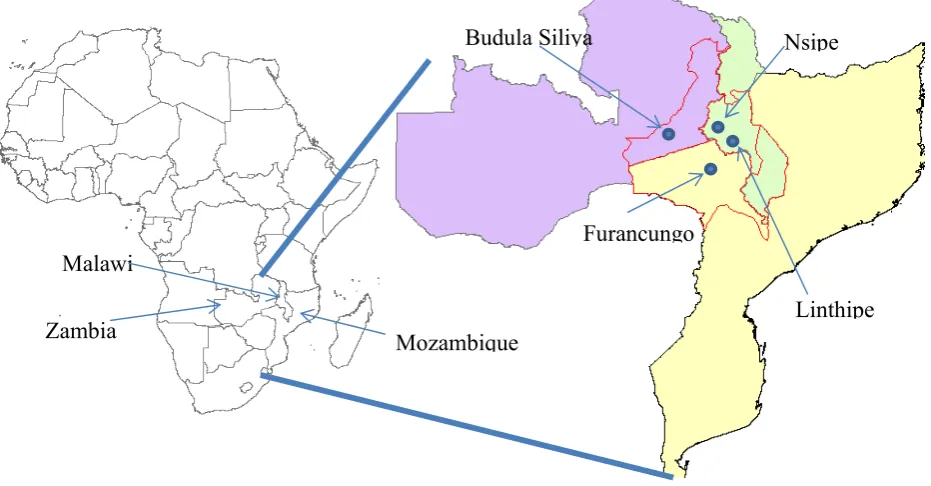
3.1. Description of study sites
8
Figure 1: Map showing the location of the Chinyanja Triangle and research sites
3.2. Sampling methods, data collection and data source
3.2.1.Sampling
Sampling units for this study were drawn using the multistage spatially stratified random sampling design of the Land Degradation Surveillance Framework [30]. Four sites, as described in Section 2.1, were used to make up the sample data. There are 16 clusters within each site. For the Africa Rising sites, the two mother trials (established during the 2012/13 growing season) were used as centre clusters with the other 14 clusters randomly spread around them. Each cluster covers an area of 2 km2 with 10 randomly located sampling plots from where a Land
Condition Survey (LCS) was conducted. For each cluster, five farmers who owned odd numbered plots (1, 3, 5, 7 and 9) were considered for a socioeconomic questionnaire. The socioeconomic data was collected from owners of the plots sampled during the LCS, thereby
Zambia Mozambique
Malawi
Budula Siliya Nsipe
Furancungo
9
geo-referencing farmers to their sampled plots and not their place of residence. Plot owners were identified during the LCS by locals from the nearest village.
3.2.2.Data collection and source
The household survey was conducted to collect primary household socioeconomic data using structured questionnaires. Collected data includes the socio demographic and economic characteristics of the households, land characteristics and Integrated Soil Fertility Management (ISFM) technology usage, livestock ownership and species, as well as irrigation and water harvesting technology practices. Extension service personnel, agriculture research officers and trained enumerators collected data between December 2012 and June 2013. Data on different livestock species was further converted into standard livestock units (LUs) using nutritional and feed requirement factors for sub-Saharan Africa [31, 32].
10
3.3. Data analysis
In this article, both descriptive and econometric data analysis methods are used. The crop production system in the studied areas on the four different sites represents multi-crop agricultural production. Where land holdings are fixed, the allocation of land into crop type and the adoption of small-scale irrigation farming are possibly endogenous. The adoption decision of small-scale irrigation farming and associated technologies is distinct, as a farmer can decide to adopt or not adopt, in which case the smallholder farmer faces a dichotomous decision problem to adopt or not adopt irrigation farming. In this context, smallholder irrigation farming adopters practised irrigation farming at the time of the survey, while the rest are taken as non-adopters. Similar definitions of adopters and non-adopters have been used by other writers [34]. In the OLS-based impact analysis, only farmers who had practised irrigation farming for at least one season were considered. The econometric models for adoption and the model on the effect of the adoption of small-scale irrigation farming on income are specified in Section 2.3.1 below.
3.3.1 Modelling the adoption of small-scale irrigation farming
11
the probability of a dichotomous outcome (adoption or non-adoption) is related to a set of explanatory variables and has been widely applied in adoption studies [32, 34, 36-40] . In this research, smallholder farmers’ adoption of small-scale irrigation farming is based on an assumed underlying utility function. According to this model, the farmer will adopt small-scale irrigation farming if the utility obtained from small-scale irrigation faming exceeds that of non-adoption. Considering the probability of an event = Prob (Y = 1 if the smallholder farmer adopted and 0 otherwise), the smallholder farmer’s behaviour towards irrigation farming is described as an indirect utility that is derived from the adoption of small-scale irrigation farming, which is a linear function of k explanatory variables (X) expressed as:
Zi = + ∑ ,
(1)
where is the intercept term and , , ,……, are the coefficients associated with each of the k explanatory variables (X1, X2, X3,…,Xki). The X vector of variables (including
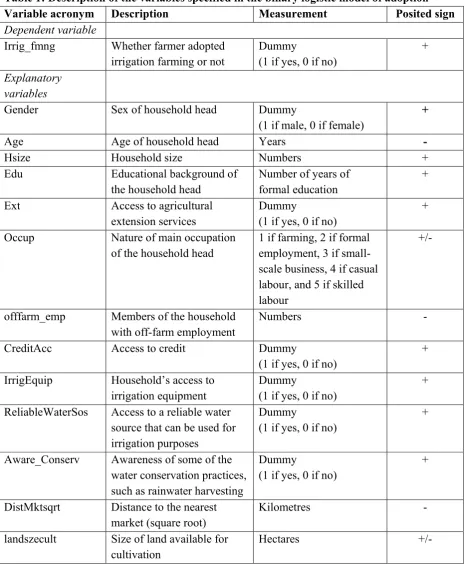
socioeconomic, farming, institutional factors and other household-specific characteristics that influence the individual farmer’s decision whether to adopt or not) explains the adoption of irrigation farming by the smallholder farmer, i.e. it explains the likelihood of the adoption of irrigation farming by the individual (ith) farmer (see Table 1).
Considering Pi = , where Pi denotes the probability of the ith farmer’s adoption decision and
(1-Pi) is the probability of non-adoption, the odds of adoption (Y = 1) versus theodds of
12
probability of non-adoption (1-Pi), namely odds = ⁄(1 − ) [41]. By taking the natural
logarithms, one gets the prediction equation for the individual farmer:
Ln ( ) = + ∑ = Zi , (2)
where Zi is referred to as the odds ratio in favour of the adoption of irrigation farming.
3.3.2 Variable selection and hypothesis on adoption decisions model
13
Table 1: Description of the variables specified in the binary logistic model of adoption
Variable acronym Description Measurement Posited sign
Dependent variable
Irrig_fmng Whether farmer adopted irrigation farming or not
Dummy
(1 if yes, 0 if no)
+
Explanatory variables
Gender Sex of household head Dummy
(1 if male, 0 if female)
+
Age Age of household head Years -
Hsize Household size Numbers +
Edu Educational background of
the household head
Number of years of formal education
+
Ext Access to agricultural extension services
Dummy
(1 if yes, 0 if no)
+
Occup Nature of main occupation of the household head
1 if farming, 2 if formal employment, 3 if small-scale business, 4 if casual labour, and 5 if skilled labour
+/-
offfarm_emp Members of the household with off-farm employment
Numbers -
CreditAcc Access to credit Dummy
(1 if yes, 0 if no)
+
IrrigEquip Household’s access to irrigation equipment
Dummy
(1 if yes, 0 if no)
+
ReliableWaterSos Access to a reliable water source that can be used for irrigation purposes
Dummy
(1 if yes, 0 if no)
+
Aware_Conserv Awareness of some of the water conservation practices, such as rainwater harvesting
Dummy
(1 if yes, 0 if no)
+
DistMktsqrt Distance to the nearest market (square root)
Kilometres -
landszecult Size of land available for cultivation
14
3.3.3 Modelling effect of the adoption of irrigation farming on income
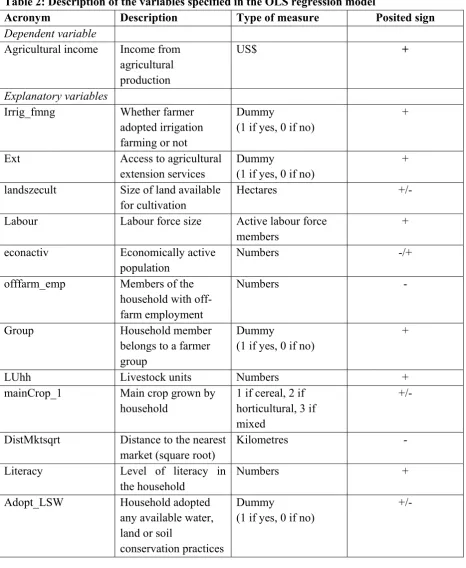
The continuous dependent variable is agricultural income. As such, the OLS regression model can be used without a doubt. Getacher et al. [34] have also used the approach to estimate the effect of irrigation technology adoption on total agricultural income. To estimate the effect of the adoption of irrigation farming on household agricultural income, a multiple OLS regression model is used that is specified as follows:
= + + + ⋯ … . . + + + ,
(3)
where = agricultural income;
is a vector of the household’s socioeconomic characteristics and other farm-specific characteristics. These characteristics include LUs, contact with agricultural extension and labour;
denotes the adoption of small-scale irrigation farming status for a farmer; a dummy variable is specified as 1 for adopters and 0 for non-adopters; and
15
Table 2 below shows the explanatory variables used in the OLS regression model with their specifications.
Table 2: Description of the variables specified in the OLS regression model
Acronym Description Type of measure Posited sign
Dependent variable
Agricultural income Income from agricultural production
US$ +
Explanatory variables
Irrig_fmng Whether farmer
adopted irrigation farming or not
Dummy
(1 if yes, 0 if no)
+
Ext Access to agricultural
extension services
Dummy
(1 if yes, 0 if no)
+
landszecult Size of land available for cultivation
Hectares +/-
Labour Labour force size Active labour force members
+
econactiv Economically active
population
Numbers -/+
offfarm_emp Members of the
household with off-farm employment
Numbers -
Group Household member
belongs to a farmer group
Dummy
(1 if yes, 0 if no)
+
LUhh Livestock units Numbers +
mainCrop_1 Main crop grown by household
1 if cereal, 2 if horticultural, 3 if mixed
+/-
DistMktsqrt Distance to the nearest market (square root)
Kilometres -
Literacy Level of literacy in the household
Numbers +
Adopt_LSW Household adopted
any available water, land or soil
conservation practices
Dummy
(1 if yes, 0 if no)
16
3.3.4 Descriptive statistics of variables used in the two econometric models
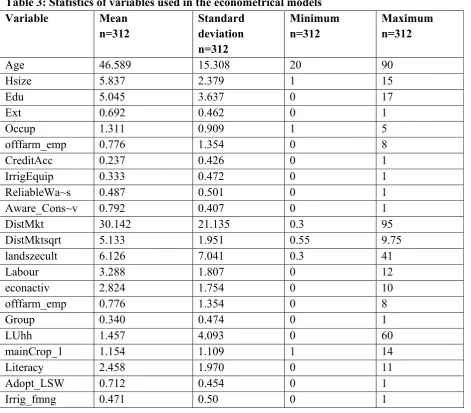
The statistics of the variables specified in the two empirical models (the adoption of irrigation farming model and the income model), as shown in Table 1 and Table 2, are given in Table 3 below. The table shows summary statistics on the profile of enumerated smallholder farmers.
Table 3: Statistics of variables used in the econometrical models Variable Mean n=312 Standard deviation n=312 Minimum n=312 Maximum n=312
Age 46.589 15.308 20 90
Hsize 5.837 2.379 1 15
Edu 5.045 3.637 0 17
Ext 0.692 0.462 0 1
Occup 1.311 0.909 1 5
offfarm_emp 0.776 1.354 0 8
CreditAcc 0.237 0.426 0 1
IrrigEquip 0.333 0.472 0 1
ReliableWa~s 0.487 0.501 0 1
Aware_Cons~v 0.792 0.407 0 1
DistMkt 30.142 21.135 0.3 95
DistMktsqrt 5.133 1.951 0.55 9.75
landszecult 6.126 7.041 0.3 41
Labour 3.288 1.807 0 12
econactiv 2.824 1.754 0 10
offfarm_emp 0.776 1.354 0 8
Group 0.340 0.474 0 1
LUhh 1.457 4.093 0 60
mainCrop_1 1.154 1.109 1 14
Literacy 2.458 1.970 0 11
Adopt_LSW 0.712 0.454 0 1
17
4. Results and discussion
4.1. Validity of the binary logistic model
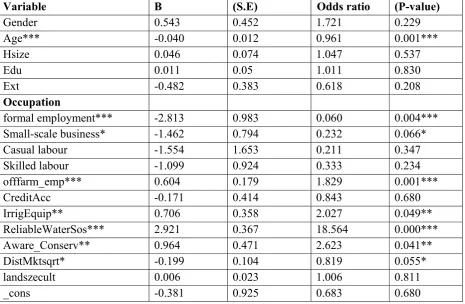
Coefficients of the binary logistic model were estimated by the maximum likelihood method using STATA 12 software. The results of the binary logistic model are given in Table 4. The number of observations used in the model is 312. Prob > Chi2 = 0.000 and a pseudo R2 of 42.2% shows that the model is valid and the model estimates fit very well with the data at an acceptable level.
4.2. Results of the model and discussion
Table 4 reports the coefficients (B), standard errors of the coefficients (S.E), odds ratios and the p-values. Odds ratios show the predicted change in odds for a unit increase in the corresponding explanatory variable. Expressed in terms of variables used in the model, the logistic regression equation is:
Ln ( ) = Ln (Odds) (reporting coefficients of only significant variables)
= -(0.040*Age) -(2.813 formal employment)- (1.462 Small-scale business) +
(0.604*offfarm_emp) + (0.706*IrrigEquip) +(2.921*ReliableWaterSos) +
(0.964*Aware_Conserv) -(0.199* DistMktsqrt) (4)
18
The results of the logit model (Table 4) show that, among the hypothesised explanatory variables, only eight significantly influenced the adoption of irrigation farming. Age, formal employment, Small-scale business, offfarm_emp, IrrigEquip, ReliableWaterSos, Aware_Conserv and DistMktsqrt were the significant variables in the binary logistic model. Contrary to the hypothesis, Gender, Hsize, Edu, Ext, Casual labour, Skilled labour, CreditAcc and landszecult did not significantly influence the adoption of small-scale irrigation farming.
Table 4: Parameter estimates of the binary logistic regression model for factors influencing the adoption of irrigation in the Chinyanja Triangle
Variable B (S.E) Odds ratio (P-value)
Gender 0.543 0.452 1.721 0.229
Age*** -0.040 0.012 0.961 0.001***
Hsize 0.046 0.074 1.047 0.537
Edu 0.011 0.05 1.011 0.830
Ext -0.482 0.383 0.618 0.208
Occupation
formal employment*** -2.813 0.983 0.060 0.004***
Small-scale business* -1.462 0.794 0.232 0.066*
Casual labour -1.554 1.653 0.211 0.347
Skilled labour -1.099 0.924 0.333 0.234
offfarm_emp*** 0.604 0.179 1.829 0.001***
CreditAcc -0.171 0.414 0.843 0.680
IrrigEquip** 0.706 0.358 2.027 0.049**
ReliableWaterSos*** 2.921 0.367 18.564 0.000***
Aware_Conserv** 0.964 0.471 2.623 0.041**
DistMktsqrt* -0.199 0.104 0.819 0.055*
landszecult 0.006 0.023 1.006 0.811
_cons -0.381 0.925 0.683 0.680
19
Age has a negative impact on the adoption of small-scale irrigation farming, which suggests that the odds of adoption are higher among younger farmers than older farmers. Specifically, results show that a one-year increase in the farmer’s age reduces the odds of adoption by about 4% (1 to 0.96). The average age of 46 for a population with a life expectancy of 40 shows that most farmers are ageing. As farmers get older, despite their accumulated experience in farming, they tend to lose energy, have short planning horizons and become more risk averse, so adopting new irrigation practices may be difficult for them. This result is expected and is consistent with other scientists’ findings [45, 46-48]. Moreover, small-scale irrigation farming is time and labour intensive. The proper management of irrigable crops (especially fruit and vegetables) also requires storage and transportation facilities, as well as market availability and access to the market, which acts as an adoption barrier to the older farmers.
20
generally a labour- and time-intensive endeavour, and households usually find it difficult to synchronise small-scale irrigation farming with other off-farm activities.
In addition, the number of household members with off-farm employment was found to significantly influence the adoption of small-scale irrigation farming. The predicted change in the adoption of small-scale irrigation farming was found to be 1.83 for every increase in membership of the household with off-farm employment by 1. This could probably be because off-farm activities play a supportive role in agricultural practices, especially as an alternative source of agricultural financing. Therefore, an increase in household members with off-farm employment increases the chances of adoption because of its supportive role. This result is consistent with that of Namara et al., [50], who concluded that off-farm employment activities improve income for the farmer and that income can be used to complement agricultural activities. However, the result was not as expected, but was still acceptable, as empirical studies by Herath and Takeya [51] noted the role of off-farm income in the adoption of agricultural practices as unclear and a contested terrain.
21
water access. In this case farmers whose fields neighbour rivers and small water channels like streams. The results thus highlight the importance of the necessary irrigation equipment and reliable water sources in setting up successful small-scale irrigation farming systems. Based on the binary logistic model, access to irrigation equipment and a reliable water source are vital for any farmer to try small-scale irrigation farming.
Awareness of water conservation practices such as rainwater harvesting was also selected as an explanatory variable to explain variability in the adoption of small-scale irrigation farming. Results show that awareness of water conservation practices within the study sites had a positive and significant influence on the adoption of small-scale irrigation farming. The odds of the adoption of small-scale irrigation farming were found to be 2.62 times greater for farmers who were aware of water conservation methods practised within the study sites in comparison to those who were not aware of such methods. This could be because the farmers who are aware of water conservation practices are more likely to adopt such practices. This necessitates the adoption of small-scale irrigation farming, since earlier results indicate that access to reliable water sources positively influences the adoption of irrigation farming. Besides farmers who have installed rain water harvesting technologies such as water tanks would divert more of their time to adopt small-scale irrigation practices in riparian areas instead of going to fetch water for domestic use.
22
adoption of irrigation farming. Odds of adoption decrease by about 18% with a one-kilometre increase in distance to the nearest input or output market for the farmer. This might be explained by the fact that most smallholder farmers now appreciate the role of markets in their farming activities. As a result, access to markets influences their farming intensification decisions. Farmers closer to input markets are motivated to adopt small-scale irrigation farming, since they realise that their production will be improved and they can easily sell the surplus to nearby markets. For farmers who travel long distances to access output markets, the situation might be very different. As much as they realise the importance of the adoption of small-scale irrigation farming in raising agricultural output, they may be discouraged to adopt the practice when they plan on selling their surpluses because long distances come with additional marketing costs, which they cannot afford.
4.3. Impact of the adoption of small-scale irrigation farming on income
23
Table 5: Impact of the adoption of irrigation farming on agricultural income: OLS results
SqrtAgricIncome Coefficient Standard error P-value
Irrig_fmng** 2.052 0.940 0.030**
Ext 1.70 0.972 0.081*
landszecult 0.097 0.067 0.147
Labour** 0.645 0.318 0.043** econactiv -0.371 0.315 0.240
offfarm_emp -0.173 0.373 0.643
Group 0.620 0.989 0.531
LUhh -0.087 0.116 0.452
mainCrop_1* 0.747 0.399 0.062*
DistMktsqrt* 0.423 0.256 0.099*
Literacy 0.036 0.264 0.893
Adopt_LSW** -2.247 1.004 0.026**
_cons** 5.979 1.780 0.001***
***=1% level of significance, **=5% level of significance, *=10% level of significance
24
Factors like access to extension, labour, crops grown, distance to the nearest market, and the adoption of land, soil and water conservation practices also had a significant influence on agricultural income.
5. Conclusions and implications
This study was undertaken to improve our understanding of how efforts to promote the adoption of small-scale irrigation farming as a climate-smart agriculture practice can influence the income of smallholder farmers in the Chinyanja Triangle. Several useful conclusions that provide insight into pathways to increase smallholder farmers’ adoption of small-scale irrigation farming in the study area and improve agricultural income have emerged from this research.
Firstly, results indicate that promoting small-scale irrigation farming as a climate-smart agriculture practice for adoption by smallholder farmers should consider the farmer’s age, main occupation, off-farm employment status, access to and availability of micro-irrigation equipment, water source reliability, awareness of certain water conservation measures and distance to the nearest markets. The lesson from this article is that failure to consider these socioeconomic aspects may lead to inappropriate results when aiming for higher rates of adoption of small-scale irrigation farming as a climate-smart agriculture practice in the study area.
25
methods and techniques, through extension or any other means will be critical towards improving the uptake of small-scale irrigation farming.
Secondly, results suggest that succeeding in enhancing the adoption of small-scale irrigation farming as a climate-smart agriculture practice through careful consideration of the socioeconomic aspects and other farm-specific attributes will enhance farmers’ income. This is an important finding, since the main motivation for urging farmers to adopt technology is their welfare. Enhancing the adoption of small-scale irrigation farming within the Chinyanja Triangle will be a great step towards improving farmers’ agricultural income and combating climate variability and change.
Acknowledgement
The authors would like to acknowledge the financial assistance received from the Dryland Systems Consultative Research Programme (CRP1.1) that was used in carrying out this study. The authors would also like to acknowledge the support of Janine Smit editorial services that helped with language editing and proof reading of this article. We thank all the enumerators for good work in data collection and most importantly to farmers who patiently gave us their time and responded to our questions.
26
Conflicts of Interest: The authors declare no conflict of interest.
6. References
1. Burney, J. A., & Naylor, R. L. (2012). Smallholder Irrigation as a Poverty Alleviation Tool in Sub-Saharan Africa. World Development, 40(1), 110–123,
doi:10.1016/j.worlddev.2011.05.007.
2. Barrett, C. B., & Swallow, B. M. (2006). Fractal poverty traps. World Development, 34(1), 1-15.
3. Barnichon, R., & Peiris, S. J. (2008). Sources of inflation in sub-Saharan Africa. Journal
of African Economies, 17(5), 729-746. https://doi.org/10.1093/jae/ejn002
4. Conway, G., Waage, J., & Delaney, S. (2010). Science and Innovation for Development; UK Collaborative on Development Sciences (UKCDS). London.
5. Davies, M., Guenther, B., Leavy, J., Mitchell, T., & Tanner, T. (2009). Climate change adaptation, disaster risk reduction and social protection: complementary roles in agriculture and rural growth? IDS Working Papers, 2009(320), 01-37.
6. FAO (2013). Sourcebook on Climate Smart Agriculture, Forestry and Fisheries (Rome, Italy: Food and Agriculture Organization of the United Nations (FAO). Food and Agriculture Organization.
7. SciDev.Net (2014). African smallholder farmers need tech to spur food security. [Online].
27
socioeconomic approach. Food Policy, 36, 770-782. doi:doi:10.1016/j.foodpol.2011.09.001.
9. AQUASTAT (2009). Online: Food and Agriculture Organization (FAO).
10. NEPAD, & AU (2009). Sustainable Land and Water Management. The CAADP Pillar 1 Framework: New Partnership for African Development and African Union.
11. Zhi You, L. (2008). Irrigation investment needs in sub-Saharan Africa. A report produced for the World Bank by the Environment and Production Technology Division: International Food Policy Research Institute (IFPRI).
12. Archer, E., Mukhala, E., Walker, S., Dilley, M., & Masamvu, K. (2007). Sustaining agricultural production and food security in Southern Africa: an improved role for climate prediction? [journal article]. Climatic Change, 83(3), 287-300, doi:10.1007/s10584-006-9192-5.
13. Bekele, W., & Drake, L. (2003). Soil and water conservation decision behaviour of subsistence farmers in the Eastern Highlands of Ethiopia: a case study of the Hunde-Lafto area. Ecological economics, 46(3), 437-451. https://doi.org/10.1016/S0921-8009(03)00166-6
14. Balcha, Y. (2013). Prospects of transforming subsistence agriculture into sustainable livelihoods. A case study of the Ribb sub-catchment, Ethiopia. Master thesis, Uppsala University.
28
16. Carruthers, I., Rosegrant, M. W., & Seckler, D. (1997). Irrigation and food security in the 21st century. Irrigation and Drainage Systems, 11, 83-101.
17. Bacha, D., Namara, R., Bogale, A., & Tesfaye, A. (2011). Impact of small‐scale irrigation on household poverty: empirical evidence from the Ambo district in Ethiopia.
Irrigation and Drainage, 60(1), 1-10. DOI:10.1002/ird.550
18. Tesfaye, A., Bogale, A., Namara, R. E., & Bacha, D. (2008). The impact of small-scale irrigation on household food security: The case of Filtino and Godino irrigation schemes in Ethiopia. Irrigation and Drainage Systems, 22(2), 145-158.
19. Woldeab, T. (2003). Irrigation practices, state intervention and farmers life-worlds in drought-prone Tigray. Dissertation, Wageningen University, Netherlands.
20. Gebrehaweria, G., Regassa, E. N., & Stein, H. (2009). Poverty reduction with irrigation investment: An empirical case study from Tigray, Ethiopia. Agricultural Water
Management, 96, 1837–1843.
21. IFAD (2005). Special country program phase II. Interim evaluation. Ethiopia: International Fund for Agricultural Development.
22. Chamber, R. (1994). Irrigation against rural poverty. In G. J. RK (Ed.), Socioeconomic
dimension and irrigation. India: Printwell.
23. Singh, B., Singh, B. N., & Singh, A. (1996). Effect of mulch and irrigation on yield of Indian mustard on dry terraces in Alfisols. Indian J Agric Sci, 60(7), 477-479.
24. Hussain, I., Namara, R. E., & Madar, S. (2004). Water for food security for the poor. A
collection of thematic papers. Asian Development Bank.
29
26. Kumar, D. (2003). Food security and sustainable agriculture in India: the water management challenge. Working paper. Colombo, Sri Lanka: International Water Management Institute.
27. Mudima, K. (2002). Socioeconomic impact of smallholder irrigation development in Zimbabwe: A case study of five successful irrigation schemes. In H. Sally, & C. L. Abernethy (Eds.), Proceedings of private irrigation in sub Saharan Africa: IWMI, FAO, ACP-EU.
28. Amede, T., Desta, L.T., Harris, D., Kizito, F. and Xueliang, C. (2014). The Chinyanja Triangle in the Zambezi River Basin, Southern Africa: status of, and prospects for, agriculture, natural resources management and rural development. WLE Research for Development (R4D) Learning Series 1. [Online] Available at:
http://www.iwmi.cgiar.org/Publications/wle/r4d/wle_research_for_development-learning_series-1.pdf
29. CGIAR (2013). Characterization of areas targeted for sustainable intensification.
http://drylandsystems.cgiar.org/content/characterization-areas-targeted-sustainable-intensification. Accessed 28 December 2017.
30. Vågen, T., Winowiecki, L., Desta, L., & Tondoh, J. (2010). The land degradation surveillance framework field guide. Nairobi: World Agroforestry Centre (ICRAF).
31. Chilonda, P., & Otte, J. (2006). Indicators to monitor trends in livestock production at national, regional and international levels. Livestock Research for Rural Development, 18(8), 117.http://www.lrrd.org/lrrd18/8/chil18117.htm
30
33. Chianu, J. N., & Tsujii, H. (2004). Determinants of farmers’ decision to adopt or not adopt inorganic fertilizer in the savannas of northern Nigeria. Nutrient cycling in
agroecosystems, 70, 293–301.
https://link.springer.com/article/10.1007/s10705-005-0715-7
34. Getacher, T., Mesfin, A., & Gebre-Egziabher, G. (2014). Adoption and impacts of an irrigation technology: evidence from household-level data in Tigray, Northern Ethiopia.
Universal Journal of Agricultural Research, 1(2), 30-34.
35. Asfaw, A. and Admassie, A. (2004). The role of education on the adoption of chemical fertilizer under different socioeconomic environments in Ethiopia. Agricultural
Economics, 30(3), 215–228. DOI: 10.1111/j.1574-0862.2004.tb00190.x
36. Mulugeta, E., Belay, K. and Legesse, D. (2001). Determinants of adoption of physical soil conservation measures in central highlands of Ethiopia: the case of three districts of North Shewa Zone. Agrekon, 40(3), 313–335.doi/abs/10.1080/03031853.2001.9524955 37. Adesina, A.A. and Chianu, J. (2002). Determinants of farmers’ adoption and adaptation
of alley farming technology in Nigeria. Agroforestry Systems, 55, 99–112. doi:10.1023/A: 1020556132073.
38. Somda, J., Nianogo, A.J., Nassa, S. and Sanou, S. (2002). Soil fertility management and socioeconomic factors in crop livestock systems in Burkina Faso: a case study of siting technology. Ecological Economics, 43, 175–183. https://doi.org/10.1016/S0921-8009(02)00208-2
31
40. Kassie, M., Zikhali, P., Manjur, K. and Edwards, S. (2009). Adoption of organic farming technologies: evidence from semi-arid regions of Ethiopia. Natural Resources Forum, 33, 189–198.
41. Long, J.S. (1997). Regression models for categorical and limited dependent variables.
Advanced quantitative techniques in the social sciences number 7. Thousand Oaks: Sage Publications.
42. Caswell, M.F. and Zilberman, D. (1985). The choices of irrigation technologies in California. American Journal of Agricultural Economics, 67(2), 224–234.
43. Shrestha, R.B. and Gopalakrishnan, C. (1993). Adoption and diffusion of drip irrigation technology: an econometric analysis. Economic Development and Cultural Change, 41(2), 407–418
44. Skaggs, R.K. (2001). Predicting drip irrigation use and adoption in a desert region.
Agricultural Water Management. 51, 125–142.
45. Sureshwaran, S., Londhe, S.R. and Frazier, P. (1996). A logit model for evaluating farmer participation in soil conservation programs: slopping agricultural land technology on upland farms in the Philippines. Journal of Sustainable Agriculture, 7(4), 57–69. 46. Yohannes, G.M. (1992). The effects of conservation on production in the Andit Tid Area,
Ethiopia. In T. Kebede and H. Hurni (eds), Soil Conservation for Survival. Iowa, IA: Iowa State University Press.
32
48. Sidibe, M. (2005). Farm-level adoption of soil and water conservation techniques in northern Burkina Faso. Agriculture Water Management, 71, 211–224. doi:10.1016/j.agwat.2004.09.002
49. Abera, B.D. (2003). Factors influencing the adoption of soil conservation practices in Northwestern Ethiopia. Discussion Paper No. 37. Goettingen: Institute of Rural Development, University of Goettingen.
50. Namara, R.E., Upadhyay, B. and Nagar, R.K. (2005). Adoption and impacts of micro-irrigation technologies: empirical results from selected localities of Maharashtra and Gujarat states of India. Research Report 93. Colombo: International Water Management Institute.
51. Herath, P.H.M.U. and Takeya, H. (2003). Factors determining intercropping by rubber smallholders in Sri Lanka: a logit analysis. Agricultural Economics, 29, 159–168. Doi: 10.1016/S0169-. 5150(03)00045-8.
52. Diao, X., Hazell, P. and Thurlow, J. (2010). The role of agriculture in African development. World Development, 38(10), 1375–1383.