The Palladium-Hydrogen
System
P A R T 111: ALLOY SYSTEMS A N D HYDROGEN PERMEATION
By
F.
A.
Lewis
'Ilie Queen's I'nibersity of Belfast
Hydrogen absorption
b y
series ofpalladium alloys with s e v c d other metals has nou: b p e r i quite c.xtcnsiwIy invesligated w i t h rcjference to systematic alterations o,f pressurr- co m p o s i t io n o t h e r rrlated thermodynamic factors and
2: a r i o us p a r a rn P t e r s
.
Ilydrogen permeation has b r w i a nimportant area o,f both academic rind technological intercJst with relation,
f o r examplP, to ( f f w t i n g reductions of dqformations asaoriaird with phasp transitions, whilr rptairiing t h r high calues of hydrogen solubilities nnd hydrogcm ditfusion coefficients in palladium at convc:nicmt tcmp(Jraiuros.
r e la t io ns h ips,
p h y s ic a
1
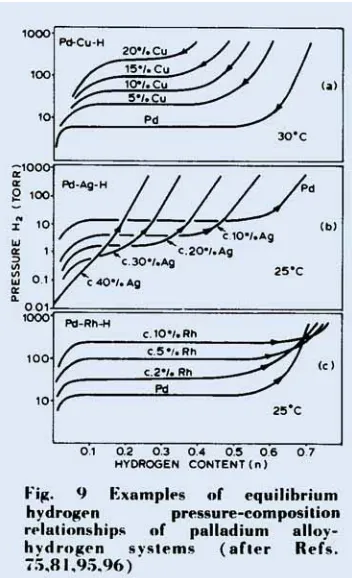
Characteristic examples of three types of change of form of p n relationships at 2 5 T , as the contents of elements alloying with p a l l a d i u m a r e g r a d u a l l y i n c r e a s e d
(4,37,70,74-83,95-98,~04,108,153,154), are
illustrated in Figure 9. As for the palladium- hydrogen system itself (4), such relationships have been determined from direct equili- brations with hydrogen gas, as well as being derived from measurements of electrode poten- tial. Similarly as for palladium-hydrogen, temperature dependences of the p n relation- ships have been used to supplement calorimetric data ( I 10) in deriving heats and cntropies of hydrogen absorption, both at initially low values (79-82,95,100,108) of hydrogen content ( n - t o ) and over (Y
= p
transition regionsThe sequence of relationships in Figure 9(c) (4,37,70,74-83,'04,I54,I78).
shows gradual increases with increasing rhodium content in the range o f n over which (Y and /J' phases coexist. This sequence now seems unique to the palladium-rhodium-hydrogen system (45,75, I 53,154), since some suggestions of similarities of the palladium-manganese- hydrogen system (179) seem doubtful in view of possible incomplete equilibrations.
'The remaining families of p n isotherms for palladium alloy-hydrogen systems would thus seem to be divisible into two groups represented by those in Figures 9(a) and 9 (b). In both cases the ranges of n over t i
+
p
phase regions are successively shortened with increasing content of the alloying element, even in the cases of alloys with readily hydride-forming transition or inner transition elements such as vanadium( 8 2 ) or cerium (76), but the corresponding values of equilibrium pressure are being suc- cessively increased (74,794 1,82), as in Figure
9(a), or decreased (37,70,75,80), Figure 9(b).
Decreases, in the range of n over (r +/I regions, with increasing amounts of alloying elements, have continued to be deduced from X-ray determinations of and /3 phase lattice constants for additional palladium alloy- hydrogen systems (4,79-82,157, I 80-1 8 2 ) .
later, has importance in choices of alloy com- positions as hydrogen permeation membranes.
In addition to the arguments concerning the solubility of hydrogen in the palladium-silver alloys, the extents of decreases of hydrogen solubilities with increasing contents of other alloying metals have been used (95,104,108) in support of an essentially protonic nature of the hydrogen entities. However, in order to allow for proposed levels of electron donation it has seemed necessary to postulate adoptions of oxidation states by the alloying elements which can be difficult to reconcile with their relative positions in sequence of electronegaiivities.
Moreover as for the palladium-hydrogen system, latterly there has been increasing emphasis on the account to be taken of lattice expansions accompanying hydrogen absorption (26,37,166) in palladium alloys. There has also been attention to the localised as well as to the continuing effects of the alloying metals as exemplified by appearance, potential measure-
ments ( 1 83) and by Mossbauer Spectroscopy examinations ( I 33,180,184,185). For example, evidence of preferential location of hydrogen
around rhodium atoms (186) might be
correlated with wider ranges of (Y and /3 phase coexistence with rhodium content in the palladium-rhodium-hydrogen system in Figure 9(c). A particular example of the significance of differences in the distribution of alloying atoms has been provided by measurements, made under high pressures of hydrogen, of changes of electrical resistivity of a palladium-iron alloy of approximate composition Pd,Fe ( I 87). Figure I o illustrates the substantial differences between the ranges of pressures (hydrogen chemical potentials) over which evidence was found of significant hydrogen absorption in ordered and disordered structures of the alloy.
The two main families of p n isotherms illustrated in Figures 9(a) and 9(b) also differ from one another in regard to the direction of changes of the heats of hydrogen absorption with alteration of' alloying metal content (4,37,70,74-76,79-82,100,178), relative to
heats of hydrogen absorption in pure
palladium. Thus those alloys with the pattern of Figure 9(b) in general exhibit more exothermic heats of hydrogen absorption than palladium, both at infinite dilution (n + 0) and over regions of (r and
B
coexistence, while the converse ;less exothermic heats of absorption than palladium) appears generally true for alloy series associated with families of p n isotherms as in Figure 9(a). Attempts to provide underlving reasons have so far stressed two alternative ways by which the different series of alloys may themselves be divided. In one line of argument (100,178), emphasising differences in electronic structure, it has been pointed out that patterns similar to Figure 9(a) are followed by alloys formed by palladium with other transition elements, and those of Figure 9(b), accompanied by more exothermic heats of hydrogen absorption, tend to occur with alloys of non transition elements.reported has been - I 7 K with a Pd,,Cu,, com- position (46). With increasing content of alloy- ing element in several alloy series the transition temperature passes through a maximum value and, as for PdH,(D,), plots of transition temperature against hydrogen content also exhibit maxima (46). Recent studies with palladium-silicon alloys ( T 9 1 ) have shown that
superconducting transitions also can be found with amorphous materials.
For many of the investigated palladium alloy-hydrogen systems, the alloy element can only be considered 10 be in solid solution up
to relatively low limits of concentration (37,75, 80,82,85,108,133,180, I 81,189,190,192,193), and only a few studies have so far been reported produce overall average increases of f.c.c. lattice
constants (“expanded alloys”) and vice versa. Since additions of platinum to palladium produce very small increases of lattice constant
( I 88), the palladium-platinum-hydrogen system
constitutes a marginal exception to this latter division. However, it may be possible that differences of elastic constants provide a decid- ing feature in this case. In explanations based on size factors, it might be argued that atoms of alloying elements causing increases of lattice parameters in an elastic medium could produce overall expansions in the volumes of interstices which could result in lower energies being required to introduce hydrogen, as reflected by the high exothermic heats of hydrogen absorp- tion. It is in any event interesting, as illustrated in Figure I I , that relative extents of increases of initial lattice parameter with contents of alloying element, quite closely parallel extents of decreases of isobaric ( J atm) hydrogen solubilities in such chemically diverse sub- stitutionally alloying metals as cerium (76), silver (70-72,86,95-98,r04,160), lead (80) and with interstitially incorporated boron (37, T 89).
with higher alloy percentage intermetallic
However, palladium can form binary alloys with certain neighbouring elements also crystallising in the f.c.c. structure, which approximate to solid solutions over the entire composition range.
In principle these systems have offered possibilities of studying gradual changes in alloying behaviour from pure palladium to that of the pure alloying element. In practice this has required extension of studies into the range of high hydrogen pressures, which at upper limits correspond to particularly high fugacities (45,196). Here, difficulties of making direct measurements of hydrogen contents have so far required that these are inferred from changes in phases (1 94, I 95).
physical properties such as thermoelectric power (50,197) and electrical resistivity.
Examples of relationships derived between electrical resistivity and high hydrogen pres- sures obtained with three such series of alloys (45,50,68,69,154,196), combined with data pre- viously derived over lower ranges of pressure (4,70,75), are illustrated in Figure 12.
The somewhat complex case of the
This trend may be seen to continue for com- positions of up to approximately Pd,$g,,, but for still higher silver contents significant changes of resistivity only become perceptible at increasingly higher pressures, as shown by the examples of Pd,,Ag,, and P d l a g 8 1 . These provide an indication that substantial a b s o r g tion of hydrogen by pure silver should only occur at 25°C a t hydrogen pressures in excess of 30 kilobars.
Trends in the form of relationships for the palladium-rhodium-hydrogen and palladium- platinum-hydrogen systems (50,68,69,154) in Figures I 2(b) and (c) are somewhat more simply continuous in appearance.
In the case of the palladium-rhodium- hydrogen system ( I
54),
measurements of approximate hydrogen contents attained under high Eydrogen pressures have endorsed indica- tions from the persistence of the hysteresis effects illustrated in Figure rz(b) that (1 ep
phase hydride transitions continued to occur for alloying contents up to 80 per cent rhodium. These findings suggested the possibility of the formation of a P-phase hydride by pure rhodium at still higher pressures, and sub- sequent analogous studies of resistivity changesat 250°C have since indicated the formation of
such a rhodium hydride at pressures in the region of 40 kilobars (I 55).
Figure I 2(c) illustrates, for the palladium- platinum series of alloys, that continuously increasing hydrogen pressures again are needed to effect significant hydrogen absorption as platinum contents are increased (68,69). This is consistent with trends in p-n relationships
( 4 7 4 ) similar to those in Figure 9(a) which also
would be consistent with universal decreases of hydrogen solubility with increasing hydrogen content at any given reference of hydrogen pressure at 25°C.
In contrast to the pattern in Figure 12(b) for
the palladium-rhodium-hydrogen system,
Figure I 2(c) also illustrates a gradual reduction of hysteretic differences between “absorption” and “desorption” relationships with increasing platinum content. Again this is consistent with indications from p n relationships and X-ray
studies (4,50,69,74) of complementary
decreases of the critical temperature of rn and
P
phase coexistence to around zs”C, for platinum contents of about 25 per cent. However the resistivity changes with hydrogen pressure in Figure 12(c) also provide evidence of a con- tinuation of substantial hydrogen absorption by alloys with platinum contents much higher than 20 per cent, over what have been termedregions of quasi two phase coexistence (68). Even for an alloy containing 70 per cent platinum, the onset of what would seem likely to be a further such region of absorption has been detected at hydrogen pressures of around 30 kilobar (50,69). Extrapolations of available data have suggested that analogous absorptions of hydrogen by pure platinum could be expected to occur at hydrogen pressures of near I O O kilobar, at 25°C.
For the palladium-platinum alloys with 2 20 per cent platinum, the absence of hysteretic effects and accompanying lower levels of macroscopic deformation in cycles of absorp- tion and desorption of hydrogen have been found to be of some practical advantage. Because of this, measurements of changes of the electrical resistivity of certain palladium- platinum and other suitable alloy compositions have been usefully employed for repetitive analytical determinations of the solubility of hydrogen in solutions (4,198), and for estimat- ing high values of hydrogen chemical potentials in electrochemical studies (39,50,62).
Hydrogen Diffusion Coefficients
and Hydrogen Permeation Studies
q u a s i e l a s t i c n e u t r o n s c a t t e r i n g
(29, I 18, I 36,163-1 65,201) and anelastic
Gorsky Effect measurements (51,169-173). At very low ix phase hydrogen contents, a large measure of agreement now exists between values derived by the various methods
(104,202). At 25°C these are of the order of
I
o
-‘/cm2/s representing an average value over the narrow a phase range of contents within which the only reported trend has been that of a slight decrease with increasing hydrogen content (86). Only a few studies have been reported of hydrogen diffusion coefficients in platinum but these (57,58,203,204) have suggested values of approximately two orders of magnitude lower (say ~ o ~ ’ / c m ~ / s ) than in palladium, near 25OC.Values of about ro-h/cmz/s have been derived for the Fick hydrogen diffusion coefficient in
p
phase palladium hydride for hydrogen contents of 11-0.7 (4,71,72,86). Such values are thus about an order of magnitude higher than the a phase values. However studies of break- through times (86) and of relaxation times associated with changes of electrical resistivity at high pressures (45,205) have indicated that at still higher hydrogen contents there are marked decreases of diffusion coefficient. These have been attributed to “blocking” of the diffusion process due to reductions in the numbers of vacant octahedral interstitial positions (206).
Academic interest has been sustained in
correlations between Fick and Einstein
I 7 I ,204), and problems of interpretation at low temperatures ( I 8,51,169-171,201,207,208), and near ohase transitions and critical points
Much interest also has continued in the method of hydrogen purification by its permea- tion through palladium alloys. As quite recently reviewed by Knapton (209), a wide variety of alloys already have been proposed for this purpose, and others continue to be examined (2 10). Factors which influence practical utilisa-
tion include those of resistance to poisoning of surface catalytic activity, suitable mechanical properties over desirable ranges of temperature,
and also convenience of manufacture-
including quality control.
Other basic considerations are that con- centrations of the alloying element should be sufficient for critical temperatures, corres- ponding to (I and phase coexistence, to be decreased to ambient or below in order to reduce deformation in cycles of use (4,62,96-98, 104,158,176,181), and that diffusion co- efficients and solubilities of hydrogen at convenient input pressures should both con- tinue to have high values.
In regard to values of diffusion coefficients, characteristic examples in Figure I
3
show that initial, small percentage, additions of most binary alloying elements (77,78,85,86,97,98,104,170,173,~81,206) produce only relatively small decreases from values (at 25OC) for pure palladium-when compared at low values of hydrogen content, that is as n + 0.
Sustained or increased hydrogen solubilities at convenient input pressures and temperatures are features generally associated with palladium alloy-hydrogen systems exhibiting similar sequences of changes of form of p n isotherms to those in Figure 9(b) and also for a specific case in Figure I 3. As examples of this group of systems, compositions from the palladium- boron series (37,211,212) and from series of alloys of palladium with transition metals of Subgroup 111 and the closely allied lanthanide series have been suggested for practical utilisa- tion, the palladium-yttrium system being a promising example (I 8 I ,z I 0). The palladium- (36,86,104,17 1).
gold (207) and, as illustrated in Figure 9(b), the palladium-silver series (4,95,96) alloys also belong to this general class of systems. Com- positions from the latter series such as Pd,,Ag,3 and Pd,,Ag,, have continued to be widely employed as commercially suitable materials, although certain measures of deformation still have been observed after many cycles of use (98,160,21 I). Several studies of both hydrogen and deuterium diffusion coefficients in these c o m p o s i t i o n s h a v e b e e n r e p o r t e d
For the palladium-silver series of alloys measurements have been reported of gradual changes of diffusion coefficient with changes of
hydrogen content, principally by the
electrochemical breakthrough technique
(86,104,2 14). For alloys with relatively high contents of silver, such as Pd,&g,, and Pd,,Ag,,, results (86,104) show a continuous increase of diffusion coefficient with increasing hydrogen content from initially lower values than those of pure palladium at n + 0 ; this is
consistent with trends suggested by studies of the shifts with temperature of internal friction peaks associated with Zener relaxation effects (97, I 27,2 I 6). However, for compositions near to I'd,,AgZ3 two alternative trends of change of diffusion coefficient have been suggested from results so far available (97) as diagrammatically represented in Figure I 3.
(71,72,85,86,170,214,215).
Some Concluding
Comments
The last two decades have seen substantial expansions of experimental information concer- ning the palladium-hydrogen system over wider ranges of temperature and pressure, with generally increased precision of the measure- ment and control of hydrogen content. Several further physical parameters have been studied.
hydrides, has now been increasingly appreciated. stress a n d spatial influences o n neighbouring In regard to structural considerations, there palladium atoms, with reference to such issues has been increasing attention to evaluation of as mechanisms of diffusion, isotope effects, t h e effects of introduction of individual phase transitions and associated hysteresis a n d hydrogen entities, in regard t o their localised gross deformational phenomena.
References
173 J. kermlk, A. Kufudakis, G. Gardavskl and E‘. A. Ixwis, Suppl. Trans. 3pn. Inst. Met., 1980, 21,
125; Surf. Technol., 1982, 16, (I), 57
I 7 4 R. R . Arons, J. Bouman, M. Wijzenbeek, I?. T. A. Klaase, C. Tuyn, G. Leferink and G. de Vriess,
Acta Metall., 1967, 15, ( I ) , 144
I 75 J. K. Jacobs, C. K. Brown, V. S . Pavlov and F. 11.
Manchester,J. Phys. F, 1976, 6 , ( I Z ) , 2219 176 F. M. Mazzolai, P. G. Bordoni and F. A. Lewis,
“Internal Friction and Ultrasonic Attenuation in Solids”, Proc. 3rd European Conf., Oxford, Pergamon, I 980, p. 229
177 B. Strobel, V. Muller, I>. Schilling, K. Langer and H. E. Bomme1,J. Phvs. F, I 979, 9, L247 178 R. Burch and N. B. Mason, J . Chem. Sor.,
Faraday Trans. I , lytio, 76, 2285
179 S. Engels,%. Anorg. Cheni., 1966, 348, (3/4), 219
180 J. S . Carlow and K. E. Meads, J . Phys. C , 1969,
I 8 I 11. Fort, J. P. G. Farr and I. R . Harris,
3.
Less182 D. Fisher, 1). M. Chisdes and T. B. Flanagan,
3.
I 83 G. Sicking, Z. Phys. Chem.
184 A. Obermann, W. Wanzl, H. Mahnig and E. Wicke, 3 . Less-Common Met., 1976, 49, ( I , 2\, 75
I 85 F. E. Wagner and G. Wormann, op. cit., ref. I 7 , 28, p. I 3 I ; H. Probst, F. E. Wagner, M. Karger and G. Wortmann, %. I’hys. Chem. (Frankfurt am
Main), 19799 114, 195
186 F. E. Wagner, M. Karger and F. Probst, J . Less- Common Met., I 980,73,28 I ; M.Karger, F.Probst,
B. Schuttler and F. E. Wagner, op. c k , ref. I 6
1 8 7 T . B. Flanagan, S. Majchrzak and B. Baranowski, Phil. Mag., 1972, 2 5 , (I), 257 188 J. B. Darby and K. IM. Myles, Met. Trans., 1972,
I 89 H. Husemann and H. Brodowsky, 2. Nuturforsch.,
190 T. Skoikiewicz, A. W. Szafranski, B. Baranow- ski, Phys. Status SolidiB, 1973, 59, (2), KI35 191 B. Stritzker and H. L. Luo, J . Less-Common
192 M. L. H. Wise, J. 1’. G. Farr and I. K. Harris, op.
cit., 1975, 41, ( I ) , I 15; J. K. Hirsr, M. L. H. Wise, D. Fort, J. 1’. G. Farr and I. R. Harris,
ibid., 1976, 49, ( I , 21, 193
2 , ( I I), 2120;3. I’hyS. F, 1972, 2 , (5), 982
Common Met., 1 975, 39, (21, 293
Solid State Chem., I 977, 20
19791 116,63
3, (31,653
A , 1968, 237 (IO), 1693
Met., 1980, 73, (2), 301
193 E.Wicke, op. cit., 1980, 74, (I), 1 8 5
194 A.J.Maeland,G.G.Libowitz,op.cit.,1980,74,295 195 T. €3. Flanagan, G. E. Biehl, J. D. Clewlev, S.-
Rundquist and Y. Andersson, 3 . Chem. Soc., Faraday Trans. I , I 980, 76, 196
196 A. ’2%’. Szafrariski and B. Baranowski, Phys.
197 .I, Skoikiewicz, op. cit., I 978, 48, (21, K 165 198 1’. Vignet, R. Gabilly, J. Lutz and R. Zermiz-
oglon, French Atomic Energy Comm. (Saclay) Report DPC I S . sc 1/63-346 PV/DG, 1963 Siatus SolidiA, 1972,9, (2), 435
199 J. G. Early, AcraMeraN., 1978, 26, (8), 1 2 1 5 2ooE. F. W. Seymour, K. M. Cotts and W.
n.
Williams, Ph,vs. Rev. Lett., 1975, 35, (3), 165; P. P. llavis, E. E’. W. Seymour, I). Zamir, W.
n.
K’illiams and R. M. Cotrs,3.
Less-Common M e t . , 1976, 49, ( I , 2), 159; R. M. Cotts, op. tit., ref. 17, 2 % P. 227Z O I K. Skold, op. cit., ref. 17, 28, p. 267
202 J. Volkl and G. Alefeld, op. cir., ref. 17, 2 8 , p.
32’
203 Y. Ebisuzaki, W. J. Kass and M. O’Keefe, J . Chem. Phys., 1968, 49, (8), 3329
204 H. K. Rirnbaum and C. A. Wert, Ber. Bunsenges. Phys. Cheni., 1972, 76, (8), 806; see also J. Hauck, Z. Phys. Chem. (Frankfurt am Main),
205 M. Kuballa and B. Baranowski, Ber. Bunsenges. P h w Chem., 1 9 7 4 ~ 7 % (4), 335
206 H. Buchold, G. Sicking and E. Wicke, op. cir.,
1976, 80,
(s),
446; B. Huber and G . Sicking, Ph-vs. Status Solid2 A , 1978,47, [I), K85 207 A. M. Stoneham, Ber. Bunsenges. Phys. Chem.,1972, 76, (81, 816
208 K. W. Kehr, op. cit., ref. 17, 28, p. 197
209 A. G. Knapton, Platinum Metals Rev., 1977, 21,
2 1 0 D. T. Hughes and 1. R. Harris, Z . Phys. Chem.
/Frankfurt am Main), 1979, 117, 185; D. T. Hughes, J. Evans and I. K. Harris, J . Less- Common Met., 1980, 76, I 19; see also A. 11. Spektor, Iu. 11. Kozmanov, F. E. Kagan and V. V. Lobanov, Fiz. Mer. Metalloved., 1981, 51, (z),
354
2 I I A. Kiissner, J . Int. Etudes des Piles a Combustible, Brussels, SERAI, 1965, 2 , p. I 16
212 F. A. Lewis, R. Burch, A. S. Darling and G. L. Selman, Solid Slate Cummun., 1967, 5, (7), 613 213 K. Allard, A. Maeland, J. W. Simons and ‘I. B.
Flanagan,J. Phys. Chem., 1968,72, ( I ) , 136
2 1 4 A . Kiissner,Z. Naturforsch., A , 1966, 21, (4), 515
2 1 5 R. G. Hickman, J . Less-Common Met., 1969, 19, 216 E’. M. Mazzolai, F. A. Lewis, M. Nuovo and R. I’ranco, “Internal Friction and LJltrasonic Attenuation in Solids”, Proc. 6th Int. Conf., Univ. of ‘l‘okyo Press, 1977, p. 467; Z. Phys. Chem. (Frankfurl am Main), 1979, 114, I 85 1979, “4,165
(2)>44
(41, 369 ( 2 l ‘49