Journal of Pain Research
R e v i e w
Dove
press
open access to scientific and medical research
Open Access Full Text Article
Components of effective randomized controlled
trials of hydrotherapy programs for fibromyalgia
syndrome: A systematic review
Luke Perraton Zuzana Machotka Saravana Kumar international Centre for Allied Health evidence, University of South Australia, Adelaide, South Australia, Australia
Correspondence: Saravana Kumar international Centre for Allied Health evidence, University of South Australia, North Terrace, Adelaide, South Australia, 5000, Australia
Tel +618 8302 2085 Fax +618 8302 2766
email [email protected]
Aim: Previous systematic reviews have found hydrotherapy to be an effective management strategy for fibromyalgia syndrome (FMS). The aim of this systematic review was to summarize the components of hydrotherapy programs used in randomized controlled trials.
Method: A systematic review of randomized controlled trials was conducted. Only trials that have reported significant FMS-related outcomes were included. Data relating to the components of hydrotherapy programs (exercise type, duration, frequency and intensity, environmental fac-tors, and service delivery) were analyzed.
Results: Eleven randomized controlled trials were included in this review. Overall, the quality of trials was good. Aerobic exercise featured in all 11 trials and the majority of hydrotherapy programs included either a strengthening or flexibility component. Great variability was noted in both the environmental components of hydrotherapy programs and service delivery.
Conclusions: Aerobic exercise, warm up and cool-down periods and relaxation exercises are common features of hydrotherapy programs that report significant FMS-related outcomes. Treat-ment duration of 60 minutes, frequency of three sessions per week and an intensity equivalent to 60%–80% maximum heart rate were the most commonly reported exercise components. Exercise appears to be the most important component of an effective hydrotherapy program for FMS, particularly when considering mental health-related outcomes.
Keywords: hydrotherapy, fibromyalgia syndrome, exercise, effective, components
Introduction
Fibromyalgia syndrome (FMS) is a common condition characterized by widespread musculoskeletal pain and tenderness. It is frequently associated with other symptoms
such as feelings of stiffness, loss of sleep, fatigue, depression, and anxiety.1
Treatments for FMS have been evaluated extensively in the literature over the last two decades. A number of systematic reviews have evaluated the effectiveness of
exer-cise for FMS.2–6 All have found evidence to support the use of exercise, in particular
aerobic exercise, in the management of FMS. A recent Cochrane review concluded that moderate intensity aerobic training for 12 weeks may improve overall well-being
and physical function in FMS.2
Recently, a number of trials and systematic reviews have evaluated the effectiveness of structured exercise programs in warm water (such as hydrotherapy) for FMS. The findings of these trials and systematic reviews suggest that these programs are also effective in the management of FMS, over a range of outcomes. A recent systematic review concluded that there is strong evidence for the use of hydrotherapy in the
management of FMS.7
Journal of Pain Research downloaded from https://www.dovepress.com/ by 118.70.13.36 on 24-Aug-2020
For personal use only.
Number of times this article has been viewed
This article was published in the following Dove Press journal: Journal of Pain Research
Perraton et al Dovepress
Despite a large volume of research evidence supporting the use of hydrotherapy in the management of FMS, there has not yet been a systematic review which summarizes the components (type of exercise frequency, intensity, duration) of an effective hydrotherapy program for FMS. The aim of this systematic review is to summarize these components, using only randomized controlled trials that have reported significant FMS-related outcomes. This approach may pro-vide clinicians and researchers with a framework for the design of hydrotherapy programs for FMS.
Methods
Search strategy
The following medical and allied heath-related data-bases were searched systematically by two independent reviewers in May 2009: AMED, MEDLINE, CINAHL, Embase, PubMed, SPORTSDiscus, Scopus, Physiotherapy Evidence Database (PEDro), and Cochrane Controlled Trials Register. The following search terms were used with appropriate truncations; fibromyalgia, hydrotherapy, ‘aquatic therapy’, ‘aquatic exercise’, ‘aquatic physiotherapy’, balneotherapy, thalassotherapy, physiotherapy, ‘physical therapy’, ‘spa therapy’, exercise, water, and pool. The search was limited to randomized controlled trials published in peer-reviewed journals from 1998 onwards in the English language.
inclusion and exclusion criteria
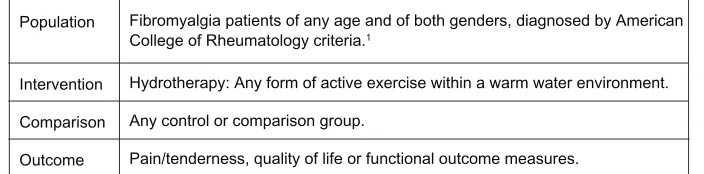
After full text versions of trials were sourced, two authors (LP & ZM) met to discuss their suitability for inclusion. The PICO framework was used to evaluate the suitability of trials for inclusion. PICO (an acronym for population, intervention, comparison and outcome) provides a
frame-work for answering a clinical question.8 Trials that did not
fit PICO criteria or did not provide sufficient detail about the components of their hydrotherapy intervention were excluded. The PICO format used in this review is outlined in Figure 1.
Quality appraisal
The methodological evaluation of included trials was conducted using the PEDro scale, an 11-point scale which addresses external and internal validity. The first criterion evaluates external validity and is not considered as part of the overall scoring. Criteria 2–11 address internal validity
which contribute to an overall score out of 10.9 Three of the
items included in the PEDro scale have been demonstrated to be predictive of systematic error or bias in random-ized trials (lack of concealment of allocation, blinding
and loss of participants at follow up).10 The PEDro scale
was chosen for this review because of its capacity to detect these potential sources of biases. Critical appraisal of each study was conducted by two independent reviewers (LP & ZM), who met to discuss any variances in scores until consensus was achieved. The 10 PEDro criteria are outlined in Figure 2.
Data extraction and analysis
Data relating to the components of hydrotherapy interven-tions were extracted in four main categories:
Exercise components: Type of exercise (aerobic, streng-thening, flexibility, relaxation, warm up and cool down), duration of each hydrotherapy session in minutes and pro-gram in weeks, frequency of sessions per week, intensity of exercises as reported in trials and method of progression of exercise.
Environmental components: Equipment used and loca-tion of the hydrotherapy intervenloca-tion.
Service delivery components: Co-interventions, nature of supervision (credentials of those supervising the hydro-therapy) and delivery format (group or individual format).
Outcome measures: Data relating to the outcomes of hydrotherapy interventions were extracted and organized into three categories; pain or tenderness, quality of life and function. Dichotomous outcomes were reported for each of these categories (significant or nonsignificant between group findings).
Population Fibromyalgia patients of any age and of both genders, diagnosed by American College of Rheumatology criteria.1
Intervention Hydrotherapy: Any form of active exercise within a warm water environment.
Comparison Any control or comparison group.
Outcome Pain/tenderness, quality of life or functional outcome measures.
Figure 1 PiCO criteria.
Journal of Pain Research downloaded from https://www.dovepress.com/ by 118.70.13.36 on 24-Aug-2020
Hydrotherapy programs for fibromyalgia syndrome Dovepress
Definitions
Hydrotherapy was defined as having two important elements:
warm water immersion and exercise.11 For the purpose of
this review, warm water was defined as a temperature over 30 degrees Celsius, or when water temperature was reported
as warm in the trial. Exercise was further defined as active
exercise, consisting of contraction and relaxation of one or more muscle groups in a structured and organized manner. Trials using warm water immersion without exercise were excluded.
The intensity of aerobic exercise is often measured as a
percentage of maximal heart rate (% HRmax) or percentage
of heart rate reserve.12 Intensity can also be measured as a
percentage of an individual’s maximal effort, determined by their perceived level of exertion using the Borg Scale, a convenient and valid measure of exercise intensity for aerobic exercise.13 The original Borg scale rates exertion on a
15-point scale from 6 to 20 and assumes a linear relationship
to maximum heart rate.13
Other terminology and definitions
Thalassotherapy has been described as a combination of bathing in sea water in a marine climate with solar
radiation.14 Thalassotherapy itself does not include exercise,
but is frequently combined with exercise. Balneotherapy is
term derived from the Latin word balneum which means
bath.15 Like thalassotherapy, balneotherapy involves
bath-ing in mineral or thermal water, and can also involve an
exercise component. Trials investigating the effectiveness of thalassotherapy and balneotherapy were only included in this review if they involved an exercise component.
Results
included and excluded trials
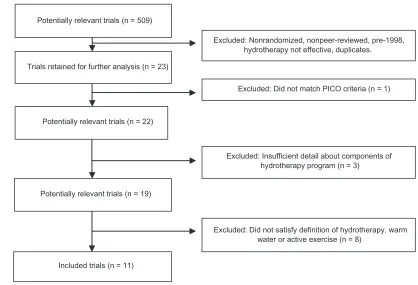
Eleven randomized controlled trials were included in this review. The article by Gowans and colleagues reported on data from their 2001 trial. Six of the 11 trials were published between 2006 and 2009, which may reflect an increasing interest in this area of research in recent years. Figure 3 provides an overview of included and excluded trials.
Quality of trials
Overall, the trials included in this systematic review were of a good quality. PEDro critical appraisal scores ranged from five16–18 to eight.19,20 The majority of trials did not use
an intention to treat analysis, which could potentially reduce the validity of their results. However, only one trial reported
a drop out rate of over 15%.14 Individual PEDro criterion
scores are listed in Table 1.
exercise components
Type of hydrotherapy program
All 11 trials utilized a warm up, cool down or relaxation period in their hydrotherapy program. In addition, all trials included some form of aerobic exercise. Aerobic exercise included deep water running, active movement of joints against the resistance of the water, jumping, jogging, dancing and low intensity resistance exercises using floatation equipment. Only one trial did not include either a strengthening or
flex-ibility component in their program.20 One trial included both
a strengthening and flexibility component and the remaining nine trials used either a strengthening or a flexibility
com-ponent, but not both.21 This may indicate that strengthening
and/or flexibility exercises are important components of hydrotherapy programs for FMS. Table 2 summarizes the type of hydrotherapy intervention used in each trial.
Duration of hydrotherapy programs
Hydrotherapy program duration ranged from 30 to 60 minutes per session. Seven of the 11 trials used a 60 minute ses-sion duration and four trials used either 30 or 35 minutes. In contrast, there was great variability in the total duration of programs, ranging from four to 32 weeks (refer to Table 3). Consistently, trials did not report a rationale for the duration of hydrotherapy sessions or the duration of their overall hydrotherapy program.
2. Random allocation
3. Concealed allocation
4. Baseline homogeneity (between groups)
5. Blinding of participants
6. Blinding of therapists
7. Blinding of outcome assessors
8. Drop-out rate less than 15%
9. Intention to treat analysis
10. Between groups statistical comparisons
11. Point measures and measures of variability
Figure 2 PeDro criteria.
Journal of Pain Research downloaded from https://www.dovepress.com/ by 118.70.13.36 on 24-Aug-2020
Perraton et al Dovepress
Frequency of hydrotherapy programs
Frequency of programs ranged from two to four times per week. The majority of trials used a frequency of three times per week. Two trials used a frequency of twice per week and one trial used a frequency of four times per week (refer to
Table 3). No trial provided an evidence-based justification for the frequency of their hydrotherapy program.
intensity of hydrotherapy programs
The intensity of aerobic exercise was reported in eight of the 11 trials Seven of these trials used a percentage of their subject’s maximum heart rate and one trial used their subject’s rating of perceived exertion on the Borg scale (refer to Table 3).10,11 The range of exercise intensity used in trials
was from 60%–80% HRmax.
Method of progression of hydrotherapy programs
Only three trials increased the difficulty of exercise as their participants improved. All three of these trials progressed their programs by increasing exercise intensity (refer to Table 3).
environmental components
Most of the trials included in this review used a pool environment. One trial was conducted in the sea.14 Seven
trials used equipment, either heart rate monitors or flotation
devices to provide flotation or resistance to movement.14,17–22
Of the 11 trials, only one described the mineral or chemical
content of the water.23
Table 1 individual PeDro criteria
Author PEDro criteria
2 3 4 5 6 7 8 9 10 11 Total
Altan et al 1 0 1 0 0 1 1 0 1 1 6
Assis 1 1 1 0 0 1 1 1 1 1 8
De Andrade et al 1 1 1 0 0 1 0 0 1 1 6
evcik et al 1 0 1 0 0 0 1 0 1 1 5
Gowans et al 1 0 1 0 0 0 1 1 1 1 6
Gowans et al and Gowans et al (follow up)
1 0 1 0 0 0 1 1 1 1 6
Gusi et al 1 0 1 0 0 0 1 0 1 1 5
Jentoft et al 1 0 1 0 0 1 1 0 1 1 6
ide et al 1 1 1 0 0 1 1 0 1 1 7
Tomas-Carus et al 1 0 1 0 0 0 1 0 1 1 5 Tomas-Carus et al 1 1 1 0 0 1 1 0 1 1 7
Abbreviation: PeDro, physiotherapy evidence database.
Figure 3 included and excluded trials.
Potentially relevant trials (n = 509)
Excluded: Did not satisfy definition of hydrotherapy, warm water or active exercise (n = 8)
Excluded: Nonrandomized, nonpeer-reviewed, pre-1998, hydrotherapy not effective, duplicates.
Excluded: Did not match PICO criteria (n = 1)
Excluded: Insufficient detail about components of hydrotherapy program (n = 3)
Trials retained for further analysis (n = 23)
Potentially relevant trials (n = 22)
Potentially relevant trials (n = 19)
Included trials (n = 11)
Journal of Pain Research downloaded from https://www.dovepress.com/ by 118.70.13.36 on 24-Aug-2020
Hydrotherapy programs for fibromyalgia syndrome Dovepress
Service delivery components
Five trials used either education or land-based exercise
as a co-intervention26,21,23–26 No other co-interventions
were reported in trials. All trials reported supervising their hydrotherapy program. Only five trials reported the credentials of the person supervising their program and all five of these trials were supervised by a physiotherapist
(physical therapist).14,16,19,21,23 All trials used a group
hydrotherapy format.
Outcome measures
In accordance with the inclusion criteria of this systematic review, all 11 trials reported statistically significant outcomes in favor of hydrotherapy, either as a between-group measure Table 2 Hydrotherapy interventions
Author Warm up Aerobic Strength Flexibility Cool down or
relaxation
Altan et al √ √ x √ √
Assis √ √ x √ √
De Andrade et al √ √ x √ √
evcik et al √ √ x √ √
Gowans et al √ √ x √ √
Gowans et al √ √ x √ √
Gusi et al √ √ √ x √
Jentoft et al √ √ √ √ √
ide et al √ √ x x √
Tomas-Carus et al √ √ √ x √
Tomas-Carus et al √ √ √ x √
Notes:√, present; x, not present.
Table 3 Components of interventions
Author Duration
(minutes)
Duration (weeks)
Frequency (sessions per week)
Intensity (excluding warm up and cool down)
Method of progression
Altan et al 35 12 3 NR NR
Assis 60 15 3 HR (anaerobic
threshold)
increased intensity after 8 weeks (increased HR)
De Andrade et al 60 12 3 Borg 12–13
(15 point scale)
increased intensity after 2 weeks (increased Borg Scale to 12–13)
evcik et al 35 5 3 NR NR
Gowans et al 30 6 2 60%–75% HRmax NR
Gowans et al 30 23 3 (0–6 weeks)
1 (6–23 weeks)
60%–75% HRmax increased intensity of aerobic component to match target HR
Gusi et al 60 12 3 65%–75% HRmax NR
Jentoft et al 60 20 2 60%–80% HRmax NR
ide et al 60 4 4 NR NR
Tomas-Carus et al 60 12 3 65%–75% HRmax NR
Tomas-Carus et al 60 32 3 60%–65% HRmax NR
Abbreviations: HR, heart rate; NR, not reported.
Journal of Pain Research downloaded from https://www.dovepress.com/ by 118.70.13.36 on 24-Aug-2020
Perraton et al Dovepress
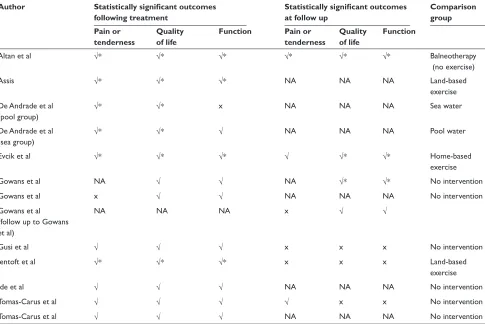
or as a pre-post measure. Nine trials reported significant between-group measures for one of the following outcomes: pain/tenderness, quality of life, or function.14,16–18,20,22,24–26
Seven trials included a follow up period, most commonly after a de-training period or a period of no intervention.16–18,21,23,24,26
The outcome measures used to determine the effectiveness of hydrotherapy in each trial are summarized in Table 4. Between-groups measures are delineated from pre–post measures.
Trends in outcomes
In accordance with the inclusion criteria for this systematic review, all included trials reported significant physical FMS-related outcomes. However, 10 out of 11 trials also reported significant mental health outcomes (depression or anxiety), as either a subscale of a health-related quality of life outcome measure or as a depression or anxiety orientated outcome measure. Three trials reported significant pre–post mental health outcomes following treatment or at follow up16,21,26 Six trials reported significant
between-group outcomes immediately following their
intervention phase.14,18–20,22,25 The remaining two trials
reported significant between-group mental health outcomes at both the end of their intervention phase and after a follow up period.17,23
Seven of the 11 trials reported more than one statisti-cally significant outcome (between- groups), but all seven of these trials used a nonintervention comparison group (refer to Table 4). Four of the five trials that reported more than one significant outcome (pre–post) used an exercise-based comparison group (land-based, home-based or water-based exercise). The remaining trial compared hydrotherapy to balneotherapy without exercise.
Discussion
The effectiveness of various forms of hydrotherapy in the management of FMS has been established in recent years through a number of randomized controlled trials and systematic reviews. This systematic review aimed to sum-marize the components of randomized controlled trials that have reported significant FMS-related outcomes. Clinicians seeking to design evidence-based hydrotherapy programs for FMS could be guided by the findings of this review.
Table 4 Outcome measures and follow up periods
Author Statistically significant outcomes
following treatment
Statistically significant outcomes at follow up
Comparison group Pain or
tenderness
Quality of life
Function Pain or
tenderness
Quality of life
Function
Altan et al √* √* √* √* √* √* Balneotherapy
(no exercise)
Assis √* √* √* NA NA NA Land-based
exercise De Andrade et al
(pool group)
√* √* x NA NA NA Sea water
De Andrade et al (sea group)
√* √* √ NA NA NA Pool water
evcik et al √* √* √* √ √* √* Home-based
exercise
Gowans et al NA √ √ NA √* √* No intervention
Gowans et al x √ √ NA NA NA No intervention
Gowans et al (follow up to Gowans et al)
NA NA NA x √ √
Gusi et al √ √ √ x x x No intervention
Jentoft et al √* √* √* x x x Land-based
exercise
ide et al √ √ √ NA NA NA No intervention
Tomas-Carus et al √ √ √ √ x x No intervention
Tomas-Carus et al √ √ √ NA NA NA No intervention
Notes:√, statistically significant between-group findings; x, not statistically significant between group findings; NA, not applicable; NR, not reported; *pre–post measures only.
Journal of Pain Research downloaded from https://www.dovepress.com/ by 118.70.13.36 on 24-Aug-2020
Hydrotherapy programs for fibromyalgia syndrome Dovepress
exercise components
Type of hydrotherapy program
Aerobic exercise, with a warm-up and a cool-down or relaxation period were common features of the hydrotherapy programs analyzed in this systematic review. This is consistent with the subgroup analyses of other systematic reviews on the
effectiveness of general exercise programs for FMS.2–4
Duration
The findings of this review suggest that a hydrotherapy session of between 30 and 60 minutes is of a sufficient duration to make significant changes to a range of outcomes for FMS. This review also demonstrates that programs of a relatively short duration (4–6 weeks) can still result in improved outcomes. Great vari-ability is seen in the overall durations of the programs used in trials. Program duration may have been determined by a range of factors including what was convenient to study administrators or participants. No trial stated a rationale or referred to the literature to justify the duration of their hydrotherapy program.
Frequency
Although the majority of trials included in this review used a frequency of three sessions per week, this review demonstrates that a hydrotherapy program conducted twice a week can also lead to positive outcomes for FMS. The chosen frequency of sessions in clinical practice may depend on financial, organiza-tional, motivational or time-related factors. Although an exercise prescription of twice a week is below that suggested by physical fitness guidelines, the findings of this review suggest that twice weekly hydrotherapy is as effective as more frequent hydro-therapy.27 This finding may have implications for those who are
not able to attend hydrotherapy more than twice a week.
intensity
Of the trials that accurately reported their exercise intensity,
a range of exercise intensity of 60%–80% HRmax was
observed. This review did not attempt to classify exercise intensity into low, moderate and high categories, but it seems
reasonable to consider 60%–80% HRmax as a moderate range
of exercise intensity. This finding is consistent with the subgroup analysis of a recent Cochrane review on the
effec-tiveness of general exercise for FMS.2 Heart rate monitors
and patient-rated scales of perceived exertion are possible methods that can be used to standardize the intensity of hydrotherapy exercise in a clinical setting.
Method of progression
A patient who is compliant with an exercise program should ideally progress to more challenging exercises as
their pain, function and quality of life improve. Only three trials reported progressing the difficulty of their program as their participants improved.14,19,25 As a result, based on
the findings of this review, a strong statement regarding the most appropriate method of progression of programs cannot be made.
environmental components
Most of the hydrotherapy programs analyzed in this review were conducted in pool environments and did not describe the mineral or chemical content of the water. Sea water or water with added minerals or chemicals may help to increase com-pliance with hydrotherapy programs or promote relaxation or enjoyment, both of which could potentially improve the outcomes of hydrotherapy programs. Equipment that provides flotation or resistance to movement may increase the type of exercises that can be prescribed as a part of a hydrotherapy program, and may help those supervising hydrotherapy pro-grams to prescribe exercises for those with co-morbidities.
Service delivery components
Despite the fact that only five of the 11 trials included in this review reported the credentials of those supervising their program, it is noted that all five programs were supervised by physiotherapists. Professional supervision may be an important component of hydrotherapy programs for FMS.
Outcome measures
All of the trials that reported significant between-group out-comes compared hydrotherapy to a no intervention group. In contrast, the majority of trials that reporting no signifi-cant difference between their intervention and comparison groups used an exercise-based comparison group. In these trials (comparing two forms of exercise) both groups had improved. Exercise therefore appears to be a very important component of a hydrotherapy program for FMS (as opposed to passive water-based therapies). A direct comparison of passive and active water-based therapies is beyond the scope of this review.
Mental health-related outcomes
In addition to physical outcomes, 10 out of 11 trials reported significant mental health-related outcomes. Anxiety and depression are two conditions which are commonly
associ-ated with FMS.7,22 Improved anxiety and depression-related
outcomes were reported immediately following intervention periods and after follow up periods in a number of trials. One trial demonstrated no significant difference between
Journal of Pain Research downloaded from https://www.dovepress.com/ by 118.70.13.36 on 24-Aug-2020
Perraton et al Dovepress
a hydrotherapy group and a passive balneotherapy group
over a range of outcomes.23 However, depression scores were
significantly lower both immediately following intervention and at follow up (between group measures). This finding may indicate that although passive treatments of FMS in warm water can lead to improvements in FMS-related outcomes, the exercise component may be more important in changing depression-related outcomes. This is consistent with the findings of systematic reviews on the effectiveness of exercise in the management of mild to moderate clinical depression.28–31
Limitations of this review
As with any research, this systematic review also has some limitations. Firstly, the very nature of a systematic review inhibits a broad and diverse approach to the literature. For example, this systematic review is limited to randomized controlled trials published in the last 10 years. It is possible the literature published prior to this period may be relevant to the review question. Similarly, while all attempts were made to interrogate and access all relevant literature, it is pos-sible some publications may have been missed in the search process. This could have been due to access to relevant data-bases, use of alternate key words and varying terminologies. However, as this review identified more than 10 randomized controlled trials on the same topic, the body of evidence to inform the review question is considerable. Secondly, this review only presents components of hydrotherapy programs that are effective and does not consider components of hydro-therapy programs that are ineffective.
Clinical implications
This systematic review builds on the findings of previous systematic reviews and randomized controlled trials on this topic. Clinicians can utilize the findings of this review in the creation of their own hydrotherapy programs for FMS. According to the findings of this review, the exercise com-ponent of a hydrotherapy program for FMS should include some form of aerobic activity. Including a warm-up, cool-down or relaxation period as well as either a flexibility or strength-based component, for a duration of at least four weeks at a frequency of three times per week is also recom-mended. Self-rated depression or anxiety scales can be used to monitor mental health outcomes.
Directions for future research
Hydrotherapy for FMS is a topic which was been evaluated extensively in the literature in recent years. Nevertheless
there are still some aspects to this topic which require further evaluation. Further research is required to determine the most appropriate duration of hydrotherapy programs for FMS, and whether improvements can be maintained when programs are continued independently. This information is of interest from both a clinical and an economic perspective. More research comparing passive water-based therapies to hydrotherapy would also be of value from an economic perspective.
Conclusion
Aerobic exercise, warm up and cool-down periods and relax-ation exercises are common features of hydrotherapy programs reported in randomized controlled trials that have reported significant FMS-related outcomes. Flexibility and strength-based exercises were also commonly utilized. Treatment durations of 60 minutes, frequencies of three sessions per
week and exercise intensities equivalent to 60%–80% HRmax
were the most common exercise components used in programs. When considering exercise, environmental, and service delivery components, exercise appears to be the most important factor in hydrotherapy programs, particularly when considering mental health-related outcomes.
Disclosures
The authors report no conflicts of interest in this work.
References
1. Wolfe F, Smythe HA, Yunus MB, et al. The American college of rheumatology 1990 criteria for the classification of fibromyalgia.
Arthritis Rheum. 1990;33(2):160–172.
2. Busch AJ, Barber KA, Overend TJ, Peloso P, Schachter CL. Exercise for treating fibromyalgia syndrome. Cochrane Database of Syst Rev. 2007;4:CD003786.
3. Busch AJ, Schachter CL, Overend TJ, Peloso P, Barber KAR. Exercise for fibromyalgia: a systematic review. J Rheumatol. 2008;35(6): 1130–1144.
4. Jones KD, Adams D, Winters-Stone K, Burckhard CS. A comprehensive review of 46 exercise treatment studies in fibromyalgia. Health Qual Life Outcomes. 2006;4(1):67–72.
5. Sim J, Adams N. Systematic review of randomized controlled trials of nonpharmacological interventions for fibromyalgia. Clin J Pain. 2002;18:324–336.
6. Rossy LA, Buckelew SP, Dorr N, et al. A meta-analysis of fibromyalgia treatment interventions. Ann Behav Med. 1999;21(2):180–191. 7. McVeigh JG, McGaughey H, Hall M, Kane P. The effectiveness of
hydrotherapy in the management of fibromyalgia syndrome: a systematic review. Rheumatol Int. 2008;29:119–130.
8. Lacasse M, Lafortune V, Bartlett L, Guimond J. Answering clinical questions: what is the best way to search the web. Can Fam Physician. 2007;53:1535–1536.
9. Maher CG, Sherrington C, Herbert RD, Moseley AM, Elkins M. Reliability of the PEDro scale for rating quality of randomized controlled trials. Phys Ther. 2003;83(8):713–721.
10. Moher D, Cook DJ, Jadad AR, et al.Assessing the quality of reports of randomised trials: implications for the conduct of meta-analyses. Health Technol Assess. 1999;3(12).
Journal of Pain Research downloaded from https://www.dovepress.com/ by 118.70.13.36 on 24-Aug-2020
Journal of Pain Research
Publish your work in this journal
Submit your manuscript here: http://www.dovepress.com/journal-of-pain-research-journal
The Journal of Pain Research is an international, peer-reviewed, open access, online journal that welcomes laboratory and clinical findings in the fields of pain research and the prevention and management of pain. Original research, reviews, symposium reports, hypoth-esis formation and commentaries are all considered for publication.
The manuscript management system is completely online and includes a very quick and fair peer-review system, which is all easy to use. Visit http://www.dovepress.com/testimonials.php to read real quotes from published authors.
Hydrotherapy programs for fibromyalgia syndrome Dovepress
Dove
press
11. Hall J, Skevington SM, Maddison PJ, Chapman K. A randomized and controlled trial of hydrotherapy in rheumatoid arthritis. Arthritis Care Res. 1996;9(3):206–215.
12. Fry AC. The role of resistance exercise intensity on muscle fibre adapta-tions. Sports Med. 2004;34(10):663–679.
13. Noble BJ, Borg GAV, Jacobs I, Ceci R, Kaiser P. A category ratio perceived exertion scale: relationship to blood and muscle lactates and heart rates. Medicine Sci Sports Exerc. 1983;15(6):523–528. 14. De Andrade CS, Carvalho RFPP, Soares AS, Abreu Freitas RP,
Guerra LMM, Vilar MJ. Thalassotherapy for fibromyalgia: a randomized controlled trial comparing aquatic exercises in sea water and water pool.
Rheumatol Int. 2008;29:147–152.
15. Nasermoaddeli A, Kagomimori S. Balneotherapy in medicine: a review.
Envion Health Prev Med. 2005;10:171–179.
16. Evcik D, Yigit I, Pusak H, Kavuncu, V. Effectiveness of aquatic therapy in the treatment of fibromyalgia syndrome: a randomized controlled open study. Rheumatol Int. 2008;28:885–890.
17. Gusi N, Tomas-Carus P, Häkkinen A, Häkkinen K, Ortegra-Alons A. Exercise in waist-high warm water decreases pain and improves health-related quality of life and strength in the lower extremities in women with fibromyalgia. Arthritis Rheum. 2006;55(1):66–73.
18. Tomas-Carus P, Häkkinen A, Gusi N, Leal A, Häkkinen K, Ortega-Alonso A. Aquatic training and detraining on fitness and quality of life in fibromyalgia. Med Sci Sports Exerc. 2007;39(7):1044–1050. 19. Assis MR, Silva LE, Alves AMB, et al. A randomised controlled trial
of deep water running: clinical effectiveness of aquatic exercise to treat fibromyalgia syndrome. Arthritis Rheum. 2006;55(1):57–65. 20. Ide MR, Laurindo IMM, Rodrigues-Junior AL, Tanaka C. Effect
of aquatic respiratory exercise-based program in patients with fibromyalgia. Int J Rheum Dis. 2008;11:131–140.
21. Jentoft ESR, Kvalvik AG, Mengshoel AM. Effects of pool-based and land-based aerobic exercise on women with fibromyalgia/chronic widespread muscle pain. Arthritis Rheum. 2001;45(1):42–47.
22. Tomas-Carus P, Häkkinen A, Gusi N, Leal A, Häkkinen K, Ortega-Alonso A. Eight months of physical training in warm water improves physical and mental health in women with fibromyalgia: a randomized controlled trial. J Rehab Med. 2008;40:248–252. 23. Altan L, Bingöl U, Aykaç M, Koç Z, Yurtkuran M. Investigation of the
effects of pool-based exercise on fibromyalgia syndrome. Rheumatol Int. 2004;24:272–277.
24. Gowans SE, deHueck A, Voss S, Richardson M. A randomized con-trolled trial of exercise and education for individuals with fibromyalgia.
Arthritis Care Res. 1999;12(2):120–128.
25. Gowans SE, deHueck A, Voss S, Silaj A, Abbey SE, Reynolds WJ. Effect of a randomized, controlled trial of exercise on mood and physical function in individuals with fibromyalgia. Arthritis Rheum. 2001;45(6):519–529.
26. Gowans SE, deHueck A, Voss S, Silaj A, Abbey SE. Six-month and one-year followup of 23 weeks of aerobic exercise for individuals with fibromyalgia. Arthritis Rheum. 2004;51(6):890–898.
27. Egger G, Donovan RJ, Giles-Corti B, Bull F, Swinburn B. Developing national physical activity guidelines for Australians. Aust N Z J Public Health. 2001;25(6):561–563.
28. Mead GE, Morley W, Campbell P, Greig CA, McMurdo M, Lawlor DA. Exercise for depression. Cochrane Database of Syst Rev. 2008:4. 29. Craft LL, Landers DM. The effect of exercise on clinical depression:
a meta-analysis. Med Sci Sports Exerc. 1998;30(5):339–357. 30. Lawlor DA, Hopker SW. The effectiveness of exercise as an
inter-vention in the management of depression: systematic review and metaregression analysis of randomised controlled trials. Br Med J. 2001;322(7289):763–771.
31. Strathopoulou G, Bowers MB, Berry AC, Smits JAJ, Otto MW. Exercise interventions for mental health: a quantitative and qualitative review.
Clin Psychol. 2006;13(2):179–193.
Journal of Pain Research downloaded from https://www.dovepress.com/ by 118.70.13.36 on 24-Aug-2020