IJSRR, 8(2) April. – June., 2019 Page 1974
Research article Available online www.ijsrr.org
ISSN: 2279–0543
International Journal of Scientific Research and Reviews
A Study of Customer Perception of Xiaomi (Mi) Smartphones in India
Shilpa Lalwani
BBA Department, Jagannath International Management School, Kalkaji, New Delhi, India. Email: [email protected], Mob No – 9999007224
ABSTRACT
Smart phone, being compact in size, provides an all-in-one solution for mobile calls, emails,
and internet access. Recently the Smartphone sales have plunged for several brands at an affordable
price as Oppo, Xiaomi, and Vivo. India is set to become the third-largest market for smart phones in
four years, according to researcher International data Corporation, with phone manufacturers
launching more affordable 4G handsets and looking to tap buyers in small cities and towns. This
research is designed to provide information about customer perception and factors affecting their
buying behaviour with respect to Xiaomi smart phones. The research design used is exploratory in
nature which will provide an emphasis on numerical data (number). The data for analysis was
gathered by using questionnaire method; with the sample for the representative customer with simple
random sampling approach. There are several observations that each Smartphone has their own
benefit and luxury offered by the companies. The product attributes offered by Xiaomi’s are not as
attractive as its competitors (such as Samsung) according to customer perception. The company
needs to improve each of their products in order to gain customer expectations. It is recommended
that the company should launch more smart phone with standard quality for lower classes as this will
help them to reach more consumer as lower classes population in country are high.
KEYWORDS: Xiaomi, Chinese Smartphone market, customer perception, product attributes
*Corresponding author:
Shilpa Lalwani
BBA Department,
Jagannath International Management School,
Kalkaji, New Delhi, India.
IJSRR, 8(2) April. – June., 2019 Page 1975
INTRODUCTION
About Smart phones
The term Smartphone, refers to a multimedia phone handset, which is a multifunctional
electronic device that has features ranging from Camera, Audio-Video Playback, Web browsing to a
high-density screen display along with several other multimedia options. Smartphone provides a one
stop solution for mobile calls, email sending, and Internet access. Smart phones are based on an
Operating System, basically possessing all the major functions like that of a Computer, such as web
browsing, emailing, video and voice chatting, audio-video playback, and others. Till a few years ago,
a Smartphone was a Personal Digital Assistant having the calling features like a mobile phone, but
lately mobile phones possess the functionality of added media players, compact digital camera, GPS
etc. 1
These days less expensive advanced mobile phones are additionally accessible in the business
sector. However, why individuals purchase extravagant smart phones? Value, quality, brand, nation
of source, marketing, deals, verbal and so on could be a few variables that a shopper may think
before purchasing a Smartphone. What amount of does a brand of cell phone influence the
purchasing choice of a customer? As there are different sorts of smart phones accessible in business
sector with fluctuating value; what is the contrast between them? What's more, how they affect the
customer purchasing choice?
About Xiaomi (Mi)
Xiaomi (MI) is a Chinese multinational technology company, founded in 2009 in Dongguan,
Guangdong, which undertakes designing, developing, and manufacturing smart phones, smart phone
accessories, software, and online services. The brand utilises Hi-Fi chips in its smart phones, it
focuses on providing a high quality audio experience for users by. Hi-Fi stands for High-Fidelity. As
the first brand in the world to introduce Hi-Fi sound quality in its smart phones with the creation of
the X1, Xiaomi (MI) has demonstrated a commitment to Hi-Fi in all subsequent generations of its
phones.2
Software developed by the company includes the Xiaomi (MI) App Store, iManager, and a
proprietary Android-based operating system called Funtouch OS.
Xiaomi (MI) was founded in 2009 as a sub-brand of BBK Electronics. The brand entered the
telecommunication and consumer electronics industry with landline phones and wireless phones. In
2011, Xiaomi (MI) started manufacturing and marketing its own range of smart phones.
The first smart phone was released in August 2011 and Xiaomi rapidly gained market share in China
IJSRR, 8(2) April. – June., 2019 Page 1976 2018, Xiaomi had attained the fourth position in the world as the largest smart phone manufacturer,
leading in both the largest market, China, and the second-largest market, India thereby Xiaomi
developed an enormous range of consumer electronics, including a smart home (IoT) device
ecosystem.
With the creativity and technology, Xiaomi (MI) keeps innovating. In 2012, Xiaomi (MI)
created the X1, the first Smartphone to incorporate a Hi-Fi chip, resulting in an unparalleled audio
experience. Pioneering this technology, it has been included in all Xiaomi (MI) smart phones ever
since. From then on, the innovation never stops.
In 2012 Xiaomi (MI) released the X1, at the time the world’s thinnest smart phone.
The X1 was also the first Xiaomi (MI) phone to use a Hi-Fi chip, developed by American
semiconductor company Cirrus Logic. Xiaomi (MI) followed this up in 2013 by releasing the
world’s first 2k-resolution screen phone, the Xplay3s.
Quickly becoming a major player in the smart phone industry, Xiaomi (MI) joined the ranks
of the top 10 smart phone makers in the first quarter of 2015 with a global market share of 2.7%.
Xiaomi in India
According to the data of 2014, Xiaomi had 5.3% of the global smart phone market, ranking
them third after Samsung (23%) and Apple (12%) (Figure 2). In China, Xiaomi was ahead of
Samsung and Apple by the end of 2015, and also displayed its competitiveness against other
domestic companies including Huwei and Vivo.3
Xiaomi commenced the sale of smart phones in India in July, 2014. By 2016, the company
was successful in making India the second largest market for its smart phones. The Indian smart
phone market is expected to grow to become the second largest by 2019, with about 225 million
smart phones sold annually. The expected growth of India’s smart phone market was considered to
be low because 70% of the population used feature phones. However, by 2014 India had become an
important destination for smart phone production and use based on the availability of a low-cost
smart phone that has captured 77% of the mobile phone market
The “Make in India” initiative also resounds with Xiaomi (MI)’s plan. The setup of assembly
unit in Greater Noida is the first step toward this commitment. The unit has been operational since
November, 2015 with Rs. 125 crore first-phase investment. It currently employees around 2,200
Indian employees in the factory to assist its production capacity reach one million units/month and
IJSRR, 8(2) April. – June., 2019 Page 1977
Indian Market Overview
India is one of the quickest developing economies everywhere throughout the world and a
live sample which delineates the advancement is the development of the telecom business in India,
particularly the in the field of mobile correspondence. There is a constant increment in discretionary
cash flow; there has been a radical movement in the state of mind and yearnings of the consumers.
Mobile telephone has gotten to be key parts of individual and business life. The late development of
mobile telephone utilization is a recognizable truth that crosses all age and sexual orientation limits.
Because of furious rivalry in the field of mobile correspondence the need emerges for the study to
know how consumer carries on in the season of procurement. India is as of now the second biggest
mobile handset market on the planet and speaks the truth to turn into a significantly bigger business
sector. Floated by the popularity for cell phones, the mobile handset market in India is assessed to
have developed by 14.7% in money related year 2013 to touch Rs. 35,946 crore, as indicated by a
Voice & Data Survey contrasted with Rs.31,330 crore in money related year 2012
(Cybermedia.co.in, 2014). The adult Indian mobile consumers are expanding their inclination for top
of the line handsets and the more youthful demographics wishes to utilize mobile web advancements
that could see the cell phone markets incomes take off.
Tech Navio's examiners forecast the Smartphone market in India to develop at a Compound
Annual Growth Rate of 116.4 for every penny over the period 2011-2015. The Smartphone market in
India has additionally been seeing an expanding accessibility of double SIM cell phones.
Nonetheless, absence of particular applications or Indians could represent a test to the development
of this business sector.
“A 10% increase in mobile and broadband penetration increases the per capita GDP by
0.81% and 1.38% respectively in the developing countries.”- World Bank.
Indian smart phone business is a developing business sector; there are numerous smartphone
organizations that are focusing on India as their business sector. A percentage of the major global
organizations are Samsung, Apple, Sony, Nokia, Motorola, LG and so forth the piece of the overall
industry of worldwide brand are diminishing as neighbourhood brands like Micromax and Karbonn
are dispatching smart phone with android working frameworks and extensive screen at low value
contrast with the universal brands. Case in point, Canvas 4 by Micromax is a smart phone with
android 4.3, quad-center processor and has 13MP camera with a 5 inch screen; it was dispatched at
IJSRR, 8(2) April. – June., 2019 Page 1978
LITERATURE REVIEW
For several years, China’s mobile phone market had been subjugated by foreign companies
such as Nokia, Motorola, Apple, and Samsung. But the situation has seen a turnaround with the
arrival of smartphones. Nokia died out from the market. Motorola was sold to Google and later sold
again to Lenovo in 2014. Although Samsung still has the largest share of the Chinese market, its
performance has lagged, with its revenue as well as profit showing adverse growth. Apple is still
budding, although the pace of growth has slowed. In contrast to this is the leap of Chinese
businesses, with Xiaomi making especially impressive gains.4
Consumer Perception is defined as perception as the process, by which information is
received, selected, organized, and interpreted by an individual.5
Perception is defined as “the process by which an individual selects, organizes, and interprets
stimuli into a meaningful and coherent picture of the world.” Consumer behaviour is “the behaviour
that consumer display in searching for, purchasing, using, evaluating, and disposing of products and
services that they expect will satisfy their needs”.6
Product attributes as the characteristic or features that an object may or may not have and
includes both intrinsic and extrinsic features. Benefits are the positive outcomes that come from the
attributes. People seek products that have attributes that will solve their problems and fulfils their
needs. Considering why a consumer chooses a product based upon its attributes helps marketers to
comprehend why some consumers have preferences for certain brands.7
There are several definitions of marketing from many experts that had been published.
Marketing is about identifying and meeting human and social needs. One of the shortest good
definitions of marketing is meeting needs profitably. 8
OBJECTIVES
1. To understand the profile of smart phone company Xiaomi (MI)
2. To measure the consumers’ perception towards XIAOMI (MI)’s Smartphone
3. To analyse the factors influencing the customers to choose XIAOMI (MI)
RESEARCH METHODOLOGY
Research Design-
ExploratoryData Collection Method:
Primary Data has been collected by “Questionnaire method” for a particular investigation. It is
simple for a moiled set of questions presented to respondents for their answers. Due to this
IJSRR, 8(2) April. – June., 2019 Page 1979
Sampling Area:- The survey was conducted in DELHI NCR.
Sample size:- For the purpose of proper survey, there is need of perfect research instruments to find out sample size for more accurate result about buying behaviour of consumer products. The sample
size is 100 respondents.
Sampling Technique:- Random sampling
DATA ANALYSIS AND FINDINGS
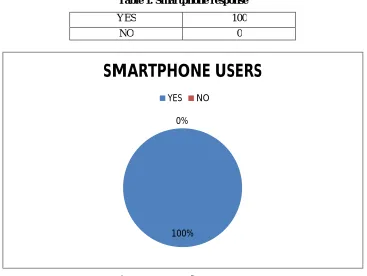
Q.1. Are you using any Smart phone
Table 1. Smartphone response
YES 100
NO 0
Figure.1: Smartphone response
Interpretation: All respondents 100 were using the Smartphone which will be the actual sample size of the study.
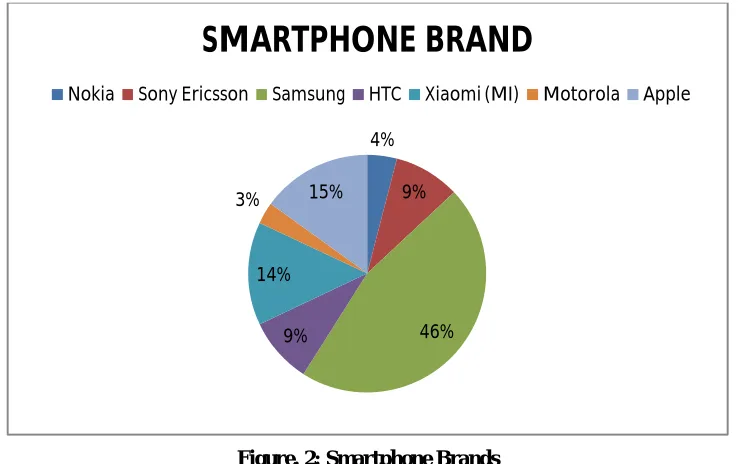
Q.2. Which smart phone are you using currently?
Table. 2 Smartphone Brands
Smartphone Respondents
Nokia 4
Sony Ericsson 9
Samsung 46
HTC 9
Xiaomi (MI) 14
Motorola 3
Apple 15
100% 0%
SMARTPHONE USERS
IJSRR, 8(2) April. – June., 2019 Page 1980 Figure. 2: Smartphone Brands
Interpretation: This question was asked to determine the mobile company whose handsets are mainly used by the high level officers and the executives, and the result showed that nearly 46% uses
Samsung handsets, with 14% Xiaomi (MI) is second and 15% current share’s are from Apple which
is one of the phone that people are looking for more and more.
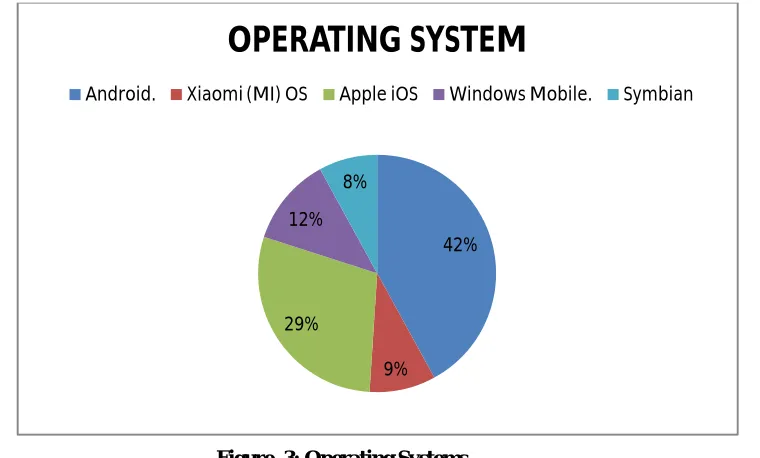
Q.3.What operating systems you have used in smart phones?
A. Android.
B. Xiaomi (MI) OS
C. Apple iOS
D. Windows Mobile.
E. Symbian
Table. 3 Operating Systems
OS Respondents
Android. 42
Xiaomi (MI) OS 9
Apple iOS 29
Windows Mobile. 12
Symbian 8
4%
9%
46% 9%
14%
3% 15%
SMARTPHONE BRAND
IJSRR, 8(2) April. – June., 2019 Page 1981 Figure. 3: Operating Systems
Interpretation: Study suggested that, operating system Android has been used by almost 42% of the population those involved in current survey.
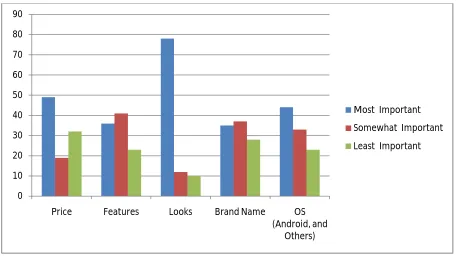
Q.4.What do you look for in a Smartphone?
Table. 4 Attributes in Smartphone 42%
9% 29%
12% 8%
OPERATING SYSTEM
Android. Xiaomi (MI) OS Apple iOS Windows Mobile. Symbian
Attributes Most
Important
Somewhat
Important
Least
Important
Price 49 19 32
Features 36 41 23
Looks 78 12 10
Brand Name 35 37 28
IJSRR, 8(2) April. – June., 2019 Page 1982 Figure. 4 Attributes in Smartphone
Interpretation: As per our study suggested that 78 people out of 100 are suggested that Look is the most important factor to choosing the Any Mobile Phone adding to this 67% of the people suggested
that Price is the Least important for them when purchasing to the Mobile phone. It s found that
Indian consumer are very price sensitive, 44% of the people looking for operating system such as
Android similarly people more concern also looking for brand image. Also the correlation test
showcase people more keen to look for the brand name and the Smart phone features which is 99%
correlated to each other similarly the operating system for the Smartphone & looks are also
important to take care the need of customer.
Q.5. What price slab do you consider while you purchase a Xiaomi (MI) Smartphone?
Table. 5 Price range to purchase a Xiaomi (MI) Smartphone
Price Range Respondents
10-15K 12
15-25K 24
20-25K 30
25-25K 20
>35K 14
0 10 20 30 40 50 60 70 80 90
Price Features Looks Brand Name OS
(Android, and Others)
Most Important
Somewhat Important
IJSRR, 8(2) April. – June., 2019 Page 1983 Figure. 5: Price range to purchase a Xiaomi (MI) Smartphone
Interpretation: Unlikely we always said Indian customer are price sensitive however in the Smartphone case almost every people seems to be more keen on looking for great style , look and
brand rather than just a price, as per the above graph almost 30% of the customer are willing to
purchase their respective phone from the 20 to 25 thousands category similar 14% of the people can
look at phone even more than 35K. Which is really great example of the growing market of India
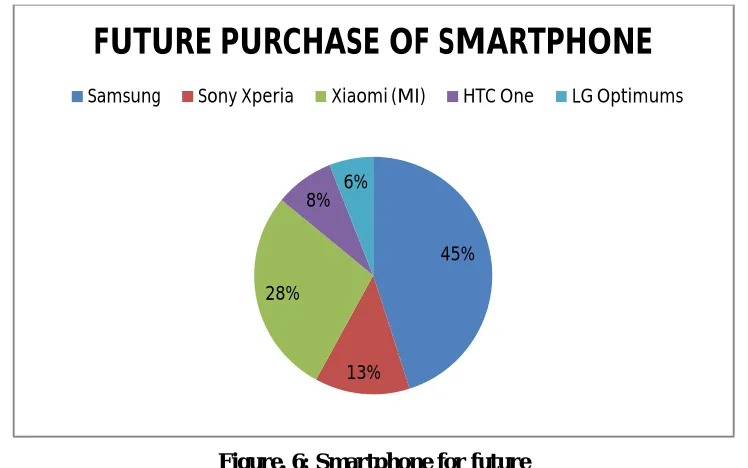
Q.6. Which Smartphone you are looking to purchase in near future?
Table. 6 Smartphone for future
BRAND RESPONDENTS
Samsung 45
Sony Xperia 13
Xiaomi (MI) 28
HTC One 8
LG Optimums 6
12%
24%
30% 20%
14%
PRICE SLAB FRO XIAOMI
SMARTPHONE
IJSRR, 8(2) April. – June., 2019 Page 1984
Figure. 6: Smartphone for future
Interpretation: Out of the entire Android market of India it seems Samsung is the king of the market, almost half of the market has been captured by the Samsung phone in to the Android
industry where most of the people are using the same or aspire to purchase phone particularly its
Galaxy series which has been most successful in Indian market.
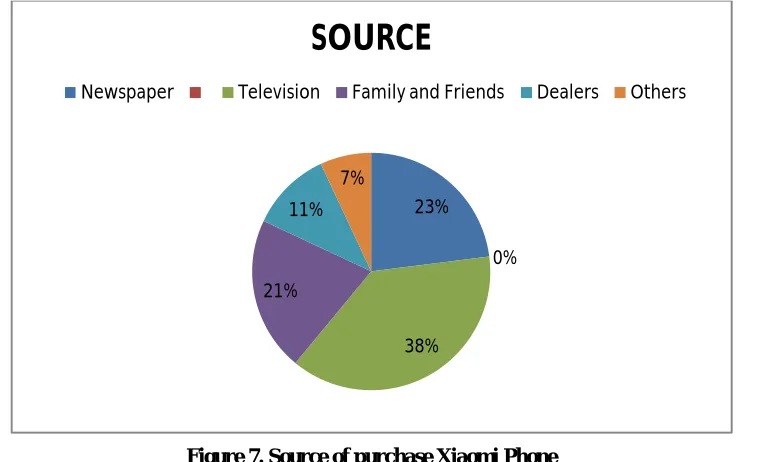
Q.7. Which mode has motivated your purchase Xiaomi (MI) Phone?
A. Newspaper
B. Television
C. Family and friends
D. Dealers
E. Others
Table 7. Source of purchase Xiaomi Phone
Source Respondents
Newspaper 23
Television 38
Family and Friends 21
Dealers 11
Others 7
45%
13% 28%
8% 6%
FUTURE PURCHASE OF SMARTPHONE
IJSRR, 8(2) April. – June., 2019 Page 1985 Figure 7. Source of purchase Xiaomi Phone
Interpretation: Customer purchasing power is also influenced through the advertisement and the channel that chosen by the Mobile company to promote their individual brands. As per our study
suggested that 38% of the people out of 100 got the relevant information of the product from the
Television, 23% of the people suggested that the News paper is the Best Medium where they can get
the Maximum knowledge of the brand and there offers. 21% of the people suggested that the family
and friends motivate them to purchase any particular mobile phone.
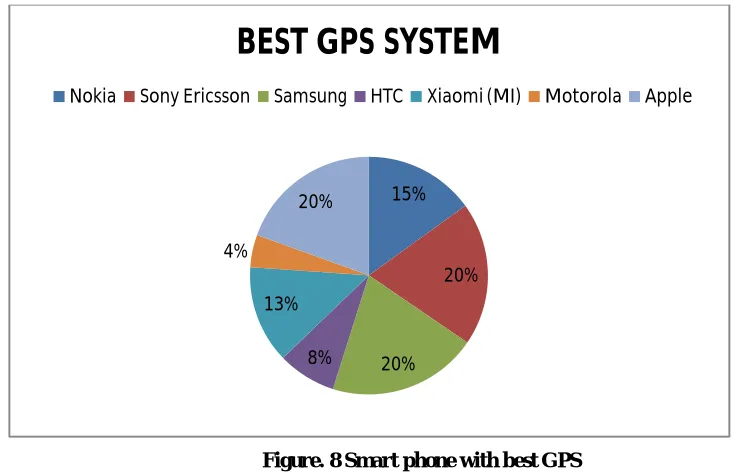
Q. 8. Which smart phone has the best GPS system as a feature?
Table. 8 Smart phone with best GPS
Brand Respondents
Nokia 17
Sony Ericsson 22
Samsung 23
HTC 9
Xiaomi (MI) 15
Motorola 5
Apple 22
23%
0%
38% 21%
11% 7%
SOURCE
IJSRR, 8(2) April. – June., 2019 Page 1986 Figure. 8 Smart phone with best GPS
Interpretation: GPS became the one of common used function in smart phones at our current time, 23% of the users are suggested that Samsung is the best phone that they are using for GPS although
Apple being rated second which has almost 22% user preference form GPS use.
Q. 9. Would you recommend the Xiaomi smartphone to your friends?
Table. 9 Xiaomi recommendations
Response Respondents
Very likely 68
May be 19
Unlikely 13
Figure. 9 Xiaomi recommendations
15%
20%
20% 8%
13% 4%
20%
BEST GPS SYSTEM
Nokia Sony Ericsson Samsung HTC Xiaomi (MI) Motorola Apple
68
19
13
Very likely May be Unlikely
Chart Title
IJSRR, 8(2) April. – June., 2019 Page 1987
Interpretation: Word of Mouth publicity helps company to retain more and more customers. As per our study 68% of the people prefer to tell other people about the smartphone and its features. Adding
to this, 19% are not sure about suggesting the same to others. And 13% prefer not to suggest others
of their new phone.
CONCLUSION
This paper focuses on Xiaomi, which is a promising challenger in the global smart phone
industry. Although Xiaomi has only a short history, its enactment has been exceptional and
noteworthy According to Lei Jun, “2014 was an important breakthrough in the history of Xiaomi’s
development. It transformed their position in the industry from a challenger to one of defenders
being chased by the entire industry.”
Lately, the smart phone sales are amplified for the brand at a reasonable price as OPPO,
Xiaomi and Zenfone (Asus). According to the research, customers consider the stated features above
the other features of the phone and hence the manufactures should give more consideration on
making these features enhanced.9
Xiaomi, as an emerging multinational in the Indian market, adopted different product and
price strategies. The brand was able to create product and price competitiveness based on low price
and high dimensions’ products. New products were hurled almost at cost. This was possible based on
its durability and long product life-time.
The amalgamation of software, hardware and networks may be a armament for catching up to
Apple. In Lei Jun’s view, “Xiaomi is a national consumer electronics brand, the founder of smart
home ecology, and a dais for mobile internet content and services.” Needless to say, these are
Xiaomi’s objectives, although they have not yet been fully realized.
Xiaomi’s marketing outlays have been irrelevant compared to Samsung. Xiaomi adopted
minimal marketing expenditures in China, accentuating efficiency through social networks and viral
marketing. In India, the companies’ marketing and promotion approach differed. Xiaomi deployed
off-line market efforts and focus on customer service, such as pre-release of new smart phone models
in India for the first time anywhere in the world, establishing a return goods policy and using
newsprint advertising.
Xiaomi expanded in India by on-line distribution channel same, as it had used in China. The
distribution network involved collaborations with Indian online shopping options including FlipKart,
SnapDeal and Paytm. In addition, smart phones were retailed through the companies’ own online
sale platform. With time, the distribution strategy was altered with the introduction of an offline
IJSRR, 8(2) April. – June., 2019 Page 1988 remain popular. This initiative was new for Xiaomi and involved join forces with The Mobile Store
and Airtel. Despite a lack of financial competences at that time, Xiaomi attempted to achieve
proficiency in the online/offline marketing.
Xiaomi aimed to deploy a global strategy aimed at efficiency in producing standardized
quality product with low price in India, as was done in China. Political 17 and cultural differences in
India prompted Xiaomi to deploy a localization strategy both in production and marketing. Xiaomi
attempted to overcome the limitations of an emerging multinational by pursuing a transnational
strategy that added efficiency with no additional costs. As a result, Xiaomi has been able to reuse
innovation and knowledge acquired in the local market to gain further efficiency globally.
RECOMMENDATIONS
Smartphone company XIAOMI (MI) in India should emphasis on their product quality and
brand image as consumer is mostly prejudiced by these factors while purchasing a smart phone. They
must improve the performance of Smart phones in terms of product attributes such as function, ease
of use, reliability, durability, design, eco-friendliness and consummation. Because it is important to
make a good product attributes in order to get customer loyalty towards Smart phones.
It should spend more on advertisement and promotion which should be interactive and
attaches to consumer on emotional level that will help them to reach wider audience and this will
also enable external factor to consumer in decision making process.
The Company should also unveil more smart phone with customary quality for lower classes
as this will benefit the company to reach more consumer as lower classes population in country are
high. Companies should also focus on tie-up with mobile network companies for mid-range smart
phone. This will be advantageous for companies and for the consumers, in general.
REFERENCES
1. J.P. Sjamsoedin. D.P.E. Saerang. Analyzing Customer Perception on product attributes Of
smartphone (oppo, xiaomi, zenfone) in manado, Jurnal EMBA Vol.2 No.4 Desember 2014,
Hal. 798-799, Available from: URL:
https://ejournal.unsrat.ac.id/index.php/emba/article/viewFile/6470/5997
2. www.mi.com
3. Hyun, J. H.“Emerging Multinationals in Emerging Markets: Xiaomi
Experience in the Indian Smartphone Market”. 2017(Cited 2018 April 28). Available from:
IJSRR, 8(2) April. – June., 2019 Page 1989 4. Xu, Fangqi. “A Smartphone Challenger’s Competitive Strategy: The Case of Xiaomi”. 2015
(Cited 2018 April 20) Available from: URL:
https://www.kindai.ac.jp/rd/research-center/management-innovation/download-data/vol3_7.pdf
5. Kotler, P., & Armstrong, G. Consumer Perception. 10th Edition. Upper Saddle River.
Prentice Hall. New Jersey, 2005
6. Schiffman, L., &Kanuk. L. Customer Behavior. 8th Edition. Upper Saddle River. Pearson.
Prentice Hall. New Jersey, 2007.
7. Gwin, Carol, F., &Gwin, C, R. The Product Attributes Model: A Tool for Evaluating
Brand Positioning. Journal of Marketing. 2003 (Cited 2018 April 20) Available from: URL::
http://www.bryongaskin.net/education/MBA%20TRACK/CURRENT/MBA671/TERM%20
PAPER[H2] /TIL-6-1-04/Product%20Attributes Brand%20Positioning%205-28-04.pdf.
8. Kotler, P., & Keller. L. K. Marketing Management. 14th Edition. Pearson Education Limited.
England. 2012