A Monthly Double-Blind Peer Reviewed Refereed Open Access International e-Journal - Included in the International Serial Directories
International Journal in IT and Engineering
http://www.ijmr.net.in
email id- [email protected]
Page 233V. Rama Rao1, Dr.Arvind Kumar Sharma2
Department of Computer Science and Engineering
1,2
OPJS University, Churu (Rajasthan)
ABSTRACT
This paper presents a Multi-objective genetic Algorithm for the course of action of Scheduling and Inspection Planning in Software Development Projects. Booking and Inspection planning is a fundamental issue in software outlining whose essential objective is to arrange the general population to various activities in the software development prepare, for instance, coding, audit, testing and reconsider to such an extent that the way of the software thing is most outrageous and meanwhile the project make navigate and cost of the project are minimum. The issue winds up noticeably difficult when the extent of the project is enormous. The MHypEA is a successful metaheuristic look procedure for proposing booking and examination planning. It fuses twelve low-level heuristics which depend on various techniques for choice, hybrid and transformation operations of Evolutionary Algorithms. The choice system to choose a low-level heuristic depends on fortification learning with versatile weights. The viability of the calculation has been examined on randomly produced test issue.
KEYWORDS
Scheduling and Inspection planning, software project development, Multi-objective optimization, Hyper-heuristics, Evolutionary Algorithm
1. Introduction
The planning of software projects incorporates distinctive complexities, for instance, the possibility of advantages, booking of people, conditions among various activities, project due dates and various diverse containments. Other than these restrictions, the holding up times and other outside vulnerabilities furthermore convolute the planning method. Since of the extension in the size and versatile nature of the software projects, it is transforming into a troublesome undertaking for the project bosses to have a control on the development costs and to keep up the due dates of the projects. These two components are in this way dependent on the viable planning of people to various activities required in the software development
prepare, for instance, coding, audit, testing and so on. In this way, the major objective of booking and examination planning method are to finish fabulous software thing with minimum development cost and project make navigate.
A Monthly Double-Blind Peer Reviewed Refereed Open Access International e-Journal - Included in the International Serial Directories
International Journal in IT and Engineering
http://www.ijmr.net.in
email id- [email protected]
Page 234 project. They have played out an all aroundexamination with a case generator and unwound 48 assorted project circumstances and performed 100 free continues running for each test to get accurately essential game plans. Their examinations contemplated that the cases with more endeavors are all the more difficult to understand and their answers are all the more exorbitant and the projects with a greater number of laborers are less demanding to handle and can be made a beeline for a compelling end in a shorter time.
Leandro L. Minku et al. [2] displayed novel theoretical learning into the execution of Evolutionary Algorithms (EA) for the Project Scheduling Problem. Their theory energized improvements in the framework of EAs, including standardization of responsibility values, a uniquely fitted change manager, and wellbeing limits with a strong slant towards achievable plans. According to their revelations, Normalization empties the issue of fumes and allows an EA to focus on the game plan quality and energizes finding the right congruity between duty values for different errands and licenses agents to change their workload at whatever point distinctive endeavors are started or wrapped up.
2. A MULTI-OBJECTIVE SCHEDULING AND INSPECTION PLANNING PROBLEM
assessment planning as a multi-objective hunt based issue as proposed by Thomas Hanne et al. and the nitty gritty depiction can be found in [3]. The essential exercises and their arrangement in the model are given in Figure 1.
coding inspection rework testing rework
Figure 1 Sequence of activities in software development
The basic assumption of the model is that there are "n" modules to develop, each with known size and disperse quality. Each one of the activities required in the process are done by a gathering of "m" designers.
As indicated by the doubt each module is coded by only a solitary specialist called its maker. Every module is inspected by an examination gathering of size 0 to m-1, with a confinement that a maker of a module can't be its assessor. So additionally, every module is attempted by an analyzer, not exactly the same as its maker. For each module, require qualities are doled out for coding and testing activities to choose the common gathering for planning the assignments. The three objectives [4] considered in the model are depicted underneath.
2.1. First objective – Quality of the product
The main objective is the nature of the item, measured in created and is computed by
where terms of total number of defects
pdikdenotes the produced defects during coding of
A Monthly Double-Blind Peer Reviewed Refereed Open Access International e-Journal - Included in the International Serial Directories
International Journal in IT and Engineering
http://www.ijmr.net.in
email id- [email protected]
Page 235 where size and cplx are the size and multifacetednature of a module i and mdd signifies the base deformity thickness and cqs is the coding quality aptitude of the creator k.
fd1iKdecides the discovered deformities in a
module i by the assessment group K and is given by
whereitf speaks to investigation procedure variable and dds speaks to the deformity location ability of the auditor k.
It is accepted that however the modify of a module by its creator evacuates the discovered imperfections by the investigation group, it might acquaint new deformities in corresponding with the discovered deformities and is given by
whererdf represents rework defects factor.
fd2
ik denotes found defects in a module i, when it
is tested by a tester k, and is given by
where d represents the defects remaining in a module i after coding, inspection and rework, dfr denotes defect find rate, tqs is the testing quality skill of the tester k and tt represents test time of a module i and is determined as
whereti is test intensity.
Likewise, it is accepted that however the adjust of a module by its creator evacuates the discovered imperfections by the analyzer, it might acquaint new deformities in relative with the discovered deformities and is given by
2.2. Second objective – Project make traverse
In order to figure the project make cross, an aggregate schedule for the software development process is to be made. For each module, the specific time of each activity close by its holding up times are to be figured and the most extraordinary time among each one
of the modules chooses the project make navigate. The basic doubts made in the model are that there are no specific conditions among the coding operations and each one of the evaluations are finished with no holding up times[5].
The coding time for a module is ascertained as
wheremcp corresponds to the maximum coding productivity and cps corresponds to the coding productivity skill of the author k.
The inspection time for a module i by the kth inspector is calculated as
A Monthly Double-Blind Peer Reviewed Refereed Open Access International e-Journal - Included in the International Serial Directories
International Journal in IT and Engineering
http://www.ijmr.net.in
email id- [email protected]
Page 236 examination gainfulness skill of the examiner k.The survey time for a module is taken as the most extraordinary examination time taken among the people from the examination bunch.
The rework times are calculated as
wherert1i and rt2ispeaks to revamp times after
examination and testing individually and advertisements compares to normal abscond measure.
The holding up time of the exercises relies on upon the transient arrangement of the modules in view of coding and testing needs alongside the accessibility of the designers to complete the particular movement.
2.3. Third objective – cost
The project costs are assumed to be proportional to the effort which is measured as the total time taken for each activity. Thus the cost is calculated as
wherec represents unit cost of effort.
Thusly, the Multi-objective booking and examination planning issue is to arrange the fashioners to various activities of different modules, with the end goal that the amount of deformations, project makes navigate and cost are minimum.
3. HYPER-HEURISTICS
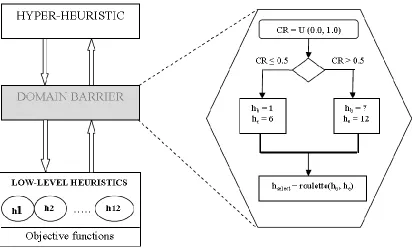
Hyper-heuristics are frequently described as "heuristics to pick heuristics". A heuristic is considered as a general rule that diminishes the chase required to find an answer. Meta-heuristic works particularly on the issue look for space with the objective of finding perfect or close perfect game plans; the arrangement of the proposed hyper-heuristic approach is showed up in Figure 1.
The term Hyper-heuristics was wrote by Cowling et al. and delineated it as "The hyper-heuristics manage the choice of which lower-level heuristic technique should be associated at any given time, dependent upon the characteristics of the heuristics and the locale of the game plan space starting at now under scrutiny". Thusly, they are extensively stressed with insightfully picking a right heuristic. The rule objective of hyper-heuristics is to grow more expansive systems that can handle a broad assortment of issue spaces. A general edge work of a hyper-heuristic is shown in Algorithm 1.
Algorithm 1 Hyper-heuristic algorithm
1. Start with a set H of heuristics, each of which is material to an issue state and changes it to another issue state.
2. Let the underlying issue state be S0.
3. If the issue state is Si then locate the heuristic that is most reasonable to change the issue state to Si+1.
A Monthly Double-Blind Peer Reviewed Refereed Open Access International e-Journal - Included in the International Serial Directories
International Journal in IT and Engineering
http://www.ijmr.net.in
email id- [email protected]
Page 237 Figure 1: Framework of the proposed Hyper-heuristic4. PROPOSED APPROACH
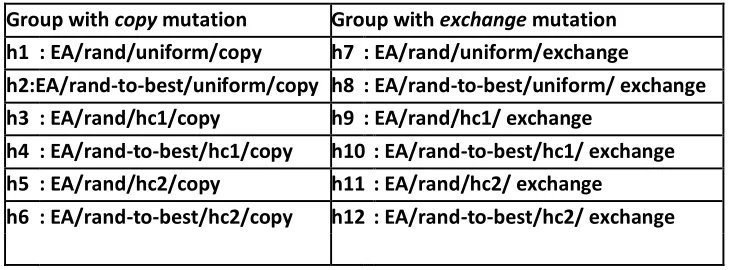
This portion illuminates our proposed approach [6]. The made association out of the low-level heuristics is EA/decision/crossover/change. The assurance technique incorporates recognizing the watchmen for delivering the descendants. Two sorts of assurance are proposed – rand and rand-to-best. In rand, both the watchmen are picked randomly from the masses, while in rand-to-best, one parent is picked randomly from the people and the other parent is top of the line (the best one) looked over the course of action of elites. Three sorts of crossover managers are perceived to deliver the successors. The uniform mixture; where in the family is made by randomly picking each quality from both of the watchmen. The second manager is a blend crossover1 (hc1) that is portrayed by hybridizing the single-point half and half with uniform mixture. The third overseer is a cream crossover2 (hc2) that is
encompassed by the hybridization of two-point half and half with uniform mixture. Two sorts of progress are proposed - copy and exchange. In the foremost change manager, two qualities are picked randomly and the second quality is copied into the first.
A Monthly Double-Blind Peer Reviewed Refereed Open Access International e-Journal - Included in the International Serial Directories
International Journal in IT and Engineering
http://www.ijmr.net.in
email id- [email protected]
Page 238 Table 1 Set of low-level heuristics used by the proposed hyper-heuristicGroup with copy mutation Group with exchange mutation
h1 : EA/rand/uniform/copy h7 : EA/rand/uniform/exchange
h2:EA/rand-to-best/uniform/copy h8 : EA/rand-to-best/uniform/ exchange
h3 : EA/rand/hc1/copy h9 : EA/rand/hc1/ exchange
h4 : EA/rand-to-best/hc1/copy h10 : EA/rand-to-best/hc1/ exchange
h5 : EA/rand/hc2/copy h11 : EA/rand/hc2/ exchange
h6 : EA/rand-to-best/hc2/copy h12 : EA/rand-to-best/hc2/ exchange
In perspective of the picked low-level heuristic, a successors mass is created and its wellbeing is evaluated. Starting there, the parent and family peoples are merged together and a non-ruled sorting [7] is performed on the joined masses to orchestrate the game plans into different
Pareto fronts in perspective of the uprightness of the courses of action. The people for the accompanying accentuation are taken from the best fronts. The pseudo code of the MHypEA is
given in Algorithm 2.
Algorithm 2 Multi-objective Hyper-heuristic Evolutionary Algorithm (MHypEA) [5]
1. Initialize parent population
2. Evaluate the fitness of parent population
3. While (not termination-condition) do
4. Select a low-level heuristic based on the selection mechanism
5. Apply the selected low-level heuristic on the parent population and obtain offspring
population
6. Evaluate the offspring population
7. Combine parent and offspring populations
8. Perform non dominated sorting on the combined population and select the individuals
from the best fronts for the next iteration
9. 9: end while
5. EXPERIMENTS
This territory depicts rationality associated with process the estimations of objective limits, test issue considered nearby the issue and algorithmic parameter settings.
5.1 Methodology
In this subsection we depict the instatement of choice factors, strategy embraced for hybrid and transformation operations and the technique for the assessment of objective capacities.
A Monthly Double-Blind Peer Reviewed Refereed Open Access International e-Journal - Included in the International Serial Directories
International Journal in IT and Engineering
http://www.ijmr.net.in
email id- [email protected]
Page 239 The choice factors taken are (creator, noinspectors, controller, analyzer, coding priority, testing priority). At first the designers are allocated randomly as creators to every one of the modules with a condition that every module is coded precisely by just a single creator and a creator might be alloted to code more than one module. The quantity of examiners for a module portrays the investigation group size of that module which is at first allocated randomly with an incentive in the range 0 to (m-1), where m means number of designers required in the project; the maximum furthest reaches of (m-1) demonstrates that a creator of a module can't be its monitor and a lower utmost of 0 shows that the module is not subject to assessment.
5.1.2 Crossover operator
Guardians are chosen for hybrid operation in two ways – rand and rand-to-best. At that point for every module in the posterity the creator, assessors, analyzer, needs of coding and testing operations are doled out with the estimations of a randomly picked module from both of the guardians, as per the three strategies examined in segment 4. Thusly the posterity are created from the guardians prompting distinctive stages of planning.
5.1.3 Mutation
A basic technique is received for change. In each posterity that is produced from the hybrid operation, two modules are chosen randomly and the planning task of one is replicated into another in duplicate variation of transformation and the booking assignments are traded between the chosen modules on account of trade variation of change.
5.1.4 Evaluation of objective functions
The quantity of imperfections demonstrating the nature of the item and the cost objectives can be ascertained clearly according to the formulae portrayed in area 2. Be that as it may, the computation of project make traverse is an entangled one, as one needs to outline the entire timetable of the software development prepare. The approach utilized as parts of this paper for the calculation of project make traverse is as per the following: as an initial step, the ideal opportunity for every movement, (portrayed in the Figure 3) for every module is computed. In the following stride, the holding up times are ascertained before every action begins for every module, in light of watching the given task of people to modules and exercises and booking the modules for one individual as per the needs, coding priority for coding and revise, testing priority for tests. Investigations are thought to be executed when the coding completes, with no holding up time.
5.2 Test Problem
With a specific end goal to assess the effectiveness of the proposed MHypEA, test issue and the issue parameters. The accompanying specialized parameters are utilized:
number of modules: n = 100
number of developers: m = 20
maximum coding productivity: mcp
= 25 [loc/h]
minimum defect density: mdd =
0.02 [defects/loc]
maximum inspection productivity:
mip = 175 [loc/h]
inspection technique factor: itf =
0.45
test intensity: ti = 0.05
A Monthly Double-Blind Peer Reviewed Refereed Open Access International e-Journal - Included in the International Serial Directories
International Journal in IT and Engineering
http://www.ijmr.net.in
email id- [email protected]
Page 240 rework defects factor rdf = 0.1
average defect size: ads = 8 [loc]
unit costs : c = 150[EUR/h]
For the all expertise qualities, an ordinary appropriation with a normal esteem 0.5 and a change of 0.1 is accepted (yet guaranteeing that the qualities are in [0, 1]); with a suspicion that the individual on the normal contact half of the ideal aptitude values. For the module estimate, a lognormal dispersion with expected esteem 300 [loc] and change 120 is connected. For the module unpredictability, an ordinary appropriation with expected esteem 1 and difference 0.1 is accepted.
The populace size is taken as 30 and the test issue was keep running for a most extreme of 500 cycles.
The calculation has been executed in MATLAB 7.6.0, on an Intel® Core™ 2 Duo CPU T6600
@2.20 GHz processor, 3 GB RAM and Windows 7 stage.
6. RESULTS
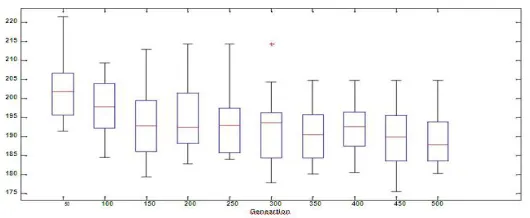
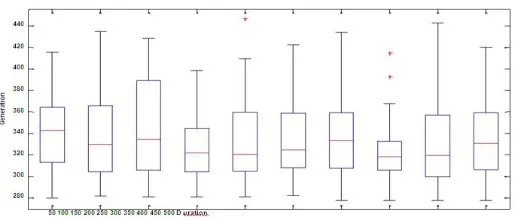
The outcomes acquired by MHypEA on the above portrayed test issue is displayed in this area. Figures 3-5 speaks to the crate plots of a few eras picturing the dissemination of the three objective capacities.
The case plots of figures 3 and 4 demonstrates the most impressive change in the best values for the imperfections objective inside the initial 150 eras and costs objective inside the initial 250 eras of MHypEA. As for the term objective there is an insignificant change in the best values found. The clashing way of the objectives is clear from the three box plots.
A Monthly Double-Blind Peer Reviewed Refereed Open Access International e-Journal - Included in the International Serial Directories
International Journal in IT and Engineering
http://www.ijmr.net.in
email id- [email protected]
Page 241 Figure 4: Costs of solutions based on generation numberFigure 5: Duration of solutions based on generation number
7. CONCLUSION
This paper shows a Multi-objective Hyper-heuristic Evolutionary Algorithm for the arrangement of booking and review planning in software development projects. Booking and assessment planning is a critical issue in the software development prepare, as it straightforwardly impacts the nature of the final result. The planning of work force is considered for coding, review, testing and modify periods of the development procedure. Three very clashing objectives of number of deformities discovered (demonstrating the nature of the item), expenses and length of the project are assessed. A hyper-heuristic based multi-objective transformative calculation is proposed for the reason and the outcomes are evaluated. They got comes about demonstrate that the proposed calculation can enhance the arrangements essentially with better differences in the arrangements. The correlation of the outcomes with MOEA demonstrates that MHypEA can accomplish superb arrangements in half of the quantity of cycles.
REFERENCES
1. E. Alba & J. F. Chicano, (2007) “Software project management with GAs”,Information Science,Vol. 177, pp 2380-2401.
2. Leandro L. Minku, Dirk Sudholt, Xin Yao, (2012) “Software Evolutionary Algorithms for the Project Scheduling Problem: Runtime Analysis and Improved Design”, Proceedings of the fourteenth international conference on Genetic and evolutionary computation conference, pp 1221-1228.
3. CharanKumari, A. &Srinivas, K., (2013) “ Software Module Clustering using a Fast Multi-objective Hyper-heuristic Evolutionary Algorithm”, International Journal of Applied Information Systems, Vol. 5, pp 12-18.
4. Burke, E., Kendall, G., Newall, J., Hart, E., Ross, P., and Schulenburg, S. (2003) “Hyper-heuristics: an emerging direction in modern search
technology”, Handbook of
A Monthly Double-Blind Peer Reviewed Refereed Open Access International e-Journal - Included in the International Serial Directories
International Journal in IT and Engineering
http://www.ijmr.net.in
email id- [email protected]
Page 242 5. Cowling, P.I., Kendall, G., Soubeiga, E.(2001) “Hyperheuristic Approach to Scheduling a Sales Summit”, Proceedings of the Third International Conference of Practice And Theory of AutomatedTimetabling, Vol. 2079, pp 176-190.
6. Kaelbling, L.P., Littman, M.L., Moore, A.W. (1996) “Reinforcement learning: a survey”, Journal of Artificial Intelligence Research 4, 237–285.