Palladium
Allov
Diffusion
Units
A
NEW
RANGE
OF
COMMERCIAL EQUIPMENT FOR
THE PRODUCTION
OF
TJLTRA-PURE HYDROGEN
By
P.
M.
Roberts
and
D.
A.
Stiles
Johnson Matthey Metals Limited
Hydrogen is capable of penetrating most output efficiencies in terms of the percentage metallic lattices, but pure palladium and of ultra-pure hy-drogen recovered from the certain palladium alloys are the only metals known hydrogen content of the impure feed in which rapid diffusion of hydrogen occurs gas than the models already described earlier under conditions of moderate pressure and in this journal (3).
temperature.
Pure palladium, however, is unsuitable for
Design
Considerations
use as a diffusion membrane since at temper- The design concept of the new ranges atures below 31o'C an alpha-beta phase of hydrogen diffusion cells incorporated in transition occurs which makes the metal the units has been arrived at after a complete dimensionally unstable and liable to severe reappraisal of the theoretical considerations
distortion and, ultimately, to failure. of hydrogen diffusion through palladium
It was discovered by the Atlantic Refining alloy membranes, coupled with the rcsults Company, Philadelphia (I), and reported in obtained from practical tests.
this journal by J. B. Hunter (2), that this
problem can be overcome by using an alloy having a composition of 23 per cent silver, 77 per cent palladium.
T h e new ranges of diffusion units now dcveloped by Johnson Matthey, while still utilising the basic principles of hydrogen diffusion, incorporate in their design the results of several years' experience and development work in this field. They are compact, being constructed on the modular principle. Additionally, they are more reliable in service and have much higher
The new Johnson Matthey IIK type diffusion units are based upon a modular cell type o j construction and incorporate a much improved input gas heating system. The units recover as much as 90 per cent of the hydrogen present in thp impure gas stream. This unit has an output of 14,000 litres per hour of ultra-pure hydrogen and is being used for the large-srale production of
In an assembly of the type shown in geometric configuration of the diffusion Fig. I, whcre a heated 23 per cent silver- membrane is such that it has the largest palladium alloy membrane acts as a barrier possible surface area compatible with an between the two compartments, pure efficient purging action. It has been deter- hydrogen will diffuse through the membrane mined experimentally that these conditions from one compartment to the other.
In such a simple system the rate of diffusion falls off rapidly due to the build-up of a layer
of impure, stagnant gas a t the surface of the membrane on the input side of the assembly. The formation of the stagnant layer can be prevented by providing a bleed tube from the input compartment, as shown in Fig. 2.
Although this effectively overcomes the stagnation problem, in practice it is found that to maintain a steady diffusion rate a high bleed rate is necessary. A diffusion unit operating under such conditions has a very
low eficiency in terms of the amount of ultra-pure hydrogen recovered from the impure gas SOUTCC. This is because not only does it require a large volume of input gas to maintain the necessary flow across the diffusion membrane to sweep away the impurities, but a substantial proportion of the gas fed into the cell passes directly from the input to the bleed, and hence plays no part in the purging action.
are best satisfied by the use of small diameter thin-walled tubes. These not only provide a large surface area for diffusion but they can be economically produced by conventional tube drawing techniques.
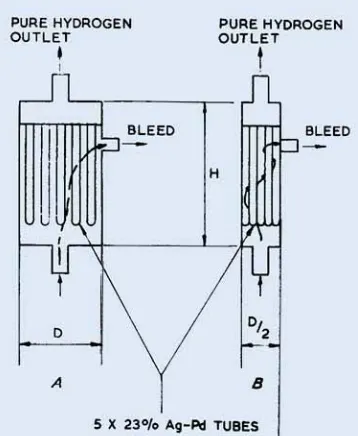
The way in which the diffusion membrane tubes are presented to the incoming impure gas stream plays a very important part in the overall efficiency of the system. Figs. 3A and
3B show two chambers of equal length, containing equal numbers of diffusion mem- brane tubes, one chamber being only half the diameter of the other. When these two units are subjected to the same conditions of temperature and input hydrogen pressure, that having the smaller diameter produces approximately 40 per cent more ultra-pure hydrogen than the large diameter assembly.
This substantial increase in output is due to the much higher packing density of the silver-palladium alloy tubes in the small diameter cell. I n this case, streaming of the impure gas from input to bleed is greatly reduced, sincc the gas, of necessity, follows a labyrinthine path through the asseinbly and
a really efficient purging of the system is achieved.
One additional advantage that is gained by using a cell design incorporating high packing density of the diffusion membrane tubes is that fatigue failure of the brazed joints made between the membranes and the stainless steel manifold, a problem en- countered with certain of the earlier models, has been virtually eliminated.
Methods of Heating
I t can be shown experimentally that the rate of hydrogen diffusion depends upon the temperature of the membrane as well as the pressure of the feed gas applied to that membrane (3).
With earlier models, the impure hydrogen was fed to the diffusion cell via a separate pre-heater, the cell itself being provided with an external heating jacket, operating at 400”C,
The occurrence of temperature gradients along the membranes can be prevented by passing the impure gas through an electrically heated, wire wool packed, stainless steel tube. This system (4), illustrated in Fig. 5 , is used in the construction of both the H and HI( ranges of diffusion units.
This method of heating the input gas has been found to be so efficient that additional external heating of the cells is now unneces- sary.
The
New
Units
Unlike the earlier models, the new H and H K ranges are designed so that the entire length of the diffusion membranes operates at 300‘C. The units are self-contained and can be connected directly to both electrical and impure gas supply.
The H range comprises four models, with outputs ranging from I ft3/h (28 l/h) to
45 ft3/h (1,260 l/h). Intended primarily for laboratory and small-scale production runs, for example, in the preparation of serni- conductor materials, the heat treatment of metals, catalytic hydrogenation and the preparation of ultra-pure materials by the
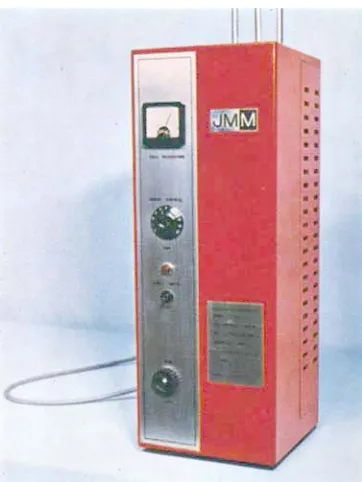
Fig. 6 A typicul Johnson Matthey 11 type diltfusion unit. The models in this series are intended primurily f o r laboratory use in, for example, gnu
chromatography, and for pilot plant development runs in t h P produrtion of semi-cunductor devices
reduction of halides, all four models are housed in cases of the type shown in Fig. 6.
The diffusion membrane tubes are arranged in the general form illustrated in Fig. 5 ,
the only difference between the four models being the numbers of tubes used. The impure gas should be applied to the units via a pressure control valve which will limit the input pressure to 300 lbf/in2 (21 kgfjcm2).
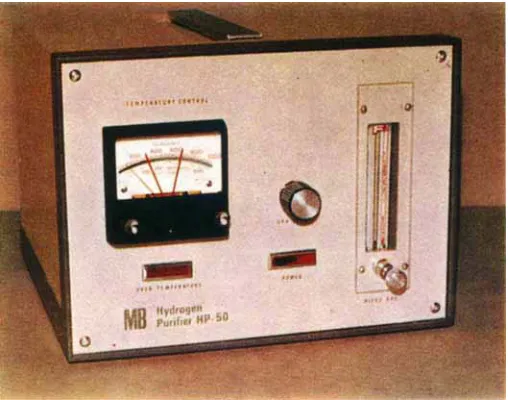
Fig. 8 This Mutthey Bishop hydrogen puri$ca-
lion unit has an output of 50 cubic feet per hour. Operating directlyfrom 110 to 120 V , 50160 I l z
elertrirul supplies, the power consumption is 258
watts
adopting this configuration it has been found that the maximum temperature variation on any module, compared with the temperature of the gas as it leaves the heater, is only
5°C.
Unlike the H series, the HK range of diffusion units is designed for operation where the pressure of the impure gas fed to the units is only 150 lbf/in2 (10.5 kgf/cm2). T h e pressure control valve on the unit is pre-set to this value during manufacture so
that this pressure cannot be inadvertently exceeded.
Models HK7 and HK14 are housed in cabinets of the type shown on page 141. The other models in this range can also be housed in cabinets of similar style, but since their outputs are so large, the user may wish to divorce the diffusion side of the apparatus from the electrical control circuits. Either of these requirements can be satisfied.
American Developments
I t has already been shown in this article that for a hydrogen diffusion system to operate satisfactorily, efficient heating of the 23 per cent silver palladium alloy diffusion mem- brane tubes must be achieved. Additionally, it is necessary that the surfaces of the diffusion membranes are constantly subjected to the
purging produced by the flow of impure input gas through the cell.
The methods of heating that can be em- ployed to give the desired results are manifold. Efficient purging of the surfaces of the dif- fusion membranes is best achieved by utilising a high packing density. Here again there are several ways in which this ideal can be achieved.
Matthey Bishop in the United States have employed an alternative closely packed construction in their new range of portable hydrogen purification units. These compact units are intended For use in applications similar to those mentioned above for the Johnson Matthey H range of diffusion units and are designed to operate at temperatures between 700 and 750°F (370-4OO0c), with an applied input gas pressure to the diffusion membranes of 200 Ibf/in2 (14 kgf/cm').
T h e series comprises four models, one of which is shown i n Fig. 8, with outputs ranging from 2 to 50 ft3/h.
References
Atlantic Refining Company, U . S . Patent
21773,561