Accelerated Frames and Galactic Rotation Curves
S. C. Ulhoa1,∗ and F. L. Carneiro1,†
1Instituto de F´ısica, Universidade de Bras´ılia, 70910-900, Bras´ılia, DF, Brazil
Abstract
In this article the galactic rotation curve is analyzed as an effect of an accelerated reference frame. This
phenomenon is the strongest evidence for the so called dark matter. We show that a non-inertial reference
frame could explain the experimental data. We also show that general relativity is not enough to complete
explain that which encouraged alternatives paths such as the MOND approach. Considering the effect of
dark matter as a realization of accelerated reference frames is a simple but powerful hypothesis.
Keywords: Accelerated frames; Galactic rotation curve; Dark matter.
∗
Electronic address:[email protected]
†
Electronic address:[email protected]
I. INTRODUCTION
Since the dawn of modern Astrophysics the idea of dark matter imbibed experimental data.
The first one to use such a term was Zwicky [1], he noted an unexpected behavior while studying
the redshift of galaxies in the Coma cluster. Then more evidences were gathered along the years,
for instance, in the pattern of Cosmic Microwave Background (CMB) and in the large structure
formation, dark matter should play an important hole. Perhaps the most famous evidence is the
galactic rotation curves [2]. In such curves the rotation velocity of stars versus their distance to the
galaxy center is not well understood by current theories. The very nature of dark matter remains
obscure, attempts to direct detect it, up to now, were unsuccessful [3, 4]. Thus candidate after
candidate was discarded due to some experimental constraint.
Milgrom proposed a modification in the Newtonian dynamics in order to explain the galaxy
rotation curves [5]. Such a proposition gave rise to the so called MOND approach which reasonable
fits experimental data [6, 7]. Inteady of assuming the existence of a non-luminous matter, MOND
suggests the introduction of a new fundamental constant that modifies Newtonian gravity up to a
certain limit. On the other hand such Newtonian limit is not suitable to describe neither a galaxy
nor a large structure dynamics. Thus this MOND method is more likely to be an effect of general
relativity. Following this idea Biˇc´ak showed that general relativity can reproduce the behavior
of the galactic rotation curve, modeling such structure as a rotating flat disc [8]. Then another
attempts have been made trying to obtain what is observed with enhanced models [9].
Although alternative explanations to dark matter exists, the search for such an exotic matter
continues. Maybe, after so many years without a positive result in its detection, it is time to expand
alternative explanations for the phenomena. In this article we present one of such alternatives.
Possibly we are observing the features of a non-inertial reference frame. Accelerated reference
frames seems to be absolute, for instance a charge accelerated with relation to a inertial reference
frame irradiates as the laws of Electrodynamics predict. However an entire different behavior
occurs when an accelerated reference frame analyzes an static charge. In fact there is no symmetry
between these two situations as one should expect if the relativity principle is valid for acceleration
[10]. In [11] dark energy was understood as an effect of accelerated reference frame. Maybe such
an effect cannot alone explain all evidences for dark matter, but certainly can not be ignored.
This article is divided as follows. In section II we present a model for a galaxy, considering
general relativity. In section III we introduce the acceleration tensor and use it to obtain the galactic
unities withG=c=1, unless otherwise stated.
II. A SIMPLE GALAXY MODEL
In this section we propose a simple model to describe a galaxy. It consists in a rotating cylinder
whose metric is [12, 13]
ds2=−e2ψ(ρ,z)dt2+e−2ψ(ρ,z)he2γ(ρ,z)dρ2+dz2+ρ2dφ2i . (1)
Most of the galaxy mass is concentrated in a central region while stars describe a close motion
around it. Thus the vacuum solution of Einstein equation is enough to predict the galactic rotation
curve since the mass of the star is much smaller than the central mass distribution.
The non-vanishing components of the Ricci tensor, constructed out of Christoffel symbols 0Γσλµ,
are
R00 = 1 ρ
ρ∂z∂zψ+∂ρψ+ρ∂ρ∂ρψ
e4ψ−2γ,
R11 =
∂ργ−ρ∂ρ∂ργ−2ρ
∂ρψ 2
+∂ρψ+ρ∂ρ∂ρψ
ρ −∂z∂zγ+∂z∂zψ ,
R22 = ρe−2γ
ρ∂z∂zψ+∂ρψ+ρ∂ρ∂ρψ
,
R13 = ∂zγ
ρ −2∂zψ∂ρψ ,
R33 = −∂z∂zγ− ∂ργ
ρ −∂ρ∂ργ−2 ∂zψ2+∂z∂zψ+ ∂ρψ
ρ +∂ρ∂ρψ . (2)
Hence the vacuum field equations read
∇2ψ≡∂ρ∂ρψ+ 1
ρ∂ρψ+∂z∂zψ=0, (3)
∂ργ=ρ
∂ρψ2− ∂zψ2
, (4)
and
∂zγ=2ρ∂ρψ∂zψ . (5)
A very simple solution occurs whenψ =ψ(ρ), thenψ = aln
ρ
b
which means that the galaxy is
a flat disc. Here the constantb is related to the galaxy mass. Therefore a star has to obey the
e2ψt˙=k, (6)
and
ρ2e−2ψ˙
φ=h, (7)
wherehandkare constants which are related to energy and angular momentum. In addition the
line element yields
˙
ρ2+z˙2=− 1
g11
1+g00t˙2+g22φ˙2
, (8)
where dot means derivative with relation to proper time. Performing a change of variableu≡1/ρ
withz=constant, then
du dφ
!2
=−u2e−2γ+ 1
h2
e−2γ−4ψk2−u2e−2γ−2ψh2 . (9)
Hence the constantshandkcan be settled by
Z
dφ=
Z
du
q
−u2e−2γ+ 1 h2
e−2γ−4ψ
k2−u2e−2γ−2ψ h2
. (10)
On the other hand the trajectory of the star in this model can be obtained by the following
differential equation
d2u
dφ2 + u+
dγ dρ
!
e−2γ= 1 u2h2
"
d
dρ 2ψ+γ
k2e−2ψ− d
dρ ψ+γ
e−2γ−2ψ
#
, (11)
And the tangential velocity is
vT =ρ ˙ φ
˙ t =
h k
e4ψ
ρ . (12)
Ifψ is negative then the galactic rotation curve considering general relativity do not reproduce
experimental data as can be seen from the solution for the flat disc and from the behavior of the
tangential velocity against the radial distance ρ, in agreement with the newtonian gravitation
prediction. Biˇc´ak analyzed the conditions to achieve such results [8]. This model can be improved
in order to consider a fluid solution getting close to a realistic galaxy model. However we would
like to consider a new variable in this scenario, i. e., the acceleration of the reference frame.
III. ACCELERATED REFERENCE FRAMES
In this section we briefly recall the ideas presented in [14–16]. Given a world-line C the velocity
field of some observer remains tangent along the curve, uα = ∂xα
∂τ , where τis the proper time. Thus the velocity field is identified directly to the temporal component of the tetrad fieldeaµ. The
tetrad field represents the components of the vector basis which has both SO(3,1) symmetry and
diffeomorphisms. Here latin indicesa =(0),(i) refer to Lorentz transformations while greek ones µ=0,ito coordinate transformations. Hence the acceleration is
aµ = Duµ dτ =
De(0)µ
dτ =u
α∇αe(0)µ, (13)
Then a generalization of the above expression is
Deaµ
dτ =φa
be
bµ, (14)
whereφab is the acceleration tensor. The absolute derivative ofeaµ establishes the kinematical
state of the reference frame which is realized by the acceleration tensor. The components φ(0)b
give the translational acceleration of the observer, in order to show that, let us use 14 together with
the orthogonality properties of the tetrad field, thus
φab=ebµ
Deaµ
dτ =e
b
µuλ∇λeaµ, (15)
where∇λebµ =∂λebµ− 0Γσ
λµebσ. Therefore
ab=ebµaµ =ebµuα∇αe(0)µ=φ(0)b. (16)
Since the tetrad field project vectors into the tangent space, a geodesic motion should be when
aµ =0.
aµ = uα∇αe(0)µ=uα∇αuµ = dx α
dτ
∂uµ
∂xα +
0Γµ αβuβ
= d2xµ
dτ2 + 0Γµ
αβ
dxα dτ
dxβ
dτ . (17)
Then as expectedφ(0)brepresent the translational acceleration of the reference frame whileφ(i)(j)
In riemannian geometry two connections are possible, the Christoffel symbols and the
Levi-Civita connection. The former one,0ωµab, existis on the tangent bundle and is necessary to couple
the Dirac equation to gravitational field [18]. These two quantities are related by the following
identity
0Γλ
µν =eaλ∂µeaν+eaλebν0ωµab, (18)
where
0ω
µab = −12ecµ(Ωabc−Ωbac−Ωcab), (19)
with
Ωabc = eaν(ebµ∂µecν−ecµ∂µebν). (20)
It worths to mention thateaλ∂µeaνis the Weitzenb ¨ock connection. Such a connection establishes
the well known teleparallel gravity which is equivalent to general relativity. By the wayΩabc is
the equivalent to the torsion tensor of Weitzenb ¨ock connection.
If expression (18) is used in (15), then the acceleration tensor simplifies to
φab=−e(0)µ 0ωµba, (21)
which yields
φab= 1
2[Ω(0)ab+ Ωa(0)b−Ωb(0)a]. (22)
This is the acceleration tensor in therms of the anholonomicity objects, this same expression was
obtained in reference [19]. It should be noted that such a acceleration tensor does not establishes
IV. ROTATION CURVES OF GALAXIES
A tetrad field constructed out from the line element (1) and adapted to an accelerated observer
is
eaµ =
−1 0 ρβ(ρ,z)A(ρ,z) 0
A(ρ,z) sin(φ) α(ρ,z) cos(φ) −ρβ(ρ,z) sin(φ) 0
−A(ρ,z) cos(φ) α(ρ,z) sin(φ) ρβ(ρ,z) cos(φ) 0
0 0 0 α(ρ,z)
, (23) where
A2−1= g00=−e2ψ,
α2=g
11=g33 =e−2(ψ−γ),
β2
1−A2=e−2ψ.
The inverse tetrad field reads
eaµ =
1
A2−1 0
A
ρ(A2−1)β 0
Asin(φ) A2−1
cos(φ) α
sin(φ) ρ(A2−1)β 0 −Acos(φ)
A2−1
sin(φ) α
cos(φ) ρβ−ρA2β 0
0 0 0 1
α ,
then the 4-velocity is
uµ =e(0)µ = − 1
A2−1,0,−
A ρβ(A2−1),0
!
. (24)
Hence there is a rotation movement around z-axis.
The acceleration tensor reveals the kinematical state of this reference frame. Using (22) its
φ(0)(1) = −
Acos(φ)A−A3+ρ∂ρA+ρA2∂ρA
ρ(−1+A2)2α ,
φ(0)(2) = −
Asin(φ)A−A3+ρ∂ρA+ρA2∂ρA
ρ(−1+A2)2α ,
φ(0)(3) = −
A1+A2∂zA
−1+A(ρ,z)22α,
φ(1)(2)
A =
q
(−1+A2)2−A2 q
(−1+A2)2−3α !
−α−3A4α+A6α+2ρA q
(−1+A2)2∂ρA !
ρ
(−1+A2)23/2α
,
φ(1)(3) =
2A2sin(φ)∂ zA (−1+A2)2α ,
φ(2)(3) = −
2A2cos(φ)∂zA
(−1+A2)2α . (25)
Then using
ˆ
ρ=cosφxˆ+sinφyˆ
and
ˆ
φ=−sinφxˆ+cosφyˆ,
we arrive at the following acceleration of the reference frame
~a=−A
A−A3+ρ∂ρA+ρA2∂ρA
ρ(−1+A2)2α ρˆ −A
1+A2∂zA
(−1+A2)2α zˆ. (26)
It should be noted that in the case of a flat disc galaxy there is no acceleration in the axial direction.
Therefore the acceleration in theρ-direction can be used to obtain the rotation curve for this galaxy
model. Since we are dealing with a flat disc model then the potentials are
ψ(ρ)=−Xlog ρ
M
γ(ρ)=Ylog
ρ
M
,
with XandY defined as positive constants in order to yield a proper behavior for the rotation
aρ=
−1+ρ M
2X +X
−1+2ρ M
2X
ρρ M
(X+Y)
and the tangential velocity reads
vT = v u u u u u t
−1+ρ M
2X +X
−1+2ρ M
2X
ρ M
(X+Y) .
IfX=Y, then it simplifies to
vT = q
− M/ρ2X+
1+Xh2− M/ρ2Xi.
Particularly ifX=1 then
vT = s
3−2 M ρ
!2
,
which has a well defined limit for M
ρ <<1,id est,vT =constant. Thus the effect of an accelerated referential frame can be easily seen. It worths to point out that such a finite limit is not predicted
by the newtonian theory. On the other hand it is a well known experimental data that supports
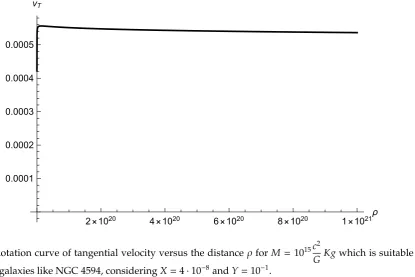
dark matter. In figures 1 and 2 we plot the rotation curve consideringMas the galaxy mass.
It should be noted that these rotation curves are displayed in geometric unities and it remains
growing until a certain limit and reaches a finite value for great distances from the galaxy center.
Hence experimental data of the rotation curves can be explained as an effect of accelerated reference
frame.
V. CONCLUSION
In this article we consider that the rotation curve of galaxies can be an effect of accelerated
reference frame. We show that for a simple model of a flat galaxy the velocity of a star decreases
when its distance is too far away from the galaxy center, but it remains finite. In such a model the
star is supposed to describe a geodesic motion. Then an accelerated reference frame was settled
by a tetrad field. The acceleration was used to obtain a galactic rotation curve and an increasing
2×10²⁰ 4×10²⁰ 6×10²⁰ 8×10²⁰ 1×10²¹ρ
0.0002 0.0004 0.0006 0.0008 0.0010
vT
FIG. 1: Rotation curve of tangential velocity versus the distanceρforM=1015c 2
GKgwhich is suitable to describe galaxies like NGC 4594, consideringY=X=4·10−8.
evidences for dark matter should be confronted to our hypothesis of non inertial observer.
[1] Fritz Zwicky. Die rotverschiebung von extragalaktischen nebeln. Helvetica Physica Acta, 6:110–127,
1933.
[2] Teresa Marrodan Undagoitia and Ludwig Rauch. Dark matter direct-detection experiments. Journal
of Physics G: Nuclear and Particle Physics, 43(1):013001, 2015.
[3] Timothy J Sumner. Experimental searches for dark matter. Living Reviews in Relativity, 5(1):4, 2002.
[4] Jianglai Liu, Xun Chen, and Xiangdong Ji. Current status of direct dark matter detection experiments.
Nature Phys., 13(3):212–216, 2017.
[5] Mordehai Milgrom. A modification of the newtonian dynamics as a possible alternative to the hidden
mass hypothesis.The Astrophysical Journal, 270:365–370, 1983.
[6] Riccardo Scarpa. Modified newtonian dynamics, an introductory review. InAIP Conference Proceedings,
volume 822, pages 253–265. AIP, 2006.
[7] G. N. Candlish, R. Smith, Y. Jaff´e, and A. Cortesi. Consequences of the external field effect for MOND
disk galaxies in galaxy clusters.Monthly Notices of the Royal Astronomical Society, August 2018.
[8] J Bic´ak, D Lynden-Bell, and C Pichon. Relativistic discs and flat galaxy models. Monthly Notices of the
Royal Astronomical Society, 265(1):126–144, 1993.
[9] Kenath Arun, SB Gudennavar, and C Sivaram. Dark matter, dark energy, and alternate models: A
2×10²⁰ 4×10²⁰ 6×10²⁰ 8×10²⁰ 1×10²¹ρ
0.0001 0.0002 0.0003 0.0004 0.0005
vT
FIG. 2: Rotation curve of tangential velocity versus the distanceρforM=1015c 2
GKgwhich is suitable to describe galaxies like NGC 4594, consideringX=4·10−8andY=10−1.
[10] JW Maluf and SC Ulhoa. Electrodynamics in accelerated frames revisited. Annalen der Physik,
522(10):766–775, 2010.
[11] Sergio C Ulhoa. On dark energy and accelerated reference frames.Annalen der Physik, 524(5):273–278,
2012.
[12] PC Waylen. The general axially symmetric static solution of einsteins vacuum field equations. Proc.
R. Soc. Lond. A, 382(1783):467–470, 1982.
[13] WB Bonnor. Physical interpretation of vacuum solutions of einstein’s equations. part i.
time-independent solutions.General relativity and Gravitation, 24(5):551–574, 1992.
[14] Bahram Mashhoon. Nonlocality of accelerated systems. International Journal of Modern Physics D,
14(01):171–179, 2005.
[15] Bahram Mashhoon and Uwe Muench. Length measurement in accelerated systems.Annalen der Physik,
11(7):532–547, 2002.
[16] Bahram Mashhoon. Vacuum electrodynamics of accelerated systems: Nonlocal maxwell’s equations.
Annalen der Physik, 12(10):586–598, 2003.
[17] JW Maluf and FF Faria. On the construction of fermi-walker transported frames. Annalen der Physik,
17(5):326–335, 2008.
[18] JW Maluf. Dirac spinor fields in the teleparallel gravity: comment on metric-affine approach to
teleparallel gravity.Physical Review D, 67(10):108501, 2003.
[19] JW Maluf, FF Faria, and SC Ulhoa. On reference frames in spacetime and gravitational energy in freely