International Journal of Advanced Research in Computer Science RESEARCH PAPER
Available Online at www.ijarcs.info
Comparative Analysis of Open Stack Software tools for Cloud Computing Framework
Environment
Rakesh Prasad Sarang
SOS in Computer Science & Applications Jiwaji University, Gwalior (M.P.), 474001, India
Abstract: In present era cloud computing is a new concept of the modern world. Cloud computing consolidates every one of the administrations models and advances together to convey IT capacities. The fundamental goal of this paper is to develop a private cloud utilizing open stack. Open stack is an open source program is simply free of cost. This uses more propelled techniques to secure their everything data. We are proposing a technique to setup cloud foundation utilizing openstack and Xen server. This paper is to provide a comparative view on the performance of openstack. In this paper, we are showing service models to manage the protection issues in cloud computing and give the best response for specialist organizations. The aim of this paper is to present an idea of deployment models and comparative investigation of most prominent open source software’s such as Nimbus, Eucalyptus, Openstack and Opennebula. The results show that execution of private cloud utilizing open source software Ubuntu 12.04 LTS server release. The paper incorporates openstack instrument and dashboard systems that demonstrate the assessment of the response of cloud computing environment.
Keywords: Cloud computing, Data security and privacy in cloud system, openstack infrastructure, opennebula, nimbus and eucalyptus.
I. INTRODUCTION
Cloud computing is a new technique for conveying registering assets, as an open utility. Computing administrations, for example, information stockpile, email taking care of, are presently accessible specifically and on-request. That is available on demand which allows to access all the database resources and software through the internet from anywhere in the world, as long as they need. The clouds are a huge pool of virtualized resources which are access and easy to use. Cloud computing is a different type of computing platform which are sharing computing resources and handles all applications.
In a cloud environment, entrepreneurs outsource their registering needs including application program administrations to an outsider. Cloud computing is internet-based computing, a growing latest trend in the information technology (IT) world. The internet is being frequently represented as a cloud and virtualized hence the term “Cloud computing”. Cloud computing is a collection of new and old concepts in many research areas, such as distributed computing, grid computing, utility computing and service oriented architectures. In brief, cloud computing is the dynamic provisioning of IT capabilities (such as hardware, software deployment and services) from over the network [1, 2].
Cloud computing can be considered as figuring worldview that permits the use of a processing framework at least one levels of deliberation, as an on demand benefit made accessible over the internet. In this paper, we give an analysis of data security and privacy issues of cloud computing adjacent to the countermeasure of every one. Out of various techniques of cloud computing such as distributed, parallel, grid, utility and service oriented etc, the technique of cloud computing is the most vital one due to its many services on pay – per use basis. Cloud computing technology can be used in several services such as telephony, gas, electricity, water, data storage, computation, and application-hosting. Cloud
computing environment suppliers expose an arrangement of program interfaces that clients use to oversee and connect with cloud systems (like provisioning, and observing) [3, 4].
This paper is organized as follows: in Section 1 present introduction of cloud computing. Section 2 presented data security and privacy in the cloud system. Section 3 discussed openstack tool. Section 4 discussed system deployment and configuration of openstack. Section 5 discussed opennebula cloud computing toolkit. Section 6 Nimbus presents the combination of open source tools. Section 7 Eucalyptus is to provide storage security. Section 8 provided comparative analysis of the cloud tools framework. Section 9 discussed experimental results and finally, section 10 presents conclusion.
II. DATA SECURITY AND PRIVACY IN CLOUD SYSTEM
A. Data Integrity
Data integrity is a standout amongst the most basic components in any data framework. For the generally, data security implies shielding information from unapproved cancellation, change, or creation. Dealing with element's permission and rights to particular undertaking assets guarantees that significant information and administrations are not mishandled misused. Data security is effectively accomplished in an independent framework with a solitary database. Data security in the independent framework is kept up through database requirements and exchanges, which is normally wrapped up by a database management system (DBMS). Transactions areas of cloud computing environment ACID (atomicity, consistency, isolation, and durability) properties to guarantee information sincerity. Most databases support ACID exchanges and can maintain information respectability.
B. Data Confidentiality
secrecy. The information privacy, validation, and get to control issues in distributed computing could be tended to by expanding the cloud unwavering quality and dependability. Since the clients don't confide in the cloud suppliers and distributed storage specialist organizations are for all intents and purposes difficult to dispose of potential insider risk, it is exceptionally risky for clients to store their touchy information in distributed storage specifically. Basic encryption is confronted with the key administration issue and can't bolster complex necessities, for example, inquiry, parallel change, and fine-grained approval.
C. Data Availability
Data Availability means, disasters hard disk harm, IDC fire, and system disappointments happen, the degree that client's information can be utilized or recuperated. And how the clients check their information by procedures instead of relying on the credit ensure by the cloud specialist association on your own. Finding information can help clients to build their trust in the cloud. Distributed storage gives the easy stockpiling administration to clients. How can moderate the many-sided quality of cloud, yet it additionally reduces the control capacity on information store of clients. The confirmations of geographic replication and prevailing with regards to finding the information put away in Amazon cloud.
Also, the cloud service providers guarantee the information security, especially information classification and respectability. The cloud provider is every single such worry to the customer and assembles put stock in the relationship in this association. The cloud seller ought to give assurances of information security and clarify purview of nearby laws to the customers. The primary concentrate of the work is on those information issues and difficulties which are related with information store area and its migration, cost, accessibility, and security.
D. Data Privacy
Data privacy is the capacity of an individual or gathering to withdraw them or data about themselves and along these lines uncover them specifically. Privacy has the following components:
(a) At the point when: a subject might be more worried about the present or future data being exposed than data from the past.
(b) How a client might be agreeable if his/her companions can physically ask for his/her data, however the client detest cautions to be sent naturally and much of the time.
(c) Extent a client may rather have his/her data announced as a questionable district instead of an exact point.
(d) How to allow clients to have control over their information when the information are put away and prepared in the cloud and stay away from burglary, detestable utilize, and unauthorized.
(e) How to ensure information replications in an authority and predictable state. where duplicating client information to various appropriate areas is a standard decision.
(f) Which gathering is in charge of security legal necessities for individual data.
(g) To what degree cloud subcontractors are included in handling which can be acceptably recognized, checked, and found out.
(h) In the cloud, the privacy implies when clients visit the delicate information, the cloud administrations can keep potential foe from construing the client's conduct by the client's.
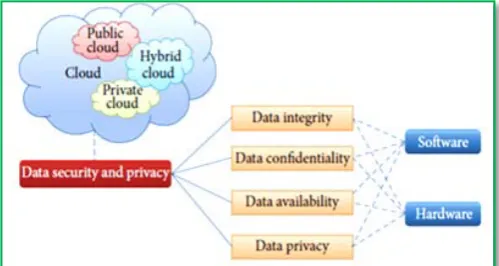
In figure 1 we have categorized data security and privacy. It contains four phases; these are data integrity, data confidentiality, data availability, and data privacy. And cloud which is a new addition. Each of these phases has two sub phases software and hardware. We connected all sub phases with their relevant main phase. We have also introduced data security and privacy of cloud computing environment [5].
III. OPEN STACK
[image:2.595.310.560.370.503.2]Openstack is an arrangement of software tool for building and overseeing cloud computing stages for private and public clouds. That is openstack is the fastest rising free open source software tool. The openstack is an IaaS computing platform, this technique in 2005 being introduced by NASA and the Rack Space. With the Rack Space start cloud formed in it was rewritten in 2009 and again in 2010, they rewrite cloud servers and open source and released their first open source cloud software tool. Openstack is used for both cloud applications and storage infrastructure. Openstack gives an Infrastructure-as-a-Service arrangement through a group of complementary administrations. Each service offers an application programming interface (API) that encourages this union [6, 7].
Figure 1 Data Security and Privacy in Cloud System
A. Proposed Framework Open Stack Platform
This research focused on open stack cloud platform. The specific component is swift storage of open stack is considered to be protected. Whereas other components like nova, compute, glance and dashboard need to be superior. Open stack not support password complexity requirements and password are stored in a cloud files format. All the information transformed within the open stack image infrastructure via using encryption and decryption techniques.
Figure 2 represents the working of openstack framework. The architecture of open stack includes different components such as nova volume, swift storage, nova compute, glance store.
• Openstack nova volume - openstack nova is for managing LVM and volume worker functions such as creation, deletion and attaching instance.
• Openstack nova compute - openstack computes is for cloud computing fabric controller. It also supports large networks of virtual machine such as TCP, UDP, SSL and IP multicast.
• Openstack glance store - openstack glance is a lookup and recovery system for the virtual machine images. It can be guaranteed delivery mechanism to virtual disk images
• Openstack horizon - openstack horizon is an administrator web interface dashboard services. Horizon can be used to user access and security management template.
• Openstack keystone - openstack keystone provides an identity of cloud services between the users and all
components. Keystone component handles
authentication, authorization, and development [8, 9, 10].
IV. SYSTEM DEPLOYMENT OPENSTACK
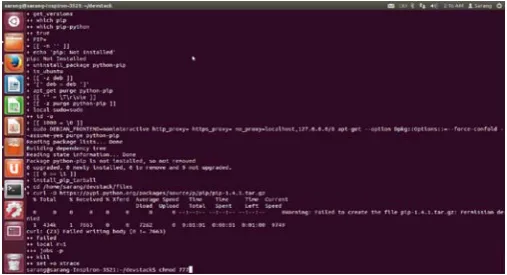
Our research provides the openstack dashboard, we used a system with Pentium IV 2GHz Intel corei3, 12 GB of RAM, 20 GB of disk storage running Ubutu Linux 12.04 LTS operating system. We used the Rack space server version of open stack releases. We installed a single node version of open stack Rack space server with the compute and controller node on the same system for simplicity from an experimental point of view. The open stack software was downloaded from the DEVSTACK web site, which offers shell scripts to automatically install open stack on our platform. DEVSTACK is the best shell script was used to install open stack on our local machine server [11]. A. Configuration and Installing the Open Stack
The various steps required to install openstack. The user will need to create a volume group for nova-volume. The nova.sh script useful for the nova administrator user, which created for user and image registered. Network configurations following commands are used in open stack:
user@user1:~$ sudo nova-manage network create novanetwork 10.1.5.164
To creating nova administrator. The user can use the following command:
10.81.203.183/24. Value one is the total number of networks user wants made, and the 64 values is the number of IP addresses in each network. To creating nova administrator user can use the following command:
10.81.203.183/24. Value one is the total number of networks user wants made, and the 64 values is the number of IP addresses in each network. To creating nova administrator user can use the following command:
user@user1:~$ sudo nova-manage user admin openstack user Update the machine using the following commands:
sudo apt-get update sudo apt-get upgrate
sudo apt-get install openssh-server cloud-init
sudo apt-get install git
sudo git clone http://github.com/openstack-dev/devstack.git
cd devstack
(Now inside devstack make a file name localrc save the following configurations)
run devstack
./stack.sh
Admin-password=cloud
Mysql-password=cloud
Rabbit-password=cloud
Service-password=cloud
Service-token=token
Flat-interface=eth0
10.81.203.183/auth
run the stack.sh script
make shure all the services are installed in the directory
/opt/stack
run again the script if all the services are not installed
[image:3.595.47.291.277.462.2] [image:3.595.302.556.580.717.2]node_install_sh Figure 2 Openstack Infrastructure
B. Login Open Stack Dashboard
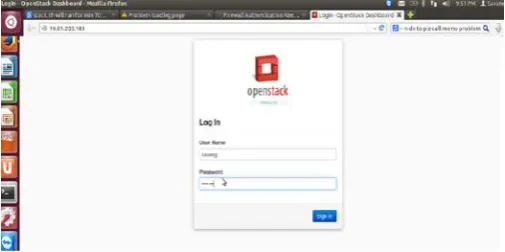
[image:4.595.307.562.57.187.2]In this section, DEVSTACK is installed on our local machine. Now you can open localhost on our browser open stack dashboard will be opened. Now just start a browser and type the IP address of server i.e., http:// 10.81.203.183. You should see the dashboard login screen. Login with the identification username - sarang and password - cloud to manage the open stack setup.
Figure 6 Snapshots Openstack Login
Above mentioned screenshot login window is shown in figure 6 appears as barriers to authenticate the validity of users entered in the system. Login window instructs a user to enter their username "sarang” and password "cloud" specified box and click on the OK button, then a user will get an entry in the open stack dashboard login. The open stack dashboard can be accessible in another system via http://10.81.203.183.
V. OPEN NEBULA
Open nebula is the open source cloud service framework for managing standard data center virtualization. The main objective of opennebula is to provide an open flexible, scalability, security and solution for the comprehensive. It can be used for complete management of virtualized data centers to enable on-premise IaaS clouds in existing infrastructures. Opennebula interoperability makes the cloud an evolution by leveraging existing IT assets, protecting your investments, and avoiding vendor [8, 15].
Opennebula is one of the key technologies of reservoir plan and the flagship research project in virtualization infrastructure and cloud computing. It allows user deploy and manage virtual machines on physical resources. Opennebula is a cloud computing toolkit it can set user’s data centers or clusters to flexible virtual infrastructure that can automatically adapt to the change of the service load. The main comparison of opennebula and Nimbus is that nimbus implements remote interface based on EC2 or Web Service Resource Framework (WSRF). But opennebula user does not can process [12].
VI. NIMBUS
[image:4.595.37.291.59.195.2]Nimbus is the combination of open source tools, which provides an IaaS cloud computing solutions to its users. Nimbus allows users to lease remote by resources manager and also it is cloud client- access permission is allowed for only the selected tasks. Nimbus deployment self configured them to represent an environment preferred by the user resources. The major features of nimbus are storage cloud service, remote deployment and lifecycle management of VMs. Workspace client with Amazon’s network protocols supports X509 credentials certificate, easy to use cloud client. Infrastructure as a Service (IaaS) gateway allows communication between two different IaaS [8, 13, 14].
Figure 7 Snapshots Services to System Information
Figure 8 Snapshots Access Security Groups
[image:4.595.38.290.234.365.2] [image:4.595.37.290.509.635.2]VII. EUCALYPTUS
Eucalyptus was originated from the University of California at Santa Barbara, which is now supported by eucalyptus incorporation. The objective of eucalyptus is to provide storage security, private and hybrid cloud service. That is to secure large storage of data and large computations.
Eucalyptus is Cloud Manager Services (CMS) compatible open source software. Eucalyptus is useful in both public and private clouds. It provides an integrated set of Application Program Interface (APIs) that are compatible with Amazon’s Elastic Cloud Computing (AEC2), Amazon Web Services (AWS), Amazon’s Simple Storage Services (S3) and EBS (Elastic Block Storage).There are various components of eucalyptus such as, CLC (Cloud Controller), Cluster Controller (CC), Data Center Manager (DCM), Node Controller (NC) and Walrus. CLC provides the web user interface to outside world. It is high level authentication, system reporting management and implement on Amazon EC2, APIs. CC is used to manage the collection of resource nodes and virtual instance network. DCM provide by the group manager, instance manager, and CC package. NC is used to manage hosts VMs and virtual network endpoints. It downloads the images from the object storage and creates and supplies the VM instances. Walrus component is used to implement S3 APIs and is useful to store VM Images and user storage. Simple Storage Services (S3) provides firewall and privacy. EC2 provides a virtual computing environment that enables a user to run Linux-based applications [8, 14, 15].
VIII. COMPARATIVE ANALYSIS
[image:5.595.310.559.78.272.2]On the basis of the work is already done previously. There are following parameters such as cloud computing service, packages support, deployment strategies, OS support, development language, developer, computing architecture, storage management, cloud types, latest configuration requires, virtual machine and uses. The comparison of our proposed cloud framework and the cloud techniques are enlisted in below given table 1 and table 2.
TABLE I. COMPARISON OF CLOUD TOOLS FRAMEWORK
TABLE II . COMPARISON OF CLOUD TOOLS FRAMEWORK
IX. EXPERIMENTAL RESULTS
This evaluation is comparison will help cloud clients and organizations. To make a decision private, public cloud using these open source cloud framework. We have implemented the newly designed component onto the openstack dashboard. In this state, we can evaluate the performance of the open stack and clients [16].
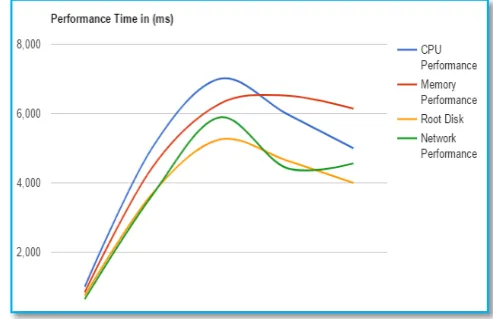
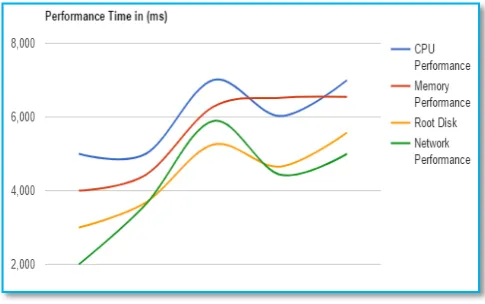
In figure 9 shows the processing time in openstack. We see the increasing 5 performance data of CPU, memory, root disk and network. Here we have finished the data estimation of various clients of different cloud providers for providing the best service.
In figure 10 shows the overall responses time in openstack. The performance of CPU time is requested in cloud records hubs. It also proved to be similar to previous values after the same number of record axis. This result shows with the intention of the performance service time is decreasing. To look at the performance of proposed framework is used and all the experiment results are performed on the machine. All the runtime reports include both evaluations based on performance.
Figure 9 Processing Time of Openstack
[image:5.595.305.552.524.683.2]X. CONCLUSION
This paper compares the four cloud open source frameworks which are eucalyptus, nimbus, openstack, and open nebula concern of open source Iaas cloud. The version and OS dependency because of this tool may not prominence on long time support. Open source cloud platforms tools must be independent of the version and OS that can be used in the association for a longer period of time. Openstack software is suitable for deployment of new private cloud framework and suitable for techniques community. The performance of cloud framework will depend upon the good organization. The future work will focus on performance the disparate used by different cloud computing tools and when each outcome may be appropriate for its use.
XI. REFERENCES
[1] Xin, Z., Song-qing, L., & Nai-wen, L, “Research on Cloud Computing Data Security Model Based on Multi-dimension”, International symposium on information technology in medicine and education, IEEE, pp 897-900, 2012.
[2] Rao, Srinivasa and V Nageswara Rao, “Cloud Computing: an Overview”, Computing, pp71-76, 2009.
[3] Jouini, M., Ben, L., & Rabai, A., “Surveying and Analyzing Security Problems in Cloud Computing Environments”, Tenth International Conference on Computational Intelligence and Security (ICCIS), PP 689-693, 2016, doi: 10.1109/.168.
[4] Nasim, R., & Kassler, A. J., “Deploying OpenStack: Virtual Infrastructure or Dedicated Hardware”, IEEE 38th Annual
International Computers Software and Applications Conference Workshops (COMPSACW), PP 84-89, 2014.
[5] Morghade1 R. K. & Honale1 S., “Data Storage Security and Privacy in Cloud Computing”, International Journal of Current Research in Science and Technology (IJCRST), Vol.3, Issue 4, pp 1–6, 2017.
[6] Pol, U. R., “Cloud Computing with Open Source Tool: OpenStack”, American Journal of Engineering Research (AJER), Vol.3, Issue 9, pp 233-240, 2014.
[7] Open Stack Deployment. [Online] Available:
http://wiki.openstack.org. Science.
[8] Nagar, N., & Suman, U., “Architectural Comparison and Implementation of Cloud Tools and Technologies”, International Journal of Future Computer and Communication (IJFCC). Vol. 3, No. 3, pp 153-160,2014.
[9] Albaroodi, H., Manickam, S., & Anbar, M., “A ProposedFramework for
Outsourcing and Secure Encrypted Data on OpenStack Object Storage (Swift)”, pp 590-597, 2015.
[10] Jha, A., Murari, K., Raju, M., Cherian, V., & Girikumar, Y., “OpenStack Beginner’s Guide (for Ubuntu - Precise) v3.0, 2012.
[11] Labarge, R., & Mcguire, T., “Cloud penetration testing”, International Journal on Cloud Computing: Services and Architecture”, (IJCCSA), Vol.2, No.6, pp 43-62, 2012.
[12] Mollah, M. B., Islam, K. R., & Islam, S. S, “Next Generation of Computing through Cloud Computing Technology”, 25th IEEE Canadian Conference on Electrical and Computer Engineering (CCECE), pp1-6, 2012.
[13] Jain, S., Kumar, R., A. & Jangir, S. K., “A Comparative Study for Cloud Computing Platform on Open Source Software”, An International Journal of Engineering & Technology (AIJET), Vol. 1, No. 2, pp 28-35, 2014.
[14] Manjaly, J. S., & S, J., “A Comparative Study on Open Source Cloud Computing Frameworks”, International Journal of Engineering and Computer Science(IJECS), Vol. 2, Issue 6, pp 2026-2029, 2013.
[15] Shetty, J., Shobha G, & Anala M R, “A State-of-art Comparison of Open source IaaS Cloud Softwares”, International Association of Scientific Innovation and Research (IASIR), USA, pp 26-30, 2015.
[image:6.595.47.290.54.206.2][16] Khanghahi, N., & Ravanmehr, R., “Cloud Computing Performance Evaluation: Issues and Challenges”, International Journal on Cloud Computing: Services and Architecture (IJCCSA), Vol.3, No.5, pp 29-41, 2013.