LoLo: A System based on Terminology for Multilingual Extraction
Yousif Almas
Department of Computing University of Surrey Guildford, Surrey, GU2 7XH, UK
Khurshid Ahmad
Department of Computer Science Trinity College,
Dublin-2. IRELAND
Abstract
An unsupervised learning method, based on corpus linguistics and special lan-guage terminology, is described that can extract time-varying information from text streams. The method is shown to be ‘language-independent’ in that its use leads to sets of regular-expressions that can be used to extract the information in typologically distinct languages like Eng-lish and Arabic. The method uses the in-formation related to the distribution of N-grams, for automatically extracting ‘meaning bearing’ patterns of usage in a training corpus. The analysis of an Eng-lish news wire corpus (1,720,142 tokens) and Arabic news wire corpus (1,720,154 tokens) show encouraging results.
1 Introduction
One of the recent trends in (adaptive) IE has been motivated by the empirical argument that annotated corpora, either annotated automatically or annotated manually, can provide sufficient information for creating the knowledge base of an IE system (McLernon and Kushmerick, 2006). Another equally important trend is to use manually selected seed patterns to initiate learn-ing: In turn, active-training methods use seed patterns to learn new related patterns from un-annotated corpora. Many of the adaptive IE sys-tems rely on the existing part-of-speech (POS) taggers (Debnath and Giles, 2005) and/or syntac-tic parsers (Stevenson and Greenwood, 2005) for analysing and annotating text corpora. The use of corpora in IE, especially adaptive IE, should, in principle, alleviate the need for manually creat-ing the rules for information extraction.
The successful use of POS/syntactic taggers is dependent on the availability of the knowledge of (natural) language used by the authors of documents in a given corpus. There is a wealth of POS taggers and parsers available for English language, as it has been the most widely used language in computational linguistics. However, this is not the case for strategically important languages like Arabic and Chinese; to start with, in Chinese one does not have the luxury of sepa-rating word-tokens by a white space and in Ara-bic complex rules are required to identify mor-phemes compared to English. The development of segmentation programs in these languages has certainly helped (Gao et al., 2005; Habash and Rambow, 2005). More work is needed in under-standing these languages such that the knowl-edge thus derived can be used to power taggers and parsers.
Typically, IE systems are used to analyse news wire corpora, telephone conversations, and more recently in bio-informatics. The first two systems deal with language of everyday
commu-nications –the general language- whereas
bio-informatics deals with a specialist domain and has its own ‘special language’. English special
languages, for example languages of law,
com-merce, finance, science & technology, each have
a limited vocabulary and idiosyncratic syntactic structures when compared with English used in an everyday context. The same is true of Ger-man, French, Russian, Chinese, Arabic or Hindi. It appears that few works, if any, take advantage of the properties of special language to build IE systems.
Our objective is to use methods and tech-niques of IE in the automatic analysis of special-ist news that streams in such a way that informa-tion extracted at an earlier period of time may be contradicted or reinforced by information ex-tracted at a later time. The impact of news on financial and commodity markets is of
able import and is often called sentiment
analy-sis. The prefix ‘sentiment’ is used to distinguish
this kind of analysis from the more quantitative analysis of assets (called fundamental analysis) and that of price movements (called technical analysis). There is a great deal of discussion in financial economics, econometrics, and in the
newly emergent discipline of investor
psychol-ogy about the impact of ‘good’ and ‘bad’ news
on the behaviour of both investors and brokers. Three Nobel Prizes have been awarded on the impact of market (trader and investor) sentiment on the value of shares, currencies, derivatives and other financial instruments (Shiller, 2000). Financial news, in addition to e-mails and blogs, has contributed to the catastrophic failures of major trading institutions (Mackenzie, 2000; Hardie & Mackenzie, 2005).
One of the key proponents of news impact
analysis is the Economics Nobel Laureate Robert
Engle who has written about asymmetry of in-formation in a market – the brokers have more knowledge than any given individual, rumours have different impact on different actors in the market. Engle’s statistical analysis suggests that the ‘bad’ news has longer lasting effect than ‘good’ news (Engle, 1993). Usually, sentiment
analysis is carried out using news proxies which
include dates/times and the names of agencies releasing key items of financial data (Anderson et al., 2002) or data like the age of a firm, its number of initial public offerings, return on in-vestment, etc. These proxies are then regressed with share, currency or commodity prices. News impact analysis is moving into its next phase where the text of news is analysed albeit to a lim-ited extent (Cutler et al., 1989; Chan, 2003). The analysis sometimes looks at the frequency distri-bution of pre-specified keywords –directional
metaphors like rose/fall, up/down, health
meta-phors like anaemic/healthy and animal
meta-phors like bullish/bearish. A system is trained
to correlate and to learn the changes in
distribu-tion of the prescribed metaphorical keywords, together with names of organisations, to the changes in the value of financial instruments (Seo et al., 2002; Omrane et al., 2005; Koppel and Shtrimberg 2004).
We are attempting to create a language-informed framework for news impact analysis using techniques of corpus linguistics and special language analysis. The purpose is to automati-cally extract patterns from a corpus of domain specific texts without prescribing the metaphori-cal keywords and organisation names. This, we
believe, can be achieved by looking at the lexical
signature of a specialist domain and extracting
collocational patterns of the individual items of the lexical signature. The lexical signature in-cludes key vocabulary items of the domain and names of people, places and things in the do-main. There are instances in the part-of-speech tagging literature (Brill, 1993) and in IE where a corpus is used and words within a grammatical category help to extract rules and patterns com-prising essential information about a domain or topic (Wilks, 1998; Yangarber, 2003). Brill,
Wilks and Yangarber induce grammars of a
uni-versal kind: we focus on inducing a local gram-mar that deals with the patterning of the items in the signature. Note that in all these cases of grammar induction the intuition of the grammar builder plays a critical part whether it be in the choice of syntactic transformation rules (Brill 1993), or in choosing sense taggers and implic-itly semantic rules (Wilks, 1998; Ciravegna and Wilks, 2003), or in choosing user supplied seed patterns (Yangarber, 2003). Most of the work in grammar induction is focussed on English or ty-pologically similar languages. We have deliber-ately chosen typologically different languages (English and Arabic) to evaluate the extent to which our method of ‘grammar induction’ is lan-guage independent.
We describe a method for building domain specific IE systems: the patterns used to extract
domain specific information are the N-gram
col-location patterns of domain specific terms. The patterns are extracted from un-annotated domain-specific text corpora. We show how one can ana-lyse the N-gram patterns and render them as regular expressions.
The thesaurus used to identify domain specific words is itself constructed automatically from a (training) special-language corpus. The fre-quency distribution of domain specific terms in a special language corpus shows characteristic dif-ferences from the distribution of the same terms in a general language corpus. There is little or no difference in the distribution of the so-called grammatical or closed class terms in a special and a general language corpus.
compound terms co-occur more frequently with one set of words than with others. The behaviour of signature terms appears to be governed by a grammar that is local to the specialism and is not elsewhere in the general language (Harris, 1991);
local grammar is used in general language for
telling times and dates in metaphorical expres-sions (Gross, 1997), and in the lexicography for
describing the language of definitions of lemmas
in a lexicon (Barnbrook and Sinclair, 1996; Barnbrook, 2002). The local grammar approach, rooted in the lexical signature of a given domain can be used to extract ‘sentiment’ bearing sen-tences in financial markets (Ahmad el al., 2006) or in the description of work in a scientific labo-ratory (Ahmad & Al-Sayed, 2005).
We introduce a system that can help in build-ing domain specific IE systems in English and languages that are typologically distinct from English, specifically Arabic. The development
of LoLo was inspired by Engle’s pioneering
work in econometrics where news impact analy-sis is regarded as critical to the analyanaly-sis of mar-ket movement: however much of the work in financial economics relates to the correlation of the timings of news announcements rather than the content of the news stream (Ahmad et al., 2006).
LoLo can manage a corpus and extract key
terms. Given the keyword list, the system then identifies collocates and selects significant collo-cates on well defined statistical criterion (Smadja, 1994). Finally, local grammar rules are identified and an IE system is created.
LoLo has been used to build a local grammar
to extract ‘sentiment’ or key (changing) market events in English and in Arabic from unseen texts. The system can help visualise the distribu-tion of extracted patterns synchronised with the movement of financial markets.
IE systems need to be adaptive, as the special-isms in particular and the world in general is changing rapidly and this change is usually re-flected in language use. There is an equally im-portant need to build cross language IE systems as information may be in different languages. The lexically-motivated approach we describe in this paper responds to the need for an adaptive, cross domain and cross language IE systems.
2 Method
For the extraction of local grammar from a corpus of special language texts it is important to focus on the keywords. The patterns in which
the keywords are embedded are assumed to com-prise the principal elements of a subject specific local grammar.
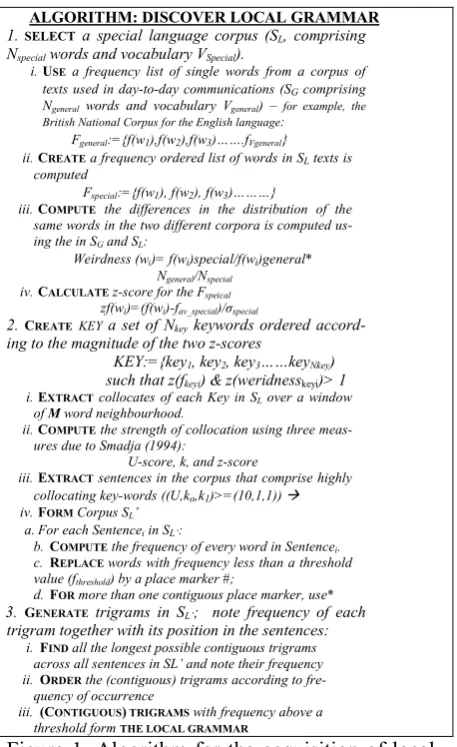
The manner in which we derive the local grammar is shown in the algorithm below (Fig-ure 1).
ALGORITHM: DISCOVER LOCAL GRAMMAR
1.SELECT a special language corpus (SL, comprising Nspecial words and vocabulary VSpecial).
i.USE a frequency list of single words from a corpus of texts used in day-to-day communications (SG comprising
Ngeneral words and vocabulary Vgeneral) – for example, the
British National Corpus for the English language: Fgeneral:={f(w1),f(w2),f(w3)…….fVgeneral} ii.CREATE a frequency ordered list of words in SL texts is
computed
Fspecial:={f(w1), f(w2), f(w3)………}
iii.COMPUTE the differences in the distribution of the same words in the two different corpora is computed us-ing the in SG and SL:
Weirdness (wi)= f(wi)special/f(wi)general*
Ngeneral/Nspecial iv.CALCULATE z-score for the Fspeical
zf(wi)=(f(wi)-fav_special)/σspecial
2.CREATEKEY a set of Nkey keywords ordered accord-ing to the magnitude of the two z-scores
KEY:={key1, key2, key3……keyNkey) such that z(fkeyi) & z(weridnesskeyi)> 1
i.EXTRACT collocates of each Key in SL over a window of M word neighbourhood.
ii.COMPUTE the strength of collocation using three meas-ures due to Smadja (1994):
U-score, k, and z-score
iii.EXTRACT sentences in the corpus that comprise highly collocating key-words ((U,ko,k1)>=(10,1,1))
iv.FORM Corpus SL’ a.For each Sentencei in SL’:
b.COMPUTE the frequency of every word in Sentencei. c.REPLACE words with frequency less than a threshold value (fthreshold) by a place marker #;
d.FOR more than one contiguous place marker, use*
3. GENERATE trigrams in SL’; note frequency of each trigram together with its position in the sentences:
i.FIND all the longest possible contiguous trigrams across all sentences in SL’ and note their frequency ii.ORDER the (contiguous) trigrams according to
fre-quency of occurrence
[image:3.595.303.532.156.530.2]iii.(CONTIGUOUS) TRIGRAMS with frequency above a threshold form THE LOCAL GRAMMAR
Figure 1. Algorithm for the acquisition of local-grammar patterns.
Briefly, given a specialist corpus (SL),
words are identified, and collocates of the key-words are extracted. Sentences containing key collocates are then used to construct a sub-corpus (SL’). The sub-corpus SL’ is then analyzed and
This process is continued until all the trigrams in the sentence are matched with the significant trigrams.
The local grammar then comprises significant contiguous trigrams that are found. These do-main specific patterns, extracted from the
spe-cialist corpus SL’ (and its constituent sub-corpus)
are then used to extract similar patterns and in-formation from a test corpus to validate the pat-terns thus found in the training corpus. Following is a demonstration of how the algorithm works using English and Arabic texts.
2.1 Extracting Patterns in English
We present an analysis of a corpus of financial news wire texts: 1204 news report produced by Reuters UK Financial News comprising 431,850 tokens. One of the frequent words in the corpus
is percent– 3622 occurrences, a relative
fre-quency of 0.0084%. When the frefre-quency of this keyword is looked up in the British National Corpus (100 million words), it was found that
percent is 287 times more frequent in the
finan-cial corpus than in the British National Corpus –
this ratio is sometimes termed weirdness (of
spe-cial language); the weirdness of grammatical
words the and to is unity as these tokens are
dis-tributed with the same (relative) frequency in Reuters Financial and the BNC. The z-score computed using the frequency of the token in the Reuters Financial is 12.64: the distribution of
percent is 12 standard deviations above the mean
of all words in the financial corpus. (The z-score computed for weirdness is positive as well). The
heuristic here is this: a token is a candidate
key-word if both its z-scores are greater than a small
positive number. So percent -most frequent to-ken with frequency and weirdness z-score over
zero- was accepted as a keyword.
The collocates of the keyword percent were
then extracted by using mutual information sta-tistics presented by Smadja (1994). A collocate in this terminology can be anywhere in the vicin-ity of +/- N-words. The frequency at each neighbourhood is calculated and then used to compute the ‘peaks’ in the histogram formed by the neighbourhood frequencies and the strength of the collocation calculated on a similar basis. The keyword generally collocates with certain words that have frequencies higher than itself –
the upward collocates- and collocates with
cer-tain words that have lesser frequency – the
down-wards collocates (These terms were coined by
John Sinclair). Upwards collocates are usually grammatical words and downwards collocates
are lexical words – nouns, adjectives- and hence the downwards collocates are treated as candi-date compound words. There were 46 collocates
of percent in our corpus – 34 downwards
collo-cates and 12 upwards collocates. A selection of
5 downwards and upwards are shown in Table 1 and 2 respectively.
Collocate Frequency U-score k-score shares 1150 1047 3.01
rose 514 2961 2.43 year 2046 396 2.40 profit 1106 263 1.65 down 486 996 1.40
Table 1. Downward collocates of percent in a
corpus of 431,850 words.
Collocate Frequency U-score k-score the 23157 6744 14.40
to 12190 7230 10.29 in 9768 4941 8.49 a 10657 3024 8.44 of 10123 3957 8.24
Table 2. Upward collocates of percent in a
cor-pus of 431,850 words.
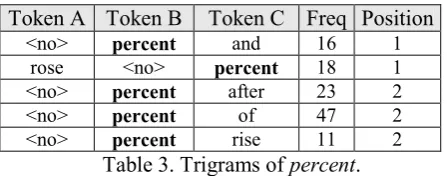
The financial texts comprise a large number of numerals (integers and decimals) and these we will denote as <no>. The numerals collocate strongly with percent for obvious reasons. The collocates are then used to extract trigrams com-prising the collocates that occur at particular po-sitions in the various sentences of our corpus:
Token A Token B Token C Freq Position
<no> percent and 16 1
rose <no> percent 18 1
<no> percent after 23 2
<no> percent of 47 2
[image:4.595.309.531.185.261.2]<no> percent rise 11 2
Table 3. Trigrams of percent.
[image:4.595.302.532.287.355.2] [image:4.595.305.529.500.588.2]Token A Token B Token C Freq Position
rose <no> percent 18 1
# <no> percent 29 2
# shares were 10 2
* <no> percent 57 2
<no> percent # 24 2
Table 4. Trigrams of percent with omitted low
frequency words (denoted as * for multiple to-kens and # for a single token).
Local Grammar Patterns Freq
<s> the * <no> percent 28
<s> * rose <no> percent 26
<s> # shares # <no> percent 22
<s> * fell <no> percent 20
<s> * <no> percent 18
[image:5.595.64.295.71.156.2]<s> # shares were up <no> percent at 17
Table 5. Some of top patterns of percent (<s> identifies a sentence boundary).
2.2 Extracting Patterns in Arabic
Arabic is written from right to left and its writ-ing system does not employ capitalization. The language is highly inflected compared to Eng-lish; words are generated using a root-and-pattern morphology. Prefixes and suffixes can be attached to the morphological patterns for gram-matical purposes. For example, the gramgram-matical conjunction “and” in Arabic is attached to the beginning of the following word. Words are also sensitive to the gender and number they refer to and their lexical structure change accordingly. As a result, more word types can be found in Arabic corpora compared to English of same size and type. Short vowels which are represented as marks in Arabic are also omitted from usual Arabic texts resulting in some words having same lexical structures but different semantics.
These grammatical and lexical features of Arabic cause more complexity and ambiguity, especially for NLP systems designed for thor-ough processing of Arabic texts compared to English. A shallow and statistical approach for IE using texts of specialism can be useful to ab-stract many complexities of Arabic texts.
Given a 431,563 word corpus comprising 2559 texts of Reuters Arabic Financial News and the same thresholds we used with the English corpus, percent (al-meaa, QRSTا) is again the most frequent term with frequency and weirdness z-score greater than zero. It has 3125 occurrences (0.0072%), a frequency z-score of 19.03 and a
weirdness of 76 compared against our Modern Standard Arabic Corpus (MSAC).
There were 31 collocates of percent; 7
up-wards and 23downwards. The downwards
collo-cates of percent appear to collocate with names
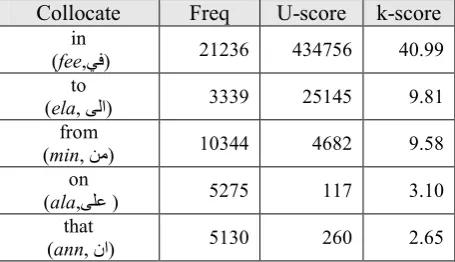
of instruments i.e. shares and indices (Table 6). The upwards collocate are with the so-called
closed class words as in English like in, on and
that (Table 7).
Collocate Freq U-score k-score
by-a-ratio
(be-nesba, QVWXY) 1257 39191 7.87
point
(noqta, QZ[\) 1167 9946 6.44
the-year
(al-aam, م^_Tا) 1753 344 3.34
index
(moasher,`abc) 1130 409 2.55
million
(milyoon, نefgc) 2281 600 2.32
share
(saham, hij) 705 206 1.84
Table 6. Downward collocates of percent (
al-meaa, QRSTا).
Collocate Freq U-score k-score
in
(fee,kl) 21236 434756 40.99
to
(ela, mTا) 3339 25145 9.81
from
(min, nc) 10344 4682 9.58
on
(ala,mgo ) 5275 117 3.10
that
(ann, نا) 5130 260 2.65
Table 7. Upward collocates of percent (almeaa, QRSTا).
Using the same thresholds the trigrams (Table 8) appear to be different from the English tri-grams in that the words of movement are not in-cluded here – this is because Arabic has a richer morphological system compared to English and Financial Arabic is not as standardised as Finan-cial English: however, it will not be difficult to
train the system to recognise the variants of rose
and fell in Financial Arabic. Table 9 lists some
[image:5.595.305.524.204.371.2] [image:5.595.67.295.207.314.2] [image:5.595.302.530.403.534.2]Token A Token B Token C Freq Position <no> ( in
fee,kl)
percent
(al-meaa,QRSTا) 197 1 in
(fee,kl)
percent
(al-meaa,QRSTا) * 39 1
in (fee,kl)
percent (al-meaa,QRSTا)
to
(ela, mTا) 22 2 percent
(al-meaa,QRSTا)
to
(ela, mTا) <no> 21 3 # ( in
[image:6.595.69.288.70.190.2]fee,kl) (al-meaapercent ,QRSTا) 66 4
Table 8. Trigrams of percent (almeaa, QRSTا).
Local Grammar Patterns Freq
<no> * <s> kl
QRSTا *
percent in 34
> s < * QVWXY > no < kl QRSTا mTا > no <
to percent in by-a-ratio 23 > s < # hij # > no < kl ا QRST
percent in share 21 > s # < `abc # ^p^Z\ qjوsا QVWXY > no < kl QRSTا mTا > no < QZ[\ > / s <
point to percent in by-ratio wider index 18 `abc * > no < QZ[\ يأ > no < kl QRSTا mTا > no < QZ[\ > / s <
point to percent in namely point index 16
kl * مev # QVWXY > no < kl QRSTا qc *
with percent in by-ratio day in 10
Table 9. Some patterns of percent
(almeaa, QRSTا).
3 Experimental Results
We have argued that a method that is focused on frequency at the lexical level(s) of linguistic de-scription – single words, compounds, and N-grams- will perhaps lead to patterns that are idio-syncratic of a specialist domain without recourse to a thesaurus. There are a number of linguistic methods – that focus on syntactic and semantic level of description which might be of equal or better use.
In order to show the effectiveness of our method we apply it to sentiment analysis – an analysis that attempts to extract qualitative opin-ion expressed about a range of human and natu-ral artefacts – films, cars, financial instruments for instance. Broadly speaking, sentiments in financial markets relate to the ‘rise’ and ‘fall’ of financial instruments (shares, currencies, com-modities and energy prices): inextricably these sentiments relate to change in the prices of the instruments. In both English and Arabic, we have found that percent or equivalent is a key-word and trigrams and longer N-grams
embed-ded with this keyword relate to metaphorical
movement words– up, down, rise, fall. However,
in English this association is further
contextual-ised with other keywords – shares, stocks- and in
Arabic the contextualisation is with shares and the principal commodity of many Arab states
economies – oil. Our system ‘discovered’ both
by following a lexical level of linguistic descrip-tion.
For each of the two languages of interest to us, we have created 1.72 million token corpora. Each corpus was then divided into two (roughly) equal sized sub corpora: training corpus and test-ing corpus; the testtest-ing corpus is sub-divided into two testing corpora Test1 and Test2 (Table 10).
First, we extract patterns from the Training
Cor-pus using the discover local grammar algorithm
(Figure 1) and also from Test1. Next, the
Train-ing1 and Test1 corpora are merged and patterns
extracted from the merged corpus. The intuition we have is that as the size of the corpus is in-creased the patterns extracted from a smaller sized corpus will be elaborated: some of the pat-terns that are idiosyncratic of the smaller sized corpus will become statistically insignificant and hence will be ignored. The conventional way of testing would have been to see how many pat-terns discovered in the training corpus are found in the testing corpora; we are quantifying these results currently. In the following we describe an
initial test of our method after introducing LoLo.
English Arabic
Corpus
Texts Tokens Texts Tokens Training1 2408 861,492 5118 860,020
Test1 1204 431,850 2559 431,563
Training2 (Training1+Test1) 3612 1,293,342 7677 1,293,342
Test2 1204 426,800 2559 428,571
[image:6.595.71.294.228.451.2]Total 4816 1,720,142 10,236 1,720,154
Table 10. Training and testing corpora used in our experiments.
3.1 LoLo
LoLo (stands for Local-Grammar for Learning
Terminology and means ‘pearl’ in Arabic) is
de-veloped using the .NET platform. It contains four components summarised in Table 11.
Component Functionality
CORPUS ANALYSER Discover domain specific
extraction patterns RULES EDITOR Group, label and evaluate
patterns and slots INFORMATION EXTRACTOR Extract information
INFORMATION VISUALISER Visualise patterns over
time
[image:6.595.308.524.475.547.2] [image:6.595.305.527.668.756.2]The various components of LoLo –the
Ana-lyser, Editor, Extractor and the Visualiser, can
be used to extract and present patterns; the sys-tem has utilities to change script and the direc-tion of writing (Arabic is right-to-left and Eng-lish left-to-right). Table 12 is an exemplar output from LoLo: “rise in profit” event patterns ex-pressed similarly in English and Arabic financial
news headlines found by the Corpus Analyser.
English * profit up <no> percent
ع^yzرا ح^Yرأ <no> * kl
QRSTا Arabic
[image:7.595.74.288.199.250.2]percent in profit rise (up) Table 12. “Rise in profit” patterns in Arabic and English where the * usually comprises names of organisations or enterprises.
The pattern acquisition algorithm presented
earlier is implemented in the Corpus Analyser
component, which is the focus of this paper. It can be used for discovering frequent patterns in corpora. The user has the option to filter smaller patterns contained in larger ones and to mine for interrupted or non-interrupted patterns. It can also distinguish between single word and multi word slots.
Before mining for patterns, a corpus pre-processor routine performs a few operations to improve the pattern discovery. It identifies any punctuation marks attached to the words and separates them. it also identifies the sentences boundaries and converts all the numerical tokens to one tag “<no>” as numbers can be part of some patterns, especially in the domain of finan-cial news.
The Rules Editor is at its initial stages of
de-velopment, currently it can export the extraction
patterns discovered by the Corpus Analyser as
regular expressions.
A time-stamped corpus can be visualised
us-ing the Information Visualiser. The Visualiser
can display a time-series that shows how the ex-tracted events emerge, repeat and fade over time in relation to other events or imported time series i.e. of financial instruments. This can be useful for analysing any relations between different events or detecting trends in one or more corpora or with other time-series.
LoLo facilitates other corpus and
computa-tional linguistics tasks as well, including generat-ing concordances and findgenerat-ing collocations from texts encoded in UTF-8. This is particularly use-ful for Arabic and languages using the Arabic
writing system like Persian and Urdu which lack such resources.
3.2 Training and Testing
3.2.1 English
We consider the English Training1 corpus first.
We extracted the significant collocates of all the high frequency/high weirdness words, where ‘high’ defined using the associated z-scores, in the training corpus. Trigrams were then ex-tracted and high frequency trigrams were chosen and all sentences comprising the trigrams were used to form a (training) sub corpus. The sub-corpus was then analysed for extracting the local grammar.
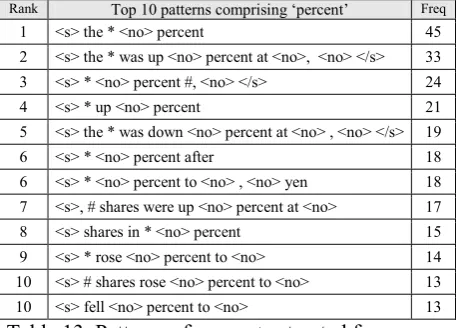
The 10 high frequency N-grams extracted
automatically from the Training1 Corpus
(861,492) are listed in Table 13. The Test1
cor-pus has most of the trigrams in the Training1
corpus, particularly some of the larger N-grams (Table 14).
Rank Top 10 patterns comprising ‘percent’ Freq
[image:7.595.303.532.368.532.2]1 <s> the * <no> percent 45 2 <s> the * was up <no> percent at <no>, <no> </s> 33 3 <s> * <no> percent #, <no> </s> 24 4 <s> * up <no> percent 21 5 <s> the * was down <no> percent at <no> , <no> </s> 19 6 <s> * <no> percent after 18 6 <s> * <no> percent to <no> , <no> yen 18 7 <s>, # shares were up <no> percent at <no> 17 8 <s> shares in * <no> percent 15 9 <s> * rose <no> percent to <no> 14 10 <s> # shares rose <no> percent to <no> 13 10 <s> fell <no> percent to <no> 13
Table 13. Patterns of percent extracted from
Training1 corpus.
Patterns Freq
<s> # shares # <no> percent 22
<s> shares in * <no> percent 13
<s> # shares were up <no> percent at 17
Table 14. Patterns of percent extracted from
Test1 corpus found as sub-patterns in Training1.
We then merged the Training1 and Test1
cor-pora together and created Training2 corpus
com-prising of 3612 texts and 1,293,342 tokens. The Algorithm was executed on the merged corpus and a new set of patterns were extracted, in
par-ticular the most frequent pattern in the Training1
elabo-rated by the Algorithm as well as those patterns shown in Table 15.
Training1 Corpus Freq Training2 Corpus Freq
<s> the * was down <no> percent at <no> , <no> </s> 19
<s> the * index was down <no> percent at <no> , <no>
</s> 23
<s> the * was up <no>
percent at <no>, <no> </s> 33 <s> the * percent at <no> , <no> </s> index was up <no> 34 Table 15. Comparison between two patterns in Training1 and Training2 corpora.
The patterns related to the collocations of
shares and percent from Training1 were
pre-served in Training2. The test on Test2 corpus
showed similar results: the smaller N-grams re-lated to the movement of instruments were simi-lar to the Test1 Corpus. The analysis of Arabic
texts is shown below with similar results.
3.2.2 Arabic
Some of frequent N-grams extracted
automati-cally from the Training1 Arabic corpus (860,020)
are shown in Table 16. Similar to the English
corpora the Test1 Arabic corpus has most of the
trigrams in the Training1 Corpus and some larger
N-grams(Table 17).
Rank Top 10 patterns comprising ‘percent’ Freq
<no> * <s> kl QRSTا * 1
percent in 35 * kl * QVWXY > no < kl QRSTا 2
percent in by-ratio in
31 * > no < QZ[\ QVWXY > no < kl QRSTا mTا > no < QZ[\ > / s < 3
point to percent in by-ratio point 28 <s> * kl QRSTا kl * 4
in percent in 24 > s < * QVWXY > no < kl QRSTا mTا > no < 4
to percent in by-ratio 24 * kl * mTا > no < kl QRSTا 5
percent in to in 21 > s #< `abc * ^p^Z\ QVWXY > no < kl QRSTا mTا > no < QZ[\ > / s < 5
[image:8.595.68.293.419.569.2]point to percent in by-ratio zone index 21
Table 16. Patterns of percent (almeaa, QRSTا)
ex-tracted from Training1 Arabic corpus.
Patterns Freq
* QVWXY <no> kl QRSTا #
percent in by-ratio 10
* QVWXY <no> kl QRSTا kl
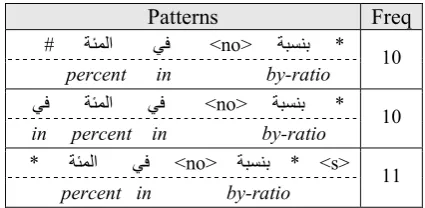
in percent in by-ratio 10 > s < * QVWXY > no < kl QRSTا *
percent in by-ratio 11
Table 17. Patterns of percent (almeaa, QRSTا)
ex-tracted from Test1 Arabic corpus found as
sub-patterns in Training1.
After merging the Training1 and Test1 Arabic
corpora together into a corpus of 7677 texts and 1,293,342 tokens, new set of patterns were ex-tracted as well. Some of the frequent patterns in the training corpus were elaborated more as well like the pattern shown in Table 18 where the
to-ken and-rise (wa-ertifaa, qyzراو) was added to the
pattern.
Training1 Corpus Freq Training2 Corpus Freq
# <s> `abc # ^p^Z\ qjوsا QVWXY <no> mTا QRSTا kl <no> QZ[\ </s> 13 <s> ;<=راو `abc # ^p^Z\ qjوsا QVWXY <no> mTا QRSTا kl <no> QZ[\
</s>
17
Table 18. Comparison between two patterns in
Training1 and Training2 Arabic corpora.
4 Evaluation
We have used the Rules Editor and the
Informa-tion Extractor to evaluate the patterns on a
cor-pus comprising 2408 texts and 858,650 tokens
created by merging Test1 and Test2 corpora. The
[image:8.595.308.526.459.537.2]Arabic evaluation corpus comprised 5118 texts and 860,134 tokens. The N-gram pattern extrac-tor (where N > 4) showed considerable promise in that who or what went up/or down was unam-biguously extracted from the English test corpus using patterns generated through the training corpus. Initial results show high precision with the longer N-grams in English (Table 19) and Arabic (Table 20).
Table 19. Patterns with high precision (English).
Table 20. Patterns with high precision (Arabic).
Pattern Precision
<ORG> shares were down <no> percent at <no> (13/13) 100%
<Movement> <no> percent to <no> , <no> yen (17/17) 100%
the <Index> was up <no> percent at <no> , <no> (11/12) 92%
<ORG> shares # up <no> percent at (30/34) 88%
Pattern Preci-sion
`abc <no> <Index> QZ[\ يأ <no> kl QRSTا mTا <no> QZ[\
point to percent in viz point index 100% (42/42) <Index> # > no < # > no < ا
percent in point for-shares index 100% (27/27)
<Movement>
`abc
<Index>
QVWXY ^p^Z\ qjوsا >
no < mTا QRSTا kl > no < QZ[\
point to percent in by-ratio zone wider index
97% (33/34) <Movement> <Index> > no < ا ا > no <
point to percent in zone index
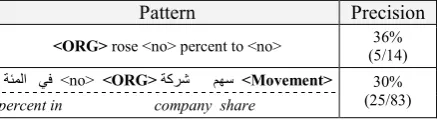
[image:8.595.307.528.565.718.2] [image:8.595.73.286.612.716.2]However, some patterns return many extracted information that require trimming. For example many organizations names are extracted in Ara-bic using the pattern shown in table 21 but they
usually have the word by-a-ratio (be-nesba, QVWXY)
attached at the end resulting in low precision.
Pattern Precision
<ORG> rose <no> percent to <no> (5/14) 36%
<Movement>
hij Qآ`a <no> <ORG>
kl QRSTا
percent in company share
[image:9.595.72.291.171.231.2]30% (25/83)
Table 21. Patterns with low precision in English and Arabic
Because we have used the same training thresholds for English and Arabic, the patterns in Arabic appeared without the motion words. However the system can extract these words along with the org/instrument/index names be-cause they appear frequently as slots in the pat-terns.
The N-gram patterns (when N ≤ 4) show poor
results in that either such patterns found in the training corpus are not found in the test corpus, or the patterns retrieved from test corpora are at semantic variance with the same pattern in the training corpus. This suggests that there is an optimal length of individual patterns in our local grammar.
5 Afterword
The patterns extracted from the English (and Arabic) corpora confirm to an extent the view of
the proponents of local grammar, of a special
language, that there are certain words (in our
case percent, shares, index) that appear to have a
specific grammatical category in the sense that the neighbourhood of these words is occupied by a small number of other words (up, down, fall,
rise, <no> for instance). If we were to apply the
grammars typically used in part-of-speech tag-gers and syntactic parsing in general, the idio-syncratic behaviour of the pivotal keywords in specialist language does not become apparent: the pivotal keywords are regarded as noun phrases and the association of these phrases is with other general categories of verb phrase, ad-jectival phrase and adverbial phrase.
The patterns we have extracted could have been extracted with the help of a thesaurus. And, this is the question which is critical to us: how to create and maintain a thesaurus within a domain.
This is illustrated in a small way by our
experi-ment on the Training1 corpus where the term
in-dex was not statistically significant for it to ap-pear in the trigrams that populate the local
grammar. However, in Training2, the larger
cor-pus did contain significant frequency of the term
index for it to make into a pattern of its own.
Furthermore, many of the patterns in Training1
persisted in Training2. Smaller N-grams persist
as well in the various Training and Test corpora – these patterns in themselves act like units around which other trigrams nucleate.
The evaluation of our Algorithm is still con-tinuing and we are in the process of setting up experiments with human volunteers, especially those with some knowledge of financial matters
to evaluate the output of LoLo. We intend to use
information retrieval metrics of recall and the
various Fβ measures.
The local grammar movement has made er-ratic progress since its inception in the 1960’s. Now, with the advent of accessible computers with substantive memories, with the advent of the Internet and the concomitant treasure of multi-lingual text deposits and text streams, one can explore the use of such grammars in address-ing the major challenges in information extrac-tion.
Reference
Ahmad, Khurshid. and Al-Sayed, Rafif. (2005) Community of Practice and the Special Language
‘Ground’. In (Eds.) Clarke, S and Coakes, E.
En-cyclopaedia of Knowledge Management and Community of Practice. Hershey (PA): The Idea Group Reference.
Ahmad, Khurshid., Cheng, David. and Almas, Yousif. (2006) ‘Multi-lingual Sentiment Analysis of
Fi-nancial News Streams.’ In Proc. of the 1st
Interna-tional Conference on Grid in Finance, Palermo. Andersen, Torben., Bollerslev, Tim., Diebold,
Fran-cis, and Vega, Clara. (2002). ‘Micro effects of macro announcements: Real Time Price Discovery in Foreign Exchange’. National Bureau of Eco-nomic Research Working Paper 8959. (Available at http://www.nber.org/papers/w8959).
Barnbrook, Geoffrey. and Sinclair, John McH. (1996) 'Parsing Cobuild Entries'. In (Eds.) John McH.
Sinclair, Martin Hoelter & Carol Peters. The
Lan-guages of Definition: the Formalization of Dic-tionary Definitions for Natural Language
Process-ing: Luxembourg: Office for Official Publications
Barnbrook, Geoffrey. (2002) Defining Language: A local grammar of definition sentences. Amsterdam: John Benjamins Publishers.
Omrane, Walid., Bauwens, Luc., and Giot, Pierre. (2005) ‘News Announcements, Market Activity and Volatility in the Euro/Dollar Foreign Exchange
Market’. Journal of International Money and
Fi-nance, 24 (7), pp. 1108-1125.
Brill, Eric. (1993) ‘Automatic Grammar Induction and Parsing Free Text: A transformation-based
ap-proach’. In Proc. of 31th Annual Meeting of the
As-sociation for Computational Linguistics, Ohio.
Chan, Wesley. (2003) ‘Stock Price Reaction to News and No-News. Drift and Reversal after Headlines’. Journal of Financial Economics, 70(2), pp. 223-260.
Ciravegna, Fabio. and Wilks, Yorick. (2003) ‘Design-ing Adaptive Information Extraction for the Se-mantic Web in Amilcare’. In (Eds.) Siegfried
Handschuh and Steffen Staab, Annotation for the
Semantic Web, Frontiers in Artificial Intelligence and Applications. US: IOS Press.
Cutler, David., Poterba, James., and Summers,
Law-rence. (1989) ‘What Moves Stock Prices?’.
Jour-nal of Portfolio Management, 15(3), pp. 4-12.
Debnath, Sandip. and Giles, C. Lee. (2005) ‘A Learn-ing Based Model for Headline Extraction of News Articles to Find Explanatory Sentences for Events’. In Proc. of the 3rd international conference on Knowledge capture, Alberta, Canada.
Engle, Robert. and K. Ng, Victor. (1993) ‘Measuring and Testing the Impact of News on Volatility’, Journal of Finance, 48(5), pp. 1749-1777.
Gao, Jianfeng., Li, Mu., Wu, Andi. and Huang, Chang-Ning (2005) ‘Chinese Word Segmentation and Named Entity Recognition: A Pragmatic
Ap-proach’, Journal of Computational Linguistics,
31(4), Cambridge, Mass.: MIT Press, pp. 531-574 Gross, Maurice. (1997) ‘The Construction of Local
Grammars’. In (Eds.) Roche, E. and Schabès, Y., Finite-State Language Processing, Language, Speech, and Communication, Cambridge, Mass.: MIT Press, pp. 329-354.
Habash, Nizar. and Rambow, Owen. (2005) ‘Arabic Tokenization, Morphological Analysis, and
Part-of-Speech Tagging in One Fell Swoop’. In Proc. of
the Conference of American Association for Com-putational Linguistics (ACL’05), Ann Arbour, MI. Halliday, Michael, A. K. (1993) 'On the language of
Physical Sciences'. In (Eds.) Halliday, Michael.
and Martin, J. R., Writing Science pp. 54-68.
Lon-don: The Falmer Press.
Hardie, Iain. and MacKenzie, Donaled. (2005) ‘An Economy of Calculation: Agencement and
Distrib-uted Cognition in a Hedge Fund’. (Available at http://www.sps.ed.ac.uk/staff/An%20Economy%2 0of%20Calculation.pdf).
Harris, Zellig. (1991) A Theory of Language and
In-formation: A Mathematical Approach. Oxford: Clarendon Press.
Kittredge, Richard. and Lehrberger, John. (1982)
Sub-language: Studies of language in restricted seman-tic domains. Berlin: Walter de Gruyter.
Koppel, Moshe and Shtrimberg, Itai. (2004) ‘Good News or Bad News? Let the Market Decide’. In AAAI Spring Symposium on Exploring Attitude and Affect in Text, Palo Alto: AAAI Press, pp. 86-88.
Mackenzie, Donald. (2000). ‘Fear in the Markets’. London Review of Books, 22(8), pp 31-32.
McLernon, Brian. and Kushmerick, Nicholas. (2006) ‘Transductive Pattern Learning for Information
Ex-traction’. In Proc. of EACL 2006 Workshop on
Adaptive Text Extraction and Mining, Trento. Seo, Young-Woo., Giampapa, Joseph. and Sycara,
Katia. (2002) ‘Text Classification for Intelligent
Agent Portfolio Management’. In Proc. of the 1st
International Joint Conference on Autonomous Agents and Multi-Agent Systems, pp. 802-803, Bo-logna.
Shiller, Robert. (2000) Irrational Exuberance.
Prince-ton: Princeton University Press.
Sinclair, John McH. (1996) Collins COBUILD
Grammar Patterns 1: Verbs. HarperCollins, Glas-gow.
Smadja, Frank. (1994) ‘Retrieving Collocations from
Text: Xtract’. In (Eds.) Armstrong, S., Using Large
Corpora. London: MIT Press.
Stevenson, Mark. and Greenwood, Mark A. (2005) ‘A Semantic Approach to IE Pattern Induction’. In Proc. of the 43rd Meeting of the Association for Computational Linguistics (ACL’05), pp. 379-386, Ann Arbour, MI.
Wilks, Yorick (1998) ‘Inducing Adequate Grammars from Electronic Texts’, EPSRC ROPA Grant
GR/K/66215 Final Report. (Available at
http://nlp.shef.ac.uk/research/reports/k66215.html).
Yangarber, Roman. (2003) ‘Counter-Training in
Dis-covery of Semantic Patterns’. In Proc. of the 41st