!
"
#"#
$ % %#
&
''' (
Implementation and Analysis of QoS in MANET using the multicast protocol MAODV
Prof. Vijayan R*
Assistant Professor (Senior Grade) School of Information Technology
And Engineering [SITE] VIT University, Vellore, India
Boojitha M and Durga Devi V
MS [Software Engineering] SITE, VIT University
Vellore, India
[email protected], [email protected]
Abstract: Routing is a fundamental engineering task on the internet. It consists of finding a path from source to destination host. Producing the Quality of Service in Mobile Ah hoc networks is a complex task due to limited bandwidth, changing topology and shared medium. The unicast routing protocols increases the cost of communication and it also consumes high bandwidth. It is also necessary for the routing protocols to guarantee the QoS services. Multicastis a bandwidth conserving technology that reduces traffic by simultaneously delivering a single stream of information to thousands of recipients. Multicast used in videoconferencing, corporate communications, distance learning, and distribution of software, stock quotes, and news. Multicast protocol MAODV is an extension of AODV works efficiently with the dynamic topology and guarantees the QoS services.
Keywords: multicast routing, MAODV, ad hoc routing, AODV, DSR and DSDV protocols
I. INTRODUCTION
One of the important and famous groups developing ad hoc networks is Mobile Adhoc network Group (MANET). With the popularity of ad hoc networks, many routing protocols have been designed for route discovery and route maintenance. At the same time, Quality of Service (QoS) models in ad hoc networks become more and more required because more and more real time applications are implemented on the network. In routing layer, QoS are guaranteed in terms of data rate, delay, and jitter and so on. By considering QoS in terms of data rate and delay will help to ensure the quality of the transmission in real time.
In this project a muticast routing protocol has been
proposed. Multicast is a bandwidth-conserving technology
that reduces traffic by simultaneously delivering a single stream of information to thousands of recipients. Multicast used in videoconferencing, corporate communications, distance learning, and distribution of software, stock quotes, and news.
II. EXISTING SYSTEM
The existing unicast routing protocols for MANET are DSDV, AODV and DSR.
A. Abbreviations and Acronyms
Term Definition
DSDV Destination Sequenced Distance Vector
AODV Adhoc Ondemand Distance Vector DSR Dynamic Source Routing protocol
MAODV Multicast Adhoc Ondemand Distance Vector
B. DSDV Routing Protocol
DSDV is a proactive unicast mobile ad hoc network routing protocol. This protocol is based on the traditional Bellman Ford algorithm. Each node maintains routing
information for all known destinations. DSDV is Destination based protocol. In routing tables of DSDV, an entry stores the next hop toward a destination, the cost metric for the routing path to the destination, and a destination sequence number that is created by the destination. Sequence numbers are used in DSDV to distinguish stale routes from fresh ones and avoid the formation of route loops. The route updates of DSDV can be either time driven or event driven.
Every node periodically transmits updates, including its routing information, to its immediate neighbors. When a significant change occurs from the last update, a node can transmit its changed routing table in an event triggered style.
C. AODV Protocol
AODV routing protocol is a reactive routing protocol; therefore, routes are determined only when needed. Hello messages may be used to detect and monitor links to neighbours. If Hello messages are used, each active node periodically broadcasts a Hello message that all its neighbours receive. Because nodes periodically send Hello messages, if a node fails to receive several Hello messages from a neighbour, a link break is detected. When a source has data to transmit to an unknown destination, it broadcasts a Route Request (RREQ) for that destination. At each intermediate node, when a RREQ is received a route to the source is created. If the receiving node has not received this RREQ before, is not the destination and does not have a current route to the destination, it rebroadcasts the RREQ. If the receiving node is the destination or has a current route to the destination, it generates a Route Reply (RREP). The RREP is unicast in a hop by hop fashion to the source. Control messages are route request route reply and Hello message.
D. DSR Protocol
means that each packet in its header carries the complete ordered list of nodes through which the packet must pass. DSR uses no periodic routing messages, thereby reducing network bandwidth overhead, conserving battery power and avoiding large routing updates throughout the adhoc network. Instead DSR relies on support from the MAC layer which informs the routing protocol about link failures. The two basic modes of operation in DSR are route discovery and route maintenance.
III. DRAWBACK OF EXISTING PROTOCOLS
A. Drawbacks in Reactive Protocols
This type of protocols finds a route on demand by flooding the network with Route Request packets. The main disadvantages of such algorithms are
{a] High latency time in route finding.
[b] Excessive flooding can lead to network clogging.
B. Drawbacks in Proactive Protocols
Proactive protocols maintain fresh lists of destinations and their routes by periodically distributing routing tables throughout the network.
[a] Slow reaction on restructuring and failures. [b] Respective amount of data for maintenance.
IV. PROPOSED SYSTEM
A multicast protocol called MAODV is proposed.
A. Need for a Multicast Protocol
Multiple receivers who subscribe to be part of the receiver group can receive using multicast a single transmission. The problem of multicast routing is born out of the need of achieving multicast capability in a scenario where all the nodes interested in participating in the multicast group are not within the transmission range of the sender. There is a need of some mechanism to forward multicast traffic through the entire multi-hop network, based on group member information. To solve this problem in wireless networks, a multicast protocol has been proposed called MAODV.
Multicasting is the transmission of datagrams to a group of zero or more hosts identified by a single destination address. A multicast packet is typically delivered to all members of its destination host group with the same reliability as regular unicast packets.
B. Working of MAODV
[a] Route discovery and Maintenance
[image:2.612.329.550.403.570.2]The MAODV routing protocol discovers multicast routes on demand using a broadcast route discovery mechanism.
Figure 1: MAODV Tree structure
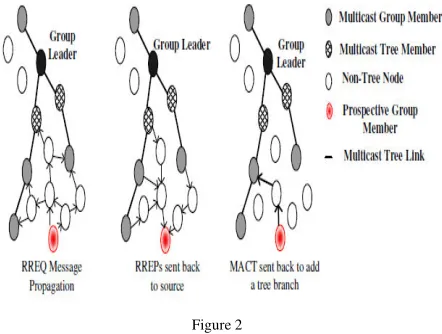
A mobile node originates an RREQ message when it wishes to join a multicast group, or when it has data to send to a multicast group but it does not have a route to that group. Only a member of the desired multicast group may respond to a join RREQ. If an intermediate node receives a join RREQ for a multicast group then only a member can rebroadcasts the RREQ to its neighbors. If the intermediate node is a member of the multicast group’s tree and its recorded sequence number for the multicast group is at least as great as that contained in the RREQ then the node updates its route and multicast route tables by placing the requesting node’s next-hop information in the tables. After updating it unicast an RREP back to the source node. When the Join Request packet reaches a multicast receiver, then the receiver creates or updates the source entry on its member. When a source node broadcasts an RREQ for a multicast group, it often receives more than one reply.
Figure 2
[b] Multicast Data Packet Forwarding
Packet forwarding uses a two-step approach:
First step: A route from that data source node to a tree member.
Second step: After the tree member receives the multicast data packets, it propagates the data through the whole tree, reaching every group member.
V. IMPLEMENTATION OF MAODV
A. Simulation Environment
Table I: Simulation parameters
Parameter Value
Channel type Wireless channel
Radio propagation model
Two ray ground
Mac layer CSMA/CA as in IEEE 802.11
Data rate at physical layer
11 Mbps
Queue type Drop tail
Maximum queue length 50
Routing protocols MAODV, AODV, DSR and DSDV
B. Creating Mobile Node Movement Scenario File
Under the directory: ns-allinone-2.31/ns-2.31/indep-utils/cmu-scen-gen/setdest, run:
./setdest [-n num_of_nodes] [-p pausetime] [-s maxspeed] [-t simtime] [-x maxx] [-y maxy] > [output-file]
C. Creating TCP Traffic Pattern File
For multicast traffic, under directory: ns-allinone-2.26/ ns-2.26/indep-utils/cmu-scen-gen, run:
ns cbrgen.tcl [-type cbr|tcp] [-nn nodes] [-seed seed] [-mc
connections] [-rate packet/second for one
connection]>[output-file]
The cbrgen.tcl script is used to generate the multicast traffic for simulation.
Figure 3: Snapshot of MAODV simulation
D. Performance Metrics
The performance of MAODV routing protocol has been analyzed using 4 QoS metrics.
[a] End to End Delay [b] Throughput
[c] Packet Delivery Ratio [d] Packet loss
[a] End to End Delay
Network delay is the total latency experienced by packet to traverse the network from the source to destination.
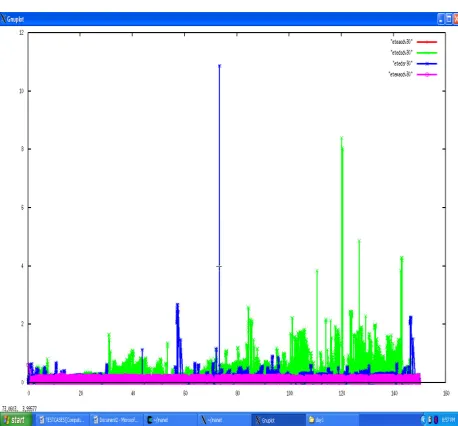
[image:3.612.63.285.66.196.2]ETE delay = Packet received time – Packet sent time. End to End Delay of DSDV, DSR, AODV and MAODV for various number of nodes has been compared in the following figures 3, 4 and 5. The number of nodes in a network has been set to 5, 15 and 30.
[image:3.612.321.553.271.478.2]Figure 4: ETE delay comparison for 5 nodes.
Figure 5: ETE delay comparison for 15 nodes.
[image:3.612.60.291.344.557.2] [image:3.612.323.552.498.711.2][b] Throughput
[image:4.612.63.288.107.280.2]Throughput is the rate of successful message delivery over a communication channel. It is measured in bits per second (bit/s or bps).
[image:4.612.326.550.239.361.2]Figure 7: Throughput comparison for 5 nodes
Figure 8: Throughput comparison for 15 nodes
Figure 9: Throughput comparison for 30 nodes
[c] Packet Delivery Ratio
Packet delivery ratio is the ratio between total numbers of packets received to the total number of packets transmitted.
PDF% = ((Number of packet received/ Number of packet sent) * 100).
[d] Packet Loss
Packet loss is the number of packets missed to reach the destination.
Packet loss= Number of packets sent- Number of packets received.
[image:4.612.67.282.300.490.2]Packet delivery ratio and packet loss of DSDV, DSR, AODV and MAODV has been compared for the network with 5, 15 and 30 nodes.
Table II: Comparison of protocols with 5 nodes
Sr
No Protocol
No of packets
sent
No of packets received
PDF (in %)
Packet loss
1 AODV 12222 12214 99.934544 8
2 DSDV 12132 12127 99.958787 5
3 DSR 44950 44934 99.964405 16
[image:4.612.326.551.384.504.2]4 MAODV 7000 6955 98.981036 45
Table III: Comparison of protocols with 15 nodes
Sr
No Protocol
No of packets
sent
No of packets received
PDF (in %)
Packet loss
1 AODV 9123 9104 99.291735 19
2 DSDV 8053 8023 99.627465 30
3 DSR 6085 6059 99.572720 26
4 MAODV 3346 3288 98.266587 42
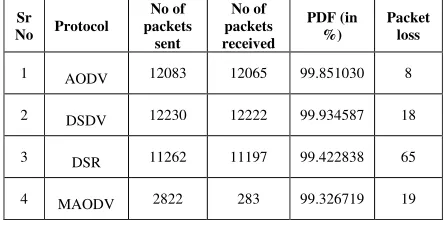
Table IV: Comparison of protocols with 30 nodes
Sr
No Protocol
No of packets
sent
No of packets received
PDF (in %)
Packet loss
1 AODV 12083 12065 99.851030 8
2 DSDV 12230 12222 99.934587 18
3 DSR 11262 11197 99.422838 65
4 MAODV 2822 283 99.326719 19
Packet loss of MAODV is decreased from 42 to 19 and packet delivery ratio is increased from 99.266 to 99.326 when the number of nodes is increased from 15 to 30.
VI. RESULTS AND DISCUSSIONS
[image:4.612.66.285.529.716.2] [image:4.612.326.549.534.648.2]protocols like AODV, DSDV and DSR in terms of the QoS metrics under the same traffic conditions and scenarios. It consumes minimum bandwidth and the number of packets transmitted is lesser when compared to the unicast protocols.
VII. CONCLUSION AND FUTURE WORK
The proposed protocol has been tested and validated with the implementation under different scenarios. And also simulation based experiments are performed to analyze the performance of MAODV Routing Protocol by evaluating Packet Delivery Ratio, throughput and packet loss. These results are compared with AODV, DSDV and DSR routing protocols by various number of nodes and mobility. The comparison shows that the proposed protocol MAODV for adhoc networks performs better as compared to the other protocols. Thus adding MAODV routing protocol is meaningful to optimize the performance of the MANET especially during the real time traffic. In this case the multicast tree may not be the most efficient. So a mechanism based on Group Hello messages can be improved in future. Currently, MAODV does not specify any special security measures. Route protocols are prime targets for impersonation attacks and must be protected by the use of authentication techniques involving generation of unforgeable and cryptographically strong message digests or digital signatures.
VIII. REFERENCES
[1] Courname, A. and Hunt, R., “An Analysis of the Tools used for Generation and Prevention of Spam”, Computer and Security, Vol.23, 2004, pp 154-166.
[2] E. Royer and C. Perkins, “Multicast Operation of the
Ad-Hoc On-demand Distance Vector Routing
Protocol,” Proceedings of Mobicom’99, Seattle, WA, August 1999, pp. 207–218.
[3] P. Mohapatra, L. Jian and C. Gui, “QoS in mobile ad hoc networks,” IEEE Wireless Communications Magazine, vol. 10, no. 3, June 2003, pp.44-52.
[4] S.-J. Lee, W. Su and M. Gerla “On-Demand Multicast Routing Protocol in Multihop Wireless Mobile Networks”, ACM/Kluwer Mobile Networks and
Applications, special issue on Multipoint
Communications in Wireless Mobile Networks, vol. 7, no. 6, December 2002, pp. 441-453.
[5] T. Kunz and E. Cheng, “Multicasting in Ad-Hoc Networks: Comparing MAODV and ODMRP,”
Proceedings of the Workshop on Adhoc
Communications, Bonn, Germany, Sep 2001.
[6] Dr.R.Asokan, “A Review of Quality of Service (QoS) Routing Protocols for Mobile Ad hoc Networks”, IEEE 2010.
[7] S Madhavi andK Duraiswamy, “ Survey of Attacks on
AODV and MAODV,” International Conference and Workshop on Emerging Trends in Technology (ICWET 2010) – TCET, Mumbai, 2010.
[8] T. Dinesh Dharmaraju and Subir Das “An
Implementation Study of Multicast Extensions of AODV”, IEEE Conferenec, 2008.
[9] The Network Simulation ns-2, available online at http://www.isi.edu/nsnam/ns.
[10] Subir Kumar Sarkar and T G Basavaraju, “Ad hoc
Mobile Wireless Networks”, Aeurbach Publications,