A Graph Kernel for Protein-Protein Interaction Extraction
Antti Airola, Sampo Pyysalo, Jari Bj¨orne, Tapio Pahikkala, Filip Ginter and Tapio Salakoski Turku Centre for Computer Science
and Department of IT, University of Turku Joukahaisenkatu 3-5
20520 Turku, Finland
Abstract
In this paper, we propose a graph kernel based approach for the automated extraction of protein-protein interactions (PPI) from sci-entific literature. In contrast to earlier ap-proaches to PPI extraction, the introduced all-dependency-paths kernel has the capability to consider full, general dependency graphs. We evaluate the proposed method across five publicly available PPI corpora providing the most comprehensive evaluation done for a ma-chine learning based PPI-extraction system. Our method is shown to achieve state-of-the-art performance with respect to comparable evaluations, achieving 56.4 F-score and 84.8 AUC on the AImed corpus. Further, we iden-tify several pitfalls that can make evaluations of PPI-extraction systems incomparable, or even invalid. These include incorrect cross-validation strategies and problems related to comparing F-score results achieved on differ-ent evaluation resources.
1 Introduction
Automated protein-protein interaction (PPI) extrac-tion from scientific literature is a task of significant interest in the BioNLP field. The most commonly addressed problem has been the extraction of binary interactions, where the system identifies which pro-tein pairs in a sentence have a biologically relevant relationship between them. Proposed solutions in-clude both hand-crafted rule-based systems and ma-chine learning approaches (see e.g. (Bunescu et al., 2005)). A wide range of results have been reported for the systems, but as we will show, differences in
evaluation resources, metrics and strategies make di-rect comparison of these numbers problematic. Fur-ther, the results gained from the BioCreative II eval-uation, where the best performing system achieved a 29% F-score (Hunter et al., 2008), suggest that the problem of extracting binary protein protein interac-tions is far from solved.
The public availability of large annotated PPI-corpora such as AImed (Bunescu et al., 2005), BioInfer (Pyysalo et al., 2007a) and GENIA (Kim et al., 2008), provides an opportunity for building PPI extraction systems automatically using machine learning. A major challenge is how to supply the learner with the contextual and syntactic informa-tion needed to distinguish between interacinforma-tions and non-interactions. To address the ambiguity and vari-ability of the natural language expressions used to state PPI, several recent studies have focused on the development, adaptation and application of NLP tools for the biomedical domain. Many high-quality domaspecific tools are now freely available, in-cluding full parsers such as that introduced by Char-niak and Lease (2005). Additionally, a number of conversions from phrase structure parses to de-pendency structures that make the relationships be-tween words more directly accessible have been in-troduced. These include conversions into represen-tations such as the Stanford dependency scheme (de Marneffe et al., 2006) that are explicitly designed for information extraction purposes. However, special-ized feature representations and kernels are required to make learning from such structures possible.
interaction of P1 and P2
prep_of>prep_of>conj_and>
P1 is aP2 binding protein
<nn
<nn
<det <cop
<nsubj
P1 fails to bind P2
[image:2.612.118.253.54.194.2]<nsubj xcomp><aux dobj> <xsubj
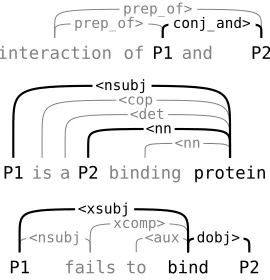
Figure 1: Stanford dependency parses (“collapsed” rep-resentation) where the shortest path, shown in bold, ex-cludes important words.
et al., 2003) and shortest path kernels (Bunescu and Mooney, 2005) have been proposed and suc-cessfully used for relation extraction. However, these methods lack the expressive power to consider representations derived from general, possibly cyclic, dependency graph structures, such as those generated by the Stanford tools. The subsequence kernel approach does not consider parses at all, and the shortest path approach is limited to representing only a single path in the full dependency graph, which excludes relevant words even in many simple cases (Figure 1). Tree kernels can represent more complex structures, but are still restricted to tree representations.
Lately, in the framework of kernel-based machine learning methods there has been an increased in-terest in designing kernel functions for graph data. Building on the work of G¨artner et al. (2003), graph representations tailored for the task of depen-dency parse ranking were proposed by Pahikkala et al. (2006b). Though the proposed representations are not directly applicable to the task of PPI extrac-tion, they offer insight in how to learn from depen-dency graphs. We develop a graph kernel approach for PPI extraction based on these ideas.
We next define a graph representation suitable for describing potential interactions and introduce a ker-nel which makes efficient learning from a general, unrestricted graph representation possible. Then we provide a short description of the sparse regular-ized least squares (sparse RLS) kernel-based ma-chine learning method we use for PPI-extraction.
Further, we rigorously assess our method on five publicly available PPI corpora, providing the first broad cross-corpus evaluation with a machine learn-ing approach to PPI extraction. Finally, we discuss the effects that different evaluation strategies, choice of corpus and applied metrics have on measured per-formance, and conclude.
2 Method
We next present our graph representation, formalize the notion of graph kernels, and present our learning method of choice, the sparse RLS.
2.1 Graph encoding of sentence structure
As in most recent work on machine learning for PPI extraction, we cast the task as learning a decision function that determines for each unordered candi-date pair of protein names occurring together in a sentence whether the two proteins interact. In the following, we first define the graph representation used to represent an interaction candidate pair. We then proceed to derive the kernel used to measure the similarities of these graphs.
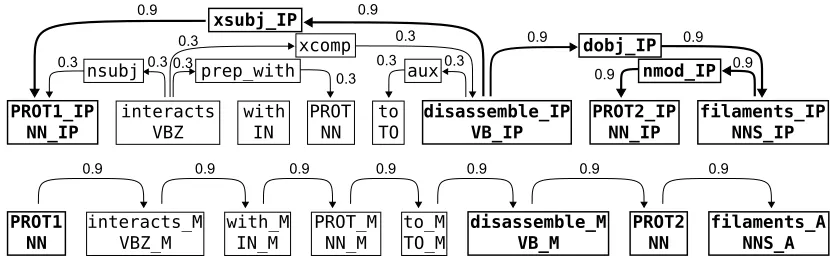
We assume that the input of our learning method is a dependency parse of a sentence where a pair of protein names is marked as the candidate interac-tion for which an extracinterac-tion decision must be made. Based on this, we form a weighted, directed graph that consists of two unconnected subgraphs. One represents the dependency structure of the sentence, and the other the linear order of the words (see Fig-ure 2).
de-Figure 2: Graph representation generated from an example sentence. The candidate interaction pair is marked as PROT1 and PROT2, the third protein is marked as PROT. The shortest path between the proteins is shown in bold. In the dependency based subgraph all nodes in a shortest path are specialized using a post-tag (IP). In the linear order subgraph possible tags are (B)efore, (M)iddle, and (A)fter. For the other two candidate pairs in the sentence, graphs with the same structure but different weights and labels would be generated.
pendent token. The graph thus represents the entire sentence structure.
It is widely acknowledged that the words between the candidate entities or connecting them in a syn-tactic representation are particularly likely to carry information regarding their relationship; (Bunescu and Mooney, 2005) formalize this intuition for de-pendency graphs as the shortest path hypothesis. We apply this insight in two ways in the graph repre-sentation: the labels of the nodes on the shortest undirected paths connecting PROT1 and PROT2 are differentiated from the labels outside the paths us-ing a special tag. Further, the edges are assigned weights; after limited preliminary experiments, we chose a simple weighting scheme where all edges on the shortest paths receive a weight of 0.9 and other edges receive a weight of 0.3. The represen-tation thus allows us to emphasize the shortest path without completely disregarding potentially relevant words outside of the path.
The second subgraph is built from the linear struc-ture of the sentence. For each token, a second ver-tex is created and the labels for the vertices are de-rived from the texts, POS-tags and named entity tag-ging as above. The labels of each word are special-ized to denote whether the word appears before, in-between, or after the protein pair of interest. Each word node is connected by an edge to its succeed-ing word, as determined by sentence order the of the words. Each edge is given the weight 0.9.
2.2 The all-dependency-paths graph kernel
We next formalize the graph representation and present the all-dependency-paths kernel. This ker-nel can be considered as a practical instantiation of the theoretical graph kernel framework introduced by G¨artner et al. (2003). Let V be the set of ver-tices in the graph andLbe the set of possible labels vertices can have. We represent the graph with an adjacency matrix A ∈ R|V|×|V|, whose rows and
columns are indexed by the vertices, and[A]i,j con-tains the weight of the edge connectingvi ∈ V and vj ∈ V if such an edge exists, and zero otherwise. Further, we represent the labels as a label allocation matrix L ∈ R|L|×|V| so that L
i,j = 1 if the j-th vertex has thei-th label andLi,j = 0otherwise. Be-cause only a very small fraction of all the possible labels are ever assigned to any single node, this ma-trix is extremely sparse.
It is well known that when an adjacency matrix is multiplied with itself, each element[A2]i,j contains the summed weight of paths from vertexvito vertex vj through one intervening vertex, that is, paths of length two. Similarly, for any lengthn, the summed weights fromvitovjcan be determined by calculat-ing[An]i,j.
[image:3.612.96.511.54.185.2]the vertices using the Neumann Series, defined as
(I −A)−1 =I+A+A2+...= ∞ X
k=0
Ak
if |A| < 1 where |A| is the spectral radius of A
(Meyer, 2000). From this sum we can form a new adjacency matrix
W = (I−A)−1−I .
The final adjacency matrix contains the summed weights of all possible paths connecting the ver-tices. The identity matrix is subtracted to remove the paths of length zero, which would correspond to self-loops.
Next, we present the graph kernel that utilizes the graph representation defined previously. We define an instance G representing a candidate interaction asG = LW LT, where L andW are the label al-location matrix and the final adjacency matrix cor-responding to the graph representation of the candi-date interaction.
Following G¨artner et al. (2003) the graph kernel is defined as
k(G0, G00) = |L| X
i=1
|L| X
j=1
G0i,jG00i,j,
where G0 andG00 are two instances formed as de-fined previously. The features can be thought as combinations of labels from connected pairs of ver-tices, with a value that represents the strength of their connection. In practical implementations, the fullGmatrices, which consist mostly of zeroes, are never explicitly formed. Rather, only the non-zero elements are stored in memory and used when cal-culating the kernels.
2.3 Scalable learning with Sparse RLS
RLS is a state-of-the-art kernel-based machine learning method which has been shown to have comparable performance to support vector machines (Rifkin et al., 2003). We choose the sparse version of the algorithm, also known as subset of regressors, as it allows us to scale up the method to very large training set sizes. Sparse RLS also has the property that it is possible to perform cross-validation and regularization parameter selection so that their time
complexities are negligible compared to the training complexity. These efficient methods are analogous to the ones proposed by Pahikkala et al. (2006a) for the basic RLS regression.
We now briefly present the basic sparse RLS al-gorithm. Let m denote the training set size and
M = {1, . . . , m}an index set in which the indices refer to the examples in the training set. Instead of allowing functions that can be expressed as a linear combination over the whole training set, as in the case of basic RLS regression, we only allow func-tions of the following restricted type:
f(·) =X
i∈B
aik(·, xi), (1)
wherekis the kernel function, xi are training data points,ai ∈Rare weights, and the set indexing the
basis vectorsB ⊂Mis selected in advance. The co-efficientsai that determine (1) are obtained by min-imizing
m X
i=1
(yi− X
j∈B
ajk(xi, xj))2+λ X
i,j∈B
aiajk(xi, xj),
where the first term is the squared loss function, the second term is the regularizer, andλ∈R+is a reg-ularization parameter. Note that all the training in-stances are used for determining the coefficient vec-tor. The minimizer is obtained by solving the corre-sponding system of linear equations, which can be performed inO(m|B|2)time.
We set the maximum number of basis vectors to 4000 in all experiments in this study. The subset is selected randomly when the training set size ex-ceeds this number. Other methods for the selection of the basis vectors were considered by Rifkin et al. (2003), who however reported that the random selection worked as well as the more sophisticated approaches.
3 Experimental evaluation
Statistics Graph Kernel Co-occ.
Corpus #POS. #NEG. P R F σF AUC σAU C P F
AIMed 1000 4834 0.529 0.618 0.564 0.050 0.848 0.023 0.178 0.301
BioInfer 1370 8924 0.477 0.599 0.529 0.053 0.849 0.065 0.135 0.237
HPRD50 163 270 0.643 0.658 0.634 0.114 0.797 0.063 0.389 0.554
IEPA 335 482 0.696 0.827 0.751 0.070 0.851 0.051 0.408 0.576
[image:5.612.89.525.54.151.2]LLL 164 166 0.725 0.872 0.768 0.178 0.834 0.122 0.559 0.703
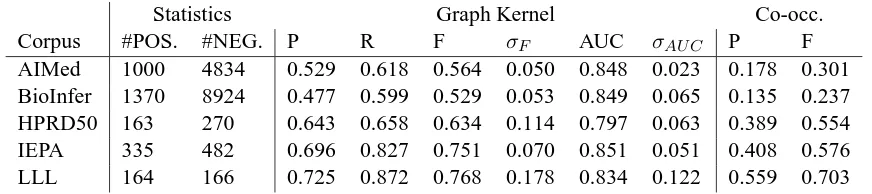
Table 1: Counts of positive and negative examples in the corpora and (P)recision, (R)ecall (F)-score and AUC for the graph kernel, with standard deviations provided for F and AUC.
3.1 Corpora and evaluation criteria
We evaluate our method using five publicly avail-able corpora that contain PPI interaction annotation: AImed (Bunescu et al., 2005), BioInfer (Pyysalo et al., 2007a), HPRD50 (Fundel et al., 2007), IEPA (Ding et al., 2002) and LLL (N´edellec, 2005). All the corpora were processed to a common format us-ing transformations1 that we have introduced ear-lier (Pyysalo et al., 2008). We parse these cor-pora with the Charniak-Lease parser (Charniak and Lease, 2005), which has been found to perform best among a number of parsers tested in recent domain evaluations (Clegg and Shepherd, 2007; Pyysalo et al., 2007b). The Charniak-Lease phrase structure parses are transformed into the collapsed Stanford dependency scheme using the Stanford tools (de Marneffe et al., 2006). We cast the PPI extraction task as binary classification, where protein pairs that are stated to interact are positive examples and other co-occuring pairs negative. Thus, from each sen-tence, n2
examples are generated, wheren is the number of occurrences of protein names in the sen-tence. Finally, we form the graph representation de-scribed earlier for each candidate interaction.
We evaluate the method with 10-fold document-level cross-validation on all of the corpora. This guarantees the maximal use of the available data, and also allows comparison to relevant earlier work. In particular, on the AImed corpus we apply the ex-act same 10-fold split that was used by Bunescu et al. (2006) and Giuliano et al. (2006). Performance is measured according to the following criteria: in-teractions are considered untyped, undirected pair-wise relations between specific protein mentions, that is, if the same protein name occurs multiple
1Available athttp://mars.cs.utu.fi/PPICorpora.
times in a sentence, the correct interactions must be extracted for each occurrence. Further, we do not consider self-interactions as candidates and remove them from the corpora prior to evaluation.
The majority of PPI extraction system evaluations use the balanced F-score measure for quantifying the performance of the systems. This metric is defined asF = p2+prr, wherepis precision andrrecall. Like-wise, we provide F-score, precision, and recall val-ues in our evaluation. It should be noted that F-score is very sensitive to the underlying positive/negative pair distribution of the corpus — a property whose impact on evaluation is discussed in detail below. As an alternative to F-score, we also evaluate the per-formance of our system using the area under the re-ceiver operating characteristics curve (AUC) mea-sure (Hanley and McNeil, 1982). AUC has the im-portant property that it is invariant to the class dis-tribution of the used dataset. Due to this and other beneficial properties for comparative evaluation, the usage of AUC for performance evaluation has been recently advocated in the machine learning commu-nity (see e.g. (Bradley, 1997)). Formally, AUC can be defined as
AU C =
Pm+
i=1
Pm−
j=1H(xi−yi)
m+m−
,
where m+ and m− are the numbers of positive
and negative examples, respectively, andx1,...,xm+
are the outputs of the system for the positive, and
y1,...,ym−for the negative examples, and
H(r) =
1, ifr >0 0.5, ifr = 0 0, otherwise.
ex-ample, the system will be able to correctly disin-guish which one is which.
3.2 Performance across corpora
The performance of our method on the five corpora for the various metrics is presented in Table 1. For reference, we show also the performance of the co-occurrence (or all-true) baseline, which simply as-signs each candidate into the interaction class. The recall of the co-occurrence method is trivially 100%, and in terms of AUC it has a score of 0.5, the ran-dom baseline. All the numbers in Table 1 are aver-ages taken over the ten folds. One should note that because of the non-linearity of the F-score measure, the average precision and recall will not produce ex-actly the average F.
The results hold several interesting findings. First, we briefly observe that on the AImed corpus, which has recently been applied in numerous evaluations (Sætre et al., 2008) and can be seen as an emerging de facto standard for PPI extraction method evalua-tion, the method achieves an F-score performance of 56.4%. As we argue in more detail below, this level of performance is comparable to the state-of-the-art in machine learning based PPI extraction. For the other large corpus, BioInfer, F-score performance is slightly lower.
Second, we observe that the F-score performance of the method varies strikingly between the differ-ent corpora, with results on IEPA and LLL approx-imately 20 percentage units higher than on AImed and BioInfer, despite the larger size of the latter two. In our previous work we have observed similar re-sults with a rule-based extraction method (Pyysalo et al., 2008). As the first broad cross-corpus evaluation using a state-of-the-art machine learning method for PPI extraction, our results support and extend the key finding that F-score performance results mea-sured on different corpora cannot, in general, be meaningfully compared.
The co-occurrence baseline numbers indicate one reason for the high F-score variance between the corpora. The F-score metric is not invariant to the distribution of positive and negative examples: for example, halving the number of negative test exam-ples is expected to approximately halve the number of false positives at a given recall point. Thus, the greater the fraction of true interactions in a corpus
is, the easier it is to reach high performance in terms of F-score. This is reflected in co-occurrence re-sults, which range from 24% to 70% depending on the class distribution of the corpus.
This is a critical weakness of the F-score metric in cross-corpus comparisons as, for example, the frac-tion of true interacfrac-tions out of all candidates is 50% on the LLL corpus but only 17% on AImed. By contrast to the large differences in performance mea-sured using F-score, we find that for the distribution-invariant AUC measure the performance for all of the AImed, BioInfer, IEPA, and LLL corpora falls in the narrow range of 83-85%. In terms of AUC, per-formance on the HPRD50 corpus is an outlier, being approximately three percentage units lower than for any other corpus. Nevertheless, the results provide a strong argument in favor of applying the AUC met-ric instead of, or in addition to, F-score. AUC is also more stable in terms of variance.
Finally, we note that the similar performance in terms of AUC for corpora with as widely differing sizes as LLL and BioInfer indicates that past a rel-atively modest number of examples, increasing cor-pus size has a surprisingly small effect on the perfor-mance of the method. A similar finding can be seen, for example, in the relatively flat learning curve of Giuliano et al. (2006). While the issue requires fur-ther investigation, these results suggest that fur-there may be more value in investing effort in develop-ing better learndevelop-ing methods as opposed to larger cor-pora.
3.3 Performance compared to other methods
We next discuss the performance of our method compared to other methods introduced in the liter-ature and the challenges of meaningful comparison, where we identify three major issues.
knowl-P R F
(Giuliano et al., 2006) 60.9% 57.2% 59.0%
All-dependency-paths graph kernel 52.9% 61.8% 56.4%
(Bunescu and Mooney, 2006) 65.0% 46.4% 54.2%
(Sætre et al., 2008) 64.3% 44.1% 52.0%
(Mitsumori et al., 2006) 54.2% 42.6% 47.7%
(Yakushiji et al., 2005) 33.7% 33.1% 33.4%
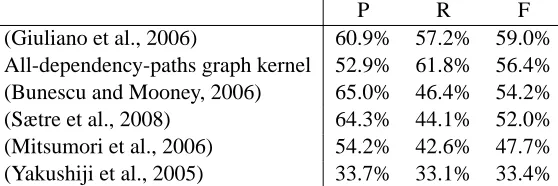
Table 2: (P)recision, (R)ecall and (F)-score results for methods evaluated on AImed with the correct cross-validation methodology.
edge, the first to report machine learning method performance on BioInfer, we will focus on AImed in the following comparison.
Second, the cross-validation strategy used in eval-uation has a large impact on measured performance. In earlier system evaluations, two major strategies for defining the splits used in cross-validation can be observed. The approach used by Bunescu and Mooney (2006), which we consider the correct one, is to split the data into folds on level of docu-ments. This guarantees that all pairs generated from the same document are always either in the train-ing set or in the test set. Another approach is to pool all the generated pairs together, and then ran-domly split them to folds. To illustrate the signifi-cance of this choice, consider two interaction candi-dates extracted from the same sentence, e.g. from a statement of the form “P1 and P2 [. . . ] P3”,
where “[. . . ]” is any statement of interaction or non-interaction. Due to the near-identity of contexts, a machine learning method will easily learn to predict that the label of the pair(P1, P2)should match that
of(P1, P3). However, such “learning” will clearly
not generalize. This approach must thus be consid-ered invalid, because allowing pairs generated from same sentences to appear in different folds leads to an information leak between the training and test sets. Sætre et al. (2008) observed that adopting the latter cross-validation strategy on AImed could lead up to 18 F-score percentage unit overestimation of performance. For this reason, we will not consider results listed in the “False 10-fold cross-validation” table (2b) of Sætre et al. (2008).
With these restrictions in place, we now turn to comparison with relevant results reported in related research, summarized in Table 2. We note that Bunescu and Mooney (2006) only applied
evalua-tion criteria where it is enough to extract only one occurrence of each mention of an interaction from each abstract, while the other results shown were evaluated using the same criteria as applied here. The former approach can produce higher perfor-mance: the evaluation of Giuliano et al. (2006) in-cludes both alternatives, and their method achieves an F-score of 63.9% under the former criterion, which they term One Answer per Relation in a given Document (OARD). Our method outperforms most studies using similar evaluation methodology, with the exception being the approach of Giuliano et al. (2006). This result is somewhat surprising, as the method proposed by Giuliano does not ap-ply any form of parsing but relies instead only on the sequential order of the words. This brings us to our third point regarding comparability of meth-ods. As pointed out by Sætre et al. (2008), the AImed corpus allows remarkably different “inter-pretations” regarding the number of interacting and non-interacting pairs. For example, where we have identified 1000 interacting and 4834 non-interacting protein pairs in AImed, in the data used by Giuliano there are eight more interacting and 200 fewer non-interacting pairs. The corpus can also be prepro-cessed in a number of ways. In particular we noticed that whereas protein names are always blinded in our data, in the data used by Giuliano protein names are sometimes partly left visible. As Giuliano has gen-erously made his method implementation available2, we were able to test the performance of his system on the data we used in our experiments. This re-sulted in an F-score of 52.4%.
Finally, there remains an issue of parameter se-lection. For sparse RLS the values of the
regular-2
[image:7.612.167.446.56.149.2]ization parameterλand the decision threshold sep-arating the positive and negative classes must be chosen, which can be problematic when no sepa-rate data for choosing them is available. Choos-ing from several parameter values the ones that give best results in testing, or picking the best point from a precision/recall curve when evaluating in terms of F-score, will lead to an overoptimistic eval-uation of performance. This issue has often not been addressed in earlier evaluations that do cross-validation on a whole corpus. We choose the pa-rameters by doing further leave-one-document-out cross-validation within each round of 10-fold-cross-validation, on the nine folds that constitute the train-ing set.
As a conclusion, we observe the results achieved with the all-dependency-paths kernel to be state-of-the-art level. However, differences in evaluation strategies and the large variance exhibited in the re-sults make it impossible to state which of the sys-tems considered can be expected in general to per-form best. We encourage future PPI-system evalua-tions to report AUC and F-score results over mul-tiple corpora, following clearly defined evaluation strategies, to bring further clarity to this issue.
4 Conclusions and future work
In this paper we have proposed a graph kernel approach to extracting protein-protein interactions, which captures the information in unrestricted de-pendency graphs to a format that kernel based learn-ing algorithms can process. The method combines syntactic analysis with a representation of the lin-ear order of the sentence, and considers all possi-ble paths connecting any two vertices in the result-ing graph. We demonstrate state-of-the art perfor-mance for the approach. All software developed in the course of this study is made publicly available at
http://mars.cs.utu.fi/PPICorpora. We identify a number of issues which make re-sults achieved with different evaluation strategies and resources incomparable, or even incorrect. In our experimental design we consider the problems related to differences across corpora, the effects dif-ferent cross-validation strategies have, and how pa-rameter selection can be done. Our recommendation is to provide evaluations over different corpora, to
use document-level cross-validation and to always selected parameters on the training set.
We draw attention to the behaviour of the F-score metric over corpora with differing pair distributions. The higher the relative frequency of interacting pairs is, the higher the performance can be expected to be. This is noticed both for the graph kernel method and for the naive co-occurrence baseline. Indeed, the strategy of just stating that all pairs interact leads to as high result as 70% F-score on one of the cor-pora. We consider AUC as an alternative measure that does not exhibit such behaviour, as it is invari-ant to the distribution of pairs. The AUC metric is much more stable across all the corpora, and never gives better results than random for approaches such as the naive co-occurrence.
Though we only consider binary interactions in this work, the graph representations have the prop-erty that they could be used to represent more com-plex structures than pairs. The availability of cor-pora that annotate complex interactions, such as the full BioInfer and GENIA, makes training a PPI ex-traction system for extracting complex interactions an important avenue of future research. However, how to avoid the combinatorial explosion following from considering triplets, quartets etc. remains an open question. Also, the performance of the cur-rent approaches may need to be yet improved before extending them to recognize complex interactions.
Acknowledgements
We would like to thank Razvan Bunescu, Claudio Giuliano and Rune Sætre for their generous assis-tance in providing us with data, software and infor-mation about their work on PPI extraction. Further, we thank CSC, the Finnish IT center for science, for providing us extensive computational resources. This work has been supported by the Academy of Finland and the Finnish Funding Agency for Tech-nology and Innovation, Tekes.
References
Andrew P. Bradley. 1997. The use of the area under the ROC curve in the evaluation of machine learning algorithms. Pattern Recognition, 30(7):1145–1159. Razvan Bunescu and Raymond Mooney. 2005. A
short-est path dependency kernel for relation extraction. In
Razvan Bunescu and Raymond Mooney. 2006. Subse-quence kernels for relation extraction. In Proceedings
of NIPS’05, pages 171–178. MIT Press.
Razvan C. Bunescu, Ruifang Ge, Rohit J. Kate, Ed-ward M. Marcotte, Raymond J. Mooney, Arun Ku-mar Ramani, and Yuk Wah Wong. 2005. Compar-ative experiments on learning information extractors for proteins and their interactions. Artif Intell Med, 33(2):139–155.
Eugene Charniak and Matthew Lease. 2005. Parsing biomedical literature. In Proceedings of IJCNLP’05, pages 58–69.
Andrew Brian Clegg and Adrian Shepherd. 2007. Benchmarking natural-language parsers for biological applications using dependency graphs. BMC
Bioinfor-matics, 8(1):24.
Marie-Catherine de Marneffe, Bill MacCartney, and Christopher D. Manning. 2006. Generating typed de-pendency parses from phrase structure parses. In
Pro-ceedings of LREC’06, pages 449–454.
J. Ding, D. Berleant, D. Nettleton, and E. Wurtele. 2002. Mining MEDLINE: abstracts, sentences, or phrases? In Proceedings of PSB’02, pages 326–337.
Katrin Fundel, Robert Kuffner, and Ralf Zimmer. 2007. RelEx–Relation extraction using dependency parse trees. Bioinformatics, 23(3):365–371.
Thomas G¨artner, Peter A. Flach, and Stefan Wrobel. 2003. On graph kernels: Hardness results and efficient alternatives. In COLT’03, pages 129–143. Springer. Claudio Giuliano, Alberto Lavelli, and Lorenza Romano.
2006. Exploiting shallow linguistic information for re-lation extraction from biomedical literature. In
Pro-ceedings of EACL’06.
James A. Hanley and B. J. McNeil. 1982. The meaning and use of the area under a receiver operating charac-teristic (roc) curve. Radiology, 143(1):29–36.
Lawrence Hunter, Zhiyong Lu, James Firby, William A. Baumgartner, Helen L Johnson, Philip V. Ogren, and K. Bretonnel Cohen. 2008. OpenDMAP: An open-source, ontology-driven concept analysis engine, with applications to capturing knowledge regarding protein transport, protein interactions and cell-specific gene expression. BMC Bioinformatics, 9(78).
Jin-Dong Kim, Tomoko Ohta, and Jun’ichi Tsujii. 2008. Corpus annotation for mining biomedical events from literature. BMC Bioinformatics, 9(10).
Carl D. Meyer. 2000. Matrix analysis and applied linear
algebra. Society for Industrial and Applied
Mathe-matics.
Tomohiro Mitsumori, Masaki Murata, Yasushi Fukuda, Kouichi Doi, and Hirohumi Doi. 2006. Extracting protein-protein interaction information from biomed-ical text with svm. IEICE - Trans. Inf. Syst., E89-D(8):2464–2466.
Claire N´edellec. 2005. Learning language in logic -genic interaction extraction challenge. In Proceedings
of LLL’05.
Tapio Pahikkala, Jorma Boberg, and Tapio Salakoski. 2006a. Fast n-fold cross-validation for regularized least-squares. In Proceedings of SCAI’06, pages 83– 90.
Tapio Pahikkala, Evgeni Tsivtsivadze, Jorma Boberg, and Tapio Salakoski. 2006b. Graph kernels versus graph representations: a case study in parse ranking. In
Pro-ceedings of the ECML/PKDD’06 workshop on Mining and Learning with Graphs.
Sampo Pyysalo, Filip Ginter, Juho Heimonen, Jari Bj¨orne, Jorma Boberg, Jouni J¨arvinen, and Tapio Salakoski. 2007a. BioInfer: A corpus for information extraction in the biomedical domain. BMC
Bioinfor-matics, 8(50).
Sampo Pyysalo, Filip Ginter, Veronika Laippala, Ka-tri Haverinen, Juho Heimonen, and Tapio Salakoski. 2007b. On the unification of syntactic annotations un-der the stanford dependency scheme: A case study on BioInfer and GENIA. In Proceedings of BioNLP’07, pages 25–32.
Sampo Pyysalo, Antti Airola, Juho Heimonen, Jari Bj¨orne, Filip Ginter, and Tapio Salakoski. 2008. Comparative analysis of five protein-protein interac-tion corpora. BMC Bioinformatics, special issue,
9(Suppl 3):S6.
Ryan Rifkin, Gene Yeo, and Tomaso Poggio, 2003.
Reg-ularized Least-squares Classification, volume 190 of NATO Science Series III: Computer and System Sci-ences, chapter 7, pages 131–154. IOS Press.
Rune Sætre, Kenji Sagae, and Jun’ichi Tsujii. 2008. Syn-tactic features for protein-protein interaction extrac-tion. In Proceedings of LBM’07, volume 319, pages 6.1–6.14.
Akane Yakushiji, Yusuke Miyao, Yuka Tateisi, and Jun’ichi Tsujii. 2005. Biomedical information ex-traction with predicate-argument structure patterns. In
Proceedings of SMBM’05, pages 60–69.