Semantic Chunk Annotation for complex questions using Conditional
Random Field
Shixi Fan
Department
of computer science
Harbin
Institute of Technology
Shenzhen Graduate School,
Shenzhen
,518055
, china
fanshixi
@hit.edu.cn
Yaoyun Zhang
Department
of computer science
Harbin
Institute of Technology
Shenzhen Graduate School,
Shenzhen
,518055
, china
Xiaoni5122
@gmail.com
Wing W. Y. Ng
Department
of computer science
Harbin
Institute of Technology
Shenzhen Graduate School,
Shenzhen
,518055
, china
wing
@hitsz.edu.cn
Xuan Wang
Department
of computer science
Harbin
Institute of Technology
Shenzhen Graduate School,
Shenzhen
,518055
, china
wangxuan
@insun.hit.edu.cn
Xiaolong Wang
Department
of computer science
Harbin
Institute of Technology
Shenzhen Graduate School,
Shenzhen
,518055
, china
wangxl
@insun.hit.edu.cn
Abstract
This paper presents a CRF (Conditional Random Field) model for Semantic Chunk Annotation in a Chinese Question and Answering System (SCACQA). The model was derived from a corpus of real world questions, which are collected from some discussion groups on the Internet. The questions are supposed to be answered by other people, so some of the questions are very complex. Mutual information was adopted for feature se-lection. The training data collection con-sists of 14000 sentences and the testing data collection consists of 4000 sentences. The result shows an F-score of 93.07%.
© 2008. Licensed under the Creative Commons
Attri-bution-Noncommercial-Share Alike 3.0 Unported
license ( http://creativecommons.org/licenses/by-nc-sa/3.0/). Some rights reserved.
1
Introduction
1.1 Introduction of Q&A System
Automated question answering has been a hot topic of research and development since the ear-liest AI applications (A.M. Turing, 1950). Since then there has been a continual interest in proc-essing knowledge and retrieving it efficiently to users automatically. The end of the 1980s saw a boost in information retrieval technologies and applications, with an unprecedented growth in the amount of digital information available, an explosion of growth in the use of computers for communications, and the increasing number of users that have access to all this information (Diego Moll′and Jose′Luis Vicedo, 2007). Search engines such as Google, Yahoo, Baidu and etc have made a great success for people’s information need.
Anyhow, search engines are keywords-based which can only return links of relevant web pages, failing to provide a friendly user-interface with queries expressed in natural language sen-tences or questions, or to return precise answers to users. Especially from the end of the 1990s, as
information retrieval technologies and method-ologies became mature and grew more slowly in pace, automated question answering(Q&A) sys-tems which accept questions in free natural lan-guage formations and return exactly the answer or a short paragraph containing relevant informa-tion has become an urgent necessity. Major in-ternational evaluations such as TREC, CLEFand NTCIR have attracted the participation of many powerful systems.
The architecture of a Q&A system generally in-cludes three modules: question processing, can-didate answer/document retrieval, and answer extraction and re-ranking.
1.2 Introduction of Question Analyzing Question Analyzing, as the premise and founda-tion of the latter two modules, is of paramount importance to the integrated performance of a Q&A system. The reason is quite intuitive: a question contains all the information to retrieve the corresponding answer. Misinterpretation or too much loss of information during the process-ing will inevitably lead to poor precision of the system.
The early research efforts and evaluations in Q&A were focused mainly on factoid questions asking for named entities, such as time, numbers, and locations and so on. The questions in the test corpus of TREC and other organizations are also in short and simple form. Complex hierarchy in question types (Dragomir Radev et al, 2001), question templates (Min-Yuh Day et al, 2005), question parsing (Ulf Hermjakob, 2001) and various machine learning methods (Dell Zhang and Wee Sun Lee, 2003)are used for factoid question analysis, aiming to find what named entity is asked in the question. There are some questions which are very complicated or even need domain restricted knowledge and reasoning technique. Automatic Q&A system can not deal with such questions with current technique. In china, there is a new kind of web based Q&A system which is a special kind of discussion group. Unlike common discussion group, in the web based Q&A system one user posts a ques-tion, other users can give answers to it. It is found that at least 50% percent questions (Valentin Jijkoun and Maarten de Rijke, 2005)posted by users are non-factoid and surely more complicated both in question pattern and information need than those questions in the test set of TREC and other FAQ. An example is as follows:
This kind of Q&A system can complement the search engines effectively. As the best search engines in china, Baidu open the Baidu Knowl-edge2 Q&A system from 2003, and now it has more than 29 million question-answer pairs. There are also many other systems of this kind such as Google Groups, Yahoo Answers and Sina Knowledge3. This kind of system is a big question-answer pair database which can be treated as a FAQ database. How to search from the database and how to analyze the questions in the database needs new methods and techniques. More deeper and precise capture of the semantics in those complex questions is required. This phe-nomenon has also been noticed by some re-searchers and organizations. The spotlight gradu-ally shifted to the processing and semantic un-derstanding of complex questions. From 2006, TREC launched a new annually evaluation CIQ&A (complex, interactive Question Answer-ing), aiming to promote the development of in-teractive systems capable of addressing complex information needs. The targets of national pro-grams AQUAINT and QUETAL are all at new interface and new enhancements to current state-of-the-art Q&A systems to handle more complex inputs and situations.
A few researchers and institutions serve as pio-neers in complex questions study. Different tech-nologies, such as definitions of different sets of question types, templates and sentence patterns (Noriko Tomuro, 2003) (Hyo-Jung Oh et al, 2005) machine learning methods (Radu Soricut and Eric Brill, 2004), language translation model (Jiwoon Jeon, W et al, 2005), composition of information needs of the complex question (Sanda Harabagiu et al, 2006) and so on, have been experimented on the processing of complex question, gearing the acquired information to the facility of other Q&A modules.
Several major problems faced now by researcher of complex questions are stated as follow:
First: Unlike factoid questions, it is very dif-ficult to define a comprehensive type hierarchy for complex questions. Different domains under research may require definitions of different sets of question types, as shown in (Hyo-Jung Oh et al, 2005). Especially, the types of certain
tions are ambiguous and hard to identify. For example:
This question type can be treated as definition, procedure or entity.
Second: Lack of recognition of different seman-tic chunks and the relations between them. FAQFinder (Radu Soricut and Eric Brill, 2004) also used semantic measure to credit the similar-ity between different questions. Nevertheless, the question similarity is only a simple summation of the semantic similarity between words from the two question sentences. Question pattern are very useful and easy to implement, as justified by pre-vious work. However, just like the problem with question types, question patterns have limitation on the coverage of all the variations of complex question formation. Currently, after the question processing step in most systems, the semantic meaning of large part of complex questions still remain vague. Besides, confining user’s input only within the selection of provided pattern may lead to unfriendly and unwelcome user interface. (Ingrid Zukerman and Eric Horvitz, 2001) used decision tree to model and recognize the infor-mation need, question and answer coverage, topic, focus and restrictions of a question. Al-though features employed in the experiments were described in detail, no selection process of those feature, or comparison between them was mentioned.
This paper presents a general method for Chinese question analyzing. Our goal is to annotate the semantic chunks for the question automatically.
2
Semantic Chunk Annotation
Chinese language differs a lot from English in many aspects. Mature methodologies and fea-tures well-justified in English Q&A systems are valuable sources of reference, but no direct copy is possible.
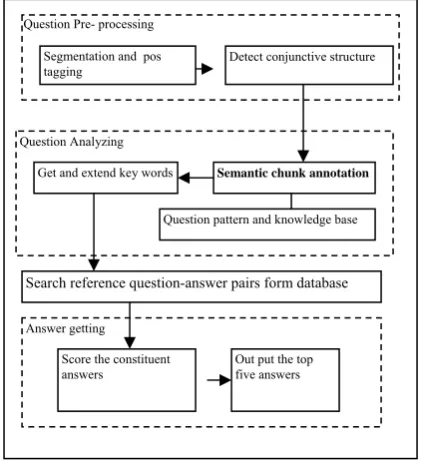
The Ask-Answer system4 is a Chinese online Q&A system where people can ask and answer questions like other web based Q&A system. The characteristic of this system is that it can give the answer automatically by searching from the asked question database when a new question is presented by people. The architecture of the automatically answer system is shown in figure 1. The system contains a list of question-answer pairs on particular subject. When users input a
4 http://haitianyuan.com/qa
question from the web pages, the question is submitted to the system and then question-answer pair is returned by searching from the questions asked before. The system includes four main parts: question pre-processing, question analyzing, searching and answer getting.
The question pre-processing part will segment the input questions into words, label POS tags for every word. Sometimes people ask two or more questions at one time, the questions should be made into simple forms by conjunctive struc-ture detection. The question analyzing program will find out the question type, topic, focus and etc. The answer getting part will get the answer by computing the similarity between the input question and the questions asked before. The question analyzing part annotates the semantic chunks for the question. So that the question can be mapped into semantic space and the question similarity can be computed semantically. The Semantic chunk annotation is the most important part of the system.
Question Pre- processing
Segmentation and pos tagging
Detect conjunctive structure
Question Analyzing
Semantic chunk annotation
Get and extend key words
Question pattern and knowledge base
Search reference question-answer pairs form database
Answer getting
Score the constituent
answers Out put the top five answers
Figure 1 the architecture of the automatically answer system
question which is the topic or subject asked is the most important semantic chunk. The focus of a question is the asking point of the question. The restriction information can restrict the question’s information need and the answers. The rubbish information is those words in the question that has no semantic meanings for the question. Inter-rogative information is a semantic tag set which corresponds to the question type. The interroga-tive information includes interrogainterroga-tive words, some special verbs and nouns words and all these words together determine the question type. The semantic chunk information is shown in table 1.
Semantic chunk tag
Abbreviation Meaning
Topic T The question subject
Focus F The additional information
of topic
Restrict Re Such as Time restriction and
location restriction Rubbish
information
Ru Words no meaning for the
question
Other O other information without
semantic meaning The following is interrogative information Quantity Wqua
Description Wdes The answer need description
Yes/No Wyes The answer should be yes or
no
List Wlis The answer should be a list
of entity
Definition Wdef The answer is the definition of topic
Location Wloc The answer is location
Reason Wrea The answer can explain the
question
Contrast Wcon The answer is the
compari-son of the items proposed in the question
People Wwho The answer is about the
people’s information
Choice Wcho The answer is one of the
choice proposed in the ques-tion
Time Wtim The answer is the data or
time length about the event in the question
Entity Went The answer is the attribute
of the topic.
Table 1: Semantic chunks
An annotation example question is as follows:
This question can be annotated as follows:
This kind of annotation is not convenient for CRF model, so the tags were transfer into the B I O form. (Shown as follows)
Then the Semantic chunk annotation can be treated as a sequence tag problem.
3
Semantic Chunk Annotation model
3.1 Overview of the CRF model The conditional random field (CRF) is a dis-criminative probabilistic model proposed by John Lafferty, et al (2001) to overcome the long-range dependencies problems associated with genera-tive models. CRF was originally designed to la-bel and segment sequences of observations, but can be used more generally. Let X, Y be random variables over observed data sequences and cor-responding label sequences, respectively. For simplicity of descriptions, we assume that the random variable sequences X and Y have the same length, and use x=
[
x1,x2...xm]
andy=[
y1,y2...ym]
to represent instances of X and Y, respectively. CRF defines the condi-tional probability distribution P(Y |X) of label sequences given observation sequences as fol-lowsWhere is the normalizing factor that ensures equation 2.
)
is a feature function (often valued) that becomes positive (one for binary-valued feature function) when X contains a cer-tain feature in a cercer-tain position and Y takes a certain label, and becomes zero otherwise. Unlike Maximum Entropy model which use sin-gle normalization constant to yield a joint distri-bution, CRFs use the observation-dependent normalization for conditional distribu-tions. So CRFs can avoid the label biased prob-lem. Given a set of training data
determines the model parameters
λ
={λ
i}by maximizing the log-likelihood of the training set)
3.2 Features for the model
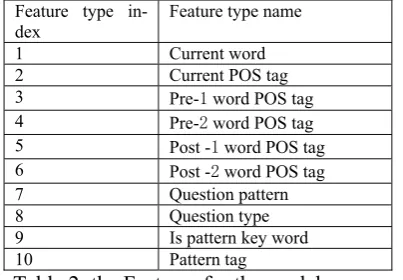
The following features, which are used for train-ing the CRF model, are selected accordtrain-ing to the empirical observation and some semantic mean-ings. These features are listed in the following table.
Feature type
in-dex Feature type name
1 Current word
7 Question pattern
8 Question type
9 Is pattern key word
10 Pattern tag
Table 2: the Features for the model Current word:
The current word should be considered when adding semantic tag for it. But there are too many words in Chinese language and only part of them will contribute to the performance, a set of words was selected. The word set includes segment note and some key words such as time key word and rubbish key word. When the cur-rent word is in the word set the current word fea-ture is the current word itself, and null on the other hand.
Current POS tag:
Current POS tag is the part of speech tag for the current word.
Pre-1 word POS tag:
Pre- 1 word POS tag is the POS tag of the first word before the labeling word in the sentence. If the Pre-1 word does not exit (the current is the first word in the sentence), the Pre- 1 word POS tag is set to null.
Pre-2 word POS tag:
Pre- 2 word POS tag is the POS tag of the second word before the labeling word in the sentence. If the Pre-2 word does not exit, the Pre- 2 word POS tag is set to null.
Post -1 word POS tag:
Post - 1 word POS tag is the POS tag of the first word after the labeling word in the sentence. If the Post -1 word does not exit (the current is the first word in the sentence), the Post - 1 word POS tag is set to null.
Post -2 word POS tag:
Post - 2 word POS tag is the POS tag of the sec-ond word after the labeling word in the sentence. If the Post-2 word does not exit, the Pre- 2 word POS tag is set to null.
Question pattern:
Question pattern which is associated with ques-tion type, can locate quesques-tion topic, quesques-tion fo-cus by surface string matching. For example, (where is <topic>). The patterns are extracted from the training data automatically. When a pat-tern is matched, it is treated as a feature. There are 1083 question patterns collected manually. Question type:
Question type is an important feature for ques-tion analyzing. The quesques-tion patterns have the ability of deciding the question type. If there is no question pattern matching the question, the question type is defined by a decision tree algo-rithm.
Is pattern key word:
For each question pattern, there are some key words. When the current word belongs to the pattern key word this feature is set to “yes”, else it is set to “no”.
Pattern tag:
When a pattern is matched, the topic, focus and restriction can be identified by the pattern. We can give out the tags for the question and the tags are treated as features. If there is no pattern is matched, the feature is set to null.
4
Feature Selection experiment
Feature selection is important in classifying sys-tems such as neural networks (NNs), Maximum Entropy, Conditional Random Field and etc. The problem of feature selection has been tackled by many researchers. Principal component analysis (PCA) method and Rough Set Method are often used for feature selection. Recent years, mutual information has received more attention for fea-ture selection problem.
According to the information theory, the uncer-tainty of a random variable X can be measured by its entropy . For a classifying problem, there are class label set represented by C and fea-ture set represented by F. The conditional en-tropy measures the uncertainty about
C when F is known, and the Mutual information The feature set is known; so that the objective of training the model is to minimize the conditional entropy equally maximize the mutual information . In the feature set F, some features are irrelevant or redundant. So that the goal of a feature selection problem is to find a feature S ( ), which achieve the higher values of . The set S is a subset of F and its size should be as small as possible. There are some algorithms for feature selection problem. The ideal greedy selection algorithm using mu-tual information is realized as follows (Nojun Kwak and Chong-Ho Choi, 2002):
)
Output: a small reduced feature set S which is equivalent to F
Step 1: calculate the MI with the Class setC,∀fi∈F , compute I(C;fi)
Step 2: select the feature that maximizes , set
Step 3: repeat until desired number of features are selected.
1) Calculate the MI with the Class set C and S, F
fi∈
∀ , compute I(C;S,fi)
2) Select the feature that maximizes , set
Step 4: Output the set S that contains the se-lected features
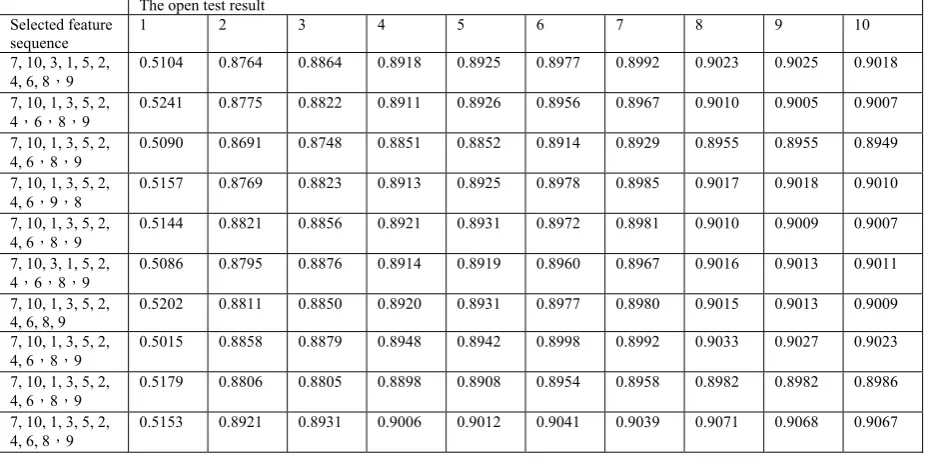
To calculate MI the PDFs (Probability Distribu-tion FuncDistribu-tions) are required. When features and classing types are dispersing, the probability can be calculated statistically. In our system, the PDFs are got from the training corpus statistically. The training corpus contains 14000 sentences. The training corpus was divided into 10 parts, with each part 1400 sentences. And each part is divided into working set and checking set. The working set, which contains 90% percent data, was used to select feature by MI algorithm. The checking set, which contains 10% percent data, was used to test the performance of the selected feature sequence. When the feature sequence was selected by the MI algorithm, a sequence of CRF models was trained by adding one feature at each time. The checking data was used to test the per-formance of these models.
The open test result Selected feature
sequence
1 2 3 4 5 6 7 8 9 10
7, 10, 3, 1, 5, 2, 4, 6, 8,9
0.5104 0.8764 0.8864 0.8918 0.8925 0.8977 0.8992 0.9023 0.9025 0.9018
7, 10, 1, 3, 5, 2, 4,6,8,9
0.5241 0.8775 0.8822 0.8911 0.8926 0.8956 0.8967 0.9010 0.9005 0.9007
7, 10, 1, 3, 5, 2, 4, 6,8,9
0.5090 0.8691 0.8748 0.8851 0.8852 0.8914 0.8929 0.8955 0.8955 0.8949
7, 10, 1, 3, 5, 2, 4, 6,9,8
0.5157 0.8769 0.8823 0.8913 0.8925 0.8978 0.8985 0.9017 0.9018 0.9010
7, 10, 1, 3, 5, 2, 4, 6,8,9
0.5144 0.8821 0.8856 0.8921 0.8931 0.8972 0.8981 0.9010 0.9009 0.9007
7, 10, 3, 1, 5, 2, 4,6,8,9
0.5086 0.8795 0.8876 0.8914 0.8919 0.8960 0.8967 0.9016 0.9013 0.9011
7, 10, 1, 3, 5, 2, 4, 6, 8, 9
0.5202 0.8811 0.8850 0.8920 0.8931 0.8977 0.8980 0.9015 0.9013 0.9009
7, 10, 1, 3, 5, 2, 4, 6,8,9
0.5015 0.8858 0.8879 0.8948 0.8942 0.8998 0.8992 0.9033 0.9027 0.9023
7, 10, 1, 3, 5, 2, 4, 6,8,9
0.5179 0.8806 0.8805 0.8898 0.8908 0.8954 0.8958 0.8982 0.8982 0.8986
7, 10, 1, 3, 5, 2, 4, 6, 8,9
0.5153 0.8921 0.8931 0.9006 0.9012 0.9041 0.9039 0.9071 0.9068 0.9067
Table 3: the feature selection result and the test result
In table 3, each row contains data corresponding to one part of the training corpus so there are ten rows with data in the table. The third row sponds to the first part and the last row corre-sponds to the tenth part. There are eleven col-umns in the table, the first colcol-umns is the
clear that the feature 7(Question pattern) and 10(Pattern tag) are very important, while the fea-ture 8(Question type) and 9(Is pattern key word) are not necessary. The explanation about this phenomenon is that the “pattern key word” and “Question type” information can be covered by the Question patterns. So feature 8 and 9 are not used in the Conditional Random Field model.
5
Semantic Chunk Annotation
Experi-ment
The test and training data used in our system are collected from the website (Baidu knowledge and the Ask-Answer system), where people pro-posed questions and answers. The training data consists of 14000 and the test data consists of 4000 sentences. The data set consists of word
tokens, POS and semantic chunk tags. The POS and semantic tags are assigned to each word to-kens.
The performance is measured with three rates: precision (Pre), recall (Rec) and F-score (F1).
Pre = Match/Model (5) Rec=Match/Manual (6) F1=2*Pre*Rec/(Pre+Rec) (7) Match is the count of the tags that was predicted right. Model is the count of the tags that was pre-dicted by the model. Manual is the count of the tags that was labeled manually.
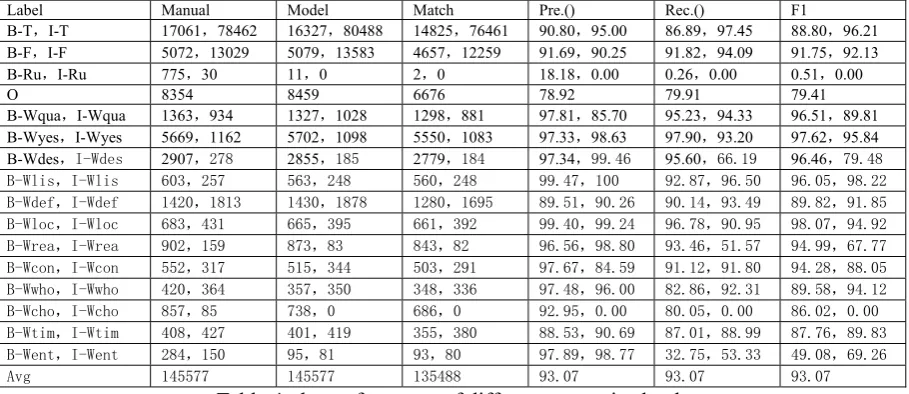
Table 4 shows the performance of annotation of different semantic chunk types. The first column is the semantic chunk tag. The last three columns are precision, recall and F1 value of the semantic chunk performance, respectively.
Label Manual Model Match Pre.() Rec.() F1 B-T,I-T 17061,78462 16327,80488 14825,76461 90.80,95.00 86.89,97.45 88.80,96.21 B-F,I-F 5072,13029 5079,13583 4657,12259 91.69,90.25 91.82,94.09 91.75,92.13 B-Ru,I-Ru 775,30 11,0 2,0 18.18,0.00 0.26,0.00 0.51,0.00
O 8354 8459 6676 78.92 79.91 79.41
B-Wqua,I-Wqua 1363,934 1327,1028 1298,881 97.81,85.70 95.23,94.33 96.51,89.81 B-Wyes,I-Wyes 5669,1162 5702,1098 5550,1083 97.33,98.63 97.90,93.20 97.62,95.84 B-Wdes,I-Wdes 2907,278 2855,185 2779,184 97.34,99.46 95.60,66.19 96.46,79.48 B-Wlis,I-Wlis 603,257 563,248 560,248 99.47,100 92.87,96.50 96.05,98.22 B-Wdef,I-Wdef 1420,1813 1430,1878 1280,1695 89.51,90.26 90.14,93.49 89.82,91.85 B-Wloc,I-Wloc 683,431 665,395 661,392 99.40,99.24 96.78,90.95 98.07,94.92 B-Wrea,I-Wrea 902,159 873,83 843,82 96.56,98.80 93.46,51.57 94.99,67.77 B-Wcon,I-Wcon 552,317 515,344 503,291 97.67,84.59 91.12,91.80 94.28,88.05 B-Wwho,I-Wwho 420,364 357,350 348,336 97.48,96.00 82.86,92.31 89.58,94.12 B-Wcho,I-Wcho 857,85 738,0 686,0 92.95,0.00 80.05,0.00 86.02,0.00 B-Wtim,I-Wtim 408,427 401,419 355,380 88.53,90.69 87.01,88.99 87.76,89.83 B-Went,I-Went 284,150 95,81 93,80 97.89,98.77 32.75,53.33 49.08,69.26 Avg 145577 145577 135488 93.07 93.07 93.07
Table 4: the performance of different semantic chunk
The semantic chunk type of “Topic” and “Focus” can be annotated well. Topic and focus semantic chunks have a large percentage in all the seman-tic chunks and they are important for question analyzing. So the result is really good for the whole Q&A system.
As for “Rubbish” semantic chunk, it only has 0.51 and 0.0 F1 measure for B-Ru and I-Ru. One reason is lacking enough training examples, for there are only 1031 occurrences in the training data. Another reason is sometimes restriction is complex.
6
Conclusion and future work
This paper present a new method for Chinese question analyzing based on CRF. The features are selected by using mutual information algo-rithm. The selected features work effectively for the CRF model. The experiments on the test data
set achieve 93.07% in F1 measure. In the future, new features should be discovered and new methods will be used.
A
cknowledgmentThis work is supported by Major Program of Na-tional Natural Science Foundation of China (No.60435020 and No. 90612005) and the High Technology Research and Development Program of China (2006AA01Z197).
References
A.M. Turing. 1950. Computing Machinery and
Intelligence. Mind, 236 (59): 433~460.
Diego Moll′, Jose′Luis Vicedo. 2007. Question
Answering in Restricted Domains: An Overview.
Dragomir Radev, WeiGuo Fan, Leila Kosseim. 2001.
The QUANTUM Question Answering System.
TREC.
Min-Yuh Day, Cheng-Wei Lee, Shih-Hung WU,
Chormg-Shyong Ong, Wen-Lian Hsu. 2005. An
Integrated Knowledge-based and Machine Learning Approach for Chinese Question Classification. Proceedings of the IEEE
International Conference on Natural Language Processing and Knowledge Engineering, Wuhan, China,:620~625.
Ulf Hermjakob. 2001. Parsing and Question
Classification for Question Answering.
Proceedings of the ACL Workshop on Open-Domain Question Answering, Toulouse,:19~25.
Dell Zhang, Wee Sun Lee. 2003. Question
classification using support vector machines.
Proceedings of the 26th Annual International ACM Conference on Research and Development in Information Retrieval(SIGIR), Toronto, Canada,26 ~ 32.
Valentin Jijkoun, Maarten de Rijke.2005. Retrieving Answers from Frequently Asked Questions Pages on the Web. CIKM’05, Bermen, Germany.
Noriko Tomuro. 2003. Interrogative Reformulation
Patterns and Acquisition of Question Paraphrases.
Proceeding of the Second International Workshop on Paraphrasing, :33~40.
Hyo-Jung Oh, Chung-Hee Lee, Hyeon-Jin Kim,
Myung-Gil Jang. 2005. Descriptive Question
Answering in Encyclopedia. Proceedings of the
ACL Interactive Poster and Demonstration Sessions, pages 21–24, Ann Arbor.
Radu Soricut, Eric Brill. 2004, Automatic Question
Answering: Beyond the Factoid. Proceedings of
HLT-NAACL ,:57~64.
Jiwoon Jeon, W. Bruce Croft and Joon Ho Lee. 2005.
Finding Similar Questions in Large Question and Answer Archives. CIKM’05, Bremen, Germany.
Sanda Harabagiu, Finley Lacatusu and Andrew Hickl.
2006 . Answering Complex Questions with Random
Walk Models. SIGIR’06, Seattle, Washington,
USA.pp220-227.
Ingrid Zukerman, Eric Horvitz. 2001. Using Machine
Learning Techniques to Interpret WH-questions.
ACL.
John Lafferty, Andrew McCallum, Fernando Pereira.
2001. Conditional Random Fields: probabilistic
Models for Segmenting and Labeling Sequence Data. Proceedings of the Eighteenth International
Conference on Machine Learning, p.282-289.
Nojun Kwak and Chong-Ho Choi. 2002. Input
feature selection for classification problems.