Top-Down Cohesion
Segmentation in
Summarization
Doina Tatar
Andreea Diana Mihis
Gabriela Serban
University "Babe¸s-Bolyai" Cluj-Napoca (Romania)
email:
[email protected]
Abstract
The paper proposes a new method of linear text segmentation based on lexical cohesion of a text. Namely, first a single chain of disambiguated words in a text is established, then the rips of this single chain are consid-ered as boundaries for the segments of the cohesion text structure (Cohe-sion TextTiling or CTT). The summaries of arbitrarily length are obtained by extraction using three different methods applied to the obtained seg-ments. The informativeness of the obtained summaries is compared with the informativeness of the pair summaries of the same length obtained us-ing an earlier method of logical segmentation by text entailment (Logical TextTiling or LTT). Some experiments about CTT and LTT methods are carried out for four “classical" texts in summarization literature showing that the quality of the summarization using cohesion segmentation (CTT) is better than the quality using logical segmentation (LTT).
1
Introduction
Text summarization has become the subject of an intense research in the last years and it is still an emerging field (Orasan, 2006; Radev et al., 2002; Hovy, 2003; Mani, 2001). The research is done in the extracts (which we are treating in this paper) and abstracts areas. The most important task of summarization is to identify the most informative (salient) parts of a text comparatively with the rest. A good segmentation of a text could help in this identification (Boguraev and Neff, 2000; Barzilay and Elhadad, 1999; Reynar, 1998).
This paper proposes a new method of linear text segmentation based on lexical cohesion of a text. Namely, first a single chain of disambiguated words in a text is established, then the rips of this chain are considered. These rips are boundaries of the segments in the cohesion structure of the text. Due to some similarities with TextTiling algorithm for topic shifts detection of Hearst (1997), the method is called Cohesion TextTiling (CTT).
The paper is structured as follows: in Section 2 we present the problem of Word Sense Disambiguation by a chain algorithm and the derived CTT method. In Sec-tion 3, some noSec-tions about textual entailment and logical segmentaSec-tion of a text by LTT method are discussed. Summarization by different methods after segmentation is the topic of Section 4. The parallel application of CTT and LTT methods to four "classical" texts in summarization literature, two narrative and two newspapers, and some statistics of the results are presented in Section 5. We finish the article with conclusions and possible further work directions.
2
A top-down cohesion segmentation method
2.1 Lexical chains
A lexical chain is a sequence of words such that the meaning of each word from the se-quence can be obtained unambiguously from the meaning of the rest of words (Morris and Hirst, 1991; Barzilay and Elhadad, 1999; Harabagiu and Moldovan, 1997; Silber and McCoy, 2002; Stokes, 2004). The map of all lexical chains of a text provides a representation of the lexical cohesive structure of the text. Usually a lexical chain is obtained in a bottom-up fashion, by taking each candidate word of a text, and finding an appropriate relation offered by a thesaurus as Rodget (Morris and Hirst, 1991) or WordNet (Barzilay and Elhadad, 1999). If it is found, the word is inserted with the appropriate sense in the current chain, and the senses of the other words in the chain are updated. If no relation is found, then a new chain is initiated.
Our method approaches the construction of lexical chains in a reverse order: we first disambiguate the whole text and then construct the lexical chains which cover as much as possible the text.
2.2 CHAD algorithm
defi-nition in the dictionary directly. The base of the algorithm is the disambiguation of a triplet of words, using Dice’s overlap or Jaccard’s measures. Shortly, CHAD begins with the disambiguation of a tripletw1w2w3and then adds to the right the following
words to be disambiguated. Hence it disambiguates at a time a new triplet, where first two words are already associated with the best senses and the disambiguation of the third word depends on the disambiguation of these first two words.
Due to the brevity of definitions in WordNet (WN), the first sense in WN for a word wi (WN 1st sense) must be associated in some cases in a "forced" way. Theforced
conditionrepresents the situation that any sense ofwiis related with the senses of the
wordswi−2andwi−1. Thus theforced conditionsignals that a lexical chain stops,
and, perhaps, a new one begins.
Comparing the precision obtained with CHAD and the precision obtained by the WN 1stsense algorithm for 10 files of Brown corpus (Tatar et al., 2007) we obtained the result: for 7 files the difference was greater or equal to 0.04 (favorable to WN 1st), and for 3 files was lower. For example, in the worst case (Brown 01 file), the precisions obtained by CHAD are: 0.625 for Dice’s measure, 0.627 for Overlap measure, 0.638 for Jaccard’s measure while the precision obtained by WN 1st sense is 0.688. Let us remark that CHAD is used to mark the discontinuity in cohesion, while WN 1stsense algorithm is unable to do this.
2.3 CHAD and lexical chains
The CHAD algorithm shows what words in a sentence are unrelated as senses with the previously words: these are the words which receive a "forced" first WN sense. Of course, these are regarded differently from the words which receive a "justified" first WN sense. Scoring each sentence of a text by the number of "forced" to first WN sense words in this sentence, we will provide a representation of the lexical cohesive structure of the text. IfF is this number, then the valleys (the local minima) in the graph representing the function 1/F will represent the boundaries between lexical chains (see Figure 2).
Lexical chains could serve further as a basis for an algorithm of segmentation. As our method of determination of lexical chains is linear, the corresponding segmenta-tion is also linear. The obtained segments could be used effectively in summarizasegmenta-tion. In this respect, our method of summarization falls in the discourse-based category. In contrast with other theories about discourse segmentation, as Rhetorical Struc-ture Theory (RST) of Mann and Thompson (1988), attentional/intentional strucStruc-ture of Grosz and Sidner (1986) or parsed RST tree of Marcu (1997), our CTT method (and also, as presented below, our LTT method) supposes a linear segmentation (ver-sus hierarchical segmentation) which results in an advantage from a computational viewpoint.
3
Segmentation by Logical TextTiling
3.1 Text entailment
consists in the verification of the relation:sim(T,H)T ≤sim(T,H)H. Heresim(T,H)T
andsim(T,H)Hare text-to-text similarities introduced in Corley and Mihalcea (2005).
The method used by our tool for Text entailment verification calculates the similarity betweenTandHbycosine, thus the above relation becomescos(T,H)T≤cos(T,H)H
(Tatar et al., 2007).
3.2 Logical segmentation
Tatar et al. (2008) present a method namedlogicalsegmentation because the score of a sentence is the number of sentences of the text which are entailed by it. Representing the scores of sentences as a graph, we obtain a structure which indicates how the most important sentences alternate with ones less important and which organizes the text according to its logical content. Simply, a valley (a local minimum) in the obtained logical structure of the text is a boundary between two logical segments (see Figure 1). The method is called Logical TextTiling (LTT), due to some similarities with the TextTiling algorithm for topic shifts detection (Hearst, 1997). The drawback of LTT, that the number of the segments is fixed for a given text (as it results from its logical structure), is eliminated by a method to dynamically correlate the number of the logi-cal segments obtained by LTT with the required length of the summary. Let us remark that LTT does not require a predicate-argument analysis. The only semantic structure processing required is the Text Entailment verification.
4
Summarization by segmentation
4.1 Scoring the segments
An algorithm of segmentation has usually the following function:
INPUT: a list of sentencesS1, ...,Snand a list of scoresscore(S1), ...,score(Sn);
OUTPUT: a list of segmentsSeg1, ...,SegN.
Given a set of N segments (obtained by CTT or LTT) we need a criterion to select those sentences from a segment which will be introduced in the summary. Thus, after the score of a sentence is calculated, we calculate a score of a segment. The final score,Scoref inal, of a sentence is weighted by the score of the segment which contains
it. The summary is generated by selecting from each segment a number of sentences proportional with the score of the segment. The method has some advantages when a desired level of granularity of summarization is imposed.
The summarization algorithmwith Arbitrarily Length of the summary (AL)is the following:
INPUT: The segmentsSeg1, ...SegN, the length of summary X (as parameter),
Scoref inal(Si)for each sentenceSi;
OUTPUT: A summarySU Mof length X, where from each segmentSegjare selected
NSenSegjsentences. The method of selecting the sentences is given by
defini-tionsSum1,Sum2,Sum3 (Section 4.2).
Remark: A number of segmentsSegj mayhaveNSenSegj>1. IfX<Nthen a
In Section 5 (Experiments) the variant of summarization algorithm as above is de-noted as Var1. In the variant Var2 a second choice of computing the score of a segment is considered. Namely, the score is not normalized, and it is equal with the sum of its sentences scores, without been divided to the segment length. The draw-back ofVar1is that in some cases a very long segment can contain some sentences with a high score and many sentences with a very low score, the final score of this segment will be a small one and those important sentences will not be included in the final summary. The drawback ofVar2is that of increased importance of the length of the segment in some cases. Thus, the score of a short segment with high sentences scores will be less then one of a long segment with small sentences scores, and again some important sentences will be lost.
4.2 Strategies for summary calculus
The method of extracting sentences from the segments is decisive for the quality of the summary. The deletion of an arbitrary amount of source material between two sentences which are adjacent in the summary has the potential of losing essential in-formation. We propose and compare some simple strategies for including sentences in the summary:
• Our first strategy is to include in the summary the first sentence from each seg-ment, as this is of special importance for a segment. The corresponding sum-mary will be denoted bySum1.
• The second way is that for each segment the sentence(s) with a maximal score are considered the most important for this segment, and hence they are included in the summary. The corresponding summary is denoted bySum2.
• The third way of reasoning is that from each segment the most informative sentence(s) (the least similar) relative to the previously selected sentences are picked up. The corresponding summary is denoted bySum3.
5
Experiments
In our experiments for CTT method each sentence is scored as following:Score(Si) =
1
nuwi wherenuwi is the number of words "forced" to get the first WN sense in the
sentenceSi. Ifnuwi=0 thenScore(Si) =2. The graph of the logical structure for the
textHirstis presented in Figure 1 while the graph for the cohesion structure for the same text is presented in Figure 2.
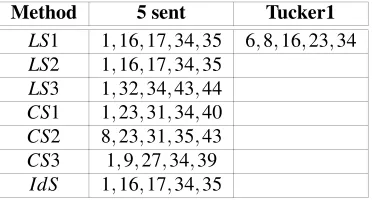
We have applied CTT and LTT methods of segmentation and summarization to four texts denoted in the following by:Hirst(Morris and Hirst, 1991),Koan(Richie, 1991),Tucker1(Tucker, 1999) andTucker2(Tucker, 1999).1The denotations are as
following: LSifor LTT withSumimethod,CSifor CTT withSumimethod. Also an ideal summary (IdS) has been constructed by taking the majority occurrences of the sentences in allLSiandCSisummaries. IdSis the last raw of the table. For the text
Tucker1the summaries with five sentences obtained by us and the summary obtained
by the author with CLASP (Tucker, 1999) are presented in Table 1.
Logical structure of Hirst text
0 11
1 3 5 7 9 11 13 15 17 19 21 23 25 27 29 31 33 35 37 39 41
[image:6.595.143.453.181.288.2]Positions of sentences
Figure 1: The logical structure of the textHirst
Cohesion structure of the Hirst text
0 2.25
1 3 5 7 9 11 13 15 17 19 21 23 25 27 29 31 33 35 37 39 41
[image:6.595.145.453.372.477.2]Positions of sentences
Figure 2: The cohesion structure of the textHirst
Table 1: The summaries with the length 5 for the textTucker1 compared with the author’s summary
Method 5 sent Tucker1
LS1 1,16,17,34,35 6,8,16,23,34 LS2 1,16,17,34,35
LS3 1,32,34,43,44 CS1 1,23,31,34,40 CS2 8,23,31,35,43 CS3 1,9,27,34,39
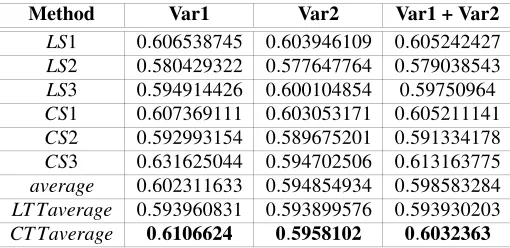
[image:6.595.206.392.595.695.2]Table 2: The average informativeness ofCT T andLT T summaries for all texts
Method Var1 Var2 Var1 + Var2
LS1 0.606538745 0.603946109 0.605242427 LS2 0.580429322 0.577647764 0.579038543 LS3 0.594914426 0.600104854 0.59750964 CS1 0.607369111 0.603053171 0.605211141 CS2 0.592993154 0.589675201 0.591334178 CS3 0.631625044 0.594702506 0.613163775
average 0.602311633 0.594854934 0.598583284
LT Taverage 0.593960831 0.593899576 0.593930203
CT Taverage 0.6106624 0.5958102 0.6032363
5.1 Evaluation of the summarization
There is no an unique formal method to evaluate the quality of a summary. In this paper we use as a measure of the quality of a summary, the similarity (calculated as cosine) between the summarized (initial) text and the summaries obtained with different methods. We call this similarity "the informativeness".
The informativeness of the different types of summaries Sum1,Sum2,Sum3 (see
Section 4.2) and of different lengths (5, 6 and 10) is calculated for each text. Then, the average informativeness for all four texts is calculated. A view with the these average results of informativeness, calculated with different methods, in variantsVar1 and
Var2, is given in the Table 2.
Let us remark that for obtaining summaries with different lengths, after a first seg-mentation with CTT and LTT methods the algorithmALfrom Section 4.1 is applied.
Table 2 displays the results announced in the abstract: the quality of CTT sum-maries is better than the quality of the LTT sumsum-maries from the point of view of informativeness.
5.2 Implementation details
The methods presented in this paper are fully implemented: we used our own systems of Text Entailment verification, Word Sense Disambiguation, top-down lexical chains determination, LTT and CTT segmentation, summarization withSumiandAL
meth-ods. The programs are realized in Java and C++. WordNet (Miller, 1995) is used by our system of Word Sense Disambiguation.
6
Conclusion and further work
The evaluation indicates acceptable performance when informativeness of sum-maries is considered. However, our methods have the potential to be improved: in CTT method we correspond a segment to a lexical chain. We intend to improve our scoring method of a segment by considering some recent method of scoring lexical chains (Ercan and Cicekli, 2008). Also, we intend to study how anaphora resolution could improve the lexical chains and the segmentation. We further intend to apply the presented methods to the corpus of texts DUC2002 and to evaluate them with the standard ROUGE method (for our experiments we didn’t have the necessary human made summaries).
Acknowledgments
This work has been supported by PN2 Grant TD 400/2007.
References
Barzilay, R. and M. Elhadad (1999). Using lexical chains for Text summarization. In J. Mani and M. Maybury (Eds.),Advances in Automated Text Summarization. MIT Press.
Boguraev, B. and M. Neff (2000). Lexical Cohesion, Discourse Segmentation and Document Summarization. InProceedings of the 33rd Hawaii International Con-ference on System Sciences.
Corley, C. and R. Mihalcea (2005). Measuring the semantic similarity of texts. In Proceedings of the ACL Workshop on Empirical Modeling of Semantic Equivalence and Entailment, Ann Arbor.
Ercan, G. and I. Cicekli (2008). Lexical cohesion based topic modeling for summa-rization. InProceedings of the Cicling 2008, pp. 582–592.
Harabagiu, S. and D. Moldovan (1997). TextNet – a textbased intelligent system. Natural Language Engineering 3(2), 171–190.
Hearst, M. (1997). Texttiling: Segmenting text into multi-paragraph subtopic pas-sages. Computational Linguistics 23(1), 33–64.
Hovy, E. (2003). Text summarization. In R. Mitkov (Ed.),The Oxford Handbook of Computational Linguistics. Oxford University Press.
Mani, I. (2001).Automatic summarization. John Benjamins.
Marcu, D. (1997). From discourse structure to text summaries. InProceedings of the ACL/EACL ’97 Workshop on Intelligent Scalable Text Summarization, pp. 82–88.
Miller, G. (1995). WordNet: a lexical database for english. Comm. of the
ACM 38(11), 39–41.
Orasan, C. (2006). Comparative evaluation of modular automatic summarization sys-tems using CAST. Ph. D. thesis, University of Wolverhampton.
Radev, D., E. Hovy, and K. McKeown (2002). Introduction to the special issues on summarization.Computational Linguistics 28, 399–408.
Reynar, J. (1998). Topic Segmentation: algorithms and applications. Ph. D. thesis, Univ. of Penn.
Richie, D. (1991). The koan. In Z. Inklings (Ed.),Some Stories, Fables, Parables and Sermons, pp. 25–27.
Silber, H. and K. McCoy (2002). Efficiently computed lexical chains, as an inter-mediate representation for automatic text summarization. Computational Linguis-tics 28(4), 487–496.
Stokes, N. (2004). Applications of Lexical Cohesion Analysis in the Topic Detection and Tracking Domain. Ph. D. thesis, National University of Ireland, Dublin.
Tatar, D., A. M. G. Serban, and R. Mihalcea (2007). Text entailment as directional relation. InProceedings of CALP07 Workshop at RANLP2007, Borovets, Bulgaria, pp. 53–58.
Tatar, D., A. Mihis, and D. Lupsa (2008). Text entailment for logical segmentation and summarization. In13th International Conference on Applications of Natural Language to Information Systems, pp. 233–244.
Tatar, D., G. Serban, A. Mihis, M. Lupea, D. Lupsa, and M. Frentiu (2007). A chain dictionary method for wsd and applications. InProceedings of the International Conference on Knowledge Engineering,Principles and Techniques, pp. 41–49.