Improving Word Alignment Using Syntactic Dependencies
Yanjun Ma1 Sylwia Ozdowska1 Yanli Sun2 Andy Way1 1
School of Computing, Dublin City University, Dublin, Ireland {yma,sozdowska,away}@computing.dcu.ie
2
School of Applied Language and Intercultural Studies, Dublin City University, Dublin, Ireland
Abstract
We introduce a word alignment framework that facilitates the incorporation of syntax en-coded in bilingual dependency tree pairs. Our model consists of two sub-models: an anchor word alignment model which aims to find a set of high-precision anchor links and a syntax-enhanced word alignment model which fo-cuses on aligning the remaining words relying on dependency information invoked by the ac-quired anchor links. We show that our syntax-enhanced word alignment approach leads to a 10.32% and 5.57% relative decrease in align-ment error rate compared to a generative word alignment model and a syntax-proof discrim-inative word alignment model respectively. Furthermore, our approach is evaluated ex-trinsically using a phrase-based statistical ma-chine translation system. The results show that SMT systems based on our word align-ment approach tend to generate shorter out-puts. Without length penalty, using our word alignments yields statistically significant im-provement in Chinese–English machine trans-lation in comparison with the baseline word alignment.
1 Introduction
Automatic word alignment can be defined as the problem of determining translational correspon-dences at word level given a parallel corpus of aligned sentences. Bilingual word alignment is a fundamental component of most approaches to sta-tistical machine translation (SMT). Dominant ap-proaches to word alignment can be classified into
two main schools: generative and discriminative word alignment models.
Generative word alignment models, initially de-veloped at IBM (Brown et al., 1993), and then augmented by an HMM-based model (Vogel et al., 1996), have provided powerful modeling capability for word alignment. However, it is very difficult to incorporate new features into these models. Dis-criminative word alignment models, based on dis-criminative training of a set of features (Liu et al., 2005; Moore, 2005), on the other hand, are more flexible to incorporate new features, and feature se-lection is essential to the performance of the system. Syntactic annotation of bilingual corpora, which can be obtained more efficiently and accurately with the advances in monolingual language processing, is a potential information source for word align-ment tasks. For example, Part-of-Speech (POS) tags of source and target words can be used to tackle the data sparseness problem in discriminative word alignment (Liu et al., 2005; Blunsom and Cohn, 2006). Shallow parsing has also been used to pro-vide relevant information for alignment (Ren et al., 2007; Sun et al., 2000). Deeper syntax, e.g. phrase or dependency structures, has been shown useful in generative models (Wang and Zhou, 2004; Lopez and Resnik, 2005), heuristic-based models (Ayan et al., 2004; Ozdowska, 2004) and even for syntac-tically motivated models such as ITG (Wu, 1997; Cherry and Lin, 2006).
In this paper, we introduce an approach to im-prove word alignment by incorporating syntactic de-pendencies. Our approach is motivated by the fact that words tend to be dependent on each other. If
we can first obtain a set of reliable anchor links, we could take advantage of the syntactic dependencies relating unaligned words to aligned anchor words to expand the alignment. Figure 1 gives an illustrating example. Note that the link(2,4)can be easily iden-tified, but the link involving the fourth Chinese word (a function word denoting ‘time’)(4,4) is hard. In such cases, we can make use of the dependency re-lationship (‘tclause’) between c2 and c4 to help the alignment process. Given such an observation, our model is composed of two related alignment models. The first one is an anchor alignment model which is used to find a set of anchor links; the other one is a syntax-enhanced alignment model aiming to process the words left unaligned after anchoring.
Figure 1: How syntactic dependencies can help word alignment: an example
The remainder of this paper is organized as
fol-lows. In Section 2, we introduce our
syntax-enhanced discriminative word alignment approach. The feature functions used are described in Sec-tion 3. Experimental setting and results are pre-sented in Section 4 and 5 respectively. In Section 6, we compare our approach with other related word alignment approaches. Section 7 concludes the pa-per and gives avenues for future work.
2 Word Alignment Model
2.1 Notation
While in this paper we focus on Chinese–English, the method proposed is applicable to any language
pair. The notation will assume Chinese–English
word alignment and Chinese–English MT. Here we adopt a notation similar to (Brown et al., 1993). Given a Chinese sentence cJ1 consisting ofJ words {c1, ..., cJ}and an English sentenceeI1consisting of
I words e1, ..., eI, we define the alignment A
be-tweencJ1 andeI1as a subset of the Cartesian product of the word positions:
A⊆ {(j, i) :j= 1, ..., J;i= 1, ..., I}
Our alignment representation is restricted so that each source word can only be aligned to one tar-get word. The alignmentAconsists of associations
j →i=aj from a source positionjto a target
po-sitioni=aj. The ‘null’ alignmentaj = 0with the
‘empty’ worde0is used to account for source words that are not aligned to any target word.
We useA∆to denote a subset ofA. The indices of theK source words involved inA∆are represented as∆K
1 and the corresponding target indices for ∆k
are represented asa∆k. The unaligned source words are represented as∆¯.
2.2 General Model
Given a source sentence cJ1 and target sentence eI1, we seek to find the optimum alignmentAˆsuch that:
ˆ
A= argmax
A
P(A|cJ1, eI1) (1)
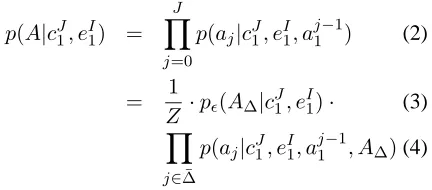
We use a model (2) that directly models the link-age between source and target words similarly to (It-tycheriah and Roukos, 2005). We decompose this model into an anchor alignment model (3) and a syntax-enhanced model (4) by distinguishing the an-chor alignment from the non-anan-chor alignment.
p(A|cJ1, eI1) =
J
Y
j=0
p(aj|cJ1, eI1, a
j−1
1 ) (2)
= 1
Z ·pǫ(A∆|c
J
1, eI1)· (3)
Y
j∈∆¯
p(aj|cJ1, eI1, a
j−1
1 , A∆)(4)
2.3 Anchor Alignment Model
The anchor alignment modelpǫ(A∆)aims to find a set of high precision links. Various approaches can be used for this purpose. In this paper we adopted the following two approaches.
2.3.1 Heuristics-based Approach
We constrain the link probabilities in such a way that:
∀i′
∈ {1, ..., I}, i′
6
=i: p((j, i))
p((j, i′)) > ǫ1 (5)
∀j′
∈ {1, ..., J}, j′
6
=j : p((j, i))
p((j′, i)) > ǫ2 (6)
Condition (5) implies that for the source wordcj,
the link with the target word ei is more probable
(with reliability thresholdǫ1) than the link with any other target word. Condition (6) guarantees that for the target wordei,cjis the only most probable (with
thresholdǫ2) source word to be linked to.
2.3.2 Intersected Generative Word Alignment Models
We can use the asymmetric IBM models for bidi-rectional word alignment and get the intersection.
2.4 Syntax-Enhanced Word Alignment Model
The syntax-enhanced model is used to model the alignment of the words left unaligned after anchor-ing. We directly model the linkage between source and target words using a discriminative word align-ment framework where various features can be in-corporated. Given a source word cj and the target
sentence eI1, we search for the alignment aj such
that:
ˆ
aj = argmax aj
{pλM
1 (aj|c
J
1, eI1, a
j−1
1 , A∆)} (7)
= argmax
aj
{PM
m=1λmhm(cJ1, eI1, a
j
1, A∆, Tc, Te)}
In this decision rule, we assume that a set of highly reliable anchor alignments A∆ has been obtained, and Tc (resp. Te) is used to denote the dependency
structure for source (resp. target) language. In such a framework, various machine learning techniques can be used for parameter estimation.
3 Feature Function for Syntax-Enhanced Model
The various features used in our syntax-enhanced model can be classified into three groups: statistics-based features, syntactic features and relative distor-tion features.
3.1 Statistics-based Features
3.1.1 IBM model 1 score
IBM model 1 is a position-independent word alignment model which is often used to boot-strap parameters for more complex models. Model 1 models the conditional distribution and uses a uniform distribution for the dependencies between source word positions and target word positions.
P r(cJ1, aJ1|eI1) =
p(J|I) (I+ 1)J
J
Y
j=1
p(cj|eaj) (8)
3.1.2 Log-likelihood ratio
The log-likelihood ratio statistic has been found to be accurate for modeling the associations between rare events (Dunning, 1993). It has also been suc-cessfully used to measure the associations between word pairs (Melamed, 2000; Moore, 2005). Given the following contingency table:
cj ¬cj
ei a b
¬ei c d
the log-likelihood ratio can be defined as:
G2(cj, ei) =−2log
B(a|a+b, p1)B(c|c+d, p2)
B(a|a+b, p)B(c|c+d, p)
whereB(k|n, p) = (n
k)pk(1−p)n
−k are binomial
probabilities. The probability parameters can be ob-tained using maximum likelihood estimates:
p1 =
a
a+b, p2 = c
c+d (9)
p= a+c
a+b+c+d (10)
3.1.3 POS translation probability
The POS tags can provide effective information for addressing the data sparseness problem using the lexical features (Liu et al., 2005; Blunsom and Cohn, 2006). The POS translation probability can be easily obtained using maximum likelihood estimation from an annotated corpus:
P r(Tc|Te) =
COL(Tc, Te)
COF(Te)
whereTc is a Chinese word’s POS tag andTeis an
English word’s POS tag. COL(Tc, Te) is the count
ofTcandTebeing linked to each other in the corpus,
andCOF(Te)is the frequency ofTein the corpus.
3.2 Syntactic Features
The dependency relationRe(resp.Rc) between two
English (resp. Chinese) words ei and ei′ (resp. cj
and cj′) in the dependency tree of the English
sen-tence eI1 (resp. Chinese sentence cJ1) can be repre-sented as a triple<ei, Re, ei′>(resp.<cj, Rc, ej′>).
Given cJ1, eI1 and their syntactic dependency trees
TcJ
1, TeI1, if ei is aligned to cj and ei′ aligned to cj′, according to the dependency correspondence
as-sumption (Hwa et al., 2002), there exists a triple
<cj, Rc, cj′>.
While we are not aiming to justify the feasibil-ity of the dependency correspondence assumption by proving to what extentRe = Rc under the
con-dition described above, we do believe thatcj andcj′
are likely to be dependent on each other. Given the anchor alignmentA∆, a candidate link(j, i)and the dependency trees, we can design four classes of fea-ture functions.
3.2.1 Agreement features
The agreement features can be further classi-fied into dependency agreement features and depen-dency label agreement features. Given a candidate link (j, i) and the anchor alignmentA∆, the depen-dency agreement (DA) feature function is defined as follows:
hDA−1 =
1 if∃<cj, Rc, cj′>,<ei, Re, ei′>
and(j′, i′)∈A
∆,
0 otherwise.
(12)
By changing the dependency direction between the wordscj andcj′, we can derive another dependency
agreement feature:
hDA−2 =
1 if∃<cj′, Rc, cj>,<ei′, Re, ei>
and(j′, i′)∈A
∆,
0 otherwise.
(13)
We can define the dependency label agreement fea-ture1as follows:
hDLA−1 =
1 if∃<cj, Rc, cj′>,<ei, Re, ei′>
and(j′, i′)∈A
∆,Rc=Re,
0 otherwise.
(14)
Similarly we can obtain hDLA−2 by changing the
dependency direction.
3.2.2 Source word dependency features
Given a candidate link(j, i)and anchor alignment
A∆, source language dependency features are used to capture the dependency label between a source
word cj and a source anchor word ck ∈ ∆. For
example, a feature function relating to dependency type ‘PRD’ can be defined as:
hsrc−1−P RD =
1 if∃<cj, Rc, cj′>
andRc=‘PRD’,
0 otherwise.
(15)
By changing the direction we can obtain
hsrc−2−P RD.
3.2.3 Target word dependency features
Target word dependency features can be defined in a similar way as source word dependency fea-tures.
3.2.4 Target anchor feature
The target anchor feature defines whether the tar-get wordeiis an anchor word.
hsrc−1−P RD=
(
1 ifi∈a∆,
0 otherwise. (16)
3.3 Relative distortion feature
We can design features encoding the relative dis-tortion information which can be used to evaluate a candidate link by computing its relative position change with respect to the anchor alignment. The relative position change of a candidate linkl= (j, i) is formally defined as follows:
1
D(l) =min(|dL|,|dR|) (17)
dL= (j−jL)−(i−iL) (18)
dR= (j−jR)−(i−iR) (19)
where (iL, jL) is the leftmost anchor link of l,
(iR, jR)is the rightmost anchor link of l. The less
the relative position changes, the more likely the candidate link is. With a set of anchor alignments, we can obtain the distribution of the relative posi-tion changes from an annotated corpus using maxi-mum likelihood estimation. In our experiments, we used the following four probabilities: p(D = 0),
p(D= 1,2),p(D= 3,4)andp(D >4).
4 Experimental Setting
4.1 Data
The experiments were carried out using the
Chinese–English datasets provided within the
IWSLT 2007 evaluation campaign (Fordyce, 2007), extracted from the Basic Travel Expression Corpus (BTEC) (Takezawa et al., 2002). This multilingual speech corpus contains sentences similar to those that are usually found in phrase-books for tourists going abroad.
We tagged all the sentences in the training and de-vset3 using a maximum entropy-based POS tagger– MXPOST (Ratnaparkhi, 1996), trained on the Penn English and Chinese Treebanks. Both Chinese and English sentences are parsed using the Malt depen-dency parser (Nivre et al., 2007), which achieved 84% and 88% labelled attachment scores for Chi-nese and English respectively.
4.1.1 Word Alignment
We manually annotated word alignments on de-vset3. Since manual word alignment is an ambigu-ous task, we also explicitly allow for ambiguambigu-ous alignments, i.e. the links are marked as sure (S) or possible (P) (Och and Ney, 2003). IWSLT devset3 consists of 502 sentence pairs after cleaning. We used the first 300 sentence pairs for training, the fol-lowing 50 sentence pairs as validation set and the last 152 sentence pairs for testing.
4.1.2 Machine Translation
Training was performed using the default training set (39,952 sentence pairs), to which we added the
set devset1 (506 sentence pairs).2 We used devset2 (506 sentence pairs, 16 references) to tune various parameters in the MT system and IWSLT 2007 test set (489 sentence pairs, 6 references) for testing.
4.2 Alignment Training and Search
In our experiments, we treated anchor alignment and syntax-enhanced alignment as separate processes in a pipeline. The anchor alignments are kept fixed so that the parameters in the syntax-enhanced model can be optimized.3 We used the support vector
ma-chine (SVM) toolkit–SVM light4 to optimize the
parameters in (7). Our model is constrained in such a way that each source word can only be aligned to one target word. Therefore, in training, we trans-form each possible link involving the words left un-aligned after anchoring into an event. In testing, the source words are consumed in sequence and the tar-get words serve as states. The SVM dual variable was used to measure the reliability of each candidate link and the alignment link for each word is made independently, which makes the alignment search much easier. A thresholdt was set as the minimal reliability score for each link.tis optimized accord-ing to alignment error rate (21) on the validation set.
4.3 Baselines
4.3.1 Word Alignment
We used the GIZA++ implementation of IBM word alignment model 4 (Brown et al., 1993; Och and Ney, 2003) for word alignment, and the heuris-tics described in (Och and Ney, 2003) to derive the intersection and refined alignment.
4.3.2 Machine Translation
We use a standard log-linear phrase-based SMT (PB-SMT) model as a baseline: GIZA++ implemen-tation of IBM word alignment model 4,5 the
refine-2
More specifically, we chose the first English reference from the 16 references and the Chinese sentence to construct new sentence pairs.
3
Note our anchor alignment does not achieve 100% preci-sion. Since we performed precision-oriented alignment for the anchor alignment model, the errors in anchor alignment will not bring much noise into the syntax-enhanced model.
4
http://svmlight.joachims.org/
5More specifically, we performed5iterations of Model 1,5
iterations of HMM,3iterations of Model 3, and3iterations of
ment and phrase-extraction heuristics described in (Koehn et al., 2003), minimum-error-rate training (Och, 2003), a trigram language model with Kneser-Ney smoothing trained with SRILM (Stolcke, 2002) on the English side of the training data, and Moses (Koehn et al., 2007) to decode.
4.4 Evaluation
We evaluate the intrinsic quality of predicted align-ment A with precision, recall and alignment error rate (AER). Slightly differently from (Och and Ney, 2003), we use possible alignments in computing re-call.
recall= |A∩P|
|P| , precision=
|A∩P| |A| (20)
AER(S, P;A) = 1−|A∩S|+|A∩P| |A|+|S| (21)
We also extrinsically measure the word alignment quality via a Chinese–English translation task. The translation output is measured using BLEU (Pap-ineni et al., 2002).
5 Experimental Results
5.1 Word Alignment
We performed word alignment bidirectionally using our approach to obtain the union and compared our results with two strong baselines based on generative word alignment models. The results are shown in Table 1. We can see that both the syntax-enhanced model based on HMM intersection anchors (Syntax-HMM) and on IBM model 4 anchors (Syntax-Model 4) are better than the pure generative word alignment models. Our approach is superior in precision with a disadvantage in recall. The best result achieved 10.32% relative decrease in AER compared to the baseline when we use IBM model 4 intersection to obtain the set of anchor alignments.
model precision recall f-score AER
HMM refined 0.8043 0.7592 0.7811 0.2059
Syntax-HMM 0.8744 0.7304 0.7959 0.1845
Model 4 refined 0.7941 0.7987 0.7964 0.1929 Syntax-Model 4 0.8566 0.7685 0.8102 0.1730
Table 1: Comparing syntax-enhanced approach with gen-erative word alignment
5.1.1 The Influence of Anchor Alignment Quality
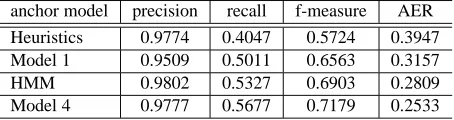
As we can see in Table 2, our precision-oriented approach to acquire anchor alignments was accom-plished quite well. All four different anchor align-ment models achieved high precision. However, the recall differs dramatically, with model 4 achieving the highest recall and the heuristics-based approach receiving the lowest. To investigate the influence
anchor model precision recall f-measure AER
Heuristics 0.9774 0.4047 0.5724 0.3947
Model 1 0.9509 0.5011 0.6563 0.3157
HMM 0.9802 0.5327 0.6903 0.2809
[image:6.612.314.541.195.255.2]Model 4 0.9777 0.5677 0.7179 0.2533
Table 2: Performance of anchor alignment
of the anchor alignment model, we first obtained the intersection of the words left unaligned after an-choring using each of the anchor alignment models. We evaluate the alignment of these words against the gold-standard alignments involving these words. The influence of anchor alignment on the perfor-mance of the syntax-enhanced model can be seen in Table 3. The performance of the syntax-enhanced model is closely related to that of the anchor align-ment method. As can be seen from Table 2 and 3, HMM anchoring achieves the best precision and so does the syntax-enhanced alignment; IBM model 4 achieves the best recall and so does the syntax-enhanced alignment. Finally, the best alignment per-formances are obtained with IBM model 4 anchor-ing, with the difference in recall between HMM and IBM model 4 anchoring being more significant than the difference in precision.
anchor model precision recall f-score AER
Heuristics 0.4505 0.3270 0.3790 0.6210
Model 1 0.5538 0.3894 0.4573 0.5427
HMM 0.5932 0.3611 0.4489 0.5511
Model 4 0.5660 0.4216 0.4832 0.5168
Table 3: Influence of anchor alignment in syntax-enhanced model
5.1.2 The Influence of Syntactic Dependencies on Word Alignment
in Table 4. Syntax plays a positive role in all differ-ent anchor alignmdiffer-ent configurations. The influence grows proportionally to the strength of the anchor alignment model. With the Model 4 intersection used as the set of anchor alignments, adding syn-tactic dependency features into the syntax-enhanced alignment model yields a 5.57% relative decrease in AER.
model precision recall f-score AER
Heuristics
no syntax 0.8362 0.6751 0.7470 0.2302
w. syntax 0.8376 0.6894 0.7563 0.2240
Model 1
no syntax 0.8759 0.6902 0.7720 0.2045
w. syntax 0.8542 0.7160 0.7790 0.2011
HMM
no syntax 0.8655 0.7168 0.7841 0.1952
w. syntax 0.8744 0.7304 0.7959 0.1845
Model 4
no syntax 0.8697 0.7340 0.7961 0.1832
w. syntax 0.8566 0.7685 0.8102 0.1730
Table 4: Influence of syntactic dependencies on word alignment
5.1.3 Contribution of Different Feature Classes
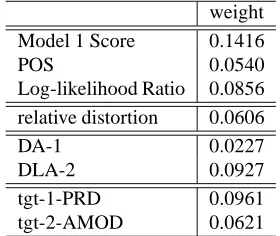
We interpret the contribution of each feature in terms of feature weights in SVM model training. The weights for the most discriminative features in each feature class in Chinese–English word ment (using HMM intersection as anchor align-ment) are shown in Table 5. As we can see, all statistics-based features are informative. Two target dependency features are informative: ‘PRD’ ing ‘predicative’ dependency, and ‘AMOD’ denot-ing ‘adjective/adverb modifier’ dependency.
weight
Model 1 Score 0.1416
POS 0.0540
Log-likelihood Ratio 0.0856
relative distortion 0.0606
DA-1 0.0227
DLA-2 0.0927
tgt-1-PRD 0.0961 tgt-2-AMOD 0.0621
Table 5: Weights of some informative features
5.2 Machine Translation
Research has shown that an increase in AER does not necessarily imply an improvement in translation quality (Liang et al., 2006) and vice-versa (Vilar et al., 2006). Hereafter, we used a Chinese–English MT task to extrinsically evaluate the quality of our word alignment.
Table 6 shows the influence of our word align-ment approach on MT quality.6 On development set, we achieved statistically significant improvement using both our syntax-enhanced models—Syntax-HMM(p<0.002) and Syntax-Model 4(p<0.008). On the test set, we observed that the MT output based on our alignment model tends to be shorter than the reference translations and the BLEU score is considerably penalized. If we ignore the length penalty (‘BP’ in Table 6) in significance testing, the improvement on test set is also statistically signif-icant: p<0.04 for both HMM and
Syntax-Model 4. However, an indepth manual analysis
needs to be carried out in order to determine the ex-act nature of the shorter sentences derived.
dev. set test set Baseline 0.5412 0.3510 (BP=0.96) Syntax-HMM 0.6015 0.3409 (BP=0.86) Syntax-Model 4 0.5834 0.3585 (BP=0.91)
Table 6: The Influence of Word Alignment on MT
6 Comparison with Previous Work
Our syntax-enhanced model is a discriminative word alignment model. Certain generative word
align-ment models (e.g. HMM or IBM 4) also take
the first-order dependencies into account.
How-ever, long distance dependencies between words are hard to incorporate into these models because of the explosive number of parameters. On the other hand, like existing discriminative models, our ap-proach uses a set of informative features based on co-occurrence statistics, e.g. log-likelihood ratio and DICE score. The advantage of our approach is the mechanism by which syntactic features may be incorporated.
6
[image:7.612.115.255.555.673.2]Some previous research also tried to make use
of syntax in word alignment. (Wang and Zhou,
2004) investigated the benefit of monolingual pars-ing for alignment. They learned a generalized word association measure (crosslingual word similarities) based on monolingual dependency structures and improved alignment performances over IBM model 2 and certain heuristic-based models. (Cherry and Lin, 2006) used dependency structures as soft con-straints to improve word alignment in an ITG frame-work. Compared to these models, our approach di-rectly takes advantage of dependency relations as they are transformed into feature functions incorpo-rated into a discriminative word alignment frame-work.
7 Conclusion and Future Work
In this paper, we proposed a model that can facili-tate the incorporation of syntax into word alignment and measured the combination of a set of syntactic features. Experimental results have shown that syn-tax is useful in word alignment and especially effec-tive in improving the recall. We have also observed that in our word alignment framework, the two sub-models are closely related and the quality of the an-chor alignment model plays an important role in the system performance.
The promising results will lead us to improve our model in the following aspects. First, the two sub-models in our approach are two separate processes performed in pipeline. We plan to jointly optimize the two models in one go. Second, some of our experiments used complex IBM models, e.g. IBM Model 4, to obtain anchor alignment. We plan to boostrap the alignment using simple heuristics with-out relying on complex IBM models. Third, the alignment searching process assumed the alignment link for each word is made independently. A feasible markovian assumption will be tested for searching. Fourth, a comparison with traditional discriminative word alignment models is also necessary to justify the merits of our approach. Finally, we also plan to adapt our approach to larger data sets and more lan-guage pairs.
Acknowledgments
This work is supported by Science Foundation Ire-land (grant number OS/IN/1732). Prof. Rebecca Hwa from University of Pittsburgh and Dr. Yang Liu from the Institute of Computing Technology, Chinese Academy of Sciences, are kindly acknowl-edged for providing us with their word alignment guidelines. We would also like to thank the anony-mous reviewers for their insightful comments.
References
Necip Fazil Ayan, Bonnie Dorr, and Nizar Habash. 2004. Multi-align: Combining linguistic and statis-tical techniques to improve alignments for adaptable mt. In Proceedings of the 6th Conference of the AMTA
(AMTA-2004), pages 17–26, Washington DC.
Phil Blunsom and Trevor Cohn. 2006. Discrimina-tive word alignment with conditional random fields. In Proceedings of the 21st International Conference
on Computational Linguistics and 44th Annual Meet-ing of the Association for Computational LMeet-inguistics,
pages 65–72, Sydney, Australia.
Peter F. Brown, Stephen A. Della Pietra, Vincent J. Della Pietra, and Robert L. Mercer. 1993. The mathematics of statistical machine translation: Parameter estima-tion. Computational Linguistics, 19(2):263–311. Colin Cherry and Dekang Lin. 2006. Soft syntactic
constraints for word alignment through discriminative training. In Proceedings of the 21st International
Con-ference on Computational Linguistics and 44th Annual Meeting of the Association for Computational Linguis-tics, pages 105–112, Sydney, Australia.
Yonggang Deng and Yuqing Gao. 2007. Guiding sta-tistical word alignment models with prior knowledge. In Proceedings of the 45th Annual Meeting of the
Association of Computational Linguistics, pages 1–8,
Prague, Czech Republic.
Ted Dunning. 1993. Accurate methods for the statistics of surprise and coincidence. Computational
Linguis-tics, 19(1):61–74.
Cameron Shaw Fordyce. 2007. Overview of the IWSLT 2007 Evaluation Campaign. In Proceedings of the
In-ternational Workshop on Spoken Language Transla-tion, pages 1–12, Trento, Italy.
Rebecca Hwa, Philip Resnik, Amy Weinberg, and Okan Kolak. 2002. Evaluating translational correspondence using annotation projection. In Proceedings of the
40th Annual Meeting of the Association for Compu-tational Linguistics, pages 392–399, Philadelphia, PA.
Technology Conference and Conference on Empirical Methods in Natural Language Processing, pages 89–
96, Vancouver, British Columbia, Canada.
Philipp Koehn, Franz Och, and Daniel Marcu. 2003. Statistical phrase-based translation. In Proceedings of
Human Language Technology Conference and Confer-ence on Empirical Methods in Natural Language Pro-cessing, pages 48–54, Edmonton, Canada.
Philipp Koehn, Hieu Hoang, Alexandra Birch, Chris Callison-Burch, Marcello Federico, Nicola Bertoldi, Brooke Cowan, Wade Shen, Christine Moran, Richard Zens, Chris Dyer, Ondrej Bojar, Alexandra Con-stantin, and Evan Herbst. 2007. Moses: Open source toolkit for statistical machine translation. In
Proceed-ings of the 45th Annual Meeting of the Association for Computational Linguistics Companion Volume Pro-ceedings of the Demo and Poster Sessions, pages 177–
180, Prague, Czech Republic.
Percy Liang, Ben Taskar, and Dan Klein. 2006. Align-ment by agreeAlign-ment. In Proceedings of Human
Lan-guage Technology Conference and Conference on Empirical Methods in Natural Language Processing,
pages 104–111, New York, NY.
Yang Liu, Qun Liu, and Shouxun Lin. 2005. Log-linear models for word alignment. In Proceedings of the
43rd Annual Meeting of the Association for Compu-tational Linguistics, pages 459–466, Ann Arbor, MI.
Adam Lopez and Philip Resnik. 2005. Improved HMM alignment models for languages with scarce resources. In Proceedings of the ACL Workshop on Building and
Using Parallel Texts, pages 83–86, Ann Arbor,
Michi-gan, June.
I. Dan Melamed. 2000. Models of translational equiv-alence among words. Computational Linguistics,
26(2):221–249.
Robert C. Moore. 2005. A discriminative framework for bilingual word alignment. In Proceedings of Human
Language Technology Conference and Conference on Empirical Methods in Natural Language Processing,
pages 81–88, Vancouver, British Columbia, Canada. Joakim Nivre, Johan Hall, Jens Nilsson, Atanas Chanev,
G¨ulsen Eryigit, Sandra K¨ubler, Svetoslav Marinov, and Ervin Marsi. 2007. MaltParser: A language-independent system for data-driven dependency pars-ing. Natural Language Engineering, 13(2):95–135. Franz Och and Hermann Ney. 2003. A systematic
com-parison of various statistical alignment models.
Com-putational Linguistics, 29(1):19–51.
Franz Och. 2003. Minimum error rate training in statis-tical machine translation. In Proceedings of the 41st
Annual Meeting of the Association for Computational Linguistics, pages 160–167, Sapporo, Japan.
Sylwia Ozdowska. 2004. Identifying correspondences between words: an approach based on a bilingual syn-tactic analysis of French/English parallel corpora. In
Proceedings of the COLING’04 Workshop on Multi-lingual Linguistic Resources, pages 49–56, Geneva,
Switzerland.
Kishore Papineni, Salim Roukos, Todd Ward, and Wei-Jing Zhu. 2002. BLEU: a method for automatic eval-uation of machine translation. In Proceedings of the
40th Annual Meeting of the Association for Computa-tional Linguistics, pages 311–318, Philadelphia, PA.
Adwait Ratnaparkhi. 1996. A maximum entropy model for part-of-speech tagging. In Eric Brill and Ken-neth Church, editors, Proceedings of the Conference
on Empirical Methods in Natural Language Process-ing, pages 133–142, Somerset, NJ.
Dengjun Ren, Hua Wu, and Haifeng Wang. 2007. Im-proving statistical word alignment with various clues. In Machine Translation Summit XI, pages 391–397, Copenhagen, Denmark.
Andrea Stolcke. 2002. SRILM – An extensible lan-guage modeling toolkit. In Proceedings of the
Inter-national Conference on Spoken Language Processing,
pages 901–904, Denver, CO.
Le Sun, Youbing Jin, Lin Du, and Yufang Sun. 2000. Word alignment of English-Chinese bilingual corpus based on chunks. In Proceedings of the 2000 Joint
SIGDAT conference on Empirical Methods in Natural Language Processing and very large corpora, pages
110–116.
Toshiyuki Takezawa, Eiichiro Sumita, Fumiaki Sugaya, Hirofumi Yamamoto, and Seiichi Yamamoto. 2002. Toward a broad-coverage bilingual corpus for speech translation of travel conversations in the real world. In Proceedings of Third International Conference on
Language Resources and Evaluation 2002, pages 147–
152, Las Palmas, Spain.
David Vilar, Maja Popovic, and Hermann Ney. 2006. AER: Do we need to “improve” our alignments? In
Proceedings of the International Workshop on Spoken Language Translation, pages 205–212, Kyoto, Japan.
Stefan Vogel, Hermann Ney, and Christoph Tillmann. 1996. HMM-based word alignment in statistical trans-lation. In Proceedings of the 16th International
Con-ference on Computational Linguistics, pages 836–841,
Copenhagen, Denmark.
Wei Wang and Ming Zhou. 2004. Improving word align-ment models using structured monolingual corpora. In Dekang Lin and Dekai Wu, editors, Proceedings
of Conference on Empirical Methods in Natural Lan-guage Processing, pages 198–205, Barcelona, Spain.
Dekai Wu. 1997. Stochastic Inversion Transduction Grammars and bilingual parsing of parallel corpora.