Abstr theor amou Couc also p today Keyw not (Str The sup [8]. grap colu data data use and lang via BSO up coll valu add Eac ID Gen que So they Ava rela Isol stat dist NoS thre mai orie
IMPLE
ract: The most rem is being dis unt of heteroge chDB. MongoD presents major y's web applicat
words: NoSQL,
NoSQL is follow the ructured Quer ese databases pport a large n
. They are m ph store, do umn-oriented abase a “docu abase. These the documen d are very s guages [1]. Th its content. D ON, XML or
of complex e lections. A do ues are not of ding or remov ch document i which is used nerally, docum ery language th they are able y store. The ailability and ational databa
lation and Du tes that littl tributed databa SQL database ee properties. in databases ented database
Interna
EMENTA
t famous NoSQ scussed for Mo eneous and uns DB uses map-re differences and tions than Couc
Document-Ori
I. INTRO
the term used relational m ry Language) s scale horiz number of use mainly categor
ocument store databases. ument” is analo
databases use nts which rep similar to c hese database Documents o r JSON forma elements such ocument’s key f fixed sizes. ving fields as is made up of d for retrievin ments oriente han other con to make use o ese databases d Partition ses follow AC urability) prop
e bit incons ases where pa es follow any
The CAP the that fall in es are CouchD
Vo
ational Jou
Av
TION OF
QL document-o ongoDB and Co structured data educe to perfor
d use cases of b chDB.
iented Database
ODUCTION
d to express da model and do as the data q zontally and
ers and a big ized into 4 c e, key-value In a do ogous to “row e a flexible da present some
onstructs of s allow use o of these datab ats. The docum h as scalar va
ys are not of In a dynamic s needed beco
f fields and co ng and indexin ed-databases h ntemporary No of the structur follow CAP Tolerance) CID (Atomici
erties [9]. Th sistencies are artitions are al
two of CAP p eorem is show the category DB and Mongo
olume 9, N
urnal of Ad
REV
vailable On
F MAP-R
C
S CS Maharsh oriented databa ouchDB. Map-Ron clusters of rm aggregation both the databa
es, MongoDB, C
ata stores that o not use SQ
query languag dynamically
amount of da classes namely databases a cument-orient w” of a relation
ata model. Th real life entit
object-orient f values of ke bases may be ments are ma alues, maps a fixed types a c schema mod omes easier [ ontains a uniq ng the databa have more ri oSQL databas re of the obje P (Consistenc
theorem wh ity, Consistenc he CAP theore e tolerable llowed [2]. Mo properties out wn in Fig 1. T y of docume oDB.
No. 2, Marc
dvanced Re
VIEW ARTI
nline at ww
REDUCE
COUCHD
Subita Kuma
SE Deptt., UIE hi Dayanand U
Rohtak, India
ses namely Co Reduce is a par f computers. M n. CouchDB use ases. It is foun
CouchDB, Map do QL ge. to ata y - and ted nal hey ties ted eys in ade and and del, 1]. que ase. ich ses. cts cy, hile cy, em by ost of The ent de ot se M co Ea C so
ch-April 20
esearch in C
ICLE
ww.ijarcs.in
PARADI
DB
ari ET University aouchDB and M rallel and distrib Map-Reduce op
es map-reduce nd that MongoD
p-Reduce
II
MongoDB eveloped by 1 ther features econdary index MongoDB data ontains many ach document ollections can orting perform
018
Computer
nfo
GM IN M
MongoDB have butive program peration has be for querying a DB is better-sui
I. MAP-RED
is open-sour 0gen. It has th
such as agg xes, sorting an
Figure 1
abases are mad documents as t contains dat n be indexed mance.
Science
ISSNMONGOD
been discussed mming paradigm en implemente and implementi ited document-oDUCE IN MON
rce document he ability to sc
gregations, g nd range queri
. CAP Theorem
de up of collec s shown in da ta in the form d, which imp
N No. 0976-56
DB AND
d in this paper. m for processing
ed in MongoDB ng views. The oriented databa
NGODB
t-oriented dat cale out along geospatial ind
ies [1].
ctions. A colle ata model of F m of key-value
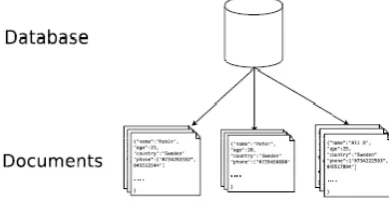
Figure 2. Data Model of MongoDB
MongoDB use map-reduce concept to carry out aggregation operation. Map-reduce concept involves two stages: a map phase processes each document of collection one by one and emits one or more objects as intermediate output. The reduce phase then aggregates the intermediate output of the map stage. An optional finalize stage may be used to make some changes to the final result. MongoDB provides
the mapReduce database command to carry out aggregation
operations over a collection [5]. Custom Java Script functions are used by MongoDB "mapReduce" command to perform the map, reduce and finalize operations. These functions provide immense flexibility but they are very complex. The syntax of thiscommand is shown as below -
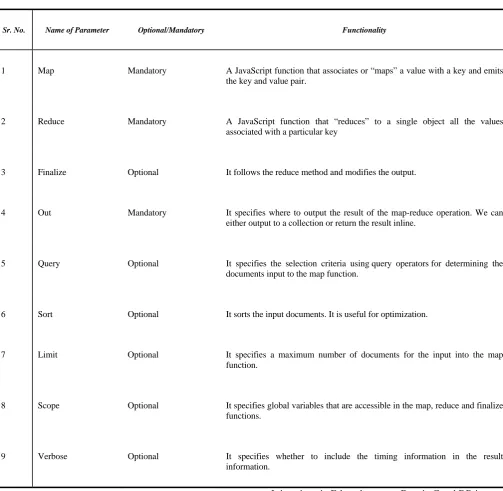
The description of various mandatory and optional parameters used by mapReduce command is shown in table1.
Now, the example below shows the implementation of
mapReduce command in the MongoDB. Suppose we have a
test database "testdb" and collection "classes". We have inserted 6 documents in this collection one by one. The code below shows the insertion of one document in the collection "classes".
db.classes.insert ({
class : "Computers 100",
startdate : new Date(2018, 1, 06),
students : [ {fname : "Amit", lname: "Gupta", age: 25}
{fname : "Veer", lname: "Rai", age: 35}
{fname : "Samar", lname: "Kashayap", age: 30}],
cost : 1400,
professor : "Pradeep Kumar"
})
Now, suppose we want to find out how many classes are being taken by professor "Pradeep Kumar". The following code of mapReduce command will provide the required results. Firstly we need to write code for map and reduce functions and then these functions are used in mapReduce
command.
var mapFunc = function( ) {
emit(this.professor, 1); }
var reduceFunc = function(professor, count) {
return Array.sum(count); }
db.classes.mapReduce(
mapFunc,
reduceFunc,
{ query : {professor : "Pradeep Kumar"},
out : "mapexample"
} )
The result of the above mapReduce command is shown as below –
{
"results" : "mapexample",
"counts" : { "input" : 3,
"emit" : 3,
"reduce" : 1,
"output" : 1
}
"ok" : 1
Table 1: Description of Parameters of "mapReduce" command
Sr. No. Name of Parameter Optional/Mandatory Functionality
1 Map Mandatory A JavaScript function that associates or “maps” a value with a key and emits the key and value pair.
2 Reduce Mandatory A JavaScript function that “reduces” to a single object all the values associated with a particular key
3 Finalize Optional It follows the reduce method and modifies the output.
4 Out Mandatory It specifies where to output the result of the map-reduce operation. We can either output to a collection or return the result inline.
5 Query Optional It specifies the selection criteria using query operators for determining the documents input to the map function.
6 Sort Optional It sorts the input documents. It is useful for optimization.
7 Limit Optional It specifies a maximum number of documents for the input into the map
function.
8 Scope Optional It specifies global variables that are accessible in the map, reduce and finalize functions.
9 Verbose Optional It specifies whether to include the timing information in the result
information.
The aggregated result is also available in collection "mapexample" as shown below –
db.mapexample.find()
{"_id" : "Pradeep Kumar", "value" : 3}
The above example shows the use of map-reduce functions in MongoDB to get aggregated results.
III. MAP-REDUCE IN COUCHDB
One word to describe CouchDB is "relax" [3]. CouchDB is an open source document-oriented database developed by Apache.
It is written in Erlang language. Data in CouchDB is organized in the form of documents. Documents consist of
Figure 3. Data Model of CouchDB
CouchDB's RESTful APIs make it easy to use database because with the help of these APIs database can be accessed through http requests [4]. CouchDB can be accessed via both the interfaces i.e. GUI as well as CLI. The name of GUI utility of CouchDB is Futon and name of CLI utility is Curl [6]. APIs of CouchDB are run on the Curl. In CouchDB, views are used to query the database and for implementing views, map-reduce functions are used. These map-reduce functions provide great flexibility because they are capable of dealing with alterations in the structure of documents. These functions generate indexes parallelly and automatically. Documents are passed to map function as arguments one by one and whole database is traversed this way. Documents with matching criteria are given as output in the form of key/value pairs. CouchDB has two types of views namely temporary and permanent. Permanent views ( static views) are formed with the help of unique documents called design document. Design document contains map function inside it and specify the criteria to get the view [7]. A single design document may contain many views. A JSON file named "design2.json" as shown in Fig 4 has been created. This file contains the id of the design document “phd_course" and map functions of two views namely “supervisor_detail” and “marks_detail".
Figure 4. Design Document for Creating Views
Design document "phd_course" is created using file "design2.json" with the help of below command.
curl-X PUT
http://127.0.0.1:5984/university/_design/phd_course-d @desktop/design2.json
Curl responds to the above command by showing following JSON document.
{"ok":true,"id":"_design/phd_course","rev":"1ddde17668d269f 5cfeb2aa3259e26b1"}
In GUI interface "Futon" our design document looks like as shown in Fig 5 containing two views.
Figure 5. Design document in Futon
[image:4.595.317.553.363.586.2]This result of the view is shown in Fig 6. The result shows the every subject's marks of each student individually.
Figure 6. Result of Permanent View
IV. DIFFERENCES BETWEEN COUCHDB AND MONGODB
Table 2: Differences between MongoDB and CouchDB
Sr. No. Feature CouchDB MongoDB
1 Developer CouchDB is an Apache product. MongoDB is developed by 10gen.
2 Language in which written
It is written in Erlang. It is written in C++.
3 Data Format It follows the document-oriented model and data is presented in JSON format.
It follows the document-oriented model but data is presented in BSON format.
4 Interface CouchDB uses HTTP/REST-based
interface. It is very intuitive and very well designed.
MongoDB uses binary protocol and custom protocol over TCP/IP.
5 Data Model In CouchDB, database contains
documents.
In MongoDB, database contains collections and collection contains documents.
6 Query Method CouchDB follows map-reduce query
method.
MongoDB follows map-reduce and object-based query language.
7 Replication CouchDB supports master-master
replication with custom conflict resolution functions.
MongoDB supports master-slave replication.
8 Concurrency It follows MVCC (Multi Version
Concurrency Control).
It follows update-in-place.
9 Preferences CouchDB favors availability. MongoDB favors consistency.
10 Performance CouchDB is safer than MongoDB. MongoDB is faster than CouchDB.
11 Consistency CouchDB is eventually consistent. MongoDB follows strong consistency.
12 Data Awareness It does not provide data awareness inherently but possible with the help of GeoCouch.
It provides data awareness inherently.
13 Sharding It does not provide auto-sharding.
Sharding can be done with the help of third-party software CouchDB Lounge.
It has auto-shading capabilities.
V. CONCLUSION
MongoDB supports multiple collections, stores data in BSON (faster access), does better querying, does aggregation through map-reduce and is capable of executing millions of queries per second. CouchDB stores data in JSON, querying through
realize that MongoDB is better-suited document-oriented database for today's web applications than CouchDB.
VI. REFERENCES
[1] Chodorow, K. (2013). MongoDB: The Definitive Guide: Powerful and Scalable Data Storage. " O'Reilly Media, Inc.".
[2] Frank, L., Pedersen, R. U., Frank, C. H., & Larsson, N. J. (2014, January). The CAP theorem versus databases with
[3] relaxed ACID properties. In Proceedings of the 8th International Conference on Ubiquitous Information Management and Communication (p. 78). ACM.
[4] Anderson, J. C., Lehnardt, J., & Slater, N. (2010). CouchDB: The Definitive Guide: Time to Relax. " O'Reilly Media, Inc.".
[5] Henricsson, R., & Gustafsson, G. (2011). A comparison of performance in MongoDB and CouchDB using a Python interface. Bachelor thesis BTH.
[6] Kumari, S., & Gupta, P. (2017a). Proposed Architecture of MongoDB-Hive Integration. International Journal of Applied Engineering Research, 12(15), 5000-5004.
[7] Kumari, S., & Gupta, P. (2018). Implementation of CouchDBViews. In Big Data Analytics (pp. 241-251). Springer, Singapore.
[8] Gulia, P. & Hemlata (2017). Novel Algorithm for PPDM of Vertically Partitioned Data. International Journal of Applied Engineering Research, 12(12), 3090-3096